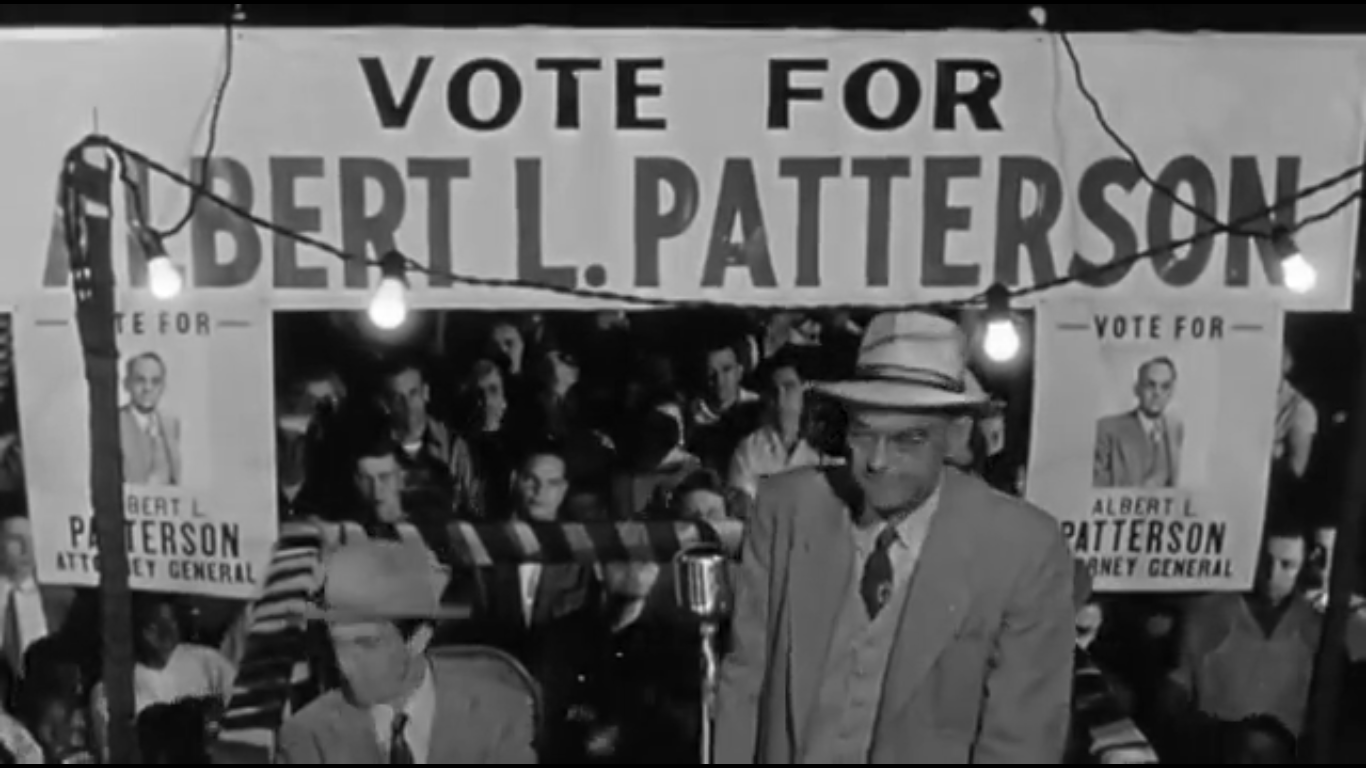
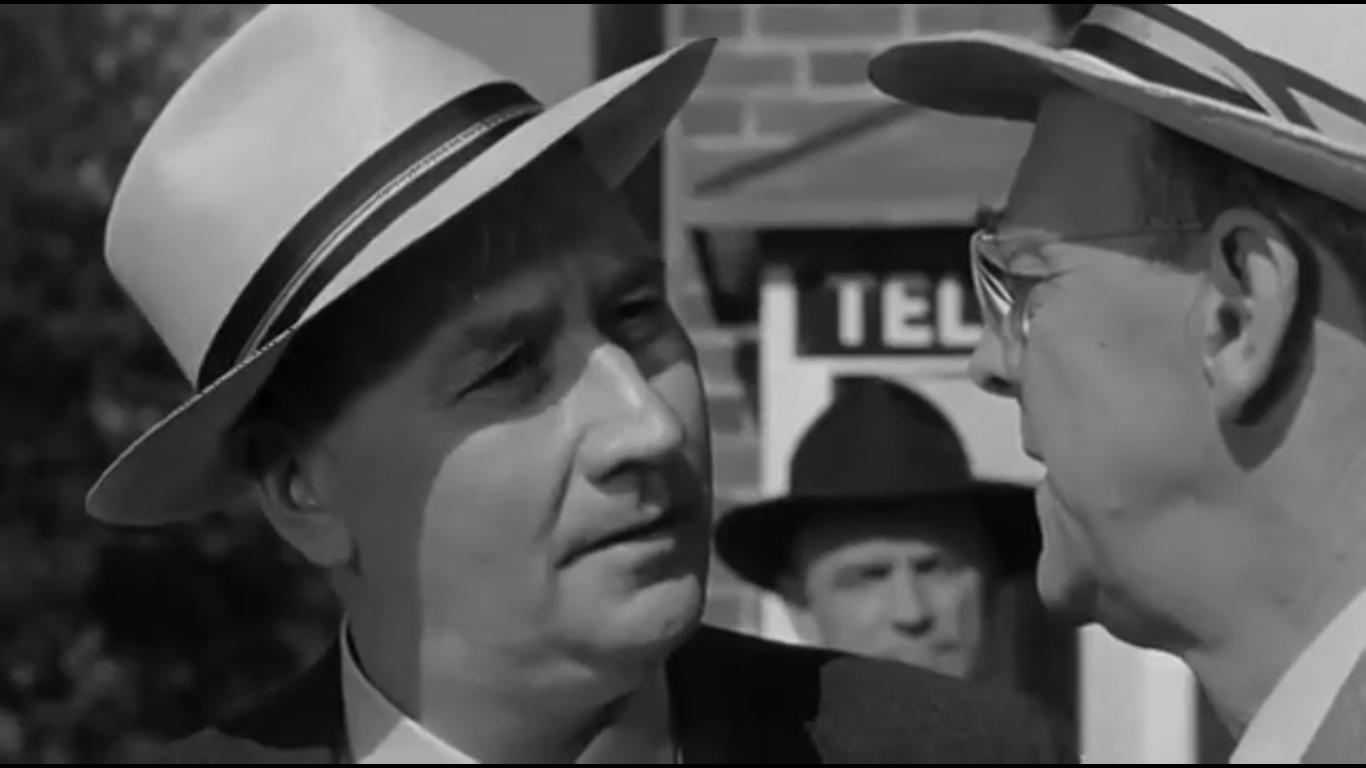
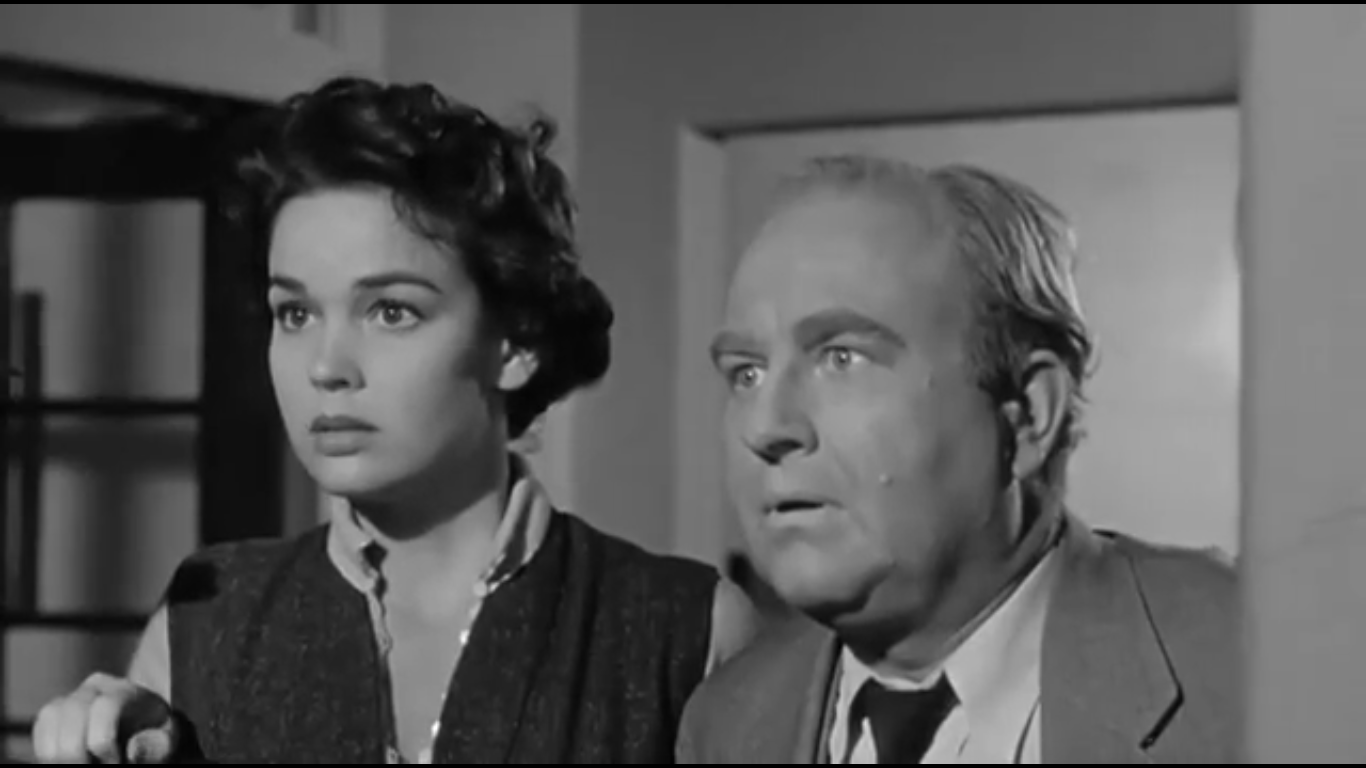
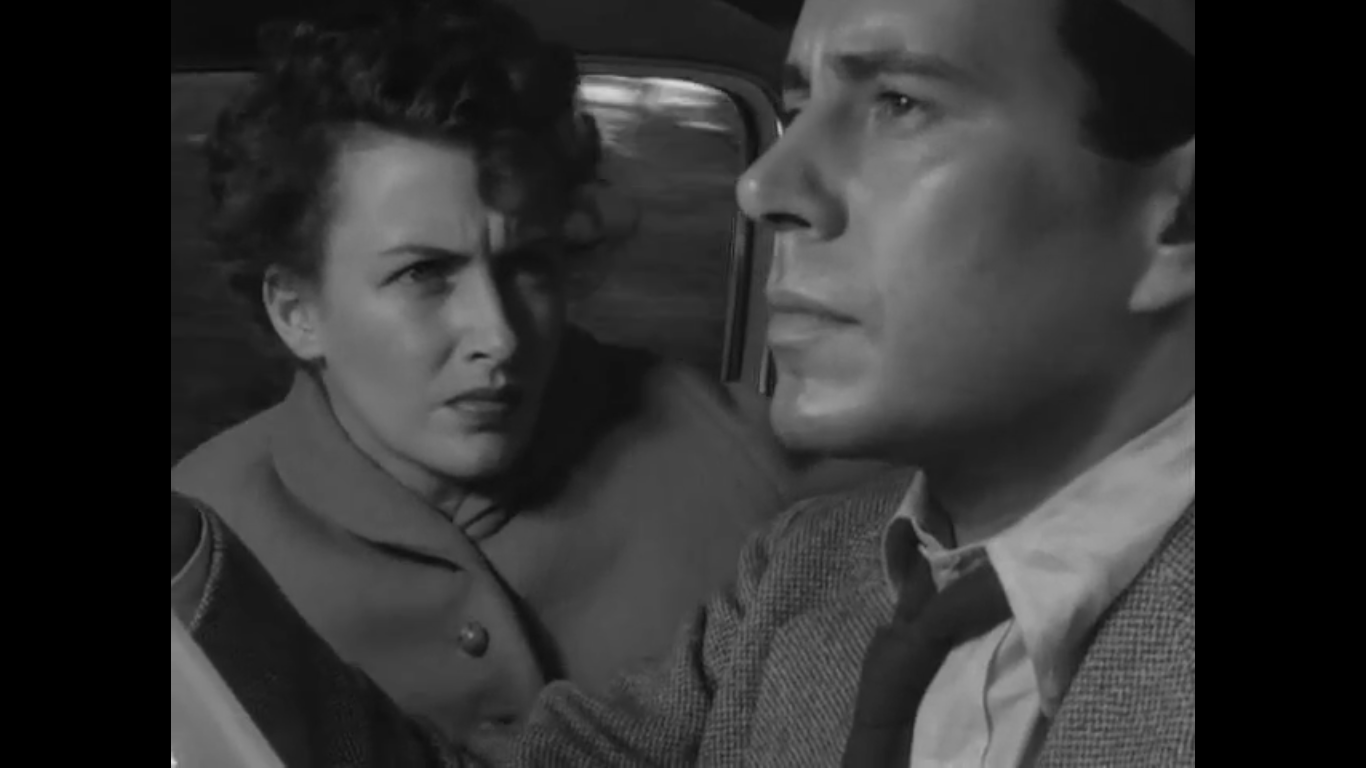
Desperate (1947): Anthony Mann Noir

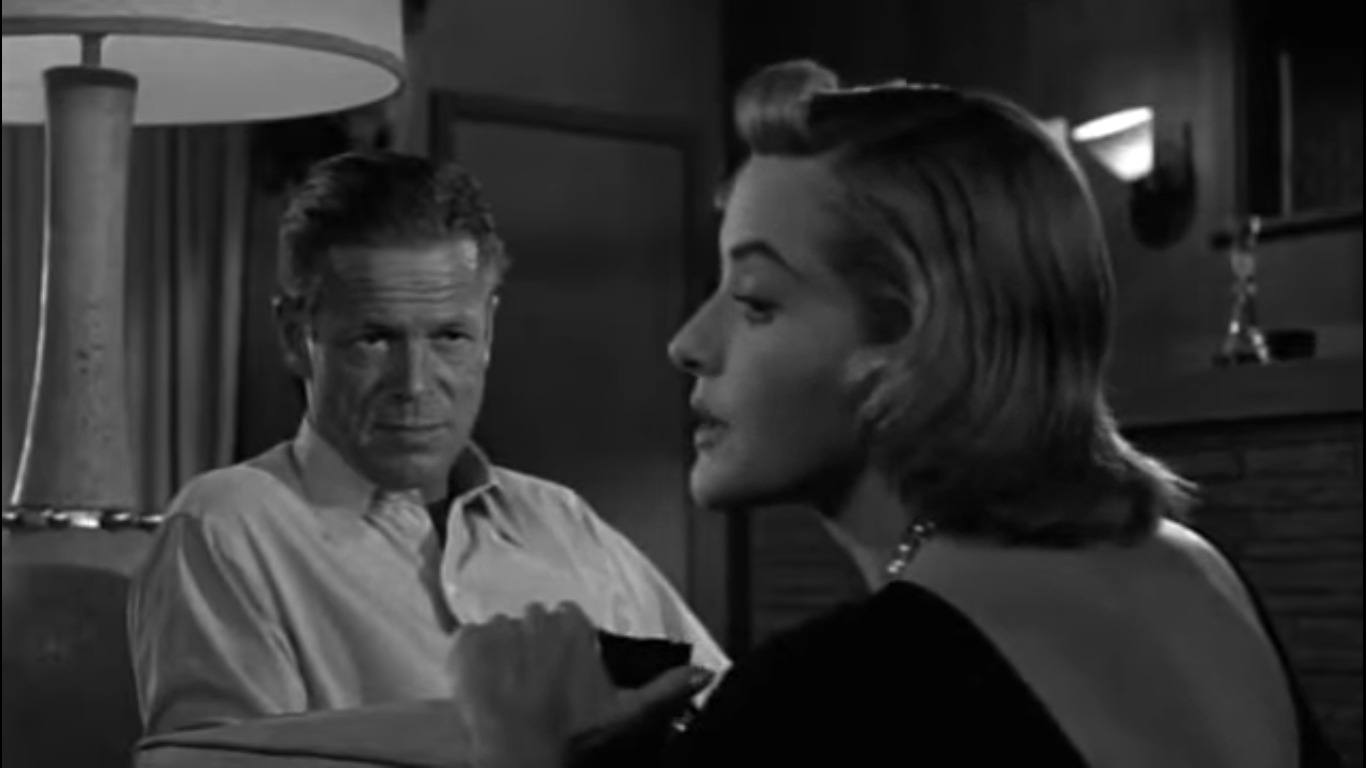
It’s easy to imagine Steve Randall (Steve Brodie) has the life of many men circa 1947. He’s a war vet, and he makes an honest wage as a truck driver. Brodie and the effervescent Audrey Long are stars befitting the budget of the film, but I rather like them for it. There’s nothing prepossessing about them, and we appreciate them for their sheer likability; they’re humble, honest folks.

From the first instance they’re in a room together, they also prove themselves to be an adorably in-love couple, between flowers, anniversary cakes, and news of a baby on the way. It certainly is an auspicious beginning, and yet it’s all so wholesome; it feels like an instant tip-off that this picture is going to hell very fast. It proves to be the case.

Because Steve gets a call to carry a special load of goods. He doesn’t think anything of it, and he could use the extra dough on his salary. Only too late does he realize his old friend is asking him to haul stolen merchandise. This wasn’t what he signed up for, but they don’t care.

Raymond Burr fortuitously has a reputation for playing the pertinacious district attorney Perry Mason because without that there’s little doubt he would be forever immortalized as one of the most vicious baddies ever conceived in the age of noir. There’s something between his piercing eyes, the command of his voice, and his formidable frame that just leave an instant impression. He knows how to use them to his full advantage in the role of Walt Radak, a merciless criminal who also has a protective streak when it comes to his kid brother.

This is crucial because, in the botched burglary, it’s his brother who is taken by the authorities; the other thugs are frazzled but get away, and all of a sudden Steve is in a load of quicksand sinking fast.

Arguably, the creative apex of the film — or at least its fundamental allure — is suggested in a low-lit sequence in the gangster lair. Steve is cornered and Walt is ready to rough him up, literally knuckling the camera. Moments later, the man’s face is disfigured by a jagged bottle, and he’s pounded to a pulp under a swinging light fixture. We don’t see it explicitly, but the scene is so violently expressive; it’s all the more evocative thanks to this very specific stylization. It’s noir at its finest courtesy of Anthony Mann.

Although maimed, Steve does get away, and he whisks Anne out of town, disregarding her pleas for him to go to the police. He’s scared, worried for his wife’s safety, and he wants to vindicate himself before going to the authorities. What it means is that both Walt and a wry police detective named Ferrari (Jason Robards Sr.) are looking for him, and only time will tell what happens when one of them finds him.

They trade out the urban apartments, trains, and trucks for rural farm life, which becomes a kind of escape valve accentuated even visually. It’s the film’s moment of reprieve as they are immersed in Anne’s doting family who agree to throw her a true Czechoslovakian country wedding — what they never had time for before — and they dance the day away.

The ending is already inevitable. Walt’s slimy private dick (Douglas Fawley) is able to locate Steve, and the vindictive mobster comes ready to pay the fugitive a call. With his baby brother’s impending appointment with the electrical chair, he’s bent on having Steve knocked off at the exact same hour. He might not be able to save his brother, but he can get some semblance of revenge. It’s an eye for an eye mentality with noirish stakes.

When they’re finally thrown together in Steve’s apartment, Mann’s not messing around, and the film’s climax delivers both in its theatrics and as an extraordinary exercise in substantive style. Between the music, the smoke, and the nervous rat-tat-tatting creating the cadence of scenes, he goes into those fabulous claustrophobic close-ups of all his main players and the ticking clock smashed together as one. They create an excruciating effect because we know when the time runs out so does Steve’s life.

Mann milks the moment for everything it’s worth and his handling of time is so very effective. There’s not an ounce of realism in the scene. Maybe we have a dining room table, a kitchen, a fridge, but everything else is fabricated and manipulated to ratchet up the tension of the moment. The results speak for themselves.

The final shootout on the stairwell of the apartment building is yet another feat of ingenuity using everything at his disposal from the visual motif to the shadows, even frightened neighbors opening their doors momentarily only to slam them again.  It all culminates in the final crescendo and the ultimate release of anxiety.

It’s easy to see Anthony Mann coming into his own and what a stunning creative force he was. Desperate doesn’t garner too many laurels today, but it capably highlights what makes Mann such a popular journeyman filmmaker. There’s so much grit and tenacity stamped into the very fabric of his genre pieces, whether film noir or his later westerns with Jimmy Stewart. There’s nothing lifelike about them, and yet he magnifies the tension so much so that they function as such a blistering exploration of crime and vindictive human psychology.

3.5/5 Stars

The Incredible Shrinking Man (1957)

These old Jack Arnold films are a perfect example of how expectations don’t always meet reality. Because if you’re like me, you have a certain preconception about how these movies will go — how they will look — and thus you may have written them off. Part of this might be the fault of the movie posters and the sensationalized advertising, and it also might be chalked up to our cliche-filled cache of old sci-fi and monster movie imagery.

The Incredible Shrinking Man fits comfortably as a twee ’50s-era television rom-com. “Scott” Carey (Grant Williams) is on a vacation with his wife playfully arguing about who will get the beers from the galley of the boat. It’s a bit of levity even as they jockey around the roles of man and wife in a marriage.

Minutes later Scott’s engulfed by a curious mist that comes out over the sea, and it leaves him confounded. For the moment, there’s nothing more to say. Months later, they are back in their suburban life. The milkman stops by in the morning, Louise busies herself in the kitchen, and Scott gets ready for work. Except, this morning his pants are too big — the dry cleaners must have made a mistake — but then his shirt is too big also. It throws him off.

His wife doesn’t have any clue either and so he goes to his doctor for a physical. The genial doctor (William Schallert) tries to explain away the changes with the routine explanations. Because, to put it plainly, people don’t get shorter…unless they do. It’s true there is no medical precedent for what’s going on with Scott.

He’s put through all sorts of tests to make some sense of the change in his body. Finally, the researchers settle on something. The molecular cells in his body have gone through a rearrangement — no, not cancer — but an anti-cancer. In a eureka moment, they realize a cocktail of insecticide and radioactive mist, led to the adverse effects.

But the Incredible Shrinking Man is hardly a story obsessed with the nuclear age. Instead, the premise turns into a far more intriguing conceit about everything from emasculation to Scott becoming a sideshow attraction in the media with national notoriety. The phone rings off the hook and people hang around to gawk at the new pariah.

Going out to clear his head only makes matters worse. Normal, everyday scenarios like walking down a street corner or grabbing a cup of coffee only emphasize his size even as the carnival freak show makes him queasy. He’s one of them. It’s true that one of their members, Clarice, is the same size as him. Being with her is some small comfort to him. Still, even that doesn’t last. He continues to shrink.

Rapidly his loving marriage begins to dissolve around him correlated with his continually diminishing size. Louise hasn’t changed, but Scott is bitter now, understandably discontent, and prone to lash out at his wife regardless of what she tries to do. On a side note, it’s wonderful to simply sit back and appreciate the scale of everything and this is years before similar trickery would be pulled in a film like the Hobbit for instance.

Marvel at the perspectives. There’s the harrowing moment where the cat gets back into the house, and it becomes a fight for survival as the feline terrorizes the dollhouse Scott now inhabits. In the wake of the incident, he is pronounced dead though he’s really only trapped in the cellar with no possible way of climbing up the massive stairs.

The pervading sense of helplessness sets in as Louise leaves the house one last time prepared to sell their home at the behest of her brother. They drive off, and that’s the end of it. What a dismal arc it is when we consider the initial joy of the marriage. We almost forget all of this if only because of the immediacy of the journey Scott still has ahead of him.

This demarcation point sets up the latter stage of the film as it devolves into a Robinson Crusoesque adventure set in the basement. He wouldn’t have given a thought about only a year prior. Now it’s a moment-by-moment struggle.

Realizing he’s trapped, Scott seeks shelter in a forgotten matchbox. Then, he finds himself water and sustenance and even creates some tools — including a spear. The emergence of a tarantula makes it all too evident he is no longer on the top of the food chain. If he is to live another day, he must vanquish the other creature or die trying. When they face off, dread sets in like I haven’t felt in some time. It’s palpable and strangely compelling in some primordial way. It plays better than many of the glossier battles we are served up today courtesy of CGI.

This is not his only trial. There are great chasms to cross, then torrential floods of water; we take on his powerlessness and are privy to his weakness. The perspective is surprisingly weighty and although Grant Williams is hardly a famed actor, there’s something totally spent about his performance. Behind the scenes, he was sent to the hospital several times due to blisters and other ailments. And he goes through the final act of the movie barefoot and scraggly like a real trouper.

As the narrative continually builds on Scott’s story, it increasingly becomes a movie full of soliloquies and at times the verbosity may be ill-fitting, but what they do provide is something running in the face of all those preconceived notions we have about these exploitative-type movies. They actually do mean something. There is an import to what it is trying to express and get across (at least sometimes).

One evening he peeks out and looks up into the heavens. He has an epiphany. In this vast majesty of creation, he realizes it has to mean something, and therefore he must mean something too.  Suddenly the existential crisis of man is given center stage and in another stunning turn, the incredible shrinking man’s struggle is precisely our struggle, coming to terms with our place in the world — the vast infinite spaces of the galaxies as we ourselves are insignificant in comparison. It’s all relative but in a single moment, we are made to feel a lot like him. But if we make peace with our station in life perhaps it is more of a blessing than a curse.

4/5 Stars

Creature from the Black Lagoon (1954)

“In the beginning God created the heavens and the earth and they were without form or void.” This not only the beginning of the book of Genesis and the creation story but also the film Creature from the Black Lagoon. If this sounds like a curious inclusion, it fits the way the story is being established.

What’s immediately evident is that this has to be one of the most geological austere creation stories; it’s a bit like watching a nature newsreel, which folds nicely into the ethos of the movie.

We get our first sense of potential terror when a South American scientist excavates the skeletal hand of some great beast. It intrigues him, and he’s not the only one. Soon he’s reintroduced to some old comrades, who share his life ambition to better understand the world around them and under the sea through scientific means. They are ichthyologists.

It’s here we meet Dr. David Reed (Richard Carlson) and Kay Lawrence (Julie Adams) for the first time, perfectly matched in both their work and romantic lives. The movie is quick to set the parameters of the story itself and how it chooses to utilize its greatest asset: the creature. In conservative fashion, The Creature from The Black Lagoon remains in the shadows initially with only two lingering shots of its webbed claw early on.

Director Jack Arnold asserted the movie’s whole premise “plays upon a basic fear that people have about what might be lurking below the surface of any body of water. You know the feeling when you are swimming and something brushes your legs down there – it scares the hell out of you if you don’t know what it is. It’s the fear of the unknown. I decided to exploit this fear as much as possible.”

In this regard, it’s an obvious precursor to what Steven Speilberg was looking to accomplish with Jaws, and there’s little doubt he was aware of this Universal production. How could he not be?

Meanwhile, back at the aquarium run by the publicity-minded Dr. Mark Williams (Richard Denning), they have further discussions about the implications of the discovery charting how even their recent studies of lungfish bridge the gap between the fish and the land animal — one of a thousand ways nature tried to get life out of the sea and onto the land.

While it’s true that discussion of the Devonian age and the kamongo (lung fish) might be a giant leap to the Gil-Man, you can at least appreciate the film for expounding on some kind of backstory — a scaffold for the rest of the film to build its credibility off of. Because only then can this great horror of the deep come in and enter into some semblance of our own present reality.

Soon they head off on their expedition set to embark for the Amazon, except it’s not presented in any way we’ve seen before; it’s an ecosystem of monstrosity and we are continually conditioned to understand how such a being could exist. Everything in this jungle is bred to be killers.

Blending a bit of Heart of Darkness and The African Queen on a budget, their Captain Lucas (Nestor Paiva), guides them to the black lagoon — the paradise lost — though no one has ever come back to talk about it. Each has their own way of coping. Carlson is generally a monotone albeit principled lead agile with a scuba tank and spear gun. By his side, Adams always has a constant congeniality — there’s a brightness in her eyes making her heroines alive from the inside out.

But she’s also a point of contention between David and Mark, who both hold a claim to her. It’s true Mark is a testy even maniacal ringleader, who garners a bit of a Captain Ahab complex in pursuit of the creature. The details and dialogue are not always polished, but there’s an agreeable atmosphere to the picture as it verges and willfully plunges into the depths of its own camp.

And yet even as it begins to cull the dark unknown depths, not only is there a forum provided for extensive underwater sequences, something curious begins to happen. In some way, we are put into the headspace of the creature. Yes, he has violent tendencies as the scientists look to track him down, and he becomes bolder, even coming aboard their steamer.

But as it progresses, The Creature from the Black Lagoon becomes a kind of underwater King Kong as they try to capture him and bring their findings back to civilization even as he pursues the one thing that can provide him some semblance of love. It cannot bode well…Because even as they drug the water and reel in the creature for good, there is this underlying sense of unease. Sure enough, he is not meant to be held in bondage, and he redoubles his efforts to impede them from leaving the lagoon. Suddenly, he feels less like a mindless animal and evolves more and more into a monstrosity with a mind of his own.

In fact, as the crew pursues this quest for the creature, it winds up saying as much if not more about the state of mankind. Suddenly The Creature from The Black Lagoon isn’t so black…perhaps it’s the people who drive him to such outbursts of violence etc. It’s a weirdly sensitive perspective to come out of a monster movie with.

Julie Adams may have summed it up best when she noted, “There always is that feeling of compassion for the monster. I think maybe it touches something in ourselves, maybe the darker parts of ourselves, that long to be loved and think they really can’t ever be loved. It strikes a chord within us.”

Whether it’s a stretch or not, we too are that creature, unknowable and unlovable on so many accounts, but still searching tirelessly for affection. It starts sounding less like an amphibious King Kong, and more like Frankenstein’s monster — a super creature missing the most important building block of life: reciprocated love. Perhaps they are one and the same.

3.5/5 Stars

It Came from Outer Space (1953)

It Came From Outer Space looks to check all the boxes when we consider prototypical 1950s Sci-Fi. Based on a treatment by Ray Bradbury, it was shot by director Jack Arnold in black and white to utilize 3D. These are only some of the trappings it offers up in line with much of what you would expect from the era.

Rather than be presumptuous, let’s take a brief moment to set the scene. It’s a basic premise. John Putnam (Richard Carlson) is an amateur astronomer with a telescope set up outside his house, and he’s soon-to-be-wed to the lovely local schoolteacher (the always alluring Barbara Rush).

He’s intrigued by a meteorite they watch dive toward the earth’s surface nearby. The next morning they’re at the crash site ready to explore the giant crater. Except, as he soon finds out, the impact wasn’t caused by a rock but by a spaceship. He catches a glimpse of it before it sinks back into the avalanche.

However, with modern man, eyewitnesses are important as is maintaining the status quo. So when Putnam sounds the alarm and sends shockwaves through the small local community, there’s a lot of skepticism and shaking of heads. After all, it’s one man trying to get people to believe him with the help of his girlfriend. There’s the publicity angle with the press looking for some juicy tidbits and even a man of science lets him down, finding his assertions highly improbable.

And yet they do exist. The alien lifeforms start taking on the likenesses of people around town but not as parasites. Their friends are kept alive, albeit hidden away, to keep hysteria from setting in. Because this is an infiltration that initially feels akin to the Invasion of The Body-Snatchers.

The local sheriff (Charles Drake) is initially cynical about their existence, and when he’s finally forced to accept the facts, he’s not going to take it lying down. He cannot trust that these creatures are harmless, simply trying to get back to their home planet without mishap or international incident.

To be fair, it’s a difficult pill to swallow given our own diet of Sci-Fi and monster movies. Surely this isn’t how they are supposed to work? Because to its credit, producer William Alland and Jack Arnold’s picture suggests so many of these long-held tropes of 50s Sci-Fi movies only to give us a surprisingly lucid alternative.

With the very roots of his story, Bradbury has struck out on a rather groundbreaking path. It’s not about hostile space invaders simply vaporizing and terrorizing Middle America, though this does appear to happen. Nor is it a straightforward paranoia tale made as an echo chamber to put a voice to the latent anxieties of the McCarthy Era.

What becomes evident is a more universal message about humanity. When we fear, when we cannot comprehend something, we have a tendency to lash out. We use science or conspiracy, jokes, and gossip to discredit and then insulate ourselves — maintaining a certain level of comfortability. Because if we really knew what was going on — the sinking feeling in the pit of our stomachs telling us all is not right — we would react in kind.

In some sense, the move posits, with all the obligatory space thrills included — we need not fear extra-terrestrials from outer space. What we should be wary of is the evil and violence inside ourselves — it’s these tendencies to see the worst in others and to suspect they are out to harm us. It settles for a worldview of enmity and malevolence over benevolence. When, in fact, the man from another planet is far more likely to be our neighbor than our foe.

Are these words too high-minded for such a tiny Sci-Fi flick? Perhaps. Is it easy to scoff at the special effects and liberal amounts of theremin music? Certainly. Is it strange seeing “The Professor,” Gilligan’s Island’s Russell Johnson, inhabited by an alien life form? Without a doubt.

But do yourself a favor and enjoy what it has to offer, then take a brief moment to consider what the film manages in its meager allotment of time. It’s not going to change the world; it’s not some great piece of cinema, but somewhere along the spectrum, it’s a classic in its own right.

3.5/5 Stars

BLOG UPDATE: Cutting Back on Posting

Masculin Féminin (1966)

Hello to everyone who has taken the time to read this film blog!

First off, thank you so much for reading! I’m really bad at self-promotion so the fact that anyone would take time to look over something I’ve written still humbles me. I’ve been amazed to see how this site has grown.

A few months ago, I celebrated 10 years of this blog! I alluded to it then, but writing for this site has been a great rhythm for me. I still love the process, and it brings me great joy to write about films. There is a thrill to it, not just in watching the films, but also getting to articulate how I feel about them.

That being said, although I still have a lot of reviews in the pipeline, I’m probably going to cut back on posting. It will be fun to focus more of my attention on other things. I’m still here, and I’ll still be releasing content every month, but I think I’ll enjoy going at a more languid pace. We’ll see what else happens along the way.

I look forward to keeping the appreciation for classic films going.

Thanks again for reading!

Tynan @ 4 Star Films

Masculin Feminin (1966): The Children of Marx and Coca-Cola

“Times had changed. It was the age of James Bond and Vietnam.”

The film opens with a casual conversation between two young people: the young man, Paul (Jean-Pierre Leaud), bugs the girl, Madeleine (Chantal Goya), sitting across the way. Then, this conversation between young people in a cafe gets rudely interrupted by a marital spat that ends in a gunshot. Surely these are Godard’s proclivities at work.

One could say form follows function. Masculin Feminin is another reminder of how literary his cinema is. We often think of his films for their visual aesthetic thanks to the likes of Raoul Coutard (or Willy Kurant here). There’s no denying this, but they are always so pregnant with ideas and thoughts, some fully formed others feel like they were scribbled out on a notepad (because they were). It’s a task to be inundated with it all as he willfully challenges any level of perspicuity.

However, whether you venerate or loathe Godard, his cinema is a tapestry woven together from all his influences. It feels like dialectical cinema where everything is a symposium of love, arts, and politics as young people converse with explosive intertitles blasting away between scenes. But that doesn’t mean everything is a logical progression. Godard gives himself license to follow every passing whim.

Other times it’s uncomfortably direct. Leaud as his avatar starts interrogating Madeleine as she powders her face, but he gets away with it, since he’s always idealistic and a bit of a romantic. He asks her, “What’s the center of the world?” When pressed, he thinks it’s “Love” and she would have said “Me.”

Eventually, he spends more time with her and gets to know her roommates too, and he finds a new job polling the public. Leaud “polls” Ms. 19 giving her a line of probing, deeply personal questions. Later, he has a whole conversation about mashed potatoes and a father discovering how the earth orbits around the sun.

Godard is always in conversation with the films that inform him, but with Masculin Feminin we see a much broader acknowledgment and exploration of the contemporary culture. Madeleine’s meteoric rise as a Ye-Ye singer finds her on the charts in Japan only surpassed by The Beatles, Frances Gall, and Bob Dylan. Not bad!

That’s also not to say Godard gives up being in dialogue with films as well, including his own, which had become part of the cultural conversation in their own right.  Bridgitte  Bardot (from Contempt) shows up receiving notes from her director. Madeleine playfully chastises her beau, “You’re not Pierro Le Fou. He stole cars for his woman!”

Later, they sit in a darkened theater together watching a perturbing arthouse movie:

“We went to the movies often. The screen would light up, and we’d feel a thrill. But Madeline and I were usually disappointed. But Madeline and I were usually disappointed. The images were dated and jumpy. Marilyn Monroe had aged badly. We felt sad. It wasn’t the movie of our dreams. It wasn’t the total film we carried inside ourselves. That film we would have liked to make, or more secretly, no doubt, the film we wanted to live.”

If this doesn’t sum up the aspirations of the youth in front of the camera staring up at the screen within the screen, it must hold true for the young batch of filmmakers who Godard himself came up with. It’s a perplexing bit of dialogue and one of the most apparently self-reflexive and personal annotations within the entire picture.

As is, all of Godard’s male heroes and stand-ins feel dense although Leaud is always miraculously able to pull off some boyish prank or a bit of mischief and still maintain some semblance of relatable humanity.

Otherwise, how could girls ever put up with these guys much less love them? All the young women are pestered to no end and rendered endearing for all they must endure. I think of Ms. 19 and Elisabeth (Marlene Joubert) in particular. We pity them.

What do we do with the totality of this picture? From experience, you usually run into issues when you try and find the narrative arc or a conventional form to follow. Because Godard’s films boast so much in ideas, asides, and digressions. There’s so much to be parsed through and digested.

It’s easier to follow impressions, a train of thought here, or a standalone scene there that left some sort of tangible impact. In the social tumult and the moral morass of the 1960s, it’s almost as if within the collage of the film, we’ll find some substantive meaning. Then, again maybe not.

Leaud walks down the street with a girl and pops into a cafe for a moment only to come back out. He continues to walk and says, “Kill a man and you’re a murderer. Kill thousands and you’re a conqueror. Kill everyone and you’re a God.”

She responds, “I don’t believe in God.” Frankly, I don’t blame her, and if that’s the world’s conception of who God is, I wouldn’t want that God either. Still, we all try and answer existential questions with something, be it politics, pop songs, or fleeting teenage romance.

I read Godard’s film was restricted to adult viewers, but he probably thought he was doing a public service announcement for the youth generations in his own individual attempt to put a voice to the times. Whatever your thoughts on Godard or Coca Cola and Marx, alongside British Swinging London time capsules, Masculin Feminin helps capture this particular moment of ’60s European culture in a bottle.

It feels increasingly difficult to reconcile all the warring forces fighting for primacy and as a young person just trying to find love and make sense of one’s life, it’s never easy. We have more questions than answers. However imperfectly, Masculin Feminin synthesizes some aspects of this universal phenomenon, one that’s not totally restricted by time. We can all relate to this idea as long as we were young once.

4/5 Stars

Note: This review was written before the passing of Jean-Luc Godard on September 13, 2022.

Le Petit Soldat (1963)

“Photography is truth, and cinema is truth 24 times a second.”

Although Le Petit Soldat was released in 1963 — no thanks to the censors — it was actually filmed in 1960. This context is all-important because Jean-Luc Godard is still fresh off the sensibilities of Breathless, and they pervade this film as well.

Its plot follows the aftermath of a professor killed in a terrorist attack and a young journalist in Geneva, who is enlisted by French intelligence to assassinate a man named Palivoda. This is in the age of the Algerian War; the young man, Bruno Forestier (Michel Subor), has avoided the draft, and the man he’s assigned to kill is a National Liberation Front sympathizer.

If it’s not apparent already, the groundwork has been set for a political spy thriller. While balking at murdering the man in a drive by, Bruno simultaneously falls in love with Veronica (Anna Karina), a dark-haired beauty in a trench coat. His friends bet him he’ll fall in love the first time he sees her on the street. He sheepishly shells over the money after only a brief introduction. He’s instantly smitten.

Le Petit Soldat is such a literary film thanks in part to its voiceover. Bruno, as Godard’s stand-in and cinematic conduit, references a myriad of things. He asks rhetorically about Veronica, “Were her eyes Velasquez gray or Renoir gray?”

It’s as if Godard is contemplating the muse in his own art. Still, he continues with a steady stream of namedrops including painters, authors, and composers. Van Gogh and Gauguin. Then, Beethoven and Mozart. Anna Karina prancing around to Joseph Haydn is definitely its own mood.

It occurs to me this is a distillation of Godard as a filmmaker. It’s a visual style wedded with these deeply mined traditions of literature and art.  Both cutting edge and steeped in the culture of the past before thenceforward going off and creating its own unique vocabulary.

Godard gleefully inserts himself all over the movie on multiple occasions where we see him in the flesh. It’s a spy movie as only he can conceive it totally deconstructed and aware of itself while simultaneously taking most of the thrills out of the genre.

Soldat remains a precursor to Alphaville by effectively turning the contemporary world around him into the environment for his latest genre picture. Whereas Breathless‘s jazz-infused contemporary aesthetic is accentuated by the black and white streets of France, here they are repurposed. Though it’s as much a film about driving around the city philosophizing as it is about any specific dramatic action.

Because Francois Truffaut, while not always disciplined, could spin stories with a narrative arc and genuine emotion. Godard is at his best as a philosopher and cinema iconoclast where his style doesn’t totally get bogged down by ideas, and he uses the medium in ways that would become the new standard. Or at least his own standard, before he decided to upend them again.

But in order to make the case for Anna Karina as more than Godard’s Pygmalion, it’s necessary to consider her screen image in depth. Whatever Godard gave to Anna Karina in terms of iconography or legacy, Karina gave that much back, and they will be inextricably linked for all times. Because if there was ever a reason to fall in love with her, it’s right there in Le Petit Soldat.

His alter ego riffs about God and politics, political left and right, quotes Lenin, and unravels his entire worldview (ie. about a man who loves ideas, not territories). When he asks his girl why she loves him, she shrugs her shoulders and says I don’t know. I don’t think she’s dumb, but whereas here we have one character who is in their head, she seems to be a creature who is real and present in the moment. She has a heart.

Whatever the digressions and despite the perplexing way Bruno interrogates her during their impromptu photoshoot, she is undeniable. If cinema is truth 24 frames a second, she somehow makes Godard’s cinema more accessible and real — she takes his theorizing on truth and gives it a pulse.

The movie is still a thriller, and it follows its own version of narrative beats. Bruno is framed, he continually has second thoughts about his assignment; he gets the gun, but things always get in his way. His heart is not in it — killing a man mercilessly — because this is not who he is.

Instead, he wishes to run away to Brazil with his girl. He’s locked away and tortured as a double agent for his troubles. These sequences are simplistic — contained in a hotel bathroom — and yet as they light matches near his fingertips and dunk him for minutes on end in the water, there’s a definite heartless menace about it.

We have the political bent of Godard’s cinema detected early on before his other overt efforts later in the 60s. It comes in the guise of his story as it unpacks current events, ideologies, and even controversy around torture.

True to form, he has the audacity to cram the final act of an entire movie into one minute of celluloid. He shows us some things and just as easily explains away the rest with voiceover.

It feels like he leaves just as he emerged. He’s totally singular. At times, maddening and bombastic, and yet always prepared with his own take and alternative approaches to convention. Godard will always challenge the viewer and make you reconsider how much you appreciate cinema even as he continually helps to redefine how we conceive things.

1960 or 63. It makes no difference. Le Petit Soldat has a young man’s malaise acting as a film for the coagulating disillusionment of the ’60s. This isn’t your father’s war nor one of his films — not the “cinema du papa” as Truffaut put it. If Godard’s style was coming into its own, with Karina cast front and center, then the propagation of his ideas is equally evident. Cinema would not be the same without his distinct point of view.

3.5/5 Stars

Note: This review was written before the passing of Jean-Luc Godard on September 13, 2022.

Bitter Rice (1949)

Doris Dowling has a name that sticks out in the opening credits for the very reason she was an American actress and she offered up a particularly memorable role as Alan Ladd’s vitriolic wife in The Blue Dahlia. Here she’s an Italian playing the moll of a two-bit hoodlum wanted by the police.

Bitter Rice opens with a curious kind of introduction. A man stares straight at the camera, breaking the unwritten contours of the fourth wall while providing some explanation of how rice harvesting is a bumper crop not only in China and India but in Northern Italy as well. A moment later, the camera pulls away revealing this presentation is all part of Radio Turin and suddenly the circumstances of the film are instantly placed in a palpable setting.

The lithe even upbeat nature of the picture allows us to fall into the world almost immediately. We have a milieu of migrant workers crossed with bustling train stations, lovers, policemen, and wanted fugitives all playing out in front of us as we try to take in the stimuli and come to grips with everything. The wanted man, named Walter (Vittorio Gassman), tries to mask himself by dancing with a pretty young field worker (Silvana Mangano). She gladly flaunts her dancing in exchange for attention as she’s accompanied by her portable gramophone.

In the aftermath of a chase, Francessca (Dowling) disappears into the crowd of workers to lay low with their cache while her boyfriend flees in order to stay out of the clutches of the police. If it’s not apparent already, a passing street vendor lets us know some priceless jewels were stolen from The Grand Hotel.

If it’s not apparent already, this opening gambit has the kind of thrust we might expect from Hollywood, not a backcountry Italian film, and it’s evident Giuseppe De Santis is well aware of the mechanisms of a thriller. However, he also allows his picture to sink back into rhythms that one would feel much more accustomed to with neorealism and a movie set in the province of Vercelli.

Suddenly a tale of illegals and registered workers is given a new context but timeless relevance to this very day. Francesca does not have a license, but she befriends the saucy young dancer, Silvana, who does her best to assuage the foremen and get her new companion on the ever-crucial list of approval. Her chances are tenuous at best, but Francesca, like so many others, has no other choice.

I couldn’t help thinking, with her chewing gum and sizzling hot music, Silvana is bred out of the same world that supplied movie posters of Gilda in Bicycle Thieves. It’s this influx of American product in its many modes — a new form of cultural dominance — steamrolling the former fascism into submission to good ol’ American capitalism.

The way she flaunts herself and becomes the focal point of the picture, I couldn’t help but compare her to Virginia Mayo in some of her saucier roles like Best Years of Our Lives or White Heat — down to the gum chewing. If it were an American film, Bitter Rice would fit somewhere within the landscape of The Grapes of Wrath or maybe Border Incident.

There’s little doubt it has a kind of collective political philosophy to present — its own vein of social commentary — and it delivers it not only through narrative, but visual depictions of the life these people are subjected to.

In one breathless comment, Silvana tells a soldier (Raf Vallone) posted nearby, “In North America everything is electric!” He’s informed enough to know “even the chair is electric…” As a side note, the Italian constitution completely abolished the death penalty for all common and civil crimes starting in 1948. Already it presents a kind of ideological chafing that must be contended with.

Upon their arrival, the rice workers receive a hero’s welcome, and we are reminded this is a yearly ritual with its own unique patterns. There’s something marvelous about taking part in these seemingly familiar habits even as we see them for the first time as an audience.

The packing of mattresses with straw, the throwing of hats to all the field hands who catch them out of the air en masse. It’s strangely riveting. Or there are the mating customs played out year after year with men yelling over the wall to the fair maidens below, searching for former flings and future partners.

We come to realize it’s built on its own kind of ecosystem. You have the foreman’s, the lines of workers bent over in the muck and the mire every which way, and they sing their river ballads to pass news along the line.

With the jewels to get between them, Francesca and Silvana find themselves positioned among the two factions of documented and undocumented workers. It’s not a simple task, and then Walter turns up again. He can only bring trouble.

Like their opening foray, there’s something about the dance scene between Silvana and Walter burning with a palpable sensuality. But what it also does quite effectively is pluck the film out of its neorealist roots and make it even momentarily something more. It’s like a precursor to the passionate sashaying in Picnic. It feels like very much a Hollywood creation and yet it’s simply De Santis’s version of it.

Likewise, the film is not totally averse to forging its own version of a love triangle (or diamond) with Francesca and Silvana finding themselves attracted and repelled by the conman Walter and another character, the soldier Marco. These see-sawing relational dynamics are the fodder for unadulterated melodrama exemplified by violent pursuits in the pouring rain, passionate embraces in mountains of rice, and a great deal more.

While the rest of the harvesters get overtaken with merriment in the wake of a wedding and subsequent beauty contest, there’s something much more catastrophic going on in the background. Silvana becomes the self-destructive queen of it all.

By the end, I stand totally astounded. Bitter Rice jumps off the deep end going from Italian Neorealism toward gut-busting, blistering drama with the dark tinges of noir. This is what it borrows from Hollywood quite effectively, reminiscent of a picture like Border Incident or even Cape Fear. In tight quarters, violence becomes especially animalistic. When a beast feels cornered, he must lash out.

Also, I still am fascinated to know why Doris Dowling was cast in a film that was otherwise completely Italian, and yet there’s something rather ironic and bewitching in her and Magnano becoming cultural foils for one another. It becomes a far more complicated portrait of the corrupting forces of greed and capitalism.

Dowling, as the quintessential, steadfast Italian girl, and the Italian actress as a poisoned vessel of sensual pop culture materialism. What’s more, it leaves a truly incisive impression and that’s most important of all. You won’t soon forget a film like this, and it just might have the power to captivate viewers on both sides of the globe with its pulpy sensibilities.

4.5/5 Stars

Ossessione (1943): Luchino Visconti Does James M. Cain

You half expect cinema to have remained dormant in wartorn Europe during the 1940s. That’s part of what makes Ossessione such a fascinating curio within this context. In fact, the film almost never made it out of the decade alive. One can only imagine how unpopular the picture might have been with the reigning government.

It doesn’t exactly preach good old-fashioned fascist values and Mussolini looked to exterminate the picture completely. Legend has it that Visconti, who had also joined the communist party, managed to salvage a copy so that his film debut could live on and he got out of the war as well with a sprawling career still to be determined ahead of him.

I learned only very recently that Visconti started out as an assistant on the films of Jean Renoir of all people. Not only does that seem like the most propitious of apprenticeships, but it’s also easy to trace the lineage of the Italian from the Poetic Realism of the French Master that would eventually coalesce into Italian Neorealism.

The films of Renoir and Michel Carne are fully present in this early work with the opening images of a train evoking something like Le Bete Humaine or Toni. Gino Costa (Massimo Girotti ) is the kind of working-class hero you’d expect in one of those earlier pictures or even some of John Ford’s work.

He’s an itinerant bum who used to be a soldier and then a mechanic in a former life. Now he’s hitched a ride on a truck bed only to be dumped outside a roadside tavern. And Visconti proceeds to introduce his primary couple through the visual synecdoche of two pairs of legs.

Finally, we see their faces together. They’re in a kitchen. Although Anna Magnani was originally meant to have the role, Clara Calamai channels the sultry come-hither coquettishness quite well even when it’s impossible to unsee the platinum blonde of Lana Turner in the part. But they have their own instant spark, like flint — burning with a consuming passion tantamount to spontaneous combustion.

If you’re well aware of the story already, she is a young woman married to a chubby misogynist named Bragana (Juan da Landa), who thinks he’s more than deserving of the marital comforts afforded by such a wife. He calls on her to rub him down after a long day, and she can’t bear to touch him. She has designs for someone else.

While her husband goes off with the local priest to do some duck hunting, in an early example of a bike-and-talk, Giovanna is quick to stoke the flames of romance with her much more desirable confidante. Visconti’s unauthorized rendition is purportedly more faithful to its source material although it’s hardly as streamlined as MGM’s later adaptation, essentially leaving more space for narrative asides.

When Giovanna clings to the security of her current life, Gino sets off on his own alone soon falling in with a hospitable street salesman, “The Spaniard,” who entertains the crowds. In what can only be expressed as noir sentiment, the tides of the narrative bring the couple together quite by chance.

Bragana is pleased to see their old friend and Gino gets pulled back into the whirlpool taking in some opera at a local tavern. This more than anything betrays Visconti’s affections for the stage.

Consequently, it’s also a film where arguably the biggest moments play out off-screen. I’m thinking of the illicit couples’ first rendezvous and then the fatal accident altering the course of the entire picture. Not all of this is due to content concerns either, but it does highlight how Visconti and his scripting compatriots, Mario Alicata, Giuseppe De Santis, and Gianni Puccini, conceived the story.

It offers another kind of dissonance because we don’t get to see what actually happened even if we’re well aware of their mutual intentions. We must wait for events to play out to see how the canker and unrest reveal themselves in due time. The most explicit response comes when Gino peels off  some bandages and then a violent struggle over a trinket ends in a passionate kiss. This might be the movie summed up in visual terms.

They must reckon with an unsettling state of limbo: freedom that feels more like purgatory as they stew in their infidelities. A man of the cloth suggests that they part ways because people do talk about their situation, real or imagined, and of course, it is very real.

Instead of detonating the story to be a full-blown melodrama like The Postman Always Rings Twice, Ossessione maintains these high levels of human intimacies. Gino reunites with his old pal again beyond delighted to see a familiar face, and yet it ends in fisticuffs because his fellow traveler is able to put words to everything he’s currently tormented by.

Then there’s a demure “ballerina.” Gino meets her knitting on a park bench, and they share an ice cream. I had to acclimate myself, thinking only momentarily that she was Giovana, but the emotions in the scene are enough to give this away. Because being around her Gino feels different; it’s as if, ironically, her purity is able to cover all his sins or at the very least help him forget them.

But the digressions only aid in leading him back to Giovana. If they aren’t totally a destructive pair, frolicking on the beach together, having rekindled their chemistry, then there’s some kind of fatalism that needs to be satiated.

In passing, Ossessione might earn the labels of Italian neorealism for its striking, ever austere imagery emblematic of the post-war working class. But it’s also often designated as film-noir for its sordid details and futile finale. However, I can’t stop but marvel at how Visconti was able to make the picture to begin with. Even after its initial release, it was hit with so many roadblocks of censorship and copyright problems only to gain a second life.

What an auspicious way to start a career, especially under such tumultuous circumstances. Much of the finest pieces of art are born out of the burnishing fires of the furnace and, for that matter, a certain level of creative obsession.

4/5 Stars

Il Generale Della Rovere (1959): Vittorio De Sica and Robert Rossellini

It occurs to me, like with Jean-Pierre Melville (and so many others), that the landscape and context of the war years left such a lasting impact on Robert Rossellini, and they are made manifest in his films. Although it’s shot over a decade later, there’s still a lived-in quality, committed to a kind of authenticity.

Whereas others, namely Americans, experienced the war and then returned home (albeit with PTSD), for these men war was a stipulation of everyday life. It was the water they drank and the bread they ate, suffusing into all aspects of society.

Vittorio De Sica is called upon to play a far different kind of gambler than he was in The Gold of Naples. His blustering lunatic is displaced by a miserable loser stumbling and bumbling his way through a mediocre existence.

Emmanuele Bardone, like everyone else, is getting trampled on by this war, just trying to survive. His debts pile up, no thanks to his rampant gambling habits. He pleads with his girlfriend, a fair-weather beauty (Sandra Milo), who has had just about enough of the meager life he can offer her on his half-baked promises. It’s to no avail. She’s not intent on bailing him out again.

Thus, he must find other means to scrounge up the funds to pay off a German Sergeant Major. They’re buddy-buddy — gambling acquaintances — but it doesn’t keep them from attempting to stab each other in the back. It’s one of those uneasy partnerships engendered by the war. Because Bardone is such a man: feckless, unctuous, self-serving. He’s always looking to get ahead, whether by courting Nazis or fellow Italians frantic to track down missing relatives at any cost…specifically well-off Italians.

Physically, Vittorio De Sica strikes me as a man whose stature and features are impressive, quite effortlessly handsome. Yet, he’s capable of bringing something out of them, wringing the comedy and the tragedy with the body God has given him.

I don’t know why exactly, but I want to compare him to Cary Grant — a man who doesn’t take himself too seriously — so whether debonair or a bit of a cad, we still find it within our hearts to root for him.

He vows to help a rich widow and her daughter-in-law in what feels like just another confidence game preying on their desperation. His gambling gets interrupted by air raids, and he crawls back into the life of one of his other girlfriends (Giovanna Ralli).

Something else happens that he knows absolutely nothing about, but it changes the course of the entire picture. A famed dissident is accidentally shot dead at a roadblock, but a cover-up ensues. The capture of Generale Della Rovere is spread around town despite a botched assignment within the Nazi ranks. Now they must find a man to fill his place: Bardone is fingered for it, and he has no bargaining power in this economy.

We’re privy to the Nazi’s intricate filing systems and notecard records helping to mechanize their ruthless war machine, but they’re also more than prepared to play spy and counterspy with a sorry drifter’s carcass.

Narrative-wise it feels like the story can easily be split into two distinct segments. Because it takes a good hour before De Sica is actually cast as the Generale and suddenly the stakes of his new life are raised.

This film was one of Rossellini’s more profitable efforts and with it came an actual high-concept idea. But this never feels like what the director is truly interested in. He skirts around the “plot” as much as possible to make this story about a character and a world.

When he is finally in prison, all the rebels and convicted patriots pledge their services through cell windows and the surrounding walls. They believe him to be who he says he is…meanwhile, Bardone maintains his pact with Colonel Muller to coax out the Generale’s contact on the inside. He’s met with a crisis calling for some self-examination.

Aside from De Sica, Hannes Messemer has to be the other obvious standout as the German SS man. He’s hard and difficult to like, especially when wearing a Nazi uniform in wartime. However, he’s not a cartoon and even momentarily there are these ever so faint flashes of nobility. He cannot be pinned down; his duty as a military officer trumps everything, and yet the contours of his person make us grapple with more than we are used to in a Nazi.

Because as much as we don’t want to admit it, every Nazi was a human being. He is another soldier, driven by duty, perhaps an ideology, and yet still complicit in these grievous sins against humanity.

There’s also what feels like a level of moralizing to the picture. Because we have this space created. It is now the 1950s. Suddenly Rossellini is out from under the complete specter of the war, and he’s able to make his hapless vagabond into an unsolicited hero. A cynic could brand it as little better than a post-war potboiler.

And yet as he tramps out into the snowy prison yard, there’s a steely conviction about him for the first time in the movie. It takes the obvious arc of this character and imbues it with something fleetingly profound. Surely this is the sensibility of Rossellini.

I recall Lino Ventura in Army of Shadows, Marlene Dietrich in Dishonored, and now  Vittorio De Sica. They all share something in common. They were valiant heroes to the end and sometimes their heroism is unwonted. It doesn’t matter so much the road you’ve taken as long as you make it there in the end. There was never any doubt.

4/5 Stars