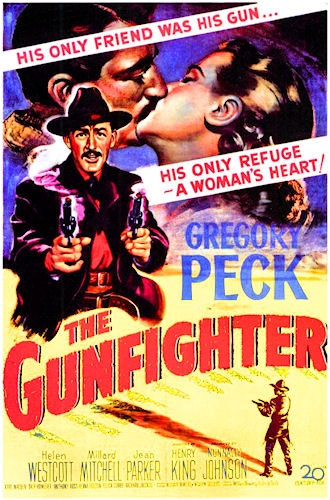
The Gunfighter (1950)

da568-the_gunfighterStarring Gregory Peck, this enjoyable western is about Jimmy Ringo, a gunfighter who has gained notoriety over the years. He rides his horse into a town and enters a saloon for a quiet drink. A cocky kids eggs him on and Ringo kills him with the boys brothers soon on his tail. He scares them off and heads to the town of Cayenne to see his estranged wife. Most of the film has Ringo resting in the saloon where the bar tender waits on him and the whole town crowds outside to peek at the legendary killer. Ringo is met by the marshall who turns out to be an old friend. He tries to help Ringo, including contacting his wife who is now a schoolteacher. Finally, Ringo is able to see his wife and their young son. Exuberant, he is about to leave town when his assailants are spotted. In the end his name was too big. This film had a striking opening score, good characters, enjoyable dialogue, and some major plot twists.
 
4.5/5 Stars

Twelve O’Clock High (1949)

Starring Gregory Pb181c-twelve_oeck, the film follows a strict brigadier general who takes command of a group of bombers who fly precision daytime missions during WWII. Frank Savage is sent to relieve his friends because the group has suffered a great deal of poor luck. From the get go this tough leader is at odds with his men. They all want to be transferred and yet with the help of the camp adjutant, Savage is able to lead them effectively. His touch tactics lead to success in the air and a pride in his men develops. However, after one good mission Savage is incapable to go up the next day. He becomes a lifeless man and only when his men return does he revert back to normal. All this is remembered by Major Stoval as the film concludes. Peck and Dean Jagger were both very good and the bombing mission was certainly exhilarating to watch. It is more about the people then the war and that still makes it a good film.


4.5/5 Stars


Frequently Asked Questions (2014)

Why is the name 4 Star Films?

I am a film enthusiasts but I try and focus on high quality films that are commonly rated 4 Stars and above. There is such a thing as a bad film, so I try and focus on ones with good reviews, entertainment value, artistic merit and a lens into humanity. 

What is the purpose of this blog?

Initially the site was just so I could catalog what films I had seen. Now I would like to think that the purpose is to talk about great films, stars, directors and other movie related news for the fun of it. I especially want others to appreciate Classic Hollywood as much as I do!

What is your Favorite Movie?

It’s a tough question so here’s my tough answer. When I was younger I would have said Star Wars. That is still good but now I would probably say Rear Window. I love Alfred Hitchcock. I love Jimmy Stewart. I love Grace Kelly and I love mysteries. 

Who is your Favorite Leading Man?

I would have to go old school and say Jimmy Stewart. He was the perfect every man and he was in a plethora of classics all over the board. It’s awesome impersonating him too.

Who is your Favorite Leading Lady?

Again I would have to go Classic Hollywood and pick Audrey Hepburn (although Grace Kelly is a close second). Both were so memorable in their film roles thanks to their beauty, poise and “grace” on screen.

Who is your Favorite Director behind and in front of the Camera?

It has to be Alfred Hitchcock. He’s the Master of Suspense for good reason and his string of cameos make his films even more memorable. The balance of entertainment and art in his films is what has allowed him to remain popular all this time. There’s something for everybody.

Favorite Movie Quote?

Maybe something from Up (2009)?

Favorite Scene from a Movie?

That’s another tough one, but I’d probably have to say the ending of It’s a Wonderful Life. When they start singing Auld Lang Syne it gets me every time. 

Favorite Film Hero

It might be a tie between Indiana Jones and George Bailey from It’s a Wonderful Life. They are both awesome characters for very different reasons.

Favorite Film Villain?

The Joker (Heath Ledger) from The Dark Knight. Another one who is fun to imitate. Why so serious?

Favorite Song in a Movie?

Moon River, composed and written by Henry Mancini and Johnny Mercer for Breakfast at Tiffany’s (1961). Instrumental version, Audrey Hepburn or Andy Williams version. Doesn’t matter. I would seriously have it play at my wedding. Seriously. 

Spartacus (1960)

91a01-spartacus_sheetaIn this epic film starring Kirk Douglas and directed by Stanley Kubrick, a slave turned gladiator leads a revolt against the Roman empire. Spartacus leads his fellow plebeians in a sacking and burning of the countryside while slowly gaining followers. Along the way he is reunited with his love (Jean Simmons). However, soon all hope of triumph or escape is gone and Spartacus must face the Roman legions in one final battle. Utterly overwhelmed by the other forces, his followers are slaughtered and taken prisoner. With all hope gone he must kill his friend (Tony Curtis) and then face death himself by crucifixion. But all is not lost because his wife and child do get away allowing his legacy to remain. Overall this film is good but it does have flaws, one of them being the casting of Tony Curtis with his New York accent. Laurence Olivier, Charles Laughton, and Peter Ustinov all have important roles in this film as well.

5/5 Stars

The Man Who Shot Liberty Valance (1962)

Starring both John Wayne and Jimmy Stewart, with Lee Marvin, Vera Miles, and direction by John Ford, this is certainly a moody western. Stewart, now a successful politician returns to a small town with his wife to pay his respects to an old friend. In the ensuing flashback he retells his story beginning as a young lawyer who had a run in with Liberty Valance (Marvin). After he got well he strove to bring justice and education to the land. Despite their differences, Stewart finds a friend in Wayne who has his eye on Miles. However, everything eventually goes awry when Stewart agrees to face Valance out in the street. He appears to be a goner because he is wounded, but miraculously a shot hits Valance and he falls dead. Stewart now a hero gets the girl and agrees to represent the town. Wayne fades into the background also a hero. The supporting cast includes Woody Strode, Edmond O’Brien, Andy Devine, and John Carradine. With two great icons and a great director, this western is certainly a classic. Although it did not end up making it into the film, Gene Pitney’s western ballad deserves to be acknowledged nonetheless.

4.5/5 Stars

A New List of 101 Popular and Beloved Films

I wanted to get away from lists that represent what critics think and I wanted to focus more on the films that have historically been popular with moviegoers or films that have gained a following over the years. Here is a list that mixes beloved classics, box office smashes, and iconic films all into a condensed group of 101.

These include films that have tremendous critical acclaim such as Gone With the Wind, Casablanca, Lawrence of Arabia, One Flew Over the Cuckoo’s Nest, and Silence of the Lambs.

There are also blockbusters such as Jaws, Titanic, Avatar, and the Avengers.

However, you cannot forget random fan favorites like Monty Python and the Holy Grail, The Breakfast Club, Ferris Bueller’s Day Off, Home Alone, Mean Girls, and Anchorman either.

I hope to continue to discuss these films in more depth because I find this list to be eclectic and fun for me personally. I hope it is for you too.

It goes without saying that discussion is welcome because any list like this can never be truly subjective. No matter what you think I sincerely hope you enjoy it!

Here is a list of some of the films I did not select (including a lot of classics).

Other Candidates:
When Harry Met Sally (1989)
Top Hat (1935)
Pretty Woman (1990)
The French Connection (1971)
Vertigo (1958)
King Kong (1933)
The Great Dictator (1940)
MASH (1970)
Saturday Night Fever (1977)
Platoon (1986)
(National Lampoon’s) Animal House (1978)
Dirty Dancing (1987)
The Notebook (2004)
Dirty Harry (1971)
The Big Lebowski (1998)
Beverly Hills Cop (1984)
The Best Years of Our Lives (1946)
Ghost (1990)
Frankenstein (1931)
Apocalypse Now (1979)
The Music Man (1962)
The Fugitive (1993)
It Happened One Night (1934)
Love Story (1970)
Raging Bull (1980)
Braveheart (1995)
Pinocchio (1940)
Citizen Kane (1941)
Seven Year Itch (1957)
The Philadelphia Story (1940)
Big (1988)
Chinatown (1974)
Scarface (1983)
The Great Escape (1963)
Say Anything (1989)
Independence Day (1996)
Monster’s Inc.(2001)
Dumb and Dumber (1994)
The Passion of the Christ (2004)
Men in Black (1997)

Part of a Series:
Dr. No (1962)
Star Wars (1977)
Toy Story (1995)
The Lord of the Rings: The Fellowship of the Ring (2001)
The Dark Knight Rises (2012)
The Planet of the Apes (1968)
Skyfall (2012)
Spider-Man (2002)
Alien (1979)
Bourne Ultimatum (2007)
Toy Story 2 (1999)
The Hunger Games: Catching Fire (2013)
The Terminator (1984)
The Godfather Part II (1974)
Indiana Jones and the Last Crusade (1989)
Star Wars: Episode I – The Phantom Menace (1999)
Harry Potter and the Deathly Hallows Part 2 (2011)

Note: Because of the limited space I only selected one film from a specific franchise/series

Back to the Future (1985)

Starring Michael J. Fox and Christopher Lloyd, the movie follows Marty McFly as he befriends the quirky Doc Brown. McFly witnesses the assassination of his friend by terrorists and unwittingly finds himself leaving his peculiar family and pretty girlfriend. He takes Doc’s DeLorean time machine back to 1955 and finds himself in a practically different world . Soon Marty is caught up in his own history when he messes with the first meeting between his teenage mom and dad. On the advice of a much younger Doc Brown, Marty tries to repair their relationship while the Doc gets ready to send Marty Back to the Future. Although he alters the past, Marty finds life even better back in 1985. The Doc turns out okay and his family is drastically different, in a good way. This film is great fun, full of sci-fi adventure, entertaining sequences, and enjoyable characters. If you ever want to catch the stars in some great TV shows watch Taxi and Family Ties.

4.5/5 Stars

Laura and a Remarkable Collection of Dopes (2013)


“I shall never forget the weekend that Laura died.” Those may have been the words of respected columnist and socialite Waldo Lydecker, but in truth they could just as easily be the words of a multitude of other players in the 1944 film Laura. The fact is, Laura not only casts a spell on everyone who happens to drift into her life, but she also captivates the audience who encounter her on the silver screen. She effectively reveals all their desires, obsessions, and shortcomings. In Laura, Otto Preminger conceived a wonderfully mysterious and enchanting film that constantly revolves around the life of this young woman. He utilizes his narrative, actors, cinematography, set design, and music in order to immerse his audience in this story. Preminger would ultimately create a hallmark in the film-noir genre of 1940s and 1950s, and it was Laura that also allowed him to truly realize his skill as a director. 

In Laura the narrative is important but it is not paramount because there are some many other variables that work alongside the plot to make the film special. Realistically, this film can be split into two distinct sections since it begins in the present before flashing back and finally returning to the present once gain. Initially Lydecker is our narrator and he relates his former relationship with the deceased Laura to Lieutenant McPherson along with the audience. However, during the second half there is a shift which focuses on McPherson and his growing fascination with this woman he is investigating (emmanuellevy.com). The film takes a shocking about face when the presumed dead person suddenly turns up, all too alive and none worse for wear. However, with that suspense gone it seems only too probable that the film would lose some of its luster. After all there are numerous plot oddities that do not quite add up. As Roger Ebert once wrote, “Laura has a detective who never goes to the station; a suspect who is invited to tag along as other suspects are interrogated, a heroine who is dead for most of the film; a man insanely jealous of a woman even though he never for a moment seems heterosexual; a romantic lead who is a dull-witted Kentucky bumpkin moving in Manhattan penthouse society, and a murder weapon that is returned to its hiding place by the cop” (rogerebert.com). Ebert brings up some very concrete instances that might cause the audience to ask questions of the film. These are not the trademarks of a taut and revered classic after all, and yet it must be said that Laura works in spite of a sometimes questionable plot. French film critics Jean George Auriol and Jacques Doniol-Valcroze put it aptly when they wrote that “the fact that this is a crime plot is not important. Laura could equally well have been introduced into a film drama or a love story…The miracle is to have brought her to life” (rememberingninofrank.org). Furthermore, the magic does not simply disappear when we discover that Laura is not actually dead. It is a cumulative effect that the director Otto Preminger was able to build up for us. 

Upon closer inspection there is a deeper significance to Laura than just its plot, because although it makes a good mystery, it is not altogether great. The actual brilliance of the film derives from something else entirely. First and foremost is the actual character of Laura played by actress Gene Tierney. Interestingly enough we do not see her in the present until the latter half of the film. Our only way of understanding her comes from the stunning portrait that hangs on her wall and the wistful recollections of columnist Waldo Lydecker. We are in the same shoes as McPherson (Dana Andrews) for the first half of the movie, as we try and piece together who Laura was. With McPherson the obsession goes so far that he actually falls in love with the image of this dead woman, in what would be a striking precursor to Alfred Hithcock’s own character study in Vertigo (emannuellevy.com). In fact, Lydecker goes so far as to call McPherson’s infatuation “warped” because the columnist believes that McPherson wanted her most when he knew that she was unattainable. In many ways she became his personal fantasy. For his part, Lydecker has his own fixation with Laura and he even tells her directly, “The best part of myself – that’s what you are. Do you think I’m going to leave it to the vulgar pawing… of a second-rate detective who thinks you’re a dame?” It seems like Lydecker almost envisions Laura as his personal creation because he endorsed her pen, introduced her to prominent people, and gave her a chance to succeed. Rather like the story of Pygmalion, he has tremendous feelings for her which quickly morph into jealousy when any other man gets close to her. He failed once to blow her head off with a shot gun and tries yet again only to slump to his death saying, “Goodbye, Laura. Goodbye, my love.” As a viewer his logic and actions do not make sense, but then again are any of the characters logical? Ms. Ann Treadwell on her part wants the one man who Laura is engaged to be married to, and she openly admits “He’s no good, but he’s what I want.” The only somewhat normal figure as far as desires goes seems to be Shelby Carpenter, who is Laura’s fiancée and Ann Treadwell’s romantic objective. However, on closer inspection even he has other needs which are met by Treadwell who gives him financial support. Amidst all of this we begin to wonder how Laura could have become involved with such “a remarkable collection of dopes” but perhaps they simply gravitate towards her, much in the same way the audience does.


It is a credit to Otto Preminger for making Laurasuch a fascinating and visually interesting film-noir. It is a film that exemplifies noir by taking typical motifs and putting a unique spin on them to further develop the genre. The sometimes confusing plot and nonlinear storytelling, which help develop the story of Laura, are typical elements of other films later on like The Big Sleep (1946). Furthermore, Preminger’s story of a man infatuated with a mysteriously beautiful woman is somewhat reminiscent of Fritz Lang’s Woman in the Window (1944). The difference with that film is that it all occurs in the mind of the protagonist. Laura actually plays out for real or at least we have no indication to believe that it is in fact a dream. The moment Laura appears in the flesh, in her front living room, it pretty much shocks us out of the dream that would be Woman and a Window and it quickly becomes certain reality. Sharp contrast cinematography is almost always essential to film-noir and Laura is no different. Often when a character enters a dark room, walks down a poorly lit street in the rain, or looks up at two figures in a window, the scene is a mix of chiaroscuro lighting, and pronounced shadows. However, perhaps just important as the lighting in Laura is the Mise-en-scene. Not only is every space developed extensively whether it is Lydecker’s bath or Laura’s living room, but numerous objects within these settings play key roles in the film. The portrait in Laura’s home has such a grander purpose in the entirety of the film, but it also fits as part of the decor. The identical clocks in Lydecker and Laura’s flats are featured prominently at the beginning and end of the film and they function as more than a piece of furniture. They reflect Lydecker’s affection for Laura but also his tendency towards distrust. They are pristine artifacts at the outset and yet by the end of the film one is busted open and the other is decimated by a shotgun. It also seems imperative to take a look at Lieutenant McPherson in comparison with other prototypical investigators in film-noir.  In the beginning, he holds the characteristic cynical, tough as nails demeanor of a Sam Spade or Phillip Marlowe, and yet by the end of the film he leaves some of that behind him. He may smoke and drink incessantly but the simple fact that he fiddles with a puzzle to stay relaxed puts him in a different category than other film-noir protagonists. Laura on her part is difficult to classify as your typical femme fatale. However, in some respects she is a manipulator who puts men under her spell. Normally a femme fatale like Phyllis Dietrichson, Brigid O’Shaughnessy, or Gene Tierney in her role as Ellen Harland, manipulate men on purpose using their sexuality, wily charms, and power of persuasion. In Laura’s case it does not seem to be like this at all. It just happens, partially since she is such an innocent beauty, or maybe because she is an unattainable woman in a painting. When she is dead, she becomes a fantasy to be recalled and obsessed over, and yet she toys with her suitors in a way by coming back to life. Another prominent part of Laura is the score by David Raksin which in actuality is not present through the entire film. However, it creeps in at opportune moments when it is most needed and it effectively acts as a queueto the audience. Whether you hear Laura’s theme near the opening, on the radio, or by an orchestra at a party, the tune is the haunting essence of Laura herself and it reflects who she is even when she is not present, much like her portrait. To his credit Otto Preminger was able to put all these bits of inspiration together cohesively to make a seminal film-noir with its own set of strengths.

It appears safe to say that Laura was a spring board for the rest of Otto Preminger’s career, because he began as a producer and then emerged as a director who was adept at tackling complex and often controversial issues. During the 1940s and 50s Preminger kept on making film-noir including Fallen Angel, Whirlpool, and Where the Sidewalk Ends which continued his collaboration with Gene Tierney and Dana Andrews, although they never equaled his success with Laura (Wallace, 91). All throughout the rest of his career Otto Preminger would test the Production Code and Joseph Breen with various taboo topics. With The Moon is Blue, he faced opposition from the Breen Office for “sexual explicitness” (Wallace, 89). Soon he would direct both Carmen Jones and Porgy and Bess where he utilized all-black casts in both cases, which was unusual for the era (Wallace, 92). Next, came yet another controversial film in The Man with the Golden Arm where Frank Sinatra portrays a man struggling with drug addiction (Wallace, 92-93). Then, of course, there is Preminger’s classic, Anatomy of a Murder which revolves around a court case involving rape and murder. The often frank dialogue was revolutionary for the 1950s and it was bolstered by performances by James Stewart and George C. Scott who play opposing lawyers (Wallace, 93). His prominence may have dropped off somewhat after that, but it is undeniable that Otto Preminger was a directorial force from the 1940s well into the 60s and he can be acknowledged for pushing the boundaries of film content.

In Laura, Waldo Lydecker chides his companion for her “one tragic weakness.” As he sees it, for her, “a lean, strong body is the measure of a man.” Perhaps this does hint at the problem with all of Laura’s relationships, because each one has a superficial aspect. With Lydecker dead and no longer able to intercede, Laura walks off with McPherson, another one of these men with a “strong body.” As an audience we would like to see this as different from before but is it really? In the same way we too have one tragic flaw as well. To put it frankly we are human; humans with wants, desires, peculiarities, and emotions which are reflected and brought to the forefront by characters such as Lydecker, McPherson, Carpenter, Treadwell, and of course Laura Hunt. Whether he meant to or not Otto Preminger makes us face these issues through his film; however in the process he also develops a wonderful noir mystery that helped define the genre. It seems safe to say that Laura is a film-noir that is both stylish and witty, and at the same time haunting. Above all the film exhibits a “remarkable collection of dopes,” all tied to this enchantress named Laura. Every one believed they were “the only one who really knew her,” but every one of them, much like us, will never be able to quite figure her out. That’s the beauty of Laura, the character, and Laura,the film.

Singin’ In the Rain (1952)

This movie is a comedy, a romance, and above all a musical. However along with the immortal dance routines there is a plot and characters that are memorable as well. It helps to glorify a very different time in Hollywood and delivers a film that is funny and full of excellent song and dance.

There is something about this film that makes it extremely special. Even after seeing it many times I am still captivated by every joke and every unforgettable song. What can beat the brilliance and antics of Gene Kelly and Donald O’Connor backed by Debbie Reynolds? There is a touching love story to go along with these great actors and songs. Gene Kelly’s sloshing about in the title song is timeless and O’Connor delivers a hilarious performance in such songs as Make ’em Laugh. There are a few dance sequences that are drawn out but the rest is top notch and keeps the audience enamored the entire time. This truly is a classic movie and musical that is both funny and heartwarming.

5/5 Stars

“Dignity. Always, dignity”
~ Don Lockwood

Mary Poppins (1964)

4635e-marypoppinsStarring Julie Andrews and Dick Van Dyke, this Disney musical permeates joy and acts as a window to enchantment. Mary Poppins is a practically perfect nanny who begins to take care of two children. They grow fond of her when she helps them clean their room, takes them through a chalk drawing, and above all sings to them. Through their adventures they meet the Chimney sweep Burt (Van Dyke). However, their actions also cause their father to lose his job. However, as Mary had planned they grow closer to their parents as Mary herself moves on. This film is full of delightful characters, funny quips, and memorable tunes. Disney put together a nice production of animation, choreography, and of course singing. Get ready for some supercalifragiliticexpialidocious (Please don’t check my spelling here)!

4.5/5 Stars