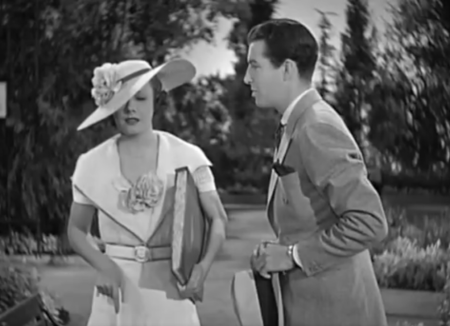
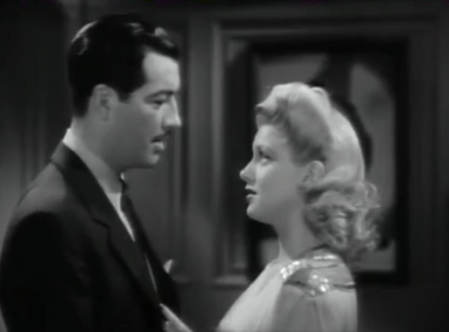
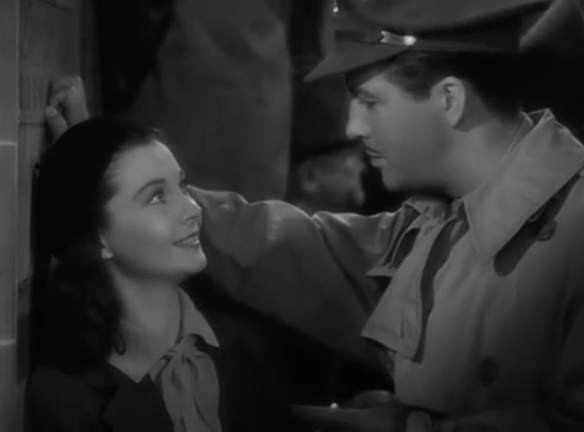
Unfinished Business (1941) for Irene Dunne

Screenshot 2020-01-04 at 82904 PM.png

Unfinished Business commences with a wedding ceremony we’re trying to place. Because it is not Irene Dunne getting married, although she stretches her famed vocal cords in lieu of a wedding march. It is her baby sister — the girl she’s mothered her entire life up to this point. Now that the responsibility is over with, she wants to give up motherhood to be herself. After all, she’s been settled down her entire life and now she wants to get unsettled.

She’s a rural Ohio gal and intially feels like the most simplistic, idealistic I’ve ever seen Irene Dunne in a picture. However, this might establish the wrong impression. Because Unfinished Business gives an inclination of being in the mold of Theodora Goes Wild, though it does make its own digressions in favor of a softer even sadder tone. It’s actually more complicated than it appears, and Dunne’s character is very much the same.

The whole conceit is in the title really, although it takes on multiple meanings. First, there’s the unfinished business in reference to her life thus far. And then, when she has a romantic encounter rudely sidelined and left unrequited, it’s quite something else entirely.

The heart of the story starts aboard the train she boards to who-knows-where to live a little. Instead, she gets seduced by a handsome man who’s waging a bet he can find the most attractive conquest on the train. Their expectations and the meaning of the encounter mean two very different things to both of them. She will never forget him with a starry-eyed infatuation. He’s moved on to other things and over women soon thereafter because that’s who Steve Duncan is.

Not to be totally paralyzed by love, Nancy, endeavoring for an opera career, spends her waking hours on her arias. By day she must settle for singing telephone messages to customers, a rather demeaning art compared to what she’s used to. Though it does wind up getting her a new job; the pays better even if it’s hardly a more glamorous turn.

Billy Ross is the first truly curious character actor out of the rank and file old Classical Hollywood normally bequeaths us in pictures like these. He has this sense about him that screams screwball comedy as does Eugene Pallete, though he comes later. But the distinction is how La Cava’s film never resorts to this plane of existence. This is a far cry from My Man Godfrey. At first, it seems like this is a bad thing.

Nancy’s still a few rungs below hatcheck girl hidden behind a counter at a switchboard still singing messages. At least this time she gets some company with a touch of humor in the form of Tommy Duncan (Robert Montgomery) who is, among other exploits, a noted alcoholic.

Montgomery’s delivery always feels abrupt and unsorted to me. Though I’m admittedly coming around to him because in this picture, in particular, he’s the one man who notices Nancy’s tears — going so far as to commandeer the switchboard for her. If you’re beginning to connect the dots, you’ll realize his older brother is Steve, her one-time, one-day love.

Nancy and Tommy prove to be a strange company going out together. It’s almost like they have a shared camaraderie however thinly connected. He can’t stand his brother with typical sibling syndrome, and she still harbors a melancholy flame. At any rate, they drown their sorrows with some extra hard milk.

They wake up in the morning — the valet (Eugene Pallette) calling on Mr. Duncan, his musical shoes needing a grease — and they have flown to South Carolina and gotten themselves Married! But it almost plays as matter-of-fact, not one of those wonky sitcoms episodes. The whole movie functions like this.

Nancy dresses up and goes “wild” in an effort to make up for her ho-hum existence thus far. It comes with mixed results, eliciting the grouchy contempt of their sleep-deprived butler Elmer. Part of the issue is how we only hear word of her merriment after the fact. We are robbed of the delight of Dunne going a little ditzy and a little wacky and breaking up the screen. This is not that kind of movie (although Montgomery does get an extended number with a pair of opera glasses).

Otherwise it feels subdued in comparison to other contemporary examples like My Favorite Wife or Here Comes Mr. Jordan. It’s very possible La Cava’s film was striving for a more delicate tone somewhere in between, which is certainly admirable, but it never seems to reach its optimal effectiveness.

While Dunne is always lovely and we do appreciate here more often than not, somehow the movie never feels centered even as Preston Foster and then Robert Montgomery drift into her life for different reasons. There is an emptiness to it. Can we say purposelessness?

But then maybe there you have a bit of Dunne’s predicament. Shall she wait around for love, focus on her career, marry for money? The options are in one way bountiful but no less restricting for a woman in her position.

One visually impactful scene comes right after the wrong Mrs. Duncan kisses the wrong Mr. Duncan. That is Dunne and Foster. The catty blonde at the party passes what she’s witnessed along gleefully, and the camera takes a hop, skip, and a whip across the various partygoers as the words catch like wildfire. It’s the most blatant of ripostes in a film where stories begin to quietly overlap. Still, it hardly unloads on the drama.

What sets the movie apart is probably the honesty — this underlying sense of pragmatism. I have no illusions that it is similar to Daisy Kenyon, but I remember watching that film and Joan Crawford’s role in it, which somehow felt unextraordinary. And yet I realized it was extraordinary for the ordinariness, at times, because it was so very unlike the cultivated or perceived Hollywood of the 40s, not to mention its lack of emotional hyperbole.

I’m curious if my gut reaction to Unfinished Business is very much the same. There’s an undue skill and finesse to it no doubt, but this never moved beyond observation and then admiration for an underrated director. It didn’t get to my core through laughs or drama like My Man Godfrey or Stage Door, and I must simply come to terms with it.

3/5 Stars

Theodora Goes Wild (1936): Irene Dunne The Comedienne

Screenshot 2020-01-04 at 80541 AM

The Lynfield Bugle, led by their fearless leader Jed Waterbury (Thomas Mitchell), keeps their nose to the proverbial grindstone printing the news as it happens in “The Biggest Little Town in Connecticut.”

Their latest act of rebellion constitutes printing a spread from the latest lurid bestseller from author Caroline Adams. It causes quite the to-do in such a proper, God-fearing community.

Because it’s true Lynfield has all the customary facets of a town its size, including emblematic moral watchdogs such as Rebecca Perry (Spring Byington), a key member in the Lynfield Literary Circle, the key force in swaying public opinion and consequently, keeping the town’s gossip in a state of constant flux. Rebecca just happens to be the most insufferable of them all.

With their mouths, they openly condemn Adam’s latest piece of titillating prose as they secretly relish its vivid detailings of passionate romance. One of their younger members, who sits zealously by, next to her two austere aunties (Elisabeth Risdon & Margaret McWade), is Theodora Lynn (Irene Dunne). She’s a devoted Sunday School teacher and plays the organ at church on a weekly basis.

Theodora also has a secret in the form of a pen name and a mendacious life as a writer, although that is rather harsh because this is Irene Dunne we’re talking about in a generally raucous screwball comedy. You see, she is the one and only Caroline Adams!

Her Uncle John is the so-called black sheep of the family (Robert Grieg) because he escaped the puritanical lives of his sisters for a much more “worldly” life in the city. He’s a jolly fellow and with a twinkle in his eye, he believes Theodora to be different. There’s still hope for her yet.

In fact, she has a streak in her that old Uncle John might just be downright proud of. It’s a decent streak mind you — helping a young woman be with her husband and setting her up with her job — but it’s the kind of activity people back home might turn their nose at. This all happens as she makes a meeting with her publisher incognito to talk business as part of her double life.

Although he does his best to keep her under wraps, that miracle elixir: whiskey has a habit of loosening the tongue. Their prying dinner companions are fascinated by the very contradictory nature of her character. Among them is a wry ne-er-do-well, Michael Grant (Melvyn Douglas). Soon the small-town gal finds herself in a fairly big city situation, in Grant’s bachelor pad, with deeply comic underpinnings.

Of course, nothing happens at first. That is until Theodora, that is Caroline Adams, has her cover blown — an old friend wanders through town quite by chance, with a furry companion Jake. He railroads his way into the aunties’ shed as a gardener and quickly sets up shop. As he sees it, he’s her deliverance from the clutches of her town, and he gleefully whistles his way into her life, tearing up their gardens backward and forwards.

She has very little in the form of a rebuttal aside from retaliating through a song of her own, “Be Still My Heart” through gritted teeth. This could be the end of the movie right there or else it wouldn’t have enough gas to wheeze its way to the finish. In this specific moment, it’s not what I would term a screwball in the strictest sense though, it does have a feel of some of the Loy and Powell comedies of the same vintage. Be it Libeled Lady, Love Crazy, or I Love You Again.

Screenshot 2020-01-04 at 95611 AM

Mervyn Douglas often feels like a version of Powell I don’t take a shining too quite as much. He has a similar playful banter at his disposal, even mustachioed good looks, but it doesn’t tickle the fancy in the same way — at least for me.

Irene Dunne, of course, in her first foray into out-and-out comedy is exquisite, although she would continue to up the ante with the likes of The Awful Truth, arguably her best film and the finest pairing she ever had with Cary Grant (or anyone for that matter).

But we must attend to this story because it doesn’t end right off, instead, it turns the tale on its head and once Theodora has been handily liberated of her small-town’s repressiveness, it gives her the freedom to have a go at Michael. Because it turns out they’re not all that different. He needs his own push of encouragement.

Instead of church choirs, temperance, and women’s book clubs, it involves high society, governorships, and public appearances. His father expects him to keep out of the newspapers and remain married to his estranged wife — at least until the public office is secured. Meanwhile, Michael becomes unhappier by the hour.

Dunne takes the movie by the horns now and truly kicks it into overdrive right when it could use a good jolt. The way she trollops and sashays around, first through her lover’s bachelor pad, and then making her way up the totem pool on the dance floor, with her new pal the governor, is the picture of jovial inhibition. She redefines our perceptions and the underlining dynamics of the movie shift wildly — and humorously — as a result of her antics.

She goes back to her publisher in fancy new duds absolutely gobsmacking him as she proceeds to drum up all the publicity she possibly can. Theodora Lynn is going to become a household name. Accordingly, she gets the newsboys in her corner, and they go to great lengths to help her (and themselves).

Soon she’s plastered over the front pages, and the ever-fastidious Bugle gets the scoop out. Like clockwork, the town is shaken into an uproar, and it even reaches the upper echelons too as Michael gets dragged into it. What a beautiful mess; just what the movie required to spruce it up. Theodora’s making waves like never before.

The key is how Dunne always has a firm handle on everything — turning the sass on and off as needed — she knows what she’s doing. Whereas other heroines are often dizzy and ditzy, like frantic hurricanes of passion and emotion, she’s probably the most controlled of all of them even as she does bring her own “wildness” to the party.

What’s even more hilarious is watching public opinion rise up like wildfire and turn in her favor. She gets as good a homecoming as the war heroes in Hail The Conquering Hero a few years down the line. All her decency and newfound transparency are met with affection.

By now, she’s harnessed the power of her neighborhood and finds a way to be a beacon of change in an uproarious manner with a romance to complement the major strides in her personal life.

As such, Theodora Goes Wild becomes a surprisingly pointed (and poignant) portrait of a young woman casting off the shackles of religious hypocrisy, societal repression, and general small-mindedness, all conveniently wrapped up in a quasi-screwball, rom-com format.

3.5/5 Stars

The Silver Cord (1933): Loving Joel McCrea is a Battlefield

The_Silver_Cord_(film)

“Surely I can be a good son and a good husband.”

Whether it means to or not, the opening interlude of The Silver Cord plays like a comic inversion of typical Hollywood. It opens in Heidelberg, and they make us blink; they’re actually speaking German and Irene Dunne is one of them!

Then Joel McCrea wanders in, Dunne at the microscope deep in her work. He kisses her on the nape of the neck, and she responds coolly in English. I got the same sudden delight out of this moment that I did in the train car at the start of Design for Living. Why? For a brief instance, it caught me off guard and I smiled.

The rest of The Silver Cord begins as nice as you please like a hunky-dory sunbeam. She is a world-class biologist. He is an up-and-coming architect. New jobs beckon in New York, marital bliss swells around them, and meeting the brother and his new wife gets off to a grand start. It’s only the mother who remains to be seen.

It just so happens Mrs. Phelps (Laura Hope Crewes reprising her stellar stage role) is the lynchpin. She’s a maternal hurricane of frenzied energy, shouting her son’s name elatedly in the drawing-room, and obsessed with him a bit more than what feels kosher. She also meets her new daughter-in-law even as the ripples of slight agitation show themselves in how she subtlety rebuffs her younger son’s fiancée. There’s already tension.

In fact, she dominates the entire household with her ways, whether it’s her views on parenting or how she conveniently puts Dave in his old room so he’s separated from his wife. It becomes plainly apparent she a smothering woman; It feels like she’s playing a desperate game of tug-of-war as she lauds an old-fashioned conception of motherhood while coveting a piece of her son’s heart.

In another moment, Mrs. Phelps literally tucks her grown son into bed. But there’s an ulterior motive. She wants all the dirt on his new wife and then she proceeds to natter on about how possessive, exacting, and selfish she is. “If only she learned to care for me as I care for her,” she says. The irony of her words fails to leave an imprint on those actually involved in the conversation. Of course, a moment later finds the belittled wife awkwardly walking in on mother and son. Yet another disconcerting scenario.

We have a two-front war on our hands. The fight is first over Robert (Eric Linden) and then David (McCrea). First, dear old Mom talks her impressionable younger son out of his love for his wife, Hester (Frances Dee), going so far as to poison his mind so her undue influence is felt in full force even when she’s not in the frame. After all, she is an insinuating, controlling woman who plays mind games and whether she does them subconsciously or not, it doesn’t much matter. She’s a genuine terror.

Crewes is so infuriating in her effectiveness making it so difficult to be civil and to concede without falling over backward like a bowling pin. If we learn anything about Christina (Dunne), it’s the fact she has a life and aspirations to go with them. A husband is part of it but as things unravel, she’s going to stand up for herself. One thing’s for certain. It moves fast.

Soon Christina makes a plea to her husband to relinquish the arid places in his heart where he retires. She plays another card by supplying a grand surprise of her own. Mrs. Phelps home is a swath of his heart on a larger scale — one she is looking to hold onto as her own by any means possible, but Christina makes it clear she will not go down without a fight.

Meanwhile,  Hester, who has been subjected to the torment the longest, is about ready to burst. They have “shocking” conversations about something as controversial as babies, and she’s just about had it. She can’t take how her marriage and her own aspirations for children have been twisted and trampled into something bad.

She’s left a trembling hysterical mess driven to get out of the house. And she cannot be anything if not a portent for what might happen to Christina as well if she doesn’t take her own leave.

Because among Mother’s many attributes is also diabolical hypochondria. The jaundice doctor rightly acknowledges a stick of dynamite would be needed to subdue her. In fact, she peps right up just when things come back around to what she’s always envisioned for her sons with wives out of the way.

If you’ll afford me a brief tangent, even with Irene Dunne wedged between them in the frame, it’s hard not to look at France Dee and Joel McCrea and think of what a fine couple they would make. What’s even more remarkable is how long they made a couple: 57 years!

Although the story’s internal logic is purposefully maddening, it gives way to a fine bit of melodrama because it manipulates the scenario in such a way to make us feel almost immediate revulsion, and it builds for little over an hour in fairly splendid fashion.

A standout moment comes with Irene Dunne ably stripping her mother-in-law down to size with a perceptive deconstruction of all her various hangups and maternal misdemeanors. She puts words to all the many things we take issue with but are unable to say as passive observers.

Her is a woman finding romance in motherhood where she didn’t find it in marriage, highlighting the peculiar dynamics the movie is being drawn up on. Mrs. Phelps reaches her own point of hysteria though she’s too delusional — too set up in her own ways — to understand who she is and what she’s doing. Still, if you can bear it, The Silver Cord is an effective drama for all it manages to heap on top of us.

3.5/5 Stars

Back Street (1932): Irene Dunne and Director John Stahl

Back_Street_1932“There’s not one woman in a million who has ever found happiness in the back streets of any man’s life.”

John M. Stahl is a bit of a neglected craftsman, even by me. Like others, I became aware of him solely for Leave Her to Heaven, a noirish technicolor melodrama positively dominated by Gene Tierney.

However, as with any director, he wasn’t formed in a vacuum and during the 1930s he worked on some of his most intriguing efforts like Back Street. Then, the following year’s Only Yesterday offered up similar dynamics, featuring Margaret Sullavan front and center. Sullavan and Dunne implement different personas and yet in trying to put my finger on what might draw them together, my mind goes instantly to one thing: class.

This particular story was adapted from a Fannie Hurst novel. Dunne ably anchors the leading role of Ray Schmidt, earning a bit of a reputation because she’s a glamorous girl who likes to get out and have a good time. However, there is a distinction to be made between a girl who has no standards and one who probably opens herself up too much. Ray fits in the latter category. She says it all in one fleeting line of dialogue, “It’s all the way or zero with me.”

Opposite her is John Boles as a gentleman narcissist somehow managing to suggest the jarring contrast of mild manners and infidelity in bodily form. Coincidentally, he would also reappear opposite Sullavan the following year. Here he meets Ray, this extraordinary girl while he is still engaged, and he’s instantly smitten. It happens when a mutual acquaintance introduces them in passing, as he makes his way out of Cincinnati. It’s the beginning of something that will define their lives.

One key benchmark occurs in a local park in front of the bandstand. Walter is to bring his mother to see the performance, and he conspires to have Ray show up, making a glowing appearance, as if by accident. It’s the bit of manufactured serendipity they need to gain approval in their relationship. And yet it never happens like it’s supposed to in the movies (at least the ones we usually play in our heads).

The story starts to construct itself out of these vignettes.  It’s now 5 years later. We’re on Wall Street in New York, and the two former flames bump into each other right where they left off. The fire hasn’t died because old habits die hard. Ray willingly waits for him because it’s true there’s something electric between them. Unfortunately, it disregards reality. He’s married with two children (all but unseen).

Instead of meeting on street corners and hiding in doorways, they get a bit more sophisticated. He furnishes her with a room and so now we have the new status quo where this clandestine, illicit thing feels almost mundane.

But that’s a curious factor to Stahl’s picture. Surely it is melodrama — especially on paper — but he makes it feel instinctively human. Of course, humanity isn’t always high-minded and righteous. It can be selfish and lonely and confused. In fact, we often embody these feelings most of all.

It’s not about the accumulation or even the escalation of scenes to the apex of a bigger climax. Instead, each moment supplies an impression to add another layer to this searing romance. And it’s in these successive snapshots from which we must fill in the gaps for ourselves. It’s a testament as much to what is shown onscreen as off. This is not in the sense of Production Codes getting in the way, but a concerted choice to have ellipsis set up all around the story. We drop and then pick up the narrative at these various intervals in the cycle of life.

Later he’s too busy to get away from all his professional and personal responsibilities. These are his excuses. She’s waiting on his words, for the ring of a telephone, playing solitaire. It feels like a thankless position to be in.

Down the hall from her, a woman is burnt badly in a house fire — all but disfigured, though she won’t call her husband — she is another kept woman. Is this the writing on the wall? Ray chides her to get out, preaching independence, although she doesn’t quite know how to put it into practice. She still believes she might just be the one in a million who will make it work.

It’s the film’s first true wrinkle when she makes a decision to break with convention. It remains to be seen what the consequences might be. Kurt (George Meeker), who’s had a crush on her since childhood, comes a-calling again, goofy and endearing as ever but having made good. He casts his usual line, and it might as well be the same old story. Ray looks at him and there is sadness even pain in her eyes. He thinks she’s rejecting him again because she’s not free, and he’s right, but not in the way he thinks.

The reunion with Walter, now a successful businessman in his own right, is a complicated thing. He has a way of exerting his will on her but making it feel like it’s her decision to determine whether he is happy or totally devastated.  It’s this driving, prevailing selfishness and woebegone attitude that dominates the story.

We settle into another scene. It’s on an ocean liner. Walter is with his wife and a grown son and daughter. It has the flavor of One Way Passage and a very different sort of Love Affair. One of the most heartbreaking scenes comes when the young upstart son comes to confront Ray to try and get her undesired presence out of their life. And in another movie this scene would play out like so — at least like how he’s imagined it. She’s the wicked, opportunistic woman ready to tear through a household with blackmail and scandal.

Still, we know Ray to her core, how much she loves — how decent and thoughtful she is — and yet she has somehow found herself in such a frowned upon station in life. It doesn’t seem fair. Then again, how much does she have herself to blame? Worse yet, is the fact that the men — the ones with money and the benefit of the doubt — are allowed the position of victim.

The whole family must come to terms with reality. Walter continues with his entitled streak telling his son, “a corner of my life belongs to me alone.” There Ray is somewhat loved but literally waiting on the end of the line for him even unto death. The ending is a kicker, a fitting dream for it to coast off on even as Ray’s own light finally goes out.

Back Street is a love story that could not have existed in mainstream Hollywood a mere 5 years later. It more than lives up to its title as this little, cofounding film working not in the mounting drama but the quiet splintering of a lovelorn soul. It befuddles my own sensibilities even as it makes me sympathize with the lovers in its grips.

3.5/5 Stars

Three Comrades (1938) in Body and Soul

Screenshot 2019-12-27 at 100048 PM.png

“Germany’s a pretty rough sea if you’re drifting.” – Breuer

“But I’m not alone anymore. There are so many drifters!” – Patricia Hollmann

Erich Maria Remarque is of course most famous for his work All Quiet on The Western Front, which was adapted to great effect for the silver screen by Lewis Milestone in 1930. Three Comrades, another one of his novels, feels very much like an extension of the same themes found in the earlier novel.

We find ourselves at the tail-end of the Great War. Mainland Europe is jaded and bedraggled. One must recall these were the days before Nazism: a force that felt like personified evil. When we look around from trench to no man’s land, it feels like everyone’s equally besmirched, equally implicated in the senseless killing.

So in this regard, it’s not a far stretch of the imagination to think a cohort of three German veterans might be likable to an American audience (especially because they are also Caucasian). However, equally importantly, they are played by three strapping young talents with charm bouncing off them like pinballs. It’s how they’re able to leave the calamitousness of war behind and attempt to discover a new life of humble contentment.

It was the war that instilled them with a certain collective memory, both scarring and then firmly solidifying their friendship in the aftermath. They take the world on like the Three Musketeers: all for one and one for all. Together they happily resolve to become car mechanics, carving out a peaceful existence for themselves, even as their beloved country has succumbed to a kind of mob rule with rampant new ideologies. To each his own.

Erich Lokhamp is the first, played by a dashing, if a bit wooden, Robert Taylor. Though it’s his friends who really seem to bring him alive. Franchot Tone is Otto Koster, always ready to support his friends and speak sense into their lives. His brand of loyalty is finer than gold. The other is Gottfried Lenz (Robert Young) also light-hearted while stricken with the mind of an idealist. Still, he gladly gives up his social conscience for the sake of his friends’ well-being. At least for a time, life is happy.

But before there’s any greater stakes, it begins as three lads having a blast taking a stuffy socialite (Lionel Atwill) for a ride as they roar down the thoroughfares in their beloved, hopped-up creation “Baby.” It’s a bit of good fun, but it also introduces the trio to one of the most important people in their subsequent life together: Pat

Margaret Sullavan is at it yet again a husky-voiced, troubled soul and yet overwhelmingly resolute in her pursuit of love and the preservation of those around her. It’s a quality found in all these characters — this self-sacrificial nature that becomes so laudable, if not entirely necessary. She is the one who surmises how lovely it might be to pick when we were born. Perhaps an age of reason and quiet. This sounds like a Borzage picture. Because of course, they must make do with the here and now, where evil still exists in the world (as it does in any era).

Screenshot 2019-12-27 at 100806 PM

Their favorite hangout belongs to a jolly man named Alfons (Guy Kibbee). Erich takes his new girl there following some awkward interplay over the telephone. Also, his buddies always have a penchant for showing up uninvited to sit in on their evenings. It’s one of the added delights of the pictures because Young and Tone can supply the wisecracks to rib their friend.

I admire Otto and Gottfried even as I relate. They are faithful, they wish the best for their friends, act as encouragers — spurring each other on — and celebrating their victories while taking any setbacks as they always do: together.

This courtship brings with it other complications, namely trying to impress a high society girl of culture no matter how good-natured she might make out. It’s still easy for a man used to the inside of cars, to feel out of place with the social elite, dancing and wearing customary uncomfortable clothing, which also has a habit of coming apart at the seams. He even spins tall tales of rolling down to South America, an exotic land full of monkeys and coffee, just so he might be able to keep up with her.

All of this show proves unnecessary. This is how it works when you are smitten with a rich man’s girl and, more importantly, when she is in love with you. In another line that feels transcendent in the usual manner of Borzage, they aspire to being “lovers on the edge of eternity between day and night.”

A lesser film — or at least one ill-befitting the predilections of Borzage — would probably have made this a fight for the woman’s hand. It’s easy enough to see how this would have pulled the boys’ bond asunder. And yet these characters are more genial, enlightened, and well-intentioned. The story itself strives for something more. Young plays cupid urging his friend toward marriage. Tone’s character knocks out a concerto on their automobile as he tries to hammer away some sense into Pat in favor of his friend.

Propitiously, all this coaxing culminates in the quaintest wedding, which somehow fits all the players to a tee. Borzage captures it such that we feel we are there with them discovering it as it happens, partially spur of the moment, but also imbued with this star-crossed purposefulness. In step with everything else, their honeymoon to the seaside is as gay as can be until it is met with a setback.

It plays into the film that Sullavan always feels emotionally strong and sturdy but often physically frail. Maybe she just exudes this quality between her throaty vocals grasping at words and the obdurance she gained a reputation for. But in Three Comrades, she is bedridden and in critical condition from hemorrhages — still nursing sickness that has clung to her for some time. Erich has little idea, but once again, Otto comes to their aid with his usual expediency. It only serves to bring them together.

Screenshot 2019-12-28 at 75036 AM

While remaining unnamed throughout the film, there’s little question that the rising Nazi Party is the instigator of public brawls. Dr. Becker (Henry Hull) speaks out on his soapbox about the need for reason in confronting the issues of the times, instead of the prevailing violence. Since it’s not the first scuffle or an isolated event, Gottfried feels compelled to stand up for his beliefs, putting his ideals on the line.

Meanwhile, Erich has a less politically charged fistfight in the streets over a work claim. He gets ganged up on before his comrades, of course, fly to his defense. Just like old times. Pat is placed in a sanitarium on the behest of her doctor (Monty Wooley) just in time for the snows of winter and then Christmas.

The violence continues to escalate, this time dragging Tone into a shootout in the streets with Handel’s “Hallelujah” clamoring in the background. It’s oddly hypnotic even as it spells what feels like the end of the beginning.

If it’s not apparent already where Three Comrades is going, it easily functions as a fitting companion piece to Borzage’s later Mortal Storm because there is this same uncanny prescience about it, although it probably did very little to halt the impending course of history. The unholy mechanisms were already in place.

Every Borzage movie makes the world a little broader and love a little grander to match. In this regard, the meeting of the prose of Erich Maria Remarque and F. Scott Fitzgerald somehow manages to work in the hands of a director.

What sets it apart from a melodrama like Douglas Sirk’s is the slow burn and how the characters take each moment on with their own brand of quiet fortitude. In many ways, love (and camaraderie) are an antidote to the wiles of the world. Our heroes know what’s inevitable and they brave it together — smiling until the end of days — even in the face of tragedy and hardship.

Is it high-minded and idealistic? Most assuredly. But it’s also one of the most blessed hallmarks of Frank Borzage’s filmmaking. This hallmark, more than anything, is why we can easily draw a line in the snow from something like Seventh Heaven or Man’s Castle to Three Comrades and then The Mortal Storm.

One is especially reminded of Margaret Sullavan because one of the pervading attributes of her characters is this all-encompassing dignity to see her to the end. We feel like unsightly sots and indignant peons compared to her eminent calm.

But really, the same might be said about all the players in Three Comrades. It’s a pacifist portrait. Not so much in prognostications of any sort. It has to do with the inner peace inside the characters that radiate out from them, due to their affections for one another. Thus, in a fitting Epilogue, with fighting breaking out in the city, the four inseparable friends walk off solemnly together. If not in body, then certainly in spirit.

4/5 Stars

The Shopworn Angel (1938): Remembering Margaret Sullavan

Screenshot 2019-12-24 at 110602 AM.png

“Dreaming’s alright if it’s all you got but if you find the real thing you’re just not satisfied with it anymore.” – Jimmy Stewart as Bill

It’s 1917: the eve of the U.S. entry in WWI. The nation is yet to feel the jadedness of everyone else in mainland Europe. James Stewart seems perfectly cast as a fresh-faced soldier boy, or as the contemporary vernacular goes, a Doughboy, named Bill Pettigrew. The whole country seems to be caught up in Jingoism spurred on by the tunes of George M. Cohan and exuberant patriotic parades.

For his part, when he’s not drilling with his buddies, Bill is observing the mating customs precipitated by men going off to war. The counter of the soda fountain boasts a waitress who is a sweetheart to the masses. He gains a lesson in the facts of life.

For Daisy Heath (Margaret Sullavan), it disrupts her rest as she tries to sleep off the previous night’s reveries. She looks perfectly disheveled in a kind of manicured Hollywood sort of way, lounging in her evening dress, hair perfectly askew.

Her longtime socializing partner is the perfectly civilized Sam Bailey (Walter Pidgeon) who looks to have never worked a day in his life, at least in any menial capacity. The war doesn’t concern people of their stature or breeding, and they’d rather not be bothered with its nuisance. She makes a living on the stage where he finances and they spend their evenings drowning in the bubbly ’til the wee hours of the morning.

These would remain two separate stories of two vastly incongruous lifestyles if it were not for Jimmy Stewart’s penchant for stepping into oncoming traffic. You see, he’s from a small, two-horse town where the horses outnumber the automobiles.

So when he’s just about run over, about to join back with his outfit, he finds himself thrown into a cab commandeered by a demonstrative but kindly street cop who’s looking out for his servicemen. However, when the doors close his coinhabitant happens to be Ms. Heath.

Given the circumstances, they get off on the wrong foot as she feels put upon and turns slightly snide, cutting Stewart’s callow Texaner’s naivete down to size. She’s a city dweller with no patience for yokums of his ilk. Again, this initial encounter might as well be the end of the picture right there, if not for Bill’s attempt at a masquerade to impress the boys.

From the story he dreams up, his beau is an extravagant movie star, and he’s got them all heartily impressed (if he’s telling the truth). In other words, they’re rightfully suspicious their dorky buddy could land such a dame.

Next Time We Love proved a fairly stale weepie, albeit boasting the fledgling leads as well as a handsome best friend played by Ray Milland. Here you have an agreeable, if lesser, second-fiddle in Walter Pidgeon. However, while maintaining Sullavan and Stewart, it has more get-up-and-go in its chassis to carry us forward.

Whereas Ralph Bellamy would always be playing this part as the other man on the outside looking in, Stewart gets the benefit of our attentions in his pursuit of a woman from such a different stratosphere than he’s accustomed to. After all, he’s just a “dumb country rube” as she so eloquently puts it, but he’s also got all the charm of Jimmy Stewart at his disposal, growing more assured by the minute.

One second he’s educating Pidgeon in the art of rolling cigarettes, and the novelty of the experience has the other man deciding he wants to put on a show for the soldiers. Far from being jealous, he seems caught up in camp life. Bill couldn’t be happier, getting a chance to show Daisy around camp one evening after the show, and she reciprocates by showing him the city limits.

They take on the raucous funhouse attractions of Coney Island together, and Sam finally allows his jealousy to come out; he’s realizing the depth of his feelings for Daisy even as she becomes more and more charmed by Bill’s brand of geniality. Still, their time together looks to have a short leash due to his impending deployment.

Surely it cannot last. And yet he makes a rash decision so he can see her one last time; he goes AWOL to say goodbye, and she drops everything to join him. It hits the height of the rom-com preposterousness right about here.

Screenshot 2019-12-24 at 90919 PM

At times, Shopworm Angel feels like a testy high wire act to navigate feelings without totally ruffling feathers. How will it fit together between Bill, Daisy, Sam, and the immovable reality of war? The pieces look ill-suited to align and yet on all accounts, the trio carries their parts with a certain aplomb that falls together nicely.

You may or may not be astonished by what happens next, but it sets up a teary-eyed ending where Sullavan goes out with a stiff upper lip singing “Pack up Your Troubles” (with the aid of Mary Martin’s vocals).

Shopworn Angel was reborn as a relic of the Pre-Code era meant for a fresh take with one of its icons, Jean Harlow, who died tragically in 1937. Instead, it got retrofitted with a new cast, including Sullavan, and toned down its content to appease the norms of the late ’30s, bleedings into the ’40s. Daisy was no longer a chorus singer but a stage performer and Sam, in part, gained a more respectable pedigree.

However, equally important to the film’s success is the subtext of Stewart and Sullavan in real life. Because not unlike their screen romance, Stewart had unacknowledged feelings for her even as their friendship and professional careers continued to bloom. His, in part, because she encouraged him and helped with drawing out his own tendencies in the performances he gave. Their first two pictures together are fine proof.

They both met in an acting brigade back in the early days, which included Henry Fonda, Stewart’s longtime friend and also Sullavan’s first husband. However, she was the one who broke first in Hollywood, and it was partially thanks to her encouragement and tutelage that Stewart was able to get a leg up in Hollywood. He got beyond the bit parts and supporting spots MGM was handing him in pictures like After The Thin Man and Wife Vs. Secretary to develop the persona the moviegoing world would come to admire.

The actual screen partnership between Sullavan and Stewart started off in The Next Time We Love with the pinnacle arriving in 1940 when they would star in Frank Borzage’s The Mortal Storm and then their most acclaimed pairing The Shop Around The Corner, which at the very least, has become revitalized through Christmastime viewing (and maybe its tenuous relationship with You Got Mail).

Thereabouts James Stewart would shoot off into superstardom on the silver screen and the Christmastime circuit. It’s a Wonderful Life is a Yuletide stalwart for many folks even if they don’t know a plethora of Stewart classics with the likes of Capra, Hitchcock, and Mann.

But the bottom line is that none of this would have been possible if not for Margaret Sullavan — an actress who was known to be difficult, who cycled through numerous marriages, and who ultimately died in 1960 before her time after struggles with hearing loss and mental illness. Still, do yourself a favor and search out her films.

While not to everyone’s taste, she is a singular actress with her own sense of beauty, assurance, and grace — husky-voiced but often warm and sentimental. Stewart loved her dearly and even after he was married in 1949 and she died in 1960, Sullavan’s lifelong friendship impacted him greatly.

It’s true you rarely forget those you came up with (like Henry Fonda) or those who were fighting in your corner (like Sullavan). Thanks be to Margaret Sullavan for being a friend to Jimmy Stewart and for leaving a body of work worth rediscovering on its own merit. She was a Good Fairy and a Shopworn Angel all rolled into one.

3.5/5 Stars

Little Man, What Now? (1934): Borzage Vs. The Depression

Screenshot 2019-12-29 at 92257 PM

Little Man, What Now? is a curious title although Carl Laemmle seemed to believe in the tale even giving it a public service announcement to make the point very clearly. This is a story for every man even as it seeks to document the daily problems of the contemporary society.

From the opening vignette, the movie preaches a message of peace, tolerance, and minding one’s own affairs like an upright citizen. If you’re like this jaded viewer, you grow wary of a picture with a self-serving agenda, especially one done poorly. Thankfully, Little Man is about a lot of ideas, including the things that get jumbled up inside a person’s head as they try to make their way through the world. Or rather, when they try and make their way through the world connected with someone else in marriage. This is Frank Borzage, after all, so a romance must be key.

One is reminded instantly we are in the throes of the Depression though this is Germany. It’s true much of the western industrialized world was plagued by stagnation and poverty. Herr Pinneberg (Douglass Montgomery) is a clerk and his tyrannical boss might very well be Ebenezer Scrooge though bald, bearded, and more oafish.

His family lives in the adjoining room with a cackling freckle-faced son and his dowdy daughter, who’s not had any luck landing a husband. Her belittling father has tried to up her prospects by hiring three bachelor’s to work for him. She dislikes them all except for Pinneberg. The feelings are not mutual, and he’s already wed. To keep his job, he conveniently keeps this detail a secret. It’s out of necessity. He’s madly in love with his wife.

Margaret Sullavan has a youthful vigor and prevailing spirit of a newlywed about her to be sure, but there’s also something deep and wise layered into her performance. She’s steady as her husband seems to crumble in the face of every change in the winds.

Next to her, Douglass Montgomery at times feels weak-willed and green, almost deserving of the world’s ill-fortunes because he gripes about them so much. And yet it’s difficult to be too harsh with him lest someone puts the mirror (with its three panes) up to my face as well.

We are continually reminded of the world’s many ailings from bigotry to unrest and poverty. Against this, Borzage literally captures them frolicking together in the lap of nature. While they do model a slightly different cross-section of Depression society from say Man’s Castle, they still exhibit the same rapturous affections for their beloved. Throughout the entire film, they remain the deliriously fixated center. What remains to be seen is how the characters and situations around them evolve.

The old man starts feeling positively chummy even as his daughter becomes petty even vindictive criticizing the “other woman” he was seen with. Speaking from experience, it doesn’t matter the age, there is a helplessness, nay, a uselessness that comes with being unemployed, especially when others are counting on you. Hans remains resolute when it matters most. Maintaining his pride and the love of a good wife mean more to him than money.

There’s another wonderfully staged scene between husband and wife as the merry-go-round sends our heroine round and round through the frame as she responds to her husband’s questions about where she’s been. She sheepishly admits she got so hungry she ate all the pieces of salmon from the market and now they have no dinner. Far from being angry, he laughs riotously. This is what love is.

Screenshot 2019-12-29 at 85936 PM

The movie is melodrama in the way that a life is full of smatterings of drama, cycling through the highs and lows, the devastations and elations, that come with the daily grind. The picture never feels like it’s aiming for a particular peak. Instead, it’s content enough to offer up vignettes because we have a couple to hold onto and root for, even as the scenery, the jobs, and the hardships change. They remain our steadfast point of reference.

Next, they make their way to Berlin, which we come to realize is only one decision out of a whole host they will have to make. They meet Hans’s step-mother at the station, a bubbly absent-minded woman always holding onto her inseparable dog.

However, she’s not so genial when you get to know her, and their desperate financial straits don’t help matters any. Thankfully, they have one friend, a most curious fellow named Jachmann. He’s a close associate with Mrs. Pinneberg. His real title, I couldn’t say.

Alan Hale was always the good-humor man but, in this case, he’s also a man with means. He just might be able to set them up with a home and a job, when he’s not kissing hands and laughing his head off, that is. Certainly, he’s some kind of shyster but a generous one with a heart of gold, especially when beautiful girls and their downtrodden husbands are concerned.

Another impeccable image comes when the couple is crammed in bed together as the mother’s party hits full stride just outside their doors. If we talk about the wage gap between our parent’s generation and us, this image of contrasting social statuses within a single family says as much about the Depression Era. However, it turns out she advertises in the papers because her home is actually a house of ill repute, and it carries with it a local reputation. They must move on.

Hans is a naive idealist and yet he rarely seems ready to make the sacrifices and the allowances his wife is; he’s not really willing to live within his means. Their new home has a Seventh Heaven rooftop, though he fails to see its quaint qualities; it’s close to a barn or better yet a stable.

If it was good enough for the baby at Christmastime, it’s good enough for them in their own humble estate. After all, being a Little Man is only in the eye of the beholder. In the eyes of his devoted wife, there couldn’t be a greater, grander, more important person to fill up her world.

As for the “What Now?” only time will tell. They rightfully state, “We created life so why should we be afraid of it?” What it does supply is this renewing sense of hope in the face of uncertainty. Again, it’s akin to the foremost Borzage pictures. It’s a testament to his convictions that he’s able to remain a romantic during the dog days of the Depression, and he keeps us believing in the power of love even within these dire straits.

3.5/5 Stars

Only Yesterday (1933): Margaret Sullavan Shines

Only-Yesterday-1933-Lobbycard.jpg

In the opening designs of Only Yesterday, the New York Stock Exchange is encapsulated by its usual hubbub only to hit the skids of pandemonium when the market crashes. We’re talking about the Big Crash of 1929. It plays as the backdrop to our story, very much functioning as current events.

The backstory makes the film fall even closer to home. Because like just about everyone else, Universal Studios was saddled with their own financial troubles so it seems fitting Only Yesterday was the project made to get them out of the doghouse and salvage their holdings.

If we are to believe this film, part of what Black Tuesday did was totally humble both the rich and the poor (and the movie studios) in their separate estates. Before the sheer magnitude of the devastation has spread, we get a front-row seat at the party hosted in the home of Mr. and Mrs. James Emerson.

What becomes immediately apparent is the buzz of the atmosphere with tumultuous music and a smattering of glib zingers. There’s a cascading frivolity on all sides to go with the idle chatter supplied by such gossipping fiends as Franklin Pangborn.

However, Mr. Emerson (John Boles) comes home positively shellshocked because he’s been cleaned out. He’s in no state to make merry opting to disappear into his study. It’s in the backrooms and corridors where the crushing reality sets in, to the point of private devastation.

From the outset, Boles comes off as a sympathetic figure and a calming presence even as he comes to terms with the weight of the Crash and its innumerable implications. It’s true the man of the house looks to be teetering on the brink of suicide, if not for a mysterious letter on his desk.

He opens it up and thereby begins the heart and soul of our story. It is partially his story and someone else’s as well; it began before anyone knew of a Depression, in 1917. If you remember, without leafing through your history books, “The War to End All Wars” was reaching its conclusion.

Back then James was a dashing soldier, unmarried, and still looking to finish up business overseas. It was on one such evening back in 17 where he met a buoyant young woman (Margaret Sullavan in her stellar debut) on a dance floor.

She is the picture of youth and her voice has yet to reach depths of only a few years later Regardless, precocious Mary Lane comes out of the woodwork to confess her love for him from afar after well nigh 2 years!

He takes it good-naturedly enough, altogether flattered anyone might look at him in this manner, and it leads to something — a dance and then whatever might come next. If the cynical would term it a one-night-stand, then it’s a little bit of paradise and Mary holds onto the evening.

In her mind, it’s the first of many, if not for the fateful news that the 309th is engaged to be shipped overseas. This is the event her whole life seems to hinge on up to this point; one evening was an entire lifetime. It just goes to show how the same event can take on differing degrees of resonance for two people.

It happens so quickly as to totally catch the audience off guard. James is off to fight a patriotic war and Mary is going up to New York as to not besmirch her family with her ignominy; she is with child.

Shopworn Angel would capture much the same jingoistic “Over There” milieu a few years down the road and yet that time around, not only would Margaret Sullavan be the veteran opposite a still callow Jimmy Stewart, the Production Codes would exert themselves more rigorously.

In terms of solely content, there’s little doubt Only Yesterday is armed with the uncompromising brazenness of the Pre-Code era. This includes a broad-minded perception of a woman’s place in an evolving society. It makes for a fascinating bit of observation, especially considering how Classical Hollywood would eventually settle into a status quo — a cult of domesticity tailored to the mid-20th century.

However, in Only Yesterday, we get Aunt Julia (Billie Burke), a progressive woman who has a life involving such independent-minded things as bob hairstyles and full-time employment. Aside from The Good Witch, Burke often played ditzy oddballs in numerous comedies where she wears on the viewer. Here there’s something resolute and distinctly likable about her because she does beat to a different drum.

The words leaving her lips are both an encouragement to her rejected niece even as they color how she sees the world in the 1930s. She has effectively worked to “kick the bottom out of the bucket called the old double standard” and she fervently believes “Today a woman can face life as honestly as a man can.”

Aunt Julia also helps to temper the situation swirling around Mary helping ease her mind. As a word of comfort, she says, “It’s no longer a tragedy, it isn’t even good melodrama, it’s just something that happened.” Meanwhile, Burke’s jovial suitor (Reginald Denny) seems like a playful generally affectionate chap. This portion is one of the film’s most carefree as a result.

Armistice eventually comes and with it parades of victory. We know what must happen now: a reunion. There don’t seem to be many close-ups throughout the film, but Sullavan gets a few of the most crucial ones when she’s reunited with her man only to realize he doesn’t remember her, having found someone else to love (Benita Hume). It’s a devastating bit of exposition and her face says it all.

If Gold Diggers of 1933 details a forgotten man, she’s a forgotten woman, although she’s not about to wait around to be noticed — she has a son to look after. It shows the depth of her character.

Mary shares a bit of the sacrificial devotion of Stella Dallas or the tragic unrequited point of view a la Letter from an Unknown Woman, maintaining a thin line of communication with her former love through a string of telegrams.

What’s astounding is even in her youthfulness — at only 24 years of age — Sullavan’s more than able to carry the weight of the performance, not only a vivacious ingenue but a mother who’s forced to weather the weight of the world alone. Like Stanwyck a few years later, they prove themselves wise far beyond their years. What a way to enter Hollywood.

Finally, it happens and The New Year brings her face to face with the man she once knew. Boles feels more and more of a cad over time, whether he was meaning to be or not. He has a steady demeanor, a serenity in his favor, but after being so ignorant of one woman, he manages to rebuttal his wife as well, all in a very civilized manner, mind you.

Even as Billie Burke represents something else, there’s still a prevailing sense that women can be cast aside for the sake of a story. Sullavan, on her part, exudes a quiet regality even unto death. What Mary has, however, is a legacy in the life of her child, and in him, like with any life, there is still some hope for the future.

From a historical perspective, there’s a lot to be learned. Even back then a young lad would rather go to the pictures to see Chaplin than read a book, and all the women want to look like Greta Garbo — one of the most sought-after glamour girls of the 30s. Some things never change.

It’s rather sobering to read Margaret Sullavan’s son Jimmy Jr. was played in real life by Jimmy Butler, who was affected by WWII like many were affected by the previous war — killed in action in France at the age of 23. It grounds Only Yesterday in real tragedy.

3.5/5 Stars

Nelly and Monsieur Arnaud (1995): The Opposite of Loneliness

nelly and monsieur arnaud.png

Claude Sautet’s Nelly and Monsieur Arnaud positions itself as a certain type of film. There are no thrills about it. We come to notice the normal rhythms of shot-reverse-shot along the 180-degree line. This comes because the movie is so invested in conversation. Unlike his earlier Max and The Junkmen, there is no crime or bank robbery to spice up the narrative. It relies solely on the presence of its two titular stars.

You could go two ways with this. Either you find Emmanuelle Beart’s face deeply enigmatic or it’s empty, all but emotionless as she goes through the paces of life. Because it’s true her performance is defined by her expressions or lack thereof. Her pursed lips, unflinching doe-eyes, the self-assured posture.

Likewise, you could say it’s either crisp or bland in both content and manner. Each verdict is subjective, even preferential, and thus I am open to giving Beart and the picture the benefit of the doubt.

Opposite her is Michel Serrault playing a distinguished, older gentleman who has seen more of life yet bears his own share of hangups. The common denominator is not just loneliness in a foreign land like a Lost in Translation; I think it goes beyond that to a want of day-to-day companionship, even as a form of convenience for both parties.

Because one has to admit although we’ve seen these types of movies play out, it’s still an unlikely friendship, platonic though it maybe. They receive a reintroduction at a cafe through a mutual friend. We know they come from two different stations in life. He with his divorced wife and grown kids. She with a failing marriage to a couch potato of a husband.

Fortuitously, Sautet’s “drama” does not stoop to illicit levels in order to be novel. This would waste the premise. Instead, it readily courts digressions that more than suit the amicable characters and the subdued world they’ve been born out of.

Monsieur Arnaud offers to sign her a blank check, no strings attached, and he genuinely means it. She agrees to help him with his memoirs. Perhaps she’s partially repaying a debt yet there’s also a desire to be altruistic. She sees a bit of a need and also deeply admires what he represents. Computers scare him; “They have memory without memories” as he says.

Nelly comes to know the judge-turned-businessman through the dictations of his autobiography. Moment by moment, he waxes poetic or reminiscences about his wife. He notes how “one day he became a monster” and they divorced; he must have been in an acute stage of his normal misogyny at that time. It’s terrifying to note the utter banality of the admission.

Meanwhile, behind them, his vast study full of volumes and texts is deconstructed after he gives the okay. It’s as if he’s cleaning up his life; all those material possessions he has don’t serve much of a purpose anymore.

nelly and monsieur arnaud 2

These are our main players, but around them are a plethora of supporting characters, in fact, more than one might expect in a story like this. We meet Monsieur’s daughter on one occasion and get acclimated to the family life of their mutual acquaintance Jacqueline, who proved instrumental in introducing them. Nelly meets someone — Arnaud’s publisher — who very confidently asks her out to dinner. She accepts. Her own spouse is seeing another woman, and they all seem very civil about the arrangement.

Certainly, Nelly and Monsieur Arnaud fails to cater to Hollywood expectations, and, therefore, it succeeds by capably taking on its own alternative outcomes. Because we don’t feel privy to their lives. At first, it seems there’s no chemistry or at least nothing that endears them. The mundane building blocks that make up their interactions are precisely that. It’s relatively easy to lose interest and still, somehow it grabs hold of me just enough to leave an impression.

I’m not an adequate judge to discern whether this is solely a blatant generalization, but many of the most remembered actresses and actors on the European landscape in the last 25 years seem to play as the antithesis of the Hollywood elite. Yes, they share beauty and charisma, but they approach characters and acting in a different manner altogether.

It’s not full of hyper-action, histrionics, or emotional outpourings all the better for telegraphing a performance. Their work becomes focused instead around muted, toned-down reactionary micro-actions where aloof and often subtler approaches to scenes take precedence.

There is one individual scene in Nelly and Monsieur Arnaud where they do blow their tops in what feels highly uncharacteristic of both of them. It appears to be a turning point in their relationship. The beginning of the end, if you will. As she gets up from the computer and rushes out of the room toward the door, she turns back briefly. Her face is almost sheepish. He looks on rather glumly (wishing he could revoke the words that came out of his mouth, no doubt) as she says she can’t come the following day. “The day after?” she asks tentatively. He nods as she exits.

It’s so minimal, but to me, it articulates the essence of this film. We get this nugget of drama and normally we are told this is what we are building towards; this is what we are meant to be drawn to when, in reality, it’s the final act of mitigation that feels the most human. Because we are not usually hot and cold people. Our emotions are a continually fluctuating gradient of everything we think and say and express on a given day. The scene’s simplicity captures this rather well.

I had also briefly forgotten what Sautet’s earlier film was blessed with. The house party near the end reminds us. His earlier picture had color and joy. Although it can get overshadowed by all that is dour and melancholic, these moments prove integral. Music, and dancing, instances where people feel alive even for a minute. It gives them a momentary lightness of being to counteract any negativity. This only makes relationships more complex.

Nelly’s boyfriend is not content in maintaining the status quo like she is; he wants to move in together. The other option is the door and since she’s not ready for further commitment, she exits the restaurant dejectedly with one last furtive glance. Of course, she goes to Monsieur Arnaud, and he offers up his empty home. It’s slightly uncomfortable in the subsequent interlude as he watches her sleep peaceably. We edge into cringe-worthy territory…

Yet again we are reminded how much he cares about others opening up to him. He wants to be wanted by others so far that he’ll give them checks and bend over backward, even being “blackmailed” by an eccentric former work associate. Is it a sense of chivalry left over from earlier generations? Perhaps. It’s also a symptom of late-onset loneliness.

The perfect capstone is a visit from his wife; her partner has recently died and now they are both alone. Although they are not completely patched up as a couple, they do agree on a spur of the moment excursion to see the world and the grandkids, gravitating toward each other under the circumstances. Again, it’s not romance, but it exemplifies how people need other people. Regardless, it catches not only Nelly but the audience off guard with the inherent abruptness of it all.

Those seeking out some obvious closure between our title characters will not find it because it proves to be a felicitous anti-Hollywood ending. Not because it’s a total downer but for the very fact there is no illusion of finality. The undetermined states of life are slightly unwonted and yet at the very same time, it fits Nelly and Monsieur Arnaud to a tee. I have only had a brief acquaintance with Claude Sautet to date. However, from the little I know of him, it seems like a fine picture for him to end his career on. It’s not for everyone but then again, what movie ever really is?

3.5/5 Stars

Max and the Junkmen (1971): Un Flic With a French Connection

max and the junkmen 1.png

I couldn’t help being reminded of Melville’s Un Flic catching the opening of Claude Sautet’s movie. There’s a policeman, 80 grand missing, and two dead after a heist. It’s not the events that are the same, but the initial sensibilities, the palette, even the world they exist in.

Because Sautet’s hero of choice is Michel Piccoli and not a dashing, virile specimen like Alain Delon. More fallible, morose, and passionate in both his failures and his underlining convictions. In fact, Piccoli’s Max, ironically, shares more in common with Popeye Doyle from The French Connection, exhibiting an unassailable nose for catching criminals under any circumstance.

However, because he hails from across the pond, Max never seems so abrasive and thuggish — there’s a cunning restraint to all the tricks he pulls. In a former life, we learn he used to be a judge but after letting up on a would-be-murderer, he turned his back on the career. Now he catches the criminals where they lie — obsessed with “cast-iron proof” as the chief inspector (Georges Wilson) ruefully observes. He fits somewhere elusively in-between those prior reference points.

For some, Max and the Junkmen might give off the pretension of a talky picture. We get news of this opening heist that ruins Max’s reputation — his informant gave him misinformation — and yet we never see anything. Instead, we are met with the aftermath, in the patrol car, getting word from his superiors, having a meal where he broods over his failures and what he plans to do about them.

Finally, something happens. Max runs into an old acquaintance who deals in scrap. It’s what he’s been waiting for — a spark — and an idea has been conceived in his mind. He’s all but inscrutable as he readies his plans.

All we can do is wait and in the meantime, Sautet explores more of this cinematic space; it’s livelier and more organic as exemplified by Saidani’s Cafe — the people, even the colors are more vibrant.  And while they’re no doubt constructed in some fashion, there’s not the same singular sense of a world being totally sculpted to a vision like Melville’s, even down to the sartorial touches and the bushido-like ethics.

Still, to his credit, Sautet tackles the heist film in a way I’ve never seen and that deserves some recognition. Of course, we’re on the side of the cops instead of the robbers, not an altogether revolutionary perspective on its own. However, as time progress, we realize how cunning the cops are and how foolishly naive the criminals play opposite them. Each of these men is given an introduction of sorts as a policeman relates who they are. It’s not a lot, but it seamlessly tells their stories and bonds them to the audience.

They’re strictly no-name hustlers caught in the pincers of a calculating beast, men barely deserving the title of criminals at all. It’s this element teasing out the almost comic connotation in Max and The Junkmen. Under slightly different circumstances, it could play as some sort of farcical caper.

It’s not merely a contrivance of a story, it’s a totally contrived crime on the inside just so a cop will have an excuse to bring some two-bit, low caliber nobodies in. This is the anatomy of a heist where he’s planning how to nab them even before the idea has ever entered their simple heads to attempt robbing a bank.

This is how far Max will go because we realize soon enough he’s going through his elaborate setup just so he can nab someone — just so he can regain some semblance of justice  to right his reputation. He does it through the means of a woman.

max and the junkmen 2

All these plans begin rather deliberately, setting their course and biding their time. However, once Piccoli and Romy Schneider get together the film alights on a compelling relational path. We want to see how they will interact with one another, how their curious relationship will be resolved because hanging in the balance are romance, crime, and justice. Any number of things.

However, we must acknowledge something. Romy Schneider is a cinema icon even outside of the bounds of any of her pictures. Her mere presence feels ubiquitous somehow. It’s easy to liken her to a bit of Dietrich or Betty Bacall, but instead of a husky voice and mid-century roots, she’s all 1970s, liberated woman. And yet with the generational difference, under the surface, human beings are still very much the same. Sautet seems most enamored with this reality. Her voice is softer though defiant when necessary. Independent and still trusting and vulnerable at its core.

Because Max sets up a scenario to totally exploit her. He’s a banker searching out female company, knowing full-well Lily’s boyfriend, Abel (Bernard Fresson), is one of the junkmen he’s gotten a line on. They build trust. He pays her well. They don’t do anything. She finds him peculiar and yet they keep on meeting. Then the hints start coming out slowly. He starts dropping information to make its way down the line. And finally, she takes the bait innocently, as the willing mechanism with which Max looks to nab these crooks. And what’s worse is that they also take to it so easily.

He’s got everything he wants. The police in the precinct have been notified. They’ll block off the streets. There’s an inside man at the bank. They’ve closed it off. It’s the epitome of overkill. The dumb fools haven’t got a prayer.

It’s around this time the shades of Notorious come into sharper focus. The so-called villains feel like the victims. The woman of ill-repute is the betrayed stooge. Our proposed hero somehow feels like the most antagonistic character of them all, and he’s so blinded by his task, when he feels twinges of love for someone, even as he’s manipulating her, there’s this inner crisis of conscience.

Hitchcock lets his protagonists walk out the front door in a harrowing bit of showmanship. Max and the Junkmen has its own devastating finale, which proves wrenching, if not altogether unexpected. Romance has a way of complicating any methodical situation we devise as human beings. Max is tripped up in the same manner. He cannot be a cold-blooded pragmatist even if he wants to; he chooses tragedy instead.

One almost forgets that the whole course of the movie was a flashback because, when it started, we hardly knew who Max was nor that his life would involve a woman who would touch him so.

By the end, getting all the answers doesn’t matter anymore; we’ve been shaken to our core with lives capitulated to unceremonious ends. Like Un Flic or The French Connection, Max and The Junkmen has no space for a happy ending.

4/5 Stars