Classic Movie Beginner’s Guide: Grace Kelly

Here is the latest installment in our beginner’s guide to classic movies where we look to profile a Hollywood star by highlighting 4 of their films and getting sidetracked by a few others too good to pass up.

This week we’ll be talking about none other than Princess Grace of Monaco who willingly gave up her movie career in 1956 to marry Prince Rainier and become royalty. Here’s where to start!

Dial M for Murder (1954)

Image result for dial m for murders

There were plenty of early films worth noting including Fourteen Hours, High Noon, and Mogambo. But how could we not acknowledge this first Hitchcock pairing that has Grace Kelly fighting desperately for her life against a jealous husband (Ray Milland)!

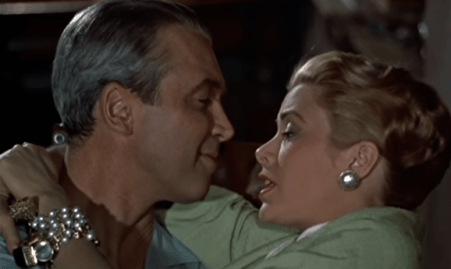
Rear Window (1954)

Classic Movie Beginner's Guide: Grace Kelly

The top tier of Hitchcock movies and it solidified Kelly and Hitch for the ages as one of the great movie partnerships. She is the quintessential “Icy Hitchcock Blonde,” cool and collected in one moment, beautiful and elegant, and yet impetuous as the stakes get higher. Despite their differences, Jimmy Stewart cannot help but fall in love with her.

The Country Girl (1954)

the country girl 4

Grace Kelly had so much poise and screen presence in all her films. But if there was ever a question of whether or not she was a “serious” actress, The Country Girl might as well dispel any doubts. She exudes a quiet dignity as she supports her husband (Bing Crosby), a soused up entertainer who unwittingly assassinates her reputation. They also starred together in the light-hearted musical High Society.

To Catch a Thief (1955)

to catch a thief 2.png

Grace Kelly and Cary Grant together are literally fireworks. The outfits are as extravagant as they are iconic. The interplay sizzles as the mystery mounts on the stunning French Riviera. A game of cat and mouse is afoot and both our leads are more than obliging in this lithe Hitchcock offering.

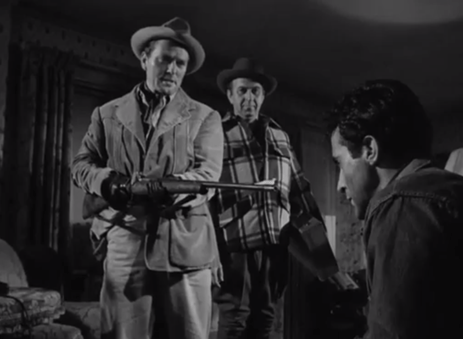
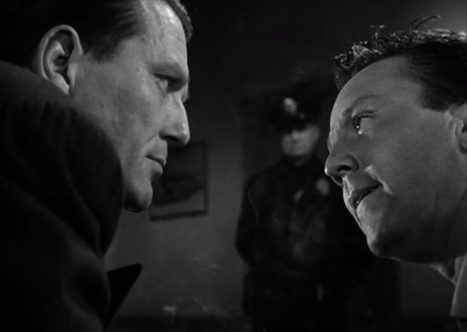
Border Incident (1949): Mann and Alton Enhanced Docu-Drama Noir

border incident 1

A voice of God with a certain newsreel ethos sets the scene. California’s Imperial Valley. An area renowned for its robust agricultural industry. The Bracero Program, that brilliant reflection of U.S.-Mexican relations during the war years and beyond. However, if this scenario sounds too simplistic and squeaky clean, it soon gets slightly more intriguing in consideration of the border.

You have illegals jumping the fence to get into the U.S. and numerous egregious perpetrators of human suffering and injustice looking to take advantage of the situation by any means possible. Indigenous Bandidos are looking to murder and pillage a la The Treasure of Sierra Madre (1948) and their savagery terrorizes the countryside. Then, there is the clandestine trafficking of labor, another real-world problem portrayed in cinematic terms.

Because Border Incident is pronounced a composite case of real life and hard facts. Like T-Men before it, the introduction leaves me rather skeptical. It does feel like reality is still being sculpted, not only for the movies but in a manner that the heroes and villains can become more easily definable.

Instead of a trail of counterfeit bills, it’s all about finding out the route of illegal transportation into the country. But regardless of my qualms, it’s extraordinary for Ricardo Montalban to get such a hefty and prominent part in a picture. There’s no question he’s the standout, at least as far as the heroes are concerned, playing a brave and charismatic Mexican agent, Pablo Rodriguez, who is tasked with uncovering the smuggling at its source. His American counterpart is American Jack Bearnes (George Murphy) who is brave but hardly as compelling.

border incident 2

There are, however, plenty of villains to fawn over as with any respectable noir. Charles McGraw is an ornery enforcer who takes no flack and pushes the impoverished Mexicans around like chattel. Being wary of the border patrol in Indio, he’s not above dumping their cargo in the Salton Sea if they have to. It’s a chilling illustration of his disreputable nature.

Jack Lambert is always game as a sneering heavy and Howard Da Silva also has a mug made for villainy. However, in this case, he’s actually a big deal — the untouchable mastermind of this entire operation — it’s the men below him who get their hands dirty.

While Rodriguez is embroiled right in the pit of the harrowing operation, befriending a sympathetic countryman named Juan Garcia (James Mitchell), it is the American agent who works from the top down; he gets an alias as a criminal on the lamb and makes contact with the big man. They look to set up a mutually beneficial business transaction, a load of visas for heaps of cash.

If the narrative structure leaves something to be desired, there’s nevertheless an impeccable framework for Mann to implement his unsentimental brand of filmmaking. In a textbook example, there’s a moment where Lamber’s fingers get crammed in a truck window — as the braceros try to flee — only to get pushed off the speeding vehicle and potentially hurtled to his death. The uncompromising imagery is only to be surpassed when a wounded border agent is squashed to smithereens by a tractor, literally dwarfing the frame. It’s this sense of suffocation even in wide open spaces.

The glorious tight angled close-ups are only one facet to the film, accentuating this sense of constraint just as the extraordinary tones of John Alton, in essence, cloak the space in a noose of supreme darkness. For a film about men trying to flee authorities crossing cultural borders, there’s hardly a better visual method of conveyance possible.

Raw Deal is still the gold standard of Anthony Mann film noir with T-Men and then Border Incident falling a rung below. Mostly because the mechanism created for the plot feel flat, and yet everything Mann and Alton touch really is dynamite, with the most gorgeous tones, equally stylistically dynamic. It’s a killer one-two punch and all business as usual for director and cinematographer.

On this front, as a merely technical and formalistic endeavor, Border Incident is superb and a darn good docu-noir. In the closing moments, Montalban gets swallowed up by quicksand, fighting for his life against adversaries, and fistfights and gunshots abound on all sides. These lightning rods of drama are appreciated.

Unfortunately, it keeps the same framework that now in present days looks more propagandistic and heavy-handed then authentic storytelling. We find ourselves with a certain rhetoric about living under the protection of two great republics and the bounty of God Almighty.

Of course, there’s no mention of the Zoot Suit Riots and the perpetration of racial violence, because that was too close to home and does not fit into a handy framework for a public service announcement storyline such as this. Instead of chalking all problems up to cold, capitalistic men in suits with greedy underlings, we must look at a social system that breeds bigotry as much as it does inequality. Admittedly, I am not one with the right answers but nonetheless, I am curious to know how we move forward from a film like this.

3.5/5 Stars


Thieves’ Highway (1949): Apple Crates and Femme Fatales

thieves highway 1

Nick Garcos (Richard Conte) makes a joyous homecoming to his parents after literally traveling the seven seas, armed with boxes of gifts to lavish upon them. In a matter of minutes, we already have a warm feeling and an affection, however cursory, for these characters we have just met.

With money to spare and a pretty girl (Barbara Lawrence) just waiting to marry him, it really does seem he doesn’t have a care in the world. However, he’s rudely awakened when he entreats his father to put on a pair of moccasins. The old man becomes dour for the first time and confesses he no longer has use of his legs.

It seems like a major reveal for the boy not to know, but it nevertheless gives traction to the forthcoming story. Mr. Garcos used to be a truck driver and yet one fateful evening, he took a load of tomatoes to San Francisco. Far from getting paid, he found himself receiving a vocal I.O.U. and getting into an accident late at night under dubious circumstances. One has to admit he’s a kindly man but a bit of a pushover.

While it doesn’t begin as a revenge story, Thieves Highway’ certainly becomes one as Nick looks to not only get his father’s money and clean up the mess left behind but also get even because its pretty obvious foul play was involved.

First things first, he looks to buy his father’s truck back, from a shifty old pro named Ed Kenny (Millard Mitchell). Instead, they wind up going into business together ready to carry the season’s first load of Golden Delicious apples to try and make a killing. With the other man’s know-how and Garcos youth and tenacity, they just might make out. Soon they’re caravanning up to San Francisco to cash out on their load. It seems simple enough, but such a journey never is.

Richard Conte fits seamlessly into this role that capitalizes on his versatility in playing both heroes and villains. Because while we can label Nick our protagonists, he exhibits violent tendencies only visible in noir films where the dividing line between good and bad is often inconsequential.

Valentina Cortese plays Rica, the hooker with a heart of gold who is initially paid $100 to lure Garcos away from his truck. If it’s totally a stereotype — she is an apple crate femme fatale if you will — then Cortese still manages to play the mixture of sensuality and genial warmth in a manner that makes us care for her as an individual. Because she gives us a couple hints, suggesting a character with more good than bad — someone who is in a tough bind, yet still out looking for goodness and love to welcome into her life.

If Rica is the embodiment of an opportunist getting their chance at redemption, Mike Figglia is pure deceitfulness. Lee J. Cobb played sour apples before but Figglia is just about as ruthless as any of his boisterous antagonists. He is a trenchant embodiment of crooked free-market industry. There is no integrity to him and even less humanity as he strives to swindle his way to one dishonest buck after another. It’s not simply survival of the fittest but the roost is literally ruled by those who have no sense of rectitude whatsoever. They absolutely relish sinking other people for their own gain.

Thieves’ Highway had its predecessors in the likes of They Drive by Night (1940), coincidentally taken from a story written by this film’s screenwriter. However, though it has its own gritty Warner Bros. elements, it’s nevertheless a studio lot entry. John Ford’s Grapes of Wrath (1940) as well, while more of a migrant story, shows us the merciless side of cutthroat capitalism.

Just to get to the marketplace takes a lot of winding roads. There are bribes stuck up tailpipes, Garcos jacks up his truck with the back of his neck, and the worst for Kinney involves his ride continuously conking out. All for the sake of a truckful of apples.

thieves highway 2

Simultaneously, two vultures (Jack Oakie and Joseph Peveney) in a truck of their own, are ravenously following Kinney as his own vehicle moans and wheezes its way toward its final destination. If time is money, he’s losing cash value fast and everyone knows it.

Still, the young newcomer has done pretty well for himself. He’s not taking any flack from Figlia, and he comes out of the shrewd operator’s office with $500 and a $34000 check. It sounds good, but it’s already a red flag. Because we know something’s going to happen to that valuable piece of paper. We just know it.

Sure enough, the story takes a devastatingly fatalistic nose dive on both Nick and Kinney’s end of the story. It’s a film literally chewing up and spitting out its protagonist.

A truck decimated. A hillside covered with busted apple crates. Then, back in the market a big fat nothing. There’s a sense of helplessness even as despondency sets in. Surely, this cannot be worth it? And yet Garcos somehow pulls himself together instead of rolling into a ball. Because he has an injustice to rail against and the perfect target is Mike Figlia.

One can quibble over whether or not it is neutralized by a slightly gushy ending — noir is certainly at its most mordant in the pits of despair — but there is still much to recommend in Thieves’ Highway.

Director Jules Dassin is one of the prominent names in post-war noir, because he made the genre not simply stylistic but imbued it with real-world grit, palpable for different reasons. Because we feel it and could see roadways and back alleys that get closer to reality than the studios ever could on their backlots.

For those familiar with the real San Francisco, Thieves’ Highway authentically embodied the robust produce industry set up within the city, detailing the area formerly adjacent to the Embarcadero, not mention more images of Oakland Produce Market.

It’s the kind of immersive imagery you can’t begin to fake in a convincing manner, and it adds another fascinating accent to this picture. Because not only is it a story with heady themes of revenge, but it’s planted in cold hard historical reality. Films at their best provide such documentation.

4/5 Stars

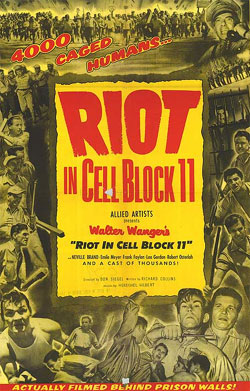
Riot in Cell Block 11 (1954): Social Commentary in The Guise of Exploitation

Riotcellblockpost.jpgIf you’re like me you met Don Siegel because of Dirty Harry (1971) or maybe The Invasion of the Body Snatchers (1956). But it was only after discovering the rest of his work — the likes of The Big Steal (1949), The Lineup (1958), or even this film, where you began to appreciate the consummate craftsman that he was.

The film makes a creative choice to set up its narrative with real-life newsreel footage of prison riots across America and this is no facsimile; it feels like the real deal. This decision begins with the initial impetus of producer Walter Wang to make a picture authentic to the plight of prisoners. Showing the inside and the inherent issues with such mass incarceration. Why would he have such a stake in telling these stories in a picture like Riot in Cell Block 11 or I Want to Live (1958)?

It’s because he actually spent a spell in prison himself after shooting his wife’s lover. That is a whole different story, but it gives us some context for the aims of this project.

Compared to Brute Force (1947) or Caged (1950), for instance, this is not simply a story of brutality at the hands of some maniacal prison guard like Hume Cronyn or Hope Emerson. Those narratives are assuredly entertaining. But for something that looks similarly exploitative, this picture decides on a more nuanced approach in a generally successful attempt at open-ended social commentary.

The warden (Emile Meyer), for instance, is a no-nonsense man but far from a tyrannical monster; he has a grim view of the prison system, knowing they are not always able to offer the best rehabilitation. He constantly strives for discipline while also harboring a certain level of sympathy for those deserving of it. He is a first-hand witness to the short-sighted effects of negligence in our justice system.

It turns out that before the days of Johnny Cash, Folsom State Prison was used as the shooting location for this film. Siegel even had the ingenuity to cast real-life prisoners as extras. I’m not sure how the logistics worked out, but the film undoubtedly benefits surrounding the already believable tough guys like Neville Brand and hulking Leo Gordon with a host of others.

The usual suspects include a skulking Alvy Moore (pre-Green Acres) and “The Colonel” who is the most learned of the inmates and helps to give them some credibility. The lives of prison guards, including Whit Bissell and Paul Frees, reflect how close the jailers get to their charges. That’s a dangerous arena and especially with the guy’s in solitary.

Without this overcrowded, undermanned system, there would be no Riot in Cell Block 11. As it is, four guards are easily overpowered and held hostage to be used as leverage against the authorities.  There’s a giddy jubilance to their trashing of the cell block that’s nearly comical, even as the stakes are far more harrowing. It proves far more than a game, with lives on either side of the wire at stake.

James V. Dunn (Brand) takes the lead, daring all others to join him and his band of cronies. Crazy Mike Carnie (Gordon) is the one who frightens everyone into line. But it is The Colonel (Robert Osterloh) who is called upon to organize their grievances to be presented. He provides a voice of reason and rationality we would be lacking otherwise.

The warden is put in an agonizing position, walking the tightrope between the prisoner demands and the outsiders coming in, including the pitiless commissioner Haskell (Frank Faylen), going all the way up to the governor. Likewise, worried spouses call his office about their husbands’ well-being as journalists (including William Schallert) look to stir up the story around the riot.

At its cores is this ideological war of treating prisoners firmly but with inherent dignity and then caging them up with the most merciless of standards to keep them in line. To show clemenscy is seen as a sign of weakness.

Inside and outside the bars, you see people with grievances and problems like any person. It humanizes everyone, in a sense, going beyond mere exploitative drama. It somehow wears a fairly convincing cloak of authenticity while still remaining pulse-pounding stuff. Because I’ve seen prison riots captured on film before but to my knowledge, there’s never been anything so enveloping and tumultuous on all fronts.

Keeping with Wang’s agenda, the film does not pull any punches as it slinks back into the status quo. There is tragedy, there is victory, and finally, there is a feeling of powerlessness in the face of bureaucracy. It’s as if a man’s word stands for nothing. It’s as if this whole ordeal was entirely pointless.  The finale is as eye-opening as it is pessimistic. But movies have a license to do that. It makes them a lot more lifelike.

4/5 Stars

Armored Car Robbery (1950): Wrigley Field L.A. Noir

armored car robbery 1

Armored Car Robbery instantly had my rapt attention in part because of its location shooting and due to one place in particular. We start out at L.A. City Hall and soon a shooting and a robbery are being called in from nearby Wrigley Field, which sends Lt. Cordell (Charles McGraw) and his partner out to respond.

It proves to be a false alarm but the setting alone might throw some contemporary audiences for a loop. After all, Wrigley Field is synonymous with the ivy-laden bricks of Chicago, not Los Angeles.

Except L.A. enthusiasts might know that the area once held a Wrigley Field of its own, formerly the home of the original Los Angeles Angels expansion team in 1961. It also served as the backdrop in many classics including Meet John Doe and Pride of the Yankees. Added to that list is Armored Car Robbery, although it only uses a facade of the stadium, which could just have easily been a studio set.

Aside from always being fascinated by time capsule moments — Wrigley Field was all but demolished in 1963 — I had always heard talk of my Grandma growing up down the street in Los Angeles. She was born in L.A. County and her family ran a grocery store in the area. I don’t have much of a picture of that world and so even a brief image like the one provided here gives me a glimpse into yesteryear. But I digress.

Richard Fleischer’s heist noir is an obvious precursor to The Killing for its stadium locale and the ever necessary complications that begin to present themselves in due time. What good is a heist if it doesn’t go completely haywire?

Because of its limited time, Armored Car Robbery spends minutes on the preparations and the actual execution of the job. But the trick is, it’s all so efficient, we are never allowed time to get bored by the usual rhythms. Still, all the information is there for us to be brought into the crime.

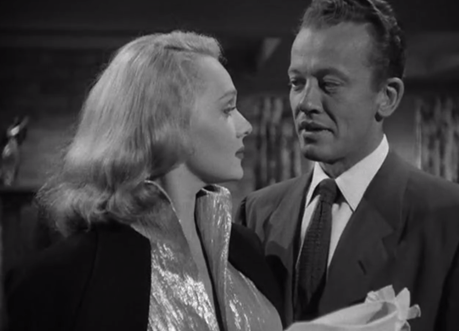
Generally known as defense attorney Hamilton Burger on Perry Mason,  William Talman gives a far more insidious turn as a meticulous criminal obsessive about keeping a low profile and tying up every loose end so he can pull off the perfect crime. What’s more, he’s secretly got a bite on his accomplice’s girl, a heartlessly opportunistic blonde bombshell (Adele Jergens).

By night she’s got the entire male populous ogling. By day, she’s looking pretty, hanging around the bar, and getting miffed with her husband (Douglas Fowley), who can’t seem to make any dough. Hence her convenient extramarital operations. Dave Purvis is the man for her, taking charge of two other thugs as they set their sights on $200,000 of cold hard cash.

armored car robbery 2.png

But there’s always a slip-up. There can hardly be a heist genre without the wrench that causes everything to hurtle out of control. As it turns out, Lt. Cordell (Charles McGraw) and his partner are on the beat, responding to the subsequent distress call at Wrigley immediately. The culprits aren’t expecting it, and the ensuing shootout leaves one of the officer’s dead in the line of duty and one of the gangsters badly injured. Soon the alarm has been raised with roadblocks set out everywhere and the police force on high alert for the four fugitives.

For the rest of the film, Cordell must live with this galling injustice, stewing day and night in his own distraughtness and copious amounts of lukewarm coffee. First, jaded by the untimely murder of his partner and then saddled with a wet-behind-the-ears replacement (Don McGuire). Although the new recruit nevertheless proves to have a certain amount of gumption when it counts.

The film employs a low-budget airport terminal ending — one of the few times it lets slip its meager means — but the film goes for the narrative jugular. We see precursors to the likes of The Big Combo, The Killing, and even Bullitt. On multiple occasions, it’s not at all squeamish about letting the bullets fly and the death toll rises as a result. And it’s this disregard for the sanctity of life that gives the narrative real heft. No one is protected and there we have grounds for a thrilling drama.

These kinds of stories are awesome pulp classics with a stripped-down punchiness that’s instantly gratifying. RKO was such a wonderful studio in this regard for giving us such raw delights. They don’t make them like this anymore.  We waste too much time.

While not completely related, one should note RKO is the only of the major classic studios that completely folded. Those were the good old days. But all good things must come to an end. Wrigley got demolished. Actors die. Studios close down. That’s why cinematic memorials are often so important. They allow us to journey back into the past.

4/5 Stars

Classic Movie Beginner’s Guide: Cary Grant

It’s that time again to profile a classic Hollywood star by briefly looking at 4 of their films. Today’s centerpiece is Archibald Leach more commonly remembered as Cary Grant, the suave, debonair, screwball extraordinaire who groomed himself into one of Hollywood’s preeminent leading men.

Philadelphia Story (1940)

Image result for the philadelphia story

He’s rude and obnoxious and yet something about him makes it hard for Katharine Hepburn to say no to her old beau even as he tries to scandalize her latest marriage. The dynamics between Grant, Hepburn, and Stewart are what you dream for with such a pairing. While you’re at it, Bringing Up Baby is a must.

His Girl Friday (1940)

Image result for his girl friday 1940

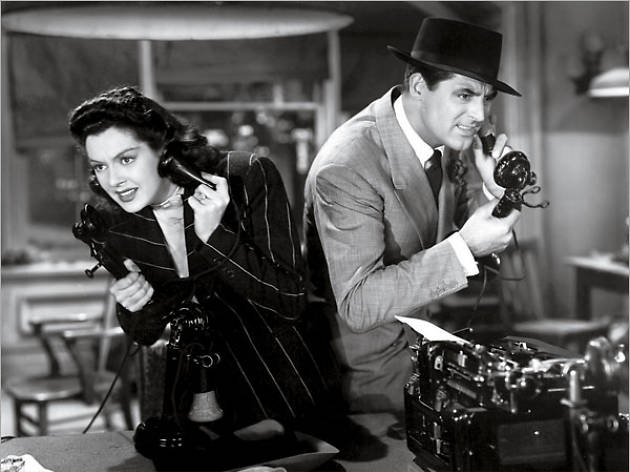
This is a true Cary Grant tour de force as he whizzes through the newsroom sparring with his old matrimonial partner in crime Rosalind Russell. Their verbal jousts are truly frenetic poetry, and the turbulence they churn up is some of the best conflict any screwball comedy was ever blessed with. The Awful Truth and The Favorite Wife with Irene Dunne are swell as well.

Notorious (1946)

Image result for notorious 1946

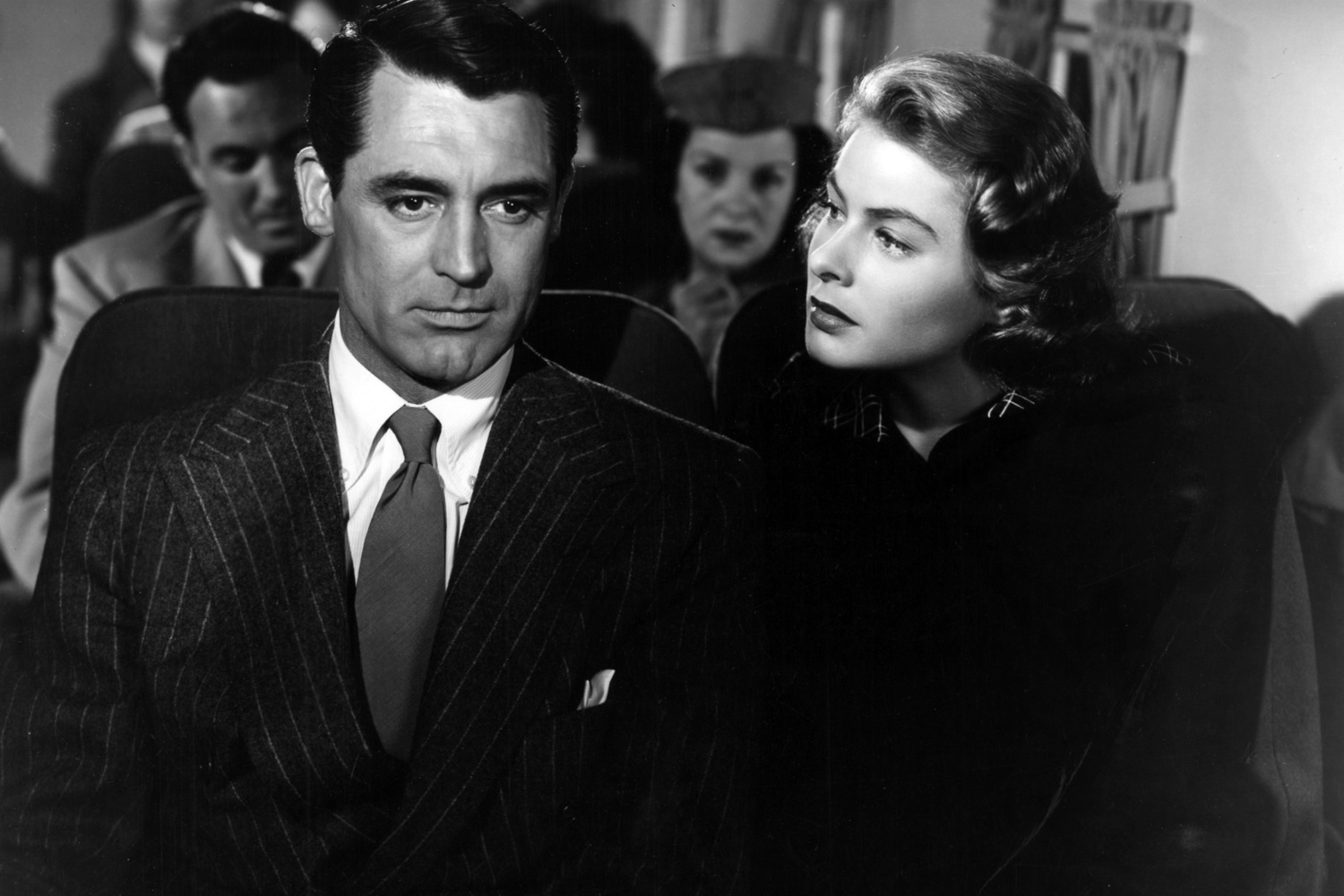
He’s always a bit of a debonair or lovable cad. In this one there’s no pretense. As the callous government agent Devlin, he makes Ingrid Bergman cry. This total revision of his persona is powerful, and it would lay the groundwork for one of the great Hitchcock movies. Not only that, their amorous kiss fest would slyly obliterate Hollywood convention.

North By Northwest (1959)

Image result for north by northwest

What makes him so great in North By Northwest is how ordinary and amicable his Roger Thornhill is only to be thrown pell-mell into a cross-country murder plot. The advertising exec finds himself fleeing from the authorities and the perpetrators in this delightful man-on-the-run pulse-pounder.

Worth Watching:

Holiday, Only Angels Have Wings, Gunga Din, Suspicion, Talk of The Town, The Bishop’s Wife, People Will Talk, To Catch a Thief, An Affair to Remember, Indiscreet, Charade, and many more!

4 Living Legends Part 6

Here is another entry in our ongoing series of Classic Hollywood Stars who are still with us. Please enjoy their many talents!

Peggy Dow (1928-)

Peggy Dow is most well-remembered for her enchanting turn as a nurse opposite Jimmy Stewart’s disarming Elwood P. Dowd in Harvey. In later life, she’s been a prominent philanthropist. She also appeared in a few lesser-known pictures including Woman in Hiding (1950), I Want You (1951), and Bright Victory (1951) worth it for classic film aficionados.

Nancy Olson (1928-)

If you’re like me, Nancy Olson stands out for two landmark films from two completely opposite ends of the spectrum. The first one is the incomparable Sunset Blvd (1950) where she played opposite William Holden. The other is that preeminent childhood classic, The Absent-Minded Professor (1961) with Fred MacMurray. I also really enjoyed her in Union Station (1950).

Ann Blyth (1928-)

Ann Blyth was in a wide variety of pictures running the gamut of musical and drama, but if she’s remembered for one film, it’s certainly her sweltering turn as the vindictive Veda in Mildred Pierce (1945). When Joan Crawford slaps her across the face, it’s the climactic moment in one of the most terrifying mother-daughter relationships ever. I’m sure she’s lovely in real life!

Jane Powell (1929-)

What a lovely performer Jane Powell is and she brightens up the frames of many a musical with her multi-talented effervescence. Some personal highlights in her career include Royal Wedding (1951) with Fred Astaire and, of course, the wonderful Seven Brides for Seven Brothers (1954).

The Curse of The Cat People (1944): The Oddest of Horror Sequels

800px-Curse_of_the_Cat_People_lobby_card.jpgThe Curse of the Cat People feels like entering a storybook only to find ourselves in Tarry Town near Sleepy Hollow. Fittingly, we are placed with a group of kindergarteners who have come with their teacher to frolic and enjoy a field trip to the place brought to life in the tall tales of Washington Irving.

Immediately, this latest Val Lewton production plays to its greatest strengths by melding folk tale, supernatural sensibilities with bits and pieces of our world. The medium through which the picture chooses to work is a little girl named Amy (Ann Carter). She’s a serial daydreamer with her big doe eyes constantly glowing with light. One moment she’s infatuated with a butterfly and an overeager boy obliterates it in his attempts to catch it for her. She proceeds to rear back and slap him across the face.

It’s only her way but the other kids see her as odd and aloof. She’s not like them. With its opening premise in place, it’s safe to say The Curse of the Cat People is one of the strangest sequels for the very fact it has a decent amount to do with its predecessor and yet feels as if we have literally been transposed to a different cinematic world. Also, the name is an utter misnomer.

We have an offshoot taking the basic characters and settings from its predecessor while foregoing normal horror beats for a stranger set of psychological and adolescent themes. It might as well be an entirely standalone film with the urban working environment being replaced with a rural suburbia.

Now our hero from Cat People (1942), Oliver Reed (Kent Smith), has settled down with his wife Alice (Jane Randolph) and his little girl, but parenthood has made him a bit testy. Given the powers previously wreaking havoc on his life, perhaps it’s warranted. He wants to shield Amy from his deceased wife’s fate at any cost. 

But if we look at their current domestic life, it’s fairly sterilized in a way that might quickly become sickening to watch. They go by their three names: “Daddy,” “Mommy,” and “Darling” while their able-bodied, eloquent servant Edward (Sir Lancelot) keeps house. However, this very veneer is set in sharp juxtaposition with forces far more volatile and unnerving — at least at first.

Amy begins to have arcane experiences with the old Farren House where a cantankerous matron resides with her brooding, spectral-like daughter. So if we want to get technical, the movie is really about two families: One seemingly perfect, the other accursed.

On one such visit, Mrs. Farren grips the little girl with the local myths. The recounting of the Legend of Sleepy Hollow all but sweeps us up in a moment of pulse-pounding vigor, in spite of taking place entirely in a single drawing-room. Something about it is so alive and deeply unsettling.

As a defense mechanism, Amy calls out to a phantom who comforts her. We’ve all had invisible companions at one time or another so it’s not a strange request. However, her friend feels far more tangible than any of ours.

Of course, it’s Irena (Simone Simon) the woman her father has never dared tell her about. Besides, Irena is dead. As her parents worry about her mental stability, Amy is comforted by having Irena as a confidante. 

Life continues cheerfully enough. On Christmas, all the most important people in her life get a present. Carolers come by and begin an impromptu chorus of, “Shepherds Shake Off Your Drowsy Sleep.” Mommy reminisces about her memories putting on “mummers plays.”

We expect something darkly twisted to invade this holiday conviviality and yet it never comes. What was initially exploited is childish fancy intertwining with this supernatural entity. But everything gives way to a heart-aching sincerity. We come in expecting one twist, and we get an almost anti-twist in its place. Instead of being haunted by demons and cursed things, a young girl makes friends and finds a way to heal wounds through a firm embrace. It turns out this could be an offbeat Christmas classic in some circles. 

The picture strikes this curious tone between obvious markers. Though it makes it maddening to try and categorize — especially for contemporary advertisers — now it plays more like a blessing than a curse. Because we expect something mundane and one dimensional, only to get a surprisingly inventive exploration of childhood and imagination. While we never quite forget we have a minor production on our hands, this Val Lewton-produced effort continues his run of beguiling material.

Taken as a body of work, Lewton’s pictures are bewitching to the very last frame. A young up-and-comer, Robert Wise, would also be called upon to complete the picture. It’s probably an understatement to say it was a humble beginning to an auspicious career. 

3.5/5 Stars

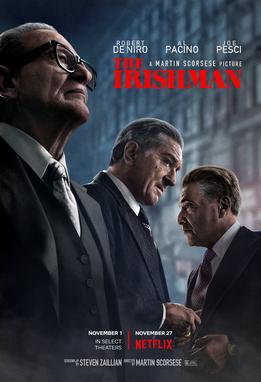
The Irishman (2019): Painting Houses Between a Rock and a Hard Place

The_Irishman_poster.jpgNOTE: I’m never too concerned about spoilers but just be warned I’m talking about The Irishman, which will come out in November. If you want to be surprised maybe wait to read this…

The opening moments caused an almost immediate smile of recognition to come over my face. There it is. An intricate tracking shot taking us down the hallway to the tune of “In The Still of The Night.” We know this world well.

Martin Scorsese does too. Because it’s an instant tie to Goodfellas. In some sense, we are being brought back into that world. Except you might say that The Irishman picked up where the other film left off, filling up its own space, coming to terms with different themes. This is no repeat.

A day ago if badgered about the film I would have said it’s about a hitman named Frank Sheeran (Robert De Niro) who had ties with the Buffalino crime family (Joe Pesci) and worked alongside Jimmy Hoffa (Al Pacino). The famed union teamster disappeared without a trace, only to become one of the most mythical unsolved cases of all time.

And yes, I had to take a few moments to get used to a de-aged Robert De Niro, although I think it might have been the blue “Irish” eyes, so I quickly accepted it and fell into the story. On a surface level, these are the initially apparent attributes. However, it’s a joy to acknowledge it’s so much more. Because all the greatest films offer something very unique unto themselves — and to their creators — in this case the world of organized crime.

We’re so used to having Scorsese and De Niro together; it’s staggering to believe their last collaboration was Casino (1995). Meanwhile, Joe Pesci came out of his near-decade of retirement to join with De Niro again and continue their own substantial screen partnership together. Some might be equally surprised to stretch their memories and realize Pacino and Scorsese have never worked together. Both have such deep ties to the American New Wave and the crime genre. The pedigree is well-deserved on all accounts.

But there’s something ranging even deeper and more elemental, resonating with us as an audience. This is not Sunday school truth but a type of hazy mythology with flawed titans going at it in a manner that feels almost bizarre. There are no pretenses here. If you are familiar with Scorsese’s work from Mean Streets to Goodfellas, this is an equally violent and profane work. And yet how is it we begin to care about characters so much that their relationships begin to carry weight? Especially over 3 and a half hours.

It is a monumental epic and that opening tracking shot I mentioned leads us to a white-haired, wheelchair-bound man who has seen so much over the course of his lifetime. Voiceover has a hallowed place in the picture akin to Goodfellas, but again, the man at the center of it all has such a different place in the story.

What’s more, The Irishman really is a full-bodied meditation on this lifestyle of organized crime. Yes, it’s placed in a historical context, but Sheeran is a man we can look at and analyze. He is a sort of case study to try and untangle the complexities of such an environment.

Steven Zaillian’s script lithely jumps all over a lifetime woven through the fabric of popular history, aided further by the music selections of Robbie Robertson (of The Band acclaim) and real-life touchstones ranging from the Bay of Pigs, the Kennedy Assassination, Nixon, and Watergate.

Thelma Schoonmaker makes the action accessible and smooth with ample artistic flourishes to grapple with the societal tensions and cold, harsh realities. Still, the majority of the picture is all about relationships. Everything else converges on them.

Sheeran didn’t know it then, but the day he met Russell Bulfino (Pesci) on his meat trucking route, would be the beginning of a beautiful friendship. Because he’s a man with clout and connections. Everyone comes to him, he expects other people to pay deference to him, and he looks kindly on those who carry out his favors.

In his company, Sheeran has a formidable ally, and he starts rising up the ranks even running in the same circles of the acclaimed Jimmy Hoffa. Being “brothers” as it were, it’s as if Sheeran and Hoffa understand one another intuitively and in a cutthroat world, they have a deep-seated, inalienable trust in one another.  Who is the man Hoffa comes to have in his room to be his friend, confidant, and bodyguard if not Frank? You can’t help but get close to someone in that context.

Al Pacino just about steals the show blowing through the film with a phenomenally rich characterization of the famed teamster, because he willfully gives a tableau of charm, charisma, warmth, humor, mingled with a ruthless streak and utter obstinacy. His loyalists are many as are his enemies. It’s facile to be a mover and a shaker when you’re an immovable force of nature.

Even as Sheeran is busy, mainly on the road, his first wife and his kids (and then his second wife) are always present and yet somehow they never get much of a mention, rarely a line of dialogue, always in the periphery. This in itself is a statement about his family life.

One recalls The Godfather mentality. Where family is important but so is the family business and never the twain shall meet. Womenfolk and children are protected, shielded even, and the dichotomy is so severe it’s alarming.

In that film, the cafe moment is where Michael (a younger Pacino) makes a life-altering decision. For Frank, that mentality somehow comes easily for him. Michael was the war hero and thus stayed out of the family business for a time. Frank’s involvement in “painting houses,” as the euphemism goes, is just an obvious extension of the killing he undertook in Europe.

It’s curious how everyone mentions his military experience, the fact that he knows what it’s like, and how that somehow makes what he’s called to do second-nature. Again, it’s business. It’s following orders. If you do a good job, if you do the “right thing,” you get rewarded.

There are some many blow-ups and hits and what-have-yous, it wears on you to the point of desensitization, especially when you’re forced to laugh it off uneasily. This is very dangerous but again, it’s anti-Godfather, which was a film where these were the moments of true climax and meaning and import for the psychology of the characters. Where Michael evolves and takes over the territory. Where his older brother Sonny is killed and his other brother Fredo gets killed. There’s meaning in every one of them.

In the Irishman, it could care less. Everything of true importance seems to happen around conversations, in dialogue, between people. To a degree that is. Because dynamics are set up in such a way and the culture and the unyielding ways of men make it inevitable, opposing forces will rub up against one another.

The complicated realms of masculinity, pride, and respect make minor tiffs and bruised egos the basis of future gang wars and vendettas. Phone calls are testy and people are pulled aside to get straightened out before more serious action is taken. It’s a social hierarchy where go-betweens come to mediate everything.

As time goes on, we come to realize Sheeran is the wedge bewteen two of these unyielding forces, and he’s caught between a rock and a hard place. Between his “Rabbi” Russell, as Hoffa calls him, and the man he’s been through the trenches with — the man he asks to present his lifetime achievement award to him. He’s deeply loyal and beholden to both.

Is this his hamartia — his fatal flaw — that will become his undoing? We never quite know if he was able to make peace with any of it. All we know is something has to give…But I will leave it at that.

The unsung surprise of the film is the load of humor it manages end to end. Everyone is funny. The exchanges get outrageous to fit the larger-than-life characters and situations. It’s the kind of stuff you couldn’t make up if you tried. But the jokes play as a fine counterpoint to the grim reality of these men and their lifestyles.

In the later stages of life, as he prepares himself for death, Sheeran meets with a priest, which prove to be some of the most enlightening moments in the film. When asked if he has remorse, he matter-of-factly admits, not really, but even his choice to seek absolution is his attempt at something.

Scorsese continues in the stripe of Silence with some deeply spiritual and philosophical intercessions in what might otherwise seem a temporal and antithetical affair.  The truth is you cannot come to terms with such a life — or any life — without grappling with the questions of the great unknown after death.

In another scene, Sheeran seeks out a casket and a resting place for his body muttering to himself just how final death is. That it’s just the end. It’s curious coming from a man who knocked off so many people, but somehow he’s just coming to terms with it himself. Perhaps it’s what old age does to one.

This is not meant to be any sort of hint or indication (we want more films), but if this were to be the last film this group of luminary talents ever made, I would be all but content. The film taps into content and themes that have been integral aspects of Martin Scorsese’s career since the beginning. Al Pacino, Robert De Niro, Joe Pesci, and even Harvey Keitel are all synonymous with the crime film — they share a common thread — a communal cinematic context and language.

My final thought is only this. The Irishman feels like Martin Scorsese’s Citizen Kane. I don’t mean it in the sense it’s his greatest film or the greatest film of all time. Rather, in a thematic sense, they are kindred. Although Scorsese’s version includes crime and violence, the ends results are very much the same.

You have a man with a life crammed full of power and money and recognition, whatever, but at the end of the day, what did it get him? He clings to dog-eared photos of his kids whom he probably hasn’t seen in years.

When the priest tells him he’ll be back after Christmas, Sheeran looks up at him pitifully, acknowledging he’ll be around. He’s not going anywhere. He has no family. He has no one to care about him. All his buddies are gone, and he’s the last of them holding onto secrets that do him no good. It’s all meaningless.

It’s a striking final image. All I could think was, “Oh, how the mighty have fallen.” Whether or not any of it was true (as the film seems to validate), what’s leftover is a paltry life. It’s a testament to everything we’ve witnessed thus far that we feel sorry for him.

4.5/5 Stars

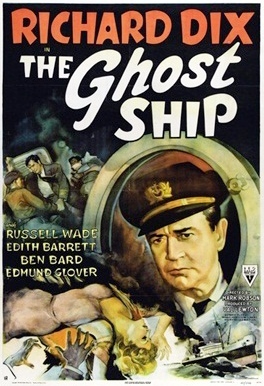
The Ghost Ship (1943): Creaky Yet Atmospheric

Ghostship.jpg“What a hobby to pick: authority.” 

The Ghost Ship is yet another serving of shadows and sound courtesy of legendary cinematographer Nicholas Musuraca and former editor-turned-director Mark Robson. However, the film is punctuated by few dramatic notes and instead settles in to develop a world of continual foreboding. It begins with the near-ESP of a blind street peddler who warns a youthful 3rd officer (Russell Wade) about the new ship he is about to board.

Though our lead actors are fairly bland types — the kind of people who could easily be slotted into any number of similar projects — I still found myself interested in them. Because with both Richard Dix and Wade I hardly have any history with them; it’s a tabula rasa. They remain as a reminder of how many actors and actresses are all but lost to time just waiting to be discovered anew. Some give a more lasting impression than others.

But Ghost Ship‘s most intriguing characters are certainly the shipmates because each man has an element to his performance. Sparks (Edmund Glover) is probably the most affable and the closest thing to a friend the new 3rd officer has onboard. Beyond this, the radioman sprinkles in some Latin with his normal vernacular.

Our next person of interest is an all-seeing mute who is nevertheless given the courtesy of a voiceover. He is the first among seafaring hands aboard, including Boats (Dewey Robinson, a Preston Sturges regular), the calypso-singer (Sir Lancelot), and the Greek who needs his appendix taken out mid-voyage. This is a whole ordeal in its own right.

But none of this gets at the reason the Altair just might be one of the most perturbing seas vessels in the annals of maritime movies. It should be noted the previous third officer died under unusual circumstances and rather dubiously, Mr. Merriam is occupying the same room the deceased man passed away in. Another old mate is found dead on the deck without much fanfare.

There were flying coffins during WWII, but this is a floating coffin if there ever was one. Its all very curious because The Skipper seems a good, honest seaman. His new mate likes him and the men — though at times disgruntled — listen to him, for the good of the outfit.

One particularly perilous event involves a loose hook on the bridge all but ready to decapitate a mate. Still, as time progresses, the captain’s words get more and more troubling. Without blinking an eye, he says, “I have rights over their lives – I have the right to do anything for the crew – because their lives depend on me.”

He is drunk on authority. It remains his only concern, and he will do anything to maintain his image, even fabricating events involving the aforementioned appendix operation. He can raise people from the brink of death while a cascading stack of clinking chains quickly means the demise of another man. No one can prove it outright, but the captain literally holds everyone’s life in his hands.

The third officer wants no part of this scenario. However, it seems fate brings him back into the clutches of this dictatorial madman, and the net is slowly contracting around him. Only time will tell if he is stopped in his tracks before knocking off another defenseless victim.

Obviously, given the time period, we can have a guess at the allegorical references toward the crazed power hunger of Hitler. It’s not difficult to see the parallels, but I don’t think we need much of a reminder such slavish devotion is detrimental. In this regard, such a pronouncement seems altogether superfluous.

The plot is also a bit stagnant and our leads admittedly bland. We are reminded of not only wartime shortages but that these are far from A-list talents on hand. In spite of these admissions, it’s all the more astounding to consider the impression this Lewton production still manages to provide.

The bottom line is that the ideas and the visuals are still worth remembering. Because Ghost Ship is not completely derailed by its shortcomings, still casting a fine vision lingering ominously over every frame.

3/5 Stars