House on Haunted Hill (1959)

house on haunted hill 2.png

The finest compliment I can extend to House on Haunted Hill is how it manages to exemplify many of the tropes we have come to imagine in old horror movies of yore even without having seen one. Because the hallmarks of the genre, by some curious form of cultural osmosis, have been passed down through the generations. Rather than a blank slate, an entire history of preconceived notions serves you well since many of us do not have the benefit of the former.

Much like Psycho (1060), we have some vague sense of what we have consigned ourselves too before we’ve begun. In fact, the low budget success of director William Castle’s picture is said to be behind Hitchcock’s own impetus to make a low budget horror flick. It, of course, paid absurd dividends at the box office. But now for House on Haunted Hill which proved successful in its own right.

In the very nature of its quintessential campiness, this haunted mansion seems to have just about everything. We are met with shrieking screams in the night and for someone like me who partook through in-home viewing, we have to use our imaginations in order to fully appreciate what a pitch black theater and surround sound would do to the nerves.

Because House on Haunted Hill is very much about a created atmosphere both architecturally with the facade of the house in exterior shots and then interiors which though obviously shot on sound stages, develop the ever-present eeriness handily. The soundtrack as well is an integral component with creaking doors, the liberal use of the theremin, and of course, a blood-curdling scream sprinkled throughout every now and again.

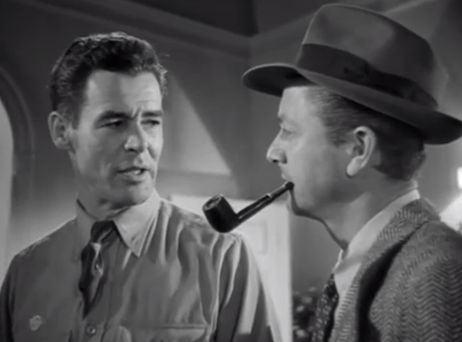
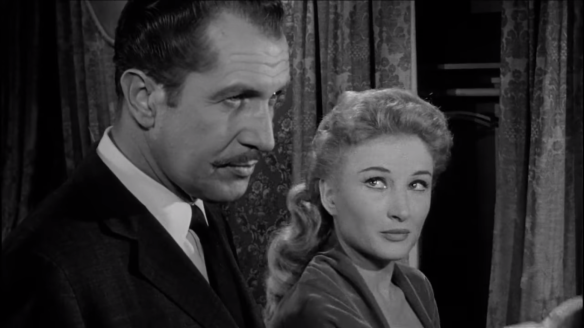
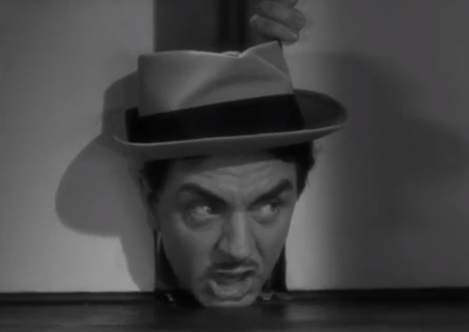
Our first introduction comes in the form of the disembodied heads of first Elisha Cook Jr. and then our host. While the memorably flighty actor preaches a message of spooky legends, Mr. Vincent Price comes in to recount how he and his wife decided to throw a little spend the night ghost party.

With the trademark condescending lilt of his voice, he introduces his guests and blandly acknowledges how amusing his wife, Mrs. Loren, is for planning such an affair. However, it really does seem like he had a major hand in it, providing an incentive to each guest of $10,000 apiece if only they manage to stay in the building alive through the night.

Whereas his wife Annabelle (Anna Ohmart) seems generally lukewarm about the gathering, he seems strangely obsessed with it. A bedroom encounter sets up just how dysfunctional their relationship is hinging on dueling strains of jealousy and avarice. What makes it delightful is the playful threats embedded in their jousting. They are cajoling each other constantly but there’s also something sinister lingering behind their words.

house on haunted hill.png

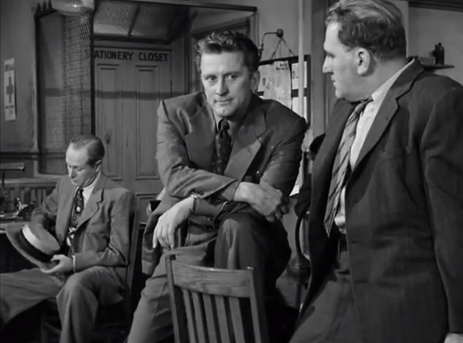
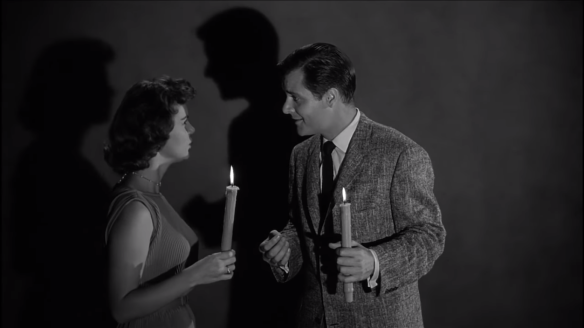
The guests themselves are wide-ranging. Watson Prichard is called upon to make the festivities more chilling. The rest of the continent include a dashing airline pilot (Richard Long), a distinguished psychologist (Alan Young), a local newspaper columnist (Julie Mitchum), and lastly a young secretary (Carolyn Craig) employed in Mr. Loren’s company. What ties them all together is their desperate need for cash even if some veil their intentions behind personal preoccupations.

Their welcome is hardly cordially as they let themselves in and have a moment to get acquainted and get accustomed to their surroundings — hardly a place of gaiety and warmth. Finally, Mr. Loren makes his entrance. By now, we know his relationship with the missus is a troubled one but that is privileged information.

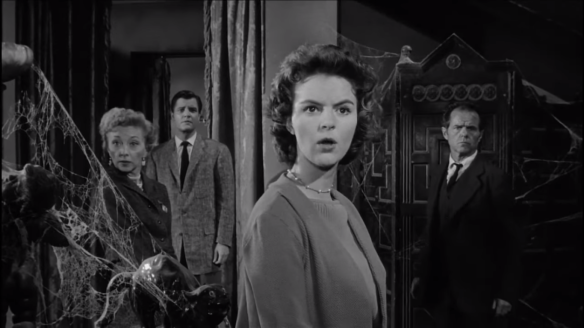
For the time being, he leads the guests on a tour of his recently acquired property as Prichard recounts tall tales of severed heads of his ancestors among other legends. Ceilings dripping blood and a basement complete with a trapdoor leading to a vat of acid are two of the most harrowing attractions.

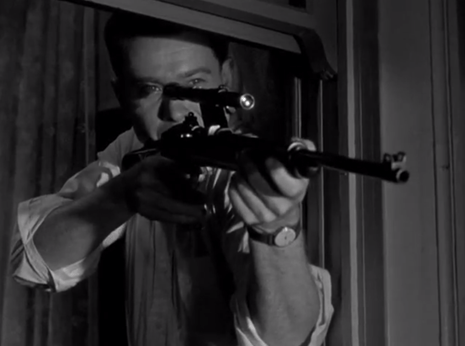
But Mr. Loren relishes to make the occasion interesting and after his wife makes a stunning appearance he passes out the party favors — in the form of handguns.  They aren’t much use against spirits so one must gather they are to fend off humans. It’s a startling twist to the proceedings though he doesn’t give much explanation for such a deadly gift.

Everyone decides to lock themselves away in their rooms. Easy enough right? Wrong. Because Ms. Nora Manning seems especially susceptible to scares at the hands of horrible creatures lingering in the shadows. They frighten her out of her wits and she races around looking for some friendly face. Only time will tell what other hideous unspeakable acts she will witness.

house on haunted hill 3.png

But House on Haunted Hill has far more human origins than we might initially suspect. It’s not just a pop out at you scary movie. Though the atmospherics are a large part of the allure, there is also an underlying motive to all we see. It provides a crucial tie back to the real world and the people assembled.

So, in the end, it works best blurring genre lines between mystery, ghost story, and a tale of murder. It’s served by elements akin to Diabolique (1955) as much The Spiral Staircase (1946) though admittedly catering to the B-grade crowd. Mind you, that’s not meant to be an insult because in its own right House on Haunted Hill is a ghoulish delight.

Although I have to admit I couldn’t help but smirk when Vincent Price’s skeleton came alive again, it is soon tied back to something rational we can comprehend. The movie plays all these pieces as parlor tricks as much as supernatural acts. And this melding makes the dividing line between the two blurry. It could be everything Watson Prichard spouted was the truth. Then, again, it’s not hard to believe everything was a fabrication utilized solely for human gain. Because everyone in this picture wants something. This is important.

As per usual, it’s hardly difficult despising Vincent Price’s characters. However, in some paradoxical way we like him for the sardonic edge. Because he holds undying scorn for just about everyone. It’s so very easy for him to turn into a parody of himself but then again in a genre such as horror so often prone to parody, it rather works to his advantage.

3.5/5 Stars

Love Crazy (1941)

love crazy 1.png

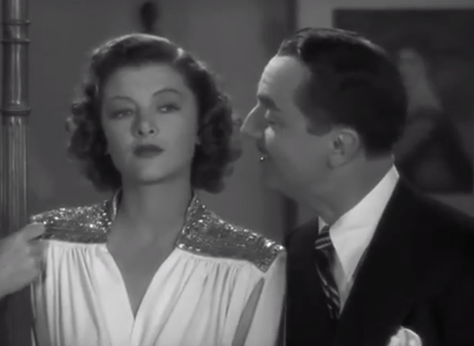
Love Crazy puts William Powell and Myrna Loy in their wheelhouse as the lithe and sprightly romantic partners placed at the center of this screwball comedy.  Steve Ireland (Powell) is in a terribly good mood getting home in his taxi singing ditties as he makes his way up to surprise his wife Susan on their wedding anniversary.

All of which is an encouraging change of pace because Hollywood often made the nagging of marriage look like a real ball and chain. For once that’s not the case. They want a romantic second honeymoon full of dancing, escapades, and a dinner served backward. It’s the fact that he can never get enough time with his wife to suit either of them. Well, there you have the film in a nutshell anyway.

Except storytelling 101 tips us off that the film will have to begin swinging like a pendulum in such a way that both our lovebirds in this connubial comedy will no longer be so inseparable. The main instigators prove to be his overbearing mother-in-law who inserts herself into all their plans. The other is a former flame, Gail Patrick at the most delightful I’ve never known her to be, who playfully cajoles him to have some fun. She’s married but acts as if she’s still single and ready to mingle.

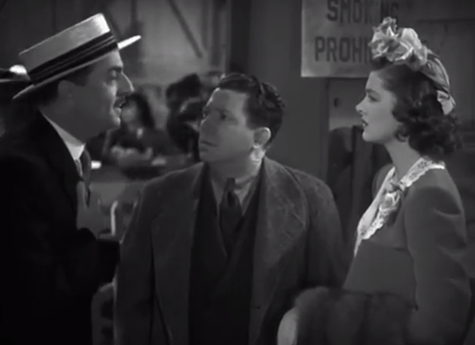
You would think he already had more excitement than he could take getting trapped in the elevator shaft with this frisky female and the elevator boy (Elisha Cook Jr.). Proving I’m no comic snob, I heartily enjoyed watching Powell’s head get clunked around. It’s a resoundingly hilarious image.

love crazy 2

However, he forgot about who was waiting for him back home. It’s the lesser of two evils to sneak out for a drink with Isobel and while his wife has to step out he uses his worst possible lifeline to get away from his aggravating mother-in-law. It doesn’t take too much for the root of doubt to sneak up and it only gets worse when Ward Willoughby (Jack Carson) is introduced as a studly archer in an undershirt. What else? Now both spouses have someone to be jealous of.

It hearkens back to the days where the sitcom hadn’t been invented yet because we didn’t have TV so instead, there were films like this which function around all the most cringe-worthy bits of comedic irony, namely mistaken identity and all sorts of misunderstandings. But like its predecessor from the year prior, I Love You Again, the steam slowly begins to evaporate off about midway through.

Because the main subplot becomes the whole plot in a way that provides some gags but on the whole feels tired and worn out. I want to see Powell and Loy together or at least more of Patrick and Carson who actually bring a lot of comedic chops to the picture. In fact, one of the more hilarious wrinkles involves Powell getting the other man interned at the sanitarium only to have him escape later. But it means very little to the integrity of the story. That’s part of what makes it so enjoyable.

Otherwise, Powell plays up his insanity to string along his wife so she can’t divorce him. His main showcase is at a party where he emancipates a fleet of hats trying to play up his looney side, followed thereafter by a string of other coincidental mishaps. His wife knows it’s a game but the man he’s christened “General Electric Whiskers,” who he met at the party, is actually a doctor who thinks he’s very sick indeed.

This all feels like fairly uninteresting fluff. Meanwhile, the film’s finale relies on another bout of concealed identity but to its credit, it circles back on the things that made it laudable before, entering back into the apartment complex. There the chaos of all those individuals from earlier is heightened in close proximity with a supposed crazy man on the loose and the police after him. They are aided by Willoughby and Steve is helped first by Isobel and then his wife.

But the crowning piece of comedy has to do with Powell’s ultimate masquerade as he even sacrifices his beloved pencil-thin mustache for the sake of it all. While not particularly inspired by today’s standards, Love Crazy boasts Powell and Loy in as fine a form as ever. That is enough to enjoy the picture even in its middling moments.

3.5/5 Stars

I Love You Again (1940)

i love you again 1.png

The film’s plotline can be summed up by amnesia. A no-fun businessman named Larry Wilson who drinks nothing harder than grape juice is conked on the head while saving a drunk who went overboard. Poof! Just like that Larry is no longer and he becomes his presumed former self — the suave alter ego — George Carey. If you’re willing to buy into the premise and not ask too many clarifying questions, it’s quite easy to enjoy the inevitable wacky ride ahead of us.

I even got the inkling that it was going to be a funnier version of Random Harvest (1942). Really it’s part of that esteemed screwball subset — the comedy of remarriage. Carey heads back home with his newfound pal and fellow grifter Doc (Frank McHugh) to scope out his past life and do his best to be the man he is supposed to be with humorous complications. You see they don’t realize he’s a married man until his wife comes to meet them at the gangplank. Well, actually he’s a soon to be a divorced man. Hence the marital conflict perfectly positioned for ensuing comedic fodder.

The main wrinkle and ultimately what makes it so different is that Powell and Loy are at separate poles in this film by necessity. All throughout The Thin Man pictures, they’re in perfect cadence and that’s what makes their chemistry and the onscreen marriage work.

Here Powell is a charming man with a twinkle in his eye like always — but his wife is expecting the same boring schmuck she married all those years before. She’s coming at this man from a different point of view and boy is she surprised with what she gets. In one way, annoyed because he makes it infinitely more difficult for her to let him go but then thankful because he is the precise man she always dreamed was right in front of her.

i love you again 2.png

In this way, I Love You Again is actually a fairly personable romance beyond its simple roots in screwball comedy. There’s almost a bit of depth there if we dare admit it but of course, that doesn’t take away from the underlining laughs most especially offered up by Powell.

He’s not opposed to making a fool of himself by dancing all by his lonesome until his wife saves his self-respect. And he plants a kiss on her that all but broke the world record in the sleepy town of Haversville. But she’s not going to go down without a fight and in one particular squabble he gets scrambled eggs all over his face (and on top of his head). Her current beau is an idiotically annoying bloke in his own right who is made for antagonizing. They always are.

If William Powell fly fishing in Libeled Lady (1936) was one of the defining comic images of his career than perhaps its equal is found in the confines of this film where he dons a boy scout uniform from his past life. Because he’s a woodsman of some repute who has quite the following with newspaper articles being penned about him and little tykes (AKA Alfalfa) being discouraged by how difficult he is to track. I feel that I saw some of these images years later in another intrepid yet bumbling outdoorsman, Barney Fife.

The moments exuding entertainment appeal outpace the rest including Powell’s constant cooing impression of a lovebird but nevertheless, it does drag in segments after a fairly interesting setup. Extended boy scouting sequences and spying out the old stomping grounds aren’t all bad though.

One could say that it’s even necessary as we watch the malleable relationship between Powell and Loy morph into something new. Everything else serves this singular purpose. It’s really what you wait for in a comedy of remarriage as the wistful regrets and longings seep in only to get replaced by happy expectancy of what is yet to come. The future is made sweet and those truths remain in I Love You Again.

3.5/5 Stars

Boom Town (1940)

boom town 6.png

Clark Gable was anxious to do a movie about oil — wildcatters as they call ’em — because his father had been an oil man. Of course, MGM was looking to put him in such a picture too and when a certain story was published in Cosmopolitan it would prove the inspiration for Jack Conway’s Boom Town.

The most obvious attraction to this picture then and now is the copious amount of star power. We already mentioned MGM’s beloved Gable but Boom Town has Spencer Tracy, Claudette Colbert, and Hedy Lamarr all readily available. This would be the two men’s final film together out of three outings. It’s not so much that they didn’t like each other but the fact that they were both formidable attractions and Tracy was starting to command top billing.

In an industry consumed with A-list and B-list stars, MGM didn’t quite know how to go about keeping them together and so they never appeared in the same film again. I can’t say that it leaves me heartbroken.

They meet on a plank crossing a muddy mining street. Whether it was purposeful or not you can’t help but recall the fateful meeting of Robin Hood and Little John. Except these two men share the same name. The local saloon keeper christens them Big John (Gable) and Square John (Tracy) respectively. They’re none too amicable at first but after a bar brawl that looks more like lawn bowling, they’re pals enough. Those type of things builds camaraderie in hard-bitten men like these.

Soon enough they are going halfsies on a piece of land “Shorty” has been aiming to drill on. Frank Morgan isn’t much help as the begrudging equipment salesman and so they take matters into their own hands. A lovable Chill Wills plays a drawling Sheriff with a penchant for cookbooks and a decent shot with a rifle.

The film could have been a gusher laden with drama but most of the blasts of energy are few and far between hidden under layers of good luck and hard luck, romantic interplay, and the ever-changing tides of the oil business. Some of these themes would be echoed again in works like Giant (1956) and There Will Be Blood (2007).

The most rewarding scene by far is watching Gable and Tracy brawl it out in an office. By now they’ve both been big men who have known both failure and success. But this strips everything down to the two of them and the woman caught between them.

boom town 8.png

I must admit that Hedy Lamarr’s part is rather uninteresting — little fault of her own — though most would note that she is as alluring as ever as the ingenious socialite and serial eavesdropper who helps McMasters take over the New York market.

Claudette Colbert is compelling enough in a role that reunites here with her It Happened One Night (1934) leading man, though the role was written initially for Myrna Loy and there is an innate sense that if she could have repeated her spectacular turn in Test Pilot (1938), this picture now transplanted to the oil fields would have been better for it. As it is Gable and Tracy do seem to command most of the attention. After all, this is really their story as we watch them rise, fall, and come back clawing again and again.

The final big moment, however, goes to Tracy standing up at the witness stand and even though he and McMasters have long since parted ways, pushed each other out of business, and even come to blows, he still manages to exonerate the man of any wrongdoing.

Because if nothing else they are both oil men with ideals of what the country might be if we take care of our limited resources for our children. You might call “Hogwash” but it’s a nice sentiment anyways and as usual, Spence delivers it with his typical candor that silences any naysayers. However, one wonders what the picture might have been if Colbert and Lamarr were given a bigger stake.

3/5 Stars

Test Pilot (1938)

test pilot 1.png

Test Pilot is a fine piece of time capsule filmmaking and there’s little doubt that the film showcases a dizzying array of airplanes that we very rarely see today. In that sense, it’s an aerial picture with some truly dazzling footage.

By 1930s standards, this is also an action picture, a sprawling exhibition that simultaneously has a pretty thin story in some patches. In fact, it’s too long for its own good. But it’s a character drama as much as an aerial show, which takes precedence over anything else, narrative included.

The screenplay was forged by Howard Hawks (who worked on several other flight films) and a whole host of others. Its overall success is not necessarily in any amount of tension that is created or a certain brand of visceral storytelling though there are undoubtedly some emotional moments, the brunt of the heavy lifting comes from the cast as they articulate the beats of the script.

It’s true that under veteran director Victor Fleming and a cast including Clark Gable, Spencer Tracy, and Myrna Loy, it’s difficult to find a more prestigious partnership out of MGM in the 1930s. This was pretty close to tops. Still, even in this dynamic, there were foreseeable problems. Spencer Tracy has a bit of a thankless job playing the faithful mechanic Gunner Morris, the character who is there to support his friend and he conveniently never gets the girl.

You can understand why Tracy could get a little tired of such roles because there’s no doubt that Gable is in one sense the main attraction as the eponymous “Test Pilot” Jim Lane. He was the great movie star of the age.

test pilot 3.png

However, Tracy was the acting powerhouse of the two and that’s the chafing at work once again in this picture. The stellar personality and the quality talent seesawing back and forth. Except Tracy’s stock had been rising year after year and by now he was a solid draw in his own right. It’s evident that he’s a formidable third wheel in the picture though he had his sights set on something slightly more gratifying.

In fact, he’s nearly invincible. Gable famously implored “Spence” to go ahead and die already because the actor milked his last words for all they were worth. However, even if this jousting match between the two male stars is most visible, out of the three I think Myrna Loy comes away having the most fun and getting the most out of the picture. It’s completely understandable why she cherished her work here.

She is the Kansas girl who has her head in the clouds like a ditzy farmer’s daughter watching as a man brings his plane down on her family’s land. He’s simultaneously an ungrateful lug and her shining knight. There’s something whimsical and wholly uninhibited about her that lets her meet a grouchy pilot out in the pasture with a wit of her own and yell her head off at ballgames like a seasoned fanatic.

Her performance runs the entire gamut from near screwball antics to deep heartfelt emotion. The dimensions there are at times difficult to read — even enigmatic. I think that’s why Jim falls for her. She’s in some ways just as tantalizing and fascinating to him as the air above.

Test Pilot also examines tragedy of such a pioneering and devil may care lifestyle — themes that Douglas Sirk would streamline in a picture such as Tarnished Angels (1956). Here we get the alluring frolicking fun of going where no man has gone before until it is tapered by the stark reality at hand. Icarus had the thrill of his life but it’s possible to fly too high or for your engines to blow out or for your instruments to fail. It’s a part of the lifestyle that pilots come to accept. They take the risk because the skies call out to them so earnestly. It’s their obsession.

Jim is one of those who has always followed that call. His story is really about his romance with two women. His wife waiting for him on the ground and the blue heavens which call out to him from above. It takes a reality check ripping something so dear away for him to realize he doesn’t mind being grounded. It was the one thing he swore he would never do and yet, in the end, he gladly does it.

3.5/5 Stars

San Francisco (1936)

san francisco 1.png

There was a time when San Francisco was synonymous with the earthquake. Before Rice-A-Roni, The Golden Gate, Bullitt, or heaven forbid, The Giants. For me, it’s hardly a major spoiler to say this film revolves around this tragic date back in 1906 (a strikingly recent 30 years before the film came out).

What the film does for most of its runtime is stack the bricks of the foundation while developing some kind of connection to the material through the world of that age. Because for destruction to mean anything there must first be context.

Clark Gable is Blackie (a name he also carried in Manhattan Melodrama), a man who runs a club in the dubious Barbary Coast sector of the city. It’s not a ritzy joint by any means but due to his outspoken nature, he’s a beloved pillar of society — especially when the society is a difficult place to live in.

Similar to the earlier film, it’s about people on the opposite side of the railroad tracks at least when their vocational calling is concerned. You see, Blackie can at best be called a saloon keeper moonlighting as a gambler and his best bud from childhood just happens to be a priest — Father Mullins (Spencer Tracy) — who runs the local parish.

An up-and-coming Mary Blake (Jeanette MacDonald) is hired on to sing San Francisco honky-tonk by Blackie because she needs work bad. Despite the prominence of the male actors, this was actually meant to be a vehicle for MacDonald and though she is no doubt vocally powerful, she’s not my favorite, blasphemous as it might be. Clark Gable didn’t like her much in real life for some reason.

Their relationship within the film proves to be a complicated one because she is a preacher’s daughter and her style of singing cannot find its true audience in Blackie’s place. She has the training of an opera singer who is far above the trash that’s she’s expected to peddle. But she is loyal to him and the favor he has shown her. She becomes a fan favorite.

That doesn’t make the tantalizing glow of the opera any less seductive nor her relationship with the man who made her any less difficult. Father Mullin tries to reform his good friend and he sees Mary as the perfect figure to help him in his crusade and yet in the same instance, he wants her to get away from Blackie’s influence. There are some happy times dancing in the park (“Would You”) but ultimately it seems she can find nothing but heartbreak in his presence.

san francisco 2.png

Meanwhile, Blackie is coaxed into making a run at the position of local supervisor to finally get some reforms including fire regulations. Father Mullins has long been trying to scrimp and save for an organ to have at the church. Without batting an eye Blackie donates one to his old pal. And that’s what makes this character fascinating given his paradoxical qualities.

He’s a tremendous force. He lives by a code and always has. But to him, religion is just a bunch of hocus-pocus making monkeys out of everyone. He’s a relativist. If that’s what you believe it’s alright by him. He won’t hold it against you for being a sap. But in his world, Blackie is number one.

Now that the context is set, the forthcoming impact is inevitable and it’s one of the great setpieces of its day. In fact, it’s a sequence so overwhelming even today and that import is placed on it because we have been so conditioned; it leaves us feeling truly shaken to the core. Yes, it’s a visual feat, to be sure, but there’s an equally crucial understanding to be had. There are consequences to this horrendously devastating disaster. It matters deeply. Not just the damage from the earthquake but the ensuing rash of fires that broke out all over town too.

I must admit I balk slightly at the film’s finale, however, as we see Blackie fall to his knees and pray to God after all the destruction he has experienced first hand. I want this transformation to be true as much as the next person but I couldn’t help thinking that this is often not how the world works or at least based on the little I know of humanity. Would a man who has no belief in a God all of a sudden drop to his heels and be made prostrate?

If anything he would seem more likely to lash out in anger. How could a loving God let this happen? How could He be silent with so much suffering? Those are the questions that ring out within me. Those are the burning thoughts that need an answer. And usually, I get them but in my own way. Still, what do I know?

Each person processes through grief and tragedy in different ways. I’ll begrudgingly give the film San Francisco its happy Hollywood ending. That might speak truth to somebody. There’s no doubt powerful emotions course through the scene based on all we have already witnessed thus far. I’ll willingly concede that. The emotional resonance in the wake of the visual horrors is unparalleled. It actually does make me feel something. That alone is something to marvel at. Not whether or not those emotions are logical or so-called correct. They very rarely are. I’m realizing now that that is okay.

Although I must admit it’s rather strange that MacDonald belts out a few rallying lines triumphantly as Clark Gable holds onto her and he just walks forward silently. Somehow it lacks camaraderie. It was as if he was implicitly saying, “You can sing but you won’t get me to do it in a million years.” However, don’t let this completely detract from the moment.

3.5/5 Stars

Manhattan Melodrama (1934)

manhattan melodrama 1.png

The stars are out for Manhattan Melodrama, at least three of the biggest from the 1930s, in Clark Gable, William Powell, and Myrna Loy. Except the latter two had yet to start their star-making run with director W.S. Van Dyke in The Thin Man until later in the year. This picture would prove to be a boost and a portent of good things to come.

The opening scene captures the bedlam during a fire aboard a riverboat with an alarmingly raw energy. One might even stoop to call it pure melodrama but to the film’s credit, it’s not faulty advertising since right from the beginning it goes for the jugular.

In fact, it continues to stack the tragic setpieces one on top of another. The next is a politically charged riot between capitalist and Soviet sympathizers. That brings with it yet another bitter tragedy already upon us in only a matter of minutes.

Because the aftermath of such events means many kids are left without parents (including Mickey Rooney’s character Blackie) and many parents are left without kids. One man resolves to fill in the hole in his heart. Of course, it doesn’t last for long when he is run over by a horsecart. Two boys are made orphans yet again.

So no time is wasted whatsoever suggesting that this is their story. The stage has been set. Our two divergent heroes head their separate ways while nevertheless remaining lifelong friends.

Blackie’s (Gable) adult life is really an outcropping of his childhood pursuits. Namely, gambling and getting other people’s money. He’s a smart character who has the police paid off and his slightly suspect establishment is running on all cylinders. But he’s hardly a bad fellow, mind you.

That’s what allows Jim (Powell) who has pursued a law degree to still be fast friends with his old chum. What they do for a living never impedes on the affection they have for one another. And for a long time that works fine. Blackie’s girl Eleanor (Loy) tries to coax him away from the life he leads — to something close to a marriage — but that was never quite him.

manhattan melodrama 2.png

One evening when she is supposed to hold onto Jim before Blackie gets there so they can all celebrate Jim’s ambitious rise, she finds herself taken with a man who is what Blackie can never be for her. She goes for Jim since he is the man who can make her a happy wife. Again, there’s no ill-will. Blackie only wants the best for his friends.

The ominous sounding tune “The Bad in Every Man” plays quite prominently in this film and many audience members will undoubtedly recognize it under a different name it would have later in life,   “Blue Moon.” For now, it’s a nightclub number that adds a palpable atmosphere to the world and especially our impression of the male protagonists.

Blackie proves to be so deeply invested that he does everything in his power to keep his friend on the path of the straight and narrow without any hindrance from a no-good degenerate like himself. He would never jeopardize Jim in his rise from district attorney to governor and so on. In fact, he would even take a hit for him. Because the film ends with Jim tossing Blackie on the funeral pyre. He’s gotten tough on crime and that means not backing down on murder raps — even involving a friend. Little does he know what Blackie has done for him. But his wife knows.

This is, of course, the picture that has the notoriety of being the last one John Dillinger viewed before being shot by Federal Agents outside the Biograph Theater in Chicago. He purportedly came out of hiding just to see Myrna Loy.

The picture itself begs the question if there was more to Dillinger. Did he have a troubled past or someone else on the other side of the train tracks who made good? More likely than anything else he was a little insignificant man and his violence was met with violence in an equal and opposite direction. His death helped sell tickets no doubt. It was probably even made into a couple of movies. But it couldn’t be a movie. Life never is.

In that sense, this film hardly seems authentic or real even when we juxtapose it with reality. It’s a nice thought, Clark Gable going off to the electric chair grinning — no good but at least a man of principle. If you want arguably a similar look with a slightly different outcome Angel With Dirty Faces (1938) provides it. John Dillinger never got around to seeing that picture though. For him, real life happened with real consequences. There was nothing idealized about it.

3.5/5 Stars

Red Dust (1932)

red dust 1.png

My earliest recollection of knowing anything about Red Dust comes from the novel A Confederacy of Dunces where it’s recounted how the feckless oaf of a main character was born soon after his parents saw the picture being so caught up in the throes of Gable and Harlow’s cinematic passion. The fact we had this film in part to thank for such an annoying lout kept me away no fault of its own. But let’s forget Ignatius Jacques O’Reilly and cut to the picture.

The world we find ourselves in is a far-off land in Indo China on a rubber plantation. As such, Red Dust is a Pre-Code colonialist tale full of romantic heat, natives, tigers, and more heat. The only speaking part these natives are accorded belongs to the giggling cook who is not too bright as far as stereotypical Asian characters go. The tiger speaks a few times too. It’s noted more than once to be a dirty rotten country. It’s also true that to an untrained eye like my own the rubber industry looks a bit like a maple syrup colony but hardly as tasty.

The man running this particular one is named Dennis (Clark Gable). Why he could care for such a life is a worthy question and the one and only answer is that he was made for this country. It runs in his blood and he was born smelling the smells of rubber. But that doesn’t mean he wants other people in his life.

The film introduces two women in particular who test him in different ways. The first is (Jean Harlow) who gabs and gabs while pushing the boundaries of what is decent during the 1930s. She annoys the man mostly. There’s no question that Clark Gable and Jean Harlow light it up. In fact, they sizzle like hot coals. It’s often the case that true romantic chemistry that burns like this comes out of conflict and they have plenty of it.

He’s a strapping man’s man and he doesn’t want a worthless gal with a dubious reputation motoring her mouth off around him. He’s got work to do. She’s not about to be pushed around and she’s going to push all his buttons (You won’t grow up to be a big strong boy if you don’t eat your din-din ) and stay around as long as she pleases. The kerosene and gorgonzola is provided. Just stay around for the fireworks also free of charge.

This could be the picture right there. However, the new surveyor arrives, which is news enough, until it comes out that his wife is with him as well. It’s an added complication especially for Dennis because after her husband gets sick and they nurse him to a full recovery, he finds himself falling for a married woman. The difficulty is that the feelings are mutual.

red dust 2.png

There’s a clear evocation of David and Bathsheba when Gable sends off his new surveyor into the swamps and his wife is left behind. It’s the perfect opportunity to get to know her a lot better. He knows what he is doing. She probably does too.

When the monsoon hits and Clark Gable plucks Mary Astor up and starts carrying her through the underbrush you can feel the forces of nature ripping through the country. It’s one of those precise moments when you remember why we go to the movies.

Then we also realize why Clark Gable was so popular with the ladies. He was a brash yet handsome cad. “Dreamboat” was written all over his rugged features. In the movies it spelled stardom but if this were real life it would mean disaster for true romance.

In some sense, you would think that Gable and Harlow own the picture but Astor has just as much right to it as anyone with her performance that while begging pathos is still slightly muddied by her own indiscretions. She’s not quite without fault as we find out.

But the film ends with imperfect people making certain decisions that look to preserve lives rather than utterly ruin them. Sometimes those are the most impressive feats. It’s not simply the white knights remaining untarnished but the already muddied ones willfully doing something decent. So Red Dust is a fairly landmark love story but to the credit of its cast and crew, there’s still some magic left in it even today. I won’t begrudge Red Dust anymore than I already have. It deserves that much.

Famously John Ford would remake the story as Mogambo (1953) which brought back Clark Gable 20 years later with two more ladies portrayed by Ava Gardner and Grace Kelly. I feel like colonialism was more in vogue during the 1930s.

4/5 Stars

Red-Headed Woman (1932)

red headed woman 1.png

Ironically Harlow as a Red-Head feels more representative of her projected image than Harlow as a Platinum Blonde (1931). Lil is a malevolent seductress. A homewrecker. The queen of meretricious relations. Simultaneously frisky and fun.

But she’s got one specific man (Chester Morris) on her radar and she makes it her goal to bring him down. Of course, he’s married and he has means. Everything she could want in a man. Perhaps there’s a tinge of actual romance in the air too. She kisses him enough for it to be so.

She continually ambushes him to begin with and he’s not particularly averse to her. He’s not as strong as he would like to think. First, in his office. Then, in a telephone booth and so on and so forth. As strong as he is and as much as he glares at her, there’s only so much he can take. “Red” goes back to her boarding house to regale her roommate (Una Merkel) about her daily victories. It seems she enjoys the hunt, mechanizing her feminine wiles to serve her. But she’s not above knocking back a few drinks slowly sinking into a stupor on the floor with the lively strains of “Frankie and Johnny.” That about sums up the woman we have before us.

Finally, she locks her prey in a room with her and throws away the key as it were. In the end, it works. Soon Bill’s marriage with his sensible childhood sweetheart “Rene” (Leila Hyams) is utterly trashed. Lil has got him where she wants him and he resigns himself to this new lifestyle. Divorce follows. She’s got him tied down.

Their life together isn’t perfect as “Red” wants more of a society life with parties and notoriety. And of course, little surprise, there are other men she’s openly involved with. Still, she exploits her charms fishing for compliments, flirting, throwing out typical Harlow baby talk. All the works.

Baby Face (1933) with Barbara Stanwyck seems like an obvious answer to this picture’s themes. And it must be said that while there’s the inkling of an idea here, what the latter film has is a greater resonance because it’s not just a trashy romance propelled by a leading performance. But Stanwyck beyond being a siren also has a depth to her that while not fully fleshed out leads to some amount of conflict.

Here Harlow’s no good and that’s most of the novelty. There’s not a speck of true integrity in her and we are given few cues to why she’s the way she is. Maybe if we were provided more it would be easier to empathize even a little.

Baby Face makes me dismayed because Stanwyck is a tragic figure. Red-Headed Woman gets to me for a different reason. There is no remorse in Harlow’s “Red.” She’s just a sleaze and there’s little interest in anything else. It feels exploitive.

Everything is summed up perfectly by an uncomfortably comical ending. After taking a shot at her former husband and nearly killing him, she finds a life for herself in France with her chauffeur (a dashing Charles Boyer) no less.

F. Scott Fitzgerald purportedly got taken off the picture in favor of Anita Loos because he took the material too seriously. However, I’m inclined to want to see how his rendition would have panned out. For some reason, I cannot find it within myself to laugh at these characters. That’s undoubtedly a tribute to Jean Harlow but it’s still ribald entertainment any way you slice it.

3.5/5 Stars

Platinum Blonde (1931)

platinum blonde 1.png

“It’s like a giraffe marrying a monkey!” ~ Conroy

The nucleus of Capra regulars are all present and accounted for including a script adaptation by Jo Swerling and dialogue by Robert Riskin. The cast, on the other hand, is an interesting array of talents that simultaneously proves a major asset.

Foremost among them and most notable in this picture right off is Jean Harlow. It’s certainly true Platinum Blonde was one of those that helped build the mythology around her that still seems to linger following her death in 1936. Thanks in part to its title alone. And yet it’s a role that feels contrary to the Harlow archetype. Further still, it’s nearly a misnomer because this is somebody else’s picture entirely and it’s very likely you’ve never heard his name uttered before.

Anyways, his name is Robert Williams and he plays our main protagonist Stew Smith, a newspaperman who works the beat with not only shrewdness but an understated affability and integrity.

platinum blonde 4

Idle moments at his typewriter are spent penning a play set in Siberia and then Araby and finally Old Madrid. He’s planning to figure out the plot later. Either that or he’s killing time playing his handheld puzzle with his co-conspirator Gallagher (Loretta Young) instead of doing work like any gainful employee. He’s the thorn in the side of his editor Conroy but the man can’t fire him. He’s too good at his job.

In this respect, it’s a picture that shares the same world and figures immortalized in comedies such as The Front Page (1931), Libeled Lady (1936), and His Girl Friday (1940). In fact, it seems like the newspaperman had a certain appeal during the 30s and 40s at least in cinematic terms.

Smith’s the man who digs up a story on the well-off Schulyer clan who are currently embroiled in a breach of promise suit that involves the family playboy Michael and a chorus gal. Though a reporter from The Tribune is easily bought, Stew’s not and comes out with a major scoop. He’s got his editor’s thanks and the family’s ire. Still, they are more surprised that he’s an actual honest-to-goodness newshound and not an opportunist.

Soon enough Ann Schuyler (Harlow) has fallen for him. So this is also a class picture and there’s the expected chafing when a man of working stock falls in love with a woman with means. They can go batty for each other but that doesn’t make acclimating to a new life any easier. And someone has to give. In this particular instance, it’s Smith and he goes absolutely stir crazy.

platinum blonde 2.png

He and Harlow are beyond cute together having a playful marital tiff over garters. For him, he would lose all respectability in the newsroom and his own individuality if he went back to donning this archaic emblem of the old elite. For her, it would help make him into a gentleman.

But far from just glowing with Harlow, Williams can’t seem to put a step wrong. Whether it came purely out of the script or not, he translates the actions with a sincerity that feels utterly disarming. When he has the mansion all to himself, he starts hopping about and testing out the acoustics with his vocal chords. Then there’s an extended sequence with a discourse between Smith and his valet Smythe about the art of “puttering.” Don’t try and figure it out.

And he keeps the lamp burning with Gallagher too. Loretta Young at 18 years old and radiant as ever is not exactly a “one of the boys” prototype and she can’t pull it off like a Rosalind Russell or Barbara Stanwyck might. But that doesn’t downplay her usual effervescent and winsome charm, bouncing off Williams nicely. There’s no doubt about it; they’re pals. You know a girl’s one in a million when she’ll help you get out of a jam with your play. She advises him to write about something he actually knows about like his own life story with Ann.

Of course, the aforementioned play proves imperative to the final act of the film because we see the very events occurring in real time being used as perfect fodder for the fiction. The man finally stands up to his wife. He finally moves out and plans to get a divorce without “alimony” attached. He’s too proud for such an arrangement. Always has been.

platinum blonde 3.png

But most importantly the play’s ending gets written right in front of us too. He goes back to the girl he’s always loved without ever realizing it. He tells her what a fool he’s been. End scene. Call me a sentimental sop but I couldn’t have envisioned a better ending for the picture if I’d written it myself.

The great tragedy of this particular film is not that Harlow was gone in 5 years time but that Williams would pass away only 3 days after the picture was released. And that’s why the film history books don’t have as large a page on this man as they very well might have. There’s no question he’s a charming dope with a touch of understated comedy and certain charisma.

It’s a testament that in a movie boasting Frank Capra, Jean Harlow, and Loretta Young, Robert Williams is the undisputed standout, holding together all its various relationships with aplomb. He elevates the picture. It’s a shame that we lost him on the precipice of what could have been such a rewarding film career. I admit it’s a bit selfish. I would have loved to see him in more

4/5 Stars