
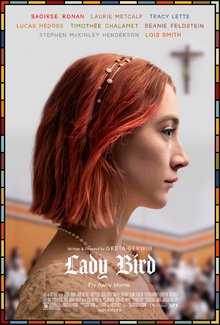
Greta Gerwig has a deep connection with Sacramento that I failed to appreciate when I first saw her in Frances Ha (2012). In that film, she’s making a life for herself in New York but stops off in Paris and returns home to the west coast. Now with Gerwig directing in lieu of Noah Baumbach, we have the inverse and the affection on display is indisputable.
A young woman resides in Sacramento with dreams of the culture of the east coast, namely New York. It’s the old story. We rarely appreciate where we come from or who we have in our lives until we have to leave and say goodbye. There’s no place like home.
Although I lived in California most of my life, it’s a big place and I do not know Sacramento intimately and yet I can deeply admire someone who does and takes care in portraying it on screen. It’s hardly a touch-up job but Lady Bird exudes an agreeable rose-colored nostalgia.
We are reminded that this is the post 9/11 generation which barely had cell phones and was still listening to “Crash Into Me” and Justin Timberlake. I remember bits and pieces of that time and I certainly recall the aftermath which will never be wiped from my memory. However, I increasingly realize fewer of my generation remember this era and so for me it’s a type of period piece that I can appreciate first hand.
There’s something about the story that evokes Anne of Green Gables for me. It is a mother-daughter movie. Our heroine Christine (Saoirse Ronan) has a gripping personality and like her predecessor desires a name change, in this case, Lady Bird. It leads to heated conflict with her mother and yet there’s a father too who has an affable spirit to play peacekeeper. We grow to appreciate them all.
The opening conversation between Lady Bird and her mother (Laurie Metcalf) is so very honest in capturing how as human beings we are so quick to cycle through emotions – bonding, loving, then arguing and instantly annoyed. I heard talk in an interview Gerwig gave about her writing process. It wasn’t so much about hitting all the right beats at first. She wrote so many pages and lived with the characters and let them take her where they would. In this regard, there’s a three-dimensional even lived in quality to each individual that cannot be fabricated. Far from being types, they overlap and interact in ways that feel refreshing and authentic.
The parents actually have an integral place in the lives of their children. They are not relegated to being killjoys or caricatures. There’s hard and fast truth to both Metcalf and Tracy Letts as they exquisitely inhabit their roles. There’s none of that leaving out a parent conveniently to make it easier to write for. Lady Bird pays respect to all of its characters much as it does its setting.
The best friend is another well-trod trope and you wonder if there’s any way to create something that has not already been done. Lady Bird and Julie’s (Beanie Feldstein) relationship sums it up precisely. As they quarrel, get involved in theater, and dance and daydream about all the things you’re supposed to. Eating unconsecrated communion wafers, feet in the air, backs on the floor chatting. It’s endearing and what we all craved in high school, whether we had that person or not.
Then, of course, there has to be the love interest. And yet again Lady Bird does something far more realistic. There’s not just one boy but two. The theatrical one, Danny (Lucas Hedges), from a big Irish family and then the hipster nonconformist one, Kyle (Timothy Chalamet), who can be found playing bass, smoking, and reading Howard Zinn’s A People’s History of the United States at a cafe. And even by the end, we never know which one was better for her. That’s not the point.
They were all part of her discovering more of herself. You even have the cool girl who everyone tries to suck up to. She’s entitled and has a hunk boyfriend and her parents don’t care what she does but even she has some humanity and a moral code. She’s not the devil’s incarnate. None of these characters are. As one who has dabbled in writing coming-of-age fiction with varying degrees of success, I recognize the ability of someone who is able to balance the economy of the genre with something that feels so resonant. It captures that expanse of time that is high school colorfully and with a degree of variedness. There is little chaff.
Like some of its immersive and empathetic brethren — The 400 Blows (1959), American Graffiti (1973), and Boyhood (2014) spring to mind — Lady Bird is not simply a coming-of-age story from the female perspective but an eloquent articulation of the human experience.
It’s also a film of benevolent spirituality. It’s set at a Catholic high school with some of the hallmarks we might recognize — uniforms, mass, communion. But it never feels like a mere punchline and those in positions of authority are generally warm and understanding.
The bright-eyed sister (a venerable Lois Smith) shares her love of Aquinas, Augustine, and Kierkegaard. Later she’s the victim of Lady Bird’s practical joke to try to gain a new friend. She plasters a sign on the sister’s car reading “Just Married to Jesus.” At a later date, it gets brought up matter-of-factly, the sister smiling at the joke but noting it’s been at least 40 years.
She is the perfect embodiment of a spiritual leader, leading by example and a heavy dose of compassion. She nudges her students but there’s also enough sense to realize ultimately they will have to figure it out. I did have a momentary flash of how perfect it would have been to cast Dolores Hart in the role but that’s hardly a complaint mind you. I also felt compelled to quote Kierkegaard’s journalings right about now and so I will. He penned the following:
“Of what use would it be to me to be able to formulate the meaning of Christianity, to be able to explain many specific points–if it had no deeper meaning for me and for my life… I certainly do not deny that I still accept the imperative of knowledge and that through it men may be influenced, but then it must come alive in me, and this is what I now recognize as the most important of all.”
I’m not sure if I have anything to add to his words but they just feel applicable to all of us. And Christine gets somewhere in her personal journey. In one moment, she’s finally made the move to New York and like all good insecure college students, she’s having a drunken conversation with a dude about God. He asserts that he doesn’t believe that there is one. Then she mumbles to herself how people don’t think there’s a God and yet they so readily take on the arbitrary names their parents choose for them.
Eventually, she wanders by a church on a Sunday morning after a short stint in the hospital (nothing too serious) and stays to enjoy the choir. But in a moment of realization, she walks out and calls up her mom to reconcile because she recognizes how important that relationship is to her life. She’s willing to acknowledge her affection for her mom which is a step toward greater understanding and love.
Lady Bird paints in warmth and laughter, anger and tears, that all have deep abiding roots in the love of family and friends. That’s how a film about a red-haired teenager in Sacramento could manage to be for all of us. I want to see it again already as I know my esteem for it will only rise.
4/5 Stars
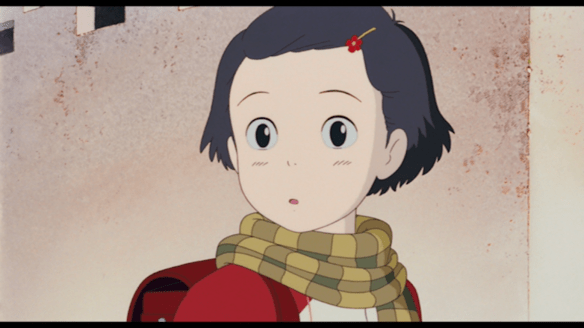
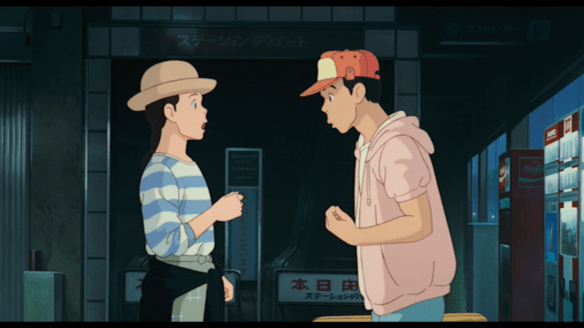
 The song “Sukiyaki” sung by Kyu Sakamoto proved such a charming enigma for me. Here was a record that was so quintessentially Japanese, a melodious ballad, that was nevertheless branded in the West with a more novel title and became a smash hit. However, here within the framework of this anime, the song feels perfectly at home once more as “Ue o Muite Arukō” an impeccable benchmark of an era in Japan’s history. It’s true that the full extent of the musical score is noticeably more western than we might be used to with anime yet the cornerstone of the soundtrack is Sakamoto’s iconic tune.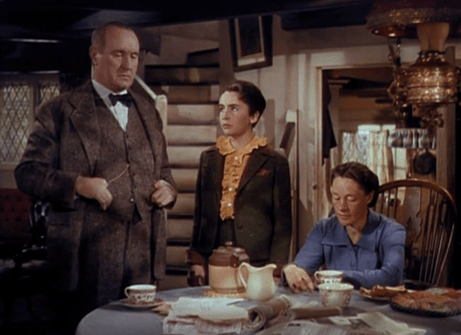
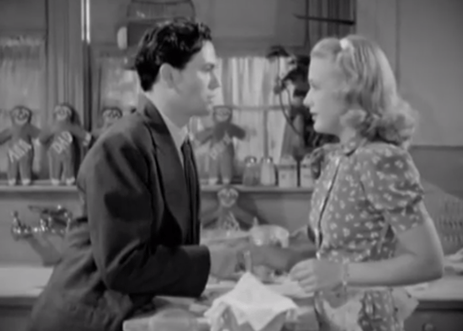
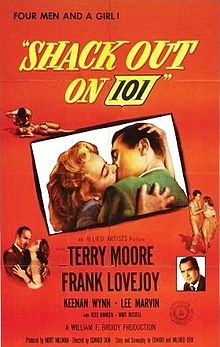 Like a Cry Danger (1951) or a Private Hell 36 (1954), this low budget film noir flick is such a joy to watch because it wears what it is right on its sleeve, clear out in the open. What we get is an utterly absurd paranoia thriller that also happens to be a heaping plate of B-noir fun.

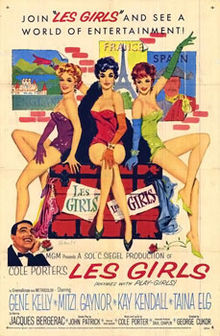 Classic Hollywood musicals usually have a very common framework that they rarely seem to deviate from. There’s almost an accepted unwritten rule that they will function like so. Typically, there is an overarching story being told and yet the narrative is conveniently broken up by song and dance routines that not only provide immeasurable entertainment value and give an excuse for talented performers to strut their stuff but also serve to move our movie forward comedically, romantically, dramatically, whatever it may be.
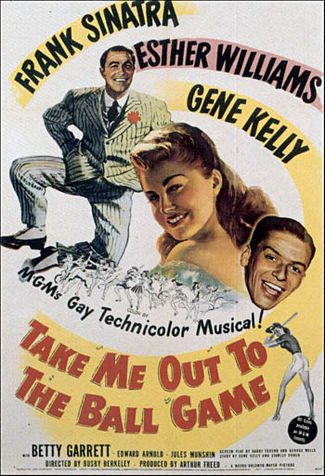 There’s something perfectly in sync between Gene Kelly and Donald O’Connor so I could never choose another duo over them but Kelly and Frank Sinatra are such wonderful entertainers that they help make this period baseball number a real musical classic even if it has to fall in line behind a row of other quality contenders.
 4 Star Films