Hiroshima, Mon Amour (1959), Nevers, and Casablanca

“Like you I know what it is to forget.”

Recently I’ve been meditating a lot on the impact of the atomic bombs in part because of the resurgence of the life and work of Robert Oppenheimer; he will be inextricably tied to Hiroshima and Nagasaki for posterity’s sake. Thanks to Alain Resnais’s film, Hiroshima and Nevers will always have a connection in the minds of cinephiles everywhere. 

Although I have walked the streets of Nagasaki and been to the memorial museum there, most of what I know of Hiroshima is gleaned from John Hersey’s journalistic account. The documentary footage from this film never ceases to scald my senses. I have to avert my gaze when the images grow harsher than any horror film imaginable. 

Hiroshima, Mon Amour gets much of its thematic resonance out of filming in Hiroshima itself because it comes with an abundance of inbred meaning; it will be ground zero of devastation and a beacon of peace for perpetuity now, ever since that day on August 6, 1945. 

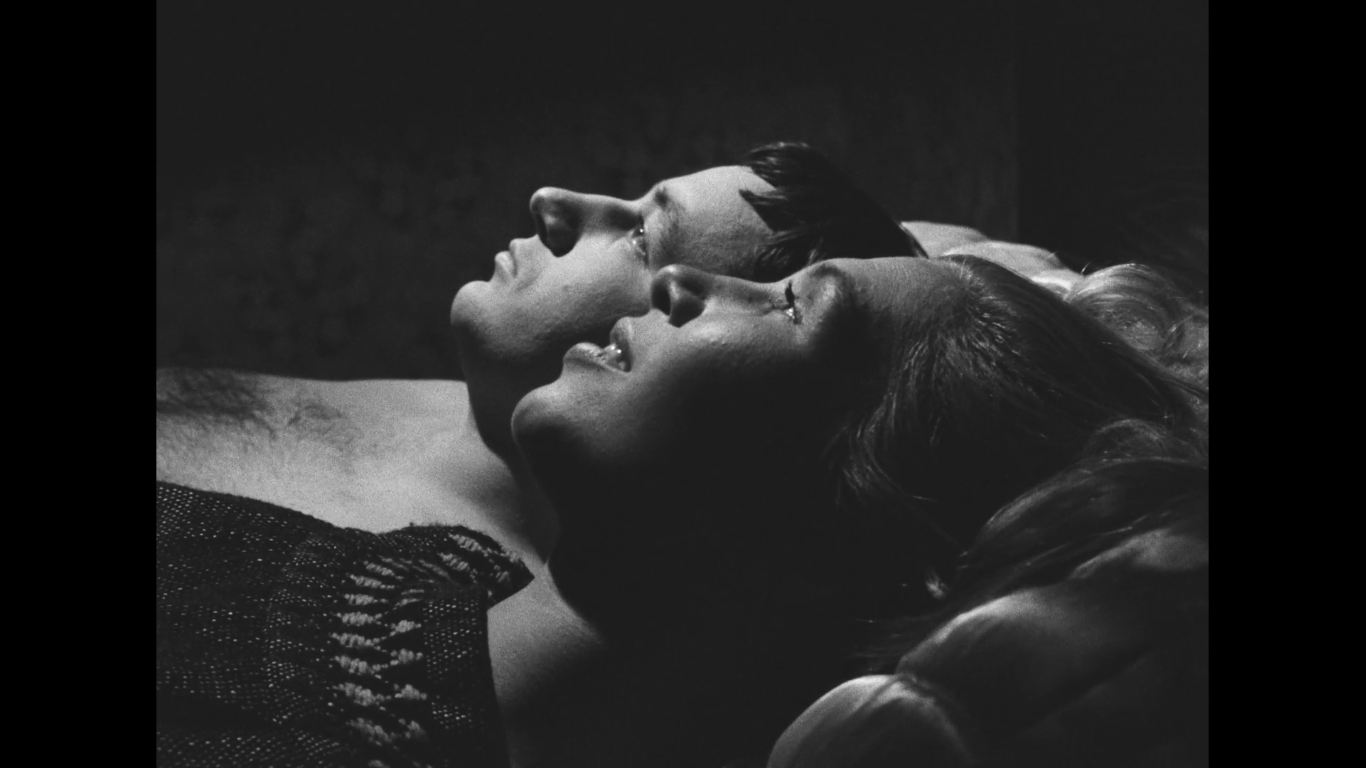
This lays the groundwork for the film’s first half as we consider Hiroshima – the images primarily being juxtaposed with two bear bodies of a couple intertwined. 

It slaloms so effortlessly through time and space like few films before or after. Although as it progresses, the way the film and its characters are set adrift by the editing is increasingly unnerving. This in itself feels honest to where our characters find themselves. 

There’s something rhythmic, repetitive, and still poetic about their questions and responses conjured up by the voiceover penned by Marguerite Duras. It builds this contrast between the French actress filming an international movie in Hiroshima and the Japanese Architect that she’s having an affair with on-location. They only have one day together before time and space will pull them apart, potentially forever. 

In truth, once you know a little bit more about Resnais, it gets harder and harder to separate his film from this kind of relativism of the age where truth seems to be subjective and everything we seemed to take for granted before, from absolute truths to morals, seem to have totally eroded around us. 

Even with this perplexing development denoted by Resnais’s fairly oblique style, brought to even greater fruition in Last Year at Marienbad, it’s hard to discount the swaths of beauty in his film. And if it is mostly an agnostic film, one cannot totally dismiss this point of view in a world coming to terms with carnage and the brutality of the atomic bomb. Because this disillusionment does have an amount of warrant, arguably more than any other time in modern history. 

The movie becomes this roving portrait involving a want of intimacy and closeness in a world ravaged by so much pain and suffering. Is it any wonder that in the post-war years plagued with the atomic threat, the world hit its baby boom. Couples coming together to start their nuclear families as a balm to the hysteria in the world at home and abroad. 

They both say they are a happily married man and a happily married woman, but even this I read almost ironically seeing the connection they form. If they are culturally worlds apart, somehow they share in the same traumas of a post-war, post-atomic generation coming to terms with all that entails. 

He has the specter of Hiroshima to contend with and she was castigated for loving the enemy during wartime: imprisoned, her head shaved, while also seeing her lover die in her arms. They’re different experiences and still share something endemic to both their realities. Thus, they gladly share a real-world romance on the edge of the apocalypse as time is slipping away from them. For now, they have tangible passion and meaning that they can caress in their arms. 

There is a passage in the movie that felt reminiscent of the jaded pessimism of the ancient wisdom literature of Ecclesiastes: 

He: Maybe it’s possible for you to stay.
She: You know it’s not. Still more impossible than to leave.
He: A week
She: No.
He: Three days.
She: Time enough for what? To live from it? To die from it?
He: Time enough to know which.
She: That doesn’t exist. Neither time enough to live from it. Nor time enough to die from it. So I don’t give a damn.

There’s a fluidity to the night and their relationship as the clock ticks and they know they will be pulled apart. Eventually, they make their way to a late-night cafe called Casablanca. The name carries with it all these connotations: Rick & Illsa, “As Times Goes By,” “La Marseillaise,” and even bits of your favorite dialogue.

Of course, one of the finest remembrances is “We’ll always have Paris.” Nothing can strip these memories away from the Casablanca couple regardless of sacrifice. Somehow there’s something honest about Hiroshima, Mon Amour in that it recognizes all these things are transient – these memories of love will pass away. They are already dissipating, and not as eternal as we would like to believe. 

More and more I see the shared vision of Agnes Varda’s La Pointe Courte and Hiroshima, Mon Amour – finding their form as part documentary, part romantic treatise. It’s the blending of the two giving them body and making them sublime. 

Here the performers also work wonders. Emmanuelle Riva has the most vibrant eyes in the cinema. They are a delight to look at in the light of the camera both glassy and at times equally melancholy. It’s her film debut and you would never know it. She’s youthful and lithe, yes, but there is so much depth to her. Call it self-confidence with the prerequisite vulnerability. 

Eiji Okada seems ruggedly handsome, but not without the capacity for gentleness. It feels as if he’s experienced an entire lifetime during the war years which in part was true. The only reason he foregoes the horrors of Hiroshima is that he was off fighting in the war with the Imperial Army. 

I read that all his French dialogue was memorized phonetically and if that is the case, although I don’t always have an ear, it came together splendidly, never pulling me out of the story. It felt real and believable to have these two people relate in such a way. 

What’s more, as someone who grew up in a culturally mixed environment, Hiroshima, Mon Amour stands as a groundbreaking depiction of a couple who plow through the societal conventions of the times.

When I watch this film it’s about so much more than the bomb. On the surface, it’s about an illicit affair that cannot be, it’s about two people coping with the fallout of war, and one woman’s struggle to hold onto her memories and cling to the love that’s still there in her life before it evaporates before her. How she cannot forget this man in Hiroshima or that man in Nevers because they are tied to emotions and specific moments in time – times when she felt something.  

Somehow it parallels what the film itself represents. Because it is a document as much as a piece of art. It came out about 14 years after the bombs were dropped. Somehow still fresh and a minor lifetime away from the fallout. These people have living memories to contend with. 

Someone like me does not and so the film is as much about these character’s memories as it is the visual representation of the film itself so we might never forget what those places represent in the cry for universal peace. 

Watching it in a theater I could sense a level of perplexity in the air. It’s not an easy film. Not everything makes sense, and there’s some troubling conclusions that you can come to. Also, one earth-shattering slap in a cafe is hard to deal with. Still, in the wake of all of this, it’s hard to reject the moments of beauty present here. I don’t think this is a mere justification. 

Rather I watch a movie like Hiroshima, Mon Amour where not everything is summed up or painted in full. We must leave with the impressions, the maddening anti-literalism of the piece that has no point-for-point attributions we can easily plug in. Nothing comes out in a nice bow nor do we get a true emotional resolution. It just kind of hangs in the air for us to consider in full.

But sometimes this hard work when something is perplexing feels all the more worthwhile because it provides something worth going back to so we might cull for something new. I’m never going to understand every grain of this film, and that’s okay. 

The distinction is having something to fall back on. When memories fade and we forget and the world seems to be fragmenting around us, it helps to have some standard or reference point outside ourselves to mediate the chaos. 

Otherwise, what’s the point if there’s no time to live and no time to die? What hope is left in such a debilitating landscape? On top of that, there’s a bomb that might just easily blow us all to smithereens. We require something more. 

4.5/5 Stars

La Pointe Courte (1955): Agnes Varda and The French New Wave

Agnes Varda became a modern-day cinema celebrity in the 21st century thanks to her immediately recognizable profile and modern incarnations of her work like Vague Visages. Because it’s true she never stopped creating, never ceased exploring this terrestrial sphere.

Watching something like La Pointe Courte (1955), one of her early efforts, one begins to imagine and reconfigure how the movie canon gets forged. Some of it has to do with accessibility (Varda’s Cleo from 5 to 7 seems to gain a resurgence in popularity by the year).

But whereas 400 Blows, Hiroshima Mon Amour, and Breathless became the lodestars for an entire seismic shift in film, Varda is rarely considered in this dialogue. If at all, it’s in tandem with Alain Resnais or her husband Jacques Demy from the Left Bank who were contemporaries of The filmmakers from Cahiers du Cinema. But never is Varda mentioned as a predecessor or the initial pioneer of forthcoming movements and yet she shot a film with little money, passion, and a point of view.

Early on as we glide down the alleyway with the laundry swaying in the breeze I couldn’t help but think how Yasujiro Ozu would have photographed it so differently — stagnant and beautiful — still, Varda makes it feel graceful and alive.

She uses it as a way to get into the house. There’s a man loitering around on the corner, we see boats in the background, and then we’re past the very same laundry through the window into the home of a working-class family.

The stranger by the fig tree has the locals suspicious. They snatch a glance at him, suspecting he’s an inspector come to turn them in. Sure enough, health services show up to pay a house call.

This is a story of the steady degradation of a way of life. These men earn their livelihood through fishing. But with the local bodies of water increasingly polluted, the authorities are quick to come down on them. Young children are tasked with keeping watch and sounding the alarm so the men can rush back to shore and hide their spoils. But the antiquated ways of kids keeping watch don’t stand a chance against newfangled motorboats. Later a man is taken off to prison for such an infraction.

A movie like this looks deceptively simple and yet I’m able to pore over it with such relish. Look at the street, the shape of a tree, some bit of wood, or fishing equipment tossed on the ground. None of this can be fabricated on a green screen. This is a unique and real-world before us that we get to feel and experience in all of its immediate eccentricities.

The way a cat crawls through a hole in a wooden fence. Women crowd in the doorway to acknowledge the death of a child. A man skipping over the train tracks to greet his love. The reunited lovers walking along a stone wall or crouched in the enormous darkened hull of a boat.

Because La Pointe Courte also tells of a Parisian couple (Silvia Monfort and Philippe Noiret), who have returned to the husband’s childhood home. They have different philosophies. For him, it is simple but the lap of contentment. Just living is a pleasure. He can be satisfied here.

His ambitions lie with the intricate, extraordinary things — the kind of everyday visions that prove plentiful in Varda’s gaze, but his woman wants something else. She wants to travel — to see more than the humble alleyways of his small backwater town.

We might liken her to a connoisseur of Hollywood delicacies. Although they are not a pair of Hollywood faces and Varda’s camera finds them immeasurably interesting. She photographs and frames them in all manner of ways: profiles, from up above, side by side, and walking apart. It makes no difference. They are totally worthy of her close consideration.

I find it easy to reminisce about Roberto Rossellini’s Stromboli another film that ties together the worlds of fishing and apathetic romance. There are even touches of  Ingmar Bergman from the boating of Summer with Monika and the visual melding of two human beings in Persona.

It also features water jousting a generation before Cesar et Rosalie. But one must once again acknowledge the imprint of Resnais — he helped edit the picture — and La Pointe Courte predates such seismic works as Hiroshima Mon Amour or Last Year at Marienbad.

This is not an empirical observation but although both their films share momentarily visible sensibilities — how they glide through space — allowing lovers ample opportunity to quibble poetically if not totally inexplicable, Varda seems more invested in the world around them.

These are still real people to her with real problems, not merely the symbols or totems of countries and generations (ie. Nevers and Hiroshima). And so although Resnais’s characters share some intimacies, Varda’s picture is intimate in a different way, allowing for understanding outside the umbrella of romance alone.

She’s intent on humanity — a little boy licking his ice cream cone — in a way Resnais probably wouldn’t devote time to. The moment develops into something bitter and then sweet. He thinks his woman has left him and then she returns with two ice creams (economy size). He gives his cone to a small child. Rather than a mere act of charity or guilt, he’s probably lost any appetite.

The movie is this constant dance between signs of dissolution — these steps back and apart — and then steps forward leading them together again. It’s romance played out in the moments of conversation and indifference rather than any form of malicious Hollywood tirade.

It’s telling Varda ends her movie, not with her couple pontificating as they wade through a local dance party in the streets. For them, it’s practically a joyous occasion. However, she leads us back to a family as they get in their boat to ride off into the distant night. It never loses this level of familiarity in its humble origins. It relishes them even as it signals the inevitable dwindling of a way of life. Whether Varda recognized it or not, her film remains a presage for coming attractions.

4/5 Stars.

Review: Hiroshima Mon Amour (1959)

hiroshima mon amour 1

Like you I know what it is to forget and yet still be endowed with memory. These are only a couple fragments from this film stitched together but in many ways, they encapsulate the essence of its core themes.

I suppose such words ring true for all of us and Alain Resnais’ film is composed of a plethora of equally perplexing paradoxes that though never quite coming into full clarity nevertheless prove Hiroshima Mon Amour to be one of the most bewitching cinematic expressions born out of the French cinema. Without question, it is an undisputed touchstone of the forthcoming Nouvelle Vague that blew up the conventions of the 1960s.

The first time I ever saw Resnais’ romantic meditation there was something so arresting about it such that I will never forget the likes of Nevers and Hiroshima — the two entities that make up this film as not simply places of past tragedy but crucial to the very identities of the characters who come within the frame.

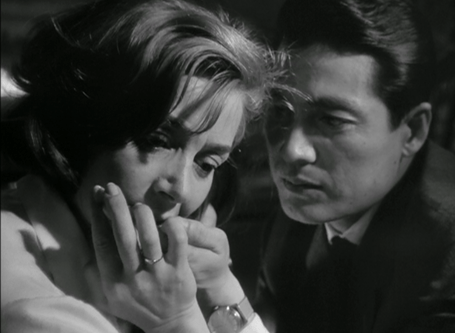
We never need to know the true names of this French actress (Emanuelle Riva in a riveting performance of immense grace) and the equally candid Japanese architect (Eiji Okada) who fall into the throes of a passionate affair together. They are represented well enough by these monikers — symbolic torchbearers of these names — emblematic of the age they ascribed to.

Like L’Eclisse (1961) or Dr. Strangelove (1964), this film too is in the wake of the atomic bomb and any subsequent discussion thereof cinematically speaking must at least acknowledge such films. Part of the necessity in this specific case is how the film takes a particular event and then extends it and intertwines it with so much more in such a way that it not only a monument to Hiroshima but a testament to human history.

We are people so quick to forget. We lose sight of the past. We bury our hurts deep inside. We are doomed to repeat many of our past mistakes. But still, more so we are capable of passions, emotions, and love that carry us through times of tribulation, pain, and suffering. It’s something to be immensely thankful for.

Resnais film is one of the great visual marvels of the 20th century with its graceful fade-outs and flashbacks — delicate camera zooms connecting memories and realities. Stylistically there’s a continuous poetic cadence of image and dialogue, repetitions with recollections. A solemnity exists in its very purposeful pacing that ties everything together with the utmost elegance which, far from being a muddled hodgepodge, forms a perplexing experience never to be fully elucidated.

It has very few equals and remains so as an achievement that can hardly be defined as a typical love story or any such blase categorization. It’s what we might conceive when we think of Film as art worthy of any sphere of discussion.

There’s hardly a meter to begin measuring how it makes us feel or the emotions it elicits.  Somehow connected to fate — two lovers crossing paths — these two individuals seemingly meant to be together and tied together not only by their romantic passion but their own histories. The striking flashback structure subsequently creates tiny microcosms of emotional resonance that flood with abandon.

Recollections of past scars unearthed over the course of the love affair. Both historical and personal. We have the depiction of the devastation in the aftermath of the bomb with images that are all but scorched into our mind’s eye with an unfettered pointedness. We are meant to see these images and take into account how they came into being.

But there’s also the personal trauma brought to the fore and exhumed with a kind of transfixing equanimity that’s hard to fully comprehend but nevertheless leaves us with something to ruminate over. Equally telling is the passage of time as memories begin to fade and minds begin to slowly forget. Again, that is the curse of our beings that we must fight to remember what has come before.

It’s no small coincidence that the cafe that our two lovers rendezvous at is none other than the Casablanca. The yearning and the melancholy are right there in the lyric of “As Time Goes By.” If you’ve never consciously thought about their meaning before then Resnais film might make you hear them anew and be moved.  Love, memory, and heartbreak are often so closely tied together. This is a film that dwells on each and finds some amount of catharsis.

The diversity of the crew is another glimmering bright spot of this joint partnership between nations with an abundance of involvement from both French and Japanese staff taking the shoot on-location to both countries. It’s a lovely marriage and a bond is formed by the picture just as the romance signals a tight-knit cross-cultural relationship on screen.

For some, individuals somewhat attuned to diverse backgrounds, Hiroshima Mon Amour is utterly groundbreaking in this realm. Though its cast is small, it’s a mighty statement having a French woman playing opposite a Japanese man. 50 years on it remains as an image that we do not see all that often, despite the changing of the tides.

Their closeness is palpable. Hands clasping tenderly. Eyes gazing with the deepest longing. The intimacy that they share speaks volumes. Even as it’s undercut by the morose strains of infidelity and wistfulness; this is a love story like few others.

4.5/5 Stars


Last Year at Marienbad (1961)

lastmarienbad1As I’ve grown older and, dare I say, more mature, I like to think that I’ve gained a greater appreciation for those moments when I don’t understand, can’t comprehend, and am generally ignorant. Now I am less apt to want to beat myself up and more likely to marvel and try and learn something anew. Thus, Marienbad is not so much maddening as it is fascinating. True, it is a gaudy enigma in form and meaning, but it’s elaborate ornamentation and facades easily elicit awe like a grandiose cathedral or Renaissance painting from one of the masters. It’s a piece of modern art from French director Alain Resnais and it functions rather like a mind palace of memories–a labyrinth of hollowness.

There are figures existing in a defined mise-en-scene without voices or at the most backed by puzzling voice-overs. Almost behaving like specters at times against this backdrop of baroque ornateness. Still, the loose narrative, following a solitary man and aloof woman he’s convinced he met only the year before, is firmly planted in the worlds of architecture, sculpture, and painting in so many ways overlapping and coinciding with this cinematic creation of the moving image. In fact, there is the juxtaposition of images, two figures in the bar, low light only to be contrasted with the gaiety of a girl bathed in sunlight within a bedroom. Later it is followed by a rapid repetition of shots of that same woman.

There’s immense power here, because there is no tie to any narrative strand, allowing complete freedom to go any direction it may so choose. There’s the ambiguity between fantasy, reality, truth, and fiction, all the while backed by the wailing organ music that becomes almost exhausting with its persistence. The camera is constantly tracking, the “story” shifting between time and place with ease.

It’s art at its most unadulterated and audacious, although it does admittedly lack a general geniality or heart. Its predecessor Hiroshima Mon Amour feels imminently more personal and intimate, compared to this truly somber affair. It’s not quite so stiff and stuffy, but Marienbad is still masterclass in other ways.

lastmarienbad2In fact, although this film was shot on estates in and around Munich, I have been on palace grounds similar to the film. There’s something magnificent about the sprawling wide open spaces and immaculate landscaping. But still, that can so easily give way to this sense of isolation, since it becomes so obvious that you are next to nothing in this vast expanse. Marienbad conveys that beauty so exquisitely, while also paradoxically denoting a certain detachment therein.

With some films, it becomes hard to decipher fantasy and reality but there usually is at least some initial dividing line before distinctions get fuzzy. That often holds true for the works of Bergman or Fellini. However, here such a dichotomy seems of little consequence. Instead, images become fascinating, architecture is to be examined, and there is hardly a need to know everything. As an audience that frees us up to be mesmerized and truly entranced by what we are being met with.

lastmarienbad3Do we understand this bit of interaction at this stately chateau? Probably not. In fact, I’m not sure if we are meant to know the particulars about last year in Marienbad. That doesn’t mean we still can’t enjoy it for what it is. Because Alain Resnais is perennially a fascinating director and he continued to be for many years. Whether you think this is a masterpiece or a piece of rubbish at least give it the courtesy and respect it is due. Then you can pass judgment on it, whatever it may be.

I for one am still mesmerized by that mathematical strategy games, but that’s only the half of it. When it is all and said and done, I have no cogent, well-informed answer. The most striking thing that stayed with me is how Last Marienbad is rather like strolling through a gallery of art. Each framed image acting as its own distinct entity, crossing mediums and really engaging with the viewer. While I am all for Film as a purely visceral form of entertainment, there’s seems to be a necessity for such visionary pieces as Resnais’ work here with screenwriter Alain Robbe-Grillet. What they did is extraordinarily remarkable. That’s the best I can do. You need to see it for yourself.

4.5/5 Stars

Hiroshima Mon Amour (1959)

72bd9-hiroshima_mon_amour_1959This film is not only a seemingly early form of the French New Wave, it also has many qualities of a documentary, and it is certainly an international film. The film opens with a one night stand between a French actress and a Japanese architect who rendezvous one night in Hiroshima. In the short time they spend together, she reflects on her memories of the city that was not too long ago devastated by the atomic bomb. He often rejects her recollections but nevertheless, he cannot bear for her to leave and he continues to pursue her. Eventually in the course of their time together she relates her days back in the town of Nevers in France. During the occupation, she had a beau who was German and was eventually killed. The events and aftermath haunted her even many years later. They spend some of their time together walking the streets of Hiroshima and with their time running out they vow to remember each other by Hiroshima and Nevers respectively because their real names are never mentioned. This film begins very much like a documentary on Hiroshima but very quickly it turns into a character study focusing on ideas of love, memory, and personal identity. This film is more about art and expression and it uses quick flashbacks to replicate the past with voice-overs bringing the audience back to the present. That being said it should be treated as such because it truly is a masterpiece from Alain Resnais.

4.5/5 Stars