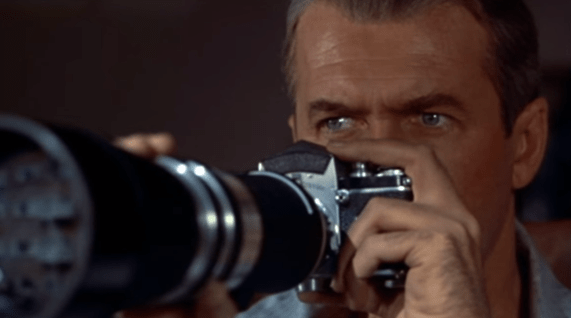
Review: Rope (1948)

rope 1.png

Rope’s title sequence is composed of your prototypically serene establishing shot. But really, you could not have a more unique and in some sense unnerving picture. It was Alfred Hitchcock’s first foray into Technicolor and it’s quite the looker as are the beautifully constructed backdrops that spice up the mise-en-scene for this glorified stage play.  He also busied himself with camera set-ups in an effort to shoot the picture as near to a single take as was possible with the technology of the time. He actually “cheated” a bit by splicing segments of film together at intentional breaks to give the effect of continuous motion. Still, it’s an impressive endeavor all the same.

But the experiment is twofold both behind and in front of the camera. It’s all a reworking of the murderers Leopold and Loeb, two affluent students who succumbed to Nietzsche’s superman complex. The project was an early script by playwright Arthur Laurents penned from an adaptation by Hume Cronyn, a Hitchcock regular in several earlier pictures (Shadow of a Doubt and Lifeboat).

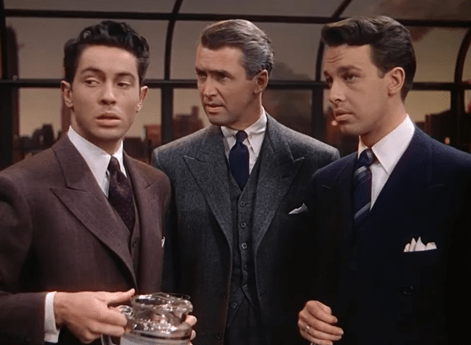
In this case, Brandon (John Dall) and Phillip (Farley Granger) are looking for the perfect victim in the perfect murder. Where murder is a crime for most men but a privilege for a few — like themselves.  It all begins with a shockingly graphic opening for the 40s that rips away any shred of upper-middle-class sensibilities put upon us by that establishing shot. It’s all a ruse.

The assertive, far more charismatic Brandon also happens to be the main architect pulling along the flighty Phillip into his little experiment.

The act of throwing a small get-together against this exhilarating backdrop proves tenuous because of the insidiously dark deed that Hitchcock has made his audience privy to. Otherwise, this would be a run-of-the-mill picture of cocktails and hor ‘d oeuvres. But underline it with a murder and it’s a completely different proposition altogether.

Their exhibition comes as little surprise from two men who are snobbish, entitled jerks. Their lives are so dull that they stoop to murder to see if they can be brilliant enough and brazen enough to pull it off, going so far as inviting their most astute mentor played by none other than James Stewart.

Though I enjoy him as much as the next fellow, Stewart does feel oddly out of place in this film and within this role of Rupert. He seems to know it too. Nevertheless, Hitchcock would find far superior uses for him in due time.

There are also a couple knowing winks to the sinisterly attractive James Mason (a future Hitchcock collaborator) who is conjured up to do battle against the dreamboats Erroll Flynn and Cary Grant by a few admiring partygoers. Of course, no one seems to take into account that they have Jimmy Stewart right in their stead.

We begin to feel for Janet and Kenneth two schoolmates who have been used in the game. She is soon to be engaged to the formerly eligible David. Kenneth was the beau she was with before he broke it off. Now their lives are manipulated just like the late boy’s father who is also invited to the gathering.

Rupert proves that he knows something’s afoot not that it’s all that difficult to see Granger’s character slowly coming apart at the seams. Alcohol hardly helps his unstable demeanor. It becomes a showdown with his two pupils but he could have never expected this. It’s on this level that Rope is thoroughly troubling. It’s in this way that we begin to understand why Nietzsche might have been troubled by his own conclusions. There is little hope in this conception of the world.

Simply put, the film is dour to its core. It has no heart and in that sense, Jimmy Stewart does not feel at home within its heartless frames. The charade falls short for these very reasons. Though it’s technically ambitious, it doesn’t quite manage that perfect Hitchcock balancing act of crime mixed with wit. There’s no way it can with such a worldview.

Still, Rope shows, if anything, that Hitchcock is never complacent, always looking for the next great challenge. That is one of the many reasons that we still hold him in high regard as one of the foremost directors of any age. Because even a callous film such as Rope is worth seeing.

3.5/5 Stars

Saboteur (1942)

saboteur 1942.png

“It’s my duty as an American citizen to believe a man innocent until he is proven guilty.” 

I stand corrected. Maybe Foreign Correspondent (1940) is not Alfred Hitchcock’s most patriotic movie. Maybe it’s Saboteur, made two years later. Or maybe they are both made by the fact that they are more than mere propaganda and that’s what makes them still worthwhile today. This is, above all, another thriller by the same man who continually tinkered with the genre in the subsequent years.

The narrative starts with wartime industry which has hit its boon since there are Nazis and Japanese to fight. Defense Plants have become a crucial part of the war and also part of everyday life for the average American. Robert Cummings is the epitome of one, a fresh-faced lad who all of the sudden finds himself wanted for the murder of his best friend which happened after a ruthless act of sabotage. In this respect, Saboteur is a more elegant version of Hitchcock’s predecessor Sabotage (1936).

There’s a wonderful sequence where our protagonist has hitched a ride with a gabby truck driver who consequently looks a bit like James Cagney. Every subsequent thread of conversation and even the passing billboard, all points back to everything that’s gone down so far. The man’s trying to run away but he can’t. Fugitives never have been able to as far back as Jonah. They always have to face the music.

Barry Kane follows the one wild lead he has involving a man played by Norman Lloyd (a future Hitchcock partner in Alfred Hitchcock Presents) and it lands him at a stately ranch that feels like quintessential Americana — it’s a luscious slice of West Coast leisure. But it’s another delicious instance where Hitchcock allows villains to live lives not unlike our own with families, babies toddling around, and swimming pools. Except these people also happen to be involved with conspiracies threatening national security in the wake of WWII.

After, a harrowing escape from the police with a swan dive off a bridge, Kane continues his journey. Saboteur quickly becomes another entry in Hitchcock’s innocent man-on-the-run canon and while not the tip of the spear, it’s thoroughly entertaining for the very fact that it remains on the move as it jumps from place to place. In fact, there are obvious shades of 39 Steps (1935) and North by Northwest (1959) in place as it goes literally from coast (California) to coast (New York).

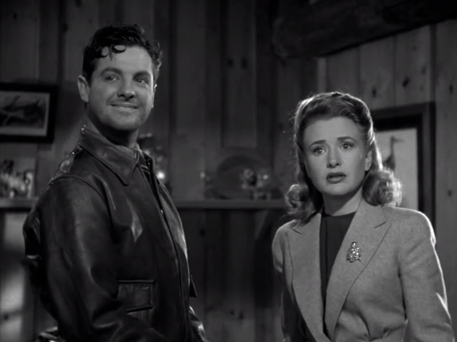
And in each location, we meet a row of interesting side characters whether a trucker or the sagely blind man and a band of eclectic circus vagabonds. But the most important is the stalwart Patricia Martin (Priscilla Lane), initially looking to turn in this traitorous criminal with his hands cuffed together until she realizes that’s not who he is.

The director and his writers use the whole film to tell tiny parables about America where the circus can function like our democracy or a decision to not turn in a man can merely be an exercise in basic human rights. In these moments the film evokes the kind of patriotic messages that feel unconvincing when viewed now. Even Cummings brief stint on the soapbox facing off against his sophisticated foe is an obvious call-to-action.

But for 1942 it makes complete sense and that hardly takes away from the thriller that Hitchcock still manages to spin because though war might be afoot and Film serves different purposes on the Homefront, it can still function as entertainment. Hitchcock was one of the greats in that capacity. A murderer is set loose in a movie theater during a crime picture and the action leads us most iconically atop the standard bearer of American freedom and equality, Lady Liberty herself. Once again, it’s the perfect Hitchcock ending even if that’s more in going with the style of the entire picture thus far rather than pure execution.

3.5/5 Stars


Review: Foreign Correspondent (1940)

foreign correspondent 1.png

If Alfred Hitchcock had any contribution to the war effort then Foreign Correspondent would no doubt be it. Nazi Minister of Propaganda Joseph Goebbels was purported to have admired its qualities as a work of propaganda and that’s high praise coming from someone who was quite familiar with influencing people. If nothing else it proves that moving pictures can be deeply impactful on mass audiences and that still holds true much the same today.

It’s also subsequently reductive to call our leading man Joel McCrea the poor man’s Gary Cooper which may have come into being because the other star turned down the role. Something that he subsequently regretted. However, there’s something inside of me that thinks that McCrea almost works better because he has a sardonic edge. Cooper was quiet and strong, a true blue American but McCrea is ready to hit the pavements with a voice that’s incisive.

In this picture that’s his trade. He’s used to crime beats and as such he’s given the task as a scoop getter, a foreign correspondent, in the European theater for the folks at home. What he comes upon is more than he could ever imagine with international treaties, assassinations, kidnapping, drugging, and far-ranging conspiracy. All because of a peace conference looking to alleviate the belligerent rumblings in Europe. In this case, Johnny Jones (McCrea) aka Huntley Haverstock acquaints himself with an international peacekeeper named Van Meer only to have the man disappear, reappear, and wind up in places that one would never expect. It’s all very peculiar.

One of his other acquaintances is the lovely and bright young woman played by Laraine Day (known to baseball fans as the future Mrs. Leo Durocher), who has joined her father (Herbert Marshall) at a summit of the International Peace Party.

Within this basic storyline laced with some snappy lines provided by a whole slew of script contributors (including regulars Charles Bennett and Joan Harrison), Hitchcock strings together some lovely visuals including crowds of top hats, crowds of umbrellas, and a lively chase as Haverstock sprints through traffic to try and apprehend a gunman. Unsuccessfully I might add.

The world is highlighted by some equally inventive locales that are simultaneously indigenous to their environment in typical Hitchcock fashion like the windmills in Holland. With its churning mechanisms and creaky stairwells fit with cavernous hallways, you can tell Hitchcock finds great delight in using the stage to build the stakes of his story.

Because it’s all a massive cover-up and that conveniently sets the stage for our romantic comedy which is being overlaid by this international thriller of stellar intrigue. As our intrepid correspondent acknowledges, he’s “thrown a monkey wrench into some international dirty business whatever it is.” That’s about all we need to know and it does suffice.

My only misgiving is how easily Laraine Day’s character gives way and loses her disapproving edge to fall madly in love with Joel McCrea. Still, the film doesn’t end there. There’s a lot more that must happen. A lot more crises to be averted.

Though it’s hard to know the precise timeline now, there’s an innate sense that Foreign Correspondent is really on the cutting edge of the current events and it benefits from that very quality that still lends a certain amount of credence to this nevertheless wildly absurd plot.

Because though it’s undeniably a work of fiction as noted by the opening disclaimer, there’s still the touches of truth that were all too obvious to the general public. Namely, Hitler and a World War threatening to explode — bombs already raining down on Great Britain as undeniable proof.

The most remembered setpiece comes last and it’s a beautiful touch of ingenuity, Hitchcock simulating the crash landing of an airplane like few others of his era would ever dare to attempt and it comes off with torrents of energy that leave a stirring impression.

But that is almost matched by the passionate rallying cry that Joel McCrea sends up over the radio waves to his fellow Americans, urging them to keep their lights burning because they’re the only source of hope in a world getting increasingly darker. This final monologue was essentially an afterthought penned by Ben Hecht but it’s heft no doubt impressed Goebbels. This one’s an international thriller with a patriotic tinge. Fitting, as Hitchcock in many ways would be as much an American as he was an Englishman.

Foreign Correspondent is sutured together along those same lines. Because just as Joel McCrea and George Sanders’ characters work together to get to the bottom of things, the imminent war necessitated a partnership between the American and British nations. It was a long time coming but the lights kept burning and remained indefatigable to the very end.

4/5 Stars

Review: Rebecca (1940)

rebecca 1.png

“Last night I dreamt I went to Manderley again…” ~ Joanne Fontaine in Rebecca 

In normal circumstances, voice-over introductions rarely resonate but for some reason, the ethereal tones of Joan Fontaine opening Rebecca leave a lasting impact and that’s after well nigh 80 years.

This was Alfred Hitchcock’s first film in Hollywood and it truly is a stunning debut but if you take a step back and see who was working behind the scenes, it soon because fairly plain that this was as much of a David O. Selznick film as it was a Hitchcock one, if not more so. Because Selznick had Hitch under contract and he was following up the grandeur of Gone with the Wind (1939) with another costume drama positioned to be a smash hit.

Though Rebecca was slightly less ornate and preoccupied with its more gothic sensibilities, Daphne du Maurier’s novel was nevertheless ripe for a Selznick treatment with a sturdily constructed story and quality production values all across. And of course, you have the acting talent which while not necessarily head and shoulders above all of Hitch’s previous works was nevertheless top of the line.

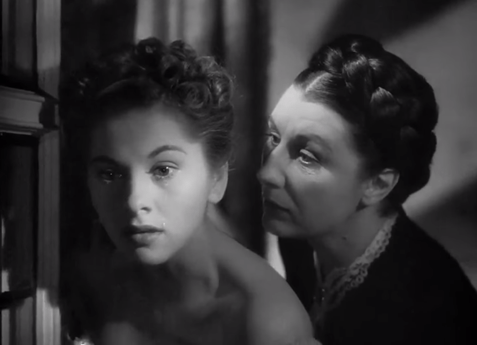
First, of course, is Laurence Olivier providing a great deal of import to the part of one of our protagonists, George Fortescue Maximilian De Winter, the tortured man of breeding whose life is stricken with past tragedies. But equally crucial is Joan Fontaine’s role as the unnamed woman who subsequently becomes the second Mrs. De Winter after a whirlwind courtship in Monte Carlo. She began as the meek lady in waiting for a boorish socialite Mrs. Edythe Van Hopper only to fall in love with the older man.

Fontaine inhabits the role with a breathless wide-eyed timidity that’s immediately attractive and makes her the object of our sympathies. She always gives off the appearance of a frazzled little deer in the headlights like she doesn’t quite know what to say or what to do in the presence of others whom she deems more important than herself.

It’s that very quality that drew me to Fontaine from the outset the first time I saw Rebecca and no doubt a similar quality that draws Maxim de Winter to her character. There’s an undeniable innocence there full of an angelic beauty that exerts itself each time she interacts with others, eyes wide with mouth agape. That in itself is an immaculate illusion given Fontaine’s own life full of estrangement. Here she is faultless and demure.

And that comes into focus even more clearly because Maxim can often be an unfeeling man, swarmed with past demons though he might be. Put them together and he’s certainly the dominant figure. The same goes for their arrival at his stately home Manderley. The current Mrs. De Winters is totally overwhelmed by this grand estate and the staff that frequent its halls.

The shining example is the apparition of a housekeeper Ms. Danvers (Judith Anderson) and it’s a career-defining role for a character actress who always could be imperious and a little unscrupulous. But she was never as harrowing as the fiercely loyal woman who starts playing mind games with her new employer.

You also have the incomparable George Sanders playing his English gentleman with biting wit and a touch of blackmail. He becomes pivotal to the story for the very sake that he speaks up on the deceased Rebecca’s behalf as much as Mrs. Danvers does. They adored this woman that Maxim loathed so deeply by the end of their relationship. And it’s in this chafing that the ultimate conflict is uncovered — the type of conflict that threatens to rip Maxim away from his new love and splatter his reputation in the courtroom drama that ensues.

Much like Laura (1944) in her eponymous film, Rebecca lingers over the entire narrative and haunts its frames from start to finish. Yet in the latter work of Otto Preminger, the lady actually makes an appearance on screen incarnated by the entrancing Gene Tierney.

Here Rebecca is a specter who never tries to show herself. There is no physical semblance of her, only signs and references of her being — most memorably the scripted letter “R.” Because, truthfully, she doesn’t need to show her face. She almost wields more power without being seen. It’s that rather unnerving feeling of impending dread that’s hanging over the audience as much as it does Mrs. De Winter.

In the end, Hitchcock didn’t exactly get the murder that he would have liked but in any case, it does not fully take away from the impact of Rebecca. Instead of being a film of overt actions it starts to work on our psyches as a sterling psychological exercise matched by its deliciously dark atmosphere. The mental distress is heightened by the eerie interiors marked by layers of shadow and the shrouded impressionistic seaside that envelops the De Winter compound. Fittingly, Manderley is razed to the ground once and for all.

Ironically enough, though the production is very much on the Hollywood scale, it’s probably the most “British” film that Hitchcock ever made in America based on not only the subject matter but the majority of the acting talent because on top of Olivier and Sanders you have such esteemed character actors as C. Aubrey Smith, Nigel Bruce, Melville Cooper, and Leo G. Carroll (a Hitchcock favorite).

Still, he was blessed with the best talent he had at his disposal since the infancy of his career, in part because of his move across the Atlantic. Joan Harrison who would become one of the most prominent and only female producers in Hollywood turned in work on the script along with Robert E. Sherwood with the score being composed by Hollywood icon Franz Waxman. Even if the players at work are not necessarily evocative of the many trademarks we usually attribute to the director, that hardly makes Rebecca any less of a delight.

Furthermore, there is something inherently honest about the lead portrayals throughout the film. Not necessarily because they’re realistic but they are full of fear and hatred and emotion and you see it in the words and on the faces of the characters. This is hardly a playful film. It’s not trying to subvert drama with humor or dry tonal reversals. But it’s candid in its despair as much as in its joy.

For all their intrigues and complexities in technical feats, storytelling, and psychology, sincerity is not always something you look for in a Hitchcock picture. Here it works. Casting this devasting love story up against the backdrop of gothic horror makes it all the more affecting. The marriage of the talents of David O Selznick and Alfred Hitchcock turns out to be a surprisingly bountiful proposition. Even if it wasn’t made to last.

5/5 Stars

Review: Psycho (1960)

psycho 1.png

For all intent and purposes, Psycho could be an episode of Alfred Hitchcock Presents and Hitchcock knew that better than anyone else. Foregoing the more lavish Technicolor tones he had used in Vertigo (1958) and North by Northwest (1959) and lacking the same type of studio backing, he shot this film in the much cheaper black and white format and brought on a great deal of his television crew to make this production a much more inexpensive package.

In that way alone it paled in comparison to some of its much more ostentatious predecessors but that cannot for a moment take away from the impact or cultural clout that Hitchcock still managed — truly topping any of his previous efforts to date. If not his greatest film, then Psycho was certainly his greatest feat of marketing and ingenuity. Because he would never allow his public to forget their experience witnessing Psycho and very few have for generations with it becoming so closely tied to our public consciousness.

The plotline itself is a simple affair of love and small-time crime set in Arizona then transplanted to California. Marion Crane (Janet Leigh) has a man but a life with him seems unlikely especially with both of them being terminally strapped for cash. He’s got alimony to pay and she makes very little on a secretarial salary. But when $40,000 is dropped on her desk in cold hard cash — money she is supposed to deposit in the local bank — in a brief moment of decision she attempts to buy happiness.

She takes the money and keeps on going. From the moment Marion first sees her boss on a crosswalk as she drives off with the money, Bernard Hermann’s score starts pounding. Every time she hits the gas the composer does too and it’s one of the most unnerving pairings in cinematic history.

Even without the scoring, this would still be matchless silent storytelling and yet it’s improved upon by the music working with the image.  A paranoid Leigh becomes the latest iteration of Hitchcock’s icy blonde, curt and still constantly looking over her shoulder because she is not made to be a lawbreaker. She tries to dodge the interrogation of a suspicious policeman and brushes off the friendly salesmanship of California Charlie (John Anderson). But she rides on no thanks to the guilt written all over her face only to be impeded by Hitchcock’s latest implement, a fateful rainstorm that lays her up at the first motel she can find: The Bates Motel.

In Vertigo and Psycho, you can see how Hitchcock distinctly puts us in the eyes of the main character so we have no choice but to view the world as they do and it’s highly effective in bringing us into the story. Thus, it’s even more jarring when he rips our star and stand-in away from us brutally and forces us to frantically search for another anchoring character.

psycho 2.png

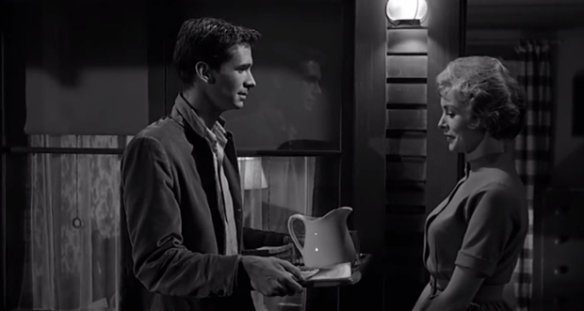
That brings us to Norman. Norman Bates (Anthony Perkins) is such a fascinating character because in one sense he’s like a shy little boy. The moment he asks Marion to have dinner with him is brimming with candor and a pitiful awkwardness — like a boy asking a girl out to the prom or something. That sweetness and social ineptitude are at the core of his being. He can’t hide it just as Anthony Perkins playing Bates feels like he is hardly acting at all. It’s just his way.

The Bates home could be a character in itself, a looming beast that hangs over Marion as the domain of the unobserved Mrs. Bates. It poses itself as a portent of Norman’s own ominous instability along with his pointed drawing room conversation with Marion where he freely discloses, “We all go a little mad sometimes. Haven’t you?” 

That, of course, brings us to the famed shower scene that is a tour de force not only in editing but in the synthesis of all the cinematic components from the image, to sound, to the scoring of Hermann’s impeccable cacophony of screeching strings. It stands alone as arguably the single most iconic scene in all the movies. Thus, it’s surprising that from the very moment Hitchcock was showing Leigh flush some pieces of paper down a toilet he was already making history — because bathrooms were long-held off-limit locations. Hitchcock made them far worse for folks after Psycho.

He also starts moving around the bathroom in a way that’s vaguely reminiscent of Rear Window’s opening. Finally, cutting from the drain to the eye of Marion Crane suggesting the same spiraling black holes of emptiness as Vertigo. It pretty much sums of the conclusion of her life.

But then we’re back to Norman. There’s an extreme distaste in how goes about cleaning up the bathroom but also a certain industry to it. He gets to it silently and efficiently in another one of Hitchcock’s great sequences that unfold without the aid of any dialogue whatsoever until it leads us the precipice of the swamp where Marion’s car is disposed of.

It’s in these interludes that we understand the full gravity of Hitch’s wicked humor. That money — the load of cash that propelled the film forward — is cast aside as simply as that. No two thoughts about it as if to say you thought that’s what this picture was about but he’s not entirely interested in that. He just wants to hook his audience on that objective before sending them hurtling in completely different directions.

psycho 3.png

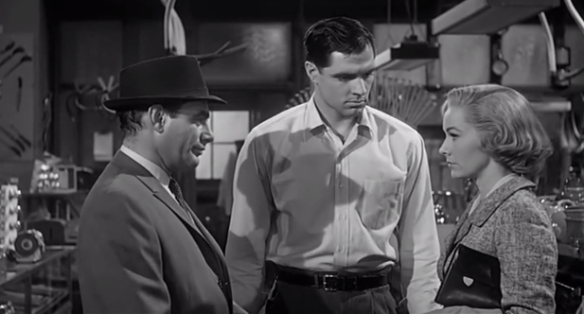
John Galvin plays Leigh’s lover and he’s the stark contrast to Perkins’ character. Both dark-haired and handsome but Sam is a virile man even a masculine ideal of the 50s and 60s. Nevertheless, he joins forces with Lila Crane (Vera Miles) Marion’s concerned sister, subsequently becoming the driving force in the latter stages.

But also of note is the hired private investigator named Arbogast (Martin Balsam) who coincidentally comes onto the scene at the same time at the behest of the old coot that lost $40,000. Balsam a wonderful character actor throughout his career, not surprisingly appeared in two episodes of Alfred Hitchcock Presents and he’s at his best as he questions Norman Bates in that genial manner of his about his person of interest, one Marion Crane.

At this point, in some small way, it feels like we are a bit of an accomplice in this crime of Norman’s.  Complicit in his secret and as Arbogast digs around for answers we crawl inside our skin. Norman tries to cover up and we know he’ll be caught in his lie.  Hitchcock frames his nervousness most overtly peering over to look at the guest registry knowing that something might give him away.

For its day and age, Psycho goes into admittedly dark and taboo territory. But what’s most unsettling is the subverted ideas of romance it showcases. Marion is looking for some form of companionship. She has desires for the American Dream including money and love. All the things that lifestyle entails and yet her desires are quickly snuffed out never to be realized. She doesn’t even receive the hope of love because on the horizon there is nothing for her — only the nothingness of a drain taking away her lifeblood.

Then, of course, Norman is so closely intertwined with his mother that it destroys his being so much so that he cannot even comprehend how to cope with other people. He’s so injured and wounded by a dominating woman and a lack of love that he has no healthy way to express his love and it’s not so much his undoing as it is his stumbling block. Sure it makes for chilling outcomes and a remarkable turn from Anthony Perkins but what resonates time and time again is the pitiful brokenness within Norman Bates. It’s all there in his famed observation that “A boy’s best friend is his mother.” His is a sorry state of mind.

Even in Sam and Lila, we find our best chance at romantic satisfaction. But that relationship too falls on problems when you cast it in the light of Vertigo. If they do continue their relationship, will it simply be because Sam sees Marion in his sister and wishes to have that or does he see the true worth of this woman in front of him blessed with an insurmountable persistence? If anyone can make it work they can but that is not to say it will not be messy. After all, this is a film of messiness — relationally, psychologically, morally. We all go a little mad sometimes. That’s why we’re not to go through life alone. We’re communal beings.

In the denouement, a psychiatrist tries to explain things away and provide a voice of reason that looks to stabilize everything his audience has just ingested. But even that fails to undo and rationalize Norman Bates completely. Yes, his psychological instabilities, his compartmentalized personalities, and the utter dissonance coursing through him can be understood at least partially by such deductions. Human psychology has its place as does scientific thought. Still, that cannot take away from that final shot as the voice inside Norman’s head keeps talking to us and he raises his eyes with a possessed grin breaking out over his face.

There is no explanation that can be given for that look. It burns into us. Emblazoned on our minds and sending shivers down the spine. That image and all those proceeding are what the cinema is capable of, evoking emotion far beyond what any word can possibly begin to unearth. That is the exorbitantly visceral brilliance of Psycho. Hitchcock was a proponent of so-called pure cinema and this is yet another showing of the “Master of Suspense” at the peak of his creative powers. Few filmmakers have made such a stream of classics of such variety and of such a multitude in such a condensed span of time — each one slowly reworking and ultimately rewriting the rules of suspense. Psycho is yet another testament to that.

5/5 Stars

Review: To Catch a Thief (1955)

to catch a thief 10.png

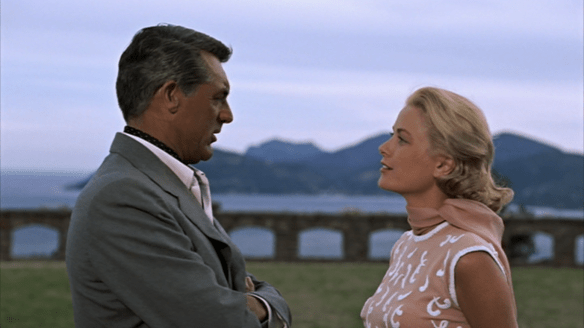
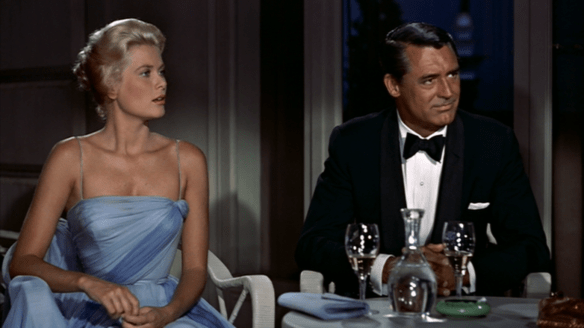
There’s little doubt that To Catch a Thief is Hitchcock at his breeziest and with the once-in-a-lifetime pairing of Cary Grant and Grace Kelly the picture could coast on looks and charm alone. Not simply based on the attributes of its stars either but the extensive on location shooting boasting Cannes shorelines colored in VistaVision and sumptuous flyovers of the winding Riviera, villas and all. It’s a scintillating getaway and a fine departure following the nerve-wracking confinement of pictures like Dial M for Murder (1954) and Rear Window (1954).

Thankfully while it is supremely light entertainment there’s something else to it as well. A rash of copycat crimes has taken place all across the Riviera leading the local police commissioner to suspect reformed cat burglar and French Resistance hero John Robie (Grant). Though the slinking and perfectly executed jewel heists bear the mark of “The Cat,” he’s the best one to acknowledge his own innocence.

Still, that doesn’t stop the police from questioning him nor his old war comrades working at a French cafe to begrudge him for what they deem as an affront to them. They want nothing to do with him. And so with things as they are, Robie must try to exonerate himself by verifying his innocence. John Williams proves the perfect accomplice as a generally agreeable chap from Lloyd’s of London who has vested interest of his own in catching the real culprit in order to recover his client’s assets.

Their introduction could not be more memorable culminating in a tussle in the flower market in Nice with bouquets flying every which way, the local authorities in hot pursuit. From there Robie floats away from the police soaking in some sunbeams as he devises his plan of action. But already we see the dangers as he must essentially play the thief, casing the joint, getting close to the jewels and their owners but all in the name of personal vindication.

What follows is a fortuitous meeting around that whirling pickpocket — the roulette wheel — where Robie makes a dashing entrance. Actually, make that a purposefully inept showing dropping a chip down a lady’s front. What follows is a fairly haphazard routine as Oregon lumber magnate Conrad Burns trading pleasantries with his newfound acquaintances.

to catch a thief 1.png

Jesse Royce Landis knocks her scenes out of the park allowing Grant and the others to laugh along amusedly due to her affinity for bourbon and straightforward speech.  Her daughter Francie (Kelly) tries to maintain her own dignity as an aloof beauty bred on finishing school.

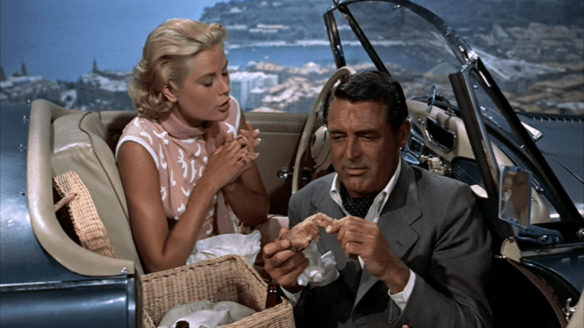
However, she’s more forward than she lets on leading with a wordless smooch in the doorway on her way to bed that begins the chase. What becomes rapidly apparent is the fact that she knows what she wants and doesn’t waste any time pursuing it. First, there’s a jaunt on the beach, then a picnic, and numerous other little romantic getaways perfectly constructed for romancing.

By now the double entendre of the title comes into full relief. On one level Robie is trying to catch someone and Francie is trying to catch him. Charade (1963) would provide a similar dynamic with the woman becoming the huntress out for love. But it’s true that the ravishing gal has a jackpot of admirable qualities which Robie nevertheless tries his best to avoid. Just as he tries relatively unsuccessfully to dodge her flurry of probing questions before finally resigning himself to beer and fried chicken.

to catch a thief 6.png

I’m the first to admit I’m the least fashion-conscious person around but there’s little denying the iconic nature of Kelly’s coral top during the picnic scenes with Grant. Again, the outfit realized by renowned costumier Edith Head is only rivaled in my admittedly meager estimation by Audrey Hepburn’s Little Black Dress (conceived by Hubert de Givenchy) in Breakfast Tiffany’s (1961) during her early morning window shopping.

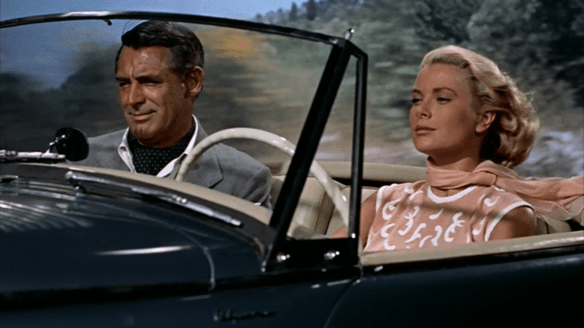
The country road car sequence is a fine summation of the film’s general balancing act of John Michael Haye’s scripting with Hitchcock eye for the visual. It’s broken up by the glib interplay between our stars and yet proves silently comedic with knowing gazes and the dodging of pedestrians and roosters as the police tail close behind Francie’s sporty Sunbeam Alpine.

Though the same scene is underlined with a bit of morbidity as Princess Grace would die in a car crash years later as Princess of Monaco brought on by a sudden stroke which occurred not far from where the film was shot. It’s a tragic moment that left a dark blot the world over.

to catch a thief 7

But for now, the picture is effervescent only bounded by fireworks with the impetuous blonde intrigued by this man who she easily pinned as “The Cat” despite his constant rebuttals. She wants to be a part of his game too, all the while entrapping him with her divine loveliness.

Now’s as good a time as any to marvel at the character of John Robie who must have been made for Cary Grant precisely. At first, it’s easy to surmise that he’s supposed to be a Frenchman who can barely speak any of his native language. However, that would disregard the randomly assorted tidbits scattered throughout the film. For one, he’s said to be an American on multiple occasions. Except as Francie notes, “you’re like an American character in an English movie.” Robie even notes he once toured Europe with a troupe of acrobats, not unlike a young Archibald Leach.

The picture is also littered with what can only be termed touches of Hitchcock whether tops of umbrellas, policemen playing hacky sack on the job, or cigarettes stubbed out in eggs instead of ashtrays.

But back to the action. The final game of cat and mouse is proposed to trap the clandestine specter who has been absconding with all the jewels. It comes down to a decadent Louis 15th extravaganza frequented by the social elite and costumed policemen milling about amid the guests. Robie is waiting to pounce and takes to the rooftops to have it out once and for all!

We think we’re in for one last perfunctory car chase instead Grant and Kelly receive their final rendezvous at a villa which proves far more thrilling. The plot generally took a backseat to the stars anyways even for a Hitchcock movie. We leave them as they embrace with Francie exclaiming, “Mother will love it here!” and Grant’s quizzical look barely visible past his costar’s shoulder. That’s priceless. How could we have more fun than this?

4/5 Stars

Review: The Lady Vanishes (1938)

The-Lady-Vanishes-1938.jpg

Though he would make Jamaica Inn the following year, it’s undoubtedly The Lady Vanishes that situated Hitchcock for the move to Hollywood as his last great British film showcasing once more his immense aptitude as a storyteller no matter the resources on hand.

At the beginning of the proceedings, an avalanche makes accommodations at an inn, hidden away in Europe somewhere, rather sparse and it makes for strange bedfellows and noisy neighbors. Among them are the prized comedy duo Caldicott and Charters (Naunton Wayne & Basil Radford), a pair of quibbling cricket enthusiasts. Meanwhile, radiant Iris Henderson (Margaret Lockwood) is just coming off a glorious vacation with a couple girlfriends as she returns to get married to her fiancee.

Dame May Whitty makes a fine showing as a rather whimsical eccentric, playing the role of a kind-spirited governess enjoying some time in the land she deems a little slice of paradise. In one off-handed comment, she notes with bright eyes, “I don’t think you should judge any country by its politics. After all, we English are quite honest by nature, aren’t we?”

It’s a passing line that suggests Hitchcock’s own indifference to politics. He briefly touches on the political climate at the time but never looks to go in depth and make some grandiose statement about the state of affairs in Europe. That is not his sentiment. Instead, he takes the natural climate of the times utilizing them for the sake of his narrative.

Things couldn’t be more delightful for them both in their encounter and yet the overcrowding is far from agreeable as an obnoxious neighbor in the attic (Michael Redgrave) unwittingly serenades the entire floor below him with an atrocious melody. It pales in comparison to the beautiful vibrato Ms. Froy was met with on her balcony nor is it quite as significant.

Of course, it’s Iris that Gilbert Redman really perturbs especially when she gets him ejected by the manager only to have him turn right back around and make himself at home in her suite. Thus, we have a bit of initial friction at home in a rom-com soon to be turned into a delightful mystery escapade with splashes of intrigue and absurdity.

The largest and most enjoyable leg of the adventure takes place onboard the train but it only works because of a seemingly inconsequential development. Iris is positively swimming after an ill-fated brick conks her on the temple and she is helped onto the train by Ms. Froy who tells her to rest up.

Iris obliges. Except when she awakens her lady companion is not in their compartment. She’s nowhere to be found. In fact, everyone that she interrogates corroborates that they never saw this kindly old lady. She must not exist. Just like that the game is afoot as our heroine endeavors to track down her friend and stave off the impending doubts that this woman was only a figment of her imagination.

It’s these perplexing developments that feel rather like a conspiracy. Still, it’s hardly that type of thing at all. It’s the very fact that all these people are humans — they’re selfish –with different self-serving motives for keeping up the charade. The clandestine couple with the man looking to stay conspicuous and a woman not minding a little bit of scandal.

The Cricket aficionados bent on getting to their match in time along with a whole host of others. Meanwhile, the psychiatrist (Paul Lukas) points out that Ms. Froy sounds vaguely like Freud and must simply be the inner workings of Irises subconscious. Of course, that’s only an easy way to explain away what is actually happening.

She likens Gilbert (Redgrave) to the dog that follows her around and it’s true he quite faithfully stays by her side even taking up the mantle of her investigation. Soon they’re traipsing around like a maladjusted Holmes and Watson, Redgrave going so far as to don a deerstalker as Lockwood coughs and passes him a pipe in utter parody.

They end up making quite a ruckus in the magician car full of hats, rabbits, and boxes with false bottoms and for the added fact that they get into a bit of a scuffle. But that’s only the beginning. Because, of course, what is a Hitchcock film without a little bit of international espionage? But once again he brings it into the world of tourists and well-to-do British subjects who have no right to be in such a scenario.

Factions form and the remaining passengers look to make a break for it amid a gunfight with foreign adversaries. Never before has there been such a droll reaction to a gunshot wound. A very Hitchcock moment without question.

The Lady Vanishes fits into the long lineage of Hitchcock with similarly high profile sequences from The 39 Steps (1935) to Shadow of a Doubt (1943), Strangers on a Train (1951), and North by Northwest (1959) but for the amount of time spent aboard, this picture is his most formidable train film.  It uses the very motion and sound of the steam engine to add crucial momentum to the plot.

Hitchcock speeds events to their conclusion and once more we find that in many cases our objective was utterly pointless, even throwaway, but it did give rise to one of the great thrillers of the 1930s. Part of the film’s unequivocal success comes from drawing equally from the wells of comedy and suspense. The laughs are ever present but far from being to the detriment of the drama they only augment the action, adding to the contours of our characters and pointing out the sheer ridiculousness found in this plotline. It’s wonderful.

4.5/5 Stars

Young and Innocent (1937)

young and innocent.png

We meet the faces of a man and a woman bickering furiously. Another young man finds a limp body awash on the beach. He runs to get help but two young girls see his response of fleeing across the sand and believe what any normal person would believe. He’s leaving the scene of the crime. Their screams are personified by seagulls a fitting precursor to The Birds years later.

Soon film star Christine Clay covers the tabloids and the fellow finds himself on trial for murder. This is the groundwork for Young and Innocent and we have yet to even meet our heroine.

There’s a bubble-headed lawyer who’s a very nice sort but, nevertheless, a bit of a country bumpkin. Not much for such a high profile case. Thus, no one can blame the accused for fleeing the courtroom in a brief moment of tumult. Hitchcock even finds time to pose as a cameraman outside the courthouse. But more importantly, the wheels begin turning as the fugitive Tisdale calls upon the reluctant help of the local Constable’s daughter Erica Burgoyne.

Erica has become a bit of a matriarch in her family of boys and she’s learned to be a mother, a daughter, and so much more for her father and brothers. Yet soon she’s seemingly become an accessory to an assumed criminal in helping him escape. Because at the core of this story, is a variation on the Hitchcock motif. There are two innocent people on the run trying to get away including Erica who gets whisked away in the moment.

The MacGuffin set out for them to pursue is a purloined raincoat. With it comes the promise of exoneration of the wanted man. But outcomes are never that easy nor the road getting there. It leads to a row of diverting events from a brawl at a roadside rest stop with the local population of bums and even a kiddie birthday party where Erica crawls with anxiety for harboring a wanted criminal in her auntie and uncle’s home.

The story devolves into an entertaining cross-country chase, but in this particular case making its way through the countryside and to a proverbial abandoned mine shaft. These very quaint locales and the small town feel with bumbling policemen and bickering lads around the dinner table make this one feel like one of Hitchcock’s overtly “British” films or maybe one of his most stereotypically British efforts.

Some visual flourishes include a cliffhanger moment captured in typical jarring fashion and equally enjoyable is a fairly expansive crane shot that carries us through a hotel focusing on a certain person in question. Our plucky protagonist has called upon the services of an old hobo to identify the man who contacted him — the man undoubtedly implicated in the murder. Such a scene is pure Hitchcock, directing our gaze in such a way that the image he places in front of us is unavoidable. There’s no doubting his intention and he lays everything out for a fine conclusion.

Blackface aside as a horrible cultural anachronism, this picture comes off well today with Nova Pilbean coming into her own as a charming protagonist who boasts smarts and a disarming drive even as she gets whisked along.  Previously she played a crucial role in Hitchcock’s earlier thriller The Man Who Knew Too Much, but here she’s one of the undisputed stars and she and Derrick De Marney have a solid chemistry working. Of course, it’s not that customary to come to a Hitchcock picture for true romance. Still, Young and Innocent is indubitably worthwhile for aficionados of “The Master of Suspense.”

3.5/5 Stars


Sabotage (1936)

Sabotage1936.jpgSabotage: Willful destruction of buildings or machinery with the object of alarming a group of persons or inspiring public uneasiness.

It’s not exactly a titillating introduction but since this is precisely where this 1930s Hitchcock thriller commences so will I.

Again, Hitch is collaborating with Charles Bennet and of course Alma Reville (his wife) core members of his team by this point. I do find it funny that it came from a novel called The Secret Agent, the name of one of Hitchcock’s earlier entries, only to be changed to Sabotage. But it only goes to show how throwaway some of these titles were because they are hardly reflective of the genuine satisfaction in partaking in what is trying to be accomplished.

The inciting incident of the entire film involves the power grid going out all across the city. Some people assume it’s a freak event but those embroiled in national security and connected with Scotland Yard know there are far more ominous intentions. There are men looking to undermine the nation through systematic acts of sabotage and ultimately terrorism.

From our perspective, these were obvious harbingers of impending world war. In that climate, they were probably quite close to home. This film occupies itself with a single individual as he’s tailed by a government agent with his adopted family (Sylvia Sidney and Desmond Tester) acting as his convenient alibis because he’s been nothing but good to them.

One telling statement comes from the little boy when he’s talking aloud excitedly about gangsters and the like.  Because gangsters look quite ordinary, just like you and me and it’s an offhand comment but he doesn’t know how right he is. This is another textbook Hitchcock scenario because this is by no means a mystery. We know from the opening shot who the perpetrator is. But Hitchcock uses that modicum amount of knowledge to grab hold of his audience.

Similarly, he uses the tried and true example he mentioned in his dialogue with Truffaut. Having two individuals talking before a bomb blows up isn’t inherently suspenseful but if you show your cards early you’ve instantly ratcheted up the tension. He does that here immaculately aboard a double-decker bus.

Although even then it would be hard to favor Sabotage over some of his other works even those that are part of his thriller Sextet. It’s really a fairly minor addition and though Sylvia Sidney is as candid as ever she’s hardly meant for a Hitchcock film. Oskar Homolka and John Loder aren’t bad per se but they’re hardly as compelling as a Peter Lorre or Robert Donat.

Though the terrorists might look slightly different and their motives are more political than any other, there’s this uneasy sense that there is very little that is new under the sun. It’s telling that Bennet’s screenplay was loosely adapted from a Joseph Conrad story which was itself focused on sabotage in the late 19th century perpetuating this idea that certain stories are truly timeless.

Reading Walt Disney’s name in the opening credits might be a pleasant surprise for some and as might be expected, since this story does take place partially in a cinema, they show a cartoon short, seeming to be a harbinger for Sullivan’s Travels (1941) except in this story the main character gets shot with an arrow — very much a Hitchcockesque spin on animated cartoons if there ever was one. There can be humor but it’s always underlined by a sizable dose of dread.

3.5/5 Stars


Rear Window (1954): Visual Cinema and “Lisa”

rear window 1.png

There are such a vast number of levels to appreciate Rear Window on and one of those is its impeccable use of sound as well as a score courtesy of Franz Waxman. In fact, it is quite easy to consider it as a film with a wholly diegetic soundtrack but it’s really a complicated weaving of sound orchestration playing against the images onscreen. For instance, against the credits, as the blinds come up, we’re met with the playfully cool jazzy beats of “Prelude and Radio” which proves to be in perfect juxtaposition with the deathly hot heatwave hitting Greenwich Village in the film’s opening moments.

We’re also inundated with all types of songs popular and otherwise which can be picked out of the story organically if you’re paying attention. Two of the most obvious additions are “That’s Amore” and then “Mona Lisa” which can be heard being sung by a group of party guests.

Whether or not it’s a slight nod to our heroine Lisa is up for debate but it’s also notable that she, in essence, receives her own theme song which is concurrently composed by the songwriter who lives in the courtyard that we come to know over the course of the film. It slowly involves from its nascent stages into a full-fledged tune that gains its wings once the romance between Lisa and our protagonist L.B. Jefferies has come into its own.

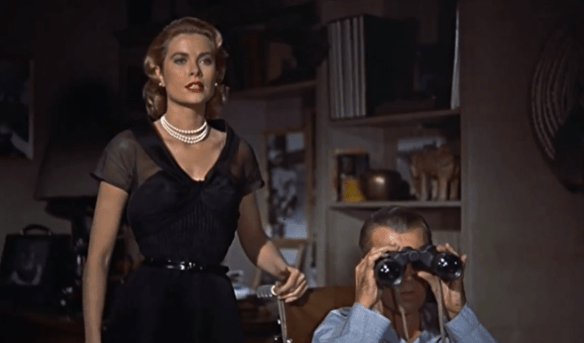
Obviously, beyond the elements of soundtrack Rear Window develops so immersive a world and Hitchcock expertly inserts us directly into the environment to the extent that we have no choice but to become involved in the whole ordeal. We are accomplices, if you will, in this viewing party of Jimmy Stewart’s.

It truly is an exhibition in the moving image because the film works so brilliantly with them. Certainly, it begins with the staging and the complex setup Hitchcock had to work with at Paramount Studios but there’s simultaneously the use of color cinematography, the lighting of the stages which sets the scene given the time of day, and common street noise that lends an almost imperceptible authenticity that we take for granted.

Furthermore, working with his long trusted photographer Robert Burks you see Hitchcock moving so fluidly and with so much purpose through the playground provided him. The camera captures objects with clear intention and a crispness that far from simply giving us the illusion of being in the space, in many ways, makes us feel like we are actually right there with Stewart looking out into the courtyard.

You also get the true essence of what visual filmmaking is because his powers of suggestion and even persuasion of the audience are impressed upon us by what he deems important. Hitchcock lays out nearly all of Stewart’s backstory not with clunky expositional dialogue but by giving us a wordless parade of his apartment while our protagonist sleeps. And the whole picture is a constant rhythmic cadence of being fed images followed by Stewart’s reaction shots. It’s Film at its primacy. Where two images put together are blessed with so much more meaning and suggestion than they could ever have alone.

But far from simply marveling at what Hitch has accomplished it’s far more miraculous that we become so enveloped in this story. It’s an admirable mystery plot chock full of tension that’s built up over time and successive shifts in perception, time of day, and personnel moving in and out of the complex. Our one commonality is Stewart stuck in that wheelchair with only his broken leg, his camera, and the neighbors to keep him entertained. They do far more than that.
rear window 4.png

Rear Window’s A-Plot is a perplexing mystery thriller that we watch unfold with a systematic unraveling that’s unnerving in part because Hitchcock has orchestrated it all in a limited space. Furthermore,  he has handicapped his protagonist and the outsiders coming in are constantly causing us to second guess or reevaluate our assumptions be they the insurance agency nurse Stella, Jefferies’  policeman pal, or his best girl Lisa. Each character is at one point in opposition to Jefferies while also providing a sounding board for his cockamamie theories which start to bear the grain of truth. We get to be a part of it all.

The utter irony is that once more not only is Hitchcock’s villain atypical — in nearly all areas a seemingly unspectacular man — he’s also quite overtly styled after David O. Selznick. If you know anything about the producer he shares some resemblance with Raymond Burr and there’s no denying that Hitchcock was never fond of the other’s meddling. As much as I love the Rebeccas (1940) and his earlier American works if Rear Window was a representation of the hands-off approach to his filmmaking than I would have to side with him.

At least by this point in his career, there’s no denying that he projected a singular vision that could hardly be quelled by any individual. This is “Alfred Hitchcock’s Rear Window,” after all, as the opening credits proclaim.

However, the beauty of this picture is that it truly does stand up to multiple viewings and every repeated viewing offers up new depths or at least minor revelations that add an even greater relish to the experience.

In particular, are the underlining themes of romance. Because this is a film about love in all its many facets with each character or couple reflecting a certain permutation of what romantic love looks like.

The love stories are playing out in each compartment of the apartment complex. Miss Torso, the queen bee with the pick of the drones. She’s very much eye candy but in the final frames, we realize there’s more to her as her love comes back home from the army. There’s Miss Lonelyhearts who is desperately seeking love and yet has enough respect not to stoop below her dignity. It’s a song that lifts her out of her despair. The Newlyweds are still in the honeymoon phase and we never see them.
rear window 2.png

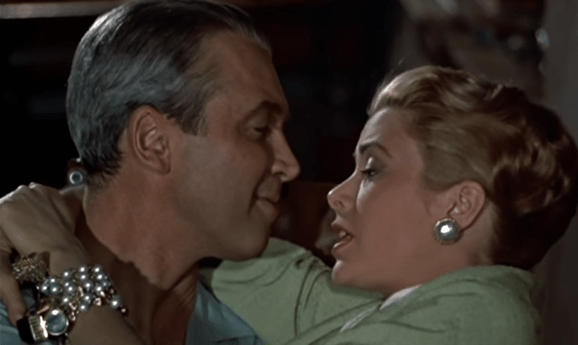
Meanwhile, you have Stella providing her homespun philosophy that people shouldn’t overanalyze their situation. Jefferies is pushing back against any serious romance because in his estimation Lisa is far too perfect for him. Meanwhile, Lisa is left believing she can live in any world that Jeff is in. The list goes on and on.

But for the threads to be resolved that must become fully intertwined with the murder at its core because such an event calls for a response from our characters — at least our main ones. When Lisa sacrifices so much to show her love and devotion to him, he realizes how much he misjudged her character and perhaps more profoundly how dearly he loves her and never wants to lose her. He has made the transition from armchair philosopher and misanthrope to a man smitten with someone else. As long as he ditches the window watching he should be fine.

That leads us to another area of discussion. There’s a bit of a moral commentary present though Hitchcock doesn’t seem all that interested in those conclusions per se as much as he likes manipulating them for the sake of his drama. And yet like Vertigo four years later there is this unnerving sense that he is tapping into some of humanity’s darkest desires to watch and spy on others for pleasure without any consequence or any vulnerability on the part of the peeper.

That draws me to another aspect of the film that I’ve never really considered. Rear Window implicitly asks what it is to be a neighbor or at least what it is to live with neighbors. There’s very little in the realm of actual judgments except for the small condemnation that comes from the woman who lives just above the murderer after her yippy dog has been killed. What does she say?

You don’t know the meaning of the word ‘neighbors’! Neighbors like each other, speak to each other, care if somebody lives or dies! BUT NONE OF YOU DO.

What she provides is a heartfelt and searing indictment which is nevertheless lost in all the commotion whether it’s the big party going on across the way or the realization by our heroes that their theories about murder have been confirmed. It did make me consider even briefly if the so-called Great Commandment is to “Love Thy Neighbor,” what does that look like?

Far from peering in at other people and staying anonymous, it seems like it involves reaching out to others. In some ways, being vulnerable and candid — transparent even — so others feel comfortable entering into our lives. Like Stella says sometimes people need to go on the outside and look in for a change. If nothing else that breeds empathy.

Of course, if that was the case, there would probably have been no murder and that’s what we want right? Well, anyways, Rear Window still stands as my favorite Hitchcock picture and one of the most clinical and compelling thrillers of all time.  But you probably already knew that. If you did not I implore you to break both your legs if need be and go lock yourself in a room and force yourself to watch it right this minute.

5/5 Stars