The Naked Spur (1953)

the naked spur 1.png

James Stewart carries over his persona from Bend of the River (1952) to continually redefine his career in the post-war years. He is a man under a different name who nevertheless is seething with the same raw fury.

In this regard, there are numerous parallel themes in this subsequent collaboration between Stewart and director Anthony Mann culling the recesses of one man’s mind to showcase his unswerving resentment. There’s not an ounce of amiability in the performance which is almost unheard of.

It winds up being a bit of an open-air paradox with gorgeous Colorado visuals which are nevertheless infused with the tension of a near suffocating chamber piece. Because it proves that such an incongruity is possible. Freedom of movement does not necessarily prohibit continually duress of another nature.

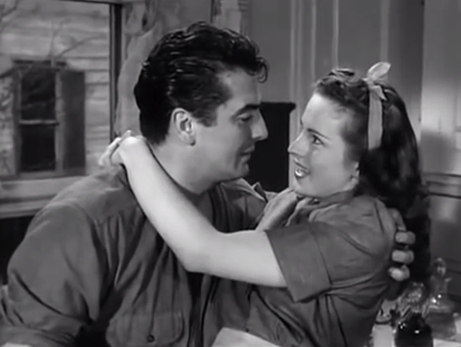
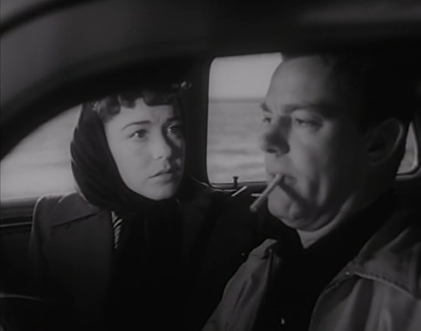
The cast is compact but a mighty group of talent with five individuals that you cannot help but remember. Stewart is the leader in all regards as Howard Kemp who has been tracking Ben Vandergroat for some time now since the other man murdered a Marshall in Kansas.

Millard Mitchell is the crusty prospector, the first man that Kemp runs into, and they form an uneasy partnership with Jesse Tate believing the other man to be a Marshall. It’s true that Kemp is always barking orders at everyone. It continues when a Union soldier helps them scale a rock face and close in on Kemp’s target.

Ralph Meeker always gives the impression that he’s ogling and that distinctive voice that would serve him well as Mike Hammer instantly labels him as a tough customer. His tattered military record suggests something else. He’s not exactly to be trusted as a soldier recently discharged for being “morally unstable,” whatever that means.

Janet Leigh despite her undeniable beauty does well to drop her ingenue image and play a tougher, earthier role as the doting girlfriend of the wanted Marshall-killer. But in her you see much the same conflict as all the other characters. Something is driving them to continue down the road they are traveling. It’s simply a matter of deciphering just what it is.

Arguably most important of all is chortling Robert Ryan as Vandergroat egging Stewart on with continuous catcalls of “Howie” as he commences the mind games that comprise most of the meat of the story. He dispels any misconceptions the other two might have about Kemp. He’s no Marshall and he’s hardly doing this out of the kindness of his heart. There’s a $5,000 reward for the wanted man.

Whether he read his Bible or not, Ben knows enough about human nature and the reality that a house divided against itself cannot stand and he’s looking for any way to pit his captors against each other. Chatting them up constantly and using his girl to try and soften up the other two while scheming here and dropping little remarks there to wheedle under Howard’s skin.

It’s a long stretch of country ahead. Final destination: Abilene, Kansas. He knows as well as they do that a lot can happen in that length of territory. He’s aiming to get himself out from under a hanging tree and so he’s mighty keen to chip away at them as much as possible.

Though he’s very much an instigator, there’s little question that Vandergroat gets some unsolicited help. Anderson’s shady past with a Native American princess means he’s soon caught up in a skirmish with a pack of warriors bent on some form of justice. While initially keeping their noses clean of the whole squabble, there’s finally no recourse but for Kemp and the prospector to get involved. Howard winds up with lead lodged in his leg and he’s hobbling feebly for the rest of the trip.

One must note that the American Indians are utilized solely for their agency to the story. They are not human as our leads are human and that is a shame. Because aside from that major oversight, The Naked Spur is a splendid Western that takes a scenario deeply-rooted in the tradition and yet uses it to more closely still examine the human psyche. Most specifically we see in each character the things that drive them and how men can so easily be weaponized against one another.

Tate immediately gets a renewed hankering for gold when Vandergroat lets him in on a little secret. He happens to be sitting on a gold mine. But only he knows where it is. Then of course, the soldier has a thing for the ladies and is looking to earn some money as much as the next fellow. For Howard, it’s his unbending sense of revenge that he must complete at all costs.

He’s practically dying, plagued by cold sweats and hallucinations but there’s a doggedly resilient quality about him. Proposing cave shoot-outs and fording rivers relentlessly. In a textbook Mann shot of brutality, his anti-hero is getting choked to death rolling around in the dirt only to live to fight another day. That is the ongoing motif that Stewart never allows us to forget for a minute up until the film’s pinnacle.

While not as heralded as a Ford and Wayne type partnership one could argue that Stewart and Mann was a no less important or formative collaboration. The Naked Spur and a slew of other pictures stand as cogent proof.

4/5 Stars
Bend of The River (1952)

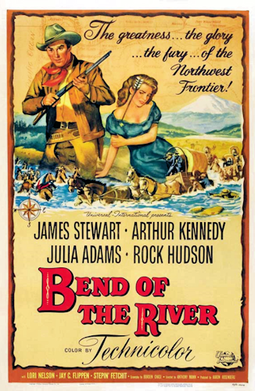
Bend_of_the_River_-_1952-_Poster.pngIn Bend of The River, there are glimpses of the man we knew before the war. Joking and smiling with that same face. The affable charm and so on. But it’s also starkly different.
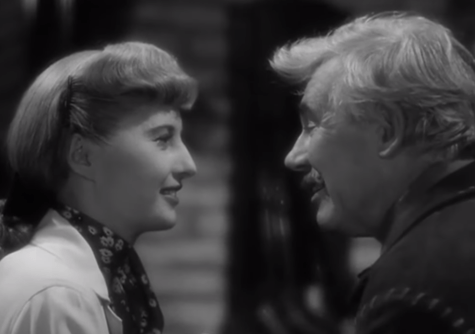
In this picture, James Stewart is on horseback leading a wagon train preoccupied with farming, cattle, ranching, and biscuits. His name is Glyn Mclyntock and this is the life he has crafted for himself.

Of course, when another man comes along to ride with them, a man named Emerson Cole (Arthur Kennedy), they trade glances and instantly know something about the other. Their names precede them as Glyn was once an infamous Missouri border raider and Cole had his own run-ins with the law for similar crimes.

However, no one knows about Mclyntock here and he’s bent on going straight. But with them together we have the perfect case study to test out the theories of one of the leaders of the caravan Jeremy Bailes. He believes a man can never change. “When an apple’s rotten there’s nothing you can do but throw it away or it will spoil the whole barrel.”

But these past sins as they were, give each man a time-tested wisdom about the real West. In one such scenario, they knowingly make talk to a pretty gal about bird calls coming from Orioles indigenous to Canada though they realize at that very moment some Shoshone are circling their camp. They’re ready for them.

The journey continues proving reminiscent of the pilgrims of old and that’s what these pioneers are, pilgrims of the Pacific Northwest. Occupied with grand visions of how they will cultivate the land and help build a prospering life for their families. But there’s also talk of stocking up enough food for the first winter and fears of the impending snows. Supplies haven’t been sent ahead yet nor have they gotten any word from Portland — the town where their supplies were supposed to come from.

It quickly becomes apparent following a return trip that the town has been swept by a frenzy of Gold Fever and things are noticeably different. We are conveniently reminded that it was Man who spoiled the land, tainting it with their many vices including pillaging and killing.

The part of the professional gambler in town — one Trey Hendricks — features Rock Hudson in a growing role as the pretty boy. He hasn’t quite reached true stardom yet but to have him in the picture is another stroke of luck in a project that is positively stacked with talent.

Julie Adams (billed as Julia) plays the main love interest, Laura, who is wounded by an arrow and laid up in the town of Bend only to fall for Cole who quickly took on a position at Trey’s establishment. As Glyn has no rightful claim to her, it looks like the two lovebirds will be married.

Mclyntock hires a group of wage laborers to help him peddle the goods back into the mountains as the riverboat they used before can only get them so far. The most memorable of the lot certainly include Harry Morgan, Royal Dano, and Jack Lambert. What’s more, they have no firm allegiances and their compensation amounts to a meager grubstake.

The uninhibited rage that burns in Stewart’s eyes with insurrection afoot becomes increasingly apparent and he’s about ready to administer a deathblow with one stab of a knife only to be stopped by the shriek of dismay from Laura. It brings him back to his senses but in no way ends his ordeal. Not by a long shot.

When a band of miners in desperate need of provisions is willing to pay an astronomical sum for the goods it all but seals the deal; we have a mutiny on our hands. That’s not altogether surprising; it’s how it goes down that proves a jolt.

But that trademark tension of Anthony Mann just will not leave us be and we find ourselves continually harried to the end of the picture because this mission of mercy is our mission. But again, we are reminded of what man is capable of left to his own devices. Avarice is a deadly beast and it brings out a fellow’s true colors.

Stewart is cast out with no horse and no gun. But he’s relentless in his pursuit. The objective clear and he makes sure his foes know it without a shadow of a doubt.

“You’ll be seeing me. You’ll be seeing me. Every time you bed down for the night, you’ll look back to the darkness and wonder if I’m there. And some night, I will be. You’ll be seeing me!”

First, it’s one man. Then two shots in the night and finally the confrontation that we’ve all been waiting for. Glyn reemerges to take back the supplies aided by Trey, Laura, and Mr. Baile. The bullets fly. The bodies fall into the stream. Horses scamper away. And our two stars have it out for good.

Mann captures it all for the maximum effect, the most striking visuals being contorted faces in the throes of hand-to-hand combat first in a wagon and finally, the bedraggled forms reeling in the depths of the water. It’s so visceral and physical even alarmingly so. But it gets to us.

Is this a western or what? My goodness. The final shots are so Hollywood — the epitome of its Technicolor glories with everyone getting together and evil conquered — but all this cannot quite rub out the images that preceded it. They are blistering with unmistakable antagonism.

Stewart’s performance might seem unprecedented and certainly, it was for all its psychological torment but his characterization is indebted to Arthur Kennedy who draws upon a vitality of his own. Together they make Bend of the River a tale well worth remembering.

4/5 Stars

The Furies (1950)

the furies 1.png

Frenzied opening strings from a score by Franz Waxman assist in introducing a film that positions itself as another textured portrait of the West boasting a pair of grandiose performances from Walter Huston and Barbara Stanwyck. This particular ride down the well-trodden paths takes place in New Mexico where cattle barons ruled the land like feudal lords. At its core is a warring clan and this is their tale of belligerent family drama that sprawls across the plains with a vengeance.

In fact, T.C. Jeffers (Walter Huston) is a man ruling his acreage known as “The Furies” with an equally-suited ferocity. He’s a larger-than-life figure who knows how to throw around his weight; the territory is scattered with his I.O.U.s christened T.C.s.

But his daughter Vance (Stanwyck) is no less imposing, knowing precisely what she wants — his empire — and chasing after it with the full intention of sinking her claws into it someday. When she finds the right man of course. We can liken them to Rockefellers of the West, ruthless while also being fiercely loyal and even generous to their friends. But they are not squeamish about going after their own.

The ensuing melodrama is laced with arsenic braced by Anthony Mann’s usual choices that ratchet the tension. While the scale has grown, his aptitude for projecting a certain raw volatility on the western frontier is no less apparent.

When rugged Rip Darrow (Wendell Corey) ambles into the Jeffers’ home during a lively gathering, Vance immediately tries to win him. It starts with a dance and goes from there.  Far more than a mere pretty face, Wendell Corey holds a grudge that really leaves an impression. He has long felt slighted by Jeffers for ending up with the land he long thought was his own and he gladly gets back at the man through his daughter. Except Vance feels betrayed when Rip takes $50,000 in bribe money never to see her again. That’s the termination of their relationship for good.

But it turns out that T.C. also seeks out companionship of his own and his chosen mate, Flo Burnett (Judith Anderson) proves to be a golddigger who hardly hides her intentions. She receives only Vance’s ire and Ms. Jeffords is not about to let this woman finagle her way into the family business even resorting to violence if necessary.

It’s yet another riff in this power struggle that reverberates again and again. Because this is an unrestrained showcase of opportunistic human beings who glory in their own avarice and pursuit of wealth. People pushing others around and undermining them with little regard for their well-being.

It ends up reaching its absolute zenith with a bloody shootout to push the Hererra Family led by brother Juan (Gilbert Roland) off the Furies once and for all.The skirmish results with one man at the end of a rope and Vance never about to let her father forget what he has done to one of her closest childhood friends.

But it doesn’t stop there because it never can. Not with people such as this. Daughter goes out across the frontier on a vendetta that will pay heavy dividends. She even reconnects with the other man she never wanted to see again. Together they scheme T.C.’s ultimate downfall but as he gets on in years the old warhorse is faltering a bit. His glory days are setting so maybe it’s for the best. One could say that T.C. got his comeuppance but by all accounts, he died a legend. The same cannot be said for many of his adversaries.

I can’t help but juxtapose Devil’s Doorway and The Furies. An interesting reference point is that Robert Taylor and Barbara Stanwyck were still husband and wife at the time but in both pictures, they try mightily to tame the West and hold onto what they believe is rightfully theirs. They have varying degrees of success.

The film also exhibits a racial element much like Devil’s Doorway because though it is rarely talked about, much of the mythology of the West is tied up in the white pioneer’s story. The marginalized folks like Native Americans, Hispanics, and certainly Asians are pushed to the edges of the frame. This film showcases the Herrera family.

Further still, there are an array of strikingly powerful women who exert their control in different ways. Though Beulah Bondi has a relatively small part you quickly realize that women such as her are important figures. Because they carry such crucial sway in the business of their husbands as the voices whispering advice into their ears.

Meanwhile, Judith Anderson while a bit of a tramp nevertheless is forthright and transparent about her intentions. She’s not a complete pushover and that makes a slight tussle with Stanwyck entirely credible.

Obviously, Barbara Stanwyck is phenomenal — one of the few performers who could have pulled off this role much like the matriarch in Sam Fuller’s Forty Guns (1957). It needs someone who is that assured and strong, who carries an unmistakable presence anchored by undeniable beauty. She was blessed with both.

Walter Huston would pass away the same year in 1950 but The Furies compiled his innumerable talents in one last monumental showing that’s a worthy swan song in a veteran career. What a way to go as T.C. Jeffords.

4/5 Stars


The Devil’s Doorway (1950)

devil's doorway 1.png

Right here we see the precise genesis of Anthony Mann as a director of westerns. To consider the string of modest classics that followed is nearly staggering. But he was well-suited for the transition taking his acquired skills over the years and translating them easily to the West.

The Devil’s Doorway is shot like his most gripping noirs thanks in part to John Alton’s continued partnership. Thunder sounding off in the background, low lights, and even lower angles when working in close-ups. Visually he certainly doesn’t pull any punches.

At first, I wasn’t sure if I would care for the picture since I knew next to nothing about it. However, in the first few minutes of expositional action, we learn something that sets up a striking dissonance not only within our character’s identity but in the West itself.

Lance Poole (Robert Taylor) comes back from the Civil War as a man who proved himself on many a battlefield from Antitiem to Gettysburg achieving the Congressional Medal of Honor for his heroics. Strikingly, for someone returning from such a divisive war, Poole has a fairly positive outlook. Except he’s rudely awakened when he comes home and finds that a different type of war is still raging.

This is the time to share the film’s major point and one that is crucial to getting into this narrative from screenwriter Guy Trosper. Poole is a Native American — a Shoshone by birth — but when he fought in the army no one judged him by the color of his skin. He shared food and quarters and fought alongside his fellow Americans.

And yet when he gets back to the land he calls his own, he finds that men have hardly changed even if the times have. White folk look at “Indians” with disdain and if not disdain then probably fear. There’s no sense of wanting to get to know them. Sure, there are a few who remain true to Poole from the old days like Zeke (Edgar Buchanan) and yet even they crumble under peer pressure. That means no drinks served to Indians in the saloon and certainly no owning property.

The Homestead Act is a grand proposition made for dreamers, rallying men to head out to the vast plains out west to stake claim to the territory and settle down. No such provision exists for the ones who have lived on the land all their lives.Under the law Poole’s not classified as an American citizen and what is he, you ask? Well, that’s very much what the picture is trying to address.

Even as desperate men surge toward Poole’s acreage of top land looking to move in, other Shoshone from a reservation, led by their chief (Chief John Big Tree) seek asylum because their current existence is a far cry from their former life of prosperity.

Poole knowing that the way of the white man worked for him during the war tries to seek out honest means of reclaiming his land. He forgoes the town’s crooked lawyer Verne Coolan (Louis Calhern) and calls upon Orrie Master (Paula Raymond); she’s a woman, not a man, which in itself is a statement.

Though reluctant, she takes his case because they need each other. She plays by the book, holding to the assertion that if something’s the law, we have to abide by it. Her faith, her religion of sorts, is the law and she treats it as sacred. But as those roads seem to lead nowhere for a man like Poole just because of the color of his skin, she tries to make him seek compromise — some amount of mutual understanding.

But when you have a bigot like Coolan doing everything in his power to push Lance off his property, such an agreement seems out of the question. Such a diabolical fellow is intent on inciting opposition and manipulating folks so that peace and compromise are no longer viable options.

People such as this are far too prevalent in this world and their philosophies poison the world for everyone. There is no understanding. There is no empathy and Lance is not about to wait around for it. He’s going to defend what he deems to be rightfully his.

Ms. Masters in near desperation sends out a distress signal to Fort Laramie calling on the Cavalry. It is her last hope for any type of peaceable resolution — even if it only stops the bleeding which has already begun between the natives and the homesteaders. We too look on powerless to stop the bloodshed because we are only an audience interfacing with a film. The question becomes what will we do with our reality if we see a parallel issue?  If and when former Union Officer Poole perishes there will be no one to play him “Taps” now will there?

Such a downbeat ending and harsh portrait was not something Hollywood was ready for and it seems that generally, Devil’s Doorway gets a bit buried. I think it’s about time that we all took our medicine and while not a perfect film it might cause one to perceive the Wild West of Hollywood lore with a very different heart.

To say it’s completely undermined by its casting is somewhat missing the point because its intentions are all but honorable and the picture lays in hard to issues that are not simply western issues but are quite easily transposed to post-war WWII, 1950s pre-civil rights America and obviously the present as well.

In fact, it hardly feels like jumping the gun to call Devil’s Doorway cutting-edge because like Broken Arrow (1950) of the same year, it actually concerned itself with the plight of Native Americans. But whereas the other picture is somewhat forgettable now, there’s still an undeniable bite to Mann’s effort. Even the black and white imagery aids in the tone (as well as practically masking a bit of Taylor’s makeup).

Here is a western that stars an “Indian” and an independent working woman who are not even romantically attached to each other. Beyond that, it straddles this line of muddied morality that hardly chooses sides but settles in the gray area that leads us to make some heady considerations.

Far be it from me to strip away visions of glorious gunfights and all-conquering heroes. But if you watch this story unfold — a grim statement of tenacity from Anthony Mann — those myths will be trampled on. You would do well to watch your step and open up your heart just a little bit, hopefully, more than when you first entered in the corral.

4/5 Stars

Side Street (1950)


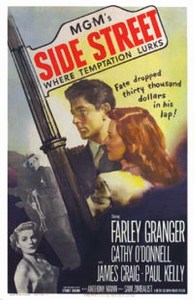
SideStreetposterThough director Anthony Mann later made a name for himself with a string of Westerns pairing him with James Stewart, it’s just as easy to enjoy him for some of the diverting crime pictures he helped craft. Everything from Raw Deal (1948) to T-Men (1947), He Walked by Night (1948), and of course this little number.
Another simple pleasure gleaned from Side Street is the second teaming of the two young starlets Farley Granger and Cathy O’Donnell who made such an impression together in Nicholas Ray’s sensitive drama They Drive By Night (1948)

We begin this particular picture with a flyover of New York City and the “Voice of God” narration comes off as another installment of The Naked City (1947) because it too takes to the streets, shot on location in the city of a thousand stories with thousands more waiting to happen.

There’s something engrossing in this style of storytelling which takes interest in several seemingly unextraordinary, unconnected individuals and then over the course of less than an hour and a half slowly ties together all the threads of their lives into one cohesive narrative.

There are some calling cards of crime pictures including sleazy extortion, a body fished out of the East River, and the police who are working the beats of the case and trying to keep the frenzy of journalists at bay. Paul Kelly and Charles McGraw head up the police procedural angle.

But the man we come to know the best is unassuming postman Joe Norson (Granger), who becomes extra jumpy after unwittingly stealing thousands of dollars when he thought he only swiped a few bucks to buy his wife a mink coat. He’s just a poor, small, unimportant little man in the scheme of things. An “Average Joe” if you pardon the expression. He’s not supposed to be embroiled in such a story. It’s a bigger can of worms than he could ever imagine and there are consequences.

Other people of interest are wealthy businessmen, crooked lawyers, cabbies, bar owners, bank tellers,  journalists, cops on the verge of retirement, nightclub singers, and at least a few ex-cons, all the usual standard bearers.

Joe’s wife is in the latest stages of her pregnancy and shortly her baby is on the way but her husband has made up a fanciful story about a new out-of-town job that’s loaded him with cash. Of course, she has no idea what’s going on and nor does he. He asks a near stranger, the man who runs the local bar to hold the cash for him. He says it’s a nightgown for his wife.

But Joe’s not a criminal. His guilty conscience is too much for him so he goes back to the office to plead with them to let him return the money. Of course, they have as much right to it as he does. What follows is a cat and mouse chase across the city. First, some thugs tail Joe looking for the $30,000. Then, Joe and ex-convict George Garsell look for the bar owner who has all but disappeared and conveniently the money’s gone too.

As the police are also involved, they want both men, believing they are complicit in different murders that have been committed. Joe has just enough time with his wife to explain his predicament. Still, he got himself into this mess and he holds the belief that he is the only one who can make it right.

What follows is a culmination of all the events thus far as all the character arcs begin to bump up against each other. Namely, Joe, a local nightclub singer (Jean Hagen), and the last man that Joe wanted to see, Garsell himself.

Side Street closes out with a lively car chase near The Third Avenue El that predates many of the revered classics from Bullitt (1968) to The French Connection (1971) years later. The full weight of the title’s meaning, subsequently makes itself increasingly clear as squads of police cars look to close in on the criminal’s getaway taxi. Of course, what makes it compelling is the fact that Joe is right in the thick of it all to the very last avenue…with a loaded gun pointed at his head. Thankfully there are no speed bumps in this one.

3.5/5 Stars


Reign of Terror/The Black Book (1949)

reign terror 1.png

Depending on where you look Anthony Mann’s 1949 film comes under two different titles that are both equally apt. Reign of Terror denotes its roots in the French Revolution of the 1790s that saw the ousting of King Louis XVI and Marie Antoinette while putting Maximilien Robespierre at the helm of one of the most ghastly mobs known to man.

Any lover of history can call most everything in this picture into question but that’s almost beyond the point. This is not a tale that claims historical accuracy but a story of claustrophobic intensity that takes an era and builds an intriguing and gritty little drama out of all the sordid, twisted details. Perhaps more importantly than that it begins to draw parallels to the contemporary moment and that’s where the second title comes in.

The black book is the object that causes men to kill and lie and deceive one another because within its pages dwells great power to dictate the outcome of this kingdom on the precipice of something new. Whether or not that proves to be an optimistic direction very much depends on who gains access to said book. Robespierre (Richard Basehart) has lost it, the chief of the secret police Fouche (Arnold Moss) is intent on acquiring it for his own, as is a ring of staunch patriots looking to pilot their beloved nation back toward stability. That is only the main narrative thread. It seems like little coincidence that a black book shares great similarity to a blacklist.

In the 1950s, whether a concrete document existed hardly mattered because having your name added to this industry list was enough. Though not the same as being sent to the guillotine, for an actor or director it was tantamount to the death of a career as many found themselves out of work for years afterward.

While High Noon is often noted as one of the most high-profile blacklist allegories, The Black Book might be one of the most striking since it dares to find a point of reference between volatile and bloody history many years prior and the current reality. There’s nothing subtle about it.

Thus, whatever you want to label it, Reign of Terror or The Black Book, it proves to be a fascinating amalgamation of historical drama, film noir, and political allegory. Somehow it manages to be a low budget epic combining some wonderful talents that go beyond just Anthony Mann but to producer Walter Wanger, legendary cinematographer John Alton, and set designer William Cameron Menzies.

On the whole, it’s an unsentimental portrait comprised of severe low angle close-ups and shadows that spell film noir forwards and backward. It’s deliciously atmospheric, brooding with darkness and matched by ferocious stylized violence that sizzles in every moment of conflict. The sequences in front of the guillotine against the backdrop of the masses even conjure up the frames of Dreyer’s Passion of Joan of Arc and it’s true that this picture ironically recycled sets from Joan of Arc from the year prior.

Looking at film from the perspective of a historian, one of the greatest enjoyments comes when I am able to view content that has a similar theme running through it whether a specific director, actor, genre, or subject. In a flurry of activity, I’ve been able to derive a greater appreciation for the talents of Robert Cummings in particular.

Though this might sound reductive, much in the way that Joel McCrea is called the poor man’s Gary Cooper, Cummings just might be the poor man’s Jimmy Stewart and I say that because he has the same type of everyman quality that’s easy to latch onto.

Although I could never see Stewart pulling off a period role like this and though not entirely authentic, Cummings is a fine protagonist navigating the back alleyways and roads of deception and treachery that dictate the life of a citizen of the New Republic. Even when he does something that might be suspect there’s inherent trust the audience attributes to him.

Meanwhile, stunning Arlene Dahl looks ravishing in period costume but she also becomes a multifaceted companion of Charles D’Aubigny (Cummings) and one of his only points of contact who proves reliable and resourceful. Otherwise, the picture is crammed full of all sorts of characters with varying allegiances and intentions, not to mention cameos from such figures as the Marquis de Lafayette and Napoleon.

If it’s not quite like the blacklist then you figure out how very easily it could be. The film takes so many about faces and turns by the denouement it’s hard to know who is in the right or wrong or more important yet who ended up on the right side of history — the ones who wrote the victor’s narrative — because oftentimes they are the ones who go down as the heroes. Whether that is true or not is up for considerable debate.

4/5 Stars

4 “Good Girls” of Film Noir

I do not particularly care for the term “Good Girl,” because it feels rather condescending toward the guardian angels of film-noir. In fact, on closer research, I’m not even sure if it’s a widely accepted term. However, they are the ones in stark juxtaposition to the femme fatales, acting as the beacons of light leading their men away from the path of destruction. As such, their roles should certainly not be discounted and here are four such women from four classic film-noir.

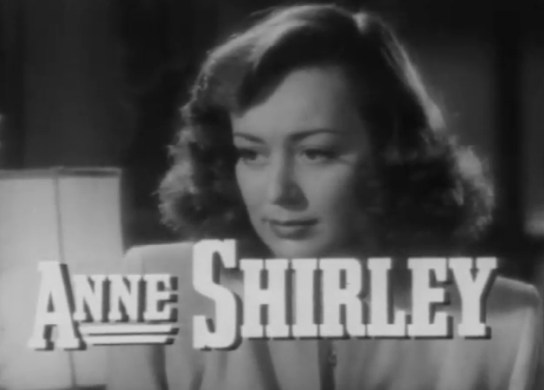
1. Anne Shirley in Murder, My Sweet (1944)

Taking her stage name from the plucky heroine out of E.L Montgomery’s perennial classic, Anne Shirley’s Ann Grayle is the one character of high moral standing in a film clogged with all sorts of undesirables. Even our protagonists Phillip Marlowe (Dick Powell) is cynical as all get out and Grayle’s seductive stepmother (Claire Trevor) cares more about her jewelry than her marriage.

AnneShirleyMurderMySweetTrailerScreenshot1955.jpg

2.Jeanne Crain in Leave Her to Heaven (1945)

Leave Her to Heaven is noteworthy for several reasons. First, it is an obvious example of noir that is atypically shot in color. Furthermore, Gene Tierney gives the most chilling performance of her career as Ellen Harland. However, Tierney’s turn would not be so deathly icy if it were not for Jeanne Crain’s angelic role as her sister Ruth. The polarity of the roles, Ellen’s conniving smile, crossed with her sister’s utter sincerity makes the film work far more evocatively.

JeanneCrainLeaveHerToHeavenTrailerScreenshot1945.jpg

3.Coleen Gray in Kiss of Death (1947)

Of all the “Guardian Angels” the late great Coleen Gray (who passed away last year) was perhaps the sweetest, kindest, most precious example you could ever conjure up. Her role as the faithful Nettie, tugs at our heartstrings. Though she doesn’t have a femme fatale counterpoint, the crazed Tommy Udo (Richard Widmark) more than fits the bill.

kissof1

4.Marsha Hunt in Raw Deal (1948)

Anthony Mann’s Raw Deal is a film that revolves around a man (Dennis O’Keefe) incarcerated in prison with a girl (Claire Trevor) on the outside ready to help him get out any way she can. But it’s the social worker Ann, who we first gravitate towards because she is the righteous one trying earnestly to reform Joe. It is his evolving character, after all, that is at the core of this one.

4a2f4-rawdeal1

T-Men (1947)

fb214-tmen3T-Men looks like it could be a dated 1940s procedural right out of a stuffy newsreel. It’s complete with an omniscient narrator overlaying everything. He gives us all the juicy bits without relaying all the superfluous details because, after all, this is a composite case. Also, a lot of effort is made to bring up similarities with the Al Capone case.  So, in other words, it does feel like a heavy-handed newsreel at times.

However, thanks to director Anthony Mann and the pure cinematography of John Alton, T-Men sheds its shallow top layer and gets interesting.

We are given a bit of dry exposition to kick things off. We are following a couple T-Men named Dennis O’Brien (Dennis O’Keefe) and Tony Genaro (Alfred Ryder), complete with full personal bios, who are called on to infiltrate a counterfeiting ring. They get in with the Vantucci mob and make their way from Detroit to L.A. O’Brien aka Vannie Harrigan goes to all the steam baths across town and finally comes across a man named the Schemer. After putting his phony dough in circulation the plan is set in motion as he gets in with the thugs of L.A. too.

And that’s what the rest of the film entails, with O’Brien keeping his cover, while also staying in contact with his superiors and being joined by Tony, aka Tony Galvani from Detroit. It would be run-of-the-mill if not for a few scenes and Alton’s images as previously mentioned.

One day Toni runs into his wife in the most awkward and potentially deadly of circumstances. A well-meaning friend nearly blows his cover in front of a thug and Mary Genaro (June Lockhart) bravely protects her husband. It’s a painful moment.

All too soon Toni’s in trouble and O’Brien soon after, but he’s almost gotten to the top. The digging and prodding have nearly reached their apex. A bit of luck and some timely police support get to O’Brien soon enough so he survives. It’s a show of heroics and gutsy police work like we have undoubtedly seen many times before.

T-Men is kind of like The Departed without all the thrills and plot twists, and cursing if you want to see it that way. But the images are so moody and beautiful that it’s hard not to at least tip your hat if you had one. Do yourself a favor and see Raw Deal, a film with many of the same components and probably a slightly better payoff.

3.5/5 Stars

Raw Deal (1948)

5453f-rawdeal2Anthony Mann may be most widely known for his westerns often headlined by Jimmy Stewart, but he most definitely honed his craft earlier on. Raw Deal is everything you want and expect from film-noir. Our protagonist is a man who breaks out of the State Penitentiary, you have your potential femme fatale, the moral ambiguity, and most of the other necessary hallmarks.

As a lover of black and white cinematography, Raw Deal is highly appealing with its chiaroscuro, silhouettes, and framing of characters. But after all, that’s often part of the allure of noir.

Claire Trevor’s matter of fact voice-over backed by the theremin is highly effective in dictating the disconcerting mood for the entirety of the film. All our previous predispositions tell us the stage is set for a chilling ending but we can hardly imagine what it is at this point.

After Joe (Dennis O’Keefe) busts out of prison, we get much of what you would expect. A tense manhunt involving a dragnet crossing multiple state lines and a fugitive at large with accomplices. There is violence and melodrama galore as Joe dodges the police while also trying to reconnect with a crooked mob boss named Rick (Raymond Burr), who leveraged an escape attempt so Joe would get knocked off.

With the circumstances as they are, he’s not too keen on giving Joe the 50Gs that he is owed and so Rick wants the fugitive knocked off if the cops don’t get to him first. Put in this light, the film feels analogous to many other noir staples like White Heat, Out of the Past, Gun Crazy or The Big Heat to name a few. However, it has its own wrinkle that makes it interesting.

Joe has his femme fatale to be sure, but the kicker is that there are two dames pulling at his heart strings. Pat (Claire Trevor) is more the dame since she was born in a bad area and has been waiting around for Joe a long time. She’s faithful even to the point of helping him escape, but she’s not the most endearing of characters. Ann (Marsha Hunt) on the other hand is the tender social worker who has been trying to help Joe the legal way. When he breaks out she is taken as a sort of hostage and has difficulties reconciling her feelings for him with what she sees in front of her.

However, he’s certainly not all hardened criminal and so that is part of what makes the rest of the film so interesting. Each character walks the thin line of morality and each one crosses over to the other side even if its only for an instant.

For, Pat the clock continues to tick and her conscience ultimately catches up with her. As the drama reaches its near apex we see Joe’s true feelings, and in a sense, who he has become compared to who he was earlier. However, we cannot help feeling a tinge of remorse in the end. So you see, the film succeeded in doing the near impossible, making me sympathize for Claire Trevor’s character. She seemingly often plays undesirables, but they are never cookie cutter and the same can be said for Raw Deal.

4/5 Stars

“You’re something from under a rock” ~ Ann Martin

Winchester ’73 (1950)

2604e-winchester_73_-_1950-_posterStarring James Stewart and directed by Anthony Mann, this western follows the journey a special rifle takes in the old west. Stewart wins it in a competition but it gets stolen soon after. An Indian trader wins it in a card game only to have an Indian take it. Stewart, his pal, get pinned down with some cavalry by the Indians. They survive and the rifle is given to a young man with a girlfriend after Stewart is gone. A treacherous gunslinger coolly kills for it but then gives it up to the original bandit who claims it as his. In a final mountaintop showdown, Stewart faces off with his estranged brother who killed their father. He wins back his rifle and rides back into town to his friends. This is a good western with an interesting storytelling device. It was a surprise to see Will Geer, Rock Hudson, and Tony Curtis as unknowns.

4.5/5 Stars