L’Atalante (1934)

LatalanteHere is perhaps one of the greatest wedding processions we could ever hope to see. Buster Keaton is more outrageously funny in Seven Chances, but this one is solemn, and somehow still funny in its own way. And that’s what is most striking about L’Atalante (which also serves as the name of the boat of choice). This film seems so serious and strait-laced, you might say, and yet it brims with comedy. It’s the type of everyday comedy that makes us laugh even now. Funny looking characters, odd voices, a plethora of cats all over the place. There’s no way for that to get lost in translation, and it remains quirky and engaging 80 years later.

It also happens to be a beautiful film exemplified by a newly-wedded bride walking the prow of a boat with the fog billowing around her. Or perhaps it’s two lovers embracing passionately and a smile bursting on the face of the woman. It’s so visceral, so engaging in its displays of love, energy, and emotion. In this way, it brings to mind other love stories of the age like Sunrise, It Happened One Night, and certainly the early works of Jean Renoir. Except the thing here is that director Jean Vigo never made another film after L’Atalante. He entered bad health even during filming and died soon afterward in his early 30s, but he left behind a masterpiece.

In short, the story revolves around four main characters living life together on a boat named L’Atalante. Jean is the captain and groom who has picked a beautiful wife named Juliette who is going to share his existence on the sea. His first mate is the weathered and scruffy Pere Jules. He might have a rough exterior, but he and his cabin boy are full of bumbling and buffoonery that endears them to all.

For the two lovebirds, Paris is the enchanting destination for a fantastic makeshift honeymoon, but it also proves to test their relationship from the get-go, since Jean is extremely jealous and a street peddler openly flirts with Juliette. It’s a tragic turn in their love story which leads to Juliette looking for a way home and Jean sinking into a state of depression aboard his boat. That’s what makes their ultimate reunion all the sweeter.

Thus, L’Atalante blends a timeless topic like love with little moments of magic that bubble up from within these scenes. Whether it is Juliette walking the streets window shopping, or Pere Jules giving a lens into his past with all the souvenirs he has accrued over the years. Without a doubt, he was my favorite character. I have never quite seen anything like him.

4.5/5 Stars

Review: Playtime (1967)

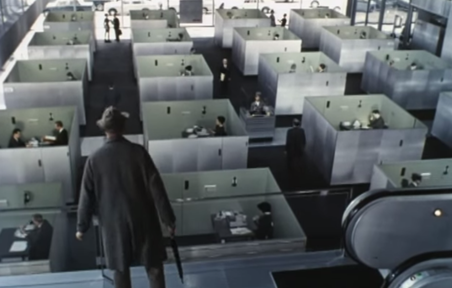
playtime1Playtime is a film that really can be broken into a number of set pieces elaborately constructed by director Jacques Tati. The vignettes begin, surprisingly enough, in an airport terminal, and a group of excited Americans are getting ready for a Parisian vacation. Mr. Hulot (Tati himself) is waiting to have a meeting in a glass office building, however, he soon gets lost in a maze of cubicles, playing cat and mouse with his contact.

Quite by accident, he wanders into an international trade exhibition and the tourists just happen to be there too. While there they are introduced to the latest gizmos, gadgets, and inventions to move society forward. They include silently slamming doors and retractable glasses. In typical Tati fashion, he gives us a glimpse of the old world from Mon Oncle. All that is left is one meager flower stand and a brief reflection of the Eiffel Tower.

Bumping into an old war buddy, M. Hulot is invited over and thus begins a long sequence in an apartment building. What makes it unusual is that the audience is left out on the street, but we can see multiple interiors through the glass. Thus, the conversation becomes unimportant, and the charades inside paired with the street noise is all we notice.

One of the most substantial sequences takes place in a place called The Golden Corkscrew. It is a packed house and the nightclub barely seems prepared for such an evening. Tiles are loose, food runs out, a band member comes late, the chairs leave marks on the backs of patrons, and much much more. Hulot stumbles in and comes in contact with several previous acquaintances. He also makes a few new friends including a boisterous American and a friendly female tourist.

After the crazy night, the morning comes and Hulot says goodbye to his new American friend but not before leaving her with a parting gift to remember her memorable time in Paris. It may not be the Paris of old, but it is still a cheery place made by its people who still remain the same even when the times change.

Jacques Tati’s Playtime took numerous years to complete and it was the most expensive French production at the time. It makes sense though because it truly is a magnificent piece of cinema. It is full of beautifully choreographed sequences and elaborate sets. Mr. Hulot often finds himself wandering through this labyrinth of modern Parisian humanity. Tati teases us, however, filling his world with Hulot doppelgangers.

Even when the gangly protagonist is on screen, he often pops off and on for minutes on end. He is no longer the primary focus of the film. Tati also takes great interest in the sterile modern society of glass, steel, and technology. The screen is filled with a wide array of individuals, which makes it fascinating to simply people watch. Furthermore, Tati almost refuses to use closeups, thus allowing the camera to capture more.

Playtime is slightly slower, to begin with than I remember, but it has wonderfully subdued humor paired with social commentary. Tati’s film may not have a lot of decipherable dialogue, but there sure is a great deal of noise. His sound effects seem to rival The Three Stooges in comical impact, often filling the void usually devoted to talking. It is moments like these where you see similarities to the old silent comics like Chaplin and Keaton.

Playtime is all about the minutiae and these moments are probably exhibited best at the nightclub. So much happens and much of it goes unnoticed, but oftentimes when you pick up on something the payoff is great because you slowly begin to notice more and more. Tati does not have to announce it, but he puts it there to be seen. For instance, there is the fish that is never served but is constantly being seasoned. Then, the doorman who opens the door without any glass. Finally, there is the waiter who gets all the ripped, torn and otherwise ruined articles of clothing. Together all these moments create some immensely funny sequences.

Another thing about Tati’s film. There is really no conflict. He is addressing the changing times, but at its heart, Playtime is just that. Light-hearted recreation.

5/5 Stars

The Best Films of Buster Keaton

1. The General
2. Steamboat Bill Jr.
3. Sherlock Jr.
4. Seven Chances
5. Our Hospitality
6. The Cameraman
7. The Navigator
8. Go West
9. Three Ages
10. College
11. Sunset Boulevard
12. Limelight
13. It’s a Mad Mad Mad Mad World

Not including his shorts

Review: Sunset Boulevard (1950)

f5016-sunset_blvd_title

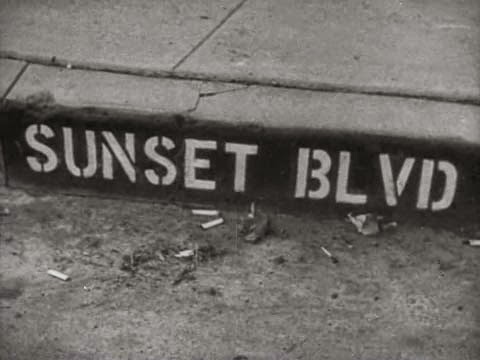
“Yes, this is Sunset Boulevard, Los Angeles, California. It’s about five o’clock in the morning. That’s the Homicide Squad – complete with detectives and newspapermen. A murder has been reported from one of those great big houses in the ten thousand block. You’ll read about it in the late editions, I’m sure. You’ll get it over your radio and see it on television because an old-time star is involved – one of the biggest. But before you hear it all distorted and blown out of proportion, before those Hollywood columnists get their hands on it, maybe you’d like to hear the facts, the whole truth.”

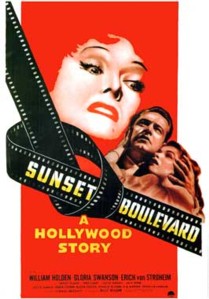
So begins one of the most caustic dramas ever constructed in Hollywood, or about Hollywood, and it was gifted to us by screenwriter-director extraordinaire Billy Wilder. His previous hard-edged film noir Double Indemnity had its own cynical narrator with a memorable voice-over of his own. However, Walter Neff was only on the verge of dying. When we hear the voice of Joe Gillis he is already speaking from the grave. It is a fantastic angle in which to look at this seemingly perfect Hollywood construction, and Gillis never ceases to tell his story until we wind up at the pool as the story comes to a close.

For now, we learn that six months back Joe (William Holden)  is a writer who is having difficulties being published, and some men want to repossess his car. Desperate, he pays a visit to a friend at Paramount named Mandrake to pitch an idea, but the script is of little merit according to a pretty young script reader. That’s a dead end so Joe leaves, but the men are waiting for him and he zooms away. A flat tire leads him to drive away into an empty garage connected to a dilapidated old mansion on Sunset Boulevard. 

There he is mistakenly introduced to drama queen Norma Desmond (Gloria Swanson) who used to be big on the silent screen, back in the day. Now all she has is money, fan letters, and old memories to rehash, while her butler Max (Erich von Stroheim) watches over her. The theatrical actress believes her big comeback is soon at hand, and when she learns Joe is a writer, she takes an interest. He needs the money so he takes a look at the rough script meant to be a vehicle for her. A small commitment turns into a life-consuming undertaking. Desmond constantly hovers and dotes over Joe, going so far as having his things moved into her home and buying him new clothes and trinkets. He reluctantly accepts the first class treatment, not minding the cushy lifestyle. But to Norma, it’s more. 

He is her closest companion. Her love. Joe cannot bear to tell her that she is washed up and that there will never be anything between them. He ditches her intimate New Years party for a more friendly affair where he crosses path with his old bud Artie (Jack Webb) and his girl, the previously critical script girl Betty Schaeffer (Nancy Olson). She takes an interest in a few of his past ideas, but he does not, and after getting shocking news from Max he is pulled back to his lavish prison.

Eventually, Norma is prepared to drop off her script with her former collaborator the great Cecil B. DeMille. However, it becomes all too clear that her story will amount to nothing, but her friend cannot bear to break her heart. She is sent off again with the strong conviction that her day is coming. Makeover’s, diets, and facials follow in preparation. Joe is indifferent to it all and secretly begins working at nights with Betty on a new screenplay. 

Desmond finds the script and jealousy takes over, causing her to call Betty to ruin the romance that is rapidly budding there. Joe hears it all and angrily tells the disbelieving Betty to come see his set-up on Sunset Boulevard. He acts as if he likes the life, and Betty leaves broken-hearted. Soon after, a fed-up Joe packs his bags to head back to Ohio. Thus, begins the systematic breakdown that we had expected for so long. Norma Desmond completely falls apart and does the one thing she knows to hold on. 

Back in the present the crowds and journalists have turned out to see the has-been movie star who is stark raving mad, and one last time Norma does not disappoint. She glides seamlessly down the stairs with a serenely ethereal look on her face before preparing for her closeup. So ends the career of one Norma Desmond and the life of Joe Gillis. We can only hope that Betty got together again with Artie, otherwise this would remain one of the bleakest tales of all time.

However, that is part of the power of this film. It is strangely dark and ominous. Franz Waxman’s score is fit for a Gothic melodrama and Desmond’s mansion is a creaky old foreboding castle that hardly sees the light of day. Max is a solemn figure who we learn brought Norma stardom, married her, got divorced, and then could not live without her. Joe Gillis gets caught in a cycle he cannot get out of, and in the middle of the whole mess is Desmond herself. She is so preoccupied with herself, so obsessed with her own former glory, and yet she is a lonely, insecure aging actress. In many ways, she is Citizen Kane’s female counterpoint. A person with so much money, prestige, and power who slowly drifts away into oblivion without anyone caring except ravenous journalists. Much in the same way, although Norma is so petty and vain in so many ways, I cannot help but feel sympathy for her sorry existence. She is an utterly pitiful person in the end. No one deserves her fate.

In this way, Sunset Boulevard seems to critique Hollywood, a place that makes stars like Norma Desmond and spits them back out just as easily. It is not easily figured out or understood it just does at is pleases. For instance, Billy Wilder became an immigrant writer and director of great repute. Cecil B. Demille was a longtime respected director. Erich von Stroheim had early success with silent films then had to turn to acting. Gloria Swanson was a silent star then struggled in the 1930s. William Holden broke out in the 30s, hit his peak in the 1950s and continued to act into the 70s. Nancy Olson went on to make a few classic Disney movies and Jack Webb, of course, went on to create the TV Show Dragnet. Each Hollywood career starkly different from the others. 

 There is also such an authenticity in this film so much so that sometimes the line between fiction and reality is blurred. First, Wilder cast Gloria Swanson to play former silent star Norma Desmond in the film, so it seems like she is playing herself (Complete with old promotional photos and silent footage). He also had appearances by both von Stroheim and Demille, who had each directed Swanson in her silent days. Some of Desmond’s bridge friends include other real silent stars including Anna Q. Nilsson, H.B. Warner, and the legendary Buster Keaton (His career had also crumbled). Even gossip columnist Hedda Hopper gets into the mix to tell the tragic story of Desmond, and it all works. 

So whether you watch Sunset Boulevard for the Hollywood angle, or as a film-noir, or a love story, or a tragic drama, the beauty of it, is that it functions as all of those things simultaneously. Gloria Swanson is absolutely loopy, William Holden is as cynical as ever with his smoked-out gravelly voice. Von Stroheim is haunting as the faithful Max, and Nancy Olson is the one young friendly face in juxtaposition with Swanson. Billy Wilder’s script with Charles Brackett is inspired a multitude of times, but instead of telling you I will give you a taste: 

“There once was a time in this business when I had the eyes of the whole world! But that wasn’t good enough for them, oh no! They had to have the ears of the whole world too. So they opened their big mouths and out came talk. Talk! TALK!”

That’s Norma Desmond in a nutshell for you. That’s Sunset Blvd.

5/5 Stars

Seven Chances (1925)

seven chances 1We’ve seen a derivative of this story many times before, but thanks to Buster Keaton, Seven Chances has a lot of marvelous comedic moments created by his wonderful physical ability.

The story goes something like this: Boy meets girl and he loves her but never makes his move. Now he has the chance at $7 million if he gets married before his 27th birthday. But that’s today so all he has to do is marry his sweetheart Mary. It sounds so easy until he complicates the whole situation with muddled words and misunderstandings.

Now he only has a matter of time to find another bride. His law partner puts down a line of candidates, and he strikes out each time earning a face full of laughs in reply. Even the secretary and coat attendant turn him down his pitiful plea.

He drives off desperate for a bride and his buddies put an ad in the paper sure to grab him a wife. Jimmy waits patiently at the church, but there’s a problem. Hundreds of women show up and soon turn into a mob bent on clobbering him for making fools of them.

Then and there begins one of the grandest, most epic, and extraordinary chase scenes of all time. Forget Bullitt or The French Connection, this is the seminal chase scene. It’s mind boggling to think how many extras they used and all dressed in drag no less. It is difficult not to marvel at Keaton’s physical prowess because that is where he tops Chaplin. He’s fantastic at scampering about, sliding around, and making pitfalls in general, given the right environment. Soon the world becomes his playground with coattails flying and droves of angry women hot on his heels.

He hitches a ride on the spare tire of a car, dangles from a crane, does frantic Australian crawl across a pond, rides a falling tree, and of course, dodges an avalanche of fake-looking boulders. All I can say is Keaton could have been a professional dodgeball player, but we can be thankful he stayed with film. He was pretty decent at comedy too.

Needless to say, Jimmy gets back in the nick of time, or did he? Of course, he did! It seems like he’s the only one who cannot plant a kiss on the bride. At least he has one now, and Mary is far more important than the money. That’s all that really matters.

Chaplin was great because his Tramp had so much expression. The Great Stone Face was great for the exact opposite reason. He lacked it. His nervous fidgeting or obvious dismay in all situations heightens the comedy making the laughs even more hilarious.

His two buddies are a comical pair in their own right with their differing heights and good-natured blunders. They get caught up in Jimmy’s unfortunate predicament and get knocked about a bit as well.

Keaton may have had greater films, but in his golden age during the 1920s, he could hardly do any wrong. Seven Chance has one of the greatest sustained comedy sequences of any of his films and it certainly does showcase his skills. He gave Chaplin a run for his money, literally.

4.5/5 Stars

Sunset Boulevard (1950) – Film-Noir

This is a great film-noir but more importantly it serves as a biting picture of the Hollywood lifestyle . Billy Wilder created a very interesting film that is well worth watching. It puts a very contrasting pair together and delivers the tale with a exceptional style of storytelling.

*May Contain Spoilers

In this film starring William Holden and Gloria Swanson (real-life silent film star) a down-on-his-luck writer, strictly by chance, finds himself living with a forgotten film actress. From the very beginning he finds her eccentric and her mansion chilling. All the same he agrees to live there in order to edit her movie script and earn some much needed money. Soon she grows accustomed and dependent on him since her only other companion is a butler. Hoping to make a comeback she goes to director Cecil B. Demille but it becomes evident to those around her that things will not work out. At the same time the young writer begins to distance himself as he begins to fall for a young woman writer he has been working for. In a chilling ending someone dies and another goes seemingly mad because the tension has grown too great. This film is very well done from the flashback and narration at the beginning to its critique of Hollywood and the parallelism with real events.

5/5 Stars


The General (1926)

This silent film starring the great Buster Keaton, tells a simple story with comical results. Keaton is Johnnie Gray, a Southern engineer who loves his locomotive and his girl. As it turns out Union spies steal his train, The General, and they also take his love captive. Now Johnnie must track them down and save his fair southern belle. After many a comedic antic, Keaton finds himself behind enemy lines and he is now on the run. However, he does eventually get the girl and then warns the Confederates that the Union forces are coming. Because of his great bravery, he is rewarded with the rank of Lieutenant even though he was not enlisted. Although this film might seem slow to the modern audience, if put in context the, the bouncy score, the slapstick comedy, and Keaton can all be enjoyable. “The Great Stone Face” was one of the few who gave Chaplin a run for his money.

4/5 Stars

Keaton and Lloyd

I have been well acquainted with the films of Charlie Chaplin which always seem to couple romance and comedy so nicely with the character of the Tramp.

However, I had seen very little of Buster Keaton and I had only heard of the name Harold Lloyd. Recently I have finally had the pleasure of taking in more of their work and I must say I have a new appreciation for them. With their respective films it is understandable how they were able to give Chaplin a run for his money. Keaton always appears as a solemn figure whether he is a Confederate soldier, a detective, and so on. He does not try and win our sympathy or affection but he is always determined to take on whatever his world throws at him. His various hilarious and often life-threatening antics cause us to cheer for his characters and in turn we also grow to respect Keaton for his talent as an actor and a director. (Recently I have been able to see Sherlock Jr., Steamboat Bill Jr., and Our Hospitality).

Then, there is Harold Lloyd, the number three man of the silent era comedians. Lloyd had his own persona that he developed to perfection. He was the nerdish fellow who always wore the same pair of glasses and the same hat. He makes us laugh because of his naivete and various antics including scaling a building only to dangle from a clock (Lloyd actually only had eight fingers to accomplish this feat because of an accident). This  causes us to empathize with him much like we would with Chaplin, but their styles could never be confused with each other. (I was able to watch Safety Last! and The Freshman).

That is the beauty of these three men because each one created his own legend and so each one is an icon in his own right. People might fight over who is the best of the group, but really there is no comparison since they all went in different directions. Although these films may be an acquired taste, I hope to be able to watch more in the future sometime!