Review: To Catch a Thief (1955)

to catch a thief 10.png

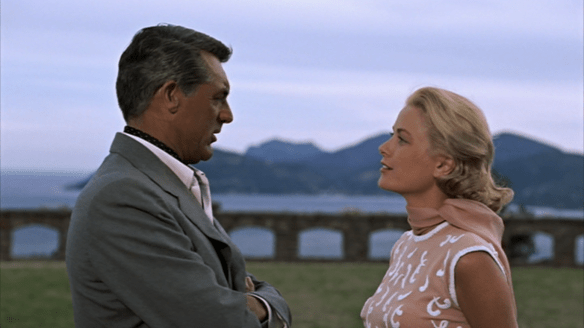
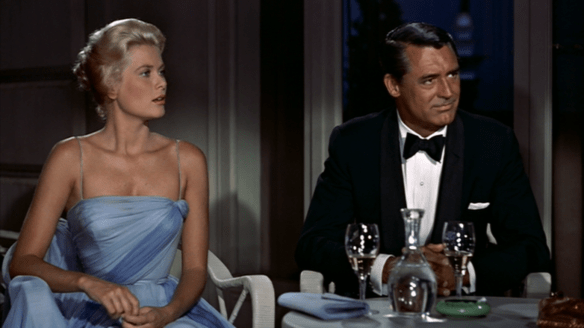
There’s little doubt that To Catch a Thief is Hitchcock at his breeziest and with the once-in-a-lifetime pairing of Cary Grant and Grace Kelly the picture could coast on looks and charm alone. Not simply based on the attributes of its stars either but the extensive on location shooting boasting Cannes shorelines colored in VistaVision and sumptuous flyovers of the winding Riviera, villas and all. It’s a scintillating getaway and a fine departure following the nerve-wracking confinement of pictures like Dial M for Murder (1954) and Rear Window (1954).

Thankfully while it is supremely light entertainment there’s something else to it as well. A rash of copycat crimes has taken place all across the Riviera leading the local police commissioner to suspect reformed cat burglar and French Resistance hero John Robie (Grant). Though the slinking and perfectly executed jewel heists bear the mark of “The Cat,” he’s the best one to acknowledge his own innocence.

Still, that doesn’t stop the police from questioning him nor his old war comrades working at a French cafe to begrudge him for what they deem as an affront to them. They want nothing to do with him. And so with things as they are, Robie must try to exonerate himself by verifying his innocence. John Williams proves the perfect accomplice as a generally agreeable chap from Lloyd’s of London who has vested interest of his own in catching the real culprit in order to recover his client’s assets.

Their introduction could not be more memorable culminating in a tussle in the flower market in Nice with bouquets flying every which way, the local authorities in hot pursuit. From there Robie floats away from the police soaking in some sunbeams as he devises his plan of action. But already we see the dangers as he must essentially play the thief, casing the joint, getting close to the jewels and their owners but all in the name of personal vindication.

What follows is a fortuitous meeting around that whirling pickpocket — the roulette wheel — where Robie makes a dashing entrance. Actually, make that a purposefully inept showing dropping a chip down a lady’s front. What follows is a fairly haphazard routine as Oregon lumber magnate Conrad Burns trading pleasantries with his newfound acquaintances.
to catch a thief 1.png

Jesse Royce Landis knocks her scenes out of the park allowing Grant and the others to laugh along amusedly due to her affinity for bourbon and straightforward speech.  Her daughter Francie (Kelly) tries to maintain her own dignity as an aloof beauty bred on finishing school.

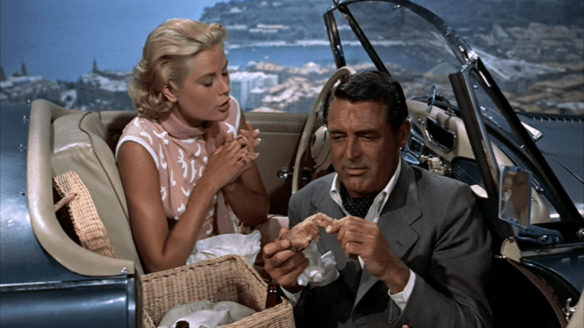
However, she’s more forward than she lets on leading with a wordless smooch in the doorway on her way to bed that begins the chase. What becomes rapidly apparent is the fact that she knows what she wants and doesn’t waste any time pursuing it. First, there’s a jaunt on the beach, then a picnic, and numerous other little romantic getaways perfectly constructed for romancing.

By now the double entendre of the title comes into full relief. On one level Robie is trying to catch someone and Francie is trying to catch him. Charade (1963) would provide a similar dynamic with the woman becoming the huntress out for love. But it’s true that the ravishing gal has a jackpot of admirable qualities which Robie nevertheless tries his best to avoid. Just as he tries relatively unsuccessfully to dodge her flurry of probing questions before finally resigning himself to beer and fried chicken.
to catch a thief 6.png

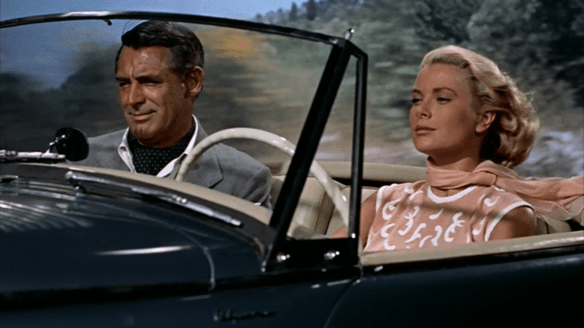
I’m the first to admit I’m the least fashion-conscious person around but there’s little denying the iconic nature of Kelly’s coral top during the picnic scenes with Grant. Again, the outfit realized by renowned costumier Edith Head is only rivaled in my admittedly meager estimation by Audrey Hepburn’s Little Black Dress (conceived by Hubert de Givenchy) in Breakfast Tiffany’s (1961) during her early morning window shopping.

The country road car sequence is a fine summation of the film’s general balancing act of John Michael Haye’s scripting with Hitchcock eye for the visual. It’s broken up by the glib interplay between our stars and yet proves silently comedic with knowing gazes and the dodging of pedestrians and roosters as the police tail close behind Francie’s sporty Sunbeam Alpine.

Though the same scene is underlined with a bit of morbidity as Princess Grace would die in a car crash years later as Princess of Monaco brought on by a sudden stroke which occurred not far from where the film was shot. It’s a tragic moment that left a dark blot the world over.
to catch a thief 7

But for now, the picture is effervescent only bounded by fireworks with the impetuous blonde intrigued by this man who she easily pinned as “The Cat” despite his constant rebuttals. She wants to be a part of his game too, all the while entrapping him with her divine loveliness.

Now’s as good a time as any to marvel at the character of John Robie who must have been made for Cary Grant precisely. At first, it’s easy to surmise that he’s supposed to be a Frenchman who can barely speak any of his native language. However, that would disregard the randomly assorted tidbits scattered throughout the film. For one, he’s said to be an American on multiple occasions. Except as Francie notes, “you’re like an American character in an English movie.” Robie even notes he once toured Europe with a troupe of acrobats, not unlike a young Archibald Leach.

The picture is also littered with what can only be termed touches of Hitchcock whether tops of umbrellas, policemen playing hacky sack on the job, or cigarettes stubbed out in eggs instead of ashtrays.

But back to the action. The final game of cat and mouse is proposed to trap the clandestine specter who has been absconding with all the jewels. It comes down to a decadent Louis 15th extravaganza frequented by the social elite and costumed policemen milling about amid the guests. Robie is waiting to pounce and takes to the rooftops to have it out once and for all!

We think we’re in for one last perfunctory car chase instead Grant and Kelly receive their final rendezvous at a villa which proves far more thrilling. The plot generally took a backseat to the stars anyways even for a Hitchcock movie. We leave them as they embrace with Francie exclaiming, “Mother will love it here!” and Grant’s quizzical look barely visible past his costar’s shoulder. That’s priceless. How could we have more fun than this?

4/5 Stars
Charade (1963)

Charade_2.jpg

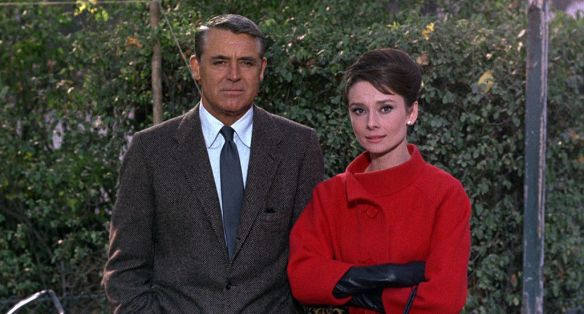
It’s easy to yearn for the days where they made stylish, amusing films like Charade which were equal parts charm, class, and wit all stirred together to perfection. Those were the days when two stars as beloved as Cary Grant and Audrey Hepburn could carry a picture no questions asked because people would turn out to see them no matter the story. And it’s true, though they were never in another picture together, there’s a wonderful chemistry that builds between them and never ceases from the outset of this lithe thriller.

From their first exchange up until their last, it’s hard not to delight in their every interaction, every word, every smirk. There’s a consistent playful patter bubbling up that’s at times suggestive but never loses its sensibilities. There’s a constant twinkle in the eyes of our stars interrupted every now and again by brief moments of sheer terror. Hepburn playing her elegant self but perpetually frantic while Grant exudes his general charisma that sees him through peril as well as innumerable comic situations (ie. an awkward game of pass the orange as well as showers with his clothes on).

Of course, it hardly hurts a bit that Charade has a surprisingly tense plot that while a little flimsy in some areas still manages to have a plethora of twists, turns, and about-faces to come off generally befuddling like many of the most enjoyable thrillers out there.

It all begins with a body getting tossed from a passing train. Regina Lampert (Audrey Hepburn) is on a vacation on a snowy mountaintop away from her husband with a wistful sense that her marriage is done for. Little does she know how right she is. She returns to her residence in Paris only to find all her belongings gone and her husband dead. The police believe it has to do with a missing $250,000 that Lampert was purported to have absconded with during the war. Their guess is that one of his old platoon mates let him have it so they could get the payload for themselves. All of this is news to Regie who was painfully ignorant of her husband’s affairs. And now with it all dropped in her lap, she doesn’t quite know what to think.

The police inspector (Jacques Marin) on one side questioning her and the Federal Agent Hamilton Bartholomew (Walter Matthau) frightening her out of her mind. The only real bright spot is her newest acquaintance Peter Joshua (Grant) and she’s bent on chasing after him before the people chasing after her catch up. Because life, even a spy life, is better with a companion.

Forget the fact that this film has often been attributed to Hitchcock. This is Stanley Donen’s creation and if nothing else it exhibits his admiration for the Master as well as his adaptability taking his own skills as a comedic and romantic director and adding a touch of the thriller to the mix.

He makes it work very well and paired with the typically jazzy score of Henry Mancini, a continually entertaining script by Peter Stone, and generally immaculate color cinematography by Charles Lang, Donen can’t miss.  If it’s not the greatest film if only for the very fact that it doesn’t take itself all that seriously, Charade uses that very quality to its advantage with plentiful splashes of fun and romance.

Audrey Hepburn robed as per usual in iconic creations by Givenchy looks to play the huntress on the prowl. While on his own admission Cary Grant takes the passive role as the pleasant older gentlemen who nevertheless wears many hats and many names. Though Hepburn and Grant undoubtedly take center stage and rightfully so,  that’s not to discount quality character actors like Walter Matthau, George Kennedy, and James Coburn filling in as the deceased Charles Lampert’s old war comrades each carrying a bit of a vendetta.

The surprisingly tense conclusion sweeps through the Parisian streets, subway stations, colonnades, and finally an abandoned theater. But, above all, Charade does well to neutralize its more intense or even grisly moments (at least by 60s standards) with its persistent charm. The type of charm that make those films of old so endearing much like the actors who starred in them.

It’s as if in the twilight years of the studio system some of the greatest names coalesced to gift the world another gem for the road. There certainly were signs of change with wistful mentions of Gene Kelly’s early classic An American in Paris or a passing remark about stamps commemorating Princess Grace’s coronation (which took her away from a brilliant film career). At 59 Cary Grant was aging gracefully but still near the end of his career with only two more pictures to follow. And Audrey Hepburn herself would finish out the 1960s with several notable classics and then she would all but conclude her illustrious career for good.With Stanley Donen still with us, he truly acts as one of the last strands connecting this generation with those Golden Years of Hollywood.

However, the most significant reality is that this film came out in December of 1963, a mere month after John F. Kennedy was assassinated near the Book Depository in Dallas Texas. That singular event more than any other was emblematic of the change that would surge through society and the world at large. That is the world that Charade was born into.

So if you were to use the unforgivable cliche at this point that they “just don’t make movies like they used to,” you probably would be correct because that’s close to the truth. Films like Charade are all but gone and when you actually consider the joy of watching Hepburn and Grant together, it really is a terrible shame, though it simply seems a testament to the rolling tides of change.

Still, there’s something truly magical that occurs when they’re together. They were an altogether different breed of star. Maybe it’s the way they carry themselves, dress, or speak. Maybe it’s the way they look at each other. Maybe it’s their quips. Maybe it’s something else entirely. But they’re two of the greatest we’ll ever know for the simple fact that they were so beloved. They made us love them and as a result, we buy into this entire film. We bought into their charade and enjoyed every last minute of it.

4/5 Stars

10 Films to Watch if You Like Classic Bond

Casino_Royale_1_–_UK_cinema_poster

North by Northwest (1959): It’s no surprise that Alfred Hitchcock was offered the chance to direct Dr. No because he had singlehandedly propelled the spy thriller into the public eye through such classic as The 39 Steps, Foreign Correspondent, and Notorious. It’s also no surprise that he turned down the chance because had essentially made the greatest spy thriller ever. There was no reason to attempt to make another. Cary Grant. Eva Marie Sainte. Bernard Hermann. Ernest Lehman. Mt. Rushmore. Cropdusters. Just a few of the things that make this film awesome. It’s a must for all Bond fans.

That Man from Rio (1964): So there’s no doubt that Philippe de Broca’s film was made in a world conscious of the James Bond phenomenon but it’s also a charming blend of Tintin-esque action serials and wild humor that’s anchored by the charming pair of Jean-Pierre Belmondo and Francoise Dorleac. Its mixture of lavish location shooting, fun-filled action, and consistent humor makes it a must for all Bond lovers.

Charade (1963): By now we’ve all heard that this picture from Stanley Donen was the best Hitchcock film that he never made. Sure, that’s probably true if you want to put any stock in such an assertion but beyond that, we have Cary Grant and Audrey Hepburn starring opposite each other in a spy comedy romance. It sounds like an absolutely delightful proposition and it is. It’s funny as a rom-com but still exhibits enough intrigue to pass as a compelling thriller.

The Ipcress File (1965): Sir Michael Caine as British spy Harry Palmer should be enough to pull audiences into this franchise. But if not that then consider this. Although it was made by some of the minds behind Bond, this franchise was supposed to be its antithesis in its representation of the spy life. It’s the anti-Bond if you will. Funeral in Berlin and Billion Dollar Brain would follow in the subsequent years.

The Spy Who Came in From the Cold (1965): However, if you want something completely different from Bond with a sense of stark realism matched with a cynical edge you probably couldn’t get closer to the mark than watching this thriller based off the work of John Le Carre. Richard Burton is as disillusioned as any spy in the history of the movies and you get the strange sense that he has the right to be. If you looking for another tonal shift in the realm of spy thrillers look to The Spy Who Came in From the Cold. It’s demanding but certainly worthwhile.

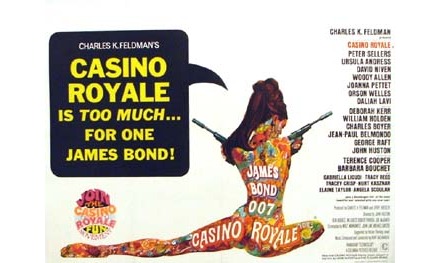
Casino Royale (1967): We’re about to enter the territory of less demanding fare and the epitome of that is this initial Casino Royale (please don’t dare confuse this installment with Daniel Craig’s. Please don’t). All you need to know is that Peter Sellers plays Evelyn Tremble (ie James Bond), Ursula Andress is Vesper Lynd (ie James Bond), Orson Welles is Le Chiffre, Woody Allen is Jimmy Bond…must I go on or do you get the idea? If you had any preconception that this was a Bond movie you were mistaken.

Our Man Flint (1967): James Coburn the tough guy from such classics as The Magnificent Seven and The Great Escape landed his own headlining gig as a spy in his own right. See him in Charade (previously mentioned) and the continuing installment In Like Flint.

Murderers Row (1966): Dean Martin as super spy Matt Helm. Need I say more? Is it any surprise that he’s a dashing ladies man who also seems to like the high life and hitting the sauce. It grabs hold of the Bond phase like any good (or mediocre copycat) although it was based on a number of novels by Donald Hamilton. A number of sequels followed including The Silencers, The Ambushers and The Wrecking Crew.

Austin Powers: International Man of Mystery (1997): Mike Myers as Austin Powers the most ludicrous, wacky, grooviest, and strangely perverse spy you’ve ever known. But his arch nemesis Dr. Evil is far worse. Pit them off against each other and you’re bound to have a stupid good time amid all the outrageous bits of parody. Oh yeah, check out The Spy Who Shagged Me and Austin Powers in Goldmember too. Groovy Baby!

Get Smart (2008): This is a public service announcement. No offense to Steve Carell or Anne Hathaway whatsoever, but please just go ahead and watch the TV show with the iconic duo of Don Adams and Barbara Feldon with Edward Platt. Mel Brooks and Buck Henry were comic geniuses and they knew a good fad when they saw one. Spies might come and go but “Shoe Phones” and “Cones of Silence” will never die. Would you believe? Because you should.

Bonus – Raiders of the Lost Ark (1981) et al: It might not feel exactly like Bond and Indiana Jones is a big enough star in his own right, but there’s no doubt that the special mixture of thrills, humor, and iconic status also falls on the mantle of Dr. Jones. Of course, it doesn’t hurt either that his father is played by none other than Sean Connery the guy who was in Marnie, The Hunt for Red October, and, yes, a few other movies.

This is only a few options so please don’t think you have a license to kill me for leaving something off. But hope you enjoyed this assortment of 10 classic flicks for every Bond lover.

Penny Serenade (1941)

cary_grant-irene_dunne_in_penny_serenade

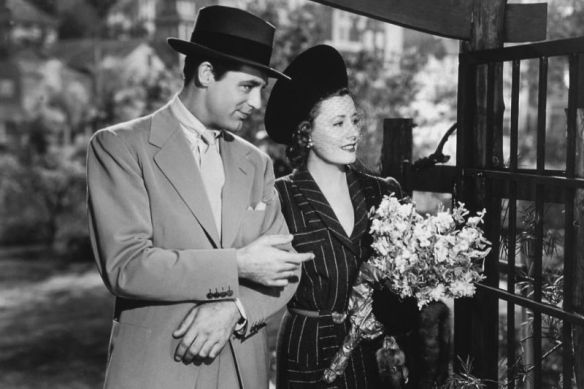
Irene Dunne still remains one of the most underrated actresses of the 20th century. She was both a lively comedienne, an impressive singer, and performed in melodrama better than most. Pair her with Cary Grant and director George Stevens and you have an impressive bulwark to build a film out of.

I disdain the rather condescending term “Woman’s Picture,” but if Mildred Pierce was one of the darkest exemplars of the genre than Penny Serenade might be one of the most heartfelt. It finds its inspiration in the revolving melodies of records on a Victrola. It’s true that music is so very powerful in evoking emotion and it is precisely these songs that lend themselves to Julie Gardiner’s myriad memories. They began when she initially met the love of her life, a budding journalist who was not too keen on getting hitched or the future prospect of having kids. But Roger’s career took him to Asia and he tied the knot with Julie because he was not about to let another man take her away from him.

The rest of the film can best be described as a marital drama concerned with the many moments that make up a marriage. The thrill of the honeymoon period. The little marital tiffs. The tough times when your fledgling self-run paper is not doing the best. The struggles of trying to have kids or wanting to adopt and realizing the process is far more arduous than you first expected. All of these moments can be found in Penny Serenade. But it is one of the sweetest that also becomes the most heartbreaking.

Julie and Roger get the child that they so desire and it’s hard and trying and oh so scary, but they make a go of it and truly revel in being parents. But even that joy is taken away from them. It’s that same pain that shakes the foundations of their marriage just like the deadly earthquake they experienced in Japan. Once more amidst the heartbreaking tremors, there are wonderful revelations and an ultimate resolution that is good.

It’s true that Penny Serenade is overlong, lacking a great deal of substantial conflict or direction but it certainly plays to its strengths. The third time around Grant and Dunne continue their impeccable chemistry that carries the film alongside the direction of George Stevens who always seems to know how to helm both drama and comedy with ease. And the secondary roles are filled out marvelously by the always venerable Beulah Bondi and a noticeably younger Edgar Buchannan playing his usual old softie with a gravelly voice.

So if you’re in a sentimental mood tune into Penny Serenade a film that is less of a classic than a film that rides on the laurels of its main players who elevate the storyline above the normal fray through sheer charisma and ingenuity. While Grant is always remembered as a comedic actor, there are several notable heart-wrenching sequences where he taps into a different side of his persona.  In the end, having Cary Grant and Irene Dunne together again is worth it in itself.

3.5/5 Stars

Review: The Awful Truth (1937)

theawfultruth2The Awful Truth came out of a trend that was in vogue during the 1930s. It’s called a comedy of “remarriage.” During the Hays Code era, it allowed films to nimbly skirt the whole issue of divorce and extramarital romance. We would see it again in the more remembered screwball His Girl Friday and various other forms as My Favorite Wife and The Lady Eve.

However, when I first saw this film I was floored by its pure comic fun that pushed Cary Grant’s persona into the public eye for the first time and made me consider Irene Dunne one of the most underrated actresses that I can possibly conjure up. I try not to use the Oscars to define the greatness of a film or star, but for her, I’ll break the rule. She got nominated for Best Actress 5 times and never won.  To call her a Jean Arthur-type is rather condescending given both stars’ magnitude, and I will say she easily gives Katharine Hepburn at least a run for Cary Grant’s best romantic partner. She was an unexpected joy of beauty perfectly wed with comedic wit.

I was afraid that with that element of surprise gone the film would lose some of its mystique. True, perhaps it was not as magical this time around, but I will still acknowledge the merit of The Awful Truth as an often under-appreciated gem of a comedy. Director Leo McCarey came into his element in 1937 with this film and Make Way for Tomorrow. They are starkly different pictures, but here he embraces the tension, the awkwardness, and everything else that makes comedy transcendent. And there is hardly anyone more transcendent than Cary Grant.

His smirks, which would be recycled for His Girl Friday and numerous other films, are universal. His adeptness with pratfalls and physical comedy are fully on display, and he simply had smashingly good chemistry with Dunne. Every time they throw a jab and the sparks begin to fly you know how much they care for each other, just like two of Ralph Bellamy’s chickens madly in love. A great deal of their success could undoubtedly be attributed to McCarey who gave them very little actual script to work with and forced them into ad-libbing scenes. The results speak for themselves.

In truth, the film begins quite innocently enough before evolving into an utterly acrimonious divorce proceeding, ending with a bitter fight for their prized pooch Mr. Smith (Asta of Thin Man fame). The second round goes to Grant as he plays third wheel with Lucy’s new air-headed, Texas beau Dan (Ralph Bellamy). He makes a new acquaintance of a southern belle who just happens to be a nightclub singer. Her performance is an awkward affair crossing Gone with the Wind with Marilyn Monroe‘s antics in The Seven Year Itch. We could take or leave her little ditty, but the reactions from our stars are priceless. On top of that, Grant shows his tumbling prowess a couple times, while also having a lark with Mr. Smith in the home of his old love and hiding behind doors at all the inopportune times. Lucy can’t seem to get rid of him and by the end of it all, she doesn’t quite want to.

Round three goes to Dunne as she tries to find a way to weasel her way back into Jerry’s life. He’s about to be wed to a high-brow socialite, but Lucy gets into the mix by masquerading as Jerry’s screwy sister. It’s an inspired bit of ditziness that Dunne plays to a tee, being the remarkable comedienne that she is. Meanwhile, the whole well-to-do family looks on rather stink-eyed, as Grant and Dunne spar back and forth. She’s trying to mess things up, he’s trying to keep all the plates from toppling as he attempts to maintain all his covers stories. It’s fit to be a disaster.

The final act is the most wistful because time is winding down and we know what that means. Jerry and Lucy won’t be married anymore. But they both still love each other, they just won’t say anything for fear that this is a one-way street. Happy endings abound in an old cabin in the woods. There, creaky doors, kitty cats, and cuckoo clocks spell wedding bells. And they go out on top, together again, in one bed. Grant and Dunne remained a phenomenal screen couple for a couple more films, but this original offering from McCarey was undoubtedly their best.

4.5/5 Stars

She Done Him Wrong (1933)

shedonehim1“I always did like a man in a uniform. That one fits you grand. Why don’t you come up sometime and see me? I’m home every evening.”  ~ Mae West
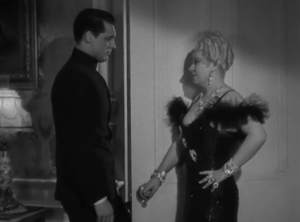
Mae West is a larger-than-life personality if there ever was one. So large in fact that it’s hard to believe she was even a real life person. It’s easy to watch a film like She Done Him Wrong and just see her as almost a mythic figure. Because, honestly this 30s pre-code comedy is only a small trifle at most. Its story is only a partially hewn tale of a gay nineties joint and the nightclub singer that rules its sleazy halls with her diamonds, stoles, and mischievous nature. There are a wide array of men in her life all ages, shapes, and sizes: Noah Beery Sr., Owen Moore, Gilbert Roland, and of course, Cary Grant.

The film gives us this very early appearance from Cary Grant, and he’s the only person close to giving West a run for her money. When they share scenes together they don’t exactly fit together. He’s young, tall, handsome, and playfully refined. She’s full-figured and older, but still glamorous. In many ways, they represent different eras, and this was most certainly hers.

shedonehim2This is her film — her personal vehicle. She rules it that twinkle in her eye and a rapier wit coming from her mouth. Sometimes it’s not even what she says but how she says it (Why don’t you come up sometime and see me?). No one quite has a delivery like her. Whatever she says seems to carry implications and double meanings. In a modern culture that’s overwrought with sexual innuendo and bad taste, West led the trend when it was still in vogue. Back then, it was certainly controversial, but the box office doesn’t usually lie, and West did pretty well for herself, especially during the Depression era. There’s a reason that soldiers named their life vests after her. She was the queen of double entendres in the post-Shakespearian age, and she was ripe in the public consciousness. There was no one quite like her.

3.5/5 Stars

Sabrina (1954) – A Lovely Fairy Tale

sabrina1Sabrina, Sabrina where have you been all my life?  ~ William Holden as David Larabee
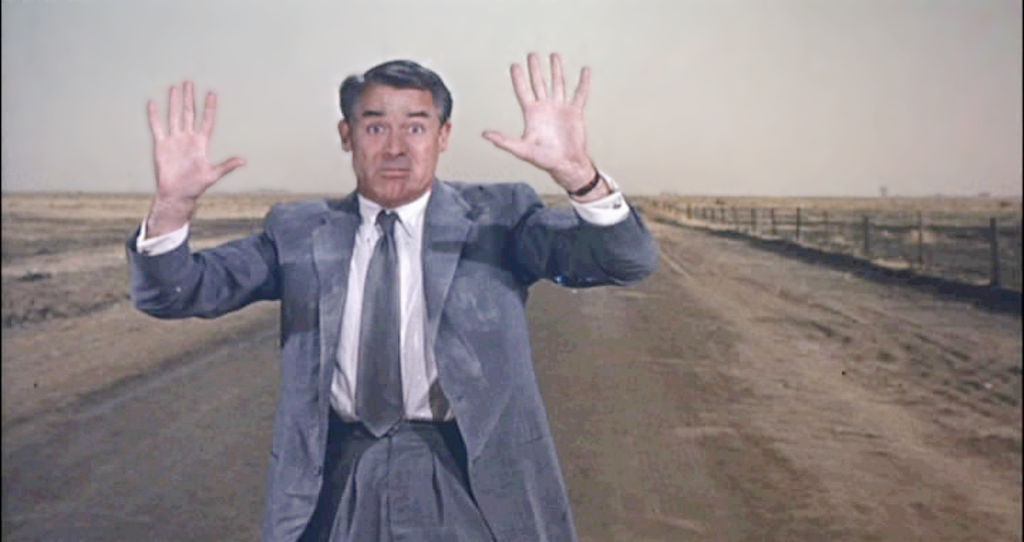
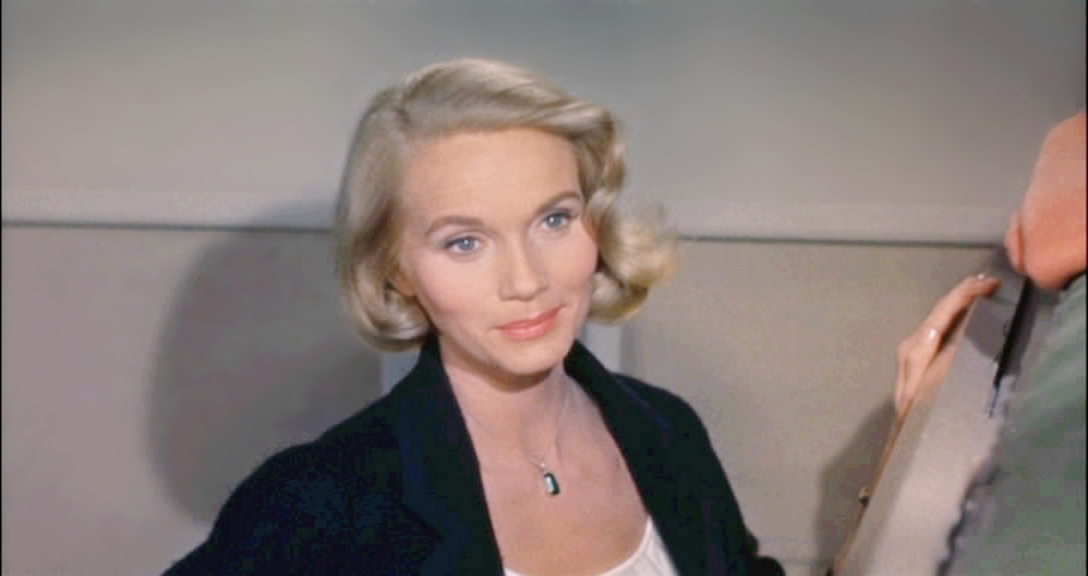
I never understood that incessantly observable trope that permeates all forms of media where the blonde is far superior to the brunette. Aside from being highly superficial, it’s simply not the case. If anything, Audrey Hepburn is the blatant exception to that rule. She turns any such presumption on its head because simply put, she is absolutely stunning. There’s a reason why she is one of the most photographed and iconic figures of all time. Her style is different than a Marilyn Monroe, a Sophia Loren or an Elizabeth Taylor because it exudes a certain demure quality. She’s glamorous in spite of a certain unassuming humility. And she’s what makes Sabrina work because she embodies Sabrina Fairchild.

The film begins with a bit of narration that feels like it’s setting up a modern fairy tale, and it really is. Sabrina recounts the life of a young girl who lives above the garages where her father is a chauffeur. He faithfully serves the well-to-do Larabee family,  and he’s content in his life. But his daughter is hardly so lucky. From an early age, she has carried a girlish crush on the younger Larabee brother David (William Holden), a womanizing, ogling playboy who seems like the unattainable dream for young Sabrina. He sees her as a child, and she worships the ground he treads on. Nor can she stand any of his female companions. Ironically, none of his conquests are good enough for him, in her estimation. But unrequited love, even young love, is a bitter pill to swallow and Sabrina hardly takes it well. The ode to Maurice Chevalier’s “Isn’t It Romantic” is the ultimate irony at this point in our storyline.

Then comes the fateful day that her father sends her off to learn the skills to become a world-class French chef like her late mother. Sabrina is unhappy in her work, cracking eggs, making souffles, and so on. But over time, David is less of a weight on her heart. She still thinks of him, but she also begins to grow into her life and truly flourish.

She left a girl and she comes back as Audrey Hepburn, immaculately radiant in a wardrobe crafted by her lifelong designer Hubert de Givenchy. David and the audience cannot help but marvel at this vision standing at the train station with her prized pooch, who by no small coincidence is also named David.

When all the pieces fall into place, the love-struck man is bowled away to find out that this is young Sabrina, the girl he never gave a second thought to. He’s ready to wine and dine her, to present her with the fantasy romance that she has always wanted and only he can offer. The dreams she always wished for in her youth are coming true before her very eyes.

But it’s David’s stuffy brother Linus (Humphrey Bogart) who steps in at this point, stage right. He’s the respectable and pragmatic one. He runs the family company and oversees their business. His latest project is a merger which will prove mutually beneficial but to help proceedings along he’s looking to marry off David to the daughter of his prospective business partner.

Sabrina stands in the way of his plans and as a proper businessman, he deals accordingly. David is holed up with injuries sustained sitting on champagne glasses, so Linus swoops in. He doesn’t seem like the wining and dining type, but he does it all in the name of sending Sabrina off to Paris again. He wants to get rid of her to salvage his merger, but he too falls under her spell. That sweetly serene personality matched with those pair of doe eyes melt any man’s heart. Still, duty calls and he admits to Ms. Fairchild just how much of a cad he has been. But now he’s a cad who truly has feelings for her. There’s no denying it. David sees it. The audience sees it. Now only Linus must acknowledge it himself. However, now we have a love triangle with time running out, and that’s when drastic action is necessary. After all, you cannot let a girl like Sabrina Fairchild, aka Audrey Hepburn, slip through your fingers.

In truth, Sabrina is easily overshadowed by Hepburn’s shining entrance in Roman Holiday and not as well remembered as her iconic personas in Breakfast at Tiffany’s or say My Fair Lady, but it is hardly a lesser film. It brings together some of the best talents you could hope for from one of the most preeminent of Hollywood directors.

Certainly, you can make a very strong case that the casting of the male leads was questionable. Bill Holden fits the playboy role well enough, but Bogart was perhaps not quite stuffy enough and far too old to be playing Hepburn’s love interest. In fact, the part was initially to go to Cary Grant. However, we got Bogey, and he’s worth a watch whatever the film and so it is with Sabrina, allowing him to reveal a little bit of his softer side. Furthermore, Billy Wilder will always and forever be the master of weaving stories together. His skill as a scriptwriter extends perfectly into his self-assured direction that gives us a thoroughly delightful comedy. Romance wins out over any dose of cynicism, and it all fits together nicely–a lovely fairy tale.

4/5 Stars

Review: North By Northwest (1959)

1024px-North_by_Northwest_movie_trailer_screenshot_(6)Wedged between two landmark Hitchcock films in Vertigo (1958) and Psycho (1960), North by Northwest is iconic in its own right, but it boasts sprawling adventure and a bit of a lighter tone. It’s rather like Teddy Roosevelt wedged in between Jefferson and Lincoln on Mt. Rushmore but that comes later.

Supposedly the film was once to be called In Lincoln’s Nose, but when the now famous slanted North by Northwest logo hits the screen you instantly know you’re in for something extraordinary. The title sequence is wonderfully exciting given a boost by yet another impeccable score from Bernard Hermann.

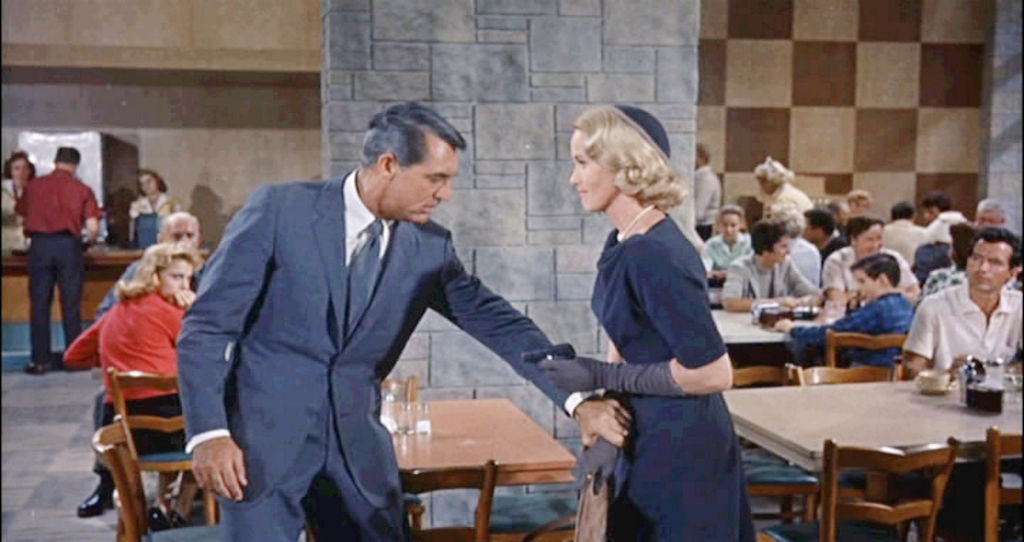
This film is once again beautifully shot in color (VistaVision), but it covers more ground than Vertigo and has far more elaborate set pieces. The action begins ordinarily enough at an office building where advertising man Roger O. Thornhill (Cary Grant) makes his way out of the office. It’s a busy day at the office, but Roger has a dinner engagement and an evening at the theater to look forward to. His plans and his whole life are put on hold after he fatefully flags down a waiter.

His actions don’t go unnoticed and two menacing men lead him off at gunpoint as he tries to head to a phone. He is utterly confused, but we know it has something to do with the name George Caplan. These men think that’s who he is, and not to be persuaded otherwise, they take him to their leader (James Mason), who is very interested to meet him. Over the course of a harrowing evening, Thornhill is left on the edge of the road in a completely drunken state to die. But instead he gets brought in on a drunk driving charge and of course, no one will believe his cockamamie story, even his skeptical mother (Jesse Royce Landis).

North_by_Northwest_movie_trailer_screenshot_(21)Next, it’s onto the U.N. Building to find out who Lester Townsend is, but of course, his captors are on his trail and just like that Thornhill is framed for murder and a fugitive on the run from the thugs and the cops. He tries to get away train ticket out of town, but in order to evade the law he ducks onto a train and meets the pretty blonde Eve Kendall (Eva Marie Sainte), who extends a favor. Little does he know what her angle is. Right now all he cares about is a little tete a tete and perhaps an amorous evening.

Kendall wistfully sends her new lover off to meet Caplan. Instead, he is met by a bi-plane and once again running for his life. But the build-up of this now iconic scene is wonderful. Hitchcock utilizes his background in silents to allow the scene to progress without hardly any dialogue and it unfolds ominously. However, he proves that even on an isolated roadside stop danger can still be present. Thornhill has new opinions of Kendall now and continues following the trail of Caplan which leads him to his old nemesis (Mason) and wouldn’t you know, Eve is by his side.

North_by_Northwest_movie_trailer_screenshot_(31)Roger feels like he has everything figured out, but he gets a visit from the mysterious Professor (Leo G. Carroll), who helps straighten him out with all the business surrounding the elusive George Caplan. With this new insight, Roger goes to the Professor to Rapid City and the one and only Mount Rushmore. It’s the perfect spot for a Hitchcockian finale to satisfy the director’s flair for the thematic.

North By Northwest is fun because we get to be right alongside Grant when he gets caught up in the whole mess. Although we see the picture a little more clearly than him, all the details are not handed over to us. So in a sense Hitch lets us in on a few secrets without showing us his entire hand. The staging is also wonderful whether it is the U.N. Building (with that marvelous aerial shot), or desolate Bakersfield, and even the soundstage set up to look like the surrounding area of Mt. Rushmore. It’s such a contrast to Rear Window and it uses the scenery very effectively similar to Vertigo.

Ernest Lehman’s script simply put is a lot of fun, because we have our villains, we have our romantic leads having a lot of great scenes together, and the pacing is surprisingly good. I am amazed how spry Cary Grant looks for his age (especially compared to aging Jimmy Stewart). Eva Marie Saint is great and in my estimation, she is the second-best Hitchcock Blonde following Grace Kelly, but you can easily disagree. James Mason plays yet another debonair villain and there are a handful of fun appearances by the likes of Martin Landau and Edward Platt.

One reason I’m constantly drawn to this film is that it feels rather like a road trip as we slowly cross the continental United States with Cary Grant. Furthermore, it’s simply good, unadulterated fun. There’s not a ton of analysis or commentary to mull over or to think deeply about (maybe some implications to the Cold War). But I’m content to sit back and watch with glee as a crop duster nearly clotheslines Cary Grant. Movies don’t get much better than this, seriously.

5/5 Stars

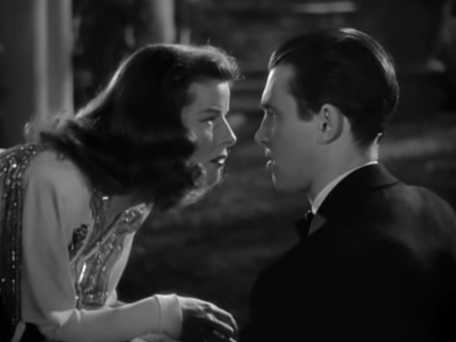
Review: The Philadelphia Story (1940)

philadelphiastory1If there ever was a benchmark for the sophisticated, high-society brand of comedy, The Philadelphia Story is most certainly it. It’s less screwball because instead of Howard Hawks, George Cukor takes the helm and injects the film with his more refined sensibilities. It’s still very much hilarious and impeccably witty, but it’s not quite as scatterbrained as it could have been. Once more you have the iconic pairing of Cary Grant with Katharine Hepburn. Previously they had been in two other Cukor pictures (Sylvia Scarlett and Holiday) and of course Hawks’ romp Bringing up Baby. However, this time they’re joined by another cinematic titan in James Stewart and it proves to be a wonderful battle for command of the screen. The story ends up being a wonderful clash of classes and culture that also manages to illuminate a few bits and pieces of truth.

C.K. Dexter Haven (Cary Grant) had it out rather acrimoniously with his wife Tracy Lord (Katharine Hepburn) and now two years down the line, she is set to marry someone else. She couldn’t be happier to be rid of him and all his faults. Her new husband is a real “man of the people,” the wooden George Kittredge (John Howard), and he got his money doing an honest day’s work. In other words, he’s everything Haven isn’t when it comes to class and manners, but he’s also quite different than Tracy. But she doesn’t seem to mind. She’s on cloud nine to be rid of Haven.

Although Cary Grant does take a back seat at times, it’s only so he can manipulate and connive in the background, because he most certainly has an agenda. It’s great fun to watch. First, he brings in the folks from Spy magazine to do a full spread on the big wedding. There’s belligerent journalist Macaulay Connor (James Stewart) scoffing at all the opulence around him and then photographer Ms. Eilzabeth Imbre (Ruth Hussey), who has something complicated going on with her colleague.

They’re all here because the editor of Spy has a nice juicy expose piece on Tracy’s father and so C.K. advises her to go along with it. She suspects her old spouse has something to do with it, and it’s true, he didn’t put up much a protest when it came to taking part. However, Tracy’s not ready to let him ruin what she’s got going. She and her younger sister the crack-up Dinah (Virginia Weidler), put on a good show of upper-class snobbery to utterly bewilder their guests.

The funny thing is that while Tracy detests C.K. with the vehemence of the plague, her mother and sister quickly welcome the old gentleman back into their home with open arms. After all, what kind of trouble could he cause a couple days before the wedding, and Dinah is always game for a little chaos. She and C.K. have a mutual affection for each other. They’re both serial troublemakers.

After the surprise of Dexter wears off, the next person Tracy clashes horns with is the brusque newsman Connor, who is as turned off by her as she is annoyed by him. As she sees it, he’s invading her house as part of the paper’s plan to make her life miserable and steal away all her privacy. For him, she’s a stuck-up brat, who has had everything served to her on a silver platter in the west drawing-room. He thumbs his nose at the whole set-up. But a chance encounter at the library no less opens up a different side to these characters. Mike Connor is actually an accomplished poet far more skilled than his lousy journalistic pursuits would suggest. He learns just how perfectly imperfect she is.

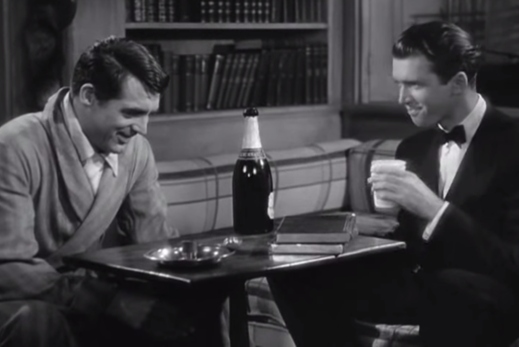
philadelphiastory2It’s at a party the night before the big day that things get particularly interesting. A lot happens when you fill people up with a little bubbly, some wine, and some early morning gaiety. Tracy is absolutely swimming in exuberance partially thanks to alcohol, partially because of the dancing, and maybe in expectancy of tomorrow’s high. But when things come a little loose around the edges, things happen that you regret. As it turns out Tracy doesn’t remember quite what happened that night, but Dinah saw all the good parts from her balcony. It involved a drunken Mike taking a jaunt to Dexter’s home at a godforsaken hour followed by Ms. Imbrie with an inebriated Tracy in tow. What this sets up is a wonderful little sequence where a hiccuping Stewart helps Grant orchestrate a plot to get back at Spy magazine editor Sidney Kidd. Then, Connor gets to spend the wee hours of the morning rambling on and on. It’s innocent enough, but quite the evening no less. It makes Kittridge quite distraught finding his bride to be in the arms of a man who is singing “Somewhere Over the Rainbow.” And of course, with such an unfortunate moment so close to the wedding it looks like things will be called off. But Kittridge is willing to make amends. It’s Tracy who realizes she has to break things off because ironically this man is too good for her.

philadelphiastory3It looks like Haven has won, but in a split second Connor is proposing marriage and ready to tie the knot with Tracy to save the wedding. Once again Tracy makes a sagacious decision (which is surprising given her earlier condition). Hangovers on your wedding day are not usually a good thing. In this moment everything falls back into place as it should and as we want it to. These are characters that we grow to care about, despite their misgivings and class differences.

When reading up on this film I was astounded to hear that the film supposedly had no outtakes. Everything we see was as it was when it was first shot and that has to be a testament to the strength of these actors and maybe a little luck. It’s true that the film sometimes enters territory that feels unscripted and loose. That’s when it really gets fun. Stewart and Hepburn. Grant throwing a quick retort here and there. Imagine, this could have been a vehicle for Hepburn paired with Clark Gable and Spencer Tracy. I’m sure that would have been great, but the whole dynamic would be very different.

So who is the winner in this film? Grant as C.K. Dexter Haven? Hepburn as “Red?” Stewart as the “Professor?” The Philadelphia Story is a real winner for the audience. What more could you want in terms of high-brow comedy bursting with legendary star power?

5/5 Stars

The Bishop’s Wife (1947)

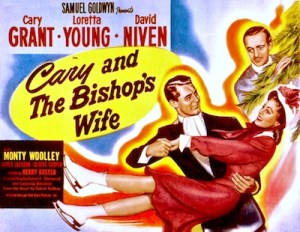
Cary_and_the_Bishop's_Wife_posterAlthough its theology probably isn’t sound, rather like It’s a Wonderful Life, The Bishop’s Wife nevertheless utilizes its central plotting device wonderfully.

Imagine if on a whim an angel came to your rescue, and then imagine that the angel is named Dudley and looks and acts like none other than Cary Grant. In this case, the person in need is a distraught Bishop named Henry Brougham (David Niven). He is right in the middle of a major undertaking to build a new cathedral, and his primary benefactor Mrs. Hamilton (Gladys Cooper) is being a thorn in his side. The building project has consumed all his time and efforts, causing him to neglect his radiant wife Julia (Loretta Young), their little daughter Debbie, and the people from their old parish.

Director Henry Koster crafts a whimsical and rather sentimental film much in the same mold as Harvey (1950) which came three years later. This time Dudley is the character who exists outside of worldly convention. He is constantly kind, always patient, never hurries, and is always helpful to everyone in need be it blind man or bishop. In truth, everyone adores him, because after all, he is an angel. Everyone, that is, except Henry who needs him most. Henry unwittingly asked for help and now he has an angel in his midst, but Dudley will not allow that to be revealed to anyone else. It’s an unnecessary detail, and besides, he has much more pressing matters like attending to Julia and assisting Henry with his work. To her, he is purely a radically pleasant and good-hearted individual. With such positives, there hardly needs to be any explanation, only wonderment.

He takes Julia through the old town she used to live in happily with Henry. They meet old friends like the blustering Professor Wutheridge (Monty Wooley), who Dudley also happens to give inspiration to. He makes little Debbie a ringer in a snowball fight, and he and Julia are joined by a chipper taxi driver (James Gleason) in an ice skating adventure. Even a check in on the humble cathedral at St. Vincent’s leads to an angelic rehearsal by the local boy’s choir. Meanwhile, Henry is absent, attending to other matters.

Of course, he is as bitter and distressed as ever by his plight — his attention still skewed in the wrong directions. Even when Dudley goes to grumpy old Mrs. Hamilton and totally redeems her perspective in order to feed the hungry, Henry hardly seems pleased. His artifice, his tower is now even farther from being completed.

The final scenes of Bishop’s Wife are key because it’s in these moments where we see the change in Henry. Cary Grant might seem obviously miscast for this role, and in truth, it was originally supposed to go to Niven who was to play opposite the equally angelic Teresa Wright. But Grant’s debonair side is important for this final act because it makes sense when he makes a pass at Julia. It fits his screen persona as the suave bachelor, angel or not. You can debate whether he was actually in love with the beautiful mortal, or if he was just doing it to get a rise out of Henry. Whichever way you see it, for the first time Henry is driven to fight for his wife out of love and because of the human emotion that still pulses through his veins. Finally, he drops the peripheral and looks at what is central, his family and friends. Dudley, or Cary Grant, takes one final approving look and walks off in the snow. His work here is done. Peace on Earth and Goodwill towards men.

4/5 Stars

“We forget nobody, adult or child. All the stockings are filled, all that is, except one. And we have even forgotten to hang it up. The stocking for the child born in a manger. It’s his birthday we’re celebrating. Don’t let us ever forget that. Let us ask ourselves what He would wish for most. And then, let each put in his share, loving kindness, warm hearts, and a stretched out hand of tolerance. All the shining gifts that make peace on earth.”

~ Final Message given by Henry (David Niven)