Favorite Films of 2023

I was a bit behind on my movie-watching for 2023, but here is a list of a few movies I enjoyed from the past year. I’ve either linked to a previous review or included a short capsule. Enjoy!

Past Lives

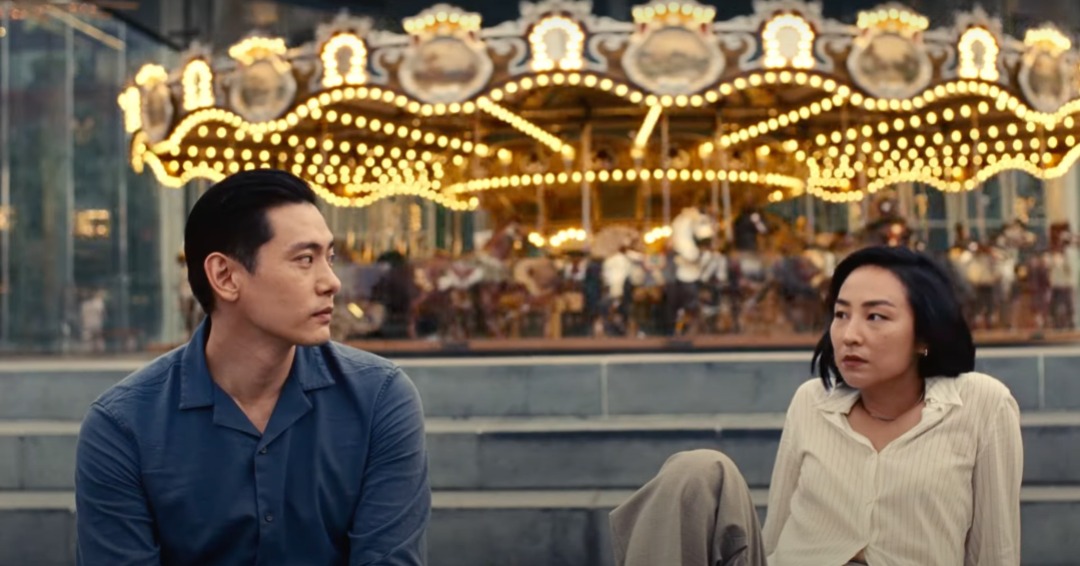
Writer-director Celine Song’s use of time is self-assured and brazen. She’s loose and elastic with it, bravely allowing her story to cut 24 years into the past before fast-forwarding 12 years and then 12 years again. But these jumps in time feel subtle and right with the perfectly applied sense of space and context. We never feel like we’re being rushed. The elliptical nature of a single cut is imbued with so much power. The movie is the epitome of contemplative cinema as it tells a fated love story.

Greta Lee is such a phenomenal conduit of this drama, and she takes every scene with a composure full of warmth and feeling. Teo Yoo has a forthright candor morphing from a boyish heartthrob to a man still grappling with unresolved feelings. John Magaro could easily be a whiny-voiced annoyance — the white evil of the movie — and yet it’s a credit to his humanity that we like him and even empathize with him (especially if we don’t speak Korean like this viewer).

As humans, we’re always looking to discern what our future will be. Religious people question God’s plan for their lives. And often we have the nagging thoughts of what-ifs and how things could have been. Perhaps I’m the only one who thinks like this. But Past Lives seems to suggest this is not the case.

Perfect Days 

It feels almost too convenient to evoke Jim Jarmusch’s Paterson from a few years back when considering this new film from Wim Wenders, but I can find no other alternative. They both focus on individuals who live contented analog lives with daily rhythms that feel almost radical in the face of the world around them. It doesn’t matter if it involves bus driving or in the case of Hirayama (Koji Yakusho), cleaning toilets in Japan under the watchful eye of the Tokyo Skytree.

Jarmusch, much like Wenders, has always felt like a sojourner with an insatiable curiosity, and both men seem to be continually expanding the cultural canvas of cinema through their travels and observations of a wide swath of humanity. Of course, Wenders started out first and has been doing sustained work for many years. It seems fitting that a film like this, while focusing on a very specific Japanese milieu, with the help of co-writer Takuma Takasaki, still boasts some of Wenders prevailing passions from photography to rock and roll music.

But what could feel like a mere gimmick gives rise to a man, thanks in part to Yakusho’s disarming performance, who has so much to offer the audience and others within the frames of the film. Because there’s something so quietly instructive about him. We can learn so much and appreciate so much more if we only observe the people and things around us. I found it charming, and it was a stirring reminder of why I love Japan (and the films of Wenders).
The Taste of Things

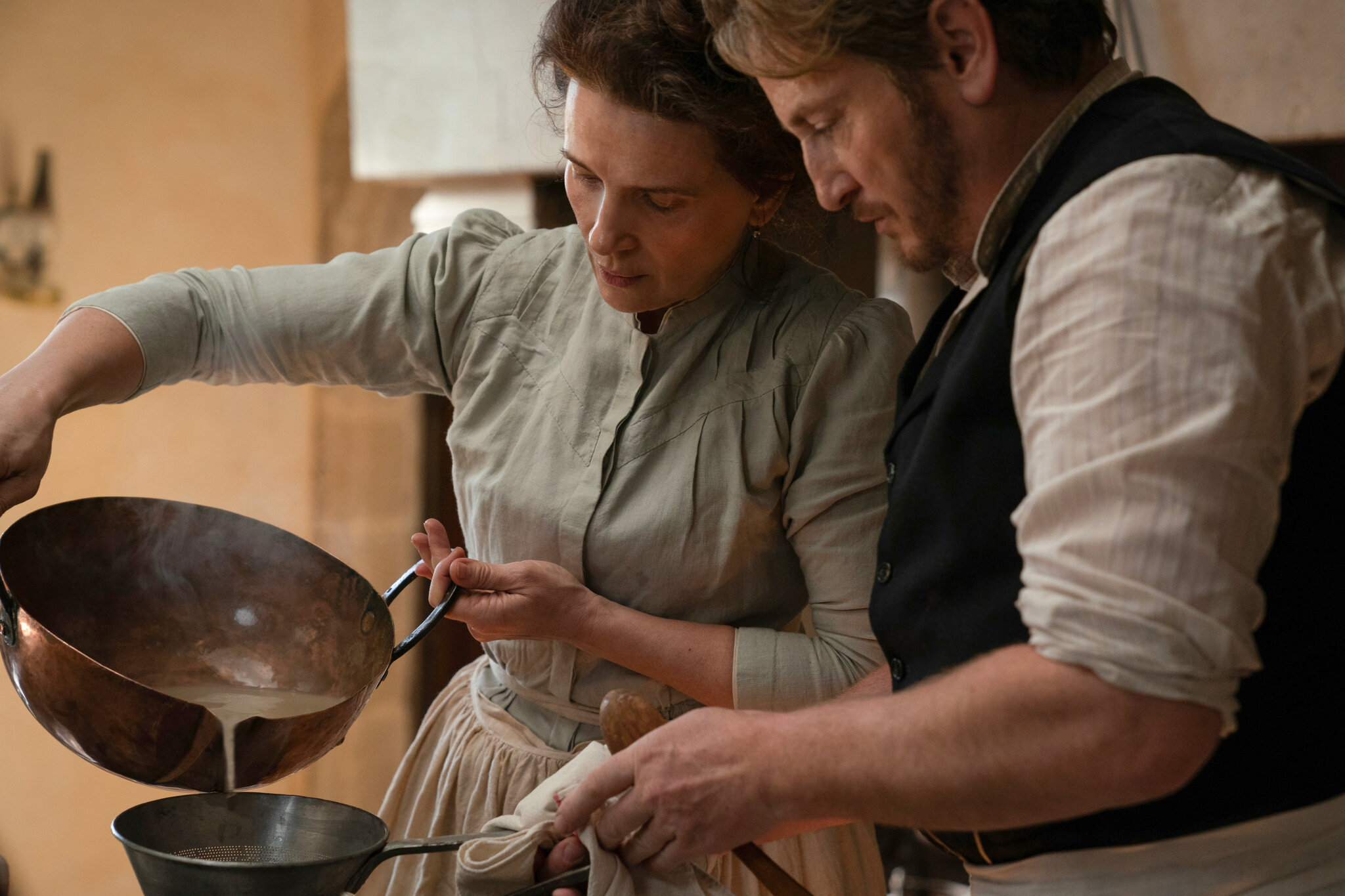
Babette’s Feast is a film that was a revelation to me from the very first time I watched it. I’m no gourmet and yet such sumptuous delights are hard to resist wrapped up in a Danish parable as it is. The Taste of Things is much the same – coming out of the same lineage – and the unbroken introduction to this tactile, delicious world of food in a 19th-century French kitchen is equally entrancing. There’s something so compelling and equally remarkable about these epicurean delights being created before our eyes. How something can have an extravagant simplicity to them requiring the utmost amount of tender loving care (and the freshest ingredients plucked straight from the garden).

While it’s not quite as thematically rich as its predecessor, it does rest on a love story brought to the screen by the incomparable Juliette Binoche and Benoît Magimel, a pair of performers with a real-life history albeit one in the past. Food is their undisputed love language. It buoys their romance in such a rapturous way paired with the delicious cavalcade of eateries and a vow to train up another generation of chefs who have the intuitive gifts and the innate passion for food that can be further cultivated. There’s something quiet, beautiful, and melancholy about Tran Anh Hung’s film that I greatly relished. 

Killers of the Flower Moon

There’s something more fundamental here. You see it in many of Scorsese’s movies from Goodfellas, Wolf of Wall Street, or any of his gangster pictures showing the traditional villains in an intimate if not entirely sympathetic light. He always seems to return to this because this was his childhood — he grew up in a neighborhood with these sorts. By the world’s standard are they corrupt? Yes, but they aren’t personified evil. They act as complicated characters full of charisma, humor, and whatever else.

It feels like this is his gift as a filmmaker. Because we don’t always like these people, but he was never interested in a black hat and white hat morality. Perhaps that’s why he did not make Killers a more traditional Western because this would not be true to the ethos he’s had since the very beginning.

Lily Gladstone is such a powerful emotive force in this movie because if Leo’s performance is so pitiful, she is his perfect scene partner by maintaining an equilibrium; there’s a regality to her that’s not easy to break and yet she’s not an unknowable stoic. She loves deeply and with Ernest and her family, we see both her affection and her deep sorrow when they are ripped away from her one by one. The movie requires her strength to hold it together and instill it with resonance. Scorsese never asks easy questions, and I believe that comes with honesty, and it’s part of the reason he’s still one of our premier filmmakers. He’s still curious and the questions he asks with his films are ones he’s still wrestling with now 80 years on. They’re universal.

Oppenheimer 

It’s easy to cast Oppenheimer as one of the most important figures of the 20th century since he was the “Father of the Atomic Bomb,” but he was also one of its greatest tragedies. There’s a scale and scope to this narrative woven right into the very fabric of history. A whole movie could be borne on Cillian Murphy’s face and it is. Between his vivid eyes, gaunt contour, the porkpie hat, and pipe, there’s something instantly iconic about him. He’s haunted and profound even before he says or does much of anything.

It’s also dizzying watching Christopher Nolan develop the rich world around Oppenheimer packed with substance — a real world of real people and events we get to experience firsthand. This immediacy is key and although I’ve read the book, I don’t think you’re required to keep it in your back pocket. Nolan has done the unthinkable by making a potentially stodgy historical piece into a gripping blockbuster. In the age of superhero movies, studios have mostly assumed historical genres are dead.

Likewise, by shaking up a prosaic biopic form, the director alights on something that’s narratively audacious even when it falters. That’s why he’s remained one of our most beloved filmmakers over the last decades. He makes big movies for thinking people, and if nothing else, I hope Oppenheimer acts as a clarion call for more thoughtful tentpoles in the industry. The audience seems to be more than rewarding his efforts.

The Boy and The Heron

I was thinking how grateful I am that filmmakers like Martin Scorsese and Hayao Miyazaki are still giving us their art. How lucky are we? The Boy and The Heron gleans some inspiration from the 1937 book How Do You Live? and also the annals of Japanese history and Ghibli Studio’s own lineage. Watching the film there are many echoes of Miyazaki’s favorite topics and also the influence of his mentor Issao Takahata.

For a Western audience, it has the tinges of Narnia where the war is an everyday tragic reality, and thus a world outside our own gives space for respite and marvelous things that can break in and heal our hurts so we might make peace with them. I was reminded of Petitte Mamam where the magical can somehow bring a parent and child closer together, even forge them by fire and trials of many kinds. 

All this fits for the simple reason that the film is very much a fairy tale. I couldn’t get away from this idea that Miyazaki’s film is so beautiful to look at, absolutely resplendent (he also has a penchant for the cutest creatures), and yet it has these pointed moments of ugliness even terror that feel like a necessity. The contrast is key to making the magical world feel in a sense real because we recognize both the good and evil from our own lives. It’s within this space where children can grow and thereby enter back into their lives ready to face the challenges ahead. It occurs to me that Scorsese, Miyazaki, and others like them maintain the curiosity and wonderment of youth. The years they’ve been on this earth belie their child-like spirit. It makes their movies still so accessible and universal to the masses, well worth our time and consideration. 

Afire

I appreciated Afire because, like many of the director’s earlier films, it’s deep in conversation with the vast annals of cinema. This one in particular feels like a paler, pudgier version of an Eric Rohmer movie. Something in the vein of La Collectionneuse, Pauline at the Beach, or even A Summer’s Tale. I felt vindicated hearing that Petzold was in fact consuming some Rohmer films during the pandemic, but that was only part of his inspiration. Unlike Hollywood, Germany doesn’t have a lineage of summer movies about the last day of school or hanging out at the beach with no adult supervision. The summer had vanished not only from their filmographies but from Germany as a whole. The nation rarely got this opportunity with the ascension of the Nazis and this historical backdrop gave rise to many of the specters which have haunted most of Petzold’s oeuvre.

If you wanted to make a case, Afire is actually Petzold’s most comedic film to date and his closest to romantic comedy thanks to its lead. I’m still trying to get my feelings in order, but Afire delivered like the director always seems to. It’s deeply observed and engaging with its perceptive vision of humanity and interpersonal relationships. But what makes it richer comes with how the writer-director takes a simple premise and simultaneously imbues it with all this intertextual meaning. His references are not always overt, but couched within his stories are the echoes of his nation’s films as well as literature and mythologies – many of his projects over the years have been adaptations of much older work. In our current age of cursory knowledge and vapid fads, he’s a refreshingly thoughtful filmmaker.

Godzilla Minus One

I found Godzilla Minus One feeling like this year’s Top Gun for what it teaches us about sequels. Obviously, Godzilla is an institution in Japan, but here we see a film that takes the very specific context of the original film amid the nuclear age — reminding us of the context of a post-war world — while building on the past in new ways. Top Gun: Maverick did much the same as its predecessor, and it was oddly such a human and intimate film in the same way that this giant monster movie with tinges of Jaws (and The Dark Knight Rises) feels even least nominally invested in interpersonal relationships beyond mere kaiju eye candy.

This new film is a spectacular bit of construction blending period drama with solid special effects, a quintessential demolition of Tokyo, and deep sea confrontation that brims with menace and personal stakes. Perhaps what’s most spectacular is how director and general mastermind Takashi Yamazaki was able to offer up a low-budget tentpole full of invention and a stirring message of hope. In a film full of devastation and general destruction, the narrative bends refreshingly toward a message promoting the sanctity of human life. This feels like a radical position for a genre that feels almost antithetical to this kind of sentiment. 

Godland

It’s the kind of taxing epic that is not for everyone. Positioned somewhere between Carl Theodor Dreyer and Werner Herzog, it’s both gloriously desolate with the raw beauty and power only nature can attain. It also brims with the kind of existential weight one feels when your attempt at Christian faith is found lacking and all your pride and human vigor are laid bare.

Our protagonist cuts a gaunt figure. He’s the most ascetic and joyless man of the cloth, but out of many striking images in the film, there is a sequence that feels emblematic of the trail he leaves in his wake. First, an interpreter who must be buried, and then his horse which is left for dead, followed by a final summative death. Seasons change and yet in our limited capacity we are so insignificant in comparison to God’s creation and his majesty and it is arrogance and folly to think otherwise. I am reminded of the verse: “What is man that you are mindful of him, and the son of man that you care for him? Yet you have made him a little lower than the heavenly beings and crowned him with glory and honor.”

This is a spectacular perspective, and it is something to be held with a loose rein of humility. Grace is something to be cherished because it changes your outlook and how you treat others. Meanwhile, colonialism is something we still feel the repercussions of here, and we see it here in the cultural and linguistic tension between Denmark and Iceland. Condescension has no place in the supposed Christian way of life; it’s ultimately a pernicious force. 

Across The Spider-Verse

As we watch the live-action Marvel comic book movies show what feels like signs of slightly waning dividends, it makes the animated iterations all the more intriguing. They exhibit a meshing of style and storytelling. It’s exquisite to look at, but they’re not simply empty animated images. The form fits the content and we get a sense of atmosphere, even emotion through the way they are distilled through the visual palette. There’s an invention and a sense of craft that takes into consideration the modern landscape while still staying true to the form of split panels or even the evolving painterly watercolor aesthetic of Gwen’s world. Somehow everything is all but typified by our hero fighting a Renaissance vulture with Jeff Koons balloon sculpture left as collateral damage. 

I still remember when they made Star Wars literature legends and they were no longer canonical. That was probably one of the first instances I began to understand the term. Now it’s pervasive across fan culture. Canon events form the building blocks of the spider-verse world, but they also say something about our search to make meaning out of circumstances. It may be entertainment but it could probably spawn a whole conversation about predestination, free will, reincarnation, and the afterlife in general.

Part of me wonders if the reason these concepts are so intriguing to us or even comforting is that we are longing for something more (or something else) — something beyond the life that we lead. Surely this can’t be all there is. Why else would the world continually clamor for sequels and ever-expanding universes? My only qualm about the movie is my problem with all these “metaverses.” We can never leave well enough alone. But then again, they never satiate us. 

Documentaries: Beyond Utopia, The Mission, The League, Still: A Michael J. Fox Story, Being Mary Tyler Moore

Honorable Mentions: Are You There God? It’s Me Margaret, Earth Mama, Suzume, Flora and Son, and Fallen Leaves

Afire (2023): A German Summer Movie a la Rohmer

Christian Petzold is a filmmaker I was introduced to over a decade ago, and I would consider myself a passionate fan. I’ve seen every one of his films since then, and I would gladly share him with anyone who might listen. There’s some pleasure in championing a director who’s not as much of a household name as one might hope. 

The other wonderful thing about Petzold is what an ardent cinephile he is, but he’s also quite loquacious and charismatic. Obviously, English is not his first language, but he always does wonderfully candid and thoughtful interviews all across the festival circuit. I can imagine he would be quite the person to grab a coffee with. He’s shared on multiple occasions how he crossed paths with Abbas Kiarostami in New York City under such circumstances. 

Forgive me for burying the lede, but I appreciated Afire because, like many of the director’s earlier films, it does feel like it’s deep in conversation with the vast annals of cinema. 

This one in particular feels like a paler, pudgier version of an Eric Rohmer movie. Something in the vein of La Collectionneuse, Pauline at the Beach, or even A Summer’s Tale. I felt vindicated hearing that Petzold was in fact consuming some Rohmer films during the pandemic, but that was only part of his inspiration. 

Reading an interview he cited a significant reference point for his latest effort in People on Sunday. It’s not a film I would have considered in a million years because it’s well, almost 100 years old. But in regard to this allusion, he makes a fascinating observation. 

Unlike Hollywood, Germany doesn’t have a lineage of summer movies about the last day of school or hanging out at the beach with no adult supervision. There’s also no Summer with Monica or Eric Rohmer. 

With men like Billy Wilder, Edgar G. Ulmer, Fred Zinnemann, and Robert Siodmak — all creative collaborators in People on Sunday, they were forced to leave Germany. And when they moved to Hollywood in the wake of the Nazi scourge, their work got harsher with the likes of Detour, Lost Weekend, and more film noir.

The summer had vanished not only from their filmographies but from Germany as a whole. The nation rarely got this opportunity with the ascension of the Nazis and this historical backdrop gave rise to many of the specters which have haunted most of Petzold’s oeuvre.

If you wanted to make a case, Afire is actually Petzold’s most comedic film to date and his closest to romantic comedy. Leon (Thomas Schubert) is staying at his friend Felix’s idyllic summer home out in the forest near the Baltic Sea. They think it’ll be a great place to get away: Leon needs to finish a manuscript and Felix (Langston Uibel) has an art portfolio to complete though he seems far more at ease and prepared to make the most of the tranquil surroundings. 

It starts out as the vacation from hell we might all be familiar with to different degrees. First, their car breaks down, they get lost taking a shortcut, and it looks like Leon might be stranded out at night in the forest with no cell signal. Felix goes off to make his way to the family cabin. 

Eventually, they get there. Except it turns out they won’t be alone. A co-worker’s daughter has set up shop; we don’t know for how long or why. We just know Leon’s plan for an uninterrupted getaway is catastrophically ruined. Strike two. 

The walls are thin and you can hear everything…It makes sleeping very hard and Leon’s even grouchier than he was before. The incessant bugs and the impending fires don’t do much to lighten the mood. 

Leon also seems genetically predisposed to be a moody, pretentious misanthrope of the first degree. Felix is good-natured and thoughtful. He would never think to impose himself on others or make a stink. It comes naturally to Leon. 

The camera takes on his surreptitious gaze which makes me uncomfortable as he spies on their housemate out in the yard before ever officially meeting her. Still, nothing he does can negate Paula Beer. In her work with Petzold, she always comes off as such a charming and intelligent performer who gives so much to the camera. 

Between her last film Undine where she played a modern-day mermaid, and Afire with its landscape ablaze, there’s this pervasive sense of the classical elements permeating the collaboration. It’s this lovely amalgamation of the deeply modern with the primordial. It makes one wonder where Petzold and Beer might go next. 

In the previous film, she was a docent focused on Berlin’s history of urban planning. Here Nadja works at an ice cream stand doling out flavors of “Smurf” sherbet. She’s disarmingly straightforward, cutting through any pretense. It makes her immediately attractive as a personality.

Whereas Leon’s a perpetual excuse machine. He never swims or takes anyone up on anything. He’s the kind of person you try to be nice to by inviting them to stuff even if you don’t want to, and then they decline so many times, you feel exasperated. They’re too blind to recognize you’re trying to do them a favor.  

Leon should be a lost cause, and yet even if we don’t particularly like him, we can empathize with him, and I think all his acquaintances in the movie make us appreciate him a little more. 

Later, at an open-air dinner, he lashes out at the rescue swimmer Devod. He feels like a stereotypical beefcake, and yet belies the image making Leon all the more uncomfortable. Because their new acquaintance was sleeping with Nadja, but he seems like a genuinely nice guy. These don’t have to be mutually exclusive. 

At first, Leon’s defensive about sharing his work; I recognize what a private and vulnerable thing it can be, and still, I wouldn’t give him that much credit. After Nadja asks to read Club Sandwich, he eventually relents. One suspects it becomes a mechanism to try and get closer to her and into her good graces — a way of covering his growing insecurities.

Leon’s also made a big deal of setting up time with his bespectacled editor (Matthias Brandt) to review his new work. He’s an older veteran, not unkind, but extremely busy. It turns out the full weekend they were meant to have together has been whittled down to one full day and some change. After Nadja invites Helmut to dinner, Leon grows jealous when it seems like everyone else gets a piece of him too. 

He takes great interest in Felix’s art portfolio – the one that Leon either didn’t get or totally disregarded. Then, Helmut trades poetry with Nadja; she recites her favorite poem, “The Asra.” It comes out she is working on a Ph.D. in Literature on Heinrich von Kleist’s The Earthquake in Chile (What she terms the “quake of representation”). 

Leon’s pettiness feels like a symptom of his own making. He knows Club Sandwich is crap. Nadja was honest enough to tell him as much. But he tried to dismiss her criticism; she’s only an ice cream seller. 

He never thought to ask her about what she might be studying. And now with the recognition that not only is this girl better looking than him but also perhaps smarter as well, it’s more than his fragile ego can take. 

Everyone else seems casual and comfortable, enjoying the throes of what summer has to offer. He’s the only one in obvious crisis, slowly imploding until the world around him joins in. 

The fire which was always hinted at continues to rage ever closer. Ash falls over their world like a ruinous dusting of snow. The boys go to tow their car with a tractor. Helmut starts to convulse on the lawn and Nadja takes charge to rush him to the hospital.

I noticed one particular jump cut in the editing involving Leon. He realizes he’s made a huge mistake; he’s been selfish and incapable of doing almost anything. What’s more, what will Nadja think of him? 

The raging conflagration brings with it human tragedy that strips away any remnant of sun-soaked vibes and focuses our story on its purest elements. As we should expect, it goes darker, but there’s another turn in the story. Our perspective changes subtly.

Nadja and Leon are called into the hospital again. There’s pensive voiceover narration to go with the images, and we realize intuitively even as the actions happen in front of us, somewhere in the present or future Leon is writing a new novel. 

I’m led to question if it’s still callous that he seems to be writing the story as the events seem to be happening or is it the most authentic thing he’s ever done? I’m not sure.

Later, he sees Nadja again from a distance. Some time has passed. We’d like to think he’s changed, and we know he’s wracked with guilt. Their eyes lock in recognition. Petzold cuts before there’s anything else, and it feels like the quintessential ending. We can fill in the rest with whatever we want.  

I’m still trying to get my feelings in order, but it delivered like Petzold always seems to. It’s deeply observed and engaging with its perceptive vision of humanity and interpersonal relationships. But what makes it richer comes with how the writer-director takes a simple premise and simultaneously imbues it with all this intertextual meaning. 

His references are not always overt, but couched within his stories are the echoes of his nation’s films as well as literature and mythologies – many of his projects over the years have been adaptations of much older work. In our current age of cursory knowledge and vapid fads, he’s a refreshingly thoughtful filmmaker. I’m still holding out for that coffee someday, preferably at Berlinale. 

4/5 Stars

Transit (2018): Casablanca in The Modern Day

Transit_(2018_film)Ever since the days of his James Cain-infused Jerichow, it’s been apparent German writer-director Christian Petzold is indebted to the written word when it comes to his brand of filmmaking. However, this time around he takes an oddly unnerving stroke of brilliance by setting his usual period piece in a version of the present, or is it a version of the present trapped in the past? Regardless, outside police cars — sounding eerily similar to Gestapo automobiles — rush through the streets while a pair of men have a hushed conference at a bar.

The scenario could nearly be mistaken for a dystopia if it weren’t for the cold hard facts the story was adapted from Anna Seghers eponymous wartime novel from 1944. What drives it forward is this compelling simplicity in the manner Petzold always seems so capable of. It’s part of the reason it’s so easy to be drawn into his films once you’re accustomed to the cadence.

The men bandy about talk of a letter and papers giving the hush-hush feel of a Casablanca, but Transit has the same restraint as Barbara (2012) and the wartime malaise of Phoenix (2014), albeit without the inimitable Nina Hoss. Georg (an unadorned yet haunting Franz Rogowski) is our protagonist, and we surmise soon enough he is on the lam from the authorities. Like many others, he has experienced the unknowable horrors of mechanized oppression.

He lives in a constant state of police-fueled paranoia brought on by the occupation, the details of which are kept purposefully murky. What we note are the resulting factors. The hotels are crammed with displaced folks trying to get out of the country, clinging to the faint wisp of hope in escaping to some far off place: the port of Marsellaise then Mexico or maybe America.

He is one of the displaced even as he’s aided in fleeing by cattle car and has a wounded colleague huddled next to him. It gives rise to the kind of pulse-pounding life or death scenarios reliant on both ingenuity and bouts of good fortune. It’s also perturbing to watch them unfold in the present.

His flight leads him to an abandoned roadside where he’s nevertheless invited to play football (soccer) with a precocious neighborhood kid named Driss. They build an instant rapport and their connections run deeper still, as we soon find out.

Whenever Georg stays within the confines of the city limits, he’s subject to the related police raids casing each room. If you don’t have your papers, you’re unceremoniously dragged away. By now it’s a daily occurrence. What becomes apparent is the rising sense of shame among the onlookers who watch and do nothing. What power do they have in such a world?

Georg lends a reluctant ear to fellow sojourners telling him their stories. Everyone seems weighed down by worries and troubles brought on by the tribulations of the times. They’re surprisingly forthcoming or rather they seem vociferous compared to individuals in Petzold’s previous movies. Although another distinction must be made.

His hero is fairly guarded as are a couple of the other central figures. It is the supporting characters who gladly use them as sounding boards to cast their thoughts on in this restless age. Even the narrator — an uncommon device for Petzold’s brand of restrained observational filmmaking — has his own insights to bring to the events.

The key again is how those central characters carry a bit of this pervasive despondency — this enigmatic nature holding us off but not completely alienating us. On the contrary, we want to know more about them as viewers transfixed by the fateful decisions they make and the encounters that befall them.

To begin with, Georg falls into a bit of luck donning the identity of a deceased writer and with it, the coveted opportunity at transit out of the country. The deceased man’s wife (Paula Beer) is a woman who drifts uncannily through his life throwing him glances as she motors on about her dutiful pursuits. What they are we have no idea. Although, with time, it’s easy enough to imagine.

That’s just it. Petzold is always toying with the arcane both in plot and characters because it’s in the ambiguities where his stories seem to come alive. It could be the first glance of the smartly dressed young woman on the street who touches Georg’s shoulder when the whole rest of the passing world seems not to pay him any heed. He’s invisible. And yet for some inexplicable reason — some cinematic kismet — she reaches out to him.

True, for the majority of the picture, it feels like she spends the movie walking in and out of places to build this air of mystique. Is she more of an object than a person? It’s easy to cry foul if only for the comfort of Petzold’s earlier collaborations with Nina Hoss. A mystifying woman put front and center can still stump us. What’s more, in the final act Marie becomes a living, breathing human being of fears and passions that turn strikingly palpable.

After she lost contact with her husband, she never gave up hope checking the consulate every day for any sign of news. Along the road, she was given a kind turn by an altruistic physician (Godehard Giese), and in a bedeviling world, they looked to one another for some amount of solace.

Their Rick’s Cafe becomes a corner pizzeria. Georg would always eat a Margherita there and find Marie stopping by. Later it becomes a meeting place with Richard — so mundane and typical, and yet it fits the context of the story.

As we find out, noble decisions aren’t so cut and dry here; they’re not capable of making our heart swell in the same romantic manner of Casablanca. We are constantly left questioning. What if the matrimonial ties aren’t so strong and beholden to the Hays Codes? What if Ilsa or Laszlo decided to stay behind at the last minute, making a grand sacrificial act null and void. What if the plane crashed en route? After all, the very thing happened to Glenn Miller over the English channel in 1944…

Speaking of music, it’s been so very long since I’ve seen Phoenix. Aside from the Vertiginous thematic elements and this same lingering sense of malaise, it seems I remember very little. It’s the impression that lasts and one scene — the scene where Nina Hoss sings “Speak Low” to her husband — imbued with so much subtext and bewitching power.

Down the road, years from now, the same lapses might happen with Transit. But I will remember the mood, this very concrete Casablanca-like mentality, and then another song. In a similar manner, the normally delphic Georg has a breach in character and shares the lullaby his mother used to sing to him. Hearing it on the radio brings the memory flooding back.

Or perhaps I will recall the other moment when, impersonating another man, he tells the consulate officer he’s done writing after all he’s seen. He wrote too many essays in school about vacations, holidays, and experiences to totally quash and trivialize everything substantive about those times.

To write about the atrocities he faced would be akin to that same sin. He’s not about to write another school essay. Even as the lines are spoken under an assumed identity, the words once more ring with an underlying resonance to denote a shared world.

The chilling edge of Transit is how it brings these obvious markers of the Holocaust into this out of body representation of our certain present. They feel poles apart until that creeping voice whispers doubts in the back of our minds. This is what I will remember. This is what will stay with me.

4/5 Stars

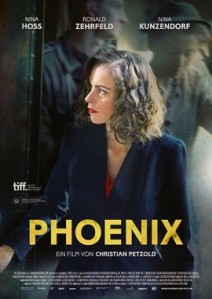
Phoenix (2014)

Phoenix_(2014_film)_POSTER

Speak low when you speak, love
Our summer day withers away too soon, too soon
Speak low when you speak, love
Our moment is swift
Like ships adrift we’re swept apart too soon
~ Speak Low (1943)

Anyone who’s watched a Christian Petzold film already knows that he crafts fascinating almost spellbinding films and that quality rests greatly on the laurels of Nina Hoss. Phoenix is yet another film that is a mesmerizing enigma.

It’s positively entrancing with its pacing — where you almost get lost within its minutes. Because although time never moves fast you quickly lose track as the mind is soon overwhelmed with a plethora of questions. In fact, all the time while you’re watching it all you can do is question. Implausibilities all but fade away in the presence of such uncertainty. If anything they get lost in the rubble.

It feels as if we’re trying to construct our own truth, which is almost maddeningly impossible because none of these characters seem ready to divulge any information. The past is a black shroud that everyone is reluctant to talk about. It makes sense because that soon after what do you say about the Holocaust? How do you cope or even begin to acknowledge the horrors that went on? It’s only 50, 60, 70 years later that we’ve finally been able to broach the subject as outsiders — people who did not experience those events firsthand. It’s easier for us to try and talk about it because we can never fully comprehend the climate. What would we have done? What would have happened to us? What would our lives have looked like in the aftermath?

The characters in Phoenix are beings in that post-war wasteland with specters hanging over them, and lives scarred by pain and suffering. They’re trying to salvage their existences the best they can, but they’re hardly existing as they did before the war. But allow me to backtrack for a moment.

Nelly (Nina Hoss) is physically maimed so horribly that her face is constantly covered in bloody bandages. Petzold does us a favor by not showing her visage before she gets reconstructive surgery. Like the shadow of the Holocaust, we are forced to imagine it on our own which is far more powerful. This is what her face looks like and this is perhaps how it happened.

What we do know is that she was arrested on October 4th, 1944 and her husband Johnny was as well. But Nelly’s faithful friend and guardian angel Lene says that he betrayed her. That’s what she believes, and yet upon hearing this news it hardly alters Nelly’s response. She’s still intent on finding him and picking up all the pieces. When she has a little more strength she begins wandering about the American sector looking for any signs of her former beau.

It turns out that Johnny works as a waiter in a cabaret Hall called Phoenix. When he first sets eyes on Nelly — it’s not his wife that he sees, but a wonderful impostor. She’s a woman who is strikingly similar, but her face is different. She’s the perfect accomplice as Johnny, or Johannes as he now goes tries to secure his dead wife’s assets.

What follows is his mission to make her into his old wife.  In many ways, it works as an inversion of the Vertigo conundrum. He thinks he’s making this woman into his deceased wife, and he coaches, dresses, and shapes her more in the image of Nelly. However, this hardly feels like an obsessive desire of dashed love, but a project to get him closer to his final goal. It’s not that sentimental, but Nelly follows along with the whole thing benevolently. To be close to Johnny is enough. But how does she even begin to break the news? Perhaps most frightening of all what will Johnny’s reaction be? After all, the wartime has changed them both.

So if you want to break it down to its most basic roots, Phoenix feels rather like a Holocaust film meeting Vertigo. But in essence, it defies that type of simple categorization. It lacks the odious horror of flashbacks and the glossy Hollywood production values of the latter. It fills its own niche altogether that even channels some of the darkness of noir. And there is no cathartic moment of emotional release. Instead, we are forced to watch as the characters bury their thoughts and feelings deeper and deeper. Perhaps they lie there somewhere under the surface. However, these are not histrionic people. They feel common and every day led by the performances of Hoss and Ronald Zehrfeld.

In this way, the performances are muted and repressed. In fact, there is little headway in the film and few epiphanies until the very end. That’s when for a few brief solitary moments things fall into place. We don’t know what will happen afterward, and in a way, we are suspended in the moment — left to ponder so many things. You could either make the case that Phoenix has shallow characters, or that there is so much depth within them that we cannot even begin to understand — like icebergs still partially submerged.

Many wonderful films lose so much of their magic because they dispel too much — give away too many of their hard-fought secrets. But Phoenix makes us work through everything, and it can be hard going certainly, and yet it is a thoroughly gratifying experience. We watch movies to be moved. We watch movies to be perplexed. We watch movies to acknowledge our wonderment in the human condition because it is a complex quandary that continually reveals new bits of enlightenment. Phoenix might leave us with more riddles than answers, and we should be content in that reality. That’s part of the magic.Like the mythical Phoenix of old, in a way, these characters try and die to their old selves, and rise out of the ashes a new.  Life is never that easy — always being clouded by doubts as our pasts come back to haunt us. It’s how we deal with that past that matters most.

4.5/5 Stars

Barbara (2012)

Barbara_(2012_film)If you’re acquainted with director Christian Petzold you probably know what you’re in for. A character study that is deliberate and systematic in its execution, courtesy of Nina Hoss, and moreover impactful in more ways than one. In this film, the narrative mode of the period piece certainly serves Petzold quite well. The setting is East Germany circa 1980. The settings are wonderfully stark. Depressed representations of a bygone era and yet somehow still strangely beautiful for depicting a simpler age. As Americans, we have a certain perspective that includes Cold War sentiment, boycotting the Moscow Olympics, and the like. But it’s a much different even intimate picture on the inside.

Our person of interest is the eponymous Barbara, a nurse stationed in Berlin, who tried to get an exit visa to the West. Now she has been transferred to a rural locale to continue her work with close surveillance by the Stasi. Her primary colleague is chief physician Andre Reiser, who is genial, but from the get-go Barbara is aloof. She does not want friends and she knows anyone could be working with the police.  She goes about her work being the best nurse she can possibly be, treating patients humanely. Most notable is Stella a girl from a labor camp, who is suffering meningitis, and finds a comforting figure in Barbara. From then on she is the only person Stella trusts.

In her free time, Barbara can often be seen smoking, riding her bike, or taking the train, but there is always a purpose to her activity. It’s in quiet defiance of her plight — an active form of rebellion as she tries to rendezvous with her boyfriend from the West in an effort to reconnect with him. Unknowingly Dr. Reiser grows continually fonder of Barbara and continues to be nice to her because she is quite remarkable. Together they try and decipher what is wrong with a young man who is recovering from a suicide attempt. But of course, his necessary surgery coincides with Barbara’s set date of escape. What follows is far from melodrama, but it is a far tenser slow burn as we watch events unfold. Our heroine does something that will alter her future although we cannot know for certain. Sometimes the best place to end a story is inside our own minds, and that is true with Barbara.

It’s a film that can make you squirm, but also make you think and feel. The German scenery is often breathtaking, the perfect landscape for bike riding, and the birds chirp blissfully in the background. It is the ultimate irony that in such a peaceful land so much suppression and pain takes place. But then again there can be so much joy taken out of something so minute as a masterwork by Rembrandt, proving that the human spirit cannot be fully quelled even there.

In the film’s nuances, you are apt to find beauty and also great depth of character. Not just in Nina Hoss, who is once again brilliant carrying an air of mystery mingled with moroseness that lingers on her face. This might be a poor comparison, but Hoss reminds me in some respects to other European starlets like Juliette Binoche, Irene Jacob, and Julie Delpy, who all carry a fascinating aura around them. The truth is American actors, in general, have to use so many words and in this way, they lose some of their allure. Nothing is left unspoken. Nothing is left untrod. But with Barbara, we do not know her ins and outs, what she is thinking, or even how her story ends.

Next on the watch list is Phoenix, the latest Petzold/Hoss collaboration. It goes without saying that I am beyond excited.

4/5 Stars