Orson Welles: Mr. Arkadin (1955) and Compulsion (1959)

Mr. Arkadin (also known as Confidential Report) has the abundance of canted angles and striking visual flourishes one usually attributes to the films of Orson Welles. It also boasts his ever more disorienting sense of space and shot-reverse-shot even as the international cast, financing, and locales outside the prying eyes of Hollywood map his labyrinthian journey to continue making movies.

His entry into this particular story is a small-time smuggler, Guy Van Stratten. There’s something abrasive and unplaceable about Robert Arden. It’s rather like when non-English-speaking filmmakers will cast an American, and it sounds tone-deaf in a picture that otherwise feels normal. Regardless, he receives a tip-off from a dying man, and it sends him in search of something…

Arkadin, an aristocratic Russian, as played by Welles, is really another version of Harry Lime from The Third Man with everyone talking about him and wanting to meet him as he remains just out of reach and hidden behind a mask at a masquerade party.

Stratten has ambitions to get in with the daughter of the enigmatic Arkadin. Welles casts his wife Paola Mori to play his carefree young daughter (albeit dubbed). In the end, the gruff answer-seeker winds up globetrotting after Arkadin, hired by the man himself to see if he can dig up any dirt on him. It feels like the ultimate act of paranoia if in fact a double-cross isn’t in order.

While his accomplice Mily (Patricia Medina) is out on her own, he crosses paths with the likes of Michael Redgrave, an eccentric pawnbroker providing some leads, and then Akim Tamiroff who is also somehow implicated in a web of conspiracy.

Plot notwithstanding, Mr. Arkadin feels increasingly emblematic of what Welles’s cinema became after his earlier successes. He was scrounging around for funding, cobbling together films all across Europe with a cadre of international talent, and increasingly drastic creative choices.

It’s evident in a picture like The Other Side of the Wind generations later, which historically took years to be completed long after Welles’s death. It does feel like every subsequent picture after Kane continued to be a monumental struggle, and it’s some small marvel that each one got made for any number of reasons. Add Mr. Arkadin to the list.

It’s not explicitly Shakespearian, but it has a certain gravitas blended with the cheap smuttiness of noir street corners and pulp novels. We are treated to a Wellesian Christmas party. The focal point is a rather perturbing visual carousel full of jocund gaiety and lurking menace capped off by a band playing “Silent Night.”

Ask me to say exactly what we’ve watched with all the various plot details, and I don’t dare try. But it bears the markers of Welles, full of flourishes and at one time both mystifying and inexorable. It’s easy to criticize the flaws, but Orson Welles hardly makes mediocre pictures. There’s always a gloriously messy vision behind them. It’s the same with Mr. Arkadin.

3.5/5 Stars

Compulsion (1959)

I never thought about it much until his passing but there’s something about Dean Stockwell in his young adult years and even his later roles that’s reminiscent of James Dean. He’s not emotive in the same way as the method actors; he’s a button-upped clean-cut version with his own neuroses.

They have some facial similarities, true, but it comes down to something more difficult to pin down when it comes to actors, whether eccentricities or the bits of business that draw in your gaze so you can’t help but watch them at work. With Stockwell, it’s something he was able to draw upon later in his career when he had a reemergence and a renaissance; acting seemed fun again.

In 1959, James Dean was gone for a few years already and Stockwell was still closer to the beginning of his career than the end. He plays one two young men who have read too much about Nietzsche’s superman believing themselves to be above the law.

Bradford Gilman is his counterpart a disingenuous sociopath who knows how to throw his charisma and influence around. Both Arthur and Judd are different than normal college students, but Arthur knows how to play the game. Then, when they’re alone in each other’s company he’s able to dominate the other boy as they play out their sick fantasies.

In one moment, stirred by his accomplice Judd takes a girl to observe some birds — it happens to be near where a boy was killed — the bird calls in the distance play against the increasingly uncomfortable conversation. He plans to force himself on her, and though he tries he cannot bring himself to go through with it. There’s a sliver of decency still left inside of him.

Soon enough he and Artie are brought in for questioning by E.G. Marshall, a calm and collected beacon of authority. I’ve never seen The Defenders, but I could see him carrying it off with a level of pragmatic stability. Artie’s the one who walks in the room and tries to flip all the power dynamics. He pointedly stays standing as Marshall questions him sitting down. He’s confident enough not to be thrown off his game though he implicates them soon enough. They must vie for their lives in the courtroom.

Jonathan Wilk shows up sooner or later. Orson Welles hardly needs a great deal of time to put his mark on the picture. His haggard magnetism holds its own against anyone as he takes in this most harrowing case defending two privileged boys who were unquestionably implicated in murder.

The ensuing case comes with a myriad of perplexing caveats. Judd was coerced into trying to attack the girl, Ruth Evans. She later takes the stand in his defense. Martin Milner is an up-and-coming newshound who at one time was classmates with the boys and soon desires to watch them hang. His feelings toward Ruth are very protective.

Wilk is a bit of a moral cypher: He’s atheist who has the KKK showing up on his lawn blazing a cross as an act of intimidation. He also flips the case on its head with a rather unorthodox and risky decision.

He looks to appeal to the so-called Christian community of the court reminding them that cruelty breeds cruelty, and charity and love are what they have devoted their lives to. When he admits to a lifetime of doubt and questioning, it doesn’t necessarily mean he’s reached any final conclusions. It makes me appreciate him more for his moral transparency

Given the fact Welles was probably playing his version of Williams Jennings Bryant, a man who was also featured in Inherit The Wind portrayed by Spencer Tracy, it’s hard not to connect the two pictures. Their subject matter is very different and yet they both dwell on these ideas of religious beliefs and how narrow-minded societies can use them to stubbornly maintain their agendas. However, they can also be exploited.

For this reason, Compulsion is a fairly perplexing courtroom drama for the 1950s; between the performances of Stockwell and others it offers up something persistently interesting.

3.5/5 Stars
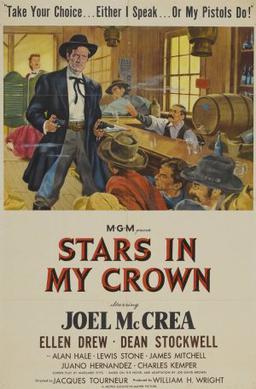
Stars in My Crown (1950)

StarsInMyCrown.jpg

It speaks not only to the man but to this film, that Joel McCrea rated Stars in My Crown among his personal favorites. (Hint: It’s not because of the imminent reunion of two cast members in Gunsmoke). The story is framed by the nostalgic recollections of an old man and it’s a singular story in the way that one life is a story. There are constant offshoots, revelations, and daily interactions with other human narratives.

John’s life (Dean Stockwell) could have been very different; it could have been drama because he was orphaned at a young age. Except he had Parson Gray (McCrea) and Mrs. Gray (Ellen Drew). Much like this film, his life was generally a joyous affair growing up as a young lad. Certainly, it was not without its roadblocks, disagreements, or minor quarrels but what remains is generally uplifting and good.

Stars in My Crown for much of its run is a vignette-driven tale but that proves to be the utmost blessing for this particular film. That inevitably brings us to Joel McCrea and why he must have relished this part. He’s a man of faith and no shame-faced Christian. There’s no denying his spiritual leanings. Still, while he’s not a spineless pushover, there’s not a condemning word that leaves his mouth either.

What keeps him upright and a pillar of the community is a quiet boldness and a genuine care for his parishioners. But that means not simply calling on the people who enter into his church on Sundays. I’ve heard it said before that it’s easy for anyone to love people who are just like them or who they like already.

What’s truly a test of someone’s heart is whether or not they are willing to reach out to those who seem alien and contrary to their station in life. The Parson is such a man. Not only does he care for the physically sick or the self-proclaimed churchgoers who are sick in the soul, he is there for those on the fringes too.

He faithfully calls on his boisterous war buddy (Alan Hale Sr. in his final role) who is larger-than-life with a strapping clan of sons (including James Arness) and a penchant for joking about religion. He’s waiting for the Parson to get God to plow his fields for him.

The good-natured Gray gently ribs him about his coming to church. But what strikes me is the worth he sees in his friend. In one resounding instance, when the local gamekeeper Famous (Juano Hernandez) has his land trampled by local bigots, it’s not the Christian folk but Jed who immediately comes to his aid. His beneficiary rightfully proclaims with all candor, “You’re a real Christian.”

Parson Gray’s rounds never seem to cease though in one instance they meet with opposition. Dr. Harris (Lewis Stone) has long been the town’s apothecary but with his ailing health, his intelligent yet rather brusque son (James Mitchell) is taking over the family business. Though more than capable, what the younger fellow is lacking is a genial bedside manner, at least upon first glance.

He does show a certain sensitivity to the local school teacher (Amanda Blake) and the certain tightness in Mitchell’s voice is stellar for articulating the feelings of a man who is hardly unfeeling — he just has trouble opening up. In fact, he’s adamant that the religious leader stays out of his way because he sees no place for such ritualism when he has practical science to help people.

The days roll ever onward with young boys lazily kicked back in a hay wagon surmising what they’d do if they were God. Namely, have it always be summer. Even Christmas would be in summer. Another time a Medicine Man (Charles Kemper) and his Carnival Show pay a visit and bring the town out of the woodwork for an evening of magic tricks and showmanship.

Then come the bad times when the typhoid hits and people are dropping like flies. First, John is sick then a whole host of others. The Doctor criticizes Gray for potentially infecting the entire population of school children and for the first time in a long time we see the normally even-tempered man angered.

However, the Parson is man enough to consider that he’s wrong because he very well could have been. He’s also humble enough to give the doctor room to work. For the sake of the people, he becomes isolated and as a result poor, bereft of his usual resources. Because all he had was out of charity and the tangible blessings of those around him.

He even goes so far as closing the church for the first Sunday service as far back as anyone can remember. It soon becomes evident how very humble and meager his portion is without the bulwark of community around him.

But it’s one of those things, out of the Parson’s seemingly selfless act comes a reciprocal act from the young doctor — the man who shed his rough exterior and became one with the people knowing full well all their suffering as well as their joys. It was this chance in the trenches with the lack of the sleep and onslaught of the slow fever where he realized there was a need for something else that he never thought was lacking before. If Ordet (1955) has the most striking resurrection scene that I can recall perhaps Stars in My Crown has the most gorgeously understated.

The final stand that the Parson is compelled to take is also weighty with significance. The townsfolk have repeatedly threatened Famous and now they’ve reached the end of the road. Stringing him up and taking his property is all that’s left to do.

When they leave that burning cross and the note, cloaked in white like cowards, it somehow brought the same realization that floods over me far too often. In some ways, this film is meant to be so archaic, reminiscent of a bygone era far removed from our present. And yet as much as we might try and move away, it sadly remains relevant.

So the Parson goes to Famous’s home alone knowing what is coming for them. He forgoes the guns of his good buddy Jed. That’s not his way now. Instead, he speaks to them resolutely as they get ready to take Famous away. He confronts them with the man’s own words and in the most piercingly moving moment of the entire picture we see how one man can be so selfless in the face of so much hatred. He can boast so many riches even if his worldly possessions seem totally inconsequential. His character speaks for itself.

Years later Atticus Finch would have a confrontation akin to this one and yet it came to an impasse. Here the Parson is able to speak the truth into each of these men’s lives and make them human again. All thanks to Famous.

So while the picture might fall too easily back into place (Klansman aren’t rooted out forthwith for instance) there’s no begrudging such a gentle and virtuous film its closure. Because these are as much the fond memories of a young boy grown old as they are the tale of one man who left an indelible impact on a life and on a community. I’m reminded that perhaps a church is not so much a building as it is a people. Though the picture is capped by the proud moment where the Parson sees his old war buddy welcomed into the fold, I would like to think he doesn’t see that as the ultimate victory.

If anything his life reflects the outpouring of an existence lived outside of the Sunday framework. He does not have compartmentalized faith — the kind of religiosity that makes people hypocritical and prideful. I can respect a man like that even if he doesn’t pack a gun.

4.5/5 Stars

I am thinking today of that beautiful land
I shall reach when the sun goeth down;
When through wonderful grace by my Savior I stand,
Will there be any stars in my crown?

Will there be any stars, any stars in my crown
When at evening the sun goeth down?
When I wake with the blest in the mansions of rest
Will there be any stars in my crown?

In the strength of the Lord let me labor and pray,
Let me watch as a winner of souls,
That bright stars may be mine in the glorious day,
When His praise like the sea billow rolls.

O what joy it will be when His face I behold,
Living gems at his feet to lay down!
It would sweeten my bliss in the city of gold,
Should there be any stars in my crown.

Blue Velvet (1986)

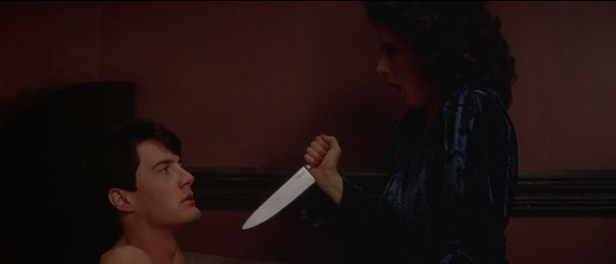
bluevelvet1It’s certainly not a news flash that I often have immense troubles dealing with black, satirical comedy. I think the difficulty for me lies in the dividing line between comedy and tragedy. Oftentimes, although I’m not always fond of violence or profanity, I can make a concession if there’s something deeper behind it. With Schindler’s List, this means watching the scenes of the Holocaust, because there are vital realities to be gleaned from that. In a Scorsese film, aside from being well made, I often see them utilizing profanity in such a way that shows the corruption and baseness that lies within mankind. Take Goodfellas for instance.

All this to say, Blue Velvet was hard to pronounce a verdict for. Without a doubt, David Lynch is a worthy director with his own surrealist vision, that is nevertheless polarizing to the viewing public. There is no doubt that his films are fascinating and in moments mesmerizing; there’s no arguing on that account.

However, Blue Velvet is a dark and brooding film, as are many others, but the big difference here is that all of that is buried under a thinly layered caricature of suburbia. These scenes are so superficial; almost stupid, because the dialogue seems torn off some billboard or magazine cover. There are flowers, white picket fences, and robins denoting the changing seasons. It reminded me of some precursor to American Beauty, except the ending was brighter and the depths seemed darker.

Under the surface lies something sinister and it all comes to a boil when Jefferey Beaumont (Kyle MacLachlan) returns to his hometown of Lumberton to visit his injured father in the hospital. The college boy comes across a severed ear, and it leads to stakeouts, and eventually brazen attempts to break into a mysterious woman’s apartment.

And as you would expect Jefferey gets in too deep, getting sucked into a twisted, subversive spiral that includes singer Dorothy Vallens (Isabella Rosellini), a sociopathic maniac named Frank (Dennis Hopper), and a whole lot of ambiguity. All things return to the status quo in this suburbia and we can go back to singing “Blue Velvet” and “In Dreams” in peace. But there’s this nagging sensation that Lynch’s treatment of this topic is utterly cruel. Isabella Rosellini gives a stellar performance that is a constant emotional roller coaster, while Dennis Hopper is the definition of a screwed up, drugged up, lunatic. These individuals have so much darkness and twisted caverns in their characters that it’s hard to leave them like this.

After all, this isn’t a big joke, and it shouldn’t be, but it’s hard to get away from that idea since the dichotomy between the two is separated here by a hair’s length. However, for others who find it easier to parse through the tonal problems I have with Blue Velvet, there’s undoubtedly a lot to take note of. This is one of those enigmatic films we leave with more question than answers; more confusion than clarity. It’s not always the easiest, but it can certainly be rewarding.

3.5/5 Stars