M (1931)

mfilm1Peter Lorre has a face that will forever live in cinematic infamy, and it started with M. In truth, Fritz Lang’s drama involving a serial killer feels fresh and engaging even after all these years, maybe because humanity hasn’t changed all that much. We still murder, we still kill, we still seek justice, we still give into our base desires, and there’s not a perfect person among of us. Each one of us has our faults — our own personal downfalls.

The film begins with a rash of disappearances across the city and the boulevards are plastered with Wanted posters for the mysterious culprit. The day that Elsie Beckmann disappears sets the community off, especially when the perpetrator sends a handwritten letter to the local newspaper. The media frenzy begins as every man, woman, and child begins to suspect their neighbor of being a child murderer. The mob mentality looks to overrun the scales of justice. Meanwhile, the police force looks to use empirical methods as well as frequent raids to drudge up answers. They’re far from popular in the underworld and the force is being run ragged in an effort to get to the bottom of the case. Everyone expects a resolution quickly, but real solutions are hard to come by.

Things have gotten so dire for the local mob bosses that they call a meeting, resolving to do the dirty work on their own. They begin their own search for the man who is single-handedly ruining their rackets because he’s no good. Now the chase is really on for Hans Beckert, because everyone is on high alert, in all spheres of society. The question becomes not if he will be caught, but when, because it is only a matter of time.

It’s in these latter moments that the longstanding mystery behind the film’s title finally is revealed and it is a fitting twist. Everything begins to fall into place, but the strangest thing is that Lang actually begins to make us empathize with his killer. True, we want him to receive justice, but the men on the other side of the law seem little better than he — in fact, many of them are criminals themselves.

M has a fascinating juxtaposition of silence and sound, acting as a bridge between both. Beckert’s whistling of “In the Hall of the Mountain King” is certainly integral to the plot. It’s those exact notes that trigger the memories of a blind beggar selling balloons. However, it is these hollow sounds of the whistling that feel strange ominous and distant in vast areas of open space  There’s as much tension in the lulls of silence as there is in the most tumultuous notes.

Although Lorre doesn’t say much, we get enough clues just dwelling for long spells on his face. Those big eyes full of crazed fear and psychological torment. His mind plagued by paranoia and torn apart by schizophrenic bouts of conscience. It suggests the perverse nature of man given that this story was taken from real life accounts of a German child murderer. But also the tragic nature of mankind that we are often drawn to do evil in a sense. Our flesh is too weak and we give into our animalistic urges. Of course, Lang reveals the flip side of the indiscriminate as well, that seems just as questionable including mob rule and a sort of vigilante justice that functions outside of the accepted modes of law enforcement.

It brings up questions on the cycle of crime and the rehabilitation of the criminal. Questions that still get hotly debated and thrown about even to this day. M became the measuring stick for all of the subsequent crime thrillers Lang would churn out so efficiently following his move to the United States. You could argue that although he came close numerous times, he never quite topped this crowning jewel of a crime drama.

5/5 Star

The Cabinet of Dr. Caligari (1920)

Das-Cabinet-des-Dr-Caligari-posterI’ve never seen anything like it, and I mean that in all truthfulness. The Cabinet of Dr. Caligari has the esteem of being called the original horror film, and that’s not something to be taken lightly. Perhaps I’m more partial to Murnau’s Nosferatu that came out two years later, but this film directed by Robert Wiene is really the epoch of German Expressionism. The German Expressionism Movement, after all, was not simply about painting, or architecture, or theater. It bled into the Weimar film industry as well, drifting as far away from realism as was possible at the time. Some say D.W. Griffith wrote the rules of moving pictures as we know them today, and if that’s so, then it was this film that tried to push the boundaries to the limit.

In an effort to be transparent, I will acknowledge that The Cabinet of Dr. Caligari does not engage me, narratively speaking, like some other silent films. It follows a Dr. Caligari as he presents his spectacular somnambulist Cesare (Conrad Veidt) at a local carnival. But all is not as it seems as a string of murders terrorize the town by night. Also, I was not a big on the score that accompanied this version. It was rather a discordant cacophony and it did not seem to go well with the action, but that is often a problem with silent films if they do not already have a score to go with them.

CABINET_DES_DR_CALIGARI_01Nevertheless, the images alone are striking, and it is still fascinating for the very reasons I mentioned above. It boasts the craziest sets, highly stylized, and made up of every type of angle and shape imaginable. We know resolutely that this is not reality, these are simply facades being put up to engage our eyes. It features a mise-en-scene for the ages, with no attempt to try and be the least bit objective. There’s no effort to aim for realism; none whatsoever, and that level of audacity is impressive. Furthermore, it’s mind-boggling to think that so many people and so many films were influenced by this movement. Especially in Hollywood.

Without it, we would not have 1930s horror films like Frankenstein and Dracula. There would be no Film-Noir or at least not the same moody, atmospheric creature that we know today. In truth, it was many European directors like Fritz Lang, Billy Wilder, Otto Preminger, and even Alfred Hitchcock, who channeled this movement in their own work. It proved to be so important to the medium of film and thus, it’s important to remember these roots. So maybe The Cabinet of Dr. Caligari is not as engaging today, but there is much to be admired and extracted from it still.

4.5/5 Stars

Metropolis (1927)

MetropolisposterFritz Lang’s archetypal sci-fi epic is steeped in politics, religion, and humanity, but above all, it is a true cinematic experience. It is visually arresting, and it still causes us to marvel with set-pieces that remain extraordinary. How did Fritz Lang piece together such a gargantuan accomplishment? Maybe even equally extraordinary, how was I able to see almost a complete cut of this film, which was at different times thought to be lost, incomplete, and ruined?

Metropolis really feels like one of the earliest blockbusters, although I would have to further substantiate that. Still, it’s basic story is generally captivating following a young man named Freder from the upper echelon of society with a father who runs things. This young man is really in the perfect position to succeed, the way society is set up. He even goes to the preeminent school where all the boys are dressed in white. Little does he know in the lower depths the beleaguered, grungy, weary masses in black are slowly killing themselves with work. The machine that drives this society is never satisfied, always desiring to be fed more and more and more.

When the boy finally sees the reality of the infrastructure his paradise is built upon, he cries out in horror. This is not the way things are supposed to be. He eventually switches places with one of these workers and attends a meeting deep in the catacombs (an allusion to the early Christians), where the pure goddess Maria lifts the spirits of her fellow man. But of course, the evil inventor Rotwang is enlisted by Freder’s father Joh Frederson. Their own relationship is marred by conflict over a woman they both loved. Freder’s dead mother. And so the scientist looks to resurrect his long lost love, and he needs Maria to develop his plan. He kidnaps her and from her likeness creates a double, who goes out to wreak havoc on all of Metropolis. The apocalyptic words of the Book of Revelation ring true as the whore of Babylon deceives the masses and leads them to destruction.

But Freder is the Mediator, he is the Savior of his people, and he is necessary to bring peace and tranquility to a world that has descended into such brokenness. So Metropolis is certainly a film full of symbolic touches, religious connotations, and political commentary, but all of this is developed by Fritz Lang through an archetypal hero’s narrative.

Hollywood has become an industry seemingly so obsessed with story, screenplays, plots. Certainly, a film like Metropolis is at least adequate in that area alone, but what really sets a film such as this apart is its cinematic scope. The sheer vast expanses it fills. The scope it creates through its plethora of extras and encompassing sets is hard to downplay. How to describe scenes where water is literally breaking down walls and covering masses of fleeing children? Or smokestacks spewing out refuse while trains, planes, and automobiles pass by in every direction. People scattering this way and that, following the false Maria in a chaotic frenzy. It reminds us what the motion picture, the moving picture, is all about. The images that are brought before us lead to a suspension of disbelief because more importantly they are incredibly affecting. At the atypical 20 frames per second, they are images full of tension, full of energy, and full of life.

Metropolis-new-tower-of-babelIn a sense, with Metropolis, we can easily see a precursor to Chaplin’s Modern Times a decade later. There is a general apprehension of the machine and the impact of a true industrial revolution. There is a fear that there are more positives than negatives. That machines will take over and man will become outdated. Perhaps someday our creation will destroy us. By today’s standards, such notions seem archaic, but are they? We still live in a society ever more obsessed with advancement, technology, and all the things that come with that. However outdated some of Metropolis might feel, and there are numerous such moments, at its core is the final resolution that between the body and the mind there must be a heart to regulate. We are not simply animals with bodies or rational machines with minds, but the beauty of humanity is that we have a heart, pulsing with life and vitality. That is something to be grateful for and never lose sight of.

5/5 Stars

You Only Live Once (1937)

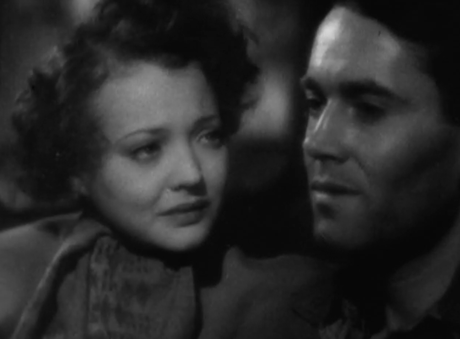
youonlylive1There are two types of lover-on-the-run narratives. There’s the Bonnie and Clyde/Gun Crazy extravaganza full of shoot-outs and bloodshed. Then you have the more sensitive approach of a film like They Drive By Night. You Only Live Once fits this second category thanks to two bolstering performances by Henry Fonda and Sylvia Sydney. Fonda is forever known for his plain, naturalistic delivery full of humanity. He has that quality as 3-time loser Eddie Taylor certainly, but he also injects the role with a somewhat uncharacteristic rage. In many ways, he has a right to be angry at a world that so easily writes him off and is so quick to pronounce guilt. There is very little attempt to rehabilitate the reprobate and Taylor is an indictment of that.

youonlylive2Secretary Jo Graham (Sylvia Sydney) is positively beaming the day they are releasing her boyfriend Taylor because he is finally getting the second chance he deserves. A glorious marriage follows soon after until reality breaks into the lovers’ paradise. Few people aside from Father Dolan and a few forward thinkers are willing to give Taylor grace. He is prematurely fired from his job and has no way to make the payments on the house that his wife has been sprucing up for him. Adding insult to injury, a brazen bank robbery is committed which he is wrongly accused of. It’s back to the clink and then the electric chair.

Jo is beside herself and Taylor is angered at the way the law deals with him. This justice is the most unjust imaginable, and he is about to pay the price. But Jo desperately gets him help and he tries to make a break for it.

youonlylive4That’s what makes a wire proclaiming his innocence all the more ironic because he will have none of it. He takes a man’s life and now his acquittal goes down the drain as quickly as he got it since he has a murder to his name. Eddie and Jo go off on the road together, looting banks and surviving the best they can with their newborn son. This is not two joyriding youngsters trying to get rich without an honest day’s work. Fritz Lang develops a more complex story with people who tried to live by the rules and found they were dealt an unfair hand.

As one of Lang’s earliest works in America, you can see some remnants of German Expressionism exported here with foggy clouds of mist engulfing the screen at times. His tale also has an interesting ambiguity suggesting that crime is not always black and white. Perhaps it has less to say about the moral degenerates or corrupt individuals in our society and more about the faulty structures that our justice system often get built around. It’s mind-boggling to think that this film came soon after the Depression meaning the bitter taste of those years was still fresh in peoples’ mouths. Nevertheless, this film is an interesting crime-filled character study.

4/5 Stars

While the City Sleeps (1956)

whilethecity1While the City Sleeps has a brilliant cold open followed by a pounding title sequence, courtesy of Fritz Lang, that brings to mind a bit of Diabolique and Psycho. The rest of the film turns into a case to find the wanted lipstick murderer (based on a real killer), but that only holds part of our attention.

When newspaper magnate Mr. Kyne dies suddenly, his begrudging son Walter (Vincent Price) takes over intent on shaking up the status quo and putting his mark on the company. He soon turns three men against each other as they desperately fight for the new position of executive director. The first is veteran newspaper editor John Day Griffith (played by the always memorable character actor Thomas Mitchell). The second candidate is chief of the wire service Mark Loving (George Sanders) who is Griffith’s main competitor. Finally, in the third spot is Harry Kritzer who happens to have a secret ace in the hole. Each of them is tasked with finding out the real scoop about the serial killer, and it turns into a real tooth and claw ordeal. Within the glass cubicles, everything can be seen, but not everything is heard and that’s where the secrets get disclosed.

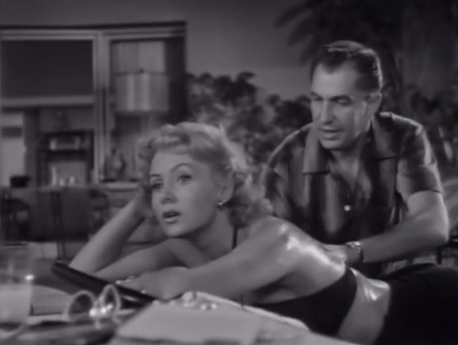
On the outside looking in, so to speak, is star TV reporter Edward Mobley (Dana Andrew), who agrees to help his friend Griffith by doing a little digging around about the murderer. He gets some tips from a cop friend Lt. Kaufmann (Howard Duff), and Mobley tries to smoke the killer out on air. However, it leads to the potential endangerment of his fiancée Nancy, who also happens to be Loving’s secretary. Loving has his love directed towards a female reporter named Mildred Donner (Ida Lupino), who attempts to needle Mobley for info. At the same time, the killer is on the move once more, with Nancy being an obvious target. Mr. Kritzer’s own romantic entanglements get him in trouble because he is seeing Kyne’s beautiful but detached wife Dorothy (Rhonda Fleming). Mildred finds out about them and they have some talking to do. Mobley also has some making up to do with Nancy after she finds out Mildred came to see him. It’s a big mess.

whilethecity3Mobley juggles everything from his love life to the big scoop and they apprehend the killer, but things at Kyne’s don’t wind up exactly the way they expected. Mobley looks to move on from the paper with Nancy, but even he cannot get away that easily.

While the City Sleeps is an underrated tale from Lang that is positively stacked with big names. Its pacing can be deliberate at times, but it is just as much an indictment of journalism as it is a thriller. The office is a web of deception with so many interconnections between these work factions. Those you would normally expect to be scrupulous seem to give up their honor in the face of this new promotion. In a sense, Mobley seems to be outside of this fray and yet he cannot help but get involved in it. It doesn’t help that nothing turns out the way it’s supposed to. Everybody seems to gain something, but nobody really wins the game.

I must say it was great to see Dana Andrews in one of these leading roles again and although their roles were smaller, Ida Lupino and George Sanders still were a deliciously stuffy and corrupt pair. I was never really a fan of Vincent Price due to the roles he normally plays, but I was inclined to like Howard Duff (Lupino’s real-life husband) in his turn as the policemen. It goes without saying that Rhonda Fleming is positively beautiful, but she also cannot be trusted. I guess that applies to about every character in this film. It’s certainly a cynical world out there that Lang paints, where the killer might be caught, but corruption is never fully quelled.

4/5 Stars

Review: The Big Heat (1953)

bigheat2The Big Heat is not a noir where the darkness comes from the shadowy visuals, but from within its characters themselves. In fact, some of these individuals are so subtle in their corruption that it easily gets overshadowed. Homicide cop Dave Bannion is, rather ironically, the straight-arrow trying to do what is right, and he becomes the most vengeful character in Fritz Lang’s film. It’s a subversion of the typical noir arc because his greatest help ultimately comes from the former femme fatale. That’s not how it’s supposed to happen, but then again a lot of things happen a little differently in The Big Heat.

The film opens and within a second a man has shot himself and left a confession on his desk. The cues tell us that he’s a cop and he’s just committed suicide. His wife comes downstairs strangely composed and shuffles through the pages he has written. She goes to the phone, not to call the police, but she talks to a third party. We quickly forget what’s she’s done, but the fact is Mrs. Duncan represents the corruption that reigns supreme in this film. She’s used a juicy piece of blackmail to receive large payoffs from someone and she’s not the only sellout.

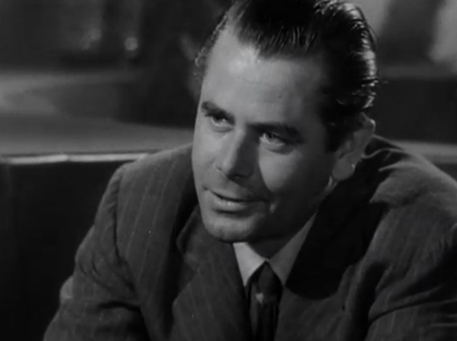
Bannion (Glenn Ford) is a cop by day and a family man at night with a loving wife and a beautiful little girl. By convention, he is supposed to be the moral compass of this film — the emblem of good conquering evil. He takes on the straightforward case of Officer Duncan’s death, but it gets convoluted when a B-girl named Lucy Chapman calls him up to say she knew the deceased, and he would never kill himself. Initially, Bannion takes little heed of this girl, because she is hardly as respectable as Mrs. Duncan, or so society says.

He gets pressure from his superior Wilks to lay off, but Bannion is discontent with loose ends, especially when he receives news that the Chapman girl has been brutally murdered. This can’t all be all coincidence, and he begins sniffing out the truth like a bloodhound. Bannion leads us into the home of this empire of crime literally. He confronts local businessman/crime boss Mike Laganna, who he accuses of involvement in the corruption. Things are beginning to heat up, and they start to infiltrate the sanctity of his home life. The dark recesses of the noir world can never be subdued, and Bannion dives deeper into the labyrinth that is created by his own obsessive vendetta. He has no tolerance for his colleagues who don’t take a stand, in favor of their pensions. He can’t stand tight-lipped locals who give him no help and most of all he hates Laganna’s guts.

bigheat3At the local shady nightclub “The Retreat,” Bannion has his first run-in with the hired thug Vince Stone (Lee Marvin). Afterward Vince’s girl Debby is genuinely impressed by Bannion’s methods, but he will not give her the time of day. He expects her to be the same superficially ditsy dame that we have all seen before. Hardly a femme fatale, but still there is the potential to be deadly. The one character who seems to conform to the stereotype is Stone, and yet he is even more brutal than most, burning girls with cigarette butts and splashing scalding coffee on Debby’s face.

Bannion gets to one of the other hired guns named Larry and both Stone and Laganna decide that something must be done to stop Bannion in his tracks. The obvious target is his little girl, but this time the family life prevails over the noir world. His family and colleagues rally around him and yet Bannion is not done with his obsession.

In fact, it is Debby who actually finishes off Bannion’s work by paying a visit to Mrs. Chapman and then Vince. Bannion arrives soon after to reprimand Vince, but Debby has already done the dirty work. The nightmare is over and everything that is good and right comes to the forefront. Debby proves her allegiance, the criminals are put away, and Bannion gets a new position with the homicide department. But underlying this seemingly happy ending is still a sense of tension. The film ends as Bannion heads out on a new homicide case with the cycle continuing and it seems like he will never be free of it.

The world will continue ripping away the ones he loves. Before he knows it, he will be left with only his personal vengeance to drive his future. Bannion very easily could cross the line between righteousness and corruption. He already almost strangled two characters and was not opposed to slugging it out with others. It’s only a matter of time before he totally blows his cool and collected exterior. It’s a dark assumption, but then again that is a lot of what film-noir is. Fritz Lang seems to get this and that’s what makes his characters here so powerful because he knows that the root of all evil can be in everyone.

4.5/5 Stars

Hangmen Also Die! (1943)

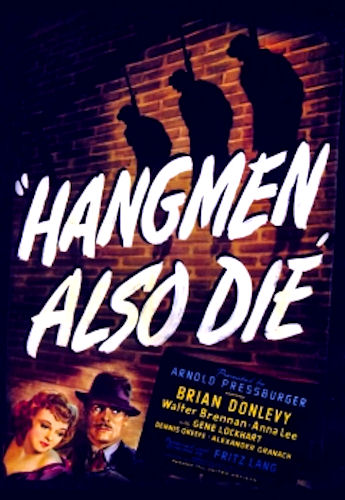
Hangmen_Also_Die_1943There are some fine pieces of intrigue in this modest WWII period film from Fritz Lang. The plot is based off real events in Czechoslovakia surrounding the assassination of Nazi Holocaust proponent Reinhold Heydrich. Mascha (Anna Lee) finds herself admidst a web of trouble when she helps a member of the underground after he commits the killing. But the Nazis are soon hounding her and it brings danger to her father’s household (Walter Brennan) . Ultimately she is forced to choose where her greatest allegiance stands.The film features Gene Lockhart playing the Nazi collaborator Czaka. Perhaps this film is not all that realistic and the casting is not perfect (although I did enjoy seeing Anna Lee in a leading role). At the time it came out this movie functioned as an anti-Nazi film and it still packs a decent punch from that perspective. It deserves some acknowledgement at the very least.

3.5/5 Stars

Contempt (1963)

Directed by Jean Luc Godard and starring an international cast including Brigitte Bardot, Michel Piccoli, Jack Palance, and Fritz Lang, this film within a film is Godard’s personal examination of the cinematic world. It opens with the shooting of a scene only to have the camera turn to face on the audience. Then begins a story where a screenwriter married to a beautiful woman is called upon to write a new screenplay for an adaption of the Odyssey. The producer is a vain and loud mouthed American who quickly has his eyes on the producer’s wife. Other members in this production are the real life legendary director Fritz Lang as well as the producer’s personal female assistant. Things begin to turn for the writer after he leaves his wife with the American playboy. She begins to become distant and she finally acknowledges that she no longer loves him. One of the famous extended sequences focuses on the argument they have inside their residence. In the course of the scene their relationship begins to crumble and finally goes beyond repair. This turn of events is very obviously paralleled in the Odyssey by Odysseus and Penelope. In the end the wife leaves with the producer and screenwriter is left in Italy to help finish up the film alone. Little does he know what has happened. Fellini’s 8 ½ may be a greater film about a filmmaker and his art, but I think “Contempt” is important because Godard focuses a great deal on the conflict between the commercial films of Hollywood and the art films of Europe. His film is more about each individual person who together make a film production possible, and he brings it to the screen with one of his best casts.

4.5/5 Stars

Scarlet Street (1945) – Film-Noir

Similar to Woman in the Window, this film-noir was directed by Fritz Lang and it stars Edward G. Robinson, Joan Bennett, and Dan Duryea. Chris Cross is a shy employee who has been working for the same man 25 years. While walking home Chris rescues a beautiful woman from an assailant, not knowing it is her brutish boyfriend. Amused Kitty agrees to have coffee and Chris who is an amateur artist, begins talking art, but Kitty gets the idea he is a wealthy painter. Because Chris is stuck in a hopeless marriage he becomes infatuated with kitty and she takes full advantage. Chris scrounges for money to pay Kitty’s rent and unbeknownst to him, Kitty’s boyfriend tries to sell the artist’s work. A critic is impressed and so Kitty masquerades as the artist. Chris finds out eventually and confronts her but the conniving femme fatale manipulates him again. Chris is delighted his work is appreciated and he is content with Kitty continuing to take the credit. An unexpected turn of events mean he can leave his wife and marry Kitty finally. However, he finds her with Johnny and after his genuine proposal she belittles him.An enraged Chris commits murder but it is pinned on Johnny. A miserable wanders the streets without a job or recognition for his art. Furthermore, he must live with his guilty conscience tormenting him until the end of his days. Woman in the Window is good but this film is more biting and powerful when it is all said and done.

4/5 Stars

The Woman in the Window (1944) – Film-Noir

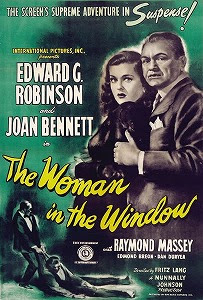
Starring Edward G. Robinson and Joan Bennett, this film-noir involves an ordinary psychology professor and a beautiful woman. The story begins at the club where the professor and his friends begin to discuss an enchanting portrait of a woman in a store window. He stays behind for a while longer and before he leaves he takes one last look at the painting. And there he meets the woman herself who then invites him over for a drink. However, her angry boyfriend comes by and he is left dead after a scuffle. Now the two perpetrators must cover up their murder and dispose of the body. That task goes to the professor and he naively dumps it out in the country leaving behind numerous clues. One of the professor’s friends is the district attorney and so he finds himself invited back to the scene of the crime. The professor is not suspected but the woman is blackmailed by a low life ex-cop who threatens to expose them if he doesn’t get his money. Much to the woman’s relief the blackmailer is killed but it comes too late for the professor. Or does it? This noir directed by Fritz Lang focuses on a mysterious woman and psychology. It also has one of the most abrupt, out of the blue endings. Every movie should not be resolved this way but I rather liked it one time around.

4/5 Stars