The Women (1939)

 6d603-womenHere is a film full of personalities. In fact there is so much personality that it nearly bowls you over with its impact and frenetic force.

In the center of it all is Norma Shearer who is the respectable socialite who is losing her husband to another woman. Joan Crawford is the gold digging woman who is as detestable as ever. Rounding it out is the equally repulsive gossip played to a tee by Rosalind Russell. There is the ever innocent Joan Fontaine and a spunky divorcee played by Paulette Goddard. Throw in numerous other memorable women and you have a cast that completely overwhelms, but in a good way.

Husbands and lovers seem to being switching hands so easily and the whole film is focused on the women who are swapping them. It begins with Mary Haines’ husband only to continually get more complicated as more gossip is divulged and mud is thrown. Not to mention a few angry fists and slaps to go with the caustic words.

There is a lot to admire about this film, because it does what it set out to do very well. It creates some empathy, some laughs, and yes, a whole lot of loathing.

However, as I contemplated the film I realized although the Women is from 1939 and the clothes often seem laughable, the people and issues in the film often seem all too real. Divorce hits close to many homes literally and gossip certainly has not gone instinct. Thus, despite the passage of time, in many ways this film still feels fresh and relevant today.

4/5 Stars

Gaslight (1944)

eb609-gaslight-1944Directed by George Cukor and starring Ingrid Bergman, Charles Boyer, and Josesph Cotten, with Angela Lansbury, this film begins rather abruptly with a young girl in England who witnessed the aftermath of her aunt’s murder. Then in a whirl wind she has become married to a nice young pianist and they move back to her old home in England to settle down to together. From that point on everything begins to change gradually. Gregory has a violent outburst over a letter, Paula loses her brooch mysteriously, a picture is misplaced, there are seemingly footsteps from above, and the gaslights change for no apparent reason. Gregory continues to manipulate and isolate his wife telling her it is for her own girl. A traumatic night at the opera and the new maid only worsen Paula’s mental state. She soon believes she is sinking deeper and deeper into hysteria thanks to Gregory. However, a former admirer of her aunt becomes curious of Paula and tries in earnest to meet her as he reopens her aunt’s case. Finally, they meet and together they piece together what is really going on. In the final climatic moments the inspector comes to Paula’s aid and she turns the tables on her husband. All the main players do a wonderful job, especially Bergman, and this film was built up nicely. My only qualms would have to be Joseph Cotten playing an Englishman and I found it hard to follow in the very beginning.

4.5/5 Stars

Something’s Got to Give (1962)

e3ac1-somethings-got-to-giveWell, this is a first for me, if my memory serves me right. I have yet to do a write up for a film without having a rating to go with it. Something’s Got to Give eventually and now it has.

I honestly was surprised that this “film” even existed. I knew about Marilyn Monroe’s last film project which ultimately was unfinished thanks to her tragic death. I assumed the project was ditched and never thought about again. I certainly did not give it a second thought then. Then, quite by accident I came upon it in all its 37 minutes of glory. Apparently others had given it a second glance and we have them to thank for this unfinished addition to Montroe’s filmography.

It looks like production quality with a few missing parts and quite the cliffhanger ending. We do not even quite know the extent of the cliff yet.
However, it was an interesting look at Marilyn Monroe in her final days. You also had a fun cast of handpicked players including Dean Martin, Cyd Charisse, Phil Silvers and Wally Cox. Not to mention one of Hollywood’s prominent directors in George Cukor. It seems likes all the makings for a light ’60s romantic comedy.

This certainly was not going to be a masterpiece (It was actually a remake of My Favorite Wife (1940) and was given a face lift for Move Over Darling). That’s okay. It is a interesting piece of history in its own way.

Rating: N/A

The Women (1939)

6cabb-poster_-_women_the_01Starring a cast including Norma Shearer, Joan Crawford, Rosalind Russell, Paulette Goddard, and Joan Fontaine, this film is all about the lives of these women. Mary is a member of New York high society who is happy with her marriage. However, when her gossipy friends begin to talk about her husband with another women she is hurt. She eventually  files for divorce and while waiting for the conformation in Reno she meets some new friends and is finally able to find a way to get her husband back. Needless to say the ending is happy and a few women get what they deserve. This film had an enjoyable introduction, a sequence in Technicolor, and an all female cast. Most of all it characterizes the various women in this walk of life. Some are kindly, others foolish, and still others are treacherous.

4/5 Stars

Holiday (1938)

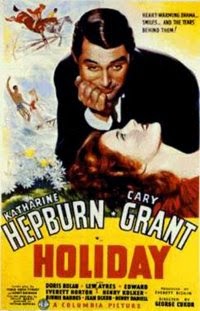
2c3de-holiday_posterJohnny Case (Cary Grant) is a happy go lucky fellow who is crazy in love with the girl of his dreams. He returns to town telling his friends the Potters that he has plans to marry this girl he met 10 days ago at Lake Placid! He is ecstatic and not afraid to show it.

However, he must become acclimated with her family and their lifestyle. Most important is gaining the approval of her sometimes stuffy and always money-minded banking father. Julia Sefton is by all accounts a lovely girl who seems to truly return Johnny’s affection. Honestly, though he is not quite used to her type of society. He makes his entrance by arriving through the servant’s door and wanders around the stately manor marveling at all the trappings. Doing the rounds he runs into her drunken but genuine brother Ned (Lew Ayres). Then, there is sister Linda (Katharine Hepburn), the so-called black sheep of the family, although her only fault is being an energetic free-spirit.

Immediately she and Johnny hit if off, and she soon realizes that her sister has a real catch on her hands. The wedding is finally agreed upon by Mr. Seton, and a big New Year’s Eve Party is thrown much to Linda’s chagrin. The night of the big to do there are two parties that take place. Downstairs all the snobs and high society mingle with Julia parading Johnny around. Upstairs is a different matter where the quarantined Linda is eventually joined by the Potters,  Ned and even Johnny.

The little gathering gets quashed and that is not all. Father and daughter are adamant that Johnny works at the bank and make money because that’s what any respectful husband would do. They take little heed of Johnny’s dream to take a holiday once he has raised enough money to live off of. He just wants to live life free of distractions for awhile, but they just do not understand. Finally, Johnny is feeling too restricted by all the obligations to bear it any longer, because he simply cannot live that way. Again, both father and daughter do not understand. But Julia does, and she finally realizes what she must do. It’s time to take a holiday.

Here is a formidable trio in Cary Grant, Katharine Hepburn, and director George Cukor. It makes me beg the question, how this film has become so overshadowed by Bringing up Baby and The Philadelphia Story? Johnny Case is a wonderfully vibrant role for Grant, and his acrobatics alone are worthwhile viewing. Hepburn on her part plays an equally spirited individual but without the scatter-brained or feisty edge that she often carried. Instead, she is just wonderfully footloose and fancy-free. Edward Everett Horton and Jean Dixon are an absolute riot, and I would love to have friends like them. Lew Ayres role was rather an odd one, but both Doris Nolan and Henry Kolker had an adequate amount of stuffiness to pull off their parts. That juxtaposition was necessary for the film to work and it did.

4/5 Stars

My Fair Lady (1964)

Adapted from the play Pygmalion, originally written by George Bernard Shaw, My Fair Lady stars Audrey Hepburn and Rex Harrison. It follows a speech therapist (Harrison) as he tries to win a bet with an old acquaintance that he can pass off a poor flower girl as a duchess. He takes Eliza Doolittle (Hepburn) and begins to train her, not as a person but as an experiment. Eliza eventually gets fed up with this treatment but at the same time also wants to become sophisticated. With Harrison’s help she does become that person and is no longer a subject to be experimented with. This is a role where Hepburn plays completely against her image for most of the film but she does pull it off in the end. Putting together a good cast, plot, and songs, this film is quite good.

4.5/5 Stars

The Philadelphia Story (1940)

Headlined by Katharine Hepburn, Cary Grant, and Jimmy Stewart, The Philadelphia Story  tells a comical tale of a divorced socialite who is about to be remarried. Tracy Lord is an arrogant socialite who divorced her equally fiery husband C.K. Dexter Haven. Now it is the day before her wedding to another man. However, Haven returns and brings a long two magazine reporters to get a scoop they were forced into. After a lavish party and many drinks the reporter (Stewart) and Tracy Lord find themselves spending an inebriated night talking and swimming. Haven manipulates the situation and the future husband Kittridge, who catches the tail end, believes something bad is happening. The next morning the wedding is in jeopardy and Hepburn and Stewart are oblivious. Although nothing happened, Lord agrees to terminate the wedding and Mike (Stewart) tries to save her embarrassment by proposing marriage. However, she realizes it is not meant to be and goes to Haven while Mike returns to the camera woman who loves him. It all ends well but the joke is still on them in the end. This romantic comedy has a lot of star power and it is actually pretty good.

4.5/5 Stars

Adam’s Rib (1949)

Starring Spencer Tracy and Katharine Hepburn as a married pair of lawyers on the opposite sides of a case, this film begins with a bang. A distraught wife followed her husband home to find him cheating and she shot a gun off. In the ensuing days she is being charged with assault and the case is getting major publicity. Adam Bonner is the district attorney put on the case believing the law must be upheld but much to his chagrin she chooses to represent the other side. Thus begins an uproarious battle of the sexes. The pair continually spar inside the courtroom then return to their normal lives at home. However, after some bad publicity they are pulled apart by the case and their marriage is in trouble. After the case is won by Amanda Bonner a seemingly angered Adam shows up with a gun. Hilarity ensues along with a fight, however importantly in the end the Bonners reunite. They realize they cannot live apart. As always Tracy and Hepburn are wonderful together and they have a good supporting cast behind them including Judy Holliday, Tom Ewell, and Jean Hagen.

4/5 Stars