Review: High and Low (1963)

highandlow1High and Low (or Heaven and Hell in the original Japanese) is a yin and yang film about the polarity of man in many ways. Gondo (Toshiro Mifune) is an affluent executive in the National Shoe Company. He worked his way up the corporate ladder from the age 16, because of his determination and commitment to a quality product. Now his colleagues want his help in forcing the company’s czar out. They come to his modernistic hilltop abode to get his support. Instead, they receive his ire, splitting in a huff. What follows is a risky plan of action from Gondo that is both fearless and shrewd. He takes all his capital to buy stock in the company so he can take over, but his whole financial stability hangs in the balance. He knows exactly what it means, but he wasn’t suspecting certain unforeseen developments.

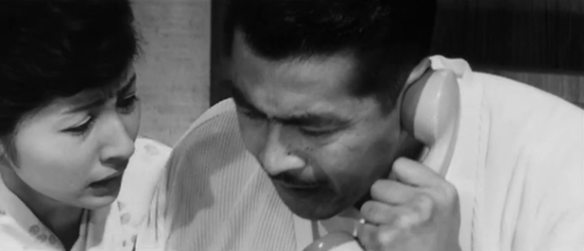
Then in a matter of moments, everything changes. Gondo gets a menacing phone call claiming that his young boy is kidnapped and an astronomical sum of money is expected in return. Gondo and then his wife are instantly horrified by the news only to be relieved when their boy winds up unharmed. The same’s not true for his chauffeur’s boy Shinichi. The mistake in identity is obvious, but it makes no difference to the perpetrator because he still has leverage. He wants to make Gondo sweat since this is more than an isolated incident. He wants to make the man suffer – bringing him down to the level of all the unfortunate souls who live in the wasteland down below.

highandlow2At this point, the police are called and they arrive incognito, ready to stake out the joint and do the best they can to get the boy back safe and sound. This section of the film almost in its entirety takes place within the confines of Gondo’s house and namely the front room overlooking the city. It’s the perfect set up for Akira Kurosawa to situate his actors. He uses full use of the widescreen and his fluid camera movements keep them perfectly arranged within the frame.

Although the number of bodies also increases the anxiety in the space with Gondo at the center of it all trying to figure out what to do. Moral issues begin bubbling up that no man would have to deal with and yet they end up right in his lap. His whole business empire that he’s given his heart and soul to hangs in the balance of this decision, but he must make it nonetheless. Make the difficult choice to pay the ransom and do what’s moral, or not pay it and maintain his financial stability. For once in his life, their’s a hesitancy.

It’s as if he’s getting pulled back and forth with his wife chiding him, “Success isn’t worth losing your humanity,” while his opportunistic right-hand man is chomping at the bit to get a move on. He’s not going to allow his superior to sink all their prospects at financial gain.

As things progress, we finally move from the living room to the train where Gondo prepares to make the drop, but his adversary has planned out everything and has a clean getaway. The money is gone and now the police double their efforts. Meanwhile, behind the scenes, his backers are prepared to push Gondo out, because of his inability to pay them. Public opinion soars for the selfless act, and we finally meet our protagonist’s unknown adversary.

Really this second leg of the film is mostly about the procedural aspect as they begin hitting the pavement canvassing and trying to close in on the culprit. This section intercuts the reports going on at headquarters with actual police work on the streets and it’s strangely engaging.
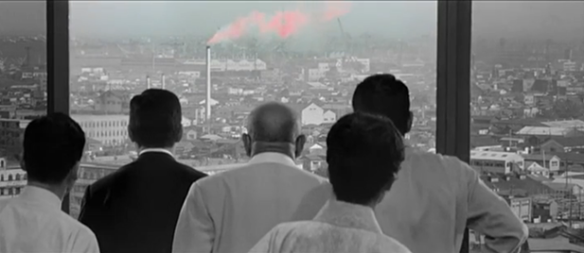
highandlow3Finally, with the help of Shinichi, they make a startling discovery that ties back to the kidnapper. And the boy’s drawings along with a colorful stream of smoke help them move in ever closer. What follows is an elaborate web of trails through the streets as they work to catch the culprit in his crime, to put him away for good. And it works.
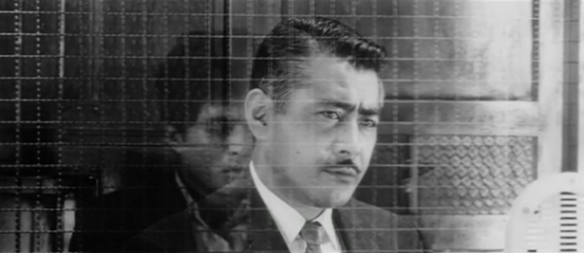
highandlow5But High and Low cannot end there without a consideration of the consequences. Gondo has been brought low. He’s losing his mansion and must start a new job on the bottom of the food chain once more. His enemy requests a final meeting as he prepares for his imminent fate, and this is perhaps the most grippingly painful scene. Gondo’s face-to-face with the man who made him suffer so much. Toshiro Mifune’s violent acting style serves him well as he wrestles so intensely with his own conscience. And yet at this junction, he is past that. What is he to do but listen? In this way, it’s difficult to know who to feel sorrier for — the man who is resigned to a certain fate passively or the one who goes out proud and arrogantly against death. Both have entered some dark territory and it’s no longer about high or low or even heaven and hell. They’re stuck in some middle ground. An equally frightening purgatory.

Yes, this works as an indictment of the justice system and even the capitalistic framework of an industrialist post-war Japan, but it’s even more so an acknowledgment of man’s own morality and mortality. We are far from indestructible, unfaltering beings.

4.5/5 Stars
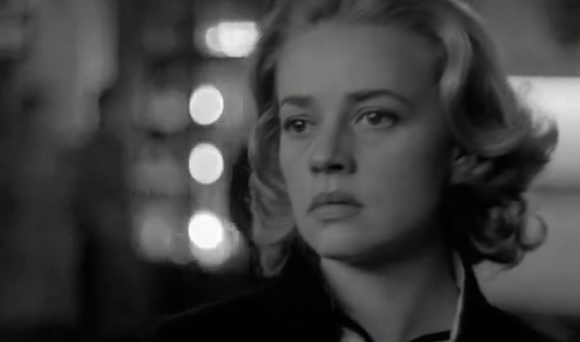
Elevator to the Gallows (1958)

elevatorto3This affair like a Racine tragedy will be over in 24 hours

Elevator to the Gallows was the debut of Louis Malle, a man who found success in both his native France and the United States. In truth, it’s an easy bit of delectable icy noir to enjoy, because it goes down quite effortlessly. From the cold open this film remains ridiculously cool, boasting a score from jazz visionary Miles Davis that dances and sways in sensual rhythm with the images onscreen. Recently I’ve gone through somewhat of a minor Jazz epiphany and Davis was a major instigator of that.

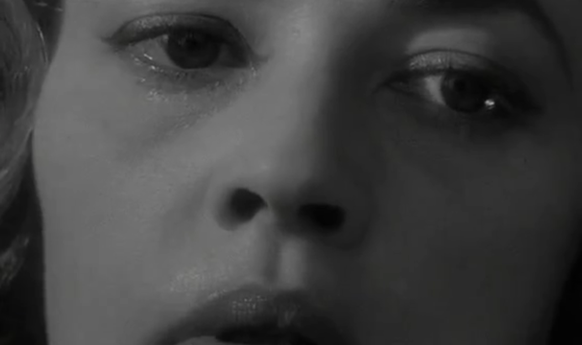
For all intent and purposes, this is the film that made Jeanne Moreau into an icon to be noticed. She’s not the same type of beauty as Brigitte Bardot or Catherine Deneuve, but this film shed some light on why she stands out among the best of France’s leading ladies. Really she’s the only character who we get inside the head of — we hear her thoughts as they drift in and out of her mind. Also, out of everyone, Malle allows his camera to dwell the longest on the face of Moreau with few distractions. We see her wander the streets listlessly, checking her complexion in windows, and somberly gliding upstream as cars speed past on all sides. It’s as if she’s constantly living in a dreamy alternate reality that is only broken when she must actually interact with the humans that inhabit the space that exists around her. But how did she get here?

elevatorto4Back to that cold open. Florence is communicating with her lover Julien, as they put their plan into action. It all happens so fast as the credits flash on the screen, but soon enough we gather that he plans to kill her husband, so the two of them can finally be together. So, in other words, it feels like some kind of love triangle with Florence Carala. As a former paratrooper deployed in Indo-China and then Algeria, Julien is more than capable of carrying out the task. It requires scaling a building on a rope, taking the shot to finish off the condescending war profiteer Mr. Carala, framing it as a suicide, and then making a getaway without anyone being wise.

All the pieces fall together, but Julien forgot one thing. The rope is still hanging there! He rushes up to fix his mistake, but on the way down another employee unwittingly shuts down the lift, and now Julien is stuck in the elevator with no easy way to get out of his jam. He is sure to be caught. It’s a tense spot he’s in, but really that’s not where the heart of the story lies because Julien remains where he is for much of the film.

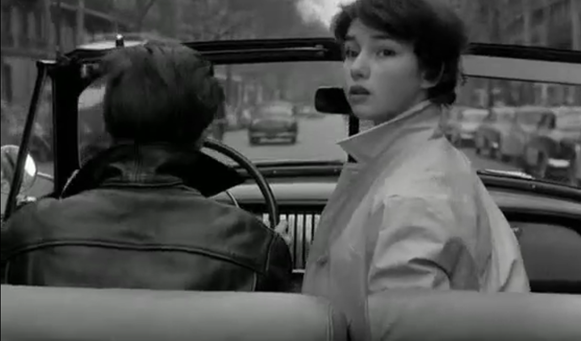
elevatortoThe other arc feels closely tied to The French New Wave Movement as an angsty young man decides to take Julien’s sweet ride for a spin and his reluctant girlfriend takes part in their little escapade. Their final destination is a hotel where they decide to register as Mr. and Mrs. Julien Taverner because it’s bound to be a good bit of fun. They even get chummy with a pair of German tourists and the champagne flows freely.

Meanwhile,elevatorto1 an anxious Mrs. Carala begins to listlessly comb the streets trying to gather what happened to her lover. Where did he go? Julien
still sits in the elevator trying to rig a way out as the cigarette stubs pile around him. The good times of young lovers Louis and Veronique soon turn sour when the boy loses his temper and with that, all rationality goes out the window. As Godard once quipped all you need for a film is a girl and a gun, and in this case, it rings true.

Now Julien is wanted for a murder he did not commit and is still the unknown perpetrator of yet another murder that has yet to be uncovered. When he finally breaks out of his prison the following morning, he inadvertently walks into a big heap of trouble. But it is Louis and Florence, who end up back at the scene of the crime where a dark room becomes their downfall.

4.5/5 Stars

Late Autumn (1960)

lateautumn1Yasujiro Ozu has the esteem of being christened “The Most Japanese Filmmaker.” It’s certainly a high honor, but at first, it can feel rather counter-intuitive because after all, such a great master of cinema cannot be considered average or a composite in the scheme of Japanese film history. And I don’t think that is what this title is trying to get at. The fact is that Ozu, over time, really experimented with the conventions written by classical western filmmakers and he built his own unique aesthetic that is quite evident later in his career. That being said, his film’s are very Japanese in the way they interact with and dissect the culture that he comes out of, and I think that is paramount to understanding and ultimately appreciating his work.

It’s no different with Late Autumn, Ozu’s penultimate film, a social-familial drama that shares a great deal of similarity to some of his earlier work. The fact is, he’s constantly returning to these ideas of marriage, family, generational differences, and the underlying etiquette that is so prevalent in Japan and Asian cultures in general. But of course, much of what he examines is universal and that’s what allows his films to remain timeless.

With Late Autumn, in particular, it’s easy to marvel at how the director frames his space because he seems to have tremendous spatial recognition. He’s confident in his aesthetics which he highlights with colors and axis lines, which are then further embellished with human subjects. Not many directors are brazen enough to show us an empty room, a hallway, or the mundane facade of a building, but Ozu is so self-assured in his composition. They are too long and occur too often to be establishing shots. He wants to continually convey to us the space that his characters inhabit and he’s meticulous. Everything is placed with pinpoint precision just the way he wants. And it shows.

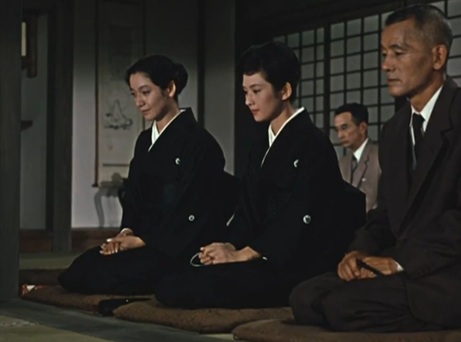
On a basic level, Late Autumn can meld nicely with many of the director’s other works also based around the seasons. In this color installment, three adult men gather for the funeral of one of their mutual childhood friends. It’s a sad occasion as they wistfully remember the good old days when they were young and in love. But as a service to their deceased friend, they agree to find a husband for his sweet sunshine-faced daughter Ayako (Yoko Tsukasa). However, they also worry for his widower Akiko (Setsuko Hara), who is equally beautiful, since the years have been very good to her. What follows is the typical fumbling attempts at matchmaking, trading manners, and so on. When Mr. Mamiya inquires if he should ask for a young man’s picture and resume, we assume it’s a joke, but he’s quite serious.

What makes Autumn different than earlier classics like Late Spring or even Tokyo Story, is that it shows the next generation of young people.  The kids embrace the rockability of Elvis while reading Mickey Mouse cartoons. The young adults are folks who have grown up in the specter of WWII. They want to leave behind the world of useless honor and restraint.They speak their minds and show their discontent.

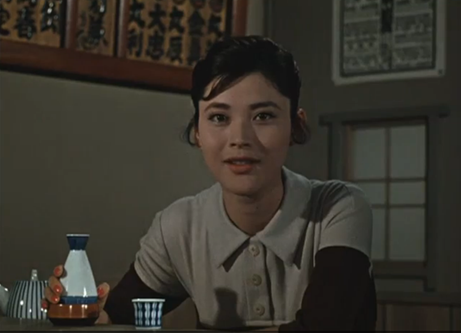
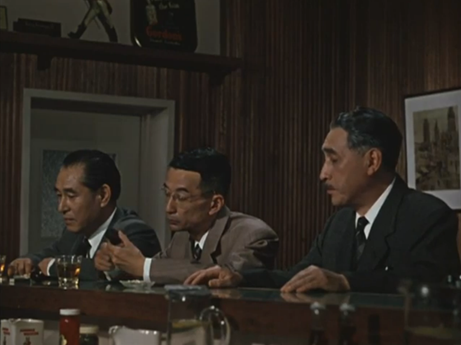
lateautumn2I enjoy the light touches of humor injected into this film because the three chums sit around the bar making observations with a bouncy score that seems more at home in a Tati comedy. Sometimes they’re genuinely trying to be funny, but more often it’s hilarious because they’re actually so dysfunctional. They take on this task of watching over their friend’s family with all seriousness, but they get sidetracked by their own desires and personal concerns. They stir up rumors, make waves, and ultimately cause a lot of trouble. Everything gets muddled and it’s the blunt and frank assertions of young Yuriko (Mariko Okada) that points out their failures. She sees how they have made a mess of things and calls them out for it. Perhaps it feels abrasive, but I think they like her for it and the audience does as well. She’s a reflection of this new generation that’s not looking to mince words or hide behind social etiquette. They’re fed up with that type of lifestyle. In fact, Yuriko is the one who says marriage is the worst. The ideal would be if love and marriage always went together, but they don’t.

lateautumn3Thus, although the relationship between Ayako and her mother takes center stage as the film progresses, Yuriko is extremely pivotal. It’s the lives of the first two women that are affected by the unintentional bungling of these men, but it is Yuriko, who signifies change for the better. In many ways, this story feels very similar to Late Spring in particular, but the interest is not so much in original ideas as it is in re-imagining ideas. It’s a film for the 1960s where men are slowly losing their vice-like grip and societal norms are changing as women move to the forefront. But what remains are the suggestion that it’s alright to push back against societal pressures, and interpersonal relationships are delicate flowers that must be cultivated with care. So easily they can be trampled and destroyed. It takes a certain type of person to acknowledge their own faults while persistently loving those around them.

This is the utmost compliment, but in many ways, Setsuko Hara reminds me a great deal of my own grandmother, a woman who radiated a genuine kindness that was apparent to everyone who walked through life alongside her. Bless their souls. Both of them.

4.5/5 Stars

Hannah and Her Sisters (1986)

hannahand1Recently I was thinking about who I would characterize as favorite directors versus directors that I simply respect. In the latter category, I would stick the likes of Quentin Tarantino, The Coen Brothers, and Wes Anderson. Because truth be told, I do not always like or even enjoy all their films, but I can still appreciate them. They have their own unique artistic visions when it comes to making movies and that comes out of the fact that they know the lineage that they are derivative of. That’s something that cannot be taken lightly.

I think I would same the same of the work of Woody Allen, and he truly is a special icon of film. There’s no saying that his work is not original because each film bears his mark, but it also takes cues from the past.The utmost compliment I can give Hannah and Her Sisters is the fact that it might be one of my favorite Allen films thus far, behind Annie Hall. It does noticeably take cues from the likes of Bergman and Bunuel however, but that does not detract from its own charms.

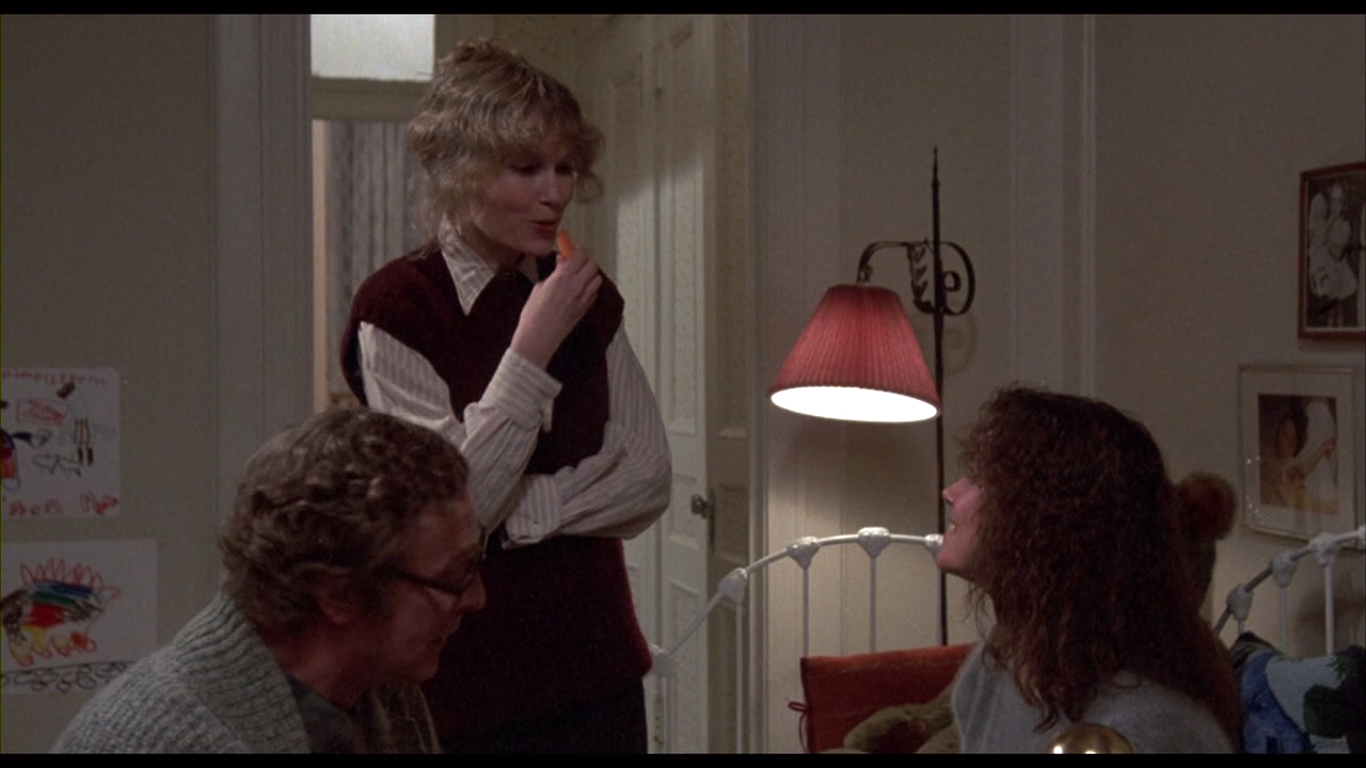
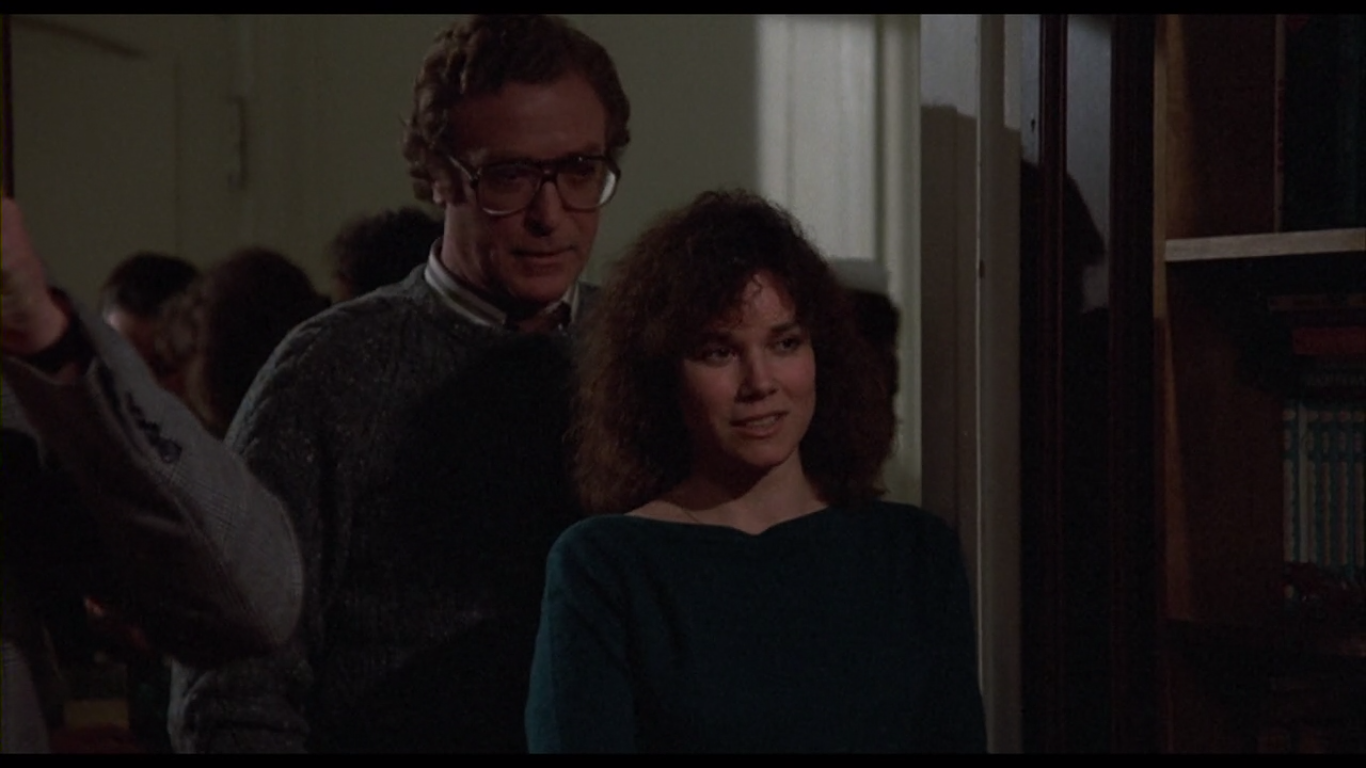
hannahand4It begins and continues throughout with rather arbitrary inter-titles written in white letters over a black background. But it’s the perfect embodiment of Allen’s style of writing to go along with his typically anachronistic scores that nevertheless elevate the charm of his films. What follows is an engaging storytelling set piece extended over three Thanksgiving dinners with Hannah (Mia Farrow) and her two sisters. Holly (Diane Wiest) is the aspiring actress, who has run a catering service on the side while fighting a drug problem and trying to figure out her love life. Lee (Barbara Hershey) is a natural beauty, who lives with an older intellectual named Frederick (Max Von Sydow). She has also unwittingly made a conquest of her sister’s respectable husband Elliot (Michael Caine), who nevertheless gets quite nervous in her presence.

This is a film about their families — their interconnected lives that constantly fluctuate and change dynamically with every passing month and holiday. Their lives go from the invariably awkward, to the tragic, and finally, find their perfect equilibrium. The voices inside their heads are constantly active with fears, thoughts, and desires.

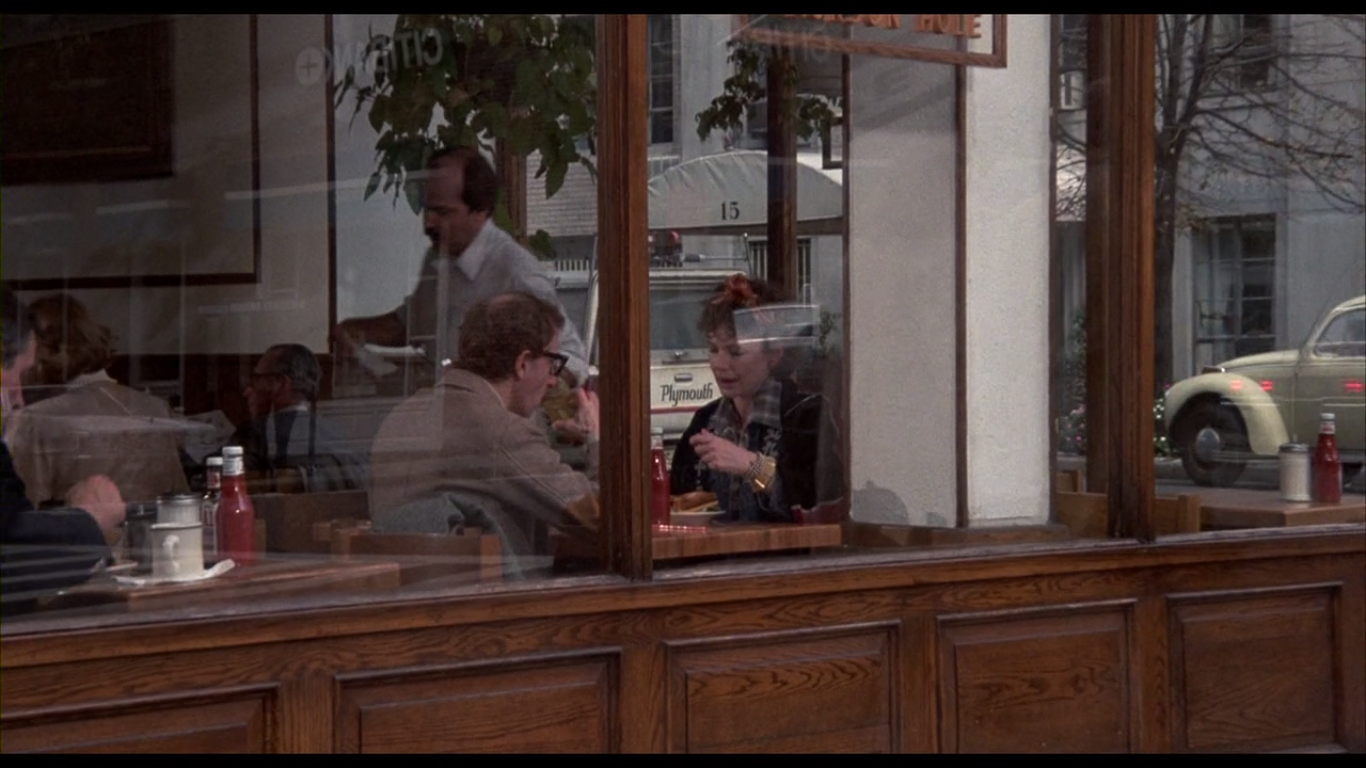
hannahand5What’s perhaps most striking about this film is the great depth of the cast. Maureen O’Sullivan stars next to her real-life daughter. Carrie Fisher makes an appearance as Holly’s friend and rival. Even Daniel Stern, Julie Louis Dreyfuss, and Allen regular Tony Roberts pop up in various moments. Perhaps most spectacularly of all, Allen himself commands the spotlight as anxious hypochondriac Mickey Sacks. Essentially it’s the character that Allen always takes on, but in this case, he stuck himself in almost a B-plot. He gets his chance to swim in his fatalism, pessimism, and philosophical dialogues about God and religion. In fact, it is quite reminiscent of Bergman in this respect, but from a uniquely Allenesque perspective. His awkward jokes (eg. I had a great time tonight it was like the Nuremberg trials) make me crack a smile or let out a genuine chuckle in spite of myself. Bergman would never do that to me, but Allen enters that territory while going so far as casting von Sydow in a slight nod to his Swedish hero.

But really all of this is set to the greater backdrop of the familial drama. That’s where the meat and potatoes of this story lie and in this dynamic, there is a lot of genuinely great moments. One of the most memorable is also one of the most difficult when the three sisters gather together over lunch and their relationships seem to be falling apart in front of our eyes. As it goes with the passage of time, things eventually turn out okay and another holiday gathering comes. Each sister is content with where they’re at and so are their spouses. It’s probably one of the most upbeat Allen movies I can think of, if only it were not besmirched by his own personal life. But that’s a dialogue for a different time. After all, this film is really about Hannah and Her Sisters.

4.5/5 Stars

Review: Shadow of a Doubt (1943)

Teresa_Wright_and_Joseph_Cotten_in_Shadow_of_a_Doubt_trailerIt is well documented that Shadow of a Doubt was Hitchcock’s personal favorite of his own films. That’s quite a telling statement when you do a quick scroll through some of the titles up for contention. Vertigo, Psycho, Rear Window, North by Northwest, Notorious, even The Birds. And yet the famed “Master of Suspense” chose the often glossed over Shadow of a Doubt.  If we take a slightly closer look it makes a great deal of sense as the film follows through with one of Hitch’s most prominent credos, “There is no terror in the bang, only in the anticipation of it.”

That’s, in fact, a great deal of what Shadow of a Doubt is. It’s the cringe-inducing anticipation for what is bound to happen. The inevitable that is plain as day, except not everyone sees it so clearly. But that’s enough ambiguity.

The story opens in a depressed urban city with Charles Oakley (Joseph Cotten) laid out pensively on his bed. Dollar bills are scattered haphazardly across his floor. Soon he learns two men want to talk with him, and he’s not about to get acquainted so he gives them the slip and heads to the one decent place he can think of. Santa Rosa, California, the peaceful abode of his older sister Emma and her family.

What we learn over time is that Charlie is known at large as the “Merry Widow Murderer,” because he has strangled three such women and taken their valuables. Hitchcock playfully alludes to the fact by opening his film with the “Merry Widow Waltz” and it will pop up throughout the entire story if you’re paying attention.

shadow-of-a-doubt-trainHis train comes barreling towards town with smoke spewing ominously. For now, his oblivious family is just happy to see his face, especially his oldest niece and namesake Charlie (Teresa Wright) who is ecstatic to have something to shake the family out of their funk of normalcy. At this point, there is little to be uneasy about, because Uncle Charlie is not about to do anything rash, but there are a few moments where he gets uneasy. Covering up a paper headline and doing his best to avoid two men taking photos for a national survey. Charlie doesn’t think much of it at first, and it feels just like old times with uncle giving gifts and receiving the royal treatment.
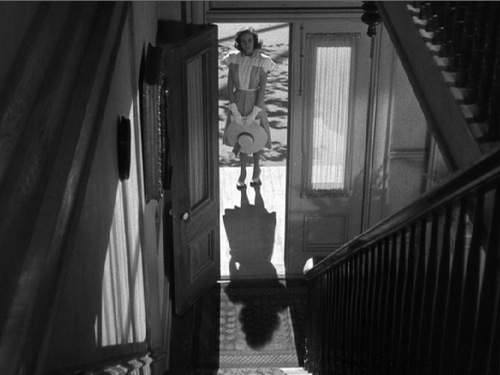
Except the ring he presents to Charlie is plundered jewelry with a mysterious pair of initials engraved on it. Of course, the men interviewing the Newton household are actually trailing Uncle Charlie, and Detective Graham fills Charlie in while also becoming fond of her. But it’s not the kind of news she’s willing to accept. How can she? It’s a late night visit to the local library that finally confirms all her deepest fears. Soon, the telltale signs become more apparent to the audacious girl, and Charlie simultaneously notices the changes in her as well.

This is where the film becomes fidget-inducing because it’s out in the open. Uncle Charlie knows that she knows, and still he remains in their home, in quiet little Santa Rosa, as if nothing has changed. For most of the family, nothing has, but Charlie’s demeanor is completely different. She just wants her uncle gone, away from her family, and then there’s the impending threat that her own life might be in danger. In truth, Uncle Charlie doesn’t want her around, even though it looks like he might get off scotch free.  His mind is already so twisted — so far gone — that he coolly attempts to get rid of Charlie, right under the very noses of their family.

It turns into a psychological mind game between uncle and niece, Charlie vs. Charlie. There’s no detective to save her now because he’s already left town and there’s no other direction to turn. She finally does succeed in getting dear uncle to leave town, and it looks like the living suburban nightmare is coming to a close. Then, in a final instant on the outbound train, Hitchcock’s lets off a BANG! The film’s culmination arrives and is just as quickly passed over. It’s done just like that, but it’s not really what was important. All that nerve-wracking build-up — the meat and potatoes of the drama was what was paramount.

Thus, Hitchcock delivers us a shocking nightmare of a film. It’s not anything like Psycho, existing in a far more mundane world. But Shadow of the Doubt brazenly suggests that murder can reach us even in our homes, even in the places that feel the safest. Hitch exhibits his wicked sense of humor with two characters who love to talk murder in Mr. Newton (Henry Travers) and the next door neighbor Herb (Hume Cronyn). They obsess over crime fiction and discussing ways to get away with murder. Little do they know that the man in their midst is trying to do just that.

Teresa Wright is certainly one of my favorite actresses and her role as Charlie is one of her bests highlighting her cordial charm, while also revealing her adeptness in the role of a tortured heroine. We want her to succeed more than anything, and as an audience, we worry for her well-being the entire film. Meanwhile, Joseph Cotten generally plays laconic types, but still, they usually have more goodness than baseness in their souls. Uncle Charlie is a fine role for him because he’s so sweetly cunning and at the same time sadistically twisted.

Shadow of a Doubt pic 3Unfortunately, the role of Detective Saunders feels rather shallow, but that’s hardly something to get stuck on. If that were the case, we could easily point to Charlie’s parents who seem way too old. But they are perfectly average, ordinary folks, as played by Henry Travers and Patricia Collinge. The script work of the preeminent Thorton Wilder (Our Town) and the on-location shooting in the Everytown of  Santa Rosa lend a universality to this thriller’s impending dread.

Dimitri Tiomkin heightens the film with his usually stirring, pulse-pounding approach to scoring. Hitchcock’s camera, while in black and white, is nevertheless noticeably dynamic. He always emphasizes the necessary focal points, and extreme close-ups and high angles only accentuate the drama. His use of the stairwells in the house is absolutely marvelous, implying both distance and foreboding in numerous shots. For every shot that Cotten looks menacing, there is an equal number highlighting the pure innocence of Wright. It’s the perfect juxtaposition of character, in a film that is really only your typical see-sawing struggle of good versus evil. Except it takes place in our own backyards.

5/5 Stars

Review: Red River (1948)

redriver1Any conversation on quintessential American Westerns certainly has to at least consider Red River. It has genre mainstay John Wayne in one of his most stirring performances, a moody precursor to The Searchers. It boasts the debut of the often criminally under-appreciated method actor Monty Clift. Moreover, it’s cinematic space is filled out by a colorful array of prominent Western stock players. You have the always ornery Walter Brennan, pudgy Noah Beery Jr., Harey Carey Jr., Hank Worden, and numerous others. For a second you can even forget that this isn’t a John Ford film, but instead, the story is placed in the ever-adept hands of Howard Hawks, who knows how to craft compelling stories no matter the genre he’s working in.

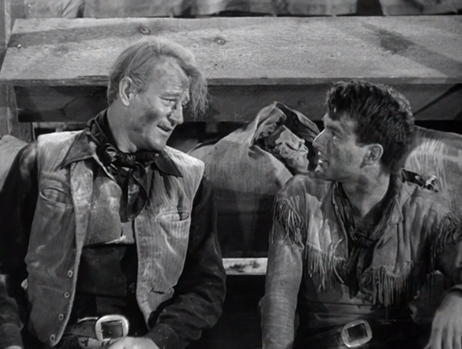
In 1851, before Tom Dunson (Wayne) settles on a new plot of land near the Rio Grande and begins to raise his cattle with the brand of the Red River D, he loses the love of his life to an Indian raid, while also picking up an orphaned boy in the aftermath. That young man, Matt Garth (Clift), would become like Dunson’s adopted son and his right-hand man when it comes to running his ranch. The rest of Red River is essentially a road film that chronicles the first cattle drive along the Chisolm Trail. It’s bound to be a gritty, sweaty, and undoubtedly smelly road ahead as Wayne and Clift take the reins on this journey. The intrigue comes with power dynamics because when you put two or more people in a confined space sparks are bound to fly at some point.

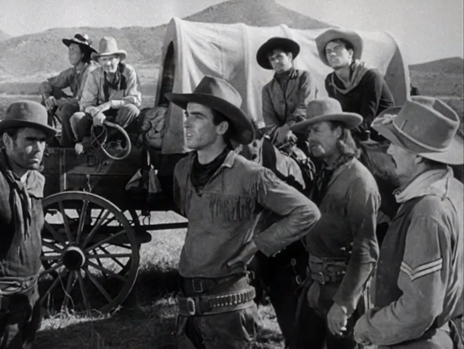
redriver2When Dunson begins the massive journey to sell his cattle in Missouri, many wranglers sign on for prospects ahead, but they don’t quite know the degree of hardship that they will face. Soon enough, a stampede leaves one man dead and the company without one of their chuck wagons of provisions. Dunson is a hard taskmaster, who expects his hired hands to finish their job. Morale in the band begins to sink from lack of food and fierce downpours that leave most everyone dejected and distraught.

Then, when Dunson prepares to hang two deserters to make an example out of them, Matt must finally step in. He’s always the subservient one, always backing Dunson with his gun, but for the first time in his life, he crosses the will of his mentor. All the wranglers are quick to continue the journey as they change course for Abilene Kansans and the prospect of the railroad. But Garth leaves a brooding Dunson behind, vowing to kill Matt if it’s the last thing he does. It’s this act of the story which brings to mind the Biblical vendetta of Esau as he pursues his kin for stealing his birthright.

red river 6Garth and his contingent do end up getting to Abilene and are met with open arms by the kindly Mr. Melville, however, perhaps, more importantly, Matt falls in love with a fiery beauty (Joanne Dru) and must leave her behind. Days later Tess Millay also meets Tom Dunson, the man she has heard so much about, and he’s far from being dissuaded from his mission.

Thus, the expected showdown comes with Dunson riding into town with his hired guns, the alarm being sounded, and Garth waiting for him. Dunson draws and Garth will not. It’s a fitting moment, but Howard Hawks develops it in a fabulous way. He fills it with tension and ultimately a hint of humor. The addition of Joanne Dru shifts the power dynamic and she says what everyone else is thinking while angrily packing a pistol.

redriver4Because if Red River was story alone, it would not be the preeminent Western that it is, and I think I made that mistake before. Hawks is a master at using all his actors to perfection in not simply the climactic moments, but also the lulls. With such a substantial ensemble, even the way he positions all his players in the scene holds importance. His scenes are continually interesting from talk of Walter Brennan’s false teeth to complaints about the abysmal quality of the coffee.

My only qualm with the film is the rather shoddy transitions, and so I am interested in getting a look at the theatrical cut with narration from Brennan. John Ford famously quipped that he never knew that Wayne could act until this film, and it’s true that he gives a darkly vengeful performance. But in many ways, Clift proves himself as a worthy co-star. There’s always a tightness, a lilt to his voice, that signals an earnestness and vulnerability. It starts coming out in this film right when he knows that he’s no longer going to follow Dunson. It took two starkly different actors to make the narrative work as well as it did, and Hawks added yet another classic to his catalog. On a side note, the music of Dimitri Tiomkin was noticeable, because the refrains can be heard verbatim in Rio Bravo. If something’s good why change it, right?

4.5/5 Stars

Day for Night (1973)

dayfornightposter10 years prior Jean-Luc Godard made his own film about movie-making entitled Contempt (1963). It too delved into what it looked like to make films, as well as the individuals behind the camera because their relationships undoubtedly affect what is revealed in front of it. His colleague Francois Truffaut came out with his own meta-film about film, but Godard was open with his criticism. In fact, their long friendship suffered because Godard accused his longtime collaborator of selling out and telling a lie.

However, if we look at Day for Night today, that feels a little harsh, because while Truffaut’s film is engrossing and different than his earlier New Wave work, he is, in general, a more accessible director on the whole than Godard. That should certainly not take away from what he gifted to his audience. What he does is color the lines between film and real life. Because, while one mirrors reality, it can never quite replicate it and things get messy when the two begin to get in the way of each other.

Immediately we are thrown into a street scene only to learn minutes later that it’s only a set; these commonplace people only extras filling up a cinematic space. It’s the perfect entry point into the meta nature of the film. Ferrand (Truffaut himself) is the director flooded with all your typical problems, setbacks, and deadlines. He must work around his stars, navigating the drama that comes about with so many personalities all gathered together. Severine is a has-been starlet with troubles remembering her lines. Alexandre is her love interest, a fading star in his own right who is aging gracefully. Alphonse (Jean-Pierre Leaud) is the young heartthrob, who secured a script girl position for his girlfriend, but their playful romance is not without bumps. All the while everyone waits with baited breath for the arrival of transcontinental star Julie Baker (Jacqueline Bisset), who has recently recovered from a nervous breakdown followed by a marriage to a distinguished doctor.

We are privy to series of takes, rushes, and all the decisions that are going on behind the scenes. It is in many ways far fuller and more in-depth than the picture Godard gives, but Truffaut maintains the same respect for his heroes. He goes so far as name dropping: Hitchcock, Hawks, Bresson, Godard himself, Bergman, Rossellini, Lubitsch, Bunuel, Jean Vigo, Jean Cocteau, not to mention an initial dedication to the Gish sisters. Even Citizen Kane and The Godfather, two of cinema’s landmark achievements, are both alluded to in passing.

But adding an exclamation point to everything is the drama of death, romantic affairs, and even a pregnancy, suggesting that life is a lot messier than a moving picture. All the strips of celluloid get tied together in a nice bow. They can be explained away by a plot point. They can be completely discarded on the cutting room floor. Or a double can be hired as an easy fix for any discrepancy. In this, there is a falseness that fails to perfectly align with reality. There is no perfect way to convey the truth, because everything, even a documentary, can never be complete subjective reality. A mirror image is only a reflection of what is real. That is part of what Truffaut is getting at and that is part of the irony of his row with Godard.

You only have to look at its title, because Day for Night points to the inherent artificiality of cinema, but Hollywood films especially.  So, far from telling a lie, Truffaut seems to riddle the film industry with all sort of holes, pointing out the difficulties that come with such a business. Life and film may meet and overlap, but they can never truly reconcile their differences because there is bound to be contention along the way that cannot be perfectly remedied by even the greatest director.

But far from condemning the art form, it’s important to realize Truffaut is pronouncing his undying affection for the medium. He was the one who famously asserted, “I have always preferred the reflection of life to life itself.” This man unquestionably loved movies and it shows.

4.5/5 Stars

The Hurt Locker (2008)

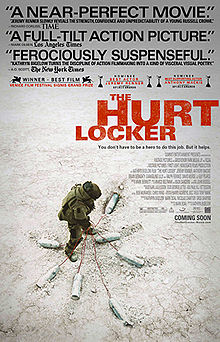
220px-HLposterUSA2Being ignorant of the term “Hurt Locker,” I did a reasonable thing and looked it up. According to IMDb:

To put someone in a “hurt locker” is to physically mess someone up, badly. It is roughly synonymous with causing someone “a world of pain.” According to the movie’s official website, “In Iraq it is soldier vernacular to speak of explosions, as sending you to the hurt locker.”

Well, that about sums it up, and it does so, beautifully by getting to the core energy that pulses through this film. It gets dicey and intense when these highly trained individuals are put into the most volatile of situations. It doesn’t get more volatile than bomb detail, and how they maintain composure in such circumstances is a miracle, a testament to grit and willpower. That’s not to say they don’t go through their own moments of turmoil. How could you not, at least at some juncture?

It struck me that this film does not feel like a political statement, even less so than Bigelow’s other war epic Zero Dark Thirty. In a sense, that would be a major disservice to the men who fight, by taking all the attention off of them and instead placing it on agendas and politics. However, all of that is left to the politicians, and we simply are given a very small taste of what those fighting the War on Terror experience. Can we fully comprehend it? No, but at least now we have a better idea of how post-traumatic stress disorder can develop. The constant strain that these people are going through takes its toll physically and emotionally. Yet they still push through their tours in order to do the job that has been handed to them. They brave a world of suicide bombers and ambiguity that could quickly send you into the hurt locker. In that way, it reminds me of a modern take on Battle of Algiers, because not everything is as clear-cut as we would like it to be.

The Hurt Locker follows Bravo Company during the tour of duty. Their first disposal expert (Guy Pearce) meets with tragedy and his buddies are forced to welcome a new member to their team, Sergeant William James (Jeremy Renner). He hasn’t disarmed 873 bombs for nothing, but he maintains such a streak by being very cavalier in his conduct. He’s a maverick, a man who will unflinchingly ditch all communication in order to focus on the task at hand. He’s a bit of a loose cannon and that’s not always the best type of personality for such a tightly knit group. They have to be if they want to survive since such behavior can be the difference between life and death. There’s a camaraderie and a rapport that builds over time, but before that he causes his compatriots to squirm more than once, and when they squirm we’re positively crawling out of our skin.

Shot in Jordan, quite close to the real-life locales, there is a gritty and raw quality to how Kathryn Bigelow frames the world with the help of cinematographer Barry Ackroyd. It manages to be personal and unsettling all at once. In comparison, it’s invariably striking how stagnant American life is when James returns home.That’s potentially a good thing, but does it mean that we’re taking life for granted, or living eternally thankful for each day that we still have breath in our lungs? That’s what The Hurt Locker does. It gives us a deeper respect for these men and a deeper appreciation for life.

4.5/5 Stars

Finding Nemo (2003)

Finding_NemoI don’t usually do this because it dates me, but I still remember buying Finding Nemo on DVD, because it was one of the first films I ever bought. It was one of the first films I ever felt was worthy enough to spend my hard-earned birthday money on or whatever the case was.

Certainly, I jest, but I also say this to note just how impactful Nemo was for kids of my generation. Pixar, in general, has left an indelible mark on many folks, but Finding Nemo had it all, garnering inspiration from the vast underwater worlds of the great ocean blue. And as they always do Pixar is able to wholly animate, literally bring to life and attribute human characteristics to non-human subjects, whether they be toys, fish, monsters, cars and so on. But Nemo was near the top of the creative spectrum, and a lot of that sits squarely on the shoulders of its characters. It was the brainchild of Andrew Stanton and with the subject matter of a young clownfish and his overprotective father he found true narrative gold.

However, it was really the supporting characters that color all portions of the frame. First and foremost in\s Dory (Ellen Degeneres), the insanely positively and joyously scatterbrained blue tang who joins Marlin (Albert Brooks) in his quest to find his son. She is the perfect foil to bounce off his dour sensibilities. In time connecting him to a band of recovering sharks with a heavy fish addiction, a band of ultra chill sea turtles, and a silently charitable Blue Whale who propels our two heroes toward their final destination: P Sherman 42 Wallaby Way.

But of course, there are always two sides to every story and Finding Nemo does well to work from both angles. There’s the father who goes on this epic hero’s journey and the lore of the mighty clownfish searching for his lost son begins to take the ocean depths by storm. Meanwhile, Nemo has been placed in captivity against his will in the fish tank of an idiotic orthodontist but spurred on by news of his father, he gains a new resilience. He resolves to make his way back to his dad because he realizes just how much his father cares. It’s a galvanizing experience and he proves just how much he is capable of. Because he disregards any hint of inferiority and realizes his potential–the kind of potential that is not reserved for certain types of individuals, but really anyone who is willing to step out in courage. And that’s how Nemo concludes, by suggesting the importance of family and really pushing ever onward. Just keep swimming. Just keep persevering.

As we wait in exuberant expectation for Finding Dory, it’s nice to reevaluate this modern classic and be rewarded by the pleasant surprise that it truly does hold up even after all these years. The animation is still wonderfully immersive, the characters compelling and the script boasts not only master storytelling from Andrew Stanton but a remarkable melding of both humor and heart. In the modern generations, that’s an extraordinary precious combination and not something that we see all that often. That’s what makes Finding Nemo enduring, and it endures not only for children, but any demographic or audience really. Because Pixar never talks down to their audience or marginalizes certain groups with their humor or a very particular brand of storytelling. In fact, their storytelling is almost classical like the films of old, which were meant for the masses no matter age, beliefs or inclinations. It’s for everyone and it’s a wonderful gift in a century that so often is restrictive and exclusive, even despite its best efforts.

5/5 Stars

Greed (1924)

Greed3With some cinematic endeavors, there is simply an aura that surrounds them which informs how we look at them. Erich von Stroheim’s ambitious silent film Greed is such a picture. To this day, a full cut of the film has never been found and perhaps never will be, but it has survived in two versions. A four-hour cut which attempted to maintain the original continuity through stills and then a 2 and a half hour cut which I saw. So you could question whether I got the full experience of Greed or not, but that is almost beside the point because the essence of this film is summed up in the title. True, it could just as easily be called sin, avarice, grudge, humanity, or all of the above. But allow me to explain more fully what I mean.

The narrative follows a slow-witted man named McTeague (Gibson Gowland), who picks up the dentistry trade from a traveling doctor. He moves to San Francisco and soon becomes smitten with the cousin of his boisterous pal Marcus (Jean Hersholt). Trina (Zasu Pitts) is quiet and a bit timid around a man as intimidating as McTeague, but they make it work. Soon enough they’re engaged and a lottery ticket Trina picked up on a whim pays off handsomely. $5,000 to be exact and this is the 1920s! They’re getting on alright because McTeague is still working and his wife is very, very frugal. But Marcus feels entitled and a grudge over the money ensues. He wants part of the cut because he thinks he deserves some good fortune too. Things between him and John finally reach the boiling point and there’s no turning back. Rather than try and patch things up, Marcus decides to get into ranching and says goodbye to his formerly close friend, but not before serving up a little revenge. He sets the dentistry board on McTeague and since he doesn’t have a true credential, his right to practice is terminated.

The loss of John’s job is aggravated by the fact that Trina is increasingly stingy, never wanting to dip into her big payoff, even when they really need it. Gold in many ways has become her master, and it leads to marital turmoil. McTeague was always a big man, but usually quite gentle. But his inner fury is finally uncorked and in one angry outburst, he goes so far as to bite his wife.

Mac leaves only to come back again and the results are not pretty. Soon he has a price on his head and he makes his way as a fugitive into the desert. And thus, the finale is shot on location in Death Valley, the perfect place for a climactic showdown between McTeague and his old pal Marcus. Of course, money doesn’t help much when you’re trapped in the desert, or when you’re dead for that matter.

Obviously, greed doesn’t bode well, but this story is an interesting inversion of the typical plot line, because in this case it is the woman who has the money, and she’s the one that the greed eats away at. She becomes obsessive and even bitter about every last piece of change. But her money also has a ripple effect that reveals the pettiness, avarice, and begrudging nature that plagues both her husband and cousin.

So in order to enjoy this film, you need to have an appreciation for the spectacle that von Stroheim has developed and the commentary he has weaved through his narrative about greed. That in itself makes this film one to truly ruminate over because it suggests so much about the ugly side of human nature, and that has hardly changed in the past century.