The Young Girls of Rochefort (1967)

rochefort1If the Umbrellas of Cherbourg is a piercing operatic drama, The Young Girls of Rochefort is pure, unadulterated escapism at its finest. 

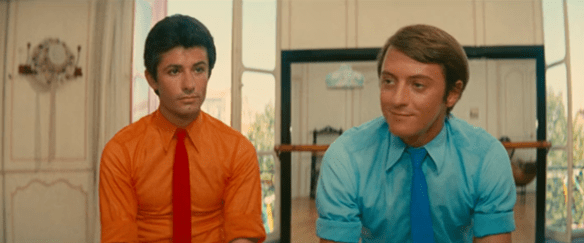
Directed by Jacques Demy and starring an ensemble cast including Catherine Deneuve, Francois Dorleac, Gene Kelly, Michel Piccoli, George Chakiris, Grover Paul, and Danielle Darrieux, this is a whimsical French musical that has no equal. 
rochefort9

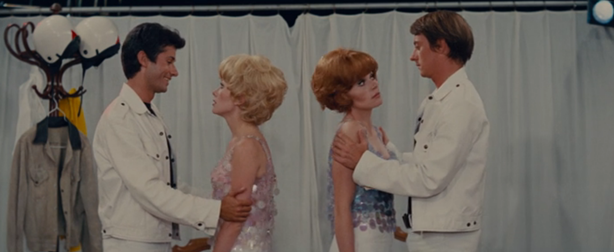
The film opens with a group of performers coming into the town of Rochefort to get ready for a big outdoor show. They become acquainted with the local hangout that includes a kindly matron (Darrieux) and many locals including an idealistic artist and sailor who is searching for his ideal lover. Nearby her two adult twin daughters hold piano and ballet lessons as they too get their little prodigies ready for the big show. Delphine (Deneuve) is fed up with her suitor and desires a new love, while Solange (Dorleac) on her part hopes to advance her career as a pianist. She goes to the proprietor of a local music store to see if he can introduce her to a prestigious American Friend.

A great deal of dramatic irony sets in and the plot is constantly moved forward through song. Yvonne at the café is still depressed over a split with a lover 10 years prior, because he had an unfortunate name. Solange has a chance encounter while stopping to pick up her kid brother Booboo, and Delphine becomes curious about an artist who painted a portrait that looks strikingly like her. All of these events reach their apex on the Sunday of the big performance, and in need of some performer, the carnies enlist the help of the twins. They are a huge success and things wind down.
rochefort4

The next morning the performers get ready to leave for Paris and the girls decide to follow suit. However, Solange has another encounter that changes her plans and then Yvonne is united with her love. That leaves only Delphine to go with the boys to Paris, but not to worry, she would be united with her painter soon enough.

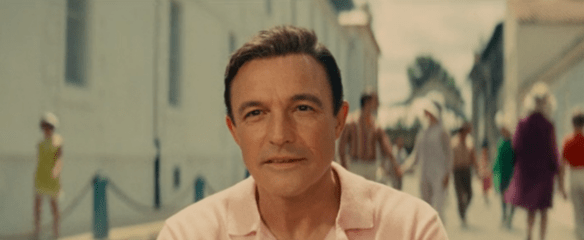
The light and very French-sounding tunes are hard not to like, but that is only the very beginning. Demy pays homage to Hollywood musicals of old going so far as casting Gene Kelly (Singin’ in the Rain) and George Chakiris (West Side Story) in his film. He undoubtedly owes a debt to Vincente Minnelli and Stanley Donen with some striking moments reminiscent of An American in Paris (1951). It makes sense. Demy uses the pastels and costumes of a Hollywood musical extravaganza while also including dashes of French style.
rochefort2

Rochefort takes place in a real location, but it truly is a fantasy world that the characters inhabit, full of perpetual dancing and dialogue that is delivered through song. The real-life sisters do a wonderful job in this film and there is something reassuring about seeing Gene Kelly. Rather like an old friend who gives comfort in a whimsical, but altogether new experience. The story arc of dashed, renewed, and ultimately newfound love allows Demy to once more explore the issues of fate and chance that always seem to enchant him.  His partnership with Michel Legrand is once again bountiful including the enduringly memorable “Chanson Des Jumelles,” an infectiously bouncy, trumpet-laden number performed by the sisters.

There’s nothing much else for me to say except The Young Girls of Rochefort is one of those underappreciated gems that is thoroughly enjoyable and chock full of all sorts of fun. It delivers a serving of something with a familiar flavor while giving it a little extra panache. It’s about as playful and fluffy as you can get which in this case is not a bad thing at all. 

4.5/5 Stars

Review: High Noon (1952)

highnoon1Drums softly beating. A voice mournfully bellowing,”Do not forsake me, oh, my darlin‘.” It can only mean one thing, the beginning of High Noon, a western that has grown near and dear to my heart in the recent years. And yet how can a western of under 90 minutes mesmerize and cause goose bumps to form time after time? That opening ballad sung so wonderfully and folksy by Tex Ritter is one great reason. It’s a mournful dirge of a song which nevertheless draws us into this film, and personally, I cannot help but belt out a few lines now and then (I’m unashamed to say I know the whole song). After all, it’s this song that reflects the story of our main character Marshall Will Kane (Gary Cooper) and reiterations of the tune can be heard throughout for the following hour as we all wait for the noon train.

The song makes it clear that Ben Miller is coming after Kane for sending him to prison. He’s got revenge on the mind and three of his buddies, including his brother, are waiting for his arrival, along with everybody else in town. Meanwhile, the Marshall is about to hang up his badge as it were, because he’s gotten hitched to a pretty young quaker (the estimable Grace Kelly), and they look to settle down with a store in some sleepy town. He’s well-deserving of it after all he’s done and the town stands behind him.

But the news of Miller’s return is no way to start the honeymoon. Still, the couple sets off, but Kane turns around realizing he cannot run (I do not know what fate awaits me. I only know I must be brave. For I must face a man who hates me, Or lie a coward, a craven coward; Or lie a coward in my grave).

highnoon4

This is the backdrop that he’s trying to scrounge up a posse with. Others getting out of town, some telling him he should get out of town too, and a general commotion about what they should do about the whole mess. There are numerous cross-sections and enclaves all with different motives and most importantly excuses. They all turn down a chance to help Kane for one reason or another (even his closest friends). It seems so easy to pass judgment, but then again what would we do in such a situation? In fact, it brings to mind the Hollywood Blacklist which this story was supposed to be an allegory for. This is not just some fictionalized parable, it was mirroring real life to some extent.

What really resonates about this film is the resolve of one man, because when it comes down to it, Kane did not need to stay, he did not need to do what he did, but he stood by his guns, literally, when no one else would stand with him. It’s easy to conform, easy to go with the crowd. It takes real courage to walk out on your own — although the Marshall did have a little help. So whether or not John Wayne thought this film was wholly “Un-American” or not, I think I would have to disagree with him on this one. Maybe what Kane has is reluctant courage, and I could see how the Duke would be disgusted by such a “spineless” individual. But for me, he’s all the more relatable played so aptly by Gary Cooper.

highnoon7It continues to amaze me that a film of this length can have so many wonderful characters who leave an indelible mark on the story. Certainly, you have the hero and the villains, but then we have character actors such as Thomas Mitchell, Harry Morgan, and Lon Chaney Jr. playing some of Kane’s buddies. There’s the gang at the bar and the hotel clerk, who are no friends of the Marshall. There’s his former flame Helen Ramirez (Katy Jurado) and his hot-headed deputy (Beau Bridges). The rest are filled out by men, woman, children, town drunks, and churchgoers. Zinnemann does a wonderful thing aside from just using the clock as a plot device and tension builder. He also calls back all these many characters as the noon train comes in with smoke billowing black. The audience and all these people know what that shrill whistle means. Things are going down, and Kane is going to face it all alone.highnoon2The isolation is so wonderfully conveyed by an aerial shot where the camera moves up to show the stoic Marshall standing in the middle of a ghost town. No people around and no one showing their faces. Then of course, when it’s all over, the floodgates open and all the folks rush into the center of town. Fittingly,  Kane drops his tin star in the dirt in disgust as the refrains of Tex Ritter’s ballad continue.

Put High Noon up against other films and it could be criticized as nothing more than a western, but perhaps that’s why I like it. I cannot help but gravitate towards it. In some ways, it reminds me of growing up and it allows me to forget about any sort of deeper meaning for an instant so I can be fully enraptured with this story, this song, and these characters. It’s a worthy incarnation of the mythic west, that also leaves a little space for some humanity.

People gotta talk themselves into law and order before they do anything about it. Maybe because down deep they don’t care. They just don’t care.” – Martin Howe (Lon Chaney Jr.)

5/5 Stars

Review: All About Eve (1950)

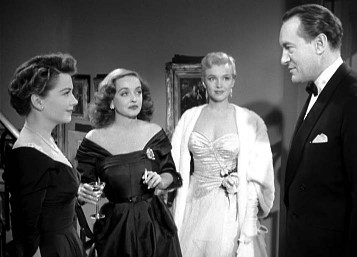
EveEveMargotCasswellWitt“Fasten your seatbelts. It’s going to be a bumpy night” ~ Margo Channing

It’s cliche, I do admit, but they simply do not make films like this anymore. Stories about people talking where the actors take center stage. In this case, the story from Joseph L. Mankiewicz is about the Broadway stage and all that happens behind the curtains, in the dressing rooms, and behind the closed doors of the royalty of that profession.There is so much that could be dissected, antagonized over, or acknowledged so I will move through it the best way I know how.

A moment must be spent acknowledging that this is the film that revitalized the career of Bette Davis. She was the tops during the 30s and early 40s, but the role of the histrionic stage icon Margo Channing was her comeback and it thoroughly suited Davis. I have actually never been a fan of hers because I always found her rather arrogant and she scares me visually. However, All About Eve plays on my personal sentiments wonderfully. When we’re first introduced to Margo, she’s everything we expect in a Bette Davis character, and truth be told I don’t really like her. But interestingly enough that changes. That’s where Eve and the rest of the cast come in.

The film is book-ended by the wonderfully wry and snooty commentary of theater critic Addison DeWitt (George Sanders). He makes it his mission to rake every new play over the coals, and he can be merciless. But he also is a great ally and he proves so for young Eve Harrington (Anne Baxter). Because, after all, this film is her story, we just don’t quite understand why at the beginning.

Eve came from humble roots and was the most devoted young fan of Margo Channing. She would attend every one of her performances and wait outside her dressing room timidly, just to get a glimpse of the star. One of Margo’s best friends Karen Richards (Celeste Holm) was accustomed to seeing the girl and in a kindly gesture she invited Eve up to the dressing room. And just like that Eve had her backstage pass into this world rounded out by Margo Channing, Karen, her husband the playwright Lloyd Richards (Hugh Marlowe), and the young director Bill Simpson (Gary Merrill) who also happens to be Margo’s suitor.

She begins unassuming enough on the outskirts of their little group. Always seen, not heard. Always thoughtful and ready to be of service. Eve takes on the role of Margo’s personal assistant just like that and an ego like Channing doesn’t mind. In fact, everyone seems to like having her around except the skeptical Birdie (embodied by the always spunky Thelma Ritter).

As time marches on, Eve loses her charm. More and more it feels as if she’s analyzing Margo. Watching her every move. Monitoring her success and slowly moving in. She plants the idea that she can be the next understudy and so it is. One fateful night Karen agrees to stall Margo and Eve gets her big chance as an understudy. She of course politely invites all the major critics to see the performance. It was the conscientious thing to do after all. Ironically, it’s at this point where things turn. Margo becomes the victim and in her great vulnerability, while sharing with Karen, we begin to sympathize with this woman hiding behind the facade of Margo Channing. Meanwhile, Eve continues her ascent using whatever means possible. She alienates Margo and begins driving a wedge between the always amiable working relationship of Lloyd and Bill. Eve even resorts to blackmail and home wrecking sharing her master plot with Addison.

She’s used everybody else and so he seems like the next logical target. However, he’s too much like her. He’s too cynical to fall for her act, and he points out a few chinks in her armor. So like that we end up back at the award ceremony where Eve is about to win her big award. Now we know all the clawing and backstabbing it took for her to get there. Now all that is veiled under her perfectly demure features and charming voice. But we see it on the faces of all the ones who sit there knowingly. Each one knows all too well the damage that this girl has done. She came out of the woodwork, used and abused them because everything was about Eve. Nothing else mattered to her.

But the beauty of the film’s ending is that the cycle continues. Margo is fading away yes, and Eve is taking her place, but that means that there are more Eves where she came from. Young girls obsessed with stardom, fame, and success. It’s a frightening evolution and it proves to be a sharp indictment of the industry as a whole.

The five leads are solid and their performances shift as the Margo-Eve dynamic fluctuates. However, George Sanders is possibly the most enjoyable character, because, despite his cruel wit, he’s the one who is outside of Eve’s influence, or at least he catches her in her charade. There’s something utterly satisfying in that. Also, he has some memorable moments alongside the aspiring Ms. Casswell (none other than the show-stopping Marilyn Monroe in an early role). So really this is a film about the performances and they are well worth it because they suggest that in such a cultured world, so many things lurk under the surface. It might be insecurity, fear, suppressed desire, or savagery. Humanity is most definitely messy, you just have to look behind the curtain sometimes.

5/5 Stars

The Empire Strikes Back (1980)

SW_-_Empire_Strikes_BackGrowing up, Star Wars was my life. I lived, ate, slept, and dreamt Star Wars. But notably, Empire Strikes Back was always my least favorite film in the original trilogy. In truth, it scared me because it showed a different side to this galaxy. It seemed to be ignoring the unwritten rule that good should and will always prevail over evil.

Now I know better than that. Every great film trilogy needs that moment where it delves into the darkness and scours the depths of despair. it’s in these moments that characters become solidified, pun intended, and we truly begin to care for them on a deeper level.

Because Empire Strikes Back is certainly a film about darkness; that’s part of the reason why I shied away from it growing up. But such evil always seems to reveal the polarities of nature.  To balance out the dark side there must be light. Heroics, sacrifice, and friendship come to the forefront because baseness calls for such a response from our protagonists.

Another reason I was not always a fan of Episode IV was rather shallow, I admit. Planets like Hoth, Dagobah, and even Bespin were just not as thrilling as Tatooine and Endor for some reason. That still holds true to some extent, but now the first issue I touched on takes greater precedent.

It’s in this story where the Rebels are struggling to survive, fleeing Hoth desperately from an Imperial garrison that seems largely regrouped and unfettered by the destruction of the Death Star. All seems bleak and hopeless once more. Things begin with Luke being kidnapped and dragged off to a Wampa lair. He almost gets crushed by an incoming AT-AT as his buddies get fried, and finally, he crashes his X-Wing into a swamp searching for a Jedi Master who is little more than a green muppet. It’s not much of a hero’s journey, or more precisely it’s a journey full of pitfalls and failures.

Meanwhile, sparks are flying between Han and Leia, not because of their chemistry, but their complete lack of any chemistry. He’s a scoundrel and she’s an aloof princess hardly enamored with his show of bravado. After all, he pilots a heap of junk and walks around with a furry walking carpet prone to fits of rage. C3P0 is at best comical every now and again when he’s not overly annoying. R2D2 is a spunky dynamo like always.  These hardly seem like complimentary words, and it’s hardly thoughtful commentary, but it sets the stage for brilliance.

The plot is contrived just as Vader contrives to lead Luke right into his trap. On both accounts, it works to perfection. Bespin becomes the perfect place for some major truth-bombs. The most obvious one pertaining to a certain person’s father. But we also see the evolution of Han and Leia’s relationship. We see the true camaraderie between Han and Chewie, and the real nature of Lando, another scoundrel with a heart of gold, much like his buddy Han. Finally, we find out that Leia has extraordinary powers of her own.

On a purely cinematic level, The Empire Strikes Back introduces us to our first real lightsaber battle we ever got and it never disappoints. True, Vader and Obi-Wan faced off, but that was more symbolic in nature. The bout between Luke and Vader was the next step, necessary for this story to progress. Luke has fallen and failed this time as the power of the dark side is too strong for him, but this is only the beginning. Any great trilogy must enter into the darkness certainly, but there’s also an ending to the story. Completely different than what came before. In this case, the Jedi will return prepared to bring order to the galaxy as it is meant to be.

Thus, I wasn’t completely against The Empire Strikes Back as a kid, because I knew it wasn’t the end of the story. We leave our characters on a hopeful note as they survey the vast galaxy in front of them. It’s far from being redeemed, but it’s also not too far gone. This is a space western for the ages with dramatic storytelling, twists, and turns worthy of one of the great series of our generation. Let’s just take another moment to salute John Williams too. Without him, Star Wars is far less. He makes this world of George Lucas come alive.

5/5 Stars

Review: Sullivan’s Travels (1941)

Veronica_Lake_and_Joel_McCrea_in_Sullivan's_TravelsIf Preston Sturges was a comic wordsmith then Sullivan’s Travels was his magnum opus. It has so many pieces worth talking about, despite it only running a meager 90 minutes. It is the kind of comedy that director John L. Sullivan (Joel McCrea) would want to make, and it’s a message movie against message movies. It’s a film about filmmaking (including mentions of Capra and Lubitsch). There’s even a scene where an ecstatic actress goes racing around the studio lot, completely disregarding the period piece she is acting in. The script has the undeniable frenetic poetry of Sturges and even takes time to wax philosophical at times. Sullivan opens the film with some very grandiose vision of what film can mean for the everyday filmgoer (I want this picture to be a commentary on modern conditions. Stark realism. The problems that confront the average man!).

Sturges’ film is scatterbrained and insane in its pacing at times. Take the opening speeding sequence as a newly bedraggled Sullivan tries to shake his caravan so he can really get a feel for the common man’s plight. It almost gives you a heart attack as they blitz down the road, people and everything imaginable flying every which way. It’s faster than most modern action sequences could achieve.

However, although Sturges is undoubtedly known for the strength of his scripts, it’s important to note that Sullivan’s Travels has some wonderful visual sequences. Many of them lack his typical lightning dialogue and instead rely on music and images to develop scenes. Sometimes it’s the plight of the homeless on the road as Sullivan and his companion make their way across country. I would have never thought of this comparison before, but sometimes his heroes elicit the same type of empathy that would be given to Charlie Chaplin or the Gamine (Paulette Goddard) in Modern Times. In that same way, this film so beautifully fluctuates between comedy and heartfelt drama.

Another beautiful thing about Sullivan’s Travels is the cast. Our star is Joel McCrea, who is sometimes known as the poor man’s Gary Cooper, but that is rather unfair because he’s a compelling actor in his own right. Just look at this film to prove his case. Also, he and Veronica Lake (Ms. Peekaboo Haircut herself) have a fun relationship going from the beginning when they first meet in a diner. You might say the shoe’s on the other foot since she thinks she’s doing a good deed for this down on his luck nobody. She has no idea that her “big boy” is actually a big shot movie director. However, it makes no difference, because in some ways she feels responsible for him, and so she takes part in his noble experiment even afterward. That’s where we build respect for them, and she, in turn, falls for him. It’s what we want as an audience. And we finally get it when Sullivan beats his death and a chain gain to return to civilization. His nagging wife has married some other boob, so Sullivan gets his girl.

Sometimes I feel like a broken record, but it definitely seems like they don’t make character actors like they used to. It helps that Sturges has a stock company of sorts and the studio system probably helped in propagating certain actors. However, there’s no doubt that players like William Demarest and Porter Hall are so memorable. Their voices. Their look. There’s no escaping them and there are numerous other faces that you get deja vu with. We’ve seen them before somewhere and just cannot place it.

Within this whole story of comedy, romance, and a heroes journey, there is, of course, a moral. However, I don’t mind Sturges and his simple didacticism. Because he ditches high rhetoric or sickening idealism for a simple conclusion (There’s a lot to be said for making people laugh). A Pluto cartoon short that brings a few giggles can be just as impactful in this world of ours compared to the next big Oscar drama. That’s what Sullivan’s Travels led to. A change in perspective through a hilarious itinerary.

5/5 Stars

Review: Dr. Strangelove or: How I Learned to Stop Worrying and Love the Bomb (1964)

Dr._StrangeloveHow to speak of Dr. Strangelove? To clarify I mean the film and not the character. First and foremost, it’s one of those films that has so much significance, because of the era it came out of and for the way it represents that time and space. It’s the defining film about the Cold War, much in the same way All the President’s Men is identified with Watergate and the sentiments at the time.

This film is wickedly funny, and yet I never found myself laughing out loud. There was more often a smirk slowly forming on my face. This film is a landmark and an important piece of cinema and yet I could never say I have a passionate love for it. What sets it apart is the way that Kubrick is able to tackle the paranoia at the time.

His plot is utterly ridiculous and absurd and yet in anything, there is always a sliver of truth that seems all too real. A film throwing around talk of nuclear war and doomsday devices is rather bleak and so I suppose Dr. Strangelove is a type of morbid humor. Certainly a black, satirical comedy.

Kubrick’s story is split into three sections: There the B-52 bomber where the crew including Slim Pickens and a young James Earl Jones patrol the skies until they get the unmistakable order to proceed with “Plan R” which begins an attack on Russia. Slim Pickens is an inspired piece of casting with his iconic southern drawl because he plays everything straight, but you cannot help find it funny. He sticks out like a sore thumb in the cockpit and then there’s, of course, his mounting the bucking bomb, but that comes later…

The order was given on the command of a General Jack D. Ripper (Sterling Hayden) after he ordered his aide British officer Lionel Mandrake (Peter Sellers) to put their base on high alert. All this came about because of Ripper’s fears about fluoridation and bodily fluids. He’s sure the Commies have infiltrated and so he prepares to decimate them. He bypasses the president, all communication is cut off, and he locks himself and Mandrake up in his office. As far as he’s concerned the deed is done. He can just go on chomping on his cigar while comforting Mandrake. Because there’s no way that he would ever disclose the three-letter code so his aide can warn the Pentagon.

The final setting of the film takes place in the legendary war room which feels rather like a velodrome with a table in the center. There the highest officials of the nation gather round to try and figure out what to do about this national crisis. General Buck Turgidson (George C. Scott) advises the president on what to do about the situation while chewing away at a wad of gum. President Merkin Muffley (Sellers once more), is far from pleased and he even sends a call over “the hotline,” to the Russian Premier. He shares his deep regrets about the situation with Dimitri and it gives Sellers a stage on which to work his deadpan humor. Muffley also tries to maintain order after Turgidson and the Russian Ambassador get in a scuffle (Gentlemen, you can’t fight in here! This is the War Room!).

Meanwhile, a battle ensues at Ripper’s base as the apt billboard inscribed “Peace is our Program” sits in the background. This is an utterly ludicrous firefight and it ends with an appearance by Keenan Wynn ready to take Mandrake and Ripper captive. However, the general has already kicked the bucket and Mandrake attempts to use a payphone to reach the Pentagon.

But the best advice the president gets comes from Nazi defector Dr. Strangelove (Sellers number three), who is restricted to a wheelchair and still has trouble stifling his “Heil Hitler” and “Mein Fuhrer.” His final solution is to gather a few hundred people in mine shafts underground, away from the radiation, where they can procreate. The female to male ratio optimally would be 10:1 and that starts Turgidson salivating. We don’t quite know how it ends, but Kubrick ends with the iconic juxtaposition of nuclear bombs exploding as “We’ll Meet Again” wafts through the air. It’s the last brilliant piece of humor.

Dr. Strangelove is a great film in part because of its performances beginning with Sellers. We’re used to his lovable buffoon Inspector Clouseau and yet he’s quite different here. Each character is starkly different in fact, but each one is played straight with their assorted quirks laid out for us.  Slim Pickens, a man also known for his comedic sidekick roles is playing it straight, which is also funny in itself.

Finally, George C. Scott is one of the stars that we would label a dramatic actor, and yet this is probably the most over the top and odd performance of his career. It’s wonderfully vibrant in all respects from the gesticulation of his body to his facial expressions.

Everything’s an odd mix where hysteria with global consequence is matter-of-fact. There’s no fighting in war rooms. There are Cold Wars and Hotlines. Nazi Doctors advise the president and Russian ambassadors are tackled to the ground. It’s pointing to the inconsistencies in this world that we live in. It’s a satire about the absurdity of nuclear deterrence in an age where that was en vogue.

4.5/5 Stars

Scarface: The Shame of a Nation (1932)

Ga220px-Scar2ngsters, prohibition, Al Capone, the St. Valentine Day’s Massacre. It all sounds like some distant piece of folklore that by now is far removed from our modern day sensibilities. But when films like The Public Enemy, Little Caesar, and of course Scarface came out, these things were at the forefront of the national conscience. In fact, it seems like these films have seeped into our culture, making it hard to pull the legends and cinematic stereotypes away from the cold hard facts that have now dissipated with time.
Like the other gangster dramas, Howard Hawks‘ effort makes it blatantly obvious with its introductory title card that it is a story condemning the rise and fall of the gangsters. Much like many modern films, there is a great deal of screen time given to corrupt characters, but in this case, there is meant to be less ambiguity. The audience is directed to the fact that this is not a glorification, but an indictment. That didn’t mean controversy was not stirred up since Scarface’s immense amount of violence got it held up by the censors. But it did finally make it past in 1932.

What follows is what we would expect: The rise and fall of one ambitious mobster Tony “Scarface” Carmona. He starts out as an enforcer and tough guy who is ready to make his way up the ranks and he’s not going to allow any Tom, Dick, or Giuseppe get in his way. He often incurs the displeasure of his worried mother, and he is often distraught with his baby sister (Ann Dvorak) since she will not keep away from the boys.

Pretty soon Tony is made second in command, and his boss is looking into taking over the South Side after the previous big shot was knocked off. The little men cannot do much about Johnny and his crew moving in on the territory, but of course Tony’s not satisfied. Along with making a pass at the bosses girl, he starts taking it to rival mobsters on the North Side even when Johnny told him to lay off.

Retaliation follows with a vengeance and the cops are also taking an increasing interest in nailing Tony since he’s such a smug hotshot. But Scarface’s new best friend is the Tommy Gun. Tony only increases his ambitions by countering the rival mobsters, ambushing and gunning them down all across town. There’s no mercy and he even annihilates the rival boss Gaffney (Boris Karloff) at a bowling alley. Tony even manages to escape a hit put on him by Johnny and pretty soon old Scarface is running the show like he always wanted.

Every rise is always followed by a crushing fall, and Tony is no different. He is enraged to find his buddy and perpetual coin flipper Little Boy (George Raft) calling on his sister. Tony literally loses his mind gunning his friend down in cold blood and thus unwittingly setting himself up for an undisputed murder wrap. He deliriously holds himself up in his barricaded flat, but the hourglass is slowly running out. The game is up as quickly as it began.

Paul Muni is a fairly captivating lead who pulls off the gruff Italian tough guy pretty well. His supporting cast including the glowering George Raft and his hapless “secretary” (Vince Barnett). Although Ann Dvorak felt like a girl miscast. Otherwise, this pre-code film has its fair share of bullets flying and sirens blaring. It’s a film full of grit and shadowy avenues that are sometimes swimming with beer and sometimes blood. It is extraordinary to think of where Hawks went from this film, one of his earlier works because he really was one of the most adaptable and successful directors I can think of. His films do not always reflect his own personal style per se, but they are more often than not engaging, self-assured, and dynamic. Scarface is little different. An early classic from one of the great American visionaries of film.

4.5/5 Stars

Make Way for Tomorrow (1937)

Make-way-for-tomorrow-1937It seems like Leo McCarey and this film for that matter often get lost in the shuffle. In his day he was a highly successful and well thought of director of such classics as The Awful Truth and Going My Way. However, his moving drama Make Way For Tomorrow is now often overshadowed by a similar film that used it as inspiration, Ozu’s Tokyo Story (1953).

I will not pass judgment on which film I like more. In fact, to even begin to make a decision I would have to go back to both. However, this film opens by restating the 5th commandment. Honor thy father and thy mother. After all, this film is certainly about the gap between generations, parents with children, grandparents with grandchildren, but at its core is this main concern. Honor thy father and thy mother.

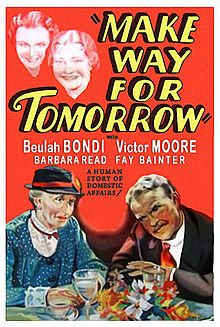
The film opens in the home of Barkley (Victor Moore) and Lucy Cooper (Beulah Bondi). 4 of their 5 grown children are gathered together on the request of their parents who have something to tell them. Because their father has not been able to work, the bank is taking their house and so they will be displaced. Thus, the story is set up as the kids worry about what to do, because no one feels capable of taking both parents. Finally, it is decided that eldest son George (Thomas Mitchell) will take Mother, and one of the sisters will take father.

It is difficult for everyone. The old folks are split up for one of the first times in their 50 years of marriage. Meanwhile, grandma disrupts bridge lessons, makes life more of a nuisance on George’s daughter, and forces the maid to take on more hours. It does not make anyone angry at first, but it begins rubbing and chafing. Creating bitterness and annoyance which is arguably worse. Things reach the breaking point when George’s peeved wife finds out that her daughter is rendezvousing with men, and she is not happy at all when grandma confesses to knowing about it. She loses her temper and grandma apologizes. Seeing a letter from a retirement home she quietly decides it would be better for all if she simply moves there.

Her husband does not fare much better, and the harsh New York weather is taking a toll on his health. Furthermore, his daughter is obviously getting tired of him as her patience continues to wear thin. Mr. Cooper does make a friend in a kindly old shop owner (Maurice Moscovitch), but he soon is turned off as well. Finally, his daughter decides to send their father out of California. She says it’s for his health, but the real reason is she wants him off their hands so her other sister can deal with him.

With this new turn of events, Barkley and Lucy have one last meeting set up so they can spend time together before he is sent off to California. This is the most touching part of the entire film because underlying this oasis is the doubt that they might not see each other again. In the wake of that proposition, they have sort of a second honeymoon. They ditch the kids and have a magical evening just the two of them, reliving their youth and remembering the olden days. The miracle of this sequence is that everyone seems to finally understand them, appreciate them, and really honor them. They are offered a ride in an automobile and are met by the hotel manager who offers them drinks and listens to their wonderful stories of times past. Even the conductor plays a slow waltz just for the two of them. It’s a beautiful extended moment that is made especially moving in contrast to the earlier scenes. These are two people who, despite their advanced years, are still very much in love. It speaks to the importance that marriage holds in the life of some people. In certain circumstances, it is not a shallow event, but a lifelong friendship that carries so much weight.

When the time comes, the two lovebirds say goodbye at the train station and we don’t know what happens to them. We can guess certainly, but McCarey leaves a sweeter taste in our mouths before finishing with a realistic ending. It’s beautiful, moving, and tearful, but not in an overdramatic sort of way. In the mundane, sorrowful way that seems to reflect the rhythms of real life. Beulah Bondi was featured in some many great films, but I’m convinced that this was her greatest performance as an individual. Victor Moore was a worthy companion for her as well. However, my favorite character was probably the shopkeeper Max, because he was such a personable man in a sea of grumbling and annoyance.

5/5 Stars

Review: Once Upon a Time in the West (1968)

Once_upon_a_Time_in_the_West 2I’m not well versed in Spaghetti Westerns, but I certainly do not need someone to tell me that Sergio Leone’s film is a sprawling epic. That’s an understatement if there ever was one. The cast, the score, the visuals. Everything about it fits together so marvelously. All the moving parts succeed in developing a majestic piece of cinema that really is awesome. I try not to use that word lightly.

Recently I saw Tarantino’s Django Unchained which of course pays homage to the Spaghetti Western, and it undoubtedly exhibits the Tarantino style. However, Leone’s film lingers as well, but with Once Upon a Time in the West, I didn’t mind. The film, after all, has a cold open that lasts 13 minutes and most of it is spent staring at Jack Elam and Woody Strode. Except the way Leone captures it all, I don’t really mind. In fact, I thoroughly enjoy it. Whereas Tarantino’s film felt like it was dawdling, Leone’s film didn’t seem to dawdle. It was just stylish in its makeup.  The pacing at times feels like a lazy Sunday afternoon underlined by dread for something to come. Then for a brief blip, the trouble comes violently and then just like that it’s gone. Everything’s back to the status quo except this structure makes every killing and gunfight seem all the more dynamic.

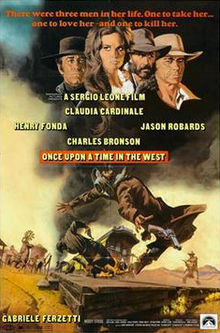
The main players are Claudia Cardinale, James Bronson, Jason Robards, and Henry Fonda. Cardinale, of course, is one of the icons of cinema, and here she feels like a wonderful embodiment of this woman who helps bring civility to this land. Whether it’s simply her immense beauty or some emotion behind her eyes, it’s hard not to watch her every movement. First, as she learns she is a widow, next when she is introduced to the other main players, and finally when she sees her dead’s husband’s dreams forming all around her.

James Bronson as the aloof, but deadly “Harmonica” has to be at his coolest. He hardly has to say anything because that ominous harmonica music is his calling card. Every time we hear it we know he’s around and also his eyes are so expressive. Sergio Leone is never squeamish about lingering on his star’s faces. In fact, that paired with landscapes is one of his signatures that helps define his iconic style. The contrasts stand out and the interludes often lacking dialogue somehow help make his characters even cooler. They take on an air of mystery and in the case of “Harmonica”, we only understand his vendetta near the very end. It all starts to make sense.

Robards is the outlaw Cheyenne, who is pinned with the murder of McBain’s wife and children. A posse is after him and his gang, but he was actually pinned for the rap. He is cast in the light of a scruffy anti-hero and Robards plays him rough around the edges, but most importantly with a heart. He’s one of the few characters who seems to get Jill. He knows enough that none of the men around her are worthy of her, because she is a special class of woman, in spite of what her past may say.

Perhaps the most striking of casting choices was Henry Fonda because by now he was well along in his career and most certainly best known for his plain-speaking heroes. That’s what makes Frank such a great character because dressed in all black and armed with a revolver, he guns someone down the first moment we see him. It’s a shock and it sets the tone for the rest of the film. He goes on to backstab his sickly employer and continues to put pressure on Mrs. McBain to give up her land. It goes so far as taking advantage of her at her home. He’s a monster, but the part is such the antithesis of the Henry Fonda we know, making it a pure stroke of genius.

At least for me, you soon forget about the dubbing of certain characters and just allow yourself to become fully engaged in the dynamic West as envisioned by Leone. After all, since there isn’t a whole lot a dialogue, in some scenes it loses its importance. It’s often about the desolately depicted visuals. The wry smile on a face. The buzz of a pestering fly or the squeaking of a windmill. That’s another thing. This film puts sound to use so wonderfully. Whether it’s the harmonica, Morricone’s engaging score, or diegetic sounds. In fact, the score evolves and reprises in concordance with the pacing of the film. It can be ominous. It can be playful. And sometimes it’s nonexistent.

When it all comes down to it, we get the final showdown between “Harmonica” and Frank, but the film is a lot larger than that. After all, we have been following multiple characters. Jill finally sees the world around here coming to life, and she has weathered the Wild West as an independent woman. As for Cheyenne, he ends as a tragic hero of sorts. There’s no question, Leone’s film, arguably his greatest alongside The Good, The Bad, and The Ugly, helps define a version of the West, with iconic characterizations placed up against striking pictorials. It’s one of those film’s that despite the length, never feels like a labor. A smile is constantly forming on my face, to mirror the visage of James Bronson. I really wish I could play the harmonica now. It’s so ridiculously cool! That’s what I really took away from this film.

5/5 Stars

Review: To Kill a Mockingbird (1962)

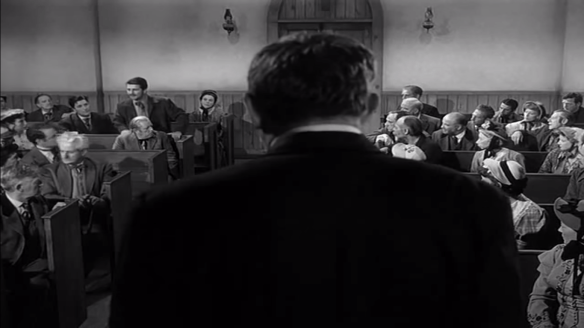
Atticus_and_Tom_Robinson_in_courtHere is one of the rare occasions when novel and film are so closely connected in my mind that I cannot help love Harper Lee’s initial work and its adaptation to the screen. They’re both so timeless in their own ways. Don’t get me wrong. They are very firmly entrenched in a bygone era, but this story exudes certain themes that are universal.

It’s rather like visiting an old friend. It seemed like so long. I can hardly remember the last time I sat down with To Kill a Mockingbird the book, or the movie for that matter. And yet it rushes back so easily. The characters, the settings, the story. I can almost visualize the words on the page as the scenes take place on screen. It’s a wonderful experience and I wish I could connect with something like this more often. But To Kill a Mockingbird is special to me because I read it at a young age and really ate it up. Thanks to Peck’s performance the story was just moving the second time around. It never ceases to be.

It struck me that I thoroughly enjoy Gregory Peck’s iconic performance as Atticus Finch, because of Mary Badham. Finch is a stalwart father figure and that comes out in the ways he guides and leads his young daughter Scout through life. She has a very cut and dry view of the world, not getting down the nuances or complexities around her. What Atticus does is model what it is to live life with other people, pure and simple. He takes the complexities of life and simplifies them in terms his daughter can try to make sense of.

To a lesser extent, that means telling his kids to leave the Radleys be and complementing the always ornery Mrs. Dubose. He is not prone to bravado by acting his age instead of playing football and not gloating about his skill with a gun. He’s too humble a man for that. He also does not fight back. He has more self-respect for himself and other people.

He attempts to instill this and other skills like tact in his kids, especially naive Scout. He gives her the eponymous metaphor that it is a sin to kill a mockingbird because they are a bird (supposedly) that brings only beauty and goodness into the world. And as he says, and I’m paraphrasing, you never understand someone else until you climb into their skin and walk around a bit. He delves into what empathy is and it’s what allows him to feel sorry for the Ewells, instead of desiring vengeance.

Atticus Finch is one of the special characters that I would actually use as a model. He makes me question my own actions as I take on a role much like Scout. He’s constantly reminding, constantly being patient, and modeling what it means to do what is right. All this is done without condescension, without lecturing. It’s done out of love.

His greatest act is, of course, defending accused African-American man Tom Robinson (Brock Peters), because after all, without this central point there is no film or book before it. But rather than focus on the depiction of these African-American characters and whether they are objectionable or not, I would rather acknowledge that this was a simpler time with a lot of evil still left in the world (as there is now), so this film speaks to me, because on a basic level, it is a story of good in the midst of all this blind discrimination and hatred.

That simple truth still speaks to me even with a story that is over 50 years old. The only adult cast member who is still with us now is Robert Duvall, and he is well into his 80s. Gregory Peck with his bespectacled visage and his soothing yet commanding voice is gone. Brock Peters is no longer with us, nor are the many other lesser known figures. But their story and these characters they embodied remain as a testament to Harper Lee’s original work.

It seems important to ask ourselves why would a man like Atticus do what he did? Why would he take that risk when no one else would? He answers Scout in this straightforward manner, “If I didn’t I couldn’t hold up my head in town, I couldn’t represent this county in the legislature, I couldn’t even tell you or Jem not to do something again.” He’s a man who holds himself to a different set of standards.

5/5 Stars