Amadeus (1984)

bcd5e-amadeus1

A common film would content itself with developing a biopic on one of the greatest composers of all time reaching the heights of the musical field in the musical capital of the world in Vienna. A typical film might paint on a canvas paying homage to a legend who revolutionized music with his genius.

This story opens as the long-forgotten composer Antonio Salieri (F. Murray Abraham) attempts to kill himself. He gets laid up in a Psych ward where a man of the cloth visits him wishing to hear his story and so the old man obliges. It’s a story that makes light and lacks reverence thanks to its title character.

Salieri was a court composer of prestige and great admiration, but even he knew Mozart was the true master and the first day they met was forever ingrained in his mind. For being such a genius Wolfgang Amadeus Mozart (Tom Hulce) is a jerk, to put it bluntly. Spoiled, conceited, dirty-minded and armed with a cackling laugh, he is hardly the image of a musical mastermind. How could God bless this man with such talent? How could God taunt Salieri using such a man? He makes a mockery of art and yet he is the best there ever was. Salieri must have some kind of justice.

But all that lies under the surface. Mozart is brought on by his Majesty to develop a German libretto. Salieri’s tolerance for God is lost and he turns his back, beginning his passive attack. He shames Mozart’s wife (Elizabeth Beridge) and sends her off as he is looking to undermine his rival as discreetly as possible.

Mozart himself has little desire to take on pupils he deems a waste of time and instead busies himself with his most ambitious piece yet. His father comes to town and is not amused with his son’s conduct or his antics at a masquerade ball. He has none of the sensibilities of a man like Salieri, but what he does have are the talent and brilliance.

Always one to push the boundaries, Mozart’s latest piece is based on the Marriage of Figaro which was expressly forbidden by His Majesty. But due to his skill, Mozart is able to get by with bending the rules. Salieri acknowledges his genius. He knows brilliance when he sees it, but he becomes even more resolved to bring about the death of his nemesis.

After the death of his father, Mozart slowly spirals down into drunkenness and poverty. Salieri manipulates the situation even further to play on the man’s emotions and the desperate Mozart becomes mad composing a funeral requiem requested by a specter of a man. The mysterious figure is, of course, a moonlighting Salieri who no longer sees his actions as justice against Mozart but against God himself and he wants to win.

In a horrible condition, the bedridden Mozart constructs his last great piece with the help of an incredulous Salieri. But Constanze will have none of it and the manuscript remains unfinished because she distrusts Salieri. Just like that Wolfgang Amadeus Mozart suddenly passes away. He’s dead and Salieri can have no satisfaction, no piece of Mozart’s brilliance. God would not give him the satisfaction, resigning him to be the so-called patron saint of mediocrity. God supposedly got the last laugh.

This is a film that makes me want to revise the noted statement to “only the great die young” as the mediocre slowly fade into oblivion. Salieri faced a cruel demise of his own as Mozart instantly became solidified as a legend. That is the irony of life that is made clear no matter how accurate the facts are. Because in Amadeus, the facts are not the most important. Milos Forman gives us a spectacle that is as grand as Mozart’s greatest masterpieces. But this is perhaps, more importantly, a film about human nature. Salieri is a man so ingrained with internal desires.

He wants to play God. He wants all things to play out as he sees fit. His malevolence is focused on others. It is even focused on God. But, in reality, it reflects the pain of his own heart. Humanity has a desire for excellence to be fully actualized. That is a lofty goal and an impossible target. Because ultimately there will always be a hole left within us. It was so with Salieri

Mozart was one of the greatest and most well-known composers of a generation if not ever. He was not a good man (few are), and he met with death early. Salieri seemed moral and yet he himself was undermined by deep-seated avarice and covetousness. Despite still having life, the world was essentially dead to him. He thought God was laughing at him. Neither man won.

4.5/5 Stars

Kramer vs. Kramer (1979)

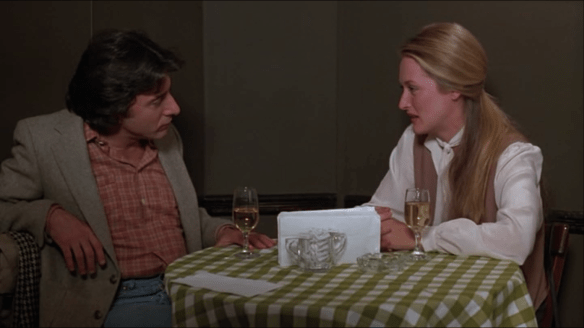
c367a-kramervkramer1The title Kramer vs. Kramer brings to mind a film about two people, formerly married, fighting over their kid who is stuck in the middle of their feud. It has the potential for high drama and tense courtroom scenes full of malice and bitter resentment. Sounds like a real winner.

Don’t get me wrong, there is some of that, but Kramer does better. It follows the complex relationship between a working man and his 7-year old son as the newly separated dad struggles to take care of them both. It shows the pain that forms between former spouses as they try and navigate life as best as they can. It shows the pain and heartache that comes with both loving their boy so dearly. There’s a realness and a vulnerability that is extraordinarily hard to discount.

It does not dawdle and within minutes a solemn Joanna Kramer (Meryl Streep) tells her husband she is leaving him, and he can hardly believe her words. What comes next is the imminent trouble of balancing work and his home life. There is an emotional toll that comes since they were together for over 7 years. Their neighbor isn’t helping matters.

The frustration manifests itself in outbursts over breakfast and anger directed pointedly at others. The most vulnerable is little Billy who is a cute kid but dearly misses his mother. At first, he and his dad don’t always see eye to eye. He does all the typical kid things. Refuses to eat food, disobeys, and causes messes. The best example is the notorious ice cream seen where he defiantly starts eating from a pint of ice cream against his father’s wishes. He’s so cute, but it’s not pretty.

Work is hardly getting any better; in fact, it’s getting worse as Ted has more responsibilities to worry about at home. His friend and superior is not happy with what he’s seeing. On her part, Joanna seems mostly out of the picture, still sending cards to Billy faithfully. His only friend becomes the also separated Margaret (Jane Alexander) and they act as confidantes.

One significant moment occurs at the playground where Billy falls from the jungle gym and cuts himself before his father rushes to his crying son’s aid and runs him to the emergency room. He stays with his boy through all the stitches and tears, solidifying their bond and his resolve to continually be there for his son.

On the work front, Ted is regretfully let go and rushes to find another job. On the home front, Joanna is back in New York and a custody battle is in the making. However, neither parent understands what they have subjected themselves to. Things get ugly and it is something that neither Ted or Joanna wanted. They don’t want to make each other hurt — all they want is their son. It’s a complex flood of emotions and feelings as a product of character assassinations. There can be no nuance only “yes” or “no” and that’s the way the court will decide the outcome.

When the process is done it is decided that custody of Billy will be awarded to his mother. Gasp! However, what Ted does next is more noteworthy. He goes home to his boy and with the greatest of fatherly love he tells his boy he will be going to his mother. Billy will have so much fun with his mommy and they will get to see each other a lot. He is strong and positive for his boy while his insides nearly burst.

Then, in a scene mirroring their earlier morning, they calmly make french toast as a team, a happy fat, er and son together. Joanna asks for a meeting and Ted goes down to meet her. Her decision is yet another surprise and this time he peeps through the elevator with a smile waiting downstairs while she goes up to see her boy. It is very taxing to work through divorce. For all parties involved so Kramer vs. Kramer ends at the happiest place it could realistically be.

I admire the portrayals, however, because Hoffman’s character is far from an angel (sometimes prone to outbursts), and yet he acknowledges his shortcomings and proves just how all encompassing his love for his son is. Meryl Streep, on her part, is relatable but it is still difficult to reconcile her leaving. By the end however,  it is quite easy to feel sympathy for her and she too proves to be a well-meaning, albeit, flawed individual.
The scene that really solidified this film for me had to be when Ted is reading to his son from The Adventures of Tintin. It’s a classic moment and it hit home, because it was a story I read many a time with my own father and will hopefully get to read to my own kids. That’s what makes movies truly wonderful. When they transcend time and place making it possible for us to relate to them on even the most basic or mundane level. That is part of the reason Kramer worked for me. At it’s most intimate, it’s about connections. Between men and women and fathers and sons. Not always pretty but always an integral part of life.

4.5/5 Stars

Review: It’s a Wonderful Life (1946)

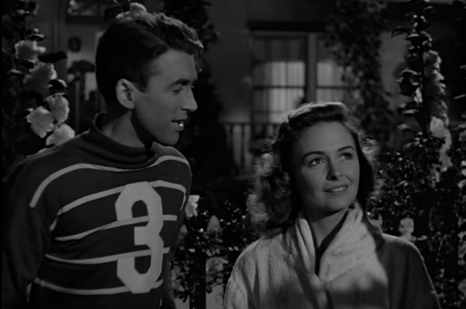
5632c-wonderfullife4Every time I go through the emotional, romantic, heart-warming and at times uncomfortable roller coaster that is It’s a Wonderful Life, something new always seems to stick out to me.

It is always impressive for a film of this length that so much is packed into it. Within minutes we are fully enveloped in this story, and every sequence gives further insight into these characters. There is hardly ever a wasted moment because there is significance in each scene. Pointing us to the nature of George Bailey.

Furthermore, it is easy to forget the darkness that this film submerges itself in because it reaches such a jubilant crescendo. However, this is a story that covers the years including The Great Depression and World War II. Its protagonist sinks into a state of wretchedness complete with angry outbursts, negative feelings, and drunkenness. George Bailey loses all hope and his perspective is so completely distorted. For all intent and purposes, his life looks like it’s over, and it takes a frightening alternate reality to shake him out of his disillusionment. Put in this framework, it makes sense why it was a commercial flop when you juxtapose it with the big winner that year The Best Years of Our Lives. They both deal with post-war reality, but with very different lenses.

That’s the benefit of hindsight and a new context since we do not usually see It’s a Wonderful Life as a gloomy post-war tale, but a more positive parable that is universal in its impact. The first part of this story feels a bit like a Job story of hardship, and the second act is reminiscent to Dickens’ A Christmas Carol, but that’s the simplest of observations. There is a lot more to be parsed through.

The romance of George and Mary is what many of us aspire to and it causes us to really empathize with their young love that weathers the good and bad breaks they receive. It’s the fairy tale love story we want, with the rock hard reality we are used to in our own lives. Some favorite moments in their life together would be the splash they make during the Charleston dance off, singing Buffalo Gals together, smooching on the telephone together, sharing a makeshift honeymoon together, and embracing after George gets his new perspective on life.

There are a fair number of close-ups utilized in this film, but they are usually used at crucial points in the narrative, and they tell us a great deal about both George and Mary.

The first key moment comes during a freeze frame of grown up George with hands outstretched giving us our first look at the man we will be following from there on out. The next big moment occurs when George learns that Potter will gain control and the Building and Loan will be disbanded if he leaves. He realizes in an instant that he must give up his plans. Then, he waits excitedly for Harry with Uncle Billy and it is a happy moment, but George learns his younger brother might have another job. The camera follows his worried face as he goes to follow his new sister-in-law. Never thinking of himself, he realizes that Harry has a chance for better things and that leaves George still working the Building and Loan.

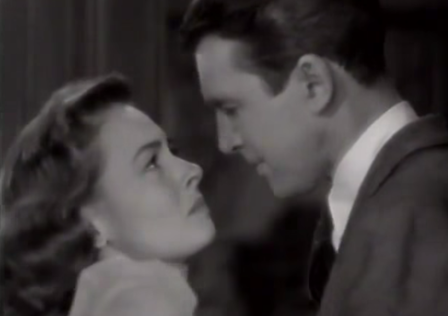
After their tiff, the scene where George and Mary are talking on the phone with Sam Wainwright is a solidifying moment in their relationship. There are so many underlying emotions and unspoken feelings that they are having trouble figuring out and reconciling. And yet there is that violent epiphany when their eyes link. The tears and anger are quickly traded for passionate kisses reflecting the often complicated facts of romance.

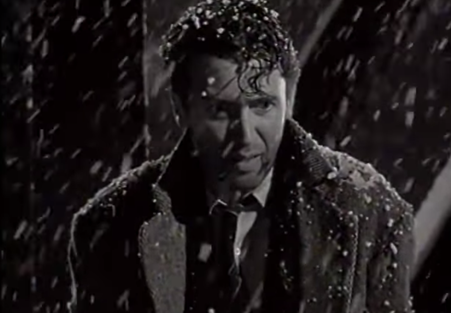
One of the final close-ups that hits home occurs when the now non-existent George stumbles away from the front door of his mother, who now has no concept of him. There is sweat on his brow (maybe from the 90 degree summer heatwave) and desperate bewilderment in his eyes. This is the lowest point he could have imagined. His own mother does not know who he is. His wife has grown old and lonely in an existence of exile. Stewart’s face is so expressive and earnest suggesting that George knows just how important human companionship is. Humanity was made to be in fellowship with each other. Lack of money means very little in comparison to our friendships and family ties. This is essentially what George finally comprehends and what Clarence reminds him. George understandably lost sight of his wife and his children and his friends. They were a gift not to be taken lightly.

Aside from these close-ups, it is also evident that a great deal of  effort was put into creating this world from the characters and their back stories to the town itself which was constructed on the RKO lot. Everything from the building facades, to stray dogs, and snow make the drama more atmospheric. It’s one of those films that reveals the beauty of using real props inhabited by seemingly real people. That’s why I sometimes am disillusioned by CGI. Although it can allow us to create amazing spectacles, oftentimes it creates a world that feels altogether fake and alien. It’s not relatable and it lacks the humanity that makes up our existence each and every day. In other words, it has very little of what makes It’s a Wonderful Life so compelling to me.

Perhaps there are more impressive or greater films, but there are few with greater heart and there is something to be said for that.

5/5 Stars

Review: Miracle of 34th Street (1947)

703c5-miracleon34thChristmas movies do not get much better than this. What a concept! Here’s a film about a man who really is Kris Kringle aka Santa Claus. He gets picked up by Macy’s department store to be their Santa Claus, and he winds up facing a hearing to decide whether he is legitimate or not. His pet project is to make an unsentimental little girl (Natalie Wood), and her practical mother (Maureen O’Hara) believe in him. He finds an ally in a young lawyer (John Payne) who believes in his holiday cheer and is also smitten with the girl’s mother.

Some people would undoubtedly say it’s a bunch a hogwash to make a movie about such a topic. Maybe it is only holiday tripe, but I find it is very hard to refute this “Miracle” of a Christmas classic. The characters portrayed are so spot on and heartfelt it is so easy to get pulled into their story. At the same time, it’s difficult not to like a film where department stores help each other, the hustle and bustle is toned down, and for once mankind has faith in each other for awhile.

As an audience, we gravitate towards Edmund Gwen because he represents the Santa we all wish to know. He is kind, thoughtful, generous, and above all a magical gift giver. Maureen O’Hara goes through a character progression that mirrors that of her daughter, except it is perhaps a little more poignant in her case due to her maturity. It would seemingly be easy to dislike her and yet thanks to O’Hara we cannot help but feel for her. She is also extremely beautiful, even in black and white. Although young, Wood proves to be a memorable little girl in this one, and she was just getting started. Payne is a good addition in his own right — a highly underrated actor.

The film is rounded out by a wonderful array of characters in the Macy’s store like magnate R.H. Macy (Harry Atrim), well-meaning Mr. Shellhammer (Philip Tonge) and friendly young janitor Alfred (Alvin Greeman). Shoppers such as the one and only Thelma Ritter in an early role, and civil servants like Judge Harper  (Gene Lockhart) round out New York’s population with generally decent people who we can relate to. The one exception is Dr. Sawyer (Porter Hall), the company psychologist, and greatest villain of the film, who is the antithesis of Kris and his Christmas spirit.

My hope is that this one never pales, never loses its cheer, and maintains its timelessness for many Christmases to come. Until the next Macy’s Thanksgiving parade comes along have yourself a merry little Christmas and remember all psychologists are not evil jerks looking to ruin the holidays!

5/5 Stars

White Christmas (1954)

58e88-white_chrismas_filmMany times I feel like a broken record (this time playing a Christmas tune), but White Christmas is one of those classics that I never get tired of. It is so ingrained, so integral to my childhood memories, that I have difficulty analyzing it or finding fault.

Wonderful, visceral films stop being something that must be thought about and simply become an all out experience. That’s what White Christmas is for me. A full blown Christmas experience courtesy of Bing Crosby, Danny Kaye, Rosemary Clooney Vera-Ellen, Dean Jagger, director Michael Curtiz and of course Irving Berlin.

I mean this as a compliment, but at a basic level, I always thought of White Christmas as a Christmas-like version of Singin’ in the Rain. We have a talented and dashing leading man in Crosby (Bing Crosby) and his mischievous and hilarious partner in crime (Danny Kaye). They are never better than during their parody of the sister’s act (It’s a priceless gem of a moment). Although, there is constant chemistry throughout the film thanks to the bickering and back and forth between two buddies.  Similarly to Singin’ in the Rain, you also have big spectacles, lavish sets, great songs, dancing, and constant quotability. It brings out the most reluctant of crooners and even the guys with two left feet. But what about the story?

White Christmas follows those two war buddies as they make it big as a boffo double act. Along the way, they help out a pair of sisters as well as their washed-up former commander General Waverly (Dean Jagger), who owns an inn in snow-less Vermont. Although, it’s lacking in business,  it’s the perfect locale for matchmaking, acts of kindness, and misunderstandings courtesy of local innkeeper and resident eavesdropper Emma (Mary Wickes). But what we end up receiving is a joyous romance with plenty of Christmas cheer and sentiment to go around.


Bing Crosby’s pipes are as good as ever (“Count Your Blessings”) and Danny Kaye can make his voice crack like no other. Vera-Ella has a talented pair of legs and Rosemary Clooney can carry a tune in her own right opposite Crosby. Whether it’s “Snow,” “Sisters,” or the eponymous track, there’s so much to offer. Weather any slow sections and you will be rewarded thanks to the even-handed direction of Michael Curtiz (Casablanca), paired with the ever memorable compositions of Irving Berlin. Now go spend the holidays with your kith and kin. Vermont must be nice this time of year, all that snow.

4/5 Stars

Boyhood (2014)

13113-boyhood1Surely others have said this already but Boyhood struck a chord with me and it was the prettiest of melodies.  Pure and simple in its brilliance.

This is not my childhood by any means or my life or my family, but there are glimpses of it here. Quick flashbulbs or touchstones that for a brief instant take me back. Sometimes many years ago or just one or two. Nostalgia is the strangest type of memory for a young person, because we are transcending the space between the here and now, which we are so used to, and going to the “back then.”

12 years is a long time but even more so when you have fewer years under your belt. Thus, Boyhood in comparison to my own life is an epic film in every sense of the word. Whereas it might only be a wonderful coming-of-age tale for older generations, there is a feeling that this film in some small way represents where I’m coming from.

A film could never fully encapsulate or perfectly represent what it is to grow up in adolescence. It’s different for every child depending on where they live, what their family is like, and so on. But Boyhood is an unprecedented depiction of what that existence looks like to many young people. There is certainly something special and important in that.

1cce5-boyhood2There are so many different vignettes, almost like short films, characterizing each and every year in Mason Jr.’s life. We are given no blatant indication of time and place. It is all context clues, cultural references, and watching Mason and his family grow and evolve around him. Always innovative Richard Linklater does not hold out a giant megaphone saying this happened that year or this year. Instead, Mason’s story plays out like it would in the so-called “real world.” There are some major milestones or life-shaping moments that are shown, but most of this journey has to do with the little caches of time that make up life.

I feel drawn to do something that I don’t normally do, but Boyhood is such a unique film it deserves to be approached in a different light since to put it truthfully, it cannot be pigeonholed into any standard category.

Instead of trying to acknowledge the entire narrative of Mason’s life, which would be as impossible with him as with anyone else, I want to give reference to the many moments and bits and pieces that Linklater placed either by accident on purpose. The fact is Boyhood is chock full of these markers of the passage of time which make it a fascinating journey of human life.

Here we go, get ready:

Coldplay’s Yellow over the credits
Britney Speares fandom
Star War dilemma: Yoda vs. Grievous
Game Boys and Wave Boards
The Astros’ Rocket Roger Clemens
Harry Potter and the Half Blood Prince
The Landlord – Will Ferrell
High School Musical – We’re All in This Together
Wii Boxing with a Nunchuk
Presidential Election in 2008
Facebook profiles
The Dark Knight
Phoenix – 1901
Twilight books
War in Iraq and Afghanistan
Lady Gaga and Beyonce
Iphone Facetiming
Gotye – Somebody That I Used to Know
Atlas Genius – Trojan

and on and on….

c94ae-boyhood3Against this backdrop, the separation of Mason’s parents (Ethan Hawke and Patricia Arquette) takes center stage. Next, follows another failed relationship riddled with abuse. Switching cities and starting a new life followed by another step-dad and another failed marriage. Then, dad (Hawke) gets remarried and it actually works out. There’s peer pressure and experimentation. Girls become a big deal. Photography is a passion. Sister (Lorelei Linklater) goes through the rebellious phase. High School graduation comes around and college soon after. Breakups happen and life still continues ever onward.

You could make an argument that Linklater could have gone on longer. He could have wrapped everything up nice and neat or cheated and fast forwarded to the end. But that was not his way out and it did not have to be. College is a major moment of change, confusion, and finding oneself, so in a sense, it is a fitting place to leave Mason behind.

He remained introspective, philosophical, and aloof for the majority of his life, despite family of origins issues and the like. It is mind-boggling to think of all the people cycled in and out of his life. Ever changing and often forgotten.

Thus, Boyhood is a gift to us for a multitude of reasons, but hopefully, its visual biography of Mason Jr. will lead us down memory lane and cause us to consider our path. For most of us, we have more than 12 years in front of us. Let us use our time well and wholeheartedly navigate the realities of life whether it is movie worthy or not. It’s our life and that’s all that matters.

4.5/5 Stars

Pickup on South Street (1953)

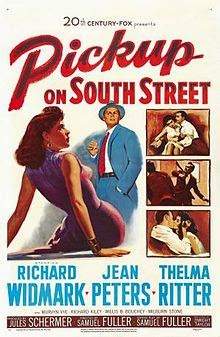
bf34b-pickuponsouthstreetFrom American cult film director Samuel Fuller comes a brief, yet potent film-noir laced with communism, pickpocketing, and a lot of shady business on the streets of New York.
Grifter Skip McCoy (Richard Widmark) is just recently out of the can, and he is back on the streets up to his old tricks again swiping wallets. His victim this time around is a pretty young dame named Candy (Jean Peters) who has a mission of her own to drop off a package. Neither of them knows quite what they have gotten into and to start off with, nothing happens. What exactly has Skip stumbled upon? The answer includes microfilm, spies, and the Commies. All of a sudden things are hot, as McCoy tries to cut a deal with the Reds, and Candy tries to recover the film she unknowingly lost. Candy gets caught in the middle of her boyfriend who is sided with Communists and Skip who wants to cash in on his good fortune. Between Skip and Candy begins a wild and passionate love affair that seems destined for disaster. Both have their own agendas, but it is ultimately Candy who drops hers because of her new found affection. McCoy is callous at first but he comes around, in the end, leaving this noir on a surprisingly positive note.
Thelma Ritter was usually colorful in her many screen appearances and she has another memorable turn as the wheeler-dealer Moe Williams in this film. However, Moe does not just deal ties and secrets; she is a woman with a conscience and a touch of good old-fashioned patriotism. In her own simple way, she is a hero whether people know it or not.
Widmark played a similar conman in Night and the City (1950), but this time around things worked out a little differently for his character. The pickpocket sequences were perhaps less elaborate but still similarly intricate to Robert Bresson’s Pickpocket (1959). It is possible that he got some of his inspiration from Fuller’s work here.
This is a real communist era thriller that Fuller injects with passion, grit, and some unadulterated violence. It is not a pretty film necessarily, but that is not what Fuller is going for, and he never does. Instead, as a former journalist, he reveals to his audience the nitty-gritty of South Street up close and personal. He succeeds with flying colors in delivering a first rate scoop of uncompromising pulp.
4/5 Stars

Ida (2013)

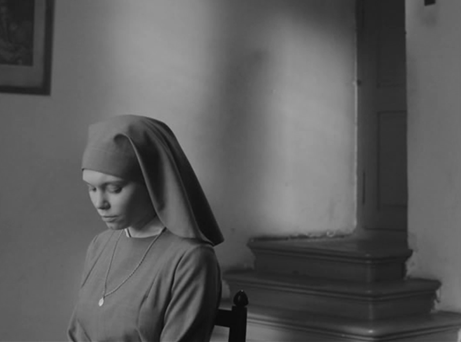
28ceb-ida1At hardly an hour and 20 minutes, you would think Ida has very little to offer, but that just is not the truth whatsoever. Polish director Pawel Pawlikowski blessed us with a nuanced film full of power and strangely pleasing visuals. It’s stark, yet crisp, black and white cinematography did not have to be that way, but it looks absolutely beautiful.

In the opening sequence, we see a young nun carving a statue and then carrying it to the grounds outside. We realize it depicts Christ and it feels rather reminiscent of La Dolce Vita and yet this film has a note of reverence.

We have been transposed to Poland during the 1960s where novice nun Ida lives a simple and disciplined lifestyle within a convent. The meager plot follows her pilgrimage to meet her only relative before taking her vows. It’s the aunt who refused to take her in after Ida’s parents passed. They have never met before now.

There doesn’t seem to be much to say. In fact, what can you say? Ida has taken up a religious calling and her aunt, a former judge named Wanda Gruz, lives life the way she pleases. Men, alcohol, and smoking are all a part of that lifestyle.

Thus, they have little in common until the moment when Gruz discloses the truth to Ida. Her real name is Ida Lebenstein. She is Jewish. Her parents were killed during the War, but the details are not too clear. They can probably guess how it happened.

Ida’s whole identity is rocked because she is now a Jew within a convent which seems like a gross incongruity. Ida’s resolve is to find her parents’ resting place and so the unlikely pair set off looking for answers.

That’s about all the film’s plot right there, and though it does not sound like much, it is far more engrossing than a lot of the other fair we come across. There are moments when it feels like we are watching something from Robert Bresson. It’s simple. There are not frills but it is chock full of humanity and seemingly real characters with real emotions.

Ida is very rarely in the center of the frame, more often than not her eyes are averted, looking away from the camera. Pawlikowski also has a curious habit of focusing on one character during a scene of dialogue. It seems to denote how isolated and confused many of these characters are. It’s one of those films that leaves us with more questions than answers and that lends itself to a truly insightful viewing experience.

4.5/5 Stars

This Jesus of yours adored people like me” ~ Wanda Gruz

Review: Murder, My Sweet (1944)

e30de-murdermysweet1Ann Grayle: You know, I think you’re nuts. You go barging around without a very clear idea of what you’re doing. Everybody bats you down, smacks you over the head, fills you full of stuff…and you keep right on hitting between tackle and end. I don’t think you even know which side you’re on.

Phillip Marlowe: I don’t know which side anybody’s on. I don’t even know who’s playing today.

Now after seeing the original Dick Powell as a crooner in light song and dance flicks, his re-imagined image as Chandler’s Phillip Marlowe is that much more surprising. This film quickly dropped being the potential musical Farewell my Lovely and ultimately became a hard-boiled Noir called Murder, My Sweet. To Powell’s credit, his new alter ego works and he brings his own spin to the role. Perhaps he has a little more humor than Bogart but there is still enough of the tough guy in his role to make it work. He’s also deliciously cheeky which is perfectly illustrated by a scene where he lights his match on the butt of a statue. It’s great.

Edward Dmytryk gave us a film that has often been credited with helping to define the film-noir style of the 1940s. It makes perfect sense since his film brims with many of the major hallmarks of the genre. The powder-burned Marlowe’s initial narration carried through a flashback lends a wry and cynical commentary to the entire story. The screen itself is cloaked in shadows, filled with billows of cigarette smoke, and is often superimposed with disorienting images.

Early on one man named Marriot is dead, Marlowe gets clocked over the head, roughed up several times, not to mention drugged up. He gets hired, used, thrown off, and seduced more than once. All because of an expensive jade necklace. As Anne (Anne Shirley) notes, Marlowe goes charging into his case not quite knowing what is going on or who he is dealing with. That ambiguity is one of the strengths of this film because we are never allowed the comfort of knowing who to side with.

By default, we begin the film from the point of view of Marlowe, and so he is our anti-hero who we track with the entire film. He gets the giant thug Moose (Mike Mazurki) tossed his way first. Marlowe meets the pretty Anne who hides her true intentions, introducing him to her wealthy father (Miles Mander) and seductive stepmother (Claire Trevor). Next up is quack doctor Jules Amthor (Otto Kruger) who appears to be our most clear cut villain and yet nothing is for sure.

It takes a late night confrontation at a beach house for things to straighten themselves out. Yet even up until that point, we do not know Marlowe’s true intentions, and he does not find out the resolution of the case until well after, thanks to the powder burns to the face.

Aside from Dick Powell’s anchoring performance, Claire Trevor is a tantalizing femme fatale, while Anne Shirley plays the guardian angel rather well. The juxtaposition of a morally questionable woman and an innocent girl develops the tension, not to mention that they are step-daughter and step-mother. When it’s all said and done, Marlowe got a sweet deal. He didn’t even need the jade necklace.

4/5 Stars

The Fellowship of the Ring (2001)

fea8c-fellowship1Without the inventiveness and lore that J.R.R. Tolkien created in his books, there would never be something as visceral and grand in scope as The Lord of the Rings. However, it is a vibrant mythology that Peter Jackson breathed life into, and it becomes evident in the opening minutes of the Fellowship.

There is so much ground to cover as far as history and context go and Jackson sets it up beautifully with an epic prologue narrated by Galadriel (Cate Blanchett) which became synonymous with this trilogy.

“But something happened then that the Ring did not intend. It was picked up by the most unlikely creature imaginable: a hobbit, Bilbo Baggins, of the Shire. For the time will soon come when hobbits will shape the fortune of all.”

Thus, begins the Fellowship of the Ring. We find ourselves in the awesomely beautiful Shire (courtesy of New Zealand) backed by an exuberant score by Howard Shore. This is the home of a now elderly Bilbo (Ian Holm) and his relation Frodo Baggins (Elijah Wood). The backdrop is Bilbo’s Eleventy-First Birthday and Gandalf (Ian McKellen) is making an appearance for his old friends birthday.

There is a lot of merriment to be had complete with Gandalf’s world famous fireworks, however, Bilbo is also preparing to say adieu, and he must finally give up the Ring. It is at this time that Gandalf is reminded of its power as it gets handed off to the unknowing Frodo. It is now this little hobbit’s task to flee everything he has ever known because 9 Black Riders sent by the evil Sauron are heading to retrieve the Ring.

By his side is the loyal gardener Samwise Gamgee (Sean Astin) and his two jesting friends Merry and Pippin. As for Gandalf, he must deal with some business with the head of his order Saruman (Christopher Lee).

With the Riders in hot pursuit, the hobbits stop at the Prancing Pony. By this time Gandalf has yet to return but they cross paths with a ranger named Strider (Viggo Mortensen). He agrees to lead them to the Elvin city Rivendell but before they can get their Frodo is ambushed by the Ring-Wraiths and receives a fatal wound. He survives and is reunited with Bilbo as well as Gandalf who was forced to flee Saruman who has switched his allegiance.

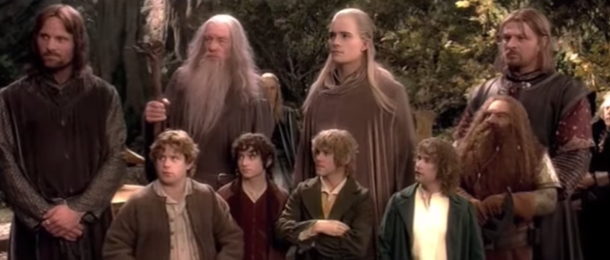
A decision is made to destroy the Ring in Mount Doom from whence it came and Frodo is joined by his friends, Gandalf, Aragorn, Legolas the elf (Orlando Bloom), Gimli the dwarf (John Rys-Davies) and Boromir (Sean Bean) the man.

They must take a treacherous path leading to the Mines of Moria which are in complete ruins. The area has been completely overrun by orcs and Gandalf must stave off an ancient demon called a Balrog so the others can escape.

They wind up in Lothlorien the home of more Elves including Galadriel who informs Frodo of what the future hold for him. Boromir is the next person to be tempted by the Ring and he tries to get it away from Frodo who starts to flee once more.

Aragorn, Gimli, and Legolas take on a legion orcs and Boromir attempts to redeem himself but is struck down. Merry and Pippin get kidnapped leading the enemy away from Frodo. Ever faithful Sam follows Frodo because of the promise he made. And the three other members of the Fellowship resolve to go after the press-ganged hobbits after they pay their respects to Boromir.

It’s a cliffhanger ending, but it is packed with enough epic drama and heart to make it a worthwhile ride. Just know that this is just the beginning of a long, hard journey.

Lord of the Rings is visually magnificent and it’s absolutely mind boggling that most of the scenery and extras in the film (ie. orcs) were actually real. Thus, it seems like The Lord of the Rings is one of the last great epics in a long line of epic films. It is sad to think that this kind of “real” epic is a dying breed with the use of CGI. Human actors and real life scenery is slowly, or actually quite rapidly, getting replaced by computers.

My criticism is that computers make the world and even characters look too perfect. You can tell that it is not real and it loses some of its allure in my mind. Furthermore, if characters are being created from scratch you lose the human interaction and thus a great deal of movie magic. My hope is that these type of epics will find a resurgence because they are usually well worth it.

Another observation has to do with Howard Shore’s magnificent score. If you removed it from this film we would have a completely different movie-going experience. It would be as if a piece of the puzzle is missing, because he seemed to so perfectly personify each locale and he accented each scene so wonderfully with music. Whether it was epic choral arrangements during dark moments or the flute for the gaiety of a sunny day in the Shire.

This certainly not my first romp in Middle Earth, but I was reminded why this world was so engaging. I am excited to revisit the other installments, because the story only gets better with time, even if we already know the ending. Thank you, Peter Jackson, and thank you, J.R.R. Tolkien.

5/5 Stars