
I was a bit behind on my movie-watching for 2023, but here is a list of a few movies I enjoyed from the past year. I’ve either linked to a previous review or included a short capsule. Enjoy!
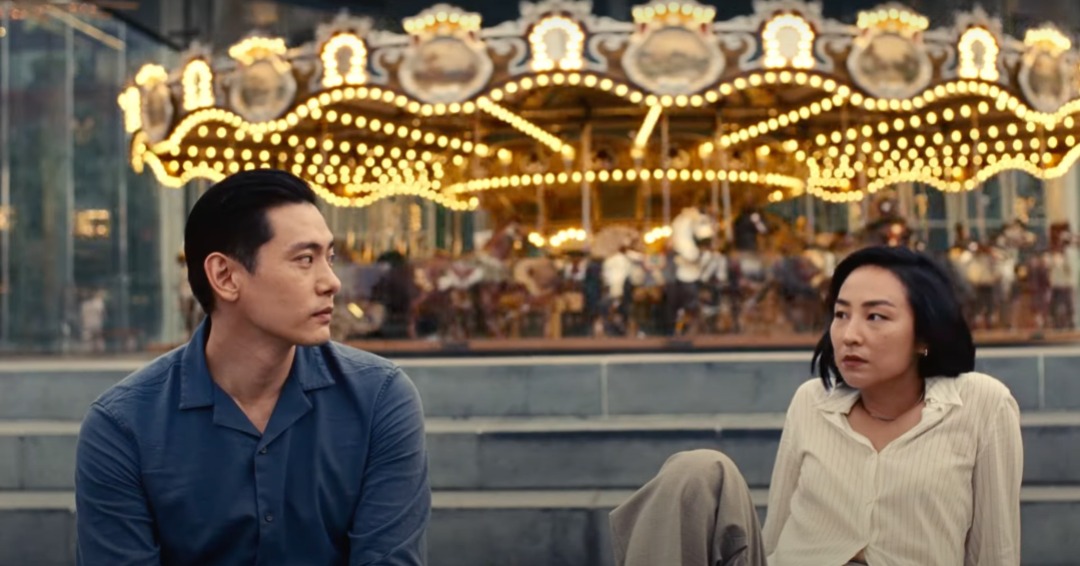
Writer-director Celine Song’s use of time is self-assured and brazen. She’s loose and elastic with it, bravely allowing her story to cut 24 years into the past before fast-forwarding 12 years and then 12 years again. But these jumps in time feel subtle and right with the perfectly applied sense of space and context. We never feel like we’re being rushed. The elliptical nature of a single cut is imbued with so much power. The movie is the epitome of contemplative cinema as it tells a fated love story.
Greta Lee is such a phenomenal conduit of this drama, and she takes every scene with a composure full of warmth and feeling. Teo Yoo has a forthright candor morphing from a boyish heartthrob to a man still grappling with unresolved feelings. John Magaro could easily be a whiny-voiced annoyance — the white evil of the movie — and yet it’s a credit to his humanity that we like him and even empathize with him (especially if we don’t speak Korean like this viewer).
As humans, we’re always looking to discern what our future will be. Religious people question God’s plan for their lives. And often we have the nagging thoughts of what-ifs and how things could have been. Perhaps I’m the only one who thinks like this. But Past Lives seems to suggest this is not the case.
Perfect Days
It feels almost too convenient to evoke Jim Jarmusch’s Paterson from a few years back when considering this new film from Wim Wenders, but I can find no other alternative. They both focus on individuals who live contented analog lives with daily rhythms that feel almost radical in the face of the world around them. It doesn’t matter if it involves bus driving or in the case of Hirayama (Koji Yakusho), cleaning toilets in Japan under the watchful eye of the Tokyo Skytree.
Jarmusch, much like Wenders, has always felt like a sojourner with an insatiable curiosity, and both men seem to be continually expanding the cultural canvas of cinema through their travels and observations of a wide swath of humanity. Of course, Wenders started out first and has been doing sustained work for many years. It seems fitting that a film like this, while focusing on a very specific Japanese milieu, with the help of co-writer Takuma Takasaki, still boasts some of Wenders prevailing passions from photography to rock and roll music.
But what could feel like a mere gimmick gives rise to a man, thanks in part to Yakusho’s disarming performance, who has so much to offer the audience and others within the frames of the film. Because there’s something so quietly instructive about him. We can learn so much and appreciate so much more if we only observe the people and things around us. I found it charming, and it was a stirring reminder of why I love Japan (and the films of Wenders).
The Taste of Things
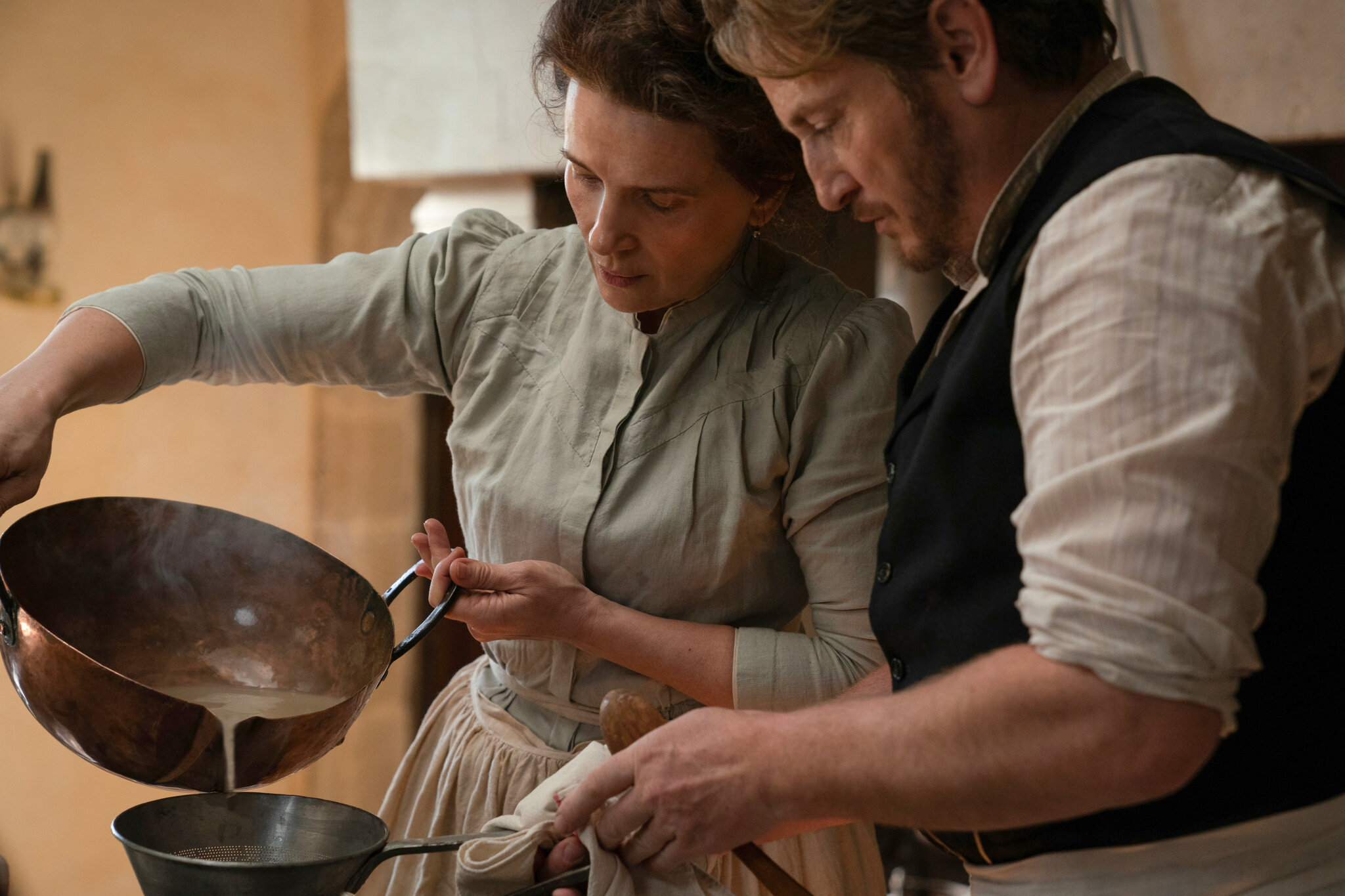
Babette’s Feast is a film that was a revelation to me from the very first time I watched it. I’m no gourmet and yet such sumptuous delights are hard to resist wrapped up in a Danish parable as it is. The Taste of Things is much the same – coming out of the same lineage – and the unbroken introduction to this tactile, delicious world of food in a 19th-century French kitchen is equally entrancing. There’s something so compelling and equally remarkable about these epicurean delights being created before our eyes. How something can have an extravagant simplicity to them requiring the utmost amount of tender loving care (and the freshest ingredients plucked straight from the garden).
While it’s not quite as thematically rich as its predecessor, it does rest on a love story brought to the screen by the incomparable Juliette Binoche and Benoît Magimel, a pair of performers with a real-life history albeit one in the past. Food is their undisputed love language. It buoys their romance in such a rapturous way paired with the delicious cavalcade of eateries and a vow to train up another generation of chefs who have the intuitive gifts and the innate passion for food that can be further cultivated. There’s something quiet, beautiful, and melancholy about Tran Anh Hung’s film that I greatly relished.
Killers of the Flower Moon
There’s something more fundamental here. You see it in many of Scorsese’s movies from Goodfellas, Wolf of Wall Street, or any of his gangster pictures showing the traditional villains in an intimate if not entirely sympathetic light. He always seems to return to this because this was his childhood — he grew up in a neighborhood with these sorts. By the world’s standard are they corrupt? Yes, but they aren’t personified evil. They act as complicated characters full of charisma, humor, and whatever else.
It feels like this is his gift as a filmmaker. Because we don’t always like these people, but he was never interested in a black hat and white hat morality. Perhaps that’s why he did not make Killers a more traditional Western because this would not be true to the ethos he’s had since the very beginning.
Lily Gladstone is such a powerful emotive force in this movie because if Leo’s performance is so pitiful, she is his perfect scene partner by maintaining an equilibrium; there’s a regality to her that’s not easy to break and yet she’s not an unknowable stoic. She loves deeply and with Ernest and her family, we see both her affection and her deep sorrow when they are ripped away from her one by one. The movie requires her strength to hold it together and instill it with resonance. Scorsese never asks easy questions, and I believe that comes with honesty, and it’s part of the reason he’s still one of our premier filmmakers. He’s still curious and the questions he asks with his films are ones he’s still wrestling with now 80 years on. They’re universal.
Oppenheimer
It’s easy to cast Oppenheimer as one of the most important figures of the 20th century since he was the “Father of the Atomic Bomb,” but he was also one of its greatest tragedies. There’s a scale and scope to this narrative woven right into the very fabric of history. A whole movie could be borne on Cillian Murphy’s face and it is. Between his vivid eyes, gaunt contour, the porkpie hat, and pipe, there’s something instantly iconic about him. He’s haunted and profound even before he says or does much of anything.
It’s also dizzying watching Christopher Nolan develop the rich world around Oppenheimer packed with substance — a real world of real people and events we get to experience firsthand. This immediacy is key and although I’ve read the book, I don’t think you’re required to keep it in your back pocket. Nolan has done the unthinkable by making a potentially stodgy historical piece into a gripping blockbuster. In the age of superhero movies, studios have mostly assumed historical genres are dead.
Likewise, by shaking up a prosaic biopic form, the director alights on something that’s narratively audacious even when it falters. That’s why he’s remained one of our most beloved filmmakers over the last decades. He makes big movies for thinking people, and if nothing else, I hope Oppenheimer acts as a clarion call for more thoughtful tentpoles in the industry. The audience seems to be more than rewarding his efforts.

The Boy and The Heron
I was thinking how grateful I am that filmmakers like Martin Scorsese and Hayao Miyazaki are still giving us their art. How lucky are we? The Boy and The Heron gleans some inspiration from the 1937 book How Do You Live? and also the annals of Japanese history and Ghibli Studio’s own lineage. Watching the film there are many echoes of Miyazaki’s favorite topics and also the influence of his mentor Issao Takahata.
For a Western audience, it has the tinges of Narnia where the war is an everyday tragic reality, and thus a world outside our own gives space for respite and marvelous things that can break in and heal our hurts so we might make peace with them. I was reminded of Petitte Mamam where the magical can somehow bring a parent and child closer together, even forge them by fire and trials of many kinds.
All this fits for the simple reason that the film is very much a fairy tale. I couldn’t get away from this idea that Miyazaki’s film is so beautiful to look at, absolutely resplendent (he also has a penchant for the cutest creatures), and yet it has these pointed moments of ugliness even terror that feel like a necessity. The contrast is key to making the magical world feel in a sense real because we recognize both the good and evil from our own lives. It’s within this space where children can grow and thereby enter back into their lives ready to face the challenges ahead. It occurs to me that Scorsese, Miyazaki, and others like them maintain the curiosity and wonderment of youth. The years they’ve been on this earth belie their child-like spirit. It makes their movies still so accessible and universal to the masses, well worth our time and consideration.
Afire
I appreciated Afire because, like many of the director’s earlier films, it’s deep in conversation with the vast annals of cinema. This one in particular feels like a paler, pudgier version of an Eric Rohmer movie. Something in the vein of La Collectionneuse, Pauline at the Beach, or even A Summer’s Tale. I felt vindicated hearing that Petzold was in fact consuming some Rohmer films during the pandemic, but that was only part of his inspiration. Unlike Hollywood, Germany doesn’t have a lineage of summer movies about the last day of school or hanging out at the beach with no adult supervision. The summer had vanished not only from their filmographies but from Germany as a whole. The nation rarely got this opportunity with the ascension of the Nazis and this historical backdrop gave rise to many of the specters which have haunted most of Petzold’s oeuvre.
If you wanted to make a case, Afire is actually Petzold’s most comedic film to date and his closest to romantic comedy thanks to its lead. I’m still trying to get my feelings in order, but Afire delivered like the director always seems to. It’s deeply observed and engaging with its perceptive vision of humanity and interpersonal relationships. But what makes it richer comes with how the writer-director takes a simple premise and simultaneously imbues it with all this intertextual meaning. His references are not always overt, but couched within his stories are the echoes of his nation’s films as well as literature and mythologies – many of his projects over the years have been adaptations of much older work. In our current age of cursory knowledge and vapid fads, he’s a refreshingly thoughtful filmmaker.
Godzilla Minus One
I found Godzilla Minus One feeling like this year’s Top Gun for what it teaches us about sequels. Obviously, Godzilla is an institution in Japan, but here we see a film that takes the very specific context of the original film amid the nuclear age — reminding us of the context of a post-war world — while building on the past in new ways. Top Gun: Maverick did much the same as its predecessor, and it was oddly such a human and intimate film in the same way that this giant monster movie with tinges of Jaws (and The Dark Knight Rises) feels even least nominally invested in interpersonal relationships beyond mere kaiju eye candy.
This new film is a spectacular bit of construction blending period drama with solid special effects, a quintessential demolition of Tokyo, and deep sea confrontation that brims with menace and personal stakes. Perhaps what’s most spectacular is how director and general mastermind Takashi Yamazaki was able to offer up a low-budget tentpole full of invention and a stirring message of hope. In a film full of devastation and general destruction, the narrative bends refreshingly toward a message promoting the sanctity of human life. This feels like a radical position for a genre that feels almost antithetical to this kind of sentiment.

Godland
It’s the kind of taxing epic that is not for everyone. Positioned somewhere between Carl Theodor Dreyer and Werner Herzog, it’s both gloriously desolate with the raw beauty and power only nature can attain. It also brims with the kind of existential weight one feels when your attempt at Christian faith is found lacking and all your pride and human vigor are laid bare.
Our protagonist cuts a gaunt figure. He’s the most ascetic and joyless man of the cloth, but out of many striking images in the film, there is a sequence that feels emblematic of the trail he leaves in his wake. First, an interpreter who must be buried, and then his horse which is left for dead, followed by a final summative death. Seasons change and yet in our limited capacity we are so insignificant in comparison to God’s creation and his majesty and it is arrogance and folly to think otherwise. I am reminded of the verse: “What is man that you are mindful of him, and the son of man that you care for him? Yet you have made him a little lower than the heavenly beings and crowned him with glory and honor.”
This is a spectacular perspective, and it is something to be held with a loose rein of humility. Grace is something to be cherished because it changes your outlook and how you treat others. Meanwhile, colonialism is something we still feel the repercussions of here, and we see it here in the cultural and linguistic tension between Denmark and Iceland. Condescension has no place in the supposed Christian way of life; it’s ultimately a pernicious force.
Across The Spider-Verse
As we watch the live-action Marvel comic book movies show what feels like signs of slightly waning dividends, it makes the animated iterations all the more intriguing. They exhibit a meshing of style and storytelling. It’s exquisite to look at, but they’re not simply empty animated images. The form fits the content and we get a sense of atmosphere, even emotion through the way they are distilled through the visual palette. There’s an invention and a sense of craft that takes into consideration the modern landscape while still staying true to the form of split panels or even the evolving painterly watercolor aesthetic of Gwen’s world. Somehow everything is all but typified by our hero fighting a Renaissance vulture with Jeff Koons balloon sculpture left as collateral damage.
I still remember when they made Star Wars literature legends and they were no longer canonical. That was probably one of the first instances I began to understand the term. Now it’s pervasive across fan culture. Canon events form the building blocks of the spider-verse world, but they also say something about our search to make meaning out of circumstances. It may be entertainment but it could probably spawn a whole conversation about predestination, free will, reincarnation, and the afterlife in general.
Part of me wonders if the reason these concepts are so intriguing to us or even comforting is that we are longing for something more (or something else) — something beyond the life that we lead. Surely this can’t be all there is. Why else would the world continually clamor for sequels and ever-expanding universes? My only qualm about the movie is my problem with all these “metaverses.” We can never leave well enough alone. But then again, they never satiate us.
 Whisper of The Heart is wholeheartedly a Japanese anime and yet learning John Denver’s “Country Roads” holds a relatively substantial place in the plotline might catch some off guard. After all, as the metropolitan imagery establishes our setting, we hear a version of the song playing against the bevy of passersby, cars, and convenience stores.
 The song “Sukiyaki” sung by Kyu Sakamoto proved such a charming enigma for me. Here was a record that was so quintessentially Japanese, a melodious ballad, that was nevertheless branded in the West with a more novel title and became a smash hit. However, here within the framework of this anime, the song feels perfectly at home once more as “Ue o Muite Arukō” an impeccable benchmark of an era in Japan’s history. It’s true that the full extent of the musical score is noticeably more western than we might be used to with anime yet the cornerstone of the soundtrack is Sakamoto’s iconic tune.

 4 Star Films