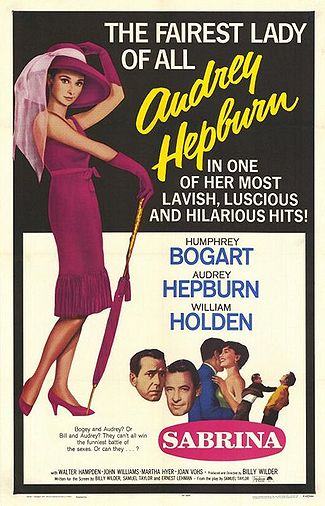
Sabrina (1954)

Starring Audrey Hepburn, Humphrey Bogart, and William Holden, with director Billy Wilder, the film begins with Sabrina (Hepburn) as a young girl. She lives with her father who is a chauffeur for a rich family. Sabrina loves the younger playboy son (Holden) however he gives her no serious attention. Depressed, Sabrina wants to kill herself and her father decides to send her off to culinary school in France. Some time passes and the grown up Sabrina is a perfect lady. Soon she catches the eye of Holden back home and all her dreams come true when they spend time together at a party. However, his older practical brother (Bogart) does not like it one bit since Holden has a fiancee. Wanting to get Sabrina away from his brother, Linus wines and dines her so the strategic wedding will stay on schedule. He then gives her a one way ticket and sends her off. Only afterward does he realize his own feelings for Sabrina and thus he decides to follow her. This film overall is a charming romance that is worth seeing.

4/5 Stars

The Caine Mutiny (1954)

With a stellar cast starring Humphrey Bogart, Van Johnson, Fred MacMurray, and Jose Ferrer among others, the film begins with a young ensign assigned to the mine sweeper named the Caine. After the first lax captain is reassigned, their new commander Queeg (Bogart) is a stickler for detail and order. After a series of incidents the crew becomes increasingly annoyed with him. The situation worsesn when Queeg begins to obsess about a few missing servings of strawberries. All these events boil over during a typhoon when the second-in-command (Johnson) prodded on, feels Queeg is unfit for command and he takes over control of the Caine. In the ensuing court martial, he is put on trial for mutiny and his attorney (Ferrer) must try to show Queeg to be truly unstable. Although he wins the case, everyone soon comes to realize Queeg was just a war-wearied man who gave a lot of himself. Despite some stark revelations the young ensign finally marries his girl and gets a pleasant surprise when he is reassigned to another boat.

4/5 Stars

The African Queen (1951)

1c3a0-the-african-queen-1With the ultimate pairing of Humphrey Bogart and Katharine Hepburn, this film throws together two starkly different people in extraordinary circumstances. Hepburn is a prim and proper missionary in Africa whose brother dies after a confrontation with German soldiers. Bogart is the rough-edged pilot of an old steamboat christened The African Queen. Together they take on the dangerous task of going down the river in order to sink a German ship. At first they are both at odds with each other and struggle to cope with their situation. However, with no one else to turn to, over time, they become close. Their bond is so great that they are willing to die rather than to be separated. This is truly a heartwarming story of love and loyalty with two legends who literally light up the screen.

5/5 Stars

In a Lonely Place (1950) – Film-Noir

Starring Humphrey Bogart and Gloria Grahame with direction by Nicholas Ray, the film is about a struggling screenwriter with a hot temper. Dixon Steele (Bogart) has not written a good script in a while but then one evening he has an enthusiastic young woman explain a novel he is supposed to adapt since he has not read it. Everything goes seemingly normal however the next morning she is dead and Steele is the main suspect. The police investigate, including Steele’s detective friend, but a neighbor gives an alibi which seems to save Steele. Soon Grahame begins to fall in love with him and vice versa. However, she soon realizes his violent side and second guesses Steele’s innocence since he has such a violent history. Although they are to be married it is broken off when he finds out she was going to leave. Only then does Grahame find out he was indeed innocent but the damage is already done and their relationship cannot be saved. This is a pretty good film noir with powerful characters.

4.5/5 Stars

The Treasure of The Sierra Madre (1948)

4d2bb-treasuremadrePutting Humphrey Bogart in his element once again, The Treasure of The Sierra Madre is another wonderful adventure film. Directed by John Huston, it tells the story of three men who join together in their search for an elusive treasure in Mexico. At the beginning, they are in good spirits eager to become wealthy. However, when they finally strike it rich they find it is not all it is cracked up to be . The situation escalates and they become paranoid of each other. Finally, Bogart’s character Dobbs is pushed over the edge and commits a malicious act out of desperation. Seemingly as an act of karma, he meets with another form of justice. However, it seems that by the end no one actually wins. A surprisingly good film, Sierra Madre takes your usual treasure hunt and realistically depicts man’s greed which often can overpower everything else. Bogart was supported nicely by Walter Huston (the father of the director) and Tim Holt.

5/5 Stars

The Maltese Falcon (1941) – Film-Noir

4ef67-falconmThis archetypal film-noir directed by John Huston, stars Humphrey Bogart as the detective Sam Spade. After an initial conversation with a mysterious woman, that same night two men end up dead. As Spade tries to understand what is going on, it puts him in contact with a paranoid little man and another man who is trailing him. All of them have something to do with a black bird and the situation gets more complicated when Spade meets the fat man. Rather surprisingly Spade ends up with the falcon but of course there has to be a twist. Soon enough the truth comes out of Brigid O’Shaughnessy and Spade coldly does his work. This film has great characters played by Mary Astor, Peter Lorre, Sidney Greenstreet, Ward Bond, and Elisha Cook Jr. The directing is good as well as the cinematography. This is the film that finally made Bogart a star and he would never look back.

5/5 Stars

Star of the Month: Humphrey Bogart

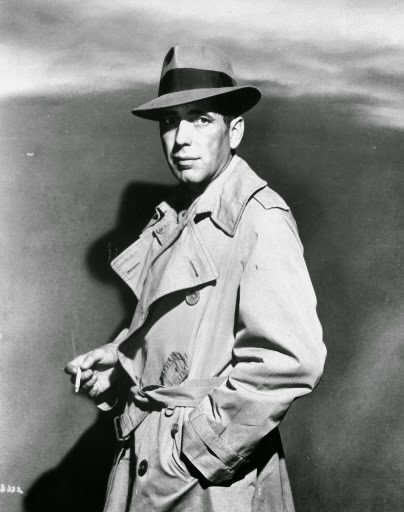
The man with the memorable speech impediment acquired from a WWI injury, Bogart began in the movies as a bit player in gangster films such as The Petrified Forest (1936) and Angels with Dirty Faces (1938). He finally made is major breakthrough as Sam Spade in The Maltese Falcon (1941) directed by John Huston, and from that point on he never looked back. He followed it up with his trademark performance as Rick Blaine in Casablanca (1942), then two Huston classics The Treasure of Sierra Madre (1948) and The African Queen (1951). The 1940s also saw the inception of his romantic pairing and eventual marriage to Lauren Bacall. They acted together in To Have and Have Not (1944), The Big Sleep (1946), Dark Passage (1947), and Key Largo (1948). Bogart continued to star in films in the 1950s including Sabrina and The Caine Mutiny before his death in 1957. He is undoubtedly one of the cultural legends of Hollywood with so many great film credits to his name. He could be a tough guy and a softie but he did it all with that iconic face and voice. Here’s looking at you Bogey.

Review: Casablanca (1942)

It was over 70 years ago that Casablanca hit the silver screen for the first time. All the main players are dead and gone now. The Golden Age of Hollywood, where pictures were being churned out with factory-like efficiency, has given way to a modern era of blockbusters. To borrow a quote from the movie, it doesn’t seem that one little film would “amount to a hill of beans” in our present world. Still, somehow Casablanca is beloved to this day, despite the numerous other films that have undoubtedly entered the black hole of film oblivion. It seemingly will not die and for good reason.

Considered one of the greatest films of all time, this well-loved classic deserves to be here. It is the hallmark of Humphrey Bogart and Ingrid Bergman’s careers. It also has one of the greatest scripts of all time, and it has achieved legendary status over the years. Many consider it purely the best film ever made and in all honesty, I would never try to refute that.

The film opens quickly and we are immersed in a world that is at the height of the Nazi terror, and many people are fleeing Europe by way of Casablanca. It is a treacherous place full of pickpockets, corrupt authorities, refugees, and naive tourists as well. Two German couriers have been murdered and some invaluable letters of transit have been stolen. That’s when we are first introduced to Rick’s Café Americain and its cynical proprietor Rick Blaine (Bogart).

A shady fellow named Ugarte (Peter Lorre) comes to Rick with the letters and asks Blaine to keep them for him. However, later that night Ugarte is taken into custody, and things begin to get even more complicated. Wanted resistance leader Victor Laszlo (Paul Henreid) is now in Casablanca, however, a Major Strasser has arrived from Germany to take him in. To top it off, Laszlo’s wife Ilsa (Bergman) was Blaine’s old flame in Paris and, needless to say, it didn’t end well.

Laszlo desperately needs the letters of transit to escape, and he inquires about them. Soon he is led to Blaine, but as Rick often admits he sticks his neck out for nobody. Knowing all too well that he is in danger, Laszlo still shows his defiance against his enemies by leading the people in a round of “La Marseillaise” and as a result, Rick’s is shut down.

All the memories of Paris begin flooding back, and then Ilsa confronts Rick in order to get the letters. This is possibly the most critical point in the film because this tense altercation ultimately renews the relationship between Rick and Ilsa. Rick asks her to trust him, and he begins to take things into his own hands. The results of his actions created one of the great romantic and cinematic moments in the history of film. The whole film leading up to this point hints at it, but Rick truly is a sentimentalist at heart. He can live with the notion that they will always have Paris and that leads him to commit a selfless act of love.

This film holds such a tremendous presence in movie history, and upon seeing the movie it makes complete sense what all the hype is about. What more could you want than Bogey, Bergman, Casablanca, and some of the greatest quotes ever uttered? Do not forget the corrupt, but nevertheless lovable French Captain Louis (Claude Rains), who delivers some terribly witty lines. Honestly, he may be my favorite character in the whole film, and that’s saying a lot!  Then, of course, there is the immortal tune of “As Time Goes By,” sung by Dooley Wilson which will forever be ingrained in film lore.

However, you also gain an appreciation for the other interesting characters of Casablanca, some comical, some sympathetic, and others despicable. We have a rogue gallery of everybody under the sun from Peter Lorre, Sidney Greenstreet, German soldiers, various guests, and all the staff at Rick’s Place. This movie has conflict and the uncertainty of war in practically every scene because at the time World War II was in full force. There are a broken romance and a forlorn hero who shows his courage in the end. As an audience, we come to realize the transformation of Rick into a truly great man. Ilsa on her part has the most radiant face I have ever seen.

It is wonderful that Casablanca succeeds as entertainment despite the fact that it is not modern. In fact, part of its charm is the black-and-white cinematography that helps make Rick’s Café so atmospheric. It effectively makes each interior shot moodi34 and every romantic scene even more striking. I am very doubtful that they would ever be able to pull this film off in color. It just wouldn’t work.

You do not need explosions and violence either, only great characters and a story with both drama and humor to reel the audience in. Up until the final moments of the movie you are captivated the entire time. Then, fittingly, you are left with the two men walking off into the night with the words, “Louis, I think this is the beginning of a beautiful friendship.”

In fact, with this film, my thoughts always go back to the script. Lines like “Here’s looking at you kid,” “We’ll always have Paris,” and “Round up the usual suspects” are so rampant that you cannot possibly remember them all, and I doubt there will ever be another film that is so immersed in American cultural lexicon. Still, many of my favorite lines in the film are those that get overshadowed by the more famous ones. That is the sign of an amazing film that never grows old. Even those who have not seen this classic film like to think they have, because the influence of Casablanca reaches everywhere. I guess I’m rather an idealist myself, so I would like to think that even if 70 more years pass, we’ll always have Casablanca.

Casablanca (1942)


Considered one of the greatest films of all-time, this well-loved classic deserves to be here. It is the hallmark of Humphrey Bogart and Ingrid Bergman’s careers. It has one of the greatest scripts of all time, and it has achieved legendary status over the years. Many consider it purely the best film ever made and in all honesty, I would never try to refute that.
The film opens quickly, and we are immersed in a world that is at the height of the Nazi terror, and many people are fleeing Europe by way of Casablanca. It is a treacherous place full of pickpockets, corrupt authorities, refugees, and some tourists as well. Two German couriers have been murdered, and some invaluable letters of transit have been stolen. That’s when we are first introduced to Rick’s Café Americain along with its cynical proprietor Rick Blaine (Bogart). A shady fellow named Ugarte (Peter Lorre) comes to him with the letters and asks Blaine to keep them for him. However, later that night Ugarte is taken into custody and things get even more complicated. 

Wanted resistance leader Victor Laszlo (Paul Henreid) is now in Casablanca, however, a Major Strasser (Conrad Veidt) has arrived from Germany to take him in. To top it off Laszlo’s wife Ilsa (Bergman) was Blaine’s old flame in Paris and it didn’t end well. Laszlo desperately needs the letters of transit to escape and he inquires about them. Soon he is led to Blaine but as he often admits Rick sticks his neck out for nobody. Laszlo shows his defiance against his enemies by leading the people in a round of “La Marseillaise” and as a result, Rick’s is shut down. 

All the memories of Paris begin flooding back, and then Ilsa confronts Rick in order to get the letters. This is possibly the most critical point in the film because the tense altercation ultimately renews the relationship between Rick and Ilsa. Rick asks her to trust him and he begins to take things into his own hands. The results of his actions created one of the great romantic and cinematic moments in the history of film. The whole film leading up to this point hints at it, but Rick truly is a sentimentalist at heart. He can live with the notion that they will always have Paris and that leads him to commit a selfless act of love.
This film holds such a tremendous presence in movie history it is quite extraordinary. Upon seeing the movie it made complete sense what all the hype was about. What more could you want than Bogey, Bergman, Casablanca, and some of the greatest quotes ever said? Do not forget the French Captain Louis played by Claude Rains or the immortal tune of As Time Goes By sung by Dooley Wilson. However, you also gain an appreciation for the other interesting characters of Casablanca, some comical, some sympathetic, and others mysterious. We have a rogue gallery of everybody under the sun from Peter Lorre, Sidney Greenstreet, German soldiers, various guests, and all the staff at Rick’s place. 

This movie has conflict and the uncertainty of war practically in every scene because at the time World War II was in full force. There are a broken romance and a forlorn hero who shows his courage in the end. As an audience, we realize the transformation of Rick into a truly great man. Ilsa, on her part, has the most radiant face I have ever seen! If you take into consideration when this movie was made, it truly is wonderful to watch. You do not need explosions and violence, only great characters and a story with both drama and humor. Up until the final moments of the movie you are captivated the entire time. Then, fittingly you are left with the two men walking off into the night with the words, “Louis I think this is the beginning of a beautiful friendship.”

 In fact, with this film, my thoughts always go back to the script. Lines like “Here’s looking at you kid,” “We’ll always have Paris,” and “Round up the usual suspects” are so rampant that you cannot possibly remember them all, and I doubt there will ever be another film that is so entrenched in American culture. Many of my favorite lines in the film are those that get overshadowed by the more famous ones. That is the sign of an amazing film that never grows old. Even those who have not seen this classic film like to think they have because the influence of Casablanca reaches everywhere.

5/5 Stars