The Young Girls of Rochefort (1967)

rochefort1If the Umbrellas of Cherbourg is a piercing operatic drama, The Young Girls of Rochefort is pure, unadulterated escapism at its finest. 

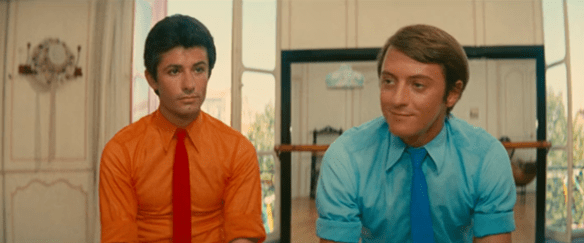
Directed by Jacques Demy and starring an ensemble cast including Catherine Deneuve, Francois Dorleac, Gene Kelly, Michel Piccoli, George Chakiris, Grover Paul, and Danielle Darrieux, this is a whimsical French musical that has no equal. 
rochefort9

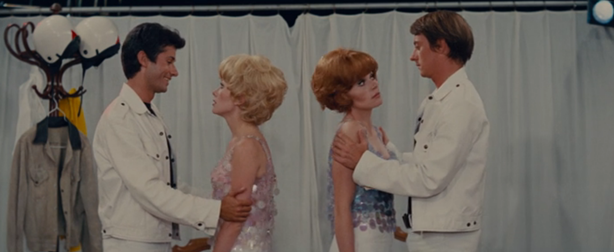
The film opens with a group of performers coming into the town of Rochefort to get ready for a big outdoor show. They become acquainted with the local hangout that includes a kindly matron (Darrieux) and many locals including an idealistic artist and sailor who is searching for his ideal lover. Nearby her two adult twin daughters hold piano and ballet lessons as they too get their little prodigies ready for the big show. Delphine (Deneuve) is fed up with her suitor and desires a new love, while Solange (Dorleac) on her part hopes to advance her career as a pianist. She goes to the proprietor of a local music store to see if he can introduce her to a prestigious American Friend.

A great deal of dramatic irony sets in and the plot is constantly moved forward through song. Yvonne at the café is still depressed over a split with a lover 10 years prior, because he had an unfortunate name. Solange has a chance encounter while stopping to pick up her kid brother Booboo, and Delphine becomes curious about an artist who painted a portrait that looks strikingly like her. All of these events reach their apex on the Sunday of the big performance, and in need of some performer, the carnies enlist the help of the twins. They are a huge success and things wind down.
rochefort4

The next morning the performers get ready to leave for Paris and the girls decide to follow suit. However, Solange has another encounter that changes her plans and then Yvonne is united with her love. That leaves only Delphine to go with the boys to Paris, but not to worry, she would be united with her painter soon enough.

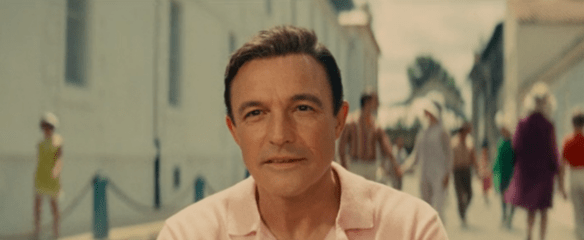
The light and very French-sounding tunes are hard not to like, but that is only the very beginning. Demy pays homage to Hollywood musicals of old going so far as casting Gene Kelly (Singin’ in the Rain) and George Chakiris (West Side Story) in his film. He undoubtedly owes a debt to Vincente Minnelli and Stanley Donen with some striking moments reminiscent of An American in Paris (1951). It makes sense. Demy uses the pastels and costumes of a Hollywood musical extravaganza while also including dashes of French style.
rochefort2

Rochefort takes place in a real location, but it truly is a fantasy world that the characters inhabit, full of perpetual dancing and dialogue that is delivered through song. The real-life sisters do a wonderful job in this film and there is something reassuring about seeing Gene Kelly. Rather like an old friend who gives comfort in a whimsical, but altogether new experience. The story arc of dashed, renewed, and ultimately newfound love allows Demy to once more explore the issues of fate and chance that always seem to enchant him.  His partnership with Michel Legrand is once again bountiful including the enduringly memorable “Chanson Des Jumelles,” an infectiously bouncy, trumpet-laden number performed by the sisters.

There’s nothing much else for me to say except The Young Girls of Rochefort is one of those underappreciated gems that is thoroughly enjoyable and chock full of all sorts of fun. It delivers a serving of something with a familiar flavor while giving it a little extra panache. It’s about as playful and fluffy as you can get which in this case is not a bad thing at all. 

4.5/5 Stars

Shall We Dance? (1996)

shallwedance1Shall We Dance is a film with important ties to American culture such as the King and I and The Drifters, but it has far more important roots in its native Japan. Thus, its remake starring Richard Gere and Jennifer Lopez undoubtedly loses some of the cultural significance of the original film.

Because Japan is a nation of etiquette, good manners, and the like. They act as a whole society, not as individuals. They care about honor, modesty, and how others will perceive them. They work hard for long hours. Men bring home the bacon and wives faithfully serve their husbands and families. Ballroom dancing in a culture like that is about as compatible as oil and water. Men and women are not to show affection — sensing it instead — and holding hands or saying “I love you” is out of the question. Thus, a mode of expression where men and women are meant to be so close and intimate has a stigma attached to it.

When a seemingly successful businessman, Mr Sugiyama (Koji Yakusho) spies a girl in the window of a dance studio, he has no intention of learning the art form. All he wants is to get close to this mysterious beauty. Of course, he has a wife, a daughter, and a good job, but he feels trapped in his life. He has nothing to give him joy, nothing to make him feel alive, just the monotonous rhythms of office life.

shallwedance2In fact, his first jaunts in the dance studio are rather comical, because his ineptness is magnified by his two classmates, one rather rotund and the other short and squat. It’s as if he’s learning to dance with Laurel and Hardy by his side. In fact, a great many characters have tremendous personality on the whole. Ms. Tamura is Shohei’s sagely teacher, who constantly builds him up with encouragement. Mr. Aoki is one of the work colleagues, who also moonlights an extravagant aficionado of the rumba. They are only a few in a vast company of supporting players.

But of course, this is a sort of faux-love story. Think Ginger Rogers and Fred Astaire and you get the idea. Except in the Japanese society, the only place you dare talk about dance is in the men’s room with no one around. Stripping away everything else this film is about finding self-expression, especially in a society that has a complex relationship with such an idea. Mr. Sugiyama eventually revels in his chance to dance, practicing steps on the platform waiting for the subway, improving his posture in the rain, or even conspicuously tapping his feet on the ride home.

Mai the beautiful object of his desire is aloof, with glassy eyes, and often feels like the antithesis of Japanese women in many ways. She is strong, straightforward, and physically imposing in a graceful way. As an audience we know essentially the road this film will traverse. Mr. Sugiyama must go through a transformation just as Mai must because they are not the same two people we first met looking out from their prospective windows.

shallwedance3What became most interesting to me was this idea of the affair. Mr. Sugiyama’s wife feels like she has been cheated on and her husband agrees with her openly. However, as an American audience, we look at this plotline and see no sex or anything like that. In essence, it depends on how you define an “affair.” For instance, if we look through the lens of an Astaire & Rogers film, their musical comedies were romances, but they could never show characters sleeping together due to the production codes. So the evolution of a relationship had to be illustrated through dance – the courtship, the conflict, and ultimately the passion. Perhaps Shall We Dance is a little different, but if we look at dance in this symbolic way, this was a film about an affair.

More importantly, however, it is a film about reconciliation, self-expression, and really breaking out of the status quo. Those are themes that ring true, although they might be easier to swallow in an American society.

4/5 Stars

The Battle of Algiers (1966)

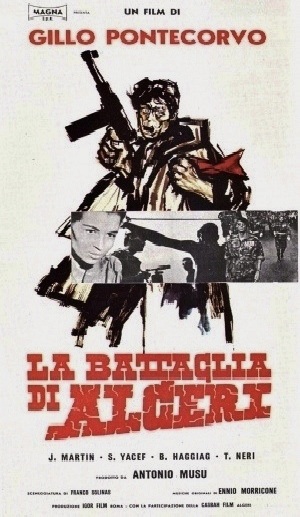
The_Battle_of_Algiers_posterBeing rather oblivious to the relations between France and Algeria as well as the battle of Algiers, this documentary-style film proved to be an enlightening and thoroughly engaging historical exercise. I certainly cannot corroborate all the facts, but the reality is, The Battle of Algiers is one of the most well-paced films that I have ever seen coming out of Europe. There is a great deal of drama, harrowing intensity, and it all brings up numerous political questions that parallel the world we live in even to this day.

It’s the story of 1950s Algeria and specifically the Casbah Muslim district of the city. It is there between 1954 to 1957 that the National Liberation Front waged war against their perceived oppressors from France. And they certainly had a point that imperialism has left an indelible mark on them. However, their own strategies include bombings and assassination that utilize civilians and people loyal to the front. You don’t know when the next attack will come, and they sweep across the land like wildfire. The leaders of the FLN include the fiery Ali la Pointe and El-hadi Jafar, who recruited la Pointe early on. A Lieutenant Colonel named Mathieu is brought in to bring down the enemy, but it proves to be a difficult task since the FLN, much like a tapeworm, will never die until the head is destroyed. Otherwise, it’s extremities will keep rebuilding in the form of loyal underlings.

The film is rather shocking in its straightforward depiction of violence, whether it be bombed buildings, gunfights in the streets, or French authorities being gunned down by insurgents. Somehow these images feel still very relevant to the contemporary age. You have the imperialists clashing horns with the locals. There’s racial profiling. Women and children are involved in the violence just as much as anyone else, and destruction pervades the public squares. There is no refuge from bomb or evil. Anyone coming around a corner could be carrying a bomb or looking to shoot you when you least expect it. Really it is amazing that a film like this was even made, and it was undoubtedly a lightning rod for controversy.

In the film’s epilogue, the unrest continues and it is finally noted that Algeria did eventually receive their independence. The French may have won the battle, but they ultimately lost the war. The audience is left to develop their own opinions about this conclusion. As for me, I find Gillo Pontecorvo’s film fascinating, because he takes a point of view that does not seem especially biased. This is not noticeably propaganda in its depiction, but instead, it is a thought-provoking document of civil unrest developing questions on war and race relations. Maybe we can even learn something from it as well in this modern age that still includes so much human conflict.

5/5 Stars

L’Atalante (1934)

LatalanteHere is perhaps one of the greatest wedding processions we could ever hope to see. Buster Keaton is more outrageously funny in Seven Chances, but this one is solemn, and somehow still funny in its own way. And that’s what is most striking about L’Atalante (which also serves as the name of the boat of choice). This film seems so serious and strait-laced, you might say, and yet it brims with comedy. It’s the type of everyday comedy that makes us laugh even now. Funny looking characters, odd voices, a plethora of cats all over the place. There’s no way for that to get lost in translation, and it remains quirky and engaging 80 years later.

It also happens to be a beautiful film exemplified by a newly-wedded bride walking the prow of a boat with the fog billowing around her. Or perhaps it’s two lovers embracing passionately and a smile bursting on the face of the woman. It’s so visceral, so engaging in its displays of love, energy, and emotion. In this way, it brings to mind other love stories of the age like Sunrise, It Happened One Night, and certainly the early works of Jean Renoir. Except the thing here is that director Jean Vigo never made another film after L’Atalante. He entered bad health even during filming and died soon afterward in his early 30s, but he left behind a masterpiece.

In short, the story revolves around four main characters living life together on a boat named L’Atalante. Jean is the captain and groom who has picked a beautiful wife named Juliette who is going to share his existence on the sea. His first mate is the weathered and scruffy Pere Jules. He might have a rough exterior, but he and his cabin boy are full of bumbling and buffoonery that endears them to all.

For the two lovebirds, Paris is the enchanting destination for a fantastic makeshift honeymoon, but it also proves to test their relationship from the get-go, since Jean is extremely jealous and a street peddler openly flirts with Juliette. It’s a tragic turn in their love story which leads to Juliette looking for a way home and Jean sinking into a state of depression aboard his boat. That’s what makes their ultimate reunion all the sweeter.

Thus, L’Atalante blends a timeless topic like love with little moments of magic that bubble up from within these scenes. Whether it is Juliette walking the streets window shopping, or Pere Jules giving a lens into his past with all the souvenirs he has accrued over the years. Without a doubt, he was my favorite character. I have never quite seen anything like him.

4.5/5 Stars

Through a Glass Darkly (1961)

througha2There is so much that could be talked about with Through a Glass Darkly, but I feel the need to point out the more obvious, to begin with. Ingmar Bergman, in retrospect, envisioned this film as the first installment in his 1960s trilogy. As such, the film is a chamber piece that takes place entirely on a single island with only four main players. It lets go of some of the symbolism of many of Bergman’s films, but it still surges with religious content that reflects Bergman’s own background and spiritual conflict.

Through a Glass Darkly is one translation of 1 Corinthians 13, essentially suggesting that at the present time we only get a poor reflection of what is to come. In other words, we cannot fully understand the ways of the world and the ways of God. But how does this theme relate to the film you ask? That’s what I wanted to know as well.

At a basic level, this is yet another story about family and interpersonal relationships. Karin is staying on an island with her husband Martin (Max von Sydow), her father David (Gunnar Bjornstad) who is an author, and her baby brother Minus. She recently was released from a hospital for schizophrenic-like symptoms while her father has recently returned from Switzerland trying to combat a fierce case of writer’s block.

In a day’s time, these four individuals try to parse through all that is going on. Though they initially attempt to shroud it with morning swims and silly stage productions, they cannot completely disregard their reality.

througha3Minus feels he is lacking love and affection. He feels like his sister makes fun of him while his father is aloof and withdrawn from his life. Meanwhile, David is grief-stricken in private, realizing that his daughter’s condition is incurable and yet he also regrets his morbid fascination with it. David tries to cope with his wife’s condition, but although she seemed jovial and fine at first, Karin’s situation begins to decline.
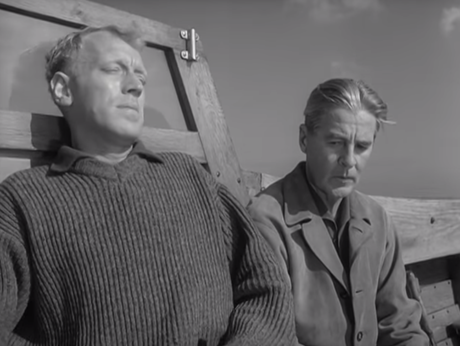
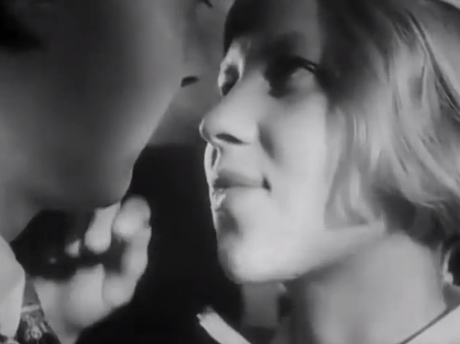
She hallucinates, speaks of going through the walls, and faints. Matters are made worse when the voices in her head tell her to go through her father’s diary. There she reads about his thoughts on her and her “incurable” state. When they take a boating outing Martin asks his father-in-law about what he wrote on the request of Karin, and they get into a discussion. As Martin surmises he seems to be a man with all the right words, but no clue about life itself, and David does not try and object.

Back on the island Minus is with his sister, who confides in him about the voices, and when a storm hits she hides dejectedly in the hull of a boat. Minus follows soon after along with his father. They send for an ambulance to fetch Karin and in a penultimate moment, she speaks candidly with her father one last time before she is to be taken to the hospital. In these final moments she goes up to the attic and while being observed by her husband and father, Karin, breaks into hysterical fits. The visions she has seen are obviously too horrible to bear

througha5This is a film about brothers, sisters, husbands, wives, fathers, and daughters. All revolving around four characters wrapped up and intertwined in this complex spider web of relationships. The spiritual content is great and there is also a lot of minutiae in Through a Glass Darkly. It shares some of the same mind-bending moments as Persona (1966) and yet this film felt even more personal if that is possible. As the title suggests and David even tells his son, we cannot fully understand what is happening, but we can be certain that someday we will know if only we grasp hold of love and the love that God has for his people.

Ingmar Bergman’s type of film-making seems foreign to us now and I don’t mean simply since it’s Swedish, but due to the fact that it is so connected to issues of spirituality and deep questions of faith and love. He cannot and will not allow his work to be cut and dry, because he cares about delving into the human condition. And that condition by default is chock full of ambiguity and complexity. Through a Glass Darkly. The title fits aptly indeed.

4.5/5 Stars

People on Sunday (1930)

peopleonsunday1One of the last German silent films was People on Sunday, a modest project from a group of young men. Our stars are young professionals in real life and only amateur actors who did not quit their day jobs. They only could film on the weekends and that’s how we end up with People on Sunday! It takes on a faux-documentary style, and it follows the lives of four individuals as they meet one another and then spend a pleasant Sunday afternoon together.

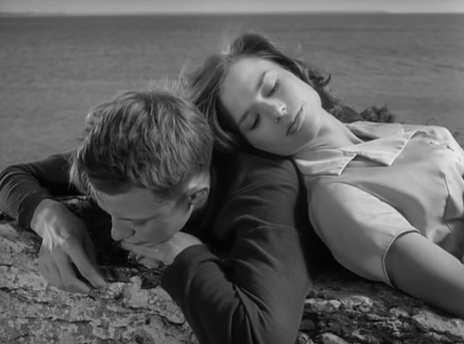
There is certainly a breezy playfulness to the film as the two men and two women spend time frolicking at the beach and reclining in the sun. They share laughs while eating and listening to records. It quality fun and there seems to be a general innocence to their behavior that while sometimes rude is all in good fun.

This is, in fact, a film of the late Weimar Republic, without the cloud of Hitler’s Nazi regime hanging over the country (not until 1933). It stands in sharp contrast to later works or documentaries because People on Sunday is seemingly free and wholly unrestrained by ideology or prejudice.

We should undoubtedly be grateful for this historical piece of New Objectivity cinema and the reasons are twofold. First, since the film essentially works as a documentary, it gives us a wonderfully clear picture of what life was like in the world of Berlin. There are continuous shots of the city streets, passing vehicles, and people making their daily rounds.

One especially memorable moment occurs when the story takes a short aside to afford time for a montage of faces. The camera slowly captures face after face providing a sample of all the individuals who walk these streets. They transcend time and space because of their humanity, their mundane quality, and they have the same lightness of our main characters.

When we look at the names behind People on Sunday, it is almost staggering to acknowledge these men who were formerly unknowns.

As directors, you have Robert and Curt Siodmak. Your main writer is the great Billy Wilder. As cinematographer, you have another great in Fred Zinnemann, and finally, production was helped by the B-picture master Edgar Ulmer. Due to the rise of the Nazis, all of these figures would end up emigrating to Hollywood and the rest was history.

In many ways, we are indebted to them, because they helped form some of the great American classics and you can already see them honing their craft. The images are visually arresting and there is even a sense of humor that we could seemingly attribute to Wilder. It would only get better from then on.

If I’m not mistaken there are several scores that have been used to accompany the film, but I did really enjoy the Czech film orchestra because it added a lot to this otherwise silent picture. Hope you enjoy this unassuming jaunt as much as I did.

4/5 Stars

Review: Breathless (1960)

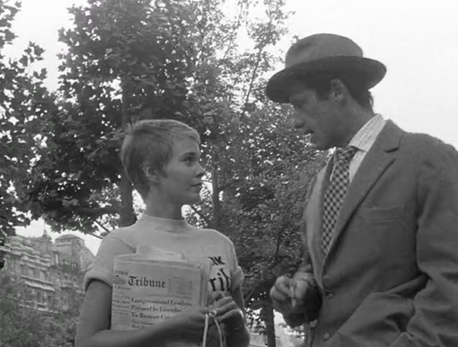
breathless2Breathless is such a fresh, smooth piece of cinema that feels as cool now as it was back then. The transcontinental French vibe paired with the revolutionary production is strangely still appealing. It does so many things with such style that is always unique but never quite off-putting. Not to mention the score which is playful in an elegant sort of way. The film has an array of quick cuts, it’s discontinuous, abrupt, and it literally jumps between images. Actions, like shooting a cop or sitting in a room with a girl, become more interesting than we could ever give them credit for.

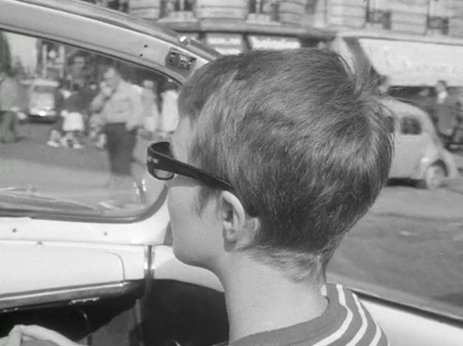
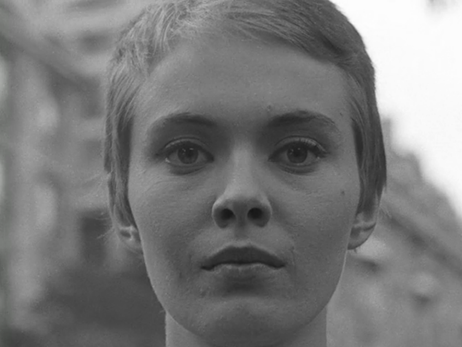
Godard is known for saying that all you need for a film is a girl and a gun and that’s basically all Breathless is. Michel (Jean-Pierre Belmondo) is a low down, no good hood who also happens to be quite funny at times. He shoots a cop for no good reason and after that, the police are after him on the streets of Paris.breathless5He’s also broke and all his buddies are either unavailable or in some trouble of their own. He swipes money from one girl and rendezvous with his latest fling, the aspiring American journalist Patricia (Jean Seberg). They do very little except drive around the city or lounge around her room. In one memorable shot, jump cuts piece together scenes of the back of Patricia’s head as she sits in the passenger seat observing the world around her pass by.

Michel, on his part, seems only to want sex and yet he says he’s never loved a girl before. He’s continually drawn to Patricia, and he never can quite pull himself away.

She, meanwhile, has another man with an eye on her, and she hopes to propel her fledgling journalism career. Her one assignment happens to be interviewing the highly philosophical and somewhat pompous Mr. Parvulesco (Jean-Pierre Melville).breathless10The billboards around town even foreshadow the impending doom of Michel. Patricia later learns from the police that her lover is wanted for murder, and she must decide what to do about it. In a memorable scene, Patricia is shown pacing around the room in a wide circle. In the end, she does turn in the hood to prove to herself that she doesn’t truly love him.

Michel looks utterly pitiful, like a wounded deer after he gets winged by the police and collapses in the middle of a quiet avenue. Patricia stares straight at the camera giving the queerest of looks as Michel breathes his last. If you wanted narrative clarity you’re definitely looking in the wrong place.

breathless9In some ways, Jean Seberg’s iconic look reminds me a young Audrey Hepburn another gamine glamour girl. The photography of Seberg is iconic from the reflection in her sunglasses to her donning Michel’s hat. Breathless proves film is not just entertainment, but it can also be lastingly stylish. There’s nothing wrong with that, and it still seems to work after over 50 years. Honestly, when I was starting out, Breathless helped open up all of European cinema to me and for that, I am indebted to Godard and The French New Wave.

4.5/5 Stars

Purple Noon (1960)

purplenoon4Right off the bat, there are two things that stick out about Purple Noon. First, you cannot help to notice the colors because the blues and reds pop like some vibrant 1960s painting. Then there’s Alain Delon who at the age of 23 made his rise to stardom, thanks to this film and Rocco and his Brothers (1960). As Tom Ripley, he finds a role that is fascinating in more ways than one.

During the first interludes of Rene Clement’s thriller, based on the Patricia Highsmith novel, I didn’t really know what I was watching or what to think. Tom was sent to Italy to bring the wealthy Phillipe Greenleaf back to San Francisco at the wishes of the man’s father who is paying Ripley. Their story begins as an entertaining jaunt through the city. They lounge at cafes, take carriage rides, and generally have fun living it up at night.

Tom is nothing like Greenleaf. He’s far poorer coming from a humbler background, but he is also much more resourceful and clever. When he takes a trip with the wealthy young man aboard his yacht, he finally hatches a plan to get what he wants. He abruptly stabs Greenleaf during a game of cards and the whole trajectory of the film changes in an instant. It began playfully absurd and quickly switches gears as a thriller involving murder, stolen identity, and deception.

purplenoon5

He plays up the tiff between Greenleaf and his girlfriend Marge, telling her that he is still angry and so he went off somewhere else without her. Thus, begins Ripley’s transformation into Greenleaf, forging a passport and signatures until he can pass off as the man himself. He starts dressing differently, spending more money, and continually acting as if he actually is Greenleaf. But things get difficult when he nearly runs into folks he knows, and Marge is desperate to know where her love is. These all prove problematic and yet Ripley skirts most of these entanglements with relative ease. It’s when a friend of Greenleaf’s named Freddie Miles figures out his charade that things begin to escalate because Tom’s only option seems to be murder. He commits the act coolly and plans his next move with calculated ease.

The police are after a murder, but it looks as if Tom has tied up all the loose ends and we find him relaxing reclined on the beach. He doesn’t know that the game is up, because of what the police found at sea.

The visuals of this film definitely do justice to the young Delon who is strikingly handsome with piercing eyes, but his turn is interesting in its own right because he was always so adept at playing the coolest of characters. He’s no different here and Purple Noon proved to be the initial boost to his storied career.

4/5 Stars

Late Spring (1949)

latespring1Late Spring is a film that I found in some ways more rewarding than Tokyo Story, another acclaimed classic from Yasujiro Ozu. Both films share a few of his trademarks. They are home dramas with basic, everyday plots, termed Shomin-geki. Also exhibited are a stationary camera and low camera angles that Ozu often used to focus on his characters while sitting. In this way, he invented the quintessentially Japanese viewpoint known as the “tatami shot.” We see it most certainly in Late Spring as the daughter Noriko interacts with her widowed father or when they have friends over in their home. It may look somewhat similar to Tokyo Story, but it does differ in subject matter.

Late Spring is a film about fathers and daughters. Marriage and divorce. All the things that make up a life that remain the same whether you’re in modern America or post-war Japan. Noriko is a pretty young woman who is devoted to her aging father through thick and thin. He likes having her around and she likes being there for him.

It’s the culture, namely aunts and friends, who tell Norkio that she must get married. She’s 27 years old, and she needs to find a husband before it’s too late. Her father won’t be around forever. She’ll need to make a new life for herself. But Noriko is content with not listening to the voices trying to sway her. Only when her father talks to her about marriage does she finally begin to listen. He makes conversation about getting remarried and encourages her to think about an arranged marriage that her aunt has waiting for her.

We never meet this man who supposedly looks like Gary Cooper, but Noriko seems to genuinely like him. And yet there still is something that isn’t quite right. In Japan there is great importance in “reading the air,” and it seems like some of the characters in Ozu’s film fail at this or they see only what they want to see.

latespring3In the end, Noriko gets married and it should be no surprise because it was what was ultimately expected of her. Her father, on the other hand, acknowledges to a friend that he had no intention of getting remarried, it was only to prompt Noriko. Professor Somiya took on a great sacrifice in the eyes of society and goes home alone.

This is a bittersweet tale that is surprisingly funny on many occasions, but it is also topped off with human tragedy. Not death or dying, but something potentially worse in loneliness and discontentment. It is only a thought, but it seems like Noriko and her father would have both been happy with the status quo. However, their sensibilities and society said otherwise, so they acted as they were expected to. From this simple drama comes one of the most powerful films on father-daughter relationships ever.

I must admit, at first, I really was not fond of Chishu Ryu’s character, but over the course of the story, he grew on me. As for Setsuko Hara, she is an amazing example of kindness and servility, but also the undisputed muse of Yasujiro Ozu.  Late Spring also plays off the conflict between the old and new not to mention the traditional Japan and western culture. It’s not a blatant presence, but the allusion to Coca-Cola and Gary Cooper reminds us that this is a post-war Japan still recuperating from an awful war. That’s the backdrop of this film and its part of what makes Ozu’s human drama all the more striking. Despite, where it is situated in the historical context, Late Spring is a timeless film giving calculated insight into human relationships.

4.5/5 Stars

Donkey Skin (1970)

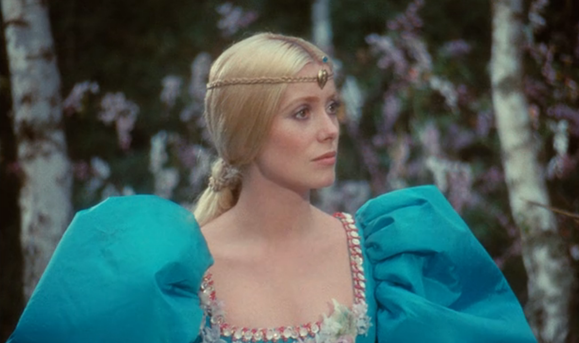
donkeyskin1Donkey Skin takes the unique world of Jacques Demy and steps it up a couple of notches. The story is based off a fairy tale and brims with all the necessary trappings accented by the French director’s own flourishes.

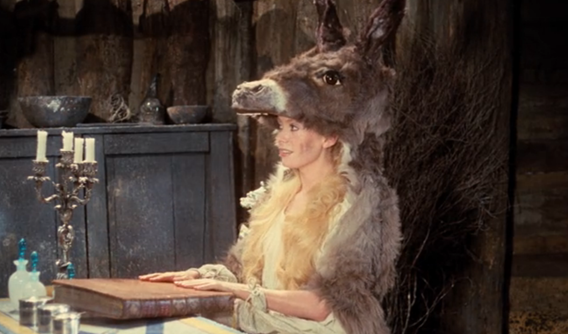
Once again the music is supplied by Michel Legrand and the songs are a mix of playfully fun and sometimes solemn songs that help dictate the path the story takes. As far as the tale itself goes, it revolves around a beautiful princess who sends herself into a forced exile wearing a donkey skin. It all sounds rather odd, but she is given the idea from her fairy godmother, in order to keep her father from marrying the princess.

The world is a fanciful array of gaudy fake interiors, blue people, red horses, a treasure-dropping donkey, oddly-masked creatures, a talking parrot, princesses, princes, and some rather alarming potential incest. This is no Disney endeavor by any means and its bright colors often call to mind Hippy culture.

donkeyskin2Into this land, the princess flees covered in her donkey skin and takes on the lowly role of a scullery maid where she is belittled and looked down upon. However, a glum young prince happens upon her in all her beauty and wants nothing more than to marry her. In fact, he plays sick just so he can be with his gorgeous vision. Instead of Cinderella’s slipper, this story deals with a ring which is only to fit the finger of his true love. A whole to do is made out of it with people coming from far and wide. However, the prince already knows who he wishes to wear it, after all, it came in a cake that Donkey Skin baked for him.

In the end, this fairy tale receives the happy denouement that is expected with plenty of riches and love for all. The film used simple but nonetheless mesmerizing special effects that add a touch of magic to this tale. It also gets bookended by some obligatory narration concluding an enchanting fairy story fit for children, mothers, grandmas and anyone else who is willing to partake. Although not as memorable as his earlier musicals, it seems that Donkey Skin sees Jacques Demy at his fully realized creative powers in a way that is uniquely his and fits with many of the trademarks he developed earlier. Furthermore, Catherine Deneuve proved that she is beautiful even wearing a donkey skin hoodie. It’s hard to say no to a movie with her in it, no matter the topic.

3.5/5 Stars