Nosferatu (1922)

nosferatu1The hand of F.W. Murnau is less noticeable in this early classic of his, but Nosferatu still works seamlessly as a piece of drama and horror. In fact, it by now has become somewhat of a horror classic and the archetype when it comes to vampire movies, taking a lot of inspiration from Bram Stoker’s Dracula. I think one of the things that makes Nosferatu so gripping is the fact that it mixes the plausible with the supernatural making for this weirdly rewarding ride. Is it scary? No, not in the modern sense of the word.

But it’s a story steeped in Myth. There is mention of the Black Death, supernatural creatures, and a being that “suckles himself on the hellish elixir of their blood.” What wonderful imagery that develops a genuine awe in this devilish being. And yet in the same instance, we’re getting scientific explanations of venus fly traps and tentacled polyps acting as symbols certainly but also tying us back to the real world. These forces of nature are real, backed by science, and make a vampire just a little more conceivable.

Running through Nosferatu is a love story, and much like Sunrise, although Nosferatu is a “symphony of horror,” there is also a bit of a love song underlying the vampire tale. It lends this story some heart, because these characters, like our protagonist Hutter, actually have something to live for.

Nosferatu most certainly is a symphony, and along with the expressionistic images, it uses title cards as well as excerpts from ship logs, books, and letters to tell the story. One such inter-title card from Count Orlock reads: Your wife has a lovely neck. Hutter has little idea what he means (or pretends not to), but we know, making it a rather funny but unnerving comment. There’s something about knowing what is undoubtedly going to happen and being powerless to stop it. For instance, when someone acknowledges they have two mosquitoes bites quite close together that spells trouble to the audience, but we can only watch and wait.
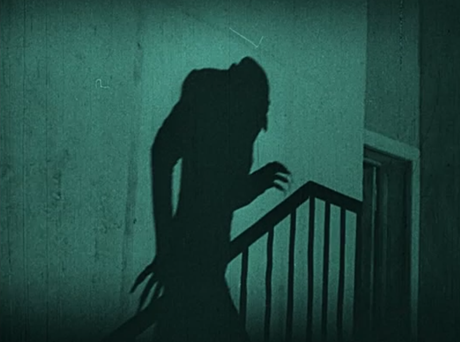
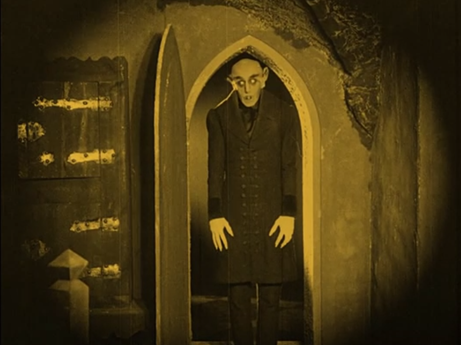
nosferatu2Because when Hutter first goes to offer Count Orlock a house we know it is bad news, to begin with, but it takes a long time for anything to actually happen. Orlock moves into the abandoned mansion across from Hutter and his wife, and that’s when the danger strikes close to home. There’s a madman in the hospital diverting attention, and Hutter winds up incapacitated so he is incapable of coming to the aid of his love. She is left vulnerable and the vampire has already proven what havoc he can wreak with the crew on a ship. Aside from Max Schreck’s frightening facade complete with pointy ears, bulging eyes, and menacing fingers, the vampire literally appears and disappears into thin air. There is a haunting aura built around him because he is something supernatural, something that we cannot understand except through myth. I found myself getting tense waiting for something that I was not sure about. That was the exciting part. It’s not a blood and guts, monsters jumping out of closets, kind of horror. It’s not ridden with cliches either because it was the one creating its own mystique.

It’s hard to believe how much popular culture has been derivative from Stoker’s Dracula, much like Doyle’s Sherlock Holmes, or Shelley’s Frankenstein. However, amidst all the vast works of Dracula and vampires, Nosferatu stands out. It represents the visual aesthetic of German Expression wonderfully, and it casts a long shadow. It’s hard not to, at the very least, admire its artistry and be taken aback by its legacy. In the realm of silent films, Nosferatu is a must, pure and simple. It doesn’t rely on bloodcurdling shrieks and screams, but the images begin to invade our consciousness. One seems fleeting and the other sticks with us.

4.5/5 Stars
Commissar (1967)

commissar1

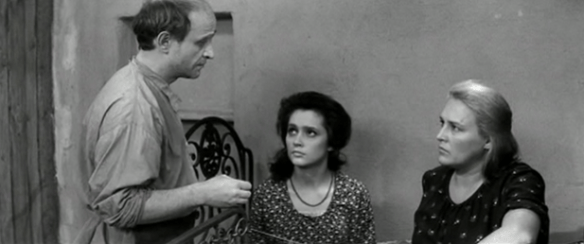
Even with the so-called Khrushchev Thaw, it’s pretty amazing that Commissar even got made and perhaps even more astounding that it made it to the viewer all these years later. Some of that might be because it originated from Russian Civil War literature and anything else we can attribute to luck.

It is, as it titles suggests, about a commissar: an official of the Communist party, but this one seems special. First of all, she’s a woman which in itself is an interesting piece of commentary, but perhaps more so is the transformation she goes through.

From the outset, she is what we conjure up in our minds. Brutal, tough as nails, masculinized and mechanized by the collectivist agenda of the party. She’s the perfect comrade cog in the communist machine. Except then she receives the startling news that she is pregnant, and she must seek refuge in the home of a nearby Jewish clan. They are forced to quarter her, serving the greater good. She’s aloof to the whole idea and their diminutive patriarch puts up a fuss.

You see, he already has five children, a wife, and a mother to look after. He can’t afford to have this unwanted extra baggage, and she’s no friend of theirs. In this sense, the film feels reminiscent of Melville’s Silence de la mer. However, Commissar evolves into its own creature, just as all parties involved change over time. Yefim and his wife make their guest comfortable the best they know how and following the pregnancy they take good care of her.

Seeing her with a newborn is an altogether strange and foreign image, and with the cult of motherhood, the commissar’s whole demeanor shifts. She looks on at this family with contented eyes and stares back at her former life with some reluctance. It seems impossible to traverse the same paths she once did.

Perhaps most frightening are the images that are interwoven into the plot. They are disorienting, paranoia-filled, listless dreams that swoop in during pregnancy and restless hours of sleep. In the present, there are the children playing their militant games, terrorizing their sister, a sad reflection of the things going on outside of their own homes. There are constant contributions and pogroms always hanging over God’s people.

Whether it’s a hopeful fairy tales or a truth which you are willing to die for, the film paints a fairly bleak picture of what it means to live life. Our commissar is wholly disillusioned and the shadows of the Holocaust hang over the narrative because they lurk in the near future, not the past.

Director Aleksandr Askoldov’s favors a  fluid camera that nevertheless feels unrefined more times than not in its blunt and most certainly chaotic movements throughout the frame. It’s as if it’s not confident keeping still  — needing to prove its mobility in all circumstances. Still, the film boasts a lasting power that feels counter-cultural. This is not the film we expect coming out of the USSR circa 1967. These characters feel conflicted, their story feels sobering at best. It also offers up a strangely haunting dance sequence like no other, but then again this is far from an ordinary film. The director would soon be fired, expelled from the party, and exiled. The KGB would lock his film away and throw away the key for 20 years. He undoubtedly struck a cord — then and now.

3.5/5 Stars

Ordet (1955)

Ordet1955screenshotCarol Theodor Dreyer’s Ordet is a deeply thought-provoking, spiritual foray into the realms of faith and love. However, it is as much about doubt as it is faith, as much about discord as it is about love. It shows a spectrum that, while irrevocably Danish with its actors and setting (a bit reminiscent of Bergman), still has a universality that correlates to the contemporary world we live in. This later work by Dreyer is deliberate in pace, simple in its misce-en-scene, but the life is breathed into it by the characterizations and a beautifully subtle approach to depicting them.

The story is based off a play by Lutheran Pastor Kaj Munk, which was first performed in 1932. The majority of the tale takes place on a rural farm belonging to aged and bearded widower Morten Borgen. Aside from being a farmer, he is a prominent member of his community and a devout Christian. Now he contents himself smoking his pipe as he has three grown sons and a couple grandchildren.

His first son is happily married to a wonderful woman and mother of two, but he himself is struggling with belief in a God, and he acknowledges lacking faith in such things. His wife continues to encourage him, but he knows that such news will deeply trouble his father.

Johannes, the middle son, began believing he himself was the incarnation of Jesus Christ after deluging himself with the works of the famed Christian existentialist Soren Kierkegaard. So now he goes around spouting off scripture and calling out those around him for their lack of faith. What makes it so mesmerizing is the dazed sincerity behind each word. He truly believes what he is saying.

Finally Borgen’s third boy, Anders, is deeply taken with a girl named Anne from the nearby town, but of course her father Peter is from a different sect, and so everyone knows that neither father would willingly agree to a marriage.

These are the problems that plague the Borgen family, so they are undoubtedly commonplace in any spiritual community. Dreyer depicts it all in very mundane terms but not as unimportant, not without a deft hand and sensitive touch.

There is one scene in particular that comes to mind. The young girl Inger, a namesake for her mother, comes up behind her uncle Johannes and with all sincerity, in her eyes and voice, she begins to ask him to raise her mother from the dead. They talk about it for a time and while they talk pensively the camera slowly makes a spiral around them. Now if this was Tarantino (in Django for instance), he would need to bring attention to his camera and the scene loses all of its impact, because he’s a director who is often about as subdued as a toothache. But with Dreyer there is a sensitivity to his movement that’s gracefully smooth, accentuated by his long takes, with a simple backdrop, and pinpoint lighting.

Between the bickering over Ander’s betrothal and the sudden decline in the condition of the pregnant Inger,  there is a lot of soul searching to be done and problems to be parsed through. In a sense, it looks like any life full of conflict, pain, and unforeseeable suffering. It’s all there and it hurts the Borgen family and turns neighbor against neighbor. This film has so many different worldviews and philosophy colliding at once. There are those who are devout in their faith, but their faiths differ. There are those who doubt it all or want cold hard facts. Some have blind faith and others are off-putting with their message. Then there those who seem content in their spiritual lives even though they are not perfect people. So essentially we have almost every iteration or cross-section of society, at least to some degree. It makes for an interesting battleground, but within that, it’s interesting how these characters start to find common ground and build rapport instead of breeding bitterness.

Furthermore, the final moments of the film are so surprising in their sincerity as they are for what actually happens. It’s in a sense wholly unbelievable, but we don’t disbelieve it — in fact, we want it — because we have followed this film thus far. What happened felt so close to home and so the ending, although somewhat unusual, feels right. It’s a strikingly beautiful conclusion to a film that speaks to our doubts, questions about faith, and ultimately our capacity to love and be loved.

This is the sort of film that would probably never see the light of day in Hollywood. It’s either you make God’s Not Dead or something that has no spirituality in it whatsoever. Ordet goes far beyond the depth of such films and it is better for it. I will not say I agree with everything that each character says, but that’s the point, because they all come from different perspectives. The best we can do is come and try to understand what others think so we can move forward from there. But spiritual conversations matter.

4.5/5 Stars

Viridiana (1961)

220px-Viridiana_coverLuis Bunuel like another cinematic auteur, Ingmar Bergman, seems to often fill his films with religious imagery and themes, but whereas Bergman appears to have genuine questions about his own spirituality, Bunuel is all but content to subvert all such depictions for his own purposes. He has a wicked sense of humor with the opening crescendos of Handel’s “Messiah” playing over the credits only to come back later when his film is at its most tumultuous.

The story opens, of all places, in a convent with a pretty young novice (Silvia Pinal) preparing to take her vows. But she is ordered by her superior to visit her long-estranged uncle. She is reluctant but goes anyways to his mansion in the country as a courtesy.

There she meets the lonely old man (Fernando Rey), isolated in his great home with only a few servants surrounding him. In young, vibrant Viridiana he finds joy and dare we say, love because in her face he sees the likeness of his now long deceased wife. She embodies the objects of all his passions and desires that he forgot so long ago when he was widowed. However, Viridiana is aloof and will show no affection towards him, ready to stay only as long as she has to. But he wants her to stay, needs her to be by his side forever, obsessing about her, and using all means necessary to keep her in his midst. It’s disconcerting how far he takes things, even lying to his niece that he took advantage of her in her slumber. Now if she leaves the house, she can never be the same woman she entered as, even if what Don Jaime is false. In the end, she does pack her bags in a tizzy and her hopeless uncle takes his life.

Now the life of a nun seems impossible, her life all of a sudden becoming tainted by these events. So she resigns to do the next best thing by taking her Uncle’s home and opening up its doors to the less fortunate — the beggars and the sickly. It’s a nice sentiment, but it doesn’t turn out especially well. She also becomes connected once more with her Uncle’s illegitimate son (Francisco Rabal), who has a more cynical view of the world. He sees her piety with an air of contempt.

In the chaotic interludes that follow, the house is torn to shreds by all the benefactors of Virdiana’s charity. While she is away, they make for themselves a rich feast, “A Last Supper,” pulling out all the stops like table clothes, fine china, and wine. What ensues is utter debauchery that Bunuel plays for laughs all the while Handel reverberates over the din.When Viridiana returns and sees the degeneracy around her she slowly dissolves into a shell of who she used to be. She’s been broken and much to her cousin’s delight, she’s lost her ardor, now jaded by all that is around her.

It’s a depressing conclusion suggesting that charity is all in vain because there is a degree depravity that courses through all people. In some sense, I find a Bunuel film more uncomfortable and disconcerting than most any, because he displays the most surreal, idiosyncratic, and even perverse things as comical. He lacks reverence and reveals the darker side of humanity all with a smile on his face. His style of filmmaking is abrasive because it rubs up against social mores and has fun with the baseness of mankind. If we note that before going forward, it still seems possible to learn from him and be a tad mystified by his work.

4/5 Stars

Grand Illusion (1937)

GrandeIllusionI’m not sure if it’s because I’ve been bred on a certain brand of war movie, but I naively went into Grand Illusion expecting a typical P.O.W. drama. In the back of my mind, I was even ready to compare this title to later works like Stalag 17 (1953) or The Great Escape (1963). Honestly, what was I thinking? With a Jean Renoir film no less.

But that’s the marvelous quality of this film. On the surface level, it looks like an archetype that we are used to. War is being waged. Soldiers are captured. Soldiers are trying to escape. In this case, the particulars are a group of French P.O.W.s in a German camp during WWI. You have the basic idea certainly, but you will not understand the power of this film with such a description. With such a set-up you expect Germans to be the craven villains and the French to be the courageous boys making their nation proud. But that’s not quite the case. It’s more complicated than that.

It’s no surprise that this film was banned by Mussolini, confiscated by Goebbels after the invasion of France, and shown in a private screening to FDR. Certainly, WWII had not started yet, but in 1937 Hitler was on the rise and a wave of fascism mixed with patriotism was flooding Europe. In the midst of such a climate, Jean Renoir, a master of so-called poetic realism, lays down a film like this. It has war, it has patriotism, and it even has enemy factions, but the difference is that Renoir gives them humanity. He casts even his “enemy” in a sympathetic light and suggests that there is a humanity that lies inside of human beings of all different classes, creeds, and nationalities (but he also acknowledges racial discrimination still exists).

Early on in the film von Rauffenstein (Erich von Stroheim) shoots down two enemy flyers in Captain de Boeldieu (Pierre Fresnay) and Marechal (Jean Gabin). However, instead of sending them away to the prisoner of war camp, he shows them the ultimate form of hospitality by inviting them to dine at his table. The cynic inside of me thought, “this must be a trap, a gimmick of some kind because he is a German after all, and they’re supposed to be the villains.” Pretty narrow-minded of me, and of course nothing happens. They share a meal and even find some common ground before going off to the camp.

This next part of the film reminds me the most of a film like Stalag 17 because there is the camaraderie, the mixing of all sorts of different people, but they are all fighting against a common enemy so there is a solidarity between them. For instance, Rosenthal (Marcel Dalio) shares his lavish care packages from back home, Cartier keeps things lively as a former vaudeville performer who is constantly cracking jokes, and even Boledieu, who is of an aristocratic background is generally well liked by everyone. Together they undertake the project of escaping the camp.

Of course, there’s still time for musical performances with song and drag and impromptu renditions of “La Marseillaise.” For such a disturbance Marechal (Gabin) gets solitary confinement, but there never seems to be any malice behind it. It feels more like the protocol of war, and he is let out soon enough. The way things work out the gang is transferred all to different camps and their tunnel is utterly wasted.

De Boldieu and Marechal’s final stop is literally a fortress that is run by their old acquaintance, the now badly maimed Von Rauffenstein. He is as civil as he has ever was but still advises them not to try escape. All the same, he regrets his reassignment and seems generally wistful about the whole situation. Meanwhile, the two officers once again come in contact with Rosenthal. The trio puts together a planned diversion led by De Boldieu which will let the other two escape. It puts von Rauffenstein in another regrettable position, but Rosenthal and Marechal do get away.

As fugitives, their dispositions fluctuate from positivity to loathing, and finally a contented state of comfort when they stay at the farmhouse of a young German woman named Elsa (Dita Parlo from L’Atalante). This is another section of the film that highlights human relationships in an extraordinary way. We expect her to be totally poisoned against “the enemy” and yet she is not. Elsa seems to see the human beings behind the French uniforms and comes to trust and almost rely on their companionship. As Rosenthal recovers from a leg injury, Marechal and Elsa get closer and closer. The time comes for the two men to leave and it is an absolutely heart-wrenching goodbye. It’s so different than our initial preconceptions.

And soon after the film ends, not with some dramatic capturing or even really a chase. But the two men get across the border to snowy Switzerland and that’s where we leave them. Except not with the usual jadedness or even the adrenaline rush of a run-of-the-mill war thriller. Grand Illusion is more piercing than that, speaking to the relationships that can cross war zones if we are only willing to see them.

Jean Gabin is a wonderfully honest-faced actor and the closest description I can give is a man with a Spencer Tracy-like visage except more imposing. Marcell Dalio did some wonderful work with Renoir, and it is unfortunate that he was relegated to such small roles in films like Casablanca, but he is nevertheless even memorable in that. Erich von Stroheim was a titan in his own right as a director and actor, but he was somewhat of a fading star by this point. However, he plays his character with a civility and sense of honor which I have never quite seen equaled before. It was a special performance that reflects a dying breed. The aristocratic soldier of the highest order in all circumstances.

Renoir himself summed up the film years later as being about human relationships and fittingly said the following: “I am confident that such a question is so important today that if we don’t solve it, we will just have to say ‘goodbye’ to our beautiful world.” Here is a master recognizing such a vital key to our very humanity — our personal interactions with one another.

5/5 Stars

The Double Life of Veronique (1991)

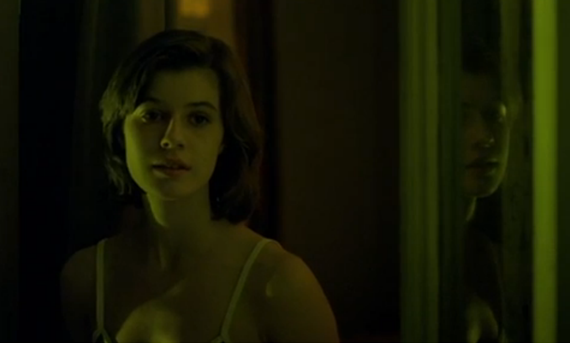
thedoublelife4Krzysztof Kieslowski’s The Double Life of Veronique fills an ethereal world full of dancing light, soft hues, and faint reflections. It’s beautifully muted visuals complement a wonderfully mysterious story. Its title suggests the potential of a story about one woman living two varying lifestyles, one respectable, the other not. Instead, the film revolves around two women living parallel lives. Neither is shameful or noticeably corrupt. They are both sweet individuals with aspirations that drive their lives. They desire love and commendation like many of us.

The first is named Weronika, a Polish beauty, who is an up and coming operatic performer. While her star is on the rise, she meets a new boyfriend and goes a trip to visit her aunt. But everything goes back to the music. In fact, music often takes center stage totally enrapturing us in song. There are sublimely haunting melodies that pierce right through our core. The angelic voices are gracefully wafting through the chambers of cathedrals and music halls. And just like that the breathe is gone out of one of the angels for good. We get a hint at it from Weronika’s aunt, suggesting that all their family members died unexpectedly, but there’s no more explanation.
thedoublelife5
The majority of the narrative follows French music teacher Veronique, who is the spitting image of her Polish counterpart. Except they have no relationship whatsoever, only some odd intuition that there is someone else out there who they do not fully know. As we observe the daily rhythms of this young woman’s life, it feels almost otherworldly with an unearthly golden glow that illuminates the streets she walks. It’s a film where marionettes are made graceful and bouncy balls are little orbs of wonder. Along the way, Veronique finds a love of her own that she doesn’t even know. But she’s enchanted by him and the magic that surrounds him, much as we are bewitched by her. Her lover is constructing two identical marionettes in order to tell a new story about two women with a connection that cannot be described. In other words, the mythos around his narratives, tread closely to Veronique’s own life. A girl in one of her photos makes it clear. Everything comes to a fitting full circle, and yet we get little in the realm of a fully gratifying ending.

thedoublelife2More often than not Kieslowski’s film has a mesmerizing effect on me and a  great deal of that power of entrancement is due to Irene Jacob. She is like a cinematic goddess with a face made to be scrutinized. A charming classical beauty, she exudes a range of emotions, while still managing to hold onto a semblance of mystique. Jacob is a wonderful muse for the director’s purposes and she would prove so again in Three Colors: Red. But that’s another conversation entirely.

I consciously ask myself, “Is this a film even to be understood?” Because the plot points and the pieces don’t always seem to fit together especially well when you actually consider them. And somehow I remain content in that reality. Whereas someone like Michelangelo Antonioni throws away a few pieces of the puzzle for good measure, for Kieslowski these final pieces never existed. They are not paramount to what he is trying to accomplish. The Double Life of Veronique maintains such a transcendental almost spiritual quality because we can only watch and listen. Ours is not to reason why ours is to simply look on in awe at what we are witnessing. The beauty, the enigma, and the feelings. Because Kieslowski is more interested in the essence of the film than the particulars.

4.5/5 Stars

Phoenix (2014)

Phoenix_(2014_film)_POSTER

Speak low when you speak, love
Our summer day withers away too soon, too soon
Speak low when you speak, love
Our moment is swift
Like ships adrift we’re swept apart too soon
~ Speak Low (1943)

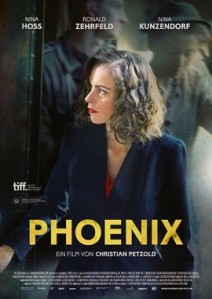
Anyone who’s watched a Christian Petzold film already knows that he crafts fascinating almost spellbinding films and that quality rests greatly on the laurels of Nina Hoss. Phoenix is yet another film that is a mesmerizing enigma.

It’s positively entrancing with its pacing — where you almost get lost within its minutes. Because although time never moves fast you quickly lose track as the mind is soon overwhelmed with a plethora of questions. In fact, all the time while you’re watching it all you can do is question. Implausibilities all but fade away in the presence of such uncertainty. If anything they get lost in the rubble.

It feels as if we’re trying to construct our own truth, which is almost maddeningly impossible because none of these characters seem ready to divulge any information. The past is a black shroud that everyone is reluctant to talk about. It makes sense because that soon after what do you say about the Holocaust? How do you cope or even begin to acknowledge the horrors that went on? It’s only 50, 60, 70 years later that we’ve finally been able to broach the subject as outsiders — people who did not experience those events firsthand. It’s easier for us to try and talk about it because we can never fully comprehend the climate. What would we have done? What would have happened to us? What would our lives have looked like in the aftermath?

The characters in Phoenix are beings in that post-war wasteland with specters hanging over them, and lives scarred by pain and suffering. They’re trying to salvage their existences the best they can, but they’re hardly existing as they did before the war. But allow me to backtrack for a moment.

Nelly (Nina Hoss) is physically maimed so horribly that her face is constantly covered in bloody bandages. Petzold does us a favor by not showing her visage before she gets reconstructive surgery. Like the shadow of the Holocaust, we are forced to imagine it on our own which is far more powerful. This is what her face looks like and this is perhaps how it happened.

What we do know is that she was arrested on October 4th, 1944 and her husband Johnny was as well. But Nelly’s faithful friend and guardian angel Lene says that he betrayed her. That’s what she believes, and yet upon hearing this news it hardly alters Nelly’s response. She’s still intent on finding him and picking up all the pieces. When she has a little more strength she begins wandering about the American sector looking for any signs of her former beau.

It turns out that Johnny works as a waiter in a cabaret Hall called Phoenix. When he first sets eyes on Nelly — it’s not his wife that he sees, but a wonderful impostor. She’s a woman who is strikingly similar, but her face is different. She’s the perfect accomplice as Johnny, or Johannes as he now goes tries to secure his dead wife’s assets.

What follows is his mission to make her into his old wife.  In many ways, it works as an inversion of the Vertigo conundrum. He thinks he’s making this woman into his deceased wife, and he coaches, dresses, and shapes her more in the image of Nelly. However, this hardly feels like an obsessive desire of dashed love, but a project to get him closer to his final goal. It’s not that sentimental, but Nelly follows along with the whole thing benevolently. To be close to Johnny is enough. But how does she even begin to break the news? Perhaps most frightening of all what will Johnny’s reaction be? After all, the wartime has changed them both.

So if you want to break it down to its most basic roots, Phoenix feels rather like a Holocaust film meeting Vertigo. But in essence, it defies that type of simple categorization. It lacks the odious horror of flashbacks and the glossy Hollywood production values of the latter. It fills its own niche altogether that even channels some of the darkness of noir. And there is no cathartic moment of emotional release. Instead, we are forced to watch as the characters bury their thoughts and feelings deeper and deeper. Perhaps they lie there somewhere under the surface. However, these are not histrionic people. They feel common and every day led by the performances of Hoss and Ronald Zehrfeld.

In this way, the performances are muted and repressed. In fact, there is little headway in the film and few epiphanies until the very end. That’s when for a few brief solitary moments things fall into place. We don’t know what will happen afterward, and in a way, we are suspended in the moment — left to ponder so many things. You could either make the case that Phoenix has shallow characters, or that there is so much depth within them that we cannot even begin to understand — like icebergs still partially submerged.

Many wonderful films lose so much of their magic because they dispel too much — give away too many of their hard-fought secrets. But Phoenix makes us work through everything, and it can be hard going certainly, and yet it is a thoroughly gratifying experience. We watch movies to be moved. We watch movies to be perplexed. We watch movies to acknowledge our wonderment in the human condition because it is a complex quandary that continually reveals new bits of enlightenment. Phoenix might leave us with more riddles than answers, and we should be content in that reality. That’s part of the magic.Like the mythical Phoenix of old, in a way, these characters try and die to their old selves, and rise out of the ashes a new.  Life is never that easy — always being clouded by doubts as our pasts come back to haunt us. It’s how we deal with that past that matters most.

4.5/5 Stars

Barbara (2012)

Barbara_(2012_film)If you’re acquainted with director Christian Petzold you probably know what you’re in for. A character study that is deliberate and systematic in its execution, courtesy of Nina Hoss, and moreover impactful in more ways than one. In this film, the narrative mode of the period piece certainly serves Petzold quite well. The setting is East Germany circa 1980. The settings are wonderfully stark. Depressed representations of a bygone era and yet somehow still strangely beautiful for depicting a simpler age. As Americans, we have a certain perspective that includes Cold War sentiment, boycotting the Moscow Olympics, and the like. But it’s a much different even intimate picture on the inside.

Our person of interest is the eponymous Barbara, a nurse stationed in Berlin, who tried to get an exit visa to the West. Now she has been transferred to a rural locale to continue her work with close surveillance by the Stasi. Her primary colleague is chief physician Andre Reiser, who is genial, but from the get-go Barbara is aloof. She does not want friends and she knows anyone could be working with the police.  She goes about her work being the best nurse she can possibly be, treating patients humanely. Most notable is Stella a girl from a labor camp, who is suffering meningitis, and finds a comforting figure in Barbara. From then on she is the only person Stella trusts.

In her free time, Barbara can often be seen smoking, riding her bike, or taking the train, but there is always a purpose to her activity. It’s in quiet defiance of her plight — an active form of rebellion as she tries to rendezvous with her boyfriend from the West in an effort to reconnect with him. Unknowingly Dr. Reiser grows continually fonder of Barbara and continues to be nice to her because she is quite remarkable. Together they try and decipher what is wrong with a young man who is recovering from a suicide attempt. But of course, his necessary surgery coincides with Barbara’s set date of escape. What follows is far from melodrama, but it is a far tenser slow burn as we watch events unfold. Our heroine does something that will alter her future although we cannot know for certain. Sometimes the best place to end a story is inside our own minds, and that is true with Barbara.

It’s a film that can make you squirm, but also make you think and feel. The German scenery is often breathtaking, the perfect landscape for bike riding, and the birds chirp blissfully in the background. It is the ultimate irony that in such a peaceful land so much suppression and pain takes place. But then again there can be so much joy taken out of something so minute as a masterwork by Rembrandt, proving that the human spirit cannot be fully quelled even there.

In the film’s nuances, you are apt to find beauty and also great depth of character. Not just in Nina Hoss, who is once again brilliant carrying an air of mystery mingled with moroseness that lingers on her face. This might be a poor comparison, but Hoss reminds me in some respects to other European starlets like Juliette Binoche, Irene Jacob, and Julie Delpy, who all carry a fascinating aura around them. The truth is American actors, in general, have to use so many words and in this way, they lose some of their allure. Nothing is left unspoken. Nothing is left untrod. But with Barbara, we do not know her ins and outs, what she is thinking, or even how her story ends.

Next on the watch list is Phoenix, the latest Petzold/Hoss collaboration. It goes without saying that I am beyond excited.

4/5 Stars

Ugetsu (1953)

ugetsu1During my film odyssey, I first met Kurosawa, then Ozu, and finally Mizoguchi. Each with similarities and most importantly their own personal touches when it comes to the language of cinema. Kenji Mizoguchi seems especially at home with Japanese folk tales in the jidaigeki mode of Japanese period-dramas. Ugetsu finds its inspiration in such a fable from 18th-century author Ueda Akinari, and it also gathers some inspiration from scroll painting. As the narrative arc begins, it’s as if the story is slowly getting rolled out bit by bit with the camera slowly tracking with the action.

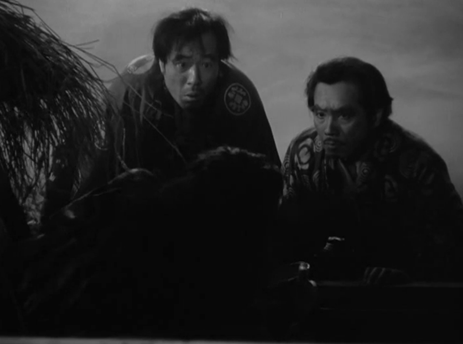
In this case, our subject is a group peasant villagers who live with their wives. Genjuro is a farmer with a penchant for pottery, who has a little boy together with his wife Miyagi. Then, there is the often buffoonish Tobei, who has fantasies of one day becoming a samurai. His wife Ohama often becomes annoyed with his obsession. When marauders come and uproot them from their homes and yet they remain together. However, with the progression of time, Genjuro has become more obsessive over his pottery as avarice overtakes him, and Tobei can no longer quell his desire for military honor. Miyagi particularly notices a change in her husband, because money has become his everything and he has put his heart and soul into that kiln of his. True, it seems to pay heavy dividends when he takes his wares to the marketplace and gets a pretty penny, while also meeting the ravishingly beautiful Lady Wakasa.

ugetsu3For our male protagonists, their wildest dreams begin to play out. Genjuro has begun a euphoric fling with his new mistress with little concern for his wife and child he left behind. Simultaneously Tobei in a stroke of good-fortune captures the severed head of a high ranking general. Although he’s a nobody, he gets in with the right crowd and his greatest wish is granted. He becomes a big shot samurai complete with weapons, armor, tassels, and an imposing entourage.

Meanwhile, unspeakable things are happening to the women in their lives, but the men seem to be lost in their dreams. When they finally are given a heavy dose of reality, it can be painful, even violently chaotic at times. And yet the reality check proves necessary because in a way it allows these men to shake off the ethereal and live in the present — allowing them to be more fully realized versions of themselves.

ugetsu2Mizoguchi rather like Fellini has a great interest in the supernatural or at least dream worlds. It’s far from nightmarish horror at least in the modern sense, but it is an everyday type of horror, where husbands act out on their darkest desires, family members die, and so on. Some would say this is far worst because it hits closer to home. The world of dreamscapes and ghosts overlap with reality.

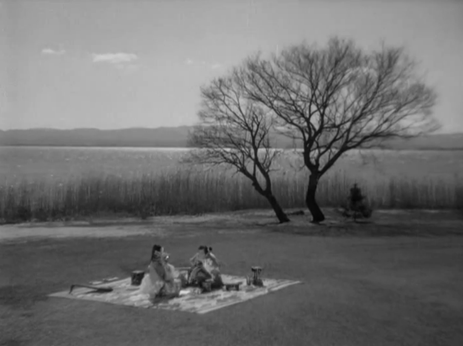
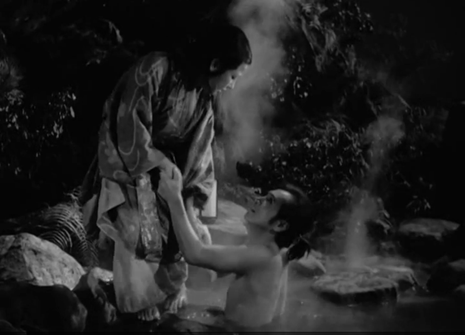
The director is also constantly utilizing long takes, but they’re far from stagnant, very often panning to the left to accentuate the feel of a scroll being unfurled. Especially in the marketplace you get the sense that you could easily be lost in a sea of people, but Mizoguchi only goes to close-ups at the most opportune moments. Otherwise, he is best suited in pseudo outdoors settings — integrating architecture and nature in perfect cohesion. These facades are put up for people to interact with whether it’s a hut or an outdoor pool, but it never loses its naturalistic beauty.

It feels quintessentially different than his contemporaries, allowing for a thoroughly unique view of the human condition. Certain types of ghosts haunt all of us whether they are choices that we wish we could take back or the hand we are dealt when our lives began. Thus, Ugetsu is remarkably poignant even in its antiquity.

5/5 Stars

Au Hasard Balthazar (1966)

auhasard1Robert Bresson’s Balthazar is the best piece of art I have viewed in some time and it is art in the sense that it may have various interpretations, it causes us to think, and it elicits an emotional response. In truth, it is a story that I do not fully understand and I can never hope to know, but there is nevertheless an austere beauty to this parable. Furthermore, there is a kind of magic in this air of ambiguity. I want to watch it, again and again, to see if I can understand, to see what revelations come my way. It was one of those experiences that left me wondering what I had just watched, however, I know enough by now not to fight it, but enjoy that feeling of not comprehending in full.

Essentially this is a tale about a donkey cherished by a young girl and over the years they lose contact, reunite, and go away again, as is the rhythm of life day to day. The plot points started becoming less important in comparison to the images and emotions that begin to well up inside of us. At the same time that the donkey is often being mistreated or carrying the burdens of his various masters, his girl Marie (Anne Wiazemsky) is growing up trying to figure out what love is. She is close to a boy named Jacques only to have him drift in and out of her life several times. She cannot decide how she feels exactly about him. There’s the boy Gerard who is good at raising hell and Marie spends some time with him. But it remains to be seen what the real agenda of her parents or Gerard and his friends are. What of these matters of honor and murder? Do all the particulars even matter that much?

Balthazar’s own path includes whippings, long hard toil as a beast of burden, a stint in the circus with all the other captive animals, and happy times driving Marie’s cart. But is that wrong to personify him? Is he even capable of emotion? I’m not sure if he is, but the audience certainly is. We can be joyful when we see that cute young donkey being enveloped in hay with young children playing. We can become somber as Balthazar is slowly being worked to death as the years drag ever onward and his master considers putting him down in lieu of getting a new harness. Somehow a donkey can be a victim of his circumstances, bravely taking the abuse of others, and living without a shred of retaliation. In some strangely entrancing way, it works.

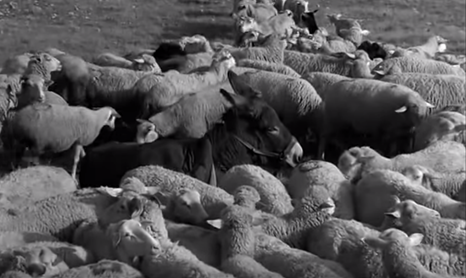
auhasard2Then, Balthazar takes a stray bullet and weakened he comes upon a green pasture where he kneels down peacefully to die. Around him comes a flock of sheep led by a shepherd. It’s a deeply heart-wrenching and visually arresting moment evoking Biblical imagery from Psalm 23. The full life having been lived and now it’s over in tranquility. It’s really a summation of the spiritual journey that each one of us traverses in our lifetime and yet Bresson brings us this allegory through simple, clean strokes. Images and sounds balanced exquisitely together in a completely naturalistic mode of expression.  Wiazemsky on her part is a natural beauty who positively captivates with every move she makes (reminding me of Anna Karina) Furthermore, Bresson somehow causes us to build a deep connection with a donkey which is hard to believe.

It’s the trademark of Bresson to have a stripped-down, straightforward approach to film-making, so much so that his style almost feels like no style at all. It’s so clean and unobtrusive. He shows us the world simply, succinctly, and without pomp. Even with the casting of non-actors, and in this case a donkey, as his main players. But he’s undoubtedly the master of inducing a response based on even the most basic of subjects. There are times it’s almost easy to forget you’re watching a film entirely because you get so wrapped up in what he is showing us.

4.5/5 Stars