Review: It’s a Wonderful Life (1946)

5632c-wonderfullife4Every time I go through the emotional, romantic, heart-warming and at times uncomfortable roller coaster that is It’s a Wonderful Life, something new always seems to stick out to me.

It is always impressive for a film of this length that so much is packed into it. Within minutes we are fully enveloped in this story, and every sequence gives further insight into these characters. There is hardly ever a wasted moment because there is significance in each scene. Pointing us to the nature of George Bailey.

Furthermore, it is easy to forget the darkness that this film submerges itself in because it reaches such a jubilant crescendo. However, this is a story that covers the years including The Great Depression and World War II. Its protagonist sinks into a state of wretchedness complete with angry outbursts, negative feelings, and drunkenness. George Bailey loses all hope and his perspective is so completely distorted. For all intent and purposes, his life looks like it’s over, and it takes a frightening alternate reality to shake him out of his disillusionment. Put in this framework, it makes sense why it was a commercial flop when you juxtapose it with the big winner that year The Best Years of Our Lives. They both deal with post-war reality, but with very different lenses.
That’s the benefit of hindsight and a new context since we do not usually see It’s a Wonderful Life as a gloomy post-war tale, but a more positive parable that is universal in its impact. The first part of this story feels a bit like a Job story of hardship, and the second act is reminiscent to Dickens’ A Christmas Carol, but that’s the simplest of observations. There is a lot more to be parsed through.

The romance of George and Mary is what many of us aspire to and it causes us to really empathize with their young love that weathers the good and bad breaks they receive. It’s the fairy tale love story we want, with the rock hard reality we are used to in our own lives. Some favorite moments in their life together would be the splash they make during the Charleston dance off, singing Buffalo Gals together, smooching on the telephone together, sharing a makeshift honeymoon together, and embracing after George gets his new perspective on life.

There are a fair number of close-ups utilized in this film, but they are usually used at crucial points in the narrative, and they tell us a great deal about both George and Mary.

The first key moment comes during a freeze frame of grown up George with hands outstretched giving us our first look at the man we will be following from there on out. The next big moment occurs when George learns that Potter will gain control and the Building and Loan will be disbanded if he leaves. He realizes in an instant that he must give up his plans. Then, he waits excitedly for Harry with Uncle Billy and it is a happy moment, but George learns his younger brother might have another job. The camera follows his worried face as he goes to follow his new sister-in-law. Never thinking of himself, he realizes that Harry has a chance for better things and that leaves George still working the Building and Loan.
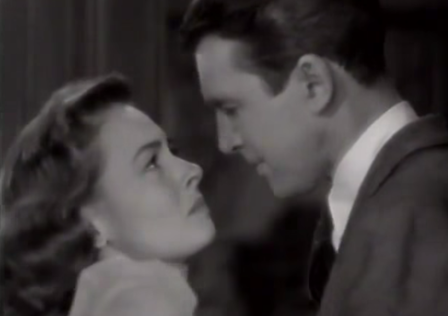
After their tiff, the scene where George and Mary are talking on the phone with Sam Wainwright is a solidifying moment in their relationship. There are so many underlying emotions and unspoken feelings that they are having trouble figuring out and reconciling. And yet there is that violent epiphany when their eyes link. The tears and anger are quickly traded for passionate kisses reflecting the often complicated facts of romance.

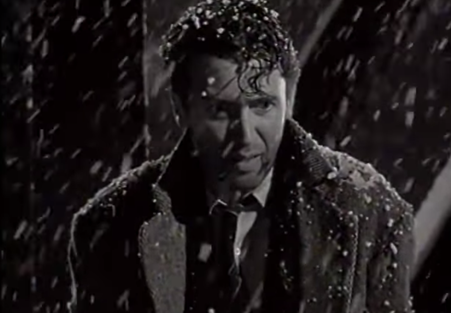
One of the final close-ups that hits home occurs when the now non-existent George stumbles away from the front door of his mother, who now has no concept of him. There is sweat on his brow (maybe from the 90 degree summer heatwave) and desperate bewilderment in his eyes. This is the lowest point he could have imagined. His own mother does not know who he is. His wife has grown old and lonely in an existence of exile. Stewart’s face is so expressive and earnest suggesting that George knows just how important human companionship is. Humanity was made to be in fellowship with each other. Lack of money means very little in comparison to our friendships and family ties. This is essentially what George finally comprehends and what Clarence reminds him. George understandably lost sight of his wife and his children and his friends. They were a gift not to be taken lightly.
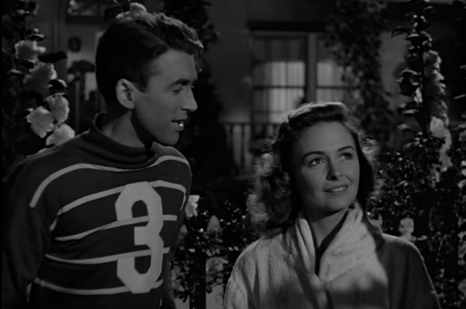
Aside from these close-ups, it is also evident that a great deal of  effort was put into creating this world from the characters and their back stories to the town itself which was constructed on the RKO lot. Everything from the building facades, to stray dogs, and snow make the drama more atmospheric. It’s one of those films that reveals the beauty of using real props inhabited by seemingly real people. That’s why I sometimes am disillusioned by CGI. Although it can allow us to create amazing spectacles, oftentimes it creates a world that feels altogether fake and alien. It’s not relatable and it lacks the humanity that makes up our existence each and every day. In other words, it has very little of what makes It’s a Wonderful Life so compelling to me.

Perhaps there are more impressive or greater films, but there are few with greater heart and there is something to be said for that.

5/5 Stars
Review: Harvey (1950)

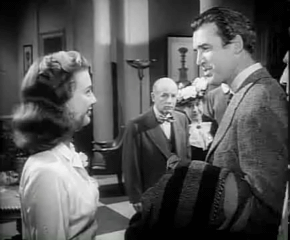
Why am I so infatuated by Harvey you ask? Let me clarify that. I’m not talking about the title rabbit. Why am I so enamored by this fantastical film from 1950? It all stems from Jimmy Stewart as Elwood P. Dowd, which was undoubtedly one of the most unique and remarkable performances in his storied film career.

Elwood is often quotable (Here, let me give you one of my cards, What did you have in mind, etc.). However, I think his innocence and perpetually pleasant demeanor is what makes him so wonderful to moviegoers, like myself, and to many of the characters in this story. He has his oddities, to be sure, but a little common courtesy and thoughtfulness is something that is often lacking in this world. Elwood is the complete epitome of that kind of individual. He always has an open invitation, he constantly insists that others enter before him, he has a penchant for giving flowers, he is the king of compliments, and he can put a positive spin on most anything (I Plan to leave. You want me to stay. Well, an element of conflict in any discussion’s a very good thing. It means everybody is taking part and nobody is left out).
. 
Sure, his friend is a giant invisible rabbit named Harvey. So what? By the end of this film, I might be a little bit of a lunatic too, but after all, that’s being human for you. What makes us who we are, are those quirks that populate our persons. For Elwood it’s his pal Harvey, for others, it might be something more mundane than a giant invisible pal. 
However, I will undoubtedly keep returning to Harvey, because it is a thoroughly enjoyable film that gives us a little lesson in life, and it certainly does not hurt that it is quite funny, in a whimsical sort of way. 

As I noted already Stewart is wonderful, playing Mr. Dowd straight, but he is surrounded by an eclectic group including Josephine Hull, Cecil Kellaway, and Jesse White. They are necessary foils for his character to bump up against. Although Charles Drake and Peggy Dow are somewhat flat at times, both of them fit the sentimentality of the film just right. It’s a pity Dow was not in more films because she seems like such a lovely person on the screen. But why focus on the negative, because after all Elwood P. Dowd never would.

4/5 Stars

The Best Films of James Stewart


1. It’s a Wonderful Life
2. Rear Window
3. Vertigo
4. Mr. Smith Goes to Washington
5. The Philadelphia Story
6. The Man Who Shot Liberty Valance
7. Anatomy of a Murder
8. Harvey
9. The Shop Around the Corner
10. You Can’t Take it With You
11. Winchester ’73
12. Rope
13. Destry Rides Again
14. The Mortal Storm
15. The Naked Spur
16. The Man from Laramie
17. Bend of the River
18. The Man Who Knew Too Much
19. The Far Country
20. Vivacious Lady
21. The Glenn Miller Story
22. The Spirit of St. Louis
23. The Flight of the Phoenix
24. After the Thin Man
25. Call Northside 777
26. Broken Arrow
27. The Stratton Story
28. The Shootist

Review: The Man Who Shot Liberty Valance (1962)

a44af-themanwhoshotNothing’s too good for the Man Who Shot Liberty Valance!!! But who is he exactly? How did it happen? Where is he now?

The Man Who Shot Liberty Valance is perhaps one of the moodiest and most atmospheric westerns of all time. In a sense, it is almost like a Noir Western with its often stark cinematography (especially during the climatic moments), and it is told through a long flashback that encapsulates nearly the entire narrative. Both qualities are typical film-noir.

John Ford had numerous classic westerns, but this one is possibly one of the darkest in tone. The film has a typically great John Ford cast (like My Darling Clementine or The Searchers). Of course, it would not be one of his westerns without John Wayne, then add James Stewart, Vera Miles, and of course Lee Marvin. Then the secondary cast is rounded out by such great character actors as Edmund O’Brien, Andy Devine, Woody Strode, Strother Martin, Lee Van Cleef, John Carradine, and Denver Pyle among others.

This film is also steeped in politics. It becomes more obvious the more you watch that there is this underlining conflict between democracy and a different system of representation. Could this be a critique of Communism also packed into a western? Probably.

One of the moments that really stood out this time around was the flashback within the flashback when Doniphan (Wayne)  reveals his point of view to Ransom Stoddard (Stewart). He was, in fact, the man who shot Liberty Valance. We knew it at heart but finally we have the proof and all of sudden his behavior seems justified and he becomes the tragic hero of the film.

It is an unjust ending and yet it plays out the way it was meant to — maybe not the way it should have. The lawyer got the girl, the fame, and the spot in Congress, because he is a hero for something he did not actually accomplish. Tom instead is the one who fades into the past. It struck me that this is one of the few films I can remember where Wayne actually dies, the other would be the Shootist. Except here he is dead before the story has even began. The legend of John Wayne himself lends nicely to this legendary man in the film who we only know through the recollections of others. As the newsman noted, when the legend becomes fact you print the legend.

4.5/5 Stars

Winchester ’73 (1950)

2604e-winchester_73_-_1950-_posterStarring James Stewart and directed by Anthony Mann, this western follows the journey a special rifle takes in the old west. Stewart wins it in a competition but it gets stolen soon after. An Indian trader wins it in a card game only to have an Indian take it. Stewart, his pal, get pinned down with some cavalry by the Indians. They survive and the rifle is given to a young man with a girlfriend after Stewart is gone. A treacherous gunslinger coolly kills for it but then gives it up to the original bandit who claims it as his. In a final mountaintop showdown, Stewart faces off with his estranged brother who killed their father. He wins back his rifle and rides back into town to his friends. This is a good western with an interesting storytelling device. It was a surprise to see Will Geer, Rock Hudson, and Tony Curtis as unknowns.

4.5/5 Stars

The Shop Around the Corner (1940)

cc994-the_shop_around_the_corner_-_1940-_posterStarring James Stewart and Margaret Sullavan with direction by Ernst Lubitsch, the film follows the events in a little shop in Budapest Hungary. Alfred Kralik (Stewart) is the most respected employee in the shop and when Ms. Novak (Sullivan) comes in he advises her no jobs are open. However, she does land one and thus begins their rocky relationship. They are constantly at each others throats arguing. Both of them want to end the conflict on a good note as they go their separate ways to marry people that they were corresponding with by letter. When Stewart is to finally meet his unknown lover, he is shocked to look in and see Ms. Novak. Through a series of events she finally figures out he was the writer of all her letters and the two former enemies fall in love. This unorthodox romance has good characters and comedic moments that make it enjoyable to watch.

4.5/5 Stars

Destry Rides Again (1939)

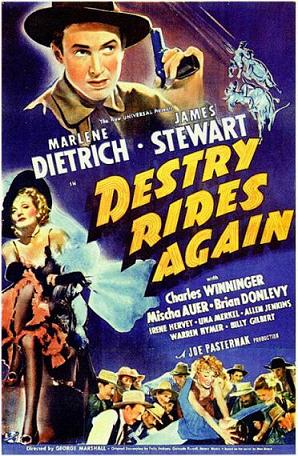
4ff56-destryridesagainposterThis comedy turned dramatic western, starring James Stewart and Marlene Dietrich, begins in a town run by a saloon owner and inhabited by a sleazy song girl. Corruption and cheating reign supreme as the sheriff is killed and the town drunk takes his place. He turns right around and calls the son of an old friend, Tom Destry Jr., to be his deputy. Despite a comical entrance, and an abhorrence for guns this man is very different. Using his smarts and playing dumb, he is able to work for justice even though he seems to be helping the villains. He picks up the trail of the dead sheriff only to have the present sheriff shot as well. In the final unorthodox showdown, good fights bad and the womenfolk join the fray. Destry finally takes up his gun and is nearly killed, but he gets the town boss in the end. It carries another great cost however. Despite this tragic end, the film finishes on a lighter note. You will finish the film understanding that Destry knew a lot of people in his time.

4/5 Stars

The Shootist (1976)

24767-shootist_movie_posterIn his last film performance, John Wayne stars alongside Lauren Bacall, Ron Howard, and James Stewart in this tale about a notorious old gunfighter, who comes to stay in a small western town. J.B. Books gets a medical diagnosis from an old friend, and the doctor confirms that he is slowly dying from cancer.

 Books pays for a room in the home of a local widow (Bacall) where his reputation and actions one night scare off tenants. He receives a visit from the uneasy local sheriff (Harry Morgan), gets an offer for a book to glorify his life, has an old flame drop in on him, and old rivals and young guns are bent on killing him.

His lifestyle impresses the young man Gillom (Howard), but his mother openly disapproves of Books. Amidst all this, Books desires to live his last days in peace and he is waited on by Bond, and the two of them become to respect each other as her boy also comes to idolize Books more. The shootist sets everything up to die on his 58th birthday, going so far as ordering a special tombstone and sending three separate notes to different gunmen in town. He leaves his horse to Gillom and bids farewell to Bond before heading off for one last showdown. 

In the saloon, he is met by three men bent on killing him. Books is wounded but proves his skill one last time. In a cruel moment, however, Books is gunned down right in front of the horrified Gillom, who in a single instant ceases to be an innocent boy and becomes a man. 

This film was the perfect swan song for Duke because in many ways the character he plays mirrors his real-life western persona. Gone were the days when he was a kid in Stagecoach, a courageous sheriff in Rio Bravo, or even the gritty old codger in True Grit. He was truly reaching the twilight of his career.

Even it was one of the most storied of acting careers it was finally coming to an end. In just three years he would die of stomach cancer, and there was no gunshot to go with it this time around. During this movie, he still has life in him though, and even when he shares scenes with the whitening and tired-looking icon James Stewart, Wayne seems as resilient as ever. The Shootist is certainly not his greatest film or best performance, but I think it can be said John Wayne went out on his own terms just like Books.

4/5 Stars

The Man Who Knew Too Much (1956) – Alfred Hitchcock

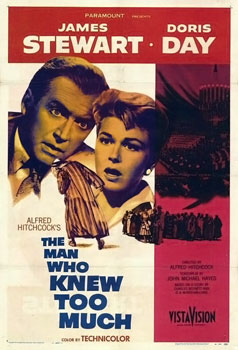
Starring James Stewart and Doris Day with director Alfred Hitchcock, the film follows the couple as they travel to Morocco with their son. Through a series of strange circumstances, Stewart finds himself learning a deadly secret from a dying man he just met the previous night. Soon his son is kidnapped and Stewart along with Day find themselves traveling to England in pursuit. Frantically, they try following leads and by the time they come up with one, the culprits are already gone before the police arrive. Their search finds them at the Royal Albert Hall foiling a plot and then they go to the embassy. Desperately, they keep up the search for their boy and it finally pays off, maybe. With the wonderful direction of Hitchcock and the song Que Sera, Sera, this film is quite good.

4/5 Stars

You Can’t Take it With You (1938)

Starring a cast boasting Lionel Barrymore, Jean Arthur, James Stewart, and Ed Arnold, this is another comical Capra film. Arnold is a wealthy banker bent on acquiring a block of land for business purposes. Stewart is his son who has fallen over heels for his secretary. Things are complicated by her peculiar family household partly because her grandfather will not give up his land to the banker. Fireworks go off literally and figuratively when the two families meet. It leads to prison, and a chaotic court appearance which causes a further rift. Because his grand daughter is sad, Grandpa decides to sell the family home. Arnold seems to have won, but his son leaves him for his love and so Arnold changes his way. Thanks to a harmonica duet and some dancing a friendship is made and everyone is happy in the end. Every Capra films comes with a message and this one preaches the importance of friends and family compared to money because after all “You Can’t Take it With You.”

4/5 Stars