You Can’t Take it With You (1938)

Starring a cast boasting Lionel Barrymore, Jean Arthur, James Stewart, and Ed Arnold, this is another comical Capra film. Arnold is a wealthy banker bent on acquiring a block of land for business purposes. Stewart is his son who has fallen over heels for his secretary. Things are complicated by her peculiar family household partly because her grandfather will not give up his land to the banker. Fireworks go off literally and figuratively when the two families meet. It leads to prison, and a chaotic court appearance which causes a further rift. Because his grand daughter is sad, Grandpa decides to sell the family home. Arnold seems to have won, but his son leaves him for his love and so Arnold changes his way. Thanks to a harmonica duet and some dancing a friendship is made and everyone is happy in the end. Every Capra films comes with a message and this one preaches the importance of friends and family compared to money because after all “You Can’t Take it With You.”

4/5 Stars

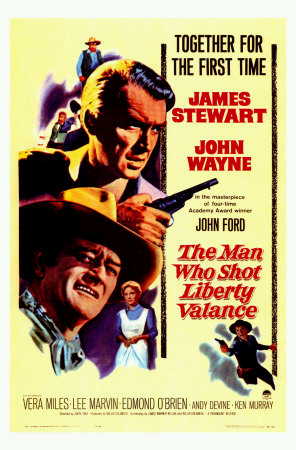
The Man Who Shot Liberty Valance (1962)

Starring both John Wayne and Jimmy Stewart, with Lee Marvin, Vera Miles, and direction by John Ford, this is certainly a moody western. Stewart, now a successful politician returns to a small town with his wife to pay his respects to an old friend. In the ensuing flashback he retells his story beginning as a young lawyer who had a run in with Liberty Valance (Marvin). After he got well he strove to bring justice and education to the land. Despite their differences, Stewart finds a friend in Wayne who has his eye on Miles. However, everything eventually goes awry when Stewart agrees to face Valance out in the street. He appears to be a goner because he is wounded, but miraculously a shot hits Valance and he falls dead. Stewart now a hero gets the girl and agrees to represent the town. Wayne fades into the background also a hero. The supporting cast includes Woody Strode, Edmond O’Brien, Andy Devine, and John Carradine. With two great icons and a great director, this western is certainly a classic. Although it did not end up making it into the film, Gene Pitney’s western ballad deserves to be acknowledged nonetheless.

4.5/5 Stars

It’s a Wonderful Life (1946)

This is not only a Christmas classic but a classic in any sense of the word. It is the best of Stewart and Capra adding up to one of the most heartwarming stories of all time.  This may exhibit Stewart is his everyman role once again, but it breaks away from Mr. Smith in many ways making it another uniquely great film. A film like this that makes you know and feel for characters so profoundly is certainly worth watching.

Starring Jimmy Stewart and Donna Reed with a fantastic supporting cast,  the film tells the life story of George Bailey. We watch with the angel Clarence as he sees George’s life unfold. George saves his brother Harry as a boy and as a result, loses hearing in his ear. He works in the Bedford Falls drugstore and keeps the proprietor Mr. Gower from making a deadly mistake. Later on, he plans to travel the world and go to college so he can escape his hometown and do bigger and better things. But once more he sacrifices. One fateful day, he doesn’t know it yet, but he meets the love of his life Mary, and the same day his kindly father has a stroke. Soon after,  Harry goes off to college and George is left holding down the fort at their father’s old building and loan. He builds up all those around him with selfless kindness, while simultaneously standing up to the grumpy millionaire Mr. Potter. Eventually, he marries Mary and has children. First, during the Depression George gives up his honeymoon to keep the building and loan open. Then, during WWII while his brother and others become heroes, George stays in Bedford Falls because of his poor hearing. In this post-war period, the story picks up in the present.

Although, by unfortunate circumstances George Bailey finds himself contemplating suicide after the absent-minded Uncle Billy misplaces $8,000. That’s when Clarence comes into his life to show George just how important he really is. George sees a world where Harry is dead, Mr. Gower is a disgrace, Martini does not own the bar, his mother has no sons, Uncle Billy is insane, Violet is disgraced, Bert and Ernie do not know him, Mary is an old maid, and Mr. Potter has monopolized Bedford Falls.

Once he gets his life back George finds immediate joy and gains so much because of his friends and family. He runs through the streets of Bedford Falls yelling out “Merry Christmas,” because he is simply grateful to live again. Miraculously, the whole town rallies around him, and George reaps the reward for all he has sowed over the years. Clarence is finally awarded his wings and George Bailey is the richest man in town. There is nothing much to do after this film but simply be happy and sing “Auld Lang Syne.” It is a Wonderful film in many ways, with a wonderful cast, and a wonderful message. It has some of the greatest character development of any film ever because you do not simply become attached to one man but an entire community. That’s what makes the scene where Uncle Billy loses the money one of the most difficult for me to watch. Each and every time I’m so attached to these people. Even if I already know the resolution, I cannot bear for anything bad to happen to them. In fact, it is interesting to focus on just one of the supporting characters and see how they are affected by the life of George Bailey. It makes me ask myself if I were to die tomorrow would anyone care? We know in the case of George they certainly would.

I am further reminded of the phrase that is written on the wall of the building and loan, “You can only take with you, that which you give away.” This is what George Bailey did, and I believe it is something that each and every one of us should be mindful of. He is a great character not only because James Stewart played him genuinely and with such magnetism and heart, but because he was such a sacrificial figure. True, this is a sentimental film given the title and the director, but it is paramount to realize the progression this film follows. George must sink into the depths of his despair and disillusionment before he can truly realize that It’s a Wonderful Life. I would challenge you the next time you watch this film, to not simply acknowledge it as perennial Christmas fare, but look a bit deeper because there is so much more here. As always, Attaboy Clarence! You did it again.

5/5 Stars

The Philadelphia Story (1940)

Headlined by Katharine Hepburn, Cary Grant, and Jimmy Stewart, The Philadelphia Story  tells a comical tale of a divorced socialite who is about to be remarried. Tracy Lord is an arrogant socialite who divorced her equally fiery husband C.K. Dexter Haven. Now it is the day before her wedding to another man. However, Haven returns and brings a long two magazine reporters to get a scoop they were forced into. After a lavish party and many drinks the reporter (Stewart) and Tracy Lord find themselves spending an inebriated night talking and swimming. Haven manipulates the situation and the future husband Kittridge, who catches the tail end, believes something bad is happening. The next morning the wedding is in jeopardy and Hepburn and Stewart are oblivious. Although nothing happened, Lord agrees to terminate the wedding and Mike (Stewart) tries to save her embarrassment by proposing marriage. However, she realizes it is not meant to be and goes to Haven while Mike returns to the camera woman who loves him. It all ends well but the joke is still on them in the end. This romantic comedy has a lot of star power and it is actually pretty good.

4.5/5 Stars

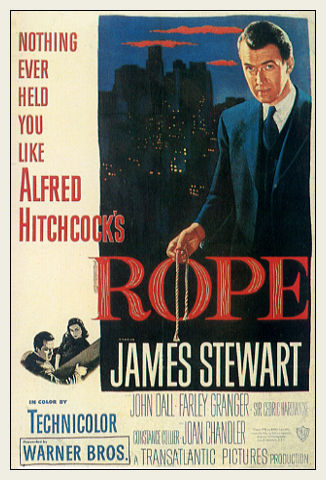
Rope (1948) – Alfred Hitchcock

eeca4-rope2What is the perfect murder? Hitchcock seemingly toys with this question in Rope . Starring Jimmy Stewart, Farley Granger, and John Dall, the latter two are students who murder their peer from university. Their only reason for doing it however is to see if they can get away with the crime. To complete their little experiment, they invite the boy’s family, his girlfriend, and other guests over to dinner, right in the room where they committed the murder. As an after though they invite their former professor (Stewart) who is the only one who would be able to catch them. At first Stewart does not suspect anything but eventually he becomes suspicious without letting on. Finally, the students lose their cool and Stewart catches them red-handed. This quickly puts an end to the perfect crime. This film is interesting because it was made to look like it was shot on one reel. Hitchcock’s movies are often known for the editing and yet this film was shot almost like a play in very long takes.

4/5 Stars

Vertigo (1958) – Alfred Hitchcock

acaeb-vertigomovie*May Contain Spoilers!

Vertigo is an intriguing Hitchcock thriller, set in San Francisco, that has you cheering for Jimmy Stewart as he falls in love and struggles with his fear of heights. Right away you are met with the haunting opening credits and the dramatic opening sequence where Scottie (Stewart) acquires his vertigo. From then on Scottie must cope with his dizzying condition however, he has no time to remedy it since he suddenly finds himself tailing a beautiful woman for a friend. Much of the rest of the film seems surreal with minimal dialogue and interesting cinematography, leading up to the death of Madaleine (Kim Novak). Then the film switches gears and is mostly about the impact on Scottie who had become infatuated with Madaleine. Often he appears to be in a trance and he becomes obsessive after meeting Judy who looks strikingly like Elster’s dead wife. Scottie becomes controlling, trying to make Judy into the image of the woman he loved. She just wants him to love her for who she is but that cannot be. Fittingly, the film ends the way it began with drama and tragedy. This certainly is a fascinating view of human psychology and complex emotions. In order to appreciate this film it is almost necessary to watch it at least twice, once to understand the plot and then another time to spot the little details. Of all of Hitchcock’s work, I would say I still enjoy Rear Window or North by Northwest better but this film at least deserves a viewing or two.

5/5 Stars

Mr. Smith Goes to Washington (1939)

84a24-mrsmithgoestowashingtonposterAs both a political drama and feel good movie, this film cemented James Stewart as an acting powerhouse. Furthermore, despite its age, it acts as a timeless reminder of the evils of political machines. It makes us root for the underdog, and it is distinctively American. Here is a cast and a story that seemingly could never be equaled, but what this film really had going for it was an idealistic outlook. I can, myself, often be a cynical person, and still Mr. Smith never fails to make me acknowledge the numerous attributes that make our country great, whether it is through montage, monuments, music, and of course Jefferson Smith himself. 

In one of his best performances, Jimmy Stewart is an idealistic, naive boy’s troop leader named Jefferson Smith. The starry-eyed Smith trusts that our nation is founded on some very noble principles that should be fought for tirelessly in government and in society. Above all, he is a likable fellow, who earnestly believes in the merits of this country, and he is beloved by boys all across the state. Now, this all sounds fine and dandy, but it would never have come across on the screen if it had not been for Stewart. He emanates this awkward and innocent energy that puts life into the idealistic creation of Jefferson Smith. 

When the film opens, everything is in turmoil when a senator suddenly dies and a replacement is needed fast. Believing Smith will be a pawn, a powerful man named Taylor (Ed Arnold) gets Smith a seat in the nation’s Senate. There he joins the respected Senator and old family acquaintance, Joe Paine (Claude Rains), who is also a cog in Taylor’s machine. However, although he is out of place in Washington, the patriotic Smith does his best to be worthy of his position. He realizes that the press will not give him a break, and the other Senators do not take him seriously.

So, on the urging of Paine, he decides to come up with a bill for a boys camp back in his home state. He requires the help of the world-weary secretary Saunders (Jean Arthur) to get his bill done. Initially, she is disgusted by his naivete, but as she grows to know him, she realizes he is only going to get himself hurt. His action to propose a bill soon find him face to face with the political machine that elected him. Taylor also has stakes on the piece of land where the boy’s camp would be, and he wants it for a dam. 

Smith finds himself being accused of using his position for his personal gain, and pretty soon he is before a committee with false evidence piling up against him. With all odds and seemingly everyone else against him as well, Smith makes one last monumental effort. Thanks to the help and guidance of Saunders, Smith fights to plead his case through a filibuster.

Fatigued by many hours of giving impassioned speeches and reciting the Constitution, Smith finally collapses, but not before effectively succeeding at his task. I doubt this would ever happen in real life, but in the film, it is fantastic watching the Senate break out into complete and utter mayhem. Ultimately, a young man with “a little bit of plain, ordinary, everyday kindness and a little looking out for the other fella,” was able to win. True, it may be overly sentimental, but it is a wonderful piece of sentiment all the same.

Frank Capra was wonderful at these type of cheering tales and his stars were in top form. There is an absolutely wonderful supporting cast here including Claude Rains, Edward Arnold, Eugene Pallette Thomas Mitchell, Charles Lane, Harry Carey, William Demarest, Beulah Bondi, and numerous other familiar faces I don’t even know the names of. That’s the beauty of the studio system I guess. It may have the same director, same leading man, and some of the same general themes, but Mr. Smith Goes to Washington covers completely different territory from Capra’s later classic It’s a Wonderful Life. Mr. Smith should be seen as a unique, and very much American film.


5/5 Stars
Rear Window (1954) – Alfred Hitchcock

02805-rearwindowposterStarring James Stewart, Grace Kelly, and Raymond Burr with director Alfred Hitchcock, this is a superb film that takes place in a very limited space. L.B. Jefferies (Stewart) is a professional photographer who is incapacitated in his flat with a broken leg. All he has to pass the time is watching the people across the courtyard. Although he very rarely interacts with them, he slowly begins to know them just by spectating. Pretty soon he realizes something is amiss when the annoying wife across the way is no where to be seen and her husband (Burr) is acting strangely. With help of his ravishingly beautiful girlfriend (Kelly), Jeffries tries to uncover the truth. Everything escalates when Lisa breaks into the man’s apartment and it finally peaks in a climatic confrontation. In the end all is well and Jeffries realizes his true love. This is one of my favorite films because of its unique setting and it is possibly Hitchcock’s best. He takes an environment that is so confined and then makes a very entertaining and suspenseful film with it.

5/5 Stars

Anatomy of a Murder (1959)

251e0-anatomymurder2Starring Jimmy Stewart, George C. Scott, Lee Remick, and a cast of others, the film follows a small town lawyer (Stewart) as he defends a man who has committed murder. The whole case is complicated by the fact that the Lieutenant’s beautiful wife was supposedly raped by the murdered man. Now Stewart must battle it out in court using every strategy he knows in order to save his client. With the help of witnesses and evidence both sides have substantial cases. However, Stewart finds the topper in the dead man’s daughter, hoping this will save his client’s life. Despite the valiant effort of the prosecuting attorney and Stewart, everything is in the hands of the jury so now all they can do is wait. With an interesting score, a methodical story, and a great cast, this movie was a good one. The judge especially made this film enjoyable for me and you certainly cannot beat Stewart. It should also be noted that this film has one of the most famous movie posters of all time which was designed by Saul Bass.

4.5/5 Stars