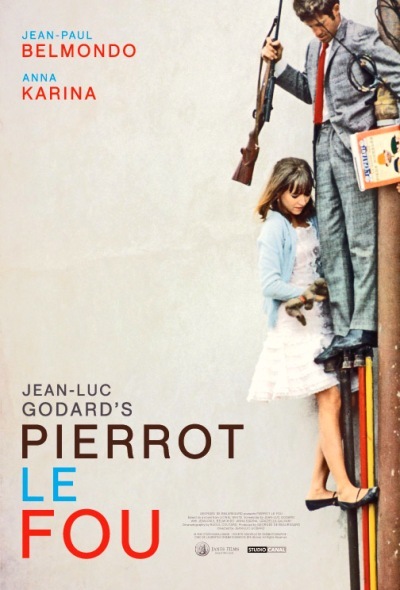
Directed by Jean-Luc Godard and starring Jean Paul Belmondo and Anna Karina, this film is chock full of poetic musings, literary allusions, pop culture images, and so on. Belmondo is a Frenchman who is unhappy with his life and marriage. When a young woman he is already acquainted with comes to watch his child, they eventually elope together. Ferdinand goes with Marianne to her apartment only to find a corpse and they must flee the scene from two gangsters. Now on the run, the two lovebirds are intent on living life and making their own Hollywood inspired movie that they can both star in. Their aspirations lead them to live a wild life on the move, but finally they settle down for a awhile in the French Riviera. Ferdinand is content with a quiet life of philosophizing but Marianne is discontent with this life right out of a Robert Louis Stevenson novel. They finally move on and stop at a night club where they face one of their pursuers. After some mishaps Ferdinand and his girl get separated. Finally they are reunited only to have Marianne turn on “Pierrot” for her real boyfriend. The final moments are filled with gunfire, a suitcase full of money, blue paint, and dynamite. You could say that everything blew up in Ferdinand’s face, and you would be quite correct.
4/5 Stars
 Directed by Jean-Luc Godard, this film follows a young woman who meets two crooks in an English language class. Through narration we learn that she told them about a cache of money she knows of and so they get her to help them swipe it. They both fight for her affection and ultimately the thug Arthur wins out. Despite Odile’s apprehension at taking the money from her aunt’s home, they continue to get the plan ready. Arthur’s uncle now wants in and then the plan changes again because the owner of the money is gone a day earlier. From this point everything begins to go wrong and after a horrible botched attempt the three culprits flee the scene with little to show for their caper. Arthur makes up an excuse to return and Odile and Franz drive off but they return when trouble seems imminent. Back at the house Arthur is confronted by his uncle and there is more bloodshed. Afterwards Odile and Franz again flee heading to South America while the narrator promises a sequel in the near future. This film unabashedly proclaims to be Nouvelle wave even going so far as having it printed on a store banner. Again, Godard combines his love of American pulp fiction and artistic experimentation to create yet another tragic tale. The film gives a nod to Hollywood crime films and also features several famous sequences. Some high points include the moment of silence, the spontaneous dance in the café, and of course the run through the Louvre. In my mind, Pulp Fiction owes at least something to Godard right here.


 4 Star Films