CMBA Blogathon: The Last Hurrah (1958)

This is my entry in the Spring CMBA Blogathon Debuts and Last Hurrahs.
In the isolated occasions when I had to debate in high school classes those who did this kind of thing for fun and seemed most destined for politics, were all people I would never want to vote for regardless of affiliation.

Because it seemed like there was a self-selecting bias. The people who wanted, nay desired, this kind of world, were not ones I necessarily respected.

How could a decent person of moral fiber get through and win? The cynical answer is they can’t unless they are propped up by a political apparatus of some kind. However, before I sound too jaded, I still am optimistic there are good people working in government.

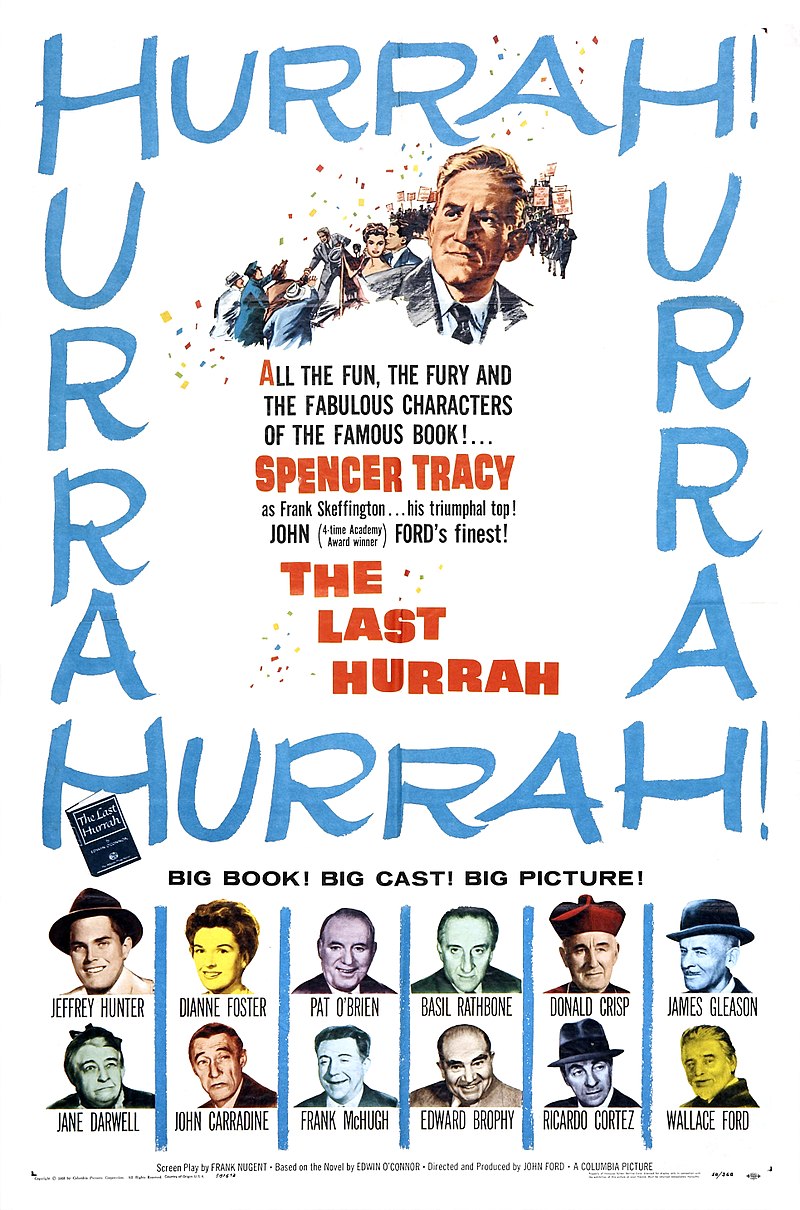
No one would confuse John Ford’s The Last Hurrah for a tirade against big government and political machines. This is not a Frank Capra picture. Instead, there’s a certain level of give and take, a nuance, celebrating a style of old-fashioned politics while acknowledging the need for political strategy and networks.

No director brought more of the Irish-American experience to film than John Ford and you see it from his Calvary westerns to his West Point hagiographies, and even a portrait of his homeland like The Quiet Man.

Frank Skeffington (Spencer Tracy) is in the midst of his latest and perhaps final foray campaigning for the mayorship in a New England town. His personal entourage of right-hand men in bowler hats (including Pat O’Brien and James Gleason in his final role) have seen him through everything.

My initial observation is that this is a mature man’s game. The young (including myself) seem like idiots. His son (Arthur Walsh) isn’t registered to vote, doesn’t watch the debates, and is always running off after golf or other frivolous entertainments.

Another local magnate (Basil Rathbone) who opposes Skeffington has a son (O.Z. Whitehead) who makes a fool of himself by unwittingly accepting the position of local fire commissioner. Skeffington has instant leverage against his old adversary. Then, there’s an up-and-coming appointment — a young Catholic war hero and lawyer. More on him in a moment.

Skeffington is not naïve. He knows how to play the game. He’s continually pragmatic, pressing his advantages and the alliances at his disposal and knowing what it takes to win. You don’t maintain the office year after year without knowing the rules of the game. Perhaps Ford casts him with a rose-colored, nostalgic tinge, but at least he has some scruples or at least a sense of who his people and electorate are. Because he’s been knee-deep in the community.

His most obvious opponent is an unknown newcomer named McCluskey, and it becomes apparent he feels like a caricature cutout of John F. Kennedy if the man lacked charisma and intelligence.

Of course, JFK was a famously photogenic figurehead who used Frank Sinatra jingles, his public image, along with a platform to beat out Richard Nixon in 1960 (He also hailed from one of the most influential families of its day thanks in part to his father Joe Kennedy).

Nixon himself practically instigated the political television revolution with the pathos appeal of his Checkers speech in 1952, and thenceforward the televised debate presaged a radical new kind of American politics. The rules changed.

Adam Caulfield (Jeffrey Hunter), Skeffington’s nephew, works as a sportswriter at a local paper. His editor (John Carradine) fights tooth and nail against Skeffington with an obsessive grudge, throwing every iota he has behind McCluskey so he might vanquish his mortal enemy. Adam is far more accommodating and has a congenial relationship with his uncle.

When he pays the seasoned politician a visit, Skeffington calls politics the greatest spectator sport! He invites Adam to cover the events and tells him in confidence that he wants to try and win a campaign race one last time the old-fashioned way; he’s astute enough to know his days are numbered thanks to television and other readymade forms of advertising.

Although it’s not mentioned explicitly I can imagine Skeffington admired the political acumen and rhetorical vigor of a great American stalwart like Abraham Lincoln. John Ford of course made a whole film about his early years and rise to prominence before he ever became president.

I mention this only to echo the thoughts of Neil Postman in Amusing Ourselves to Death. Our culture shifted drastically from a literary culture where arguments were well-thought-out and expounded upon in debates hours long. And yet in the 1950s and 60s, we see this concurrent shift to a visual, image-based society.

Suddenly we watch campaigns being won and lost by optics, the most beautiful people, or those with the largest media share. It’s a far cry from the past and this is part that’s being memorialized. It’s a strange thing to be reminiscing about a world cataloged most comically in a movie like The Great McGinty, but there is something rather quaint about it compared to the juggernauts of media and consolidated power at work today on a global scale. It dwarfs anything out of the past by sheer scope and reach.

The whole film might easily be encapsulated by a few adjoining sequences. There’s a quiet scene with Anna Lee. Her husband Knocko has passed and left her little to nothing to subsist on. In an act of sheepish compassion at the kitchen table, Tracy offers her a sum of money on behalf of his dead wife. It feels like a pretense he’s made up, and yet here no one sees his kindness aside from the camera.

However, he sticks around for Knocko’s wake, and it becomes an extension of his political campaign. When word gets out, everyone seems to be coming by to pay their respects too, though it feels more like posturing. These moments can be humorous, darkly cynical, and still somehow have glimpses of communal warmth.

Taken on the whole, The Last Hurrah is a grand picture with a lot of cast, story, and ambition. But all that space gives Ford the opportunity to move around in and go to work with his gaze set on humanity. It’s the communal events or moments of ritual where Ford is at his finest: dances, weddings; here it’s a wake and a funeral.

I mentioned Capra before and his pictures, Mr. Smith Goes to Washington in particular, decry the mechanism of the political machine. However, the adapted novel and surely Ford as well had a prescience about them.

He somehow bridges a gap between Capra’s cinema, Sturges’s McGinty, and the emerging landscape. Because Elia Kazan in some ways would depict our certain future with A Face in the Crowd. It offered up a harsh critique focused on a country bumpkin turned charlatan who uses television to captivate the public and wield his newfound influence for political gain.

In such a climate the old guard like Skeffington can no longer exist. Part of this is the march of time. There are aspects of him that feel archaic and ugly with his back parlor dealings. And yet in the same breath, as we look at the vitriol that is shoveled today and the proliferation of social media, it does feel almost quaint. Again, this might be naivete speaking. We so quickly forget the political muckraking of prior centuries because we were not there.

I had to sit with this film, and the longer I was with it the more it moved me. Ford does what he does best by eulogizing someone he deems to be an everyday American hero. The flaws are laid bare and still, he can be lauded as a great man by all those he groused so bitterly with all through the years. On his deathbed, before he is about to be given the last rites, the local Cardinal (Donald Crisp) comes to ask his forgiveness. They have been at odds, bitter rivals, and yet, in the end, there is grace and mutual respect.

It feels like a beautiful testament, like a bygone sentiment we rarely see in politics today. Because Skeffington does signal the end of something — maybe it’s the classical statesman or something else.

Spencer Tracy lying on his deathbed is a picture of blissful contentment, and he has the feisty spirit of an Irishman to the end. The film has all the hallmarks of a swan song, but thankfully he and Ford still had so much to offer us respectively, and in their final years they continued to deliver some of their most rewarding work.

4/5 Stars
Double Feature: Apartment for Peggy & Take Care of My Little Girl

Recently I was appreciating some films starring Jeanne Crain, an alluring actress who was at the height of her popularity during the ’40s and ’50s. Although she was rarely touted as a preeminent actress, I wanted to highlight two films of hers that more than highlight her appeal.

Both Apartment for Peggy and Please Take Care of My Little Girl are set in the context of college in the post-war years. One has Craine as a newlywed wife tracking down student housing and in the latter film she plays a naive college freshman with sorority aspirations.

Read my thoughts on the two films below:

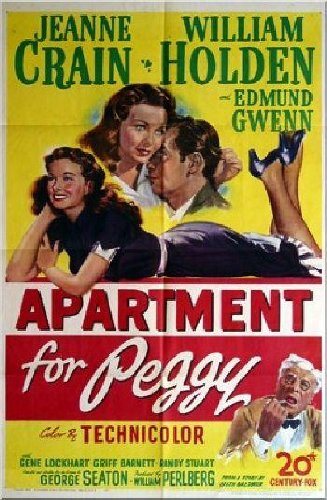
Apartment for Peggy (1948)

Apartment for Peggy is one of those Classic Hollywood films packed with pleasant surprises. The first of them is Edmund Gwenn. He’s best remembered as Kris Kringle in Miracle on 34th Street. Here he’s directed once more by George Seaton this time playing a listless university professor.

He lives off his pension in his crusty old abode spending his evenings with the same colleagues playing the same music they have for years. However, one evening he quite matter-of-factly announces his aspirations to commit suicide. He’s very rational about it. Still, his doctor won’t give him more than two sleeping pills at a time so he dutifully stores them up for a rainy day.

Then, something else far more momentous happens. He meets a young woman (Jeanne Crain) on a bench. Peggy Taylor motors about 1,000 miles per minute — her mind and conversations leapfrogging all over the place — so her new acquaintance can barely get a word in edgewise. He’s bowled over by her irrepressible zest for life. She’s precisely the person to prickle the professor’s curmudgeonly sensibilities. But she’s also the best equipped to turn Mr. Hypothetical’s life upside down for the better.

Because she tackles just about anything she sets her mind to with this same infectious verve. This is not just the age of the GI Bill (her husband is currently a student), but they are also dealing with a housing crisis. She puts her ear to the ground and manages to scrounge up a space in Pop’s decrepit attic. He’s quite against the imposition and still, Peggy keeps ping-ponging off the walls leaving no room for a rebuttal.

It’s one of many miracles how she spruces up the space and puts it through an astounding transformation. This is just the beginning. With Pop’s begrudging help, she conceives a daytime course for wives and mothers so they can learn about the great philosophers of the modern age (Spinozi included). They want to receive intellectual stimulation on par with their husbands so they can communicate with them.

Pops soon learns his new students are intrinsically driven to learn, and the professor is delighted to serve as their instructor because they seem to intuitively understand his teaching as his most receptive pupils. Their discussions are life-giving. You see already how Peggy single-handedly resurrects the old man so he’s able to see the world with new vim and vigor. Now it’s his turn to return the favor.

William Holden is just about the most innocuous thing about the picture, and that’s not to say he’s bad. Still, this is a picture made by the chemistry of Crain and Gwenn. It acknowledges the generation gap chafing between most any generations with varying perspectives on life with a comic touch. However, any conflict on the part of the elders ultimately engenders mutual affection.

Best of all, it’s a film about ideals and worthwhile pragmatism where the merits of both are made evident. But then again, film is not so much a science as it is a philosophy, an art — concerned with humanities — and the film works in this manner.

It gives off the appearance of a light, inoffensive comedy as we conceive would exist in post-war America. There are many. Certainly, this is true. However, it also sheens with warmth and goodness. Seeing the movie multiple times, the appeal of its brand of geniality just continues to bloom.

3.5/5 Stars

Take Care of My Little Girl (1951)

Sorority movies certainly feel like they’re solely made to meet an audience demand as a convenient cash grab. Take Care of My Little Girl wasn’t the first picture in this genre as I can think of at least a couple predecessors like Sorority House and These Glamour Girls (1939).

However, this movie actually had its origins in the master’s thesis of Peggy Goodin, who eventually turned her research into a novel. She was particularly concerned with how racial and religious discrimination played out in the highly moderated spaces of college sororities. To be clear, 20th Century Fox’s adaptation excises all of this commentary by casting their stable of homogenous Hollywood starlets (Jeanne Crain, Jean Peters, Mitzi Gaynor, Betty Lynn et al.) and a couple of male heartthrobs.

And yet that doesn’t mean the film doesn’t come with any teeth. For its day, it was actually rather controversial if only for its forthright portrayal of the social politics and hazing rituals that have continued to go under scrutiny generations later. The film looks different and yet at its core, it speaks to the very same issues we see today.

Jeanne Crain has such a radiant poise, it’s so easy to like her and not only like her but admire her for how she cares about others. Because she’s a shoo-in as a legacy at Tri-U sorority. Just as importantly, she’s probably the prettiest girl on campus. Not even the resident mean girl Dallas (Peters) can blackball her.

Liz cares deeply for her friends and isn’t totally swayed by the popularity contests even as she strives to make a good impression. She strikes up a rapport with a slightly cynical G.I.-turned-student (Dale Robertson), who helps advise her on classes and thrumbs his nose at the establishment after everything he’s been through. He recognizes something different in her that he likes.

Still, she’s not totally impregnable. Like any young person, she wants to be well-liked helping the class flirt (Jefferey Hunter) with the answers to his French exam. This in turn leads to being pinned. She’s the talk of the sorority house. And yet she’s not easy to categorize.

The picture is surprisingly poignant and perceptive. It’s not some hyperdramatic, superficial portrait of college life even if it’s playing to a specific audience. Also, thanks in part to Crain, there’s a genuine candor to the picture and a visible evolution to this young woman.

It may not be a lot, but it’s something. We do see her change as a human being. Surely college life looks so different now 70 years on from what we’re used to, and yet there are elements that have not changed. We still have fraternities and sororities and social hierarchies. I was aghast to realize even bluebooks have been around for well nigh a century!

This movie doesn’t necessarily suggest these institutions are inherently bad. However, sometimes we believe that tradition is good only because it’s the way things have always been done. But there should be better reasons. There need to be dissenters and people to challenge the status quo. There need to be brave folks who are willing to do what is right compared to what is easy. People who are loyal to their friends rather than simply playing the games for want of status and approval.

Even if the Epstein Brothers’ script forgoes some of the most intriguing aspects of the original story, I appreciate that they explore their topic with something a little bit more involved than superficial exploitation. It actually strives to be about something, however small.

3.5/5 Stars

A Kiss Before Dying (1956): Technicolor Noir

A Kiss Before Dying signals its intent with a score befitting a light musical or frothy romantic comedy headlined by youthful heartthrob Robert Wagner. For the uninitiated, the story is based on Ira Levin’s novel and remains all but prepared to plunge into the depths of deceitful drama. This happy pretense only remains for an instant.

The first scene of Gerd Oswald’s picture is between two people we would come to know quite well. Joanne Woodward is turned away from the camera and the handsome profile of Robert Wagner is on full display. They share an intimate conversation as she bawls, and he tries to comfort her. The word “pregnant” was a trigger in 1950s society and so much of the dialogue dances around, but the point gets across clearly enough.

This young woman has gotten pregnant, and she’s not married to her young man. They’re still in school. If you’ll allow me the first of many comparisons, Bud Corliss (Wagner) feels like a less conflicted take on Monty Clift’s protagonist in A Place in the Sun. As a sociopath and a man of ambition, he is an even fiercer aberration of the Horatio Alger archetype. He has no intention of remaining with this girl even as he continues to soothe and placate her.

It’s true that premeditated collegiate crime feels so involved in the 1950s. There’s no worldwide web so Bud nabs a book from the school library on toxicology and sneaks into the chemist supply room to mix a deadly cocktail for his girl. His objectives are explicitly clear.

Mary Astor is almost unrecognizable a generation after her greatest successes as Bud’s mother, but she’s still got spunk. Jeffrey Hunter feels a bit out of place in the picture. It’s true his holding court with a pipe throughout the entire movie is not the most believable bit of business for him. If I’m getting my dates right here he is the same year he was cast as young Martin Pawley in The Searchers.

Whether it’s purely bad casting or the fact he gets shoehorned into a convenient role as a college lecturer and part-time police detective, it’s a shame he was not set up for greater success. Regardless of his handsome face, he usually displays an incisive earnestness propelling him into more interesting territory. It plays rather like the inverse of Wagner’s turn here since Wagner pushes past his outward appearance to give us a brooding performance full of palpable malice.

If there is an element of A Place in the Sun in the movie, then the pessimistic adolescent worldview, specifically in the classroom, feels reminiscent of Rebel Without a Cause‘s Griffith Observatory scene. In a brief classroom discussion of man, reconciling predestination and free will and theological determinism, there’s this same sense of young people having no idea what to make of the philosophy they’re being force-fed. At their worst, they totally disregard its bearing on their lives.

Then, Joanne Woodward’s unceremoniously tossed from the picture. One wonders if it’s her early exit or the fact that it was an early film credit that made her rate the performance lowly.

Regardless, the most obvious touchstone going forward is a bit of Psycho. The intrepid sister (Virginia Leith) of the deceased starts by joining forces with a man to get to the bottom of the death, though she lacks the plucky fire we might easily attribute to Vera Miles.

As a fairly curious filmgoer, I’m always drawn to performers I’ve never been familiar with before. My own viewing habits have a way of fastening onto new faces that intrigue me — often those who I’m unfamiliar with — but they carry the screen in an impressionable manner. Even in a picture like Violent Saturday, Leith turned an eye with a performance that stood out. Here it’s generally amicable but never electrifying.

The film also has two moments that might be considered dramatic “setpieces,” and they both feel generally corny. They lack the Hitchcockian ingenuity, the unrivaled commitment to the vibrant theatricality of Douglas Sirk, or the impassioned emotion of Nicholas Ray. It really is a shame because otherwise, buoyed by a gorgeous palette, the movie suggests all sorts of kinetic energy.

A lot of it flows directly from Wagner, who is delightful front to back as a conniving devil. I only wish there might have been more of Astor and George Macready and that Hunter and Leith were put to better use. The same might be said of Woodward who was on the road to bigger and better things.

We’ve seen this story done better in so many other forms. I’ve listed many of them off quite shamelessly all throughout my discussion; here is part of the core issue. How can you begin to compare A Kiss Before Dying with all these bona fide classics? How do you even begin to compare it with its source material? Instead, if we allow ourselves to remain present, and invested in the individual experience, A Kiss Before Dying is a tantalizing Technicolor noir.

3.5/5 Stars

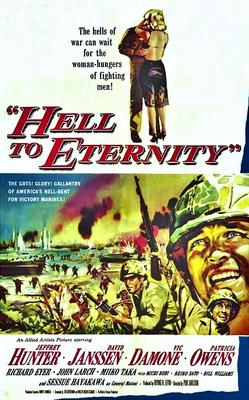
Hell to Eternity (1960): The Story of Guy Gabaldon

Helltoetpos.jpgAs someone of Japanese-American heritage, it’s become a personal preoccupation of mine to search out films that in some way represent the lives of my grandparents and their generation. This means the rich Issei and Nisei communities of Los Angeles, the subsequent internment camps, and even the famed 442nd Infantry Battalion.

Obviously, Hollywood has always had a complicated history with minorities, mirroring broader historical context. Thus, the opening images of Hell to Eternity feel like a bit of a surreal pipe dream — something I’ve looked for a long time and finally discovered. You almost have to pinch yourself into believing the industry actually made this movie.

A young punk (Richard Eyer) and his friend (George Matsui) stare down a trio of thugs who look ready for a fight. Its fitting proof Phil Karlson’s bloody knuckles aesthetic can enter the schoolyard as the two battling adolescence are pulled apart by their physical education instructor (George Shibata)

Japanese-Americans and their culture play a rich and integral part in this biography of celebrated war hero Guy Gabaldon. No, he was not one of them, but he might as well be. Coming from a broken home, his only place to turn is the Une family who gladly welcomes him into their home.

In some small regard, these scenes play out quaintly if not altogether conventional. Guy begins to pick up Japanese quickly and even teaches his benevolent “mama-san” a few terms by pointing to objects around the house. Despite, the stilted acting and out-and-out authenticity aside, the images themselves are powerful. And some background is in order on multiple accounts.

We have George Shibata who was the first Japanese-American graduate out of West Point. Then, Tsuru Aoki was one of the premier stars of the Silent Era even before Sessue Hayakawa. But the connections run deeper still because due to their Hollywood roots and the anti-miscegenation laws at the time, Aoki and Hayakawa wedded and remained married until her death in 1961.

The slightly older George is played by an extremely youthful George Takai. Meanwhile, there’s further Japanese-American representation in Papa-san, Bob Okazaki, and the likes of Reiko Sato and Miiko Taka.

It should be noted the Unes are some sort of amalgam of the real-life Nakano family whose son Lane fought in the 442nd and later become a short-lived actor in the likes of Go For Broke! and Japanese War Bride (1953). All of these basic details are based on fact.

However, with this necessary context in tow, it’s about time to turn our attention to the man himself who held such a unique background in his own right. Because make no mistake, Guy Gabaldon is certainly worthy of the biopic treatment even if a picture like this can’t quite do the man justice. That’s fine.

Although what it develops into is an unwieldy drama and having Jeffrey Hunter portray Gulbadon is one of the most hilarious examples of overstated Hollywood casting.  It feels like having John Wayne play Audie Murphy. However, what Hunter lacks in similar likeness and physique, he more than makes up for by capturing the resiliency of his subject. He offers believable candor and the embodiment of American exceptionalism.

Allied Artists was a B movie mill and Hell for Eternity was their wealthiest, most expansive undertaking to date, with their number one moneymaker on assignment: industry workhorse Phil Karlson. In one sense, Karlson seems well-equipped for some elements and then woefully disadvantaged for others.

Hell to Eternity proves itself to be wildly uneven because without jumping the gun, the opening scenes are quietly revolutionary and truly unprecedented when you consider Hollywood’s track record. Then, there’s a shift as his family is unceremoniously shipped out to internment camps, and you have Guy rushing to every branch of the service only to be rebuffed at every turn. Still, his remarkable qualifications — namely his Japanese abilities — gain him an in-road.

We also have the introduction of his buddies. Despite getting off on the wrong foot, Sergeant Bill Hazen (David Janssen) proves himself to be an intense adversary and an even fiercer companion. As they foster mutual respect and camaraderie, it becomes evident he’s the type of buddy you want in your corner. And if he’s too intense, the swinging, snapping, undulating lady’s man, Junior (Vic Damone), more than brings the party.

It’s around this time where the film reimagines itself as what could easily be considered an entirely different movie. The midpoint in Hawaii has them left entirely to their own devices with one glorious night of freedom out on the town before they ship out. Not to be disappointed, they are treated to a titillating striptease show, courtesy of Sato, with the steamy hot jazz cutting through the night. The men cheer on the women with a rueful round of inebriated leering.

Where does this all end? How does this tie into Guy Gulbandon’s story; in short, it doesn’t. What does happen is the softening of the so-called “Iron Petticoat,” a woman journalist, who has gained notoriety for her prudish ways. It’s by far the most cringe-worthy sequence as Ms. Lincoln (Patricia Owens) lets her hair down, as it were.

What follows is a barrage of lingering shots over heels, tights, legs — you get the salacious idea — and from a distance, we can admit to it being fairly risque for the 1960s. It becomes amusement for their entire company. The woman’s impregnable defenses have finally been conquered. Whatever that means.

However, with a few abrupt cuts the whole meaning of these scenes is almost salvaged. Effectively, there is no interim. We get thrown directly into the campaign and their wild bender of an evening is only a distant memory as they cut their way across the shores toward the enemy embankments.

Even as Karlson isn’t able to make every crosscut of action fundamentally compelling, he’s far more in his element amid the volatility and constant barrage of bullets and bodies. What felt initially so quietly groundbreaking and devolved into needless exhibitionism, finally settles into his forte.

Here he can dig knee-deep into the nitty-gritty and give us something that packs a wallop. Hell to Eternity is a lot less sanitized than I would have surmised, especially given its era. However, there is no mincing when it comes to what we are privy to on the simulated battlefield. He capably mobilized thousands of extras from Okinawa for some of the most spectacular scenes where the large scale is matched with tumultuous elements of very intimate trauma.

And even as the skirmishes settle into a kind of chaotic equilibrium, Galbadon — using his Japanese skills — earns his moniker as the “Pied Piper of Taipei.” Using the talents he’s been gifted by his incredible upbringing, he does his best to coax the already cowed but testy enemy to surrender using their native tongue.

The one figurehead emblematic of the proud foe is portrayed by Sessue Hayakawa, emulating his similar role from Bridge on the River Kwai as a derisive Japanese officer. Once Galbadon can conquer him, he’s all but won the fight behind enemy lines. More than anything, I’m disappointed in the fact that we never circle back around to his adopted family nor the exploits of his brothers. Still, for more context, Go For Broke! plays as a decent companion piece about the 442nd.

So although it’s an imperfect and often befuddling vehicle, Guy Gulbadon was a hero more than worthy of a biopic. Regardless of any faults, Hell to Eternity is bristling with not only action but specific depictions of a historical time and place that often remain overshadowed in Hollywood to this day. It’s been one of my missions to discover more representations of Japanese-Americans in American cinema, and in this regard, Hell to Eternity is a stirring success. It can’t help but be groundbreaking even in spite of its unassuming nature. I look up at the screen and there’s a personal connection.

3.5/5 Stars

Sergeant Rutledge (1960): Starring Woody Strode

“It’s alright for Mr. Lincoln to say we’re free, but that ain’t so. Maybe someday, but not yet.” – Sergeant Rutledge

Sergeant Rutledge rarely gets talked about with the greatest westerns or even the greatest westerns of John Ford. Without getting overly effusive with my praise, it should be heralded as an underrated gem worthy of far more scrutiny. History is more than on its side. The movie preceded To Kill a Mockingbird by at least a year while examining similar themes of a black man on trial for rape, albeit through the specific settings (ie. Monument Valley) and lens of its director.

As purely a courtroom drama, it’s probably more engrossing because the other film is just as impactful for its relationship outside the court’s walls. The familial relationship is the core of the story. In Sergeant Rutledge, Ford gladly builds up the atmosphere of the courtroom while allowing it to bleed out and color the rest of his narrative, set against the backdrop of apache raids.

Willis Bouchey stands out as the demonstrative head of the court marshall tribunal, Lt. Col. Otis Fosgate. The turn might be one of his most substantial and enjoyable roles on the big screen. Not only did he have an extraordinary career on the small screen, but he was an often called upon member of John Ford’s stable of actors. His foray in this picture makes it plain enough. Every time he asks for “water” or scolds his wife, it provides instant texture.

Because his wife, Billie Burke, is one of the goody-two-shoes in the peanut gallery, prepared to watch the court case in their finest clothes with their mouths agape and their eyes agog. Meanwhile, the rowdiest fellows stand impatiently in the back smoking their pipes and raising a brouhaha. The judge has enough gumption to clear them all out.

There’s no doubt Ford is in control of the courtroom scenes, from its initial clearing to the subsequent stage lighting to highlight witnesses on the stand. It’s quite extraordinary rather like when Hithcock worked through The Paradine Case breaking the stagnant sequences up with purposeful moments. These are bulked up through substantial flashbacks where we are allowed to invest in the drama firsthand, becoming involved more and more in something that feels like a traditional murder mystery.

The first to take the stand is Mary Beecher (Constance Towers), a quivering young woman who caught Sergeant Rutledge in a compromising and nevertheless now comes to intercede on his behalf, not to accuse him. She recounts how, left in a deserted town, it was the honorable soldier who willfully saved her life.

Next, Fosgate’s own wife (Burke) takes the stand with her usual tittering mannerisms, relaying the last time she saw spunky young Lucy Davenport alive, before she was brutally raped. She came to the general store and shared a conversation with Rutledge. This was no surprise as he was the man who taught her how to ride a horse and practically raised her. To the eyes of all those on the outside looking in, it leads them to burn with indignation.

The dialogue throughout is often curt if not altogether mundane, even overly twee in the lightweight moments, but the scenario itself and Ford’s interaction with it, make it worthwhile viewing. It’s what he’s able to build up around them, devolving into a fairly unheard of exploration of racial tensions on the range. When it gets talky and the message is made obvious, it loses its impact — looking all the more of its time.

What builds a lasting impression are the images — watching the 9th Cavalry of Buffalo Soldiers — appreciating their discipline and fortitude. Surely seeing these representations say enough about how American society treats non-whites, both in life and on celluloid. They are deserving of the same amount of human dignity and not having the burden of proof thrust upon them merely based on the color of their skin.

Because this is what it comes down to. Sergeant Rutledge (Woody Strode) is on trial to be hung, accused of rape and murder. This is not a pleasant affair whatever the outcome might be. As Jefferey Hunter headlines another Ford Western (following The Searchers), he holds a crucial stake in the case as both one of Rutledge’s superiors but also his defense counsel, and, ultimately, his friend.

Woody Strode might be buried in the credits, but there’s no doubting his prominence at the heart of the drama. It’s his stalwart characterization that allows it to stands out from the crowd of westerns from the era — and in Ford’s own lineage — because it gives him a place of cinematic significance. One scene, in particular, is easy to call upon.

In the dead of night, there’s a refrain of “Captain Buffalo” as Sergeant Rutledge stands on the ridge, the moon in the foreground behind him, looking down at his men; it’s only a brief aside, but something in me stopped still because these are the kinds of moments, if you’re lucky, you’ll see in a Ford picture. How do we quantify them? They’re a feeling, a sense, speaking to so much of who we are and what our country means. It’s history, both rich and also riddled with honor and disgrace. I look at Rutledge and I’m proud and a moment later ashamed for how a man such as this is treated.

Woody Strode was used quite well by John Ford on several occasions; he gained some repute for his role in Spartacus; but to my knowledge, he never had a role more extraordinary than that of Sergeant Rutledge. It’s indicative of the industry that Strode — once a football star alongside the likes of Jackie Robinson — was never a bigger movie star.

Here is a picture that allows him the opportunity to show his talents, and he does so with unsurpassed strength and dignity. Captain Buffalo, as eulogized, is a mythical figure surpassing John Henry in his larger-than-life gravitas, and Woody Strode is as close as we could have gotten to seeing him in the flesh.

Part of this is the man himself, quiet yet formidable, and of course, Pappy Ford does him the greatest service. He allows him to be great and sets him up in such a sympathetic yet empowering light.

I’m glad we have this movie, and I’m delighted Ford had the guts enough to make it. Woody Strode deserved many more pictures like this one. For that matter, so did the eminent Juano Hernadez and all these men. It has to do with what this film represents.

We rarely get to see eulogies to the Buffalo Soldiers and this one is as good as anything I’ve ever had the pleasure of experiencing. It’s captured as only John Ford can do it — enamored with the American myth — while still beholden to our own hardened reality. To come to terms with both is one of Ford’s great gifts.

4/5 Stars