Point Blank (1967)

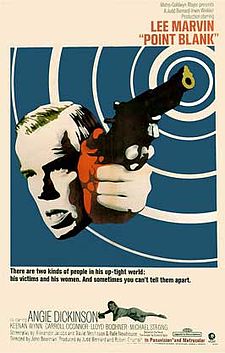
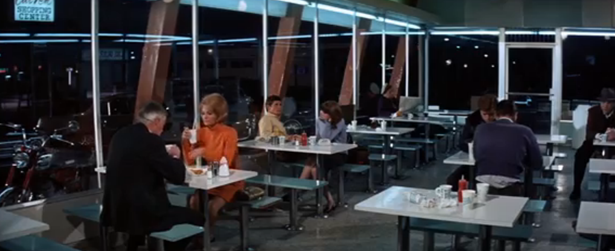
225px-PointBlankPosterJohn Boorman and Lee Marvin came together as equal parts in this venture called Point Blank and it’s quite something. You can call it neo-noir, you can call it a revenge story, a crime film, but nothing quite sums up what you end up with.

It’s a brutal, stark, psychedelic trip at times that never falters to any level of convention that we are used to. You have the clip clop of shoes on the concrete. Solemn, self-assured, repeating and ultimately deadly. There’s a man named Walker (Lee Marvin) on a seething rampage. He personally totals a car with the victim inside scared out of his wits. He’s shooting up victims all across kingdom come. Watching, waiting, then acting.

Point Blank is full of repetitive, reverberating sounds and images. Time too is repeating and evolving; fractured shards of the past followed by the present. It does not always line up or add up. Walker’s past is being fed to us through his own memories.

We get to pick up the pieces as he pushes forward on his vendetta. His wife is dead and he is after a man named Mal Reese, who double-crossed him, stole some of his money, and his girl. But the hunt doesn’t end with Reese. That would make too much sense and it would be too easy. Walker keeps going. Keeps hunting until it leads him to the next man and then the next. He gets together with the older sister (Angie Dickinson) of his wife Lynne (Sharon Acker). She is the repetition of Lynne who is now dead, just as each one of these targets is the new Reese.pointblank2There’s a point where we must beg the question? What does Walker even want now if all he gets is $93,000? What is going on in this world? Why does it tick in such a way, because to be honest, it doesn’t always add up? Is the Alcatraz we see and then the L.A. landscape true reality or is this a dream that Walker has created so he can act out his revenge? After all, he was shot, right? It might be a long shot, but the plan of Walker in itself is a long shot. He just continues pushing on and the hunt leads him back where he was in a perfect circle.
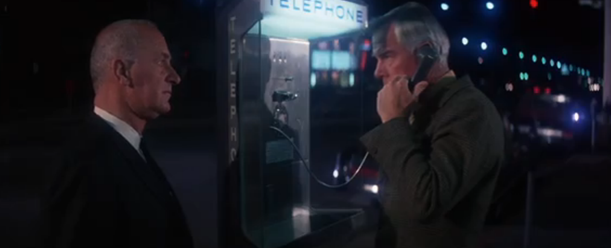
Now what? Reese is gone. Lynne is gone. Every single middleman is gone. He has a load of money laying out at Alcatraz for him and perhaps Chris is stilling waiting for him. We don’t know. That’s where Point Blank finds its conclusion and it’s just as vague as where we jumped in.pointblank3It’s understandable that it has gained a cult status over the years since Lee Marvin is an uber-cool gunman and his journey is hard to figure. His world is a bleak cityscape of 1960s L.A. and S.F. We can never hope to fully understand him or this world either and that’s the beauty of Point Blank. There is a degree of ambiguity that is fascinating. Heck, we don’t even know this man’s first name and yet we invest time in his story. I want to see Point Blink again because it’s not just your typical shoot ’em up action film. It makes you think and it has such a cool aurora and style. It deserves another viewing at some point soon.
4/5 Stars
Review: The Postman Always Rings Twice (1946)

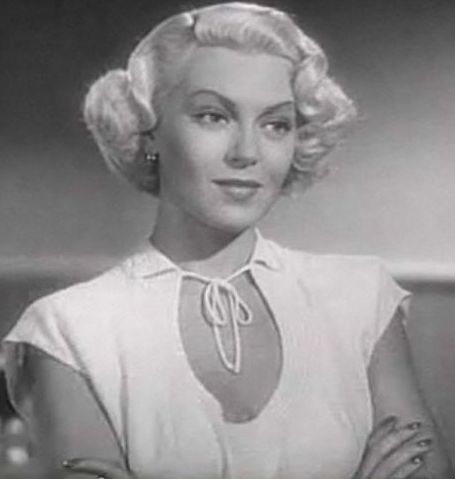
Lana_Turner_in_The_Postman_Always_Rings_TwiceThe first time I saw this gripping noir, my least favorite part of the film probably was the title, and it still is. That’s saying a lot, and the film is adapted from the James M. Cain crime novel anyways, with the title included free of charge. Otherwise, Postman is a wonderful example of the film noir canon, and yet it lacks the elements of your more typical private eye mystery.

It trades dark streets of crime for a small roadside burger joint owned by a shrewd man and his noticeably younger wife. Bring a drifter searching for a quick buck and you have everything set for the deadliest of love triangles. At the tips are John Garfield as the rambling man Frank who initially couldn’t care less for his boss’s pretty wife. Then there’s Cora, the alluring girl who seems out of place in her life. Then you have the money-grubbing Nick (Cecil Kellaway) who seems naively oblivious to the whole situation.

At first, nothing seems to be afoot, and Cora is adamant about not getting involved with the new hand. However, ultimately things evolve. That’s not necessarily the exciting part. We expect the rapid and lurid love affair that soon besets Frank and Cora.  We expect, more likely than not, that Nick will either catch them or they will knock him off first. They choose the latter and its far from preferable. Soon the district attorney is down their throats with his own suspicions about the forbidden couple. He’s pretty smart too.

Sackett plays Frank and Cora off of each other. They’re both scared. Neither one wants jail or worst the gas chamber. Nora ends up being the only one prosecuted, but her sly lawyer (Hume Cronyn) is able to call his opponents bluff and get Cora off with hardly a hitch. The only problem is that Frank and Cora hate each other guts now. They are positively poisoned to each other.

The story could end there and it would be ironic enough, but it doesn’t. It has yet another act where Frank and Cora make up following the illness of her mother, the flourishing of her establishment after the trial, and a bout with blackmail. All seems to be better than it ever was, but fate can have a cruel sense of humor.

On one out of the ordinary car ride, Frank crashes and in the aftermath, Cora is left dead with Frank on the fast track to the gas chamber. And that’s where the title comes in. The Postman Always Rings Twice. In other words, if you don’t pay for your crimes the first time around, you always end paying up one way or another. Cora was killed and Frank faced execution. Neither one got off in the end.

Putting aside the Hay’s Codes need for justice to be dealt, this is a wonderfully sardonic tale and ultimately sensual noir for the 1940s. Lana Turner was never better dancing with relative ease between amorous sweetness and acidic intentions. And the moment she first shows up on the screen is one of the most eye-catching entrances by a femme fatale period. Although not the greatest of leading men, John Garfield is surprisingly credible opposite, Turner. He plays the hard-working everyman incredibly well. Hume Cronyn, for his part, plays his wily prosecutor wonderfully with a sly smile all the while. I cannot quite put a finger on it, but I like him.

4.5/5 Stars

Seven Brides for Seven Brothers (1954)

Seven_brides_seven_brothersThe title gives a clear indication of what this Stanley Donen musical will be about, but it does not tell us how we will arrive at that conclusion. It all begins when a woodsman named Adam (Howard Keel) comes to town intent on finding himself a cute and handy bride. That he does in Milly (Jane Powell) and soon enough, in a whirlwind, they are married and heading back to his home. There she is greatly surprised to meet his rambunctious and rough-edged younger brothers. Six to be exact, but you already guessed that.

Once she accepts her new life, it becomes Milly’s mission to straighten them out and find them girls to court. It isn’t easy but soon they learn table manners and proper etiquette before the big barn raising takes place. There the boys make quite the impression and the audience is given quite the show complete with bright colors and inventive-foot-tapping choreography. It’s an understatement to say that the Pontipee brothers are not popular with the locals, and not only is there a barn-raising but some hell-raising as well.

Adam is proud of their showing, but the rest of the lads are lovesick as the long cold winter begins, separating them indefinitely from their girls. With Adam’s encouragement, they decide to do as the Romans and kidnap their sweets, but they fail to think about the consequences. The town’s in an uproar, the girls are frightened, and a man-made avalanche means there is no contact with the outside world for at least 5 months!

Milly is appalled by their actions, especially Adam’s part, and the lads are made to sleep in the barn as she dotes over the scared group of girls. Not liking what he’s seeing, Adam heads off on his own for a while. Spring brings a fresh start as young love flourishes and the boys are forgiven. Milly gives birth to a baby girl, and Adam finally returns home with a new perspective. But what about the town folk you ask? They do come after the  Pontipees, and they don’t like what they see when they ride in. Needless to say, it is a happy ending with each boy getting his girl, thanks to a few shotguns.

With catchy songs, beautiful color cinematography, lively dance numbers, and an amusing premise, this is a very strong MGM musical, even if it is not the best of the lot. That is not saying much because the studio could hardly go wrong with such previous titles as On the Town, An American in Paris, Singin’ in the Rain and The Band Wagon. Seven Brides is a nice addition although I will say it vaguely reminded me of Oklahoma. However, it is different enough to be well worth it. The only question left to ask is, “Are Adam, Benjamin, Caleb, Daniel, “Frank,” and Gideon natural red-heads? I’m not sure I know the answer but I could wager a guess.

4/5 Stars

The Women (1939)

 6d603-womenHere is a film full of personalities. In fact there is so much personality that it nearly bowls you over with its impact and frenetic force.

In the center of it all is Norma Shearer who is the respectable socialite who is losing her husband to another woman. Joan Crawford is the gold digging woman who is as detestable as ever. Rounding it out is the equally repulsive gossip played to a tee by Rosalind Russell. There is the ever innocent Joan Fontaine and a spunky divorcee played by Paulette Goddard. Throw in numerous other memorable women and you have a cast that completely overwhelms, but in a good way.

Husbands and lovers seem to being switching hands so easily and the whole film is focused on the women who are swapping them. It begins with Mary Haines’ husband only to continually get more complicated as more gossip is divulged and mud is thrown. Not to mention a few angry fists and slaps to go with the caustic words.

There is a lot to admire about this film, because it does what it set out to do very well. It creates some empathy, some laughs, and yes, a whole lot of loathing.

However, as I contemplated the film I realized although the Women is from 1939 and the clothes often seem laughable, the people and issues in the film often seem all too real. Divorce hits close to many homes literally and gossip certainly has not gone instinct. Thus, despite the passage of time, in many ways this film still feels fresh and relevant today.

4/5 Stars

The Women (1939)

6cabb-poster_-_women_the_01Starring a cast including Norma Shearer, Joan Crawford, Rosalind Russell, Paulette Goddard, and Joan Fontaine, this film is all about the lives of these women. Mary is a member of New York high society who is happy with her marriage. However, when her gossipy friends begin to talk about her husband with another women she is hurt. She eventually  files for divorce and while waiting for the conformation in Reno she meets some new friends and is finally able to find a way to get her husband back. Needless to say the ending is happy and a few women get what they deserve. This film had an enjoyable introduction, a sequence in Technicolor, and an all female cast. Most of all it characterizes the various women in this walk of life. Some are kindly, others foolish, and still others are treacherous.

4/5 Stars

Review: Singin’ in the Rain (1952)

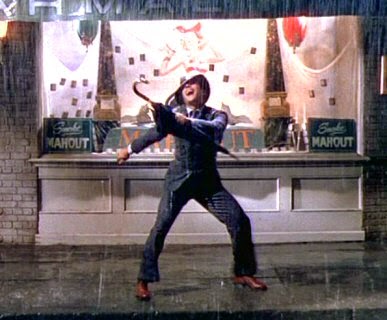
f7d3a-singin_rain I always seem to get goosebumps during Gene Kelly’s “Singin’ in the Rain” number, because each time I see and hear it, there is still a new magic to it every time. You see when I was young, before I knew all the classics, first and foremost, I knew this gem of a film. It is such a wonderful buildup to that moment with such personal favorites as “Make em’ Laugh” and “Moses Supposes.” Then you have the always popular “Good Morning” with not only Kelly but Donald O’Connor and Debbie Reynolds performing. Great stuff! There’s tireless choreography that goes into many of those sequences but it comes off so effortlessly and it brings us into the moment. There those wonderful, brief instances when you lose yourself in the music, the magic, and so on.

As the story goes, the three friends save the failing “Dueling Cavalier” by losing the simple “talkie” gimmick and making it a musical by dubbing the squeaky-voiced Lena Lamont (Jean Hagen). Cathy (Reynolds) no longer is a bit player, and she gains the acknowledgment that she deserves. Then Don Lockwood (Kelly) gets the girl who burst out of a cake. Cosmo Brown (O’Connor) is along for the ride staying with Don through thick and through thin, even calling him a cab when necessary. He’s a true friend in a million.

Although Kelly had a career with other high points (arguably never as high as this one), I am always slightly saddened that O’Connor and Reynolds never reached another apex like this in their subsequent careers. But they were both so great here, we must simply cherish this film for what it is.

Even to this day, the film holds up, and that is a tribute to the writing of Betty Comden and Adolph Green highlighting the infant Hollywood and the advent of talkies. In the same breath, it’s both a satire of the movie star culture and still a love letter to that same cottage industry. The only film with a similar dissection of Hollywood’s Golden Age is another 50s classic in Sunset Boulevard. The big difference is that Wilder’s film is chock full of drama and darkness. Singin’ in the Rain will always and forever be a light, fun musical with a lot of laughs.  It is constantly quotable whether it is “dignity, always dignity” or “I CAN’T stand it!”

Jean Hagen is always the butt of everyone’s jokes, but she is indeed very funny with the most annoying voice in the history of cinema (She can’t act, she can’t sing, she can’t dance. Triple threat). You also have other fine performers like Millard Mitchell as studio head R.F., and then appearances by Cyd Charisse and Rita Moreno who made a name for themselves as dancers in the ensuing years. And is it just me or does Donald O’Connor remind others of Danny Kaye? He not only cracks the jokes, but he is a wonderful all-around performer. Although O’Connor was undoubtedly a better dancer.

All in all, this is a timeless classic and it will undoubtedly keep that title for as long as people watch movies. Now I hope it starts pouring buckets of rain so I can go outside and stomp around in the puddles. I will let you know if I come down with pneumonia. But until that happens I’ll enjoy every minute of it. I entreat you to do the same.

5/5 Stars

A Night at the Opera (1935)

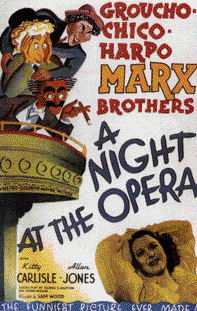
Starring The Marx Brothers, this vehicle for their comedy has Groucho, Harpo, and Chico trying to help two lovers earn  positions at the opera. Along the way Groucho tries to marry a rich patron and Chico and Harpo run from the law as stowaways. This film which could be seen as having a dramatic story, is constantly interrupted by Marxian gags. Some memorable moments include the insanity clause, two hard-boiled eggs, Groucho’s crowded stateroom, and the final scenes in the opera house. Only with the Marx Brothers would you hear Take Me Out to the Ball Game at the opera. Although Duck Soup has critical acclaim, I find this one more entertaining as comedy with a real story line. The MGM years were ushered in by this film and solidified the Marx Brother’s legacy.

4.5/5 Stars

Cat on a Hot Tin Roof (1958)

671b8-cat_roofAdapted from the Tennessee Williams play, the film stars Elizabeth Taylor, Paul Newman, and Burl Ives, with Jack Carson, and Judith Anderson. The film opens with Brick Pollick (Newman) injuring himself while he is drunk one night. The next day he is still constantly drinking and cold to his wife Maggie (Taylor). We learn this is because of the death of a friend. At the same time Big Daddy (Ives) arrives to celebrate his birthday with his family. The evening is full of angst and conflict over Big Daddy’s health, lies, truth, power, and love. Maggie wants Brick to look out for his interests based upon the conniving actions of his brother’s wife. Brick wants nothing of it and eventually tells his father so. They reconcile and Brick makes up with Maggie ending this film on a positive note. This film was certainly full of unrest and drama showing people struggling in love and figuring out their lives.

4/5 Stars

Mrs. Miniver (1942)

Starring Greer Garson, Walter Pidgeon, Teresa Wright, and directed by William Wyler, this film tells the touching if not sad story of an English family. We follow their life from the happy moments before World War II to the hardships in the midst of it. Through it all Mrs. Miniver is a quietly strong wife and mother who holds her family together. Whether she is waiting in a bomb shelter, capturing a German parachutist, or simply taking care of her family, she exhibits amazing courage and fortitude. She is a testament to those fighting on the home front  Mrs. Miniver is not a part of Dunkirk like her husband. She is not flying like her son but her role is just as important. Even in the closing when tragedy has hit Britain, the country and its Mrs. Minivers stay resilient. First used as a propaganda device in the 1940s this film is till moving today. When you see any of these people rejoice or suffer you too are moved.

4/5 Stars