Review: Rebel Without a Cause (1955)

_Rebel_Without_a_Cause_James Dean

You can wake up now, the universe has ended.” – Jim Stark to Plato in Griffith Observatory

James Dean’s “The Rebel Without a Cause.” It’s his image as much as it is a film for many people. But if we actually take the time to examine him,  Dean subverts expectations. There’s this aura built around him as that iconic rebel–cigarette in hand–a glint in his eyes. However, the beauty of his performance as Jim Stark is how broken and even gentle it is. Certainly, we remember the moments where he screams at parents, bashes in desks and kicks paintings, but really most of his screen time is made of quiet nuances. He has no friends. He’s lonely and reserved. He just wants respect.

He wants someone to listen to him–someone to stand up for what’s right. And he feels like a pendulum swinging madly between his bickering parents, constantly making him go this way and that, moving from town to town, time and time again. It sickens him and he reacts in the only way he knows.

Rebel is just as much a subversive film, being so daring as to suggest that juvenile delinquency is a sort of created social construct. Kids do bad things, sure, teens are no good, but if you dig around a bit and look in the closets, the skeletons reveal themselves in due time. We now conveniently call them “family of origin issues,” but that puts everything in a nice box when the reality is actually very messy.

That’s why the crucial scene in Rebel is when our three solitary teens go to Plato’s (Sal Mineo) abandoned mansion getaway in the dead of night.  Alone it would be a house of horrors, but in community, they make it a pleasant affair–even playing a game of “house” complete with stuffy honeymooners, who don’t want kids unless they never have to see or talk to them again and a realtor who is is willing to give them the place for $3 million a month (Thankfully the newlyweds have a budget!). In essence, amidst their jests, they’ve become one happy family, finding a bit of solace from the asphyxiation of the world around them. The world accentuated by not only their parents but their peers too. However, it cannot last.

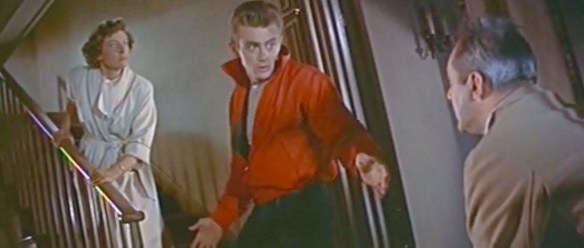
It’s these moments that feel so light and carefree and that’s the key. Blink and you’ll miss them. Look away and the bubble is popped. Focus on the drama and you’ll get it all wrong. Because the moments of drama are exactly the moments that you expect to get some deeper understanding of their psyches. You look at Jim in the now iconic scene on the staircase, quarreling with his parents or Plato running off like a frightened rabbit packing a gun. We can shake our heads and ask “why?” but if we only sit back and listen, it becomes all too obvious.

If Mr. and Mrs. Stark just listened, if Judy’s parent’s paid heed to her, if Plato actually had parents present in his life, maybe they could see what was “tearing them apart.” The suffocating hopelessness of the world that seems magnified tenfold in your adolescent years, as things are changing so rapidly. You’re getting pressured beyond belief and to top it off, it seems like no one understands you–not in the least.

Thanks be to Nicholas Ray for bringing such an intimate study of youth to light, because it’s certainly melodrama, elevated by the unpredictable magic that is James Dean. That’s often the spotlight of this film and quite understandably so, given the lore around his legendary career and tragic death.

But cull its depths and there’s even more if we look at how everything is initially foreshadowed at the Observatory, where the man in a droll tone nonchalantly summarizes the insignificant end of earth–only an infinitesimal speck in the patchwork of the universe (“In all the immensity of our universe and the galaxies beyond, the earth will not be missed. Through the infinite reaches of space, the problems of man seem trivial and naive indeed, and man existing alone seems himself an episode of little consequence”).

Buzz tells Jim before their “Chickie Run” that he actually kind of likes the guy now, but still, “You gotta do something. Don’t you?” It’s the despondency of their existence. Buzz soon dies and people hardly bat an eye.

Never before had I considered how this entire story unfolds in the course of one tragic day. It’s not realism by any means, but instead, it’s bursting with the passion and pain as reflected by Ray’s camera and impeccable use of color.  It’s as if the teenage experience is being wholly magnified and consolidated into a single moment. That’s what Rebel Without a Cause embodies.

5/5 Stars
They Live by Night (1948)

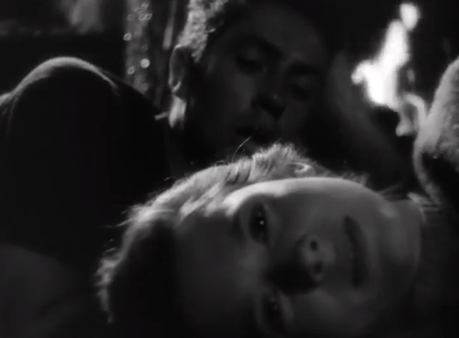
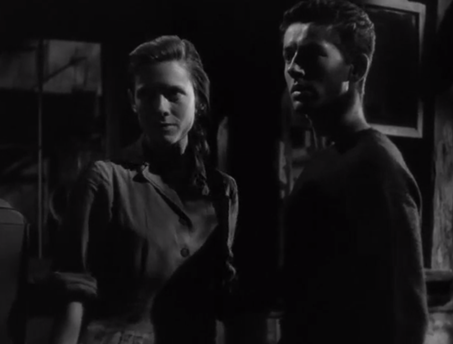
theyliveby4Regrettably, I have seen very little of Nicholas Ray, however from his debut in They Live by Night, I saw the same care spent on his youthful characters, which is also noticeable in Rebel Without a Cause. He does not treat “Keechie” and “Bowie” as cardboard cutouts or kids who are dumb and in love. They have value and feelings that are worth examining more closely.

The film opens with three thugs breaking out of the local prison. Two of the men Chicamaw (Howard Da Silva) and T-Dub (Jay C. Flippen) are weathered criminals. The third, Bowie is a baby-faced kid looking hardly a day over 20, but he went into the clink for a reason.

They find shelter at a nearby filling station where Chicamaw’s mangy older brother (Wil Wright) makes a living with his timid, no-nonsense daughter Katherine. They get a car and have enough money to get their feet off the ground before a big bank job in Kelton.

theyliveby2It goes off without a major hitch, but soon after Bowie gets in a car accident and Chicamaw takes him back to his brother’s to be cared for. Katharine is there and the two of them find companionship in each other because neither one has anyone else to turn to. They are young, naive, and in love. They’ve never had these types of feelings before.

Since Bowie needs to lay low, he takes “Keechie” with him and they make an adventure out of it. Ultimately, it results in a cheap $20 marriage and a lot of nice intimate nights spent together driving and cuddling. They’re living the lives of carefree newlyweds who need no one but each other. They find a simple cottage out in the backcountry owned by a homely proprietor (Byron Foulger), and it acts as a new home. A perfect oasis from the newspapers, the cops, and Bowie’s accomplices.

However, they do catch up with him eventually, and he and Katherine split fast after a tiff. They want a normal life, but Chicamaw and T-Dub won’t allow it because they need more money from another bank job. He won’t and in the subsequent attempt, his former partners eat it. The lookout is still hot for the boy as well.

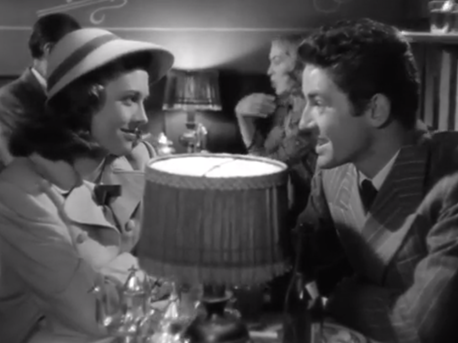
theyliveby1He seems so undeserving of hard justice, but it is bound to come after him anyways. For such relative newcomers, Farley Granger and Cathy O’Donnell (The Best Years of Our Lives) have such genuine chemistry opposite each other. Granger is more often than not gentle and kind. O’Donnell is pretty in a simple, unadorned type of way. They elicit so much more sympathy than Bonnie and Clyde or even the fugitives in Gun Crazy. Perhaps because they aren’t even outlaws, only young kids who are victims of their circumstances.

4/5 Stars

In a Lonely Place (1950) – Film-Noir

Starring Humphrey Bogart and Gloria Grahame with direction by Nicholas Ray, the film is about a struggling screenwriter with a hot temper. Dixon Steele (Bogart) has not written a good script in a while but then one evening he has an enthusiastic young woman explain a novel he is supposed to adapt since he has not read it. Everything goes seemingly normal however the next morning she is dead and Steele is the main suspect. The police investigate, including Steele’s detective friend, but a neighbor gives an alibi which seems to save Steele. Soon Grahame begins to fall in love with him and vice versa. However, she soon realizes his violent side and second guesses Steele’s innocence since he has such a violent history. Although they are to be married it is broken off when he finds out she was going to leave. Only then does Grahame find out he was indeed innocent but the damage is already done and their relationship cannot be saved. This is a pretty good film noir with powerful characters.

4.5/5 Stars

Rebel Without a Cause (1955)

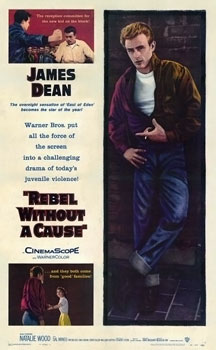
A film starring James Dean, Natalie Wood, and Sal Mineo,  with direction by Nicholas Ray, Rebel Without a Cause follows three teenagers, who are confused and conflicted about their lives. 

The initial sequence rolling behind the opening credits has the inebriated Jim Stark lying in the street fiddling with a toy monkey. Then, he is brought into juvenile hall, and simultaneously the story gives us a glimpse of not only the rowdy Jim, but discontented Judy, and the distant boy Plato. Each one has their own personal pain, and thus this film from the beginning really focuses on three rebels, who embody the adolescent generation. James Dean is Jim Stark: the new kid on the block, who is constantly moving with his parents. In the station when his parents retrieve him, there is obvious tension on all fronts, which include heated arguments, and outbursts on the part of Jim.

The morning after being brought in he meets Judy only to get mixed up with her friends. Stark however also befriends the isolated loner Plato, who was in the station the night before. The trouble with the other teens starts with a switchblade contest during a school excursion to Griffith Observatory, but the stakes get bigger when they compete in a “Chickie Run” over a cliff. Stark lives but the other boy, Buzz, dies in the accident. Everyone flees the scene before the police arrive.

Stuck between a rock and a hard place, Dean and Wood’s characters gravitate towards each other. Their parents seemingly do not understand them, and so they find comfort in each other instead. Their new found friend Plato tags along as they hold up in an abandoned mansion for the night. They spend the evening lounging around, making light of their parents and just talking. 

However, all does not bode well when some of the high school thugs come looking for Stark. Plato flees the scene with a gun, and soon he has policemen on his tail. Plato is in a paranoid and unstable state. Jim tries to console him and bring him out peacefully. But despite his best efforts, tragedy strikes one final blow.  All is not wasted, however, because Jim’s father (Jim Bachus) vows to be a better and stronger parent than he was before. 

Following his breakthrough in East of Eden, Rebel would be the movie that defined Dean’s short but iconic career. His line “you’re tearing me apart!” would further define the angst felt by many teens at the time. There is a certain aura around this film for some reason, maybe because of Dean’s portrayal that is at times so moody, and at other times so subtle, but powerful nonetheless.

I think part of the credit must go to director Nicholas Ray, who gave Dean free reign to improvise and develop his character in the way he saw fit. The film is tragic in another sense because all the primary stars died at an early age. Dean’s is the most remembered, but Mineo and Wood, both died extremely young as well. In Rebel Without a Cause, they all gave memorable performances and there are other notable players in this film including the usually comedic Jim Bachus and a very young Dennis Hopper.

I think Rebel ultimately survives today because it tells a universal tale of a generational divide and a divide between young people fighting peer pressure. In the heads of teenagers the world can become jumbled and between school, fitting in, and home life it can be a struggle. This film dramatically illustrates that fact. So maybe the kids look different, the cars are older and such, but the struggles of Jim Stark, Judy, and Plato are still relatively the same.  I must say this film really makes me want to visit the Griffith Observatory too, because it became such an integral part of this film’s story, and it is still around to this day.

James Dean only had three major film performances and you could make a case for which was the best. I think it is safe to say that this role was his most iconic. It’s hard not to identify him with his red jacket, blue jeans, and the ubiquitous cigarette. He was the Rebel Without a Cause.

 
5/5 Stars