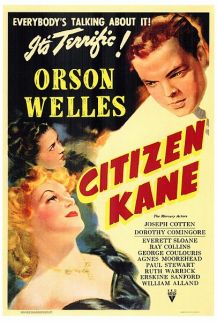
 The first time I ever saw the film, I actually wrote Citizen Kane off because my hopes were so high thanks to its major critical acclaim. Those hopes were soon dashed after viewing it once, but over time I realized I needed a second viewing. This second chance allowed me to see the minute details, which can be easily overlooked or forgotten. Now I can truthfully say I have a new found respect for this film.
The brainchild of Orson Welles, Citizen Kane opens somewhat unimpressively, however it is certainly very moody and atmospheric. As the camera closes in on a great mansion, we are given a first-hand view of a dying man followed by his mysterious final word “Rosebud.” In the following newsreel, we learn the man was Charles Foster Kane (Welles), a millionaire tycoon and newspaperman. A journalist (William Alland) is enlisted to find out anything he can about Kane. First, he scours the memoirs of Kane’s deceased childhood guardian (George Coulouris). Then, he talks with Mr. Bernstein (Everett Sloane), who worked with Kane’s paper the Inquirer. He gets around to talking to Kane’s unstable former friend Jedediah Leland (Joseph Cotten), as well as Kane’s second wife (Dorothy Comingore). We learn from these accounts about Kane’s early years, his success with yellow journalism, the evolution of his first marriage, and the rise and fall of his political career. Furthermore, we find out about Kane’s unhappy second marriage that ultimately left him loveless after looking for affection his whole life. Fittingly, we are again left with the bleak view of his fortress Xanadu, and we now have the knowledge that “Rosebud” was in fact utterly trivial.
Obviously, Greg Toland’s black and white cinematography using deep focus and low camera angles is noteworthy. The framing of the narrative with different points of view and flashbacks was unique at the time. The actors age in front of us showing the progression of time and montage is used to effectively condense time. There are the overlapping and fragmentation of dialogue to create a realistic feel throughout the film. Bernard Hermann puts together a score that slowly changes along with Kane. And of course, you have the supposed basis of Kane on William Randolph Hearst. Historically, Citizen Kane may, in fact, be the most important film of all time, and artistically it is certainly up there with the best of them. I will let others decide if that makes it the very best film, period.
4.5/5 Stars

 Starring Orson Welles and Rita Hayworth, the film is narrated by an Irish sailor (Welles) who meets a beautiful but unhappily married woman (Hayworth). Michael is given a job on the yacht of the wealthy lawyer Arthur Bannister and he is near the alluring Elsa once again. While he is aboard the yacht, Bannister’s partner Grisby asks Michael to fake a murder so Grisby can disappear and claim the insurance money. Michael is suppose to confess to the crime but Grisby will be long gone and there will be no evidence. However, things go awry when Grisby kills another man and then he himself ends up dead. This leaves an innocent Michael facing the gas chamber. Only after he makes a desperate escape from court does he learn who was behind the murder of Grisby and also actually in league with him. In a surreal climax ending in the hall of mirrors, Elsa, Michael, and Bannister all face each other. However, only one survives. Despite a slow beginning the exciting second half of this film is a credit to the directing of Welles.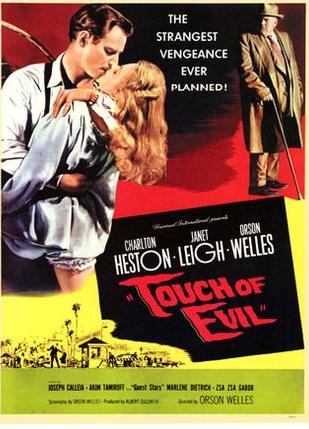

 4 Star Films