Review: Stalag 17 (1953)

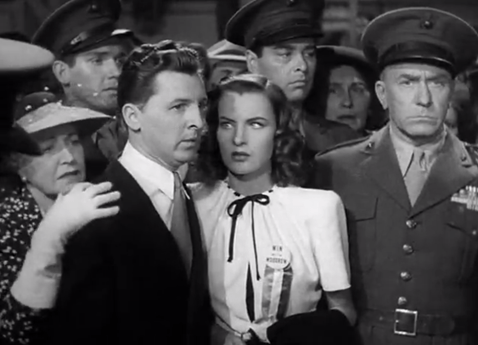
stalag 17.png

I grew up with Hogan’s Heroes reruns on our Magnavox analog television. In fact, at one point it was my favorite show because it had such a colorful cast, it was perennially entertaining and utterly goofy to the extreme. But others have understandably decried the show because they see it finding humor in something that is not very funny. They contend it was making light of the Holocaust and WWII on the whole. Although I do believe this is an oversimplification and I don’t have time to tackle it right now, it’s still an important dialogue to have. I will defer to others for the time being.

The point of discourse I want to take up is Billy Wilder’s Stalag 17 because it’s obvious there would be no Hogan’s Heroes without this P.O.W. comedy-drama. The plots, even the characterizations, are eerily similar, close enough to prompt plagiarism lawsuits. But the difference is Hogan functions as pure zaniness carried by the strength of its ensemble where the Germans are utter buffoons. That’s the hallmark of characters like Sergeant Schultz (John Banner) and Kommandant Klink (Werner Klemperer) who are both lovable imbeciles. They will never be allowed victory over Hogan and his allies.

In Wilder’s hands, a P.O.W. camp is silly and light-hearted at times, yes, but it’s also equally dark and cynical. Because what would a Wilder picture be without some pointed comic venom? Two obvious points of reference would have to be the wartime comedy directed by his idol Ernst Lubitsch, To Be or Not to Be (1942), which some would argue employs morbid humor. Then there’s Grande Illusion (1937) starring Erich von Stroheim (featured in Sunset Boulevard) as a prison camp commander who can easily be contrasted with Otto Preminger’s Colonel von Scherberg. In both, you have those evident counterpoints of humor and tragedy exquisitely executed.

Stalag 17′s opening escape attempt of two men is snuffed out by machine gun fire just waiting to mow them down. It’s the definition of unsentimental and it is the first of numerous breakdowns in communication. There is a rat somewhere. There has to be.

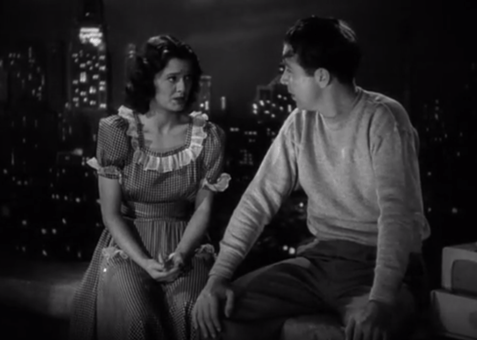
stalag 17 2.png

Then, the picture is back to its belly laughs supplied most obviously by Harry Shapiro (Harvey Lembeck) and his tubby, scruffy buddy Animal (Robert Strauss). They spearhead all of the shenanigans, including a daring attempt to break into the prison camp of Russian women to sneak a peek. You see, Animal’s deeply broken up by his unrequited love for Betty Grable. They bicker with the resident Sergeant Schultz (Sig Ruman), another Hogan’s Heroes precursor, who good-naturedly chortles at all their ribbing. Surely this isn’t anything like how Stalags actually operated?

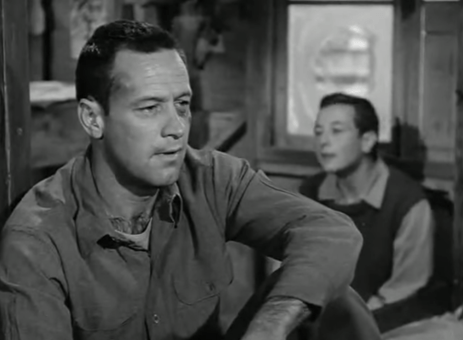
Wilder’s trademark biting wit is most fully realized in Sefton. For the part he was initially reluctant to take, William Holden donned a crew cut and scruff generally masking his normally dashing features. But this was hardly the aspect making him uneasy about the role.

Sefton is a textbook undesirable. He openly trades with the enemy in an effort to make himself as comfortable as possible. He bets a boatload of cigarettes the two fugitives won’t make it out of the camp and when it proves morbidly correct, he makes a killing.

Likewise, he’s the local wheeler-dealer, maintaining the Stalag 17 rat race turf complete with betting for all the servicemen. His other enterprises include a distillery — a flamethrower of sumptuous potato peel schnapps — and “The Observatory” where all the boys eagerly line up for a tantalizing look at the Russian delousing shack. Conveniently, he’s also the obvious culprit when a stoolie is suspected within their ranks.

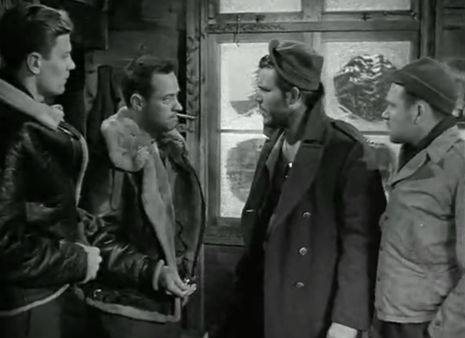
It takes all kinds to liven up the joint and make it into a space with real drama to go along with so many lighter notes. We already mentioned Harry and Animal but the Barracks chief is the always reliable Hoffy (Richard Erdman), head of security is Peter Graves, Duke (Neville Brand) is the rough and tumble one who’s not squeamish about having a fist fight. There’s a blond brainiac, the catatonic one, the amputee who uses his spare space to sneak materials in and out of the barracks, and the nasally mailman with a voice to top all voices.
stalag 17 3.png

When a new prisoner named Dunbar (Don Taylor) gets brought in with his copilot (Jay Lawrence), who has a penchant for spot-on impersonations, they receive a hero’s welcome. After all, they helped to sabotage enemy armaments on their way to being captured. But the information leaks continue with their radio being confiscated and Dunbar being called in for questioning, due to his treacherous activities. The SS is coming to take him to Berlin for questioning. If he’s ever going to come out alive the P.O.W.s must make a last ditch effort to try and get him to safety.

Meanwhile, Sefton gets a going over by the whole barracks, which is quickly overshadowed by Christmas in the camp complete with carols, dancing, and parading full of gaiety. It’s meant to lull us into a false sense of security as Sefton is put in his place and things are good again. It all conveniently diverts from something else. Sefton’s not the culprit. Someone else has been communicating with the Germans and tipping them off.

The final confrontation is when the film really puts it all on the line. We find out who the perpetrator is and Sefton’s vindicated in everything, even going out as a kind of hero. Except to the bitter end, he’s never redeemed as a human being. He’s as hard-edged and acerbic as ever and yet to the folks at homes, he’s who will be cast a hero because he did something brave. Holden was uncomfortable with this as much as we are as an audience but Billy Wilder was unflinching and ultimately right in creating this dissonance.

If anything, Stalag 17 as realized by Billy Wilder and his team is a reminder of the harshness and utter absurdity of war. This is how he conceives it — a man who lost his parents to concentration camps and was sent over to his former land to help rebuild it. He probably knew as much as anyone how horrible the Nazi atrocities were but to memorialize every attribute of the Allies as noble would not document the whole truth.

If Sefton’s the poster boy of the war, then we have to take a deep hard look out our ideals and what we stand for. Because, of course, he was the only one not taken in. Everyone else was so quick to accuse him and to see what they wanted to. It’s almost as if a film documenting an aspect of WWII was in the same breathe suggesting what was afoot with the red scare in the rising fury of the Cold War. Heaven forbid a person we don’t like or don’t agree with is not so easy to demonize as “other.”

It’s far too scary to concede they’re probably just like us. They just didn’t have the decency to hide it. Perhaps they’re better because they were not swayed by the clouded judgment of others.

So if I watch Stalag 17 and become turned off by this incongruity between the historical setting, the lightness in tone, and the shock of a generally unsympathetic lead, maybe it says more about my conception of the world than anything wrong with Billy Wilder’s admittedly incisive picture. It’s a scary admission to make but it just might be true.

4.5/5 Stars
The File on Thelma Jordon (1950)

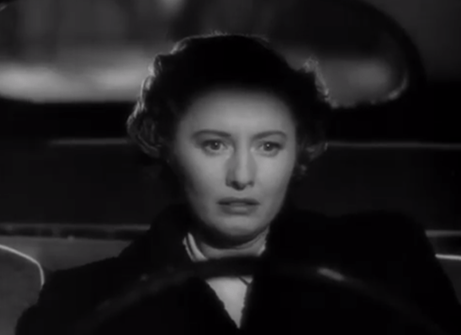
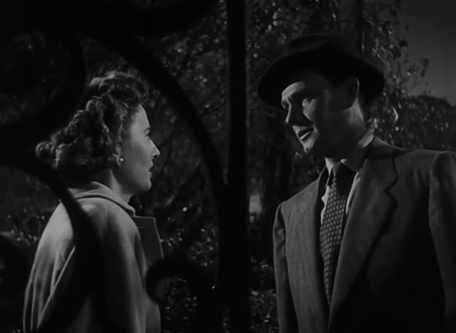
the file on thelma jordon

There is arguably no director who is, in retrospect, more important to the film movement that became classified as film noir than German emigre Robert Siodmak. His name isn’t quite as well known as the Billy Wilders or Fritz Langs necessarily but one can contend his influence on this style is without equal.

While not his greatest achievement, The File on Thelma Jordon is yet another example of the man’s proclivities for deliciously shadowy melodrama which, while not always plausible, is more often than not incessantly intriguing.

In this particular case, we are involved with a local district attorney (Wendell Corey). He is a man who loves his wife while not being too fond of her overbearing father. In fact, Cleve conveniently stays away from home whenever the in-laws are around. It’s certainly complicated his marital relationship as of late.

One such night he stays at the office to knock a few back only to cross paths with a Ms. Thelma Jordon (Barbara Stanwyck) who mistakes him for someone else as she recently inquired about protection for her paranoid aunt — a woman fearful of burglars. On the verge of a real bender, he invites her for a drink and they spend some time together. She’s just what he’s been looking for to fill the void in his life.

Meanwhile, his wife is going away with the kids for a summer at the beach house and he hates to see them leave; he really does. Maybe he knows deep down they are slowly drifting apart and his urges to see the other woman are all but insurmountable. He can’t fight it much longer. There used to be someone — an estranged one-time husband named Tony — but he’s purportedly no longer around. Cleve brushes him off and they keep seeing each other whenever possible.

But their relationship hits a dramatic turn one evening. She calls him up in the thick of night and he comes at her beck and call. They slink in the shadows as she breaks the news to him. Her aunt has been killed by an intruder; the old woman’s worst fears coming to fruition with priceless jewels being stolen from the safe.

The situation is complicated by a frantic Thelma who panicked by altering the crime scene and failing to call the police. Now the man across the road has his interest piqued and comes over to investigate. In the heat of the moment, they must hastily cover everything up as Cleve rushes out of the window and Thelma feigns sleep. It’s all part of an intense interlude coursing through the middle of the picture making the collective heart of the audience pulse with anxiety.

What follows is a murder inquest and then a trial with Ms. Jordon standing as the defendant. She’s got herself a stone-cold and exacting lawyer who could care less about her guilt or innocence. In his mind’s eye, she is innocent and that’s how he plans to win her case regardless.

Meanwhile, Cleve gets put in a very sticky and uncomfortable situation as he finds himself made the prosecuting attorney on the case. As the two sides try to legally sway the jury, the identity of a mysterious Mr. X still swirls around the case, and Cleve tries everything to throw the case in the most indirect ways possible. It’s a perilous balancing act where he will lose something regardless. Siodmak milks it for all its tension as the frenzied proceedings press on with the media jumping on it like ravenous wolves. Someone’s got to be a fall guy. Stay the course and you might be surprised in how the case resolves itself.

Wendell Corey could always be called on for steady and at times wry support but that being so, it’s refreshing to see him in a substantial leading role playing opposite a true professional. They work capably together as the story relies mostly on their two performances.

Barbara Stanwyck is great when she’s bad. Phyllis Dietrichson is the epitome of this fact, remaining one of the crowning achievements of her career. Though a lesser-known incarnation, Thelma Jordon is worthy of some notoriety in her own right.

However, the sublimeness of Stanwyck here is how she never really feels slimy or full of guile, even in the stages when the books are all but closed on her case and we get a fuller picture of who she is. The whole time we are kept constantly guessing and fluttering this way and that in indecision. More than once she surprises us.

The trick to a femme fatale like herself is never consciously deciding to be destructive. She’s doing what she personally believes to be right even if it’s due to a lapse in judgment or an impending sense of fear. I’m sure there was some greed in there too but we all harbor a little bit deep in our hearts somewhere.

So though it ends with a malaise that can only be film noir, there is some sense of rightness in the way everything goes down. It’s not to say there’s not a bite to the picture. When the file closes on Thelma Jordon two lives have been deeply affected forever with far-reaching repercussions. There’s no changing that.

3.5/5 Stars

No Man of Her Own (1950)

no man of her own 1

Helen Ferguson (Barbara Stanwyck) is slighted by her slimy boyfriend who ditches her for a blonde and the only thing he offers her in return is a train ticket out of town. What can she do but take it dejectedly with barely any money, 8-months pregnant, without any future at all? She’s in a lowly state. That is until she is befriended by the perky Patrice Harkness (Phyllis Thaxter) and her genial husband (Richard Denning), who quickly lift her spirits through their continual ebullience.

The first sign of melodrama comes with a horrible train crash that leaving both Harknesses dead but Helen survives waking up in a hospital to find that her baby was saved. Except there’s a catch and, mind you, it’s the pivot point on which the weight of the whole story balances. In the commotion-filled aftermath of the crash, Helen is mistaken for Patrice, the young wife her purported in-laws have never met before. Now she is in their home to be taken care of.

Of course, at first, Helen is scared. She has nowhere to turn and so she goes along with it as her baby for the moment has a roof over his head. As time progresses, she comes to grow deeply affectionate of Mr. and Mrs. Harkness. The kindly matriarch (Jane Cowl) is so taken with her new daughter-in-law it all but consoles her in the loss of her son. Meanwhile, her other boy Bill (John Lund) takes a deep liking for his sister-in-law and does everything to make her feel welcome in the foreign environment. You can tell he genuinely cares about her. It’s no act.

However, the film also explores themes that Alfred Hitchcock’s Strangers on The Train (1951) would traverse only a year later with strains of blackmail and the specters out of her past coming to ruin the life Helen has created for herself.

Her no-good ex is interested in what she has landed in and what he can get out of it. First, it’s money to keep her secret, then it’s marriage so that he can get in on her cut of the Harkness fortune if ever it comes her way. He’s a filthy parasite and she knows there’s only one conceivable way to be rid of him. You know if already: murder!

But far from getting tossed out by the Harknesses or being completely undone by Morley, Helen, Patrice, whatever you wish to call her, is able to salvage a life for herself because of compassionate folks who are willing to accept her no matter her background. They even get knee deep into her plight, even die for her. The extent of their kindness leaves her forever grateful and hopeful that some form of human love still remains possible for her. Even the prospects of a murder rap seem surmountable.

The ending has one of those final cherry-on-the-top-of-the-sundae resolutions allowing everything to tie together in a nice bow. Some people might find it silly but I rather liked it. It gives the storyline one ironic twist of fate perfectly suited for this turbulent strain of drama. The police are satisfied. Crime didn’t pay. Our romantic leads get to stay together. All is right with the world. After such bleak beginnings, it’s almost laughable.

Despite being an utterly preposterous conceit, Barbara Stanwyck rides it out with her usual measured commitment to her craft both sympathetic and to the degree possible, believable. In the latter half, she’s an absolutely pasty mess personifying a woman terrified about being found out in her lie and subsequently rejected by the ones she’s worked so hard to love.

Director Mitchell Leisen, though given his penchant for finely wrought romantic comedies and an eye for costumes and interiors, shows he is no less capable in this woman’s picture, keeping it afloat even as it cycles through all sorts of implausibilities. I was generally fond of John Lund in The Mating Season (1951) as well, though it’s true he’s all but overshadowed by his female costars in both movies. However, when the people in question are the caliber of Barbara Stanwyck, Gene Tierney, and Thelma Ritter it’s quite understandable.

3/5 Stars

Sorry, Wrong Number (1948)

sorry wrong number.png

“In the tangled networks of a great city, the telephone is the unseen link between a million lives…It is the servant of our common needs — the confidante of our inmost secrets…life and happiness wait upon its ring…and horror…and loneliness…and…death!!!” ~ Opening Prologue

Sorry, Wrong Number is a fairly unique adaptation in that it came into being from a radio play written by Lucille Fletcher, successfully realized for audiences as essentially a one-woman production by Agnes Moorehead — a fine actress in her own right. Director Anatole Litvak does an extraordinary job of making this film version tense and certainly cinematic, as it cannot function in the same ways as a radio show if it is to be similarly effective.

Like Rear Window (1954) or Wait Until Dark (1967), the suspense in the film comes with being constrained in a space with no way of escape from an impending intruder. It’s little surprise Barbara Stanwyck is divine offering her typically captivating performance even if, given her usual predispositions, she hardly fits the helpless wife archetype. Being the professional that she is, there’s no doubting the ferocity of emotion within her. To use a hopelessly corny pun, she hardly phones in her role as Mrs. Stevenson, the bedridden wife of a husband who just cannot seem to be located.

Though still young, Burt Lancaster brings the screen presence that made him a mainstay of early film noir. Still, he and Stanwyck somehow seem ill-paired as husband and wife. One could contend that works nicely into the plot as their marriage is essentially one-way, becoming increasingly loveless as more of the picture is revealed. She wants him and her daddy has the money to make the world spin. It’s not romance. It’s a business transaction.

So although Harry Stevenson (Lancaster) is initially going with another gal (Ann Richards), soon enough Leona’s got him. They get married and he gets a job working under the father-in-law but he feels his hands are tied with no real prospects of making anything of himself. He’s not content with this kind of lifestyle. He has ambitions of his own.

One might suspect he’s finally had enough and left his wife for good. Of course, part of the fun is that the story is pieced together through different characters recounting events, done through voiceover fragments. It becomes a kind of compulsory game we must play along with.

First, it’s Mr. Stevenson’s secretary who recounts the woman who came to his office with something urgent to talk about and it piques Mrs. Stevenson’s suspicions. Then, she gets in contact with the old flame named Sally Hunt Lord who is now happily married to a District Attorney. Nevertheless, she was worried that Henry might have been mixed in something awful, even tailing her husband and trying to get at her old beau to uncover what might be the matter. It’s all very mysterious.

Next Leona breaks up her Doctor’s (Wendell Corey) dinner engagement only to hear more of the story and how her husband kept the doctor’s prognosis from her. By this point, we’ve gotten in so deep that we have layered flashbacks. Only in noir, and we still have yet to stitch the entire convoluted mess together.

The last crucial figure is a specter of a caller named Waldo Evans who actually turns out to be a kindly old man caught up in the racket that Stevenson’s been promoting. The script doesn’t give us much to go on based on the restrictions of the production code but it has to do drug trafficking. That much is almost certain.

By this juncture, we’ve almost forgotten William Conrad was in the picture but he shows up right where you would expect him in the thick of something big. As she’s put through the ringer of psychological duress, trapped in her ominously vacant home, Stanwyck’s absolutely maxed out on the intensity.

Admittedly it does feel like two pictures told in tandem and spliced together. Stanwyck headlines what we might term the “woman’s drama” while her husband is embroiled in a shifty noir replete with the murky shadings of a criminal underworld. Of course, Lancaster is remembered for his early pictures like The Killers (1946), Brute Force (1947), and Criss Cross (1949) which share some nominal similarities.

Sorry, Wrong Number showcases an icy ending that was nearly unexpected for not only how abrupt it is but also how very unsentimental. To say more would give it away outright. Flaws readily acknowledged, Sorry, Wrong Number is a noir worth making time for as it builds tension to a fever pitch and obscures its hand behind minute after minute of methodical voiceover. When we’ve finally caught up with the events rumbling forward in real time, it’s too late to do anything and before we know it, everything’s already come to fruition. One might call that an adequate success in the storytelling department.

Due to its histrionics, the picture was ripe for parody. In fact, Barbara Stanwyck was featured on a segment of The Jack Benny Program in 1948 using extensive recordings from the film only to have Benny wind up in much the same mess. And of course, there’s Carl Reiner’s noir sendup/clip show starring Steve Martin, Dead Men Don’t Wear Plaid (1982). It’s all in good fun.

3.5/5 Stars

Review: Hud (1963)

Paul_Newman_and_Melvyn_Douglas_Hud.jpg

“I’ve always thought the law was meant to be interpreted in a lenient manner. Sometimes I lean one way and sometimes I lean the other.” – Paul Newman as Hud

Hud is up for contention for the finest film Martin Ritt ever made and it comes down to a truly collective effort. When you survey the talent assembled, it plays like a hit parade by pairing the director with some perennial collaborators who would see him to some of his greatest successes.

Obviously, Paul Newman was a hot commodity and Hud‘s tagline gets it impeccably right. He’s the man with the “barbed-wire soul.” Raffishly handsome, a womanizer, and a drunkard, no less. However, though Newman plays him as a villain, there’s this wonderful dissonance in the man because after all, he’s played by Paul Newman who was forever more likable than a Brando or a Dean. He stretches us to the limits as an audience as we try and discern what to do with him. Dare we say he’s still charismatic without giving the wrong impression about his lecherous attributes? I’m not sure.

Irving Ravetch served as joint screenwriter and producer and his partnership (along with his wife Harriet Frank Jr.) would be one of the most integral to Marty Ritt’s career. The production boasts the inimitable James Wong Howe as the cinematographer, set design by veteran Hal Pereira, Edith Head overseeing costumes, and a well-suited score by Elmer Berstein. This list of names stands as another feather in the cap of the studio system.

It’s a horizontal even cloudless palette in black and white that captures the malaise hanging over the characters with monochromatic lucidity. Bernstein’s arrangement, in fact, is only minutes long but is supplemented by the equally fitting stripped down effect of a guitar.

In many ways, Hud‘s a modern western like a Giant, The Misfits, or even The Last Picture Show documenting the evolution of a certain type of life whether it’s cattle being replaced by oil rigs, the onslaught of personal tragedy, or the debilitating nature of generational divides. There’s a certain dustiness and degradation proving itself to be a far cry from the glory days.

Melvyn Douglas gives a generally gray and emotionless performance that somehow fits the visual landscape. It grows on you minute by minute for its steady cadence, continuously exact and unhurried. Patricia Neal just might have the finest showing of the lot because she has to do battle in a man’s world. She’s both a housekeeper and thus, maternal but then also overwhelmingly assured in her independence. Staving off Hud’s advances and taking care of the two other Bannions — somehow remaining folksy, hospitable, and a bit sensuous too.

Meanwhile, Brandon de Wilde is crucial for the part he plays as the film’s most impressionable bystander. Though he is no longer the precocious little lad from Shane (1953), he is still the clean slate on which the world at large must rub off on.

The film’s first disruption comes from a state veterinarian (Whitt Bissell) with a verdict that the Bannion’s stock might be stricken with foot and mouth disease. Until they can get more conclusive information, the narrative is all but a waiting game and waiting makes the relationship between Hud and his father (Douglas) all the more contentious. They hold each other in contempt and it’s not simply for Hud’s cavorting reputation. There’s some other buried grievance that has never been resolved between them.

Pay attention and you’ll witness many recognizable small town trivialities. Lonnie (De Wilde) carries his transistor radio in his breast pocket. He and grandpa take in a comedy at the picture show complete with a rousing performance of “My Darling Clementine.” There’s the chasing of greased pigs at the Kiwanis Club event and boisterous brawls with the jukebox whirling away merrily. It’s a galvanizing moment of male bonding that fosters a might bit of camaraderie between Hud and his nephew Lonnie.

In the next pivotal sequence, Hud opens up candidly about his brother’s death in a car crash. Then, Hud has it out with his father and in his ensuing rage, fueled by a drunken stupor, makes aggressive advances on Alma. Clumped together like this, the turn of events either don’t sound impressive enough or don’t carry the air of lurid drama out of a drugstore novella. But watch the scenes themselves and they make sense and wield a resounding power in their cumulative effect.

Hud’s animal brutality is only matched by the slaughtering that is undertaken with the infected cattle. It’s a sickening image. Killing becomes so easy even as the long hard process of cultivation takes years and is subsequently snuffed out so quickly. It doesn’t seem right.

Each of our main characters seems destined for a slice of tragedy — every one of a different size and shape. But it never comes off as melodrama, at least not in the end, even as the misfortune strikes. More so, we are reminded that life is tough and at times merciless. Sometimes people are too. But Ritt never seems to leverage that to get a rise out the audience. He lets it play out. He lets his actors act and if that’s how we label it, then they do a commendable job, each contributing their piece to the ensemble.

Because what we are left with at the end of the road is a lot to mull over. I’m not sure what the conclusions are supposed to be and that’s not because this is an esoteric picture by any means. It’s for people and I think people can resonate with it for the very reason that it is affecting and the performances carry weight while never being overburdened by their own importance. Martin Ritt was an actor’s director and he cared deeply about their performances. It shows in just how beautifully they work together.

One of the truly resonating scenes is right near the end. Hud comes sauntering down the street in his cowboy hat and boots, sporting his starched white shirt like always. He gives someone a “hey” and comes around the corner to the bus stop.

We know who is sitting there and yet Wong Howe stays on his back momentarily as he turns to notice this person sitting out of sight. He sees the person and says a few words. It almost feels accidental but even in this, there’s a purpose. Because another film might have built this final interaction into a confrontation. Instead, Hud and Alma share an amiable conversation underlined by no hint of malice. It is what it is and they’ll move on like they always have. It does, however, accentuate a certain wistfulness. In an alternate reality, things might have been far different; they could have been better.

Granted, Hud doesn’t seem like the definitive source for wisdom and yet he might not be far off the truth when he tells Lonnie, “This world is so full of crap, a man’s gonna get into it sooner or later whether he’s careful or not.” It’s all but inevitable.

4.5/5 Stars

The Tin Star (1957)

the tin star 1.png

You can master a gun if you have the knack. Harder to learn men.” ~ Henry Fonda as Morgan Hickman

A veteran bounty hunter rides into town with a corpse slung over the rear of his horse and gets the whole town gawking. They don’t quite fancy this entrance because they’re about law and order in these parts. Paid guns have no place in the western utopia that they have envisioned.

Obviously, no one in town wants to house such a reprobate and he has no place to bed down his horse at the livery stable either. Finally, he finds room and board with the only folks who have enough congeniality to welcome in a man like him. Because in one sense they are ostracized too, living on the outskirts of town as local pariahs. The single mother Nona (Betsy Palmer) gets by doing needlework in the evenings and trying to keep her son out of mischief. He’s half-Indian. Hence the reason no one wants anything to do with them.

But in this man who seems little more than a hardened killer, they find someone genuine and compassionate when you get to know him. Though initially surprised by the boy’s paternity his kindness doesn’t slacken admitting only that many others grow up hating Indians. They are preached as much by their parents and take it to heart so they can’t hardly change their ways. It’s unfortunate.

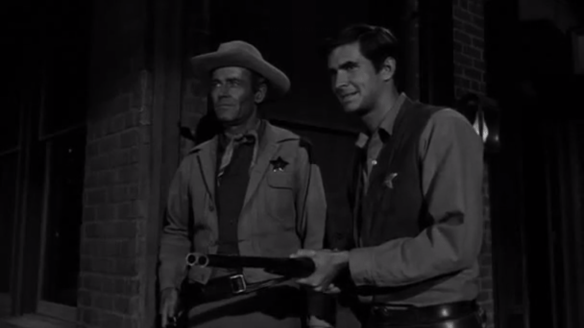
I’m not sure if I dare use the term “revisionist western” lest viewers get the wrong idea but seeing of all people gun shy Anthony Perkins as sheriff over a town you realize that something is gravely different with the film’s character types — at least this crucial one. His skittish nature is perfectly-suited along with his boyish looks because, as he soon learns, being a sheriff is not only about what you do but how you look doing it. Being smart, working your mind, and projecting a certain image.

At first, Ben Owens (Perkins) is like everyone else. He sees Hickman only at face value. But soon he gathers there is much to glean from this veteran who is handy with a gun and holds a wealth of knowledge. Most impressively he’s lived long enough to talk about it and that means he must be a pretty smart fellow. He’s become well-versed in human nature.

He looks at Owens, a young gun beholden to the duty thrust upon him, and he sees a dead man walking. He’s not going to last long. Hickman knows it. Ben’s girl (Mary Webster) knows it. Perhaps deep down Ben knows it too.

Finally, he asks the bounty hunter to be his mentor and reluctantly Morg agrees to it because his pupil still has his training wheels on as it were. He’s not ready to stand down the town or confront a hulking heavy like the local bad boy named Bogardus (Neville Brand).

One of the film’s finest creations is the local Doctor Joseph McCord (John McIntyre) who not only pulled strings to get Mrs. Mayfield work but he is keen to play matchmaker with two of the fast-growing babies he brought into the world. Indeed he is well-liked by all on every side.

Mann pulls another stunt, not unlike the one in The Far Country (1954) with the Doc making a grand entry with his horse into town to much fanfare on his birthday. It’s one of the film’s most indelible sequences.

A pair of half-breed brothers are also on the lamb and wanted for a couple of crimes. Bogardus gathers a mob of his own to go after them. But begrudgingly following the advice of Morg who has remained hands-off, the Sheriff decides to track them alone.

Morg lingers behind and ultimately ends up being the one who smokes them out without any bloodshed. He delivers the McGaffey Brothers (including Lee Van Cleef) over to the Sheriff so that justice can be implemented first in the jailhouse then in the courtroom.

But that is just the beginning. The final act takes on an uncanny turn toward a High Noon-like allegory. One man faced with a major opposition and yet resisting to back down. But whether or not that motif is McCarthyism incarnate or not, Mann’s handling of the sequence is arresting.

He sets up the action in such a way that we are standing behind Perkins peeking past his solitary frame. He’s unimposing and spindly standing there on the jail steps with his shotgun but he is a better man than me. The question he must grapple with is where the line between a good man and a dead one exists. Sheriffing is a nervewracking business and most men die young in such an occupation. Mann makes us comprehend exactly why that is.

And yet, in the end, it’s all for naught as the picture collapses too easily lacking that typical hard-edged savagery of Mann’s other pictures with James Stewart. While Dudley Nichol’s high-minded script might be quality stuff for a minor picture, it’s not necessarily the script best-suited for Mann.

He was never one for moralizing. In fact, his best films about isolation or outsiders never seemed to make a point of a racial divide or any other societal issues. It felt like they were very much implicit in the story at hand. They never were didactic instead choosing to viscerally speak to us delivering any themes through mere osmosis.

By no means does that downplay the fine chemistry between Henry Fonda or Anthony Perkins both seemingly impeccably cast. However, The Tin Star is a picture that could have been even more resonant.

3.5/5 Stars

The Furies (1950)

the furies 1.png

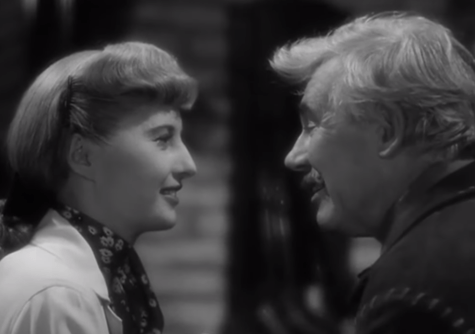
Frenzied opening strings from a score by Franz Waxman assist in introducing a film that positions itself as another textured portrait of the West boasting a pair of grandiose performances from Walter Huston and Barbara Stanwyck. This particular ride down the well-trodden paths takes place in New Mexico where cattle barons ruled the land like feudal lords. At its core is a warring clan and this is their tale of belligerent family drama that sprawls across the plains with a vengeance.

In fact, T.C. Jeffers (Walter Huston) is a man ruling his acreage known as “The Furies” with an equally-suited ferocity. He’s a larger-than-life figure who knows how to throw around his weight; the territory is scattered with his I.O.U.s christened T.C.s.

But his daughter Vance (Stanwyck) is no less imposing, knowing precisely what she wants — his empire — and chasing after it with the full intention of sinking her claws into it someday. When she finds the right man of course. We can liken them to Rockefellers of the West, ruthless while also being fiercely loyal and even generous to their friends. But they are not squeamish about going after their own.

The ensuing melodrama is laced with arsenic braced by Anthony Mann’s usual choices that ratchet the tension. While the scale has grown, his aptitude for projecting a certain raw volatility on the western frontier is no less apparent.

When rugged Rip Darrow (Wendell Corey) ambles into the Jeffers’ home during a lively gathering, Vance immediately tries to win him. It starts with a dance and goes from there.  Far more than a mere pretty face, Wendell Corey holds a grudge that really leaves an impression. He has long felt slighted by Jeffers for ending up with the land he long thought was his own and he gladly gets back at the man through his daughter. Except Vance feels betrayed when Rip takes $50,000 in bribe money never to see her again. That’s the termination of their relationship for good.

But it turns out that T.C. also seeks out companionship of his own and his chosen mate, Flo Burnett (Judith Anderson) proves to be a golddigger who hardly hides her intentions. She receives only Vance’s ire and Ms. Jeffords is not about to let this woman finagle her way into the family business even resorting to violence if necessary.

It’s yet another riff in this power struggle that reverberates again and again. Because this is an unrestrained showcase of opportunistic human beings who glory in their own avarice and pursuit of wealth. People pushing others around and undermining them with little regard for their well-being.

It ends up reaching its absolute zenith with a bloody shootout to push the Hererra Family led by brother Juan (Gilbert Roland) off the Furies once and for all.The skirmish results with one man at the end of a rope and Vance never about to let her father forget what he has done to one of her closest childhood friends.

But it doesn’t stop there because it never can. Not with people such as this. Daughter goes out across the frontier on a vendetta that will pay heavy dividends. She even reconnects with the other man she never wanted to see again. Together they scheme T.C.’s ultimate downfall but as he gets on in years the old warhorse is faltering a bit. His glory days are setting so maybe it’s for the best. One could say that T.C. got his comeuppance but by all accounts, he died a legend. The same cannot be said for many of his adversaries.

I can’t help but juxtapose Devil’s Doorway and The Furies. An interesting reference point is that Robert Taylor and Barbara Stanwyck were still husband and wife at the time but in both pictures, they try mightily to tame the West and hold onto what they believe is rightfully theirs. They have varying degrees of success.

The film also exhibits a racial element much like Devil’s Doorway because though it is rarely talked about, much of the mythology of the West is tied up in the white pioneer’s story. The marginalized folks like Native Americans, Hispanics, and certainly Asians are pushed to the edges of the frame. This film showcases the Herrera family.

Further still, there are an array of strikingly powerful women who exert their control in different ways. Though Beulah Bondi has a relatively small part you quickly realize that women such as her are important figures. Because they carry such crucial sway in the business of their husbands as the voices whispering advice into their ears.

Meanwhile, Judith Anderson while a bit of a tramp nevertheless is forthright and transparent about her intentions. She’s not a complete pushover and that makes a slight tussle with Stanwyck entirely credible.

Obviously, Barbara Stanwyck is phenomenal — one of the few performers who could have pulled off this role much like the matriarch in Sam Fuller’s Forty Guns (1957). It needs someone who is that assured and strong, who carries an unmistakable presence anchored by undeniable beauty. She was blessed with both.

Walter Huston would pass away the same year in 1950 but The Furies compiled his innumerable talents in one last monumental showing that’s a worthy swan song in a veteran career. What a way to go as T.C. Jeffords.

4/5 Stars


Hail The Conquering Hero (1944)

hail the conquering hero 1.png

I have long sought out this picture, and all I can say is all hail the conquering hero! It’s everything that could have been hoped for in a Preston Sturges wartime comedy. But in order for the laughs to come along with a great deal more, there must be a setup — a watering hole for our main players to familiarize themselves.

Sure enough, we are introduced to a fairly somber nightclub scene or maybe it’s simply the face of the one man the camera chooses to focus on, sitting dejectedly at the bar. There slumps Eddie Bracken, slightly pudgy and round-faced. By no means classically handsome but he and Preston Sturges had quite a thing going for a couple years.

He got sent home from the Marines for chronic hayfever. I’m extremely empathetic to his condition, as I’m sure innumerable others are as well. Anyway, he’s too embarrassed to go home, and it’s been a year now and he’s still not returned. However, he has nothing except the highest regard for the Marines, as his father gave his life serving his country. In fact, it was the very day our boy was born.

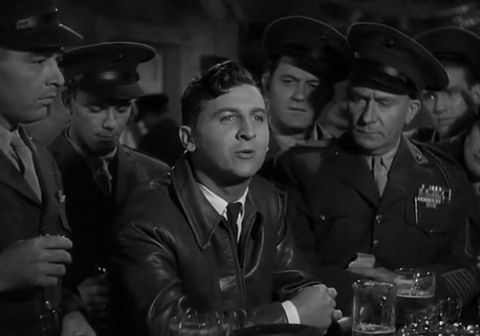
He pays it forward to a group of Marines on leave with no dough, thanks to the gambling habits of one of their pack. The act of charity isn’t lost on them and they get acquainted. Soon they find out the name of their benefactor. It has the be the most patriotic names ever invented: Woodrow Lafayette Pershing Truesmith (sans the Truesmith).

They are regaled with his story and stunned by his encyclopedic knowledge of the exploits of the Marines out on the battlefields. Their leader, Sergeant (William Demarest), even finds out they have a lot more in common as he knew the elder Truesmith — Winky Dinky for short — before he perished.

The only place for the film to go from here is back to Woodrow’s roots and so without his consent, his mother gets called up and it’s announced that he’s getting sent home. Woodrow’s against it from the beginning but his new pals say there’s nothing to it. He’ll wear a uniform for a day, give his mother a hug, and take off the uniform soon after, completely forgotten. Of course, as they ride the train into town, they have no idea what’s been stirred up in preparation.

A homecoming like you’ve never witnessed has been hurriedly assembled by the local committee chairman (the frantically hilarious Franklin Pangborn) and it’s the true essence of cacophony with unrehearsed dueling brass bands; the mayor and any number of folks milling about in expectant anticipation. The show is just beginning to warm up now.

What many will find astounding is just how perfectly Hail the Conquering Hero has been constructed by Sturges, at least in the way it skirts its topics with simultaneous delicacy and verve. Here is a film striking an impeccable course between that very same comedy and then admiration for the armed forces because no one can forget WWII was still blasting away across the world.

hail the conquering hero 2.png

Likewise, the church service far from belittling the faith is a lingering visual gag as we watch the dueling reactions of the two sides of the pews. First through the hymns and then a very sincere homily from the preacher culminating in yet another rousing display of goodwill. By now Woodrow has little hope to derail any of the fanfare with the erection of a commemorative statue christened “Like Father, Like Son” soon in the works. All his newfound Marine buddies are good for is stoking the fires and applauding the sentiment.

The next great sequence is cued by the music and Mother answers the door and mentions that the Judge (Jimmy Conlin) and some other civic leaders want to see Woodrow. Immediately his mind leaps to the worst possible scenario. The game must be up and all his Marine buddies inconspicuously grab household items in case of a tustle that might take place in the drawing room. Of course, their intentions are nothing of the sort. Far from it. The lead up makes the outcome into yet another outrageous reveal.

Just around this juncture, it becomes increasingly apparent that all the characters appear to move in packs and Sturges crams the frame gladly with bodies and faces and more appendages. Woodrow does his best to avoid the spotlight, flubbing his speech to the masses, and trying to downplay the bid for mayor thrust upon him only to be thwarted at every turn by a cheering crowd of well-wishers. One man even proclaims his was the greatest speech since William Jennings Bryan’s “Crown of Thorns!” Already we have the swellest giggle-fit inducer I’ve encountered in some time.

hail the conquering hero 3.png

I wracked my brain only to realize I’d never seen Ella Raines in a comedy before and for much of this picture she’s in the periphery, her comely smiling features on the screen with a whole host of others. But there are a few moments that, far from playing merely humorously, prove deeply moving as she is split between the man she is betrothed to marry and the one she truly loves.

The family she’s caught up in includes a quibbling father and son. The incumbent mayor (Raymond Walburn), who ponificates incessantly, attempts to dictate his speech in his latest bid for reelection only to get annoyed by his dim-witted boy (Bill Edwards) who nevertheless corrects his grammatical blunders. She’d do well to get out of there. Nevertheless, they are a bounty for humorous dialogue.

The stakes are set for a reversal of fortune with a number of parties having a chance to oust our hero. One man who’s buddy-buddy with the Mayor, the cool and collected Jake (Al Bridge) is mighty curious about Woodrow’s service record and he sends a wire to the Marine Base in San Diego. He gets the incriminating news shortly.

But ultimately it comes down to Woodrow himself and Sturges puts the perfect words in his mouth that Eddie Bracken then utters with an assured conviction. Riffing off the Biblical epithet he notes, “My cup runneth over with gall” and proceeds to pour out with veracious intent all the lies and masquerades he’s been too scared to admit to his own town. His guts are laid out right in front of him. Yes, his mother cries. The townspeople look on somberly and his Marine buddies can do nothing to dispel any of it. Even the words of the Mayor and his pal mean nothing now.

With such a showing you would think it was all over for Woodrow and he tells his mama that he’s going to leave again. He cannot stay. Not like this at least. But his girl comes back to him because she at least loves him unconditionally.

hail the conquering hero 4.png

At the train station the parlor games look like they might commence again but this time the whole town is involved, a lynching all but imminent. The Marines this time wrap up their belts inconspicuously to prepare for combat once more. Of course, the mob is there for a very different reason altogether.

The film has the foresight to see what so many of its contemporary war movies were, only made plainly obvious with the luxury hindsight: Light-hearted and good-intentioned yet still mawkish propaganda pieces. So Sturges took up his pen and tackled such hero worship and small-time jingoism, and yet settles on a resolution proving to be as venerating as it is satisfying.

Hail The Conquering Hero is a miracle assemblage of poignancy and humor; I don’t know how it comes away still intact and with my heartfelt laughter and deepest respect no less. It’s not an easy road to traverse by any means. Only a few have managed it. Chaplain in The Great Dictator (1940) distinctly comes to mind and Preston Sturges here.

4.5/5 Stars

Christmas in July (1940)

christmas in july 1.png

“If you can’t sleep at night, it isn’t the coffee – it’s the bunk” – Maxford Coffee House Slogan

Christmas in July is one of Preston Sturgeses earliest efforts where he both scripted and directed the material. He was fed up with how others had handled his handiwork. Obviously they must not have directed it in the zany scattershot way they should have. He would all but rectify that oversight in the early 1940s with his string of successes.

We are privy to a rooftop romance between Jimmy MacDonald (Dick Powell) and his best gal Betty Casey (Ellen Drew) as they take up a light squabble over modern living and radio sweepstakes. The man is intent on winning the grand prize of $25,000 for the Maxford House Slogan Competition. He hangs attentively around the radio to get the verdict. He, his girlfriend, and millions of other Americans.

But a snafu arises when the jury is hung in their decision-making process by an obdurate Mr. Bildocker (William Demarest). The radio announcer has no choice but postpone the annoucment. Not only does it annoy the public by leaving them hanging on a meat hook, it leaves space for a practical joke to go horribly awry.

You see, Jimmy is adamant that his slogan will be the kicker and he’s not shy about telling everyone about it. First, his girlfriend, then his mother, and finally any coworker who will listen. Three wiseguys in the office overhear his spouting and pull the gag to end all gags. All it takes are a few slips of paper, some paste, and an unused telegram slip. It’s a pretty horrible joke. You can probably envision it already.

In fact, I could just see it unfolding like the emperor’s new clothes and yet it’s more good-natured and innocent. He sees the note, reads it, and proceeds to stand on top of his desk to share his good fortune and tell his colleagues to gather around. It’s a sequence full of canned laughter as the floor manager comes by to see what the ruckus is about.

Jimmy and Betty are glowing and positively floating down the corridors together. They must be dreaming. He quite innocently wanders into the Maxford offices inquiring about his winnings and walks out again as nice as you please with a check for $25, 000. Next, comes the department store jewelry case and every other department they have.

Seeing the astonishing check in his possession, the store all of a sudden gets very generous and soon he’s being given everything on credit. Buying new fangled whizzbang contraptions like the all-in-one Davenola. Diamond rings and fur coats for his girl follow, and gifts for everyone else in his family and the adjoining neighbors. The street in his old neighborhood is pure bedlam with the passing out of toys to all the kiddies and free caraousel rides and confections. They’ve never had it so good. There has never been such a respite before.

christmas in july 2.png

As an audience we are in on quite a big secret. We know the bubble must burst some time. Our greatest fear is that it will completely devastate MacDonald. He’s the kind of man who requires the approbation of others to believe that his ideas are any good and that can be dangerous.

For all the madness, there is a very sincere consideration of the American Dream in this picture, not to mention what people deem to be truly important in their lives. His Manager, far from being a mere boob, has some suprisingly sagacious knowledge to dispel:

“Mr. MacDonald. I’m not a failure. I’m a success. You see, ambition is all right if it works. But no system could be right where only half of 1% were successes and all the rest were failures – that wouldn’t be right. I’m not a failure. I’m a success. And so are you, if you earn your own living and pay your bills and look the world in the eye. I hope you win your $25,000, Mr. MacDonald. But if you shouldn’t happen to, don’t worry about it. Now get the heck back to your desk and try to improve your arithmetic.”

Thankfully, the picture is loaded end to end with character parts. It’s positively swimming in them. Though he never worked with Dick Powell and Ellen Drew again, who coincidentally have a fine genial chemistry, many of the smaller bit players became mainstays of Sturgeses stock company. Aside from William Demarest (who gets the final comic punchline as per usual), you will see many other familiar faces if you’re acquainted with the director’s canon. In other words, Sullivan’s Travels (1941) Et Al.

There’s this innate sense that he’s stuffed this particular script with any number of inside jokes and he mastered the art of humorous character naming, only adding to this swirling cauldron of mayhem born out of one simple gimmick.

Hanging his hat on a slogan like, “If you can’t sleep at night, it isn’t the coffee – it’s the bunk” is seemingly a foolhardy task and yet he all but pulls it off. I must confess that I couldn’t get my head around the statement for a while because it seems that “bunk” used in its informal and archaic etymology as “nonsense” isn’t as common today But it reflects Sturges perfectly.

If there is a modern heir apparent to Preston Sturges I am still in the dark. The closest might be the Coen Brothers and yet their work has never undone me in the same ways. Maybe I’m looking in the wrong places. You also had a contemporary in Frank Capra who was well-versed in populous fare but though he had close collaborators, he rarely wrote his material or had the same unorthodox pizazz of Sturges.

Billy Wilder proved capable of much the same as Sturges, both as writer and director, but even he worked often with writing partners. His work was injected with a cynicism even foreign to Sturges in all of his idiosyncratic, zinging panache. Each is worthy of an examination due in part to their differences. However, Preston Sturges  was really one of the first high profile screenwriters, preceding so many modern success stories. He gave the formerly uninspired and restricted post a newfound respect at a time when that was all but unheard of.

One part of me speculates whether his humor is dated and another part asks why we don’t have films quite like this anymore? Part of the answer might be because of television. The kind of hijinks and episodes that Sturges seemed to showcase often got translated into I Love Lucy episodes and numerous other sitcom tropes that would gain traction over the years.

Still, there’s little doubt that something deeply satisfying is afoot — a film that zips along at an hour and seven minutes yet leaves us feeling like a whole boatload has happened in that same amount of time. Because it’s true. There are dour notes. Moments of wistfulness even, but paired with all that is frenetic and wonkers, you find Preston Sturges coming out on the other side with a comedic trifle that speaks to a great many things about American life, however superficially. Because remember, the punchlines are just as important as the lessons.

3.5/5 Stars

The Country Girl (1954)

the country girl 2.png

Yet another example of the prevalent trend of turning plays into film adaptations, director George Seaton took Clifford Odett’s eponymous work and plugged in three stars to carry the weight. Without question, the allure of The Country Girl is purely the trifecta of stars it assembles. Yes, it’s stagebound but the talent is certainly present.

William Holden is sturdy even intense when he needs to be as stage director Bernie Dodd, intent on recasting his new play The Land Around Us after his initial choice didn’t pan out. It’s a tough break but if they get it together, there’s still enough time to right the ship before the opening. He willingly takes a chance on a has-been named Frank Elgin (Bing Crosby) even fighting for him despite the criticisms of his producer. He has visions of what the man was and could be again, not the pitiful mess standing before him.

Holden slides relatively easily into the role based on prior expectations. This might be due in part to his work with Billy Wilder. The dark edges of Sunset Blvd. (1950) and Stalag 17 (1953) create almost a seamless continuity that fit with this narrative as well.

It’s the other two names on the marquee who might well surprise some viewers. It has song and dance like High Society (1956) made two years later, but this is an entirely different beast, functioning as an embittered drama more than anything else. Bing Crosby and Grace Kelly appear as you’ve rarely seen them before, if ever.

Elgin, for one, is a hopeless alcoholic, his confidence is shot, and he and his wife live in a humble flat getting by on his demeaning work doing radio jingles. It’s a far cry from the audience he used to command. I’ve never seen Crosby in anything so daring, even detrimental to the image that he cultivated his entire career.

The man puts up a happy-go-lucky facade for everyone else as his wife sees him slowly deteriorating from nerves and alcohol abuse behind closed doors. But by being a people pleaser he’s constantly tearing up his wife’s reputation with his lies. Because this is a story where the wife gets turned into a villain.

the country girl 1.png

But Grace Kelly stands bravely in opposition to the tall tales her insecure husband spins about her in the presence of others. Because it’s true he has projected all his fears and shortcomings onto her. She is in most regards everything he is not. There’s nothing flashy in her portrayal. It’s not the usual image of Grace Kelly, alluring elegance head to toe. The ultimate shorthand comes when we are introduced to her wearing glasses, those objects meant to conceal beauty behind their frames.

This is a movie of all sorts of misconceptions and little white lies cultivated by Elgin. He is the source of all the marital strain and hopelessness in his life, failing to let go of past trauma and bounce back. Critics make or break it for him. His skin is paper thin and his liver is getting doused night after night. The only chance he has is the stability of his wife and even she is brought to her breaking point. No thanks to him.

The most interesting theme making its way through the story stems from Bernie as he takes on righteous indignation against Mrs. Elgin, a woman he believes to have sucked her husband dry of all he has to offer. His continual clouded judgments are a testament to seeing only what he wants to see. Because the man is always the truth-teller and always right. It is the female who causes strife and selfishly stretches the truth due to insecurities and petty jealousy. It’s an easy enough narrative to write and for a man to swallow, horribly regressive as it is. But it’s just this version of the story that unearths these underlying biases.

Upon reevaluation, Mrs. Elgin is a far more nuanced and stalwart woman than Dodd would have ever given her credit for. He’s also rightfully humbled in the realization he made a grave error in judgment.

the country girl 6.png

By the picture’s end, he’s in love with this woman he once wrote off — the faithful wife of his star — and that could be the final twist of The Country Girl. He really wants it. She shares an affection for him too, no doubt. But that’s just it. She is a loyal wife and stays by her husband’s side in his successes just as she did throughout all his failures. We look at such behavior and through a modern lens, it seems needlessly sacrificial.

What does she owe him? Why should she forego what makes her fleetingly happy for a man who gave her more heartache than joy as of late? Is this just another instance of the subservient woman being kept down? These are certainly valid opinions. However, one could make the case more vehemently still this woman, this country girl, is driven by a sense of goodness, of sacrificial love, and a moral framework allowing her to perceive the situation with immense lucidity. This is a way she might bless her husband.

If marriage is to still stand for anything, we would expect the same from her husband if ever the tables were turned. That he might be willing to reciprocate for her someday. In this regard, it’s a moving reminder of the bonds of matrimony. Grace Kelly though less extravagant gives one of the most quietly assured performances of her meteoric career which blooms into a boon of emotional sensitivity. She never ceases to captivate.

3.5/5 Stars

THIS IS MY POST IN THE 4TH WONDERFUL GRACE KELLY BLOGATHON PUT ON BY THE WONDERFUL WORLD OF CINEMA AND THE FLAPPER DAME!