Review: Cool Hand Luke (1967)

cool hand luke.png

While I might not consider it one of the finest films ever produced, Cool Hand Luke features one of the most mythic characters ever conceived for the movies. He’s one of those figures who can seemingly only exist on celluloid. Luke Jackson comes out of a certain turbulent period in American history even as his story remains indelibly timeless.

Paul Newman realized some greats throughout the 1960s from Fast Eddie Felson to Hud and then Butch Cassidy. However, this monumental role is one of his most iconic regardless of all the others that came before and proceeded it. Newman stretches himself to the edge of the frame and then some. It’s difficult to even begin to consider who else might have managed the feat if not him — furnishing both a constant resiliency and the trademark gleam in his eye.

It’s that placid demeanor and vaguely smug attitude which is above all prepossessing. A near relentless self-subjection to suffering and malevolence follows and for the most ridiculously absurd offense. Luke was bored and so he went about town slicing the tops off parking meters while inebriated. For that, he’s given a two-year sentence on a chain gang. For that, he willingly takes on the ills, disdain, and wrath of a whole community of people without hardly batting an eye.

It begins when the “fresh meat” comes to town. They’re jeered by the veterans led by the hulking southern boy Dragline (George Kennedy) and filled out like all the quality prison movies with a bevy of talented character actors. Some fairly prominent names including Dennis Hopper and Richard Davalos as well character parts for Wayne Rogers, Lou Antonio, etc.

The new faces quiver in this foreign environment, among them Ralph Waite and Harry Dean Stanton. Meanwhile, Luke Jackson sports a stellar war record though he left the military with the same rank he had going in. He was just passing time.

There’s a mild disinterest, a silent bravado, and subtle anti-establishment slant to him. He doesn’t flaunt it necessarily but it does come out. The guards and the camp’s proprietor (Strother Martin) are wary of him and the inmates don’t believe he’ll ever come to learn their pecking order.

That’s what’s so appealing about the Luke character. He could care less what other people think. He never has to prove himself. He just does what he wants and as a result, makes himself an idol of the entire chain gang without ever trying to do so.

The script, penned by the story’s original author Donn Pearce as well as Frank Pierson, is adept at creating individual moments and bits of dialogue that are in themselves so distinctive, showcasing a remarkable ability to stand on their own merit. Even now over 50 years later.

“The Night in the Box” monologue might have its imitators but it has no equal, setting up the monotonous drudgery that makes camp life, backbreaking and yet somehow strangely comforting to some men. Strother Martin famously sums up his relationship with the troublesome prisoner as a “failure to communicate” while in another sequence the girl (Joy Harmon) saucily washes her car, tantalizing all the sex-crazed men on the job.

Dragline and Luke have a boxing bout that cements the new man’s reputation as well as a budding friendship with the camp’s resident top dog. He bluffs his way through poker games to earn his iconic nickname, “Sometimes nothing is a real cool hand” Luke grins almost matter-of-factly. Everyone else howls with delight at his exploits.

Next, overtaken by a surge of giddy energy he spurs on his compatriots turning their assignment of tarring a road into a game that captures the imagination of all involved. They are taken by his spirit which never seems to sour. It’s the same temperament that will lead him to eat 50 eggs in under an hour just for the heck of it. Whether he meant to or not the whole cohort feeds off of him, even as some spurn his attempts at individuality — most gravitate toward the man. From thenceforward, outstretched on a table like a Crucifix he is cast as their Christ-like figure.

A flurry of escape attempts is spawned by the news that his mother has died. The outcome was all but inevitable. Still, that doesn’t make it sting less. The conversation shared between the two of them earlier is only one minor scene of dialogue, and yet together Newman and Joan Van Fleet make something impactful out of it. Thus, when Arletty dies, off camera, it has critical implications for the man. For once, he shows some type of emotion; he cares about something.

Luke can be found strumming away at a banjo singing “Plastic Jesus.” Not being able to get away for the funeral he resolves to sing her a dirge of his own. The rest of the film is backed by Lalo Schrifrin’s score laced with a down-home country meandering melody contributed to by an arrangement of guitars, banjos, and harmonicas with more traditional string and brass sections. It’s the soundtrack of Luke’s exploits as he gets some jackrabbit in his blood and looks to jump the coop.

His Fourth of July escape runs the hounds ragged or else he’s “shaking the bush” to take a leak only to scramble off into the underbrush. He’s away long enough to even send the boys a souvenir from the outside featuring him gussied up with two bodacious gals. His smile lights up the page and the picture gives them something to keep their blood pumping; it’s really something to live for.

But multiple times he is brought back to confinement and “the box.” The bosses, having just about enough of his impertinence, subject him to neverending ditch digging and refilling after long days of work. They’re not about to let him forget he’s a prisoner. While his inmates helplessly watch him get worked to death in the camp yard, they sing “Ain’t No Grave” in solidarity with him. Throughout Stanton can be heard belting out Gospel spirituals accompanied by his acoustic guitar.

Director Stuart Rosenberg in his first movie after a career in TV at least ably conveys the pervasively sweaty grime of the day-to-day in such a world. Nothing is clean. Dirt clings to everyone and everything. It permeates every inch of the screen.

However, some of his visual choices come off rather clunky in execution. “The Man With No Eyes” constantly has his reflective sunglasses put on display as metaphor and the choice to end the picture in a clip show gives one last upbeat note but undermines what could have been an uncompromising ending.

Contrast Milos Forman’s One Flew Over The Cuckoo’s Nest (1976) and on an external level, you have nominally similar dramas about a group rallying around one man to stick it to the institution. But there is little comparison between Randle McMurphy and Luke beyond that point just as the endings choose their own alternative resolutions.

As it is, Luke is smiling to the end of his days and Dragline canonizes him as a saint for all posterity. He becomes the vehicle for all their hopes, dreams, and aspirations. He is their Savior but he’s a fallible Christ-figure — never perfect and he never can be perfect — but they put there hope in him nonetheless. After all, he is a natural world shaker to the very last grin.

However, In his final hour, Luke can be found talking to The Man Upstairs in an abandoned church building. It is his version of Gethsemane:

“It’s beginnin’ to look like you got things fixed so I can’t never win out. Inside, outside, all them rules and regulations and bosses. You made me like I am. Just where am I supposed to fit in? Ol’ Man, I gotta tell ya. I started out pretty strong and fast. But it’s beginnin’ to get to me. When does it end?”

Surely the implications are twofold. He maintained a failure to communicate with his fellow man as a perennial outsider turned-savior but the issue extended to his relationship with God too. He is all but alone. He’s an outsider without ever trying to be. That’s simply his God-given temperament. But that can be a wearisome existence and we cannot smile at Cool Hand Luke‘s ending without harboring a residual sense of pessimism as well.

5/5 Stars
Paris Blues (1961)

paris blues 1.png

I’m the first to admit I’m no jazz connoisseur but I dig it. In this age that we now live in of shuffling and song roulette — where the single has surged passed a cohesive album in terms of singular importance — there has been some small amount of education going on for me.

Awareness of some of the classics is starting to set in. There’s recognition of a few of the heavy hitters like Miles Davis, John Coltrane, Bill Evans, Dave Brubeck, Count Basie, and of course Duke Ellington. When we hear even the briefest interludes of “Take The A Train” we will grab a hold of it. Ellington provided the score for Paris Blues including some of his beloved classics and they couldn’t be more fitting.

Because Martin Ritt’s film is hot when it comes to jazz — you can feel it wafting through the air and giving an added layer of sensuality to the already romantic milieu of the Parisian streets. This is a propitious factor married with the fact the picture also takes its shoot right to the streets of Paris, even filling out the cast with a few native supporting players.

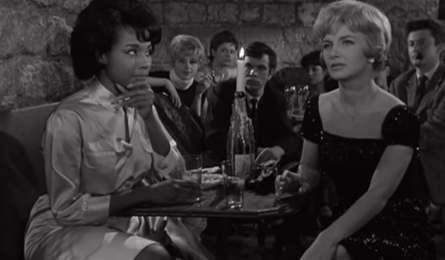
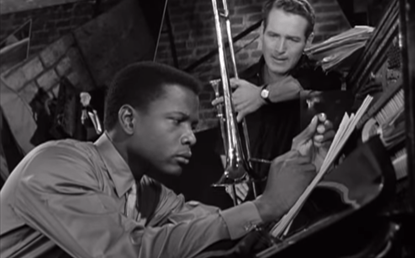
Less than a decade before, we had Roman Holiday (1953) and now we have something that might just do the same for France, except with an extra flavoring of brass and a rhythm section. The cast couldn’t be better with two of Ritt’s former students from their Actor’s Studio days, power couple Paul Newman and Joanne Woodward. Equally compelling is another legendary leading man in Sidney Poitier and Diahann Carroll as beautiful and sophisticated as ever. I admire them all.

paris blues 2.png

However, in translating the source material to the silver screen, you could easily say the story lost most of its clout. Harold Flender’s original novel was about two interracial romances between two vacationing Americans and two expatriate jazz musicians working in Paris. However, this was Hollywood in 1961. Although the script teases the original storyline when Ram Bowen (Newman) comes onto Connie Lampson (Carroll) on an inbound train, it was not meant to be — quickly brushed off for more conventional demarcations.

Believing the public was still not ready for such portrayals, the studio got cold feet and smoothed things out by making sure everyone ended up with their “kind.” It’s Lillian Corning (Woodward) who gets starstruck with the trombone player and her friend eventually softens to the handsome saxophonist Eddie Cook (Poitier).

Acknowledging this grievance, the only thing that makes me mildly okay with the change is that the husband and wife duo of Newman and Woodward get paired opposite each other so we see real-life romance partially channeled into the movie. While the four leads look great together and there’s indubitable chemistry, somehow it still feels like something is missing.

paris blues 3.png

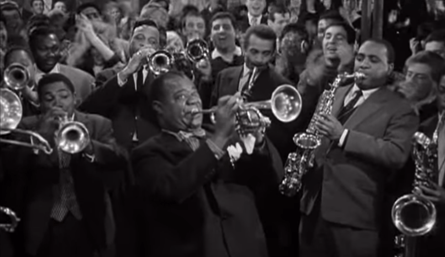
Louis Armstrong leading a parade of brass into the jazz club is a shining moment full of uninhibited synergy that fills up the underground space in the most joyous of fashions. As he always does, Wild Man Moore brings down the house. But the real issue is the lack of pizzazz outside these performances.

The story meanders without creating enough interludes ripe with meaning. They’re either cutesy momentary snapshots of lovebirds in Paris or understated pieces of human drama. Not by any means bad but what the picture might have used were some sustained sequences of action in places where it floundered. Most vividly I can recall the Vespa ride through the streets or even the party which is raided by the local police which helped make Roman Holiday a landmark.

There is nothing so memorable here. Instead, some characters leave on the train they arrived on and others stay behind. Musical aspirations and romance are continuously being weighed. Whether we care that deeply about any of it is up for debate.

Worst of all, these issues are only exasperated by the fact that the story no longer has one of Martin Ritt’s finest attributes, a theme of social importance. Because in a Pre-Civil Rights age, Paris Blues could have been a much more moving statement; instead, it’s a middling love story.

Poitier gets one conversation with Carroll where he candidly vocalizes that in Paris he’s a man or he’s a musician. To borrow someone else’s words, “he’s judged not by the color of his skin but by the content of his character” and even more so by his artistry. It spawns a minor spat but the opportunity to make a statement — a statement without the utterance of words even — was lost before it even began. Perhaps the wasted potential hurts more than anything. Like the musicians at its core, Paris Blues is ultimately a lightweight.

3/5 Stars

Review: Butch Cassidy and The Sundance Kid (1969)

butch cassidy and the sudance 1.png

Despite my general reluctance to say that the Western in its classical form was on the way out, it’s hard not to make such an assertion looking at the landscape of the late 1960s. The Wild Bunch is a common marker of the seismic shift leading to the complete obliteration of the classic western mythology, but there are some related themes strewn throughout Butch Cassidy that make it equally representative of an era or so one could argue.

The times were changing historically speaking and that plays out cinematically in Butch Cassidy and the Sundance Kid. Bicycles are the future, destined to replace the old reliable horse. And the western hero as we knew him has long since gone, replaced instead by vengeful tough guys and in this case a pair of bank robbing antiheroes. Bonnie and Clyde were the new standards and out of that trend, we saw more like them.

So it’s not just the fact that the film takes place at the tail end of the Old West, slowly evolving into the modern, or New West, but simultaneously the genre would never be the same. There’s a bit of a wistfulness to it all. The legend is fun. The mythology is something to be thoroughly embellished, but it too comes to an end. It’s only a wisp of a memory made of sepia tones and silent newsreels. But Butch Cassidy and Sundance will be remembered fondly by the audience just as the West is. Maybe that is enough.

Unfortunately, Butch Cassidy as a film does have its shortcoming which became more apparent with time. It’s possible to be a dated period piece as this film is (although it’s hard not to love “Raindrops Keep Falling on My Head). Still, it can be plodding and some would argue it’s about nothing substantial, nothing meaningful at all. Still, it manages to be one of the greatest western comedies of all time only eclipsed by its own heavy dose of cynicism.

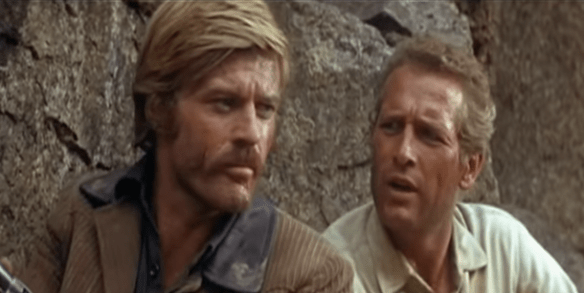
It’s funny watching Butch and Sundance go through their motions. Butch (Paul Newman) is the brains who bemoans the fact that banks are getting upgrades and shipments are being made by trains. After all, they are constantly on the move and it becomes a constant guessing game. He’s given more grief by his gang that looks to overthrow him led by the hulking thug Harvey (Ted Cassidy).

And on top of that every lawman wants him dead. In such moments, being the idea man that he is he entertains thoughts of joining the army for the Spanish-American War or even going to a far off land like Bolivia. Content with his gunplay and letting Butch do the thinking, Sundance rides by his side, certainly his own man but also part of this comic duo.

William Goldman’s script is brimming with wry wit that’s almost inexhaustible. But Paul Newman and Robert Redford loom even larger as the titular stars in this epic buddy comedy. In the age where winning charm and star power still seemed like a genuine box office draw. You came to see actors and in 1969 there were few actors as commanding as Newman and Redford. They had looks and charm. Cool and comedy. Charisma goes a long way. For those very reasons it’s an impressive film and enduringly entertaining. If we cannot watch a film and enjoy it as pure entertainment at least on some level, it really is a shame because that’s one of the many joys of the cinema.

But there’s also something admittedly depressing in how their story evolves. It can no longer be about snide repartee and living the good life robbing banks, continuously augmenting their legendary notoriety. It’s light and funny for a time before slowly spiraling into a deadly cycle.

Perhaps my faith in Butch and Sundance wavered slightly but I will go on resolutely and maintain my immense affection for them that began as a boy. This is still a wonderful film. Outlaws do not have to be one-dimensional. They can be just as funny as they are depressing. That is their right and the legend of the Hole in the Wall Gang is exactly that type of story. We don’t have to see them die. Instead, we get the satisfaction to leave them in one last shining moment of triumph. One final triumph of the West as we once knew it.

5/5 Stars

Slap Shot (1977)

slap-shot-2

The question is, what to do with Slap Shot? It’s grungy, dirty, and foul-mouthed. Bloody and violent. Did I mention profane and boisterous? Loud and obnoxious? Yet somehow there’s still something idiosyncratically lovable about this board busting hockey film. Is it wrong to call it an adult version of The Bad News Bears? After all, the men that the film follows are actually real professional hockey players. Not some kid looking to play at their local gymnasium. Except hockey’s still not the biggest sport (not even today) and the Charleston Chiefs are a minor league club if I’ve ever seen one.

But it’s precisely that quality that keeps us around. Because we all gravitate towards the rejects and the bottom dwellers. The people we can easily feel sorry for and who simultaneously make us feel a little bit better about ourselves.

In bringing George Roy Hill back with Paul Newman and surrounding him with quite the cast of lug heads, epitomized by the gloriously violent Hanson Brothers, Slap Shot somehow became a cult classic.

Player-manager Reggie Dunlop is in the twilight of his career. It’s hardly a secret that the Chiefs aren’t doing so hot and it looks like this might be their last season. It’s a fairly abysmal existence for all involved then Dunlop has the bright idea to let go of any inhibitions. Soon he has his boys brawling with everyone imaginable. Opposing players, fans, referees, anyone who is living and breathing. The funny thing is that this new style of play actually elicits winning results and the public loves them for their brutality.

One perfect illustration of this chaotic pandemonium occurs when the opposing goalkeeper goes diving over the boards to continue his showdown with Paul Newman. They shared a few choice words beforehand. That’s putting it lightly.

But these are also the same group of guys who leave every battle bloodied and bruised. The same group of guys who wind up playing cards on the bus or get mesmerized by the latest corny soap opera on television at the local watering hole. They’re a sorry lot who also happen to be ridiculously funny at times.

It’s the rowdiest of films with at least a couple screws loose. If we were to be pretentious I guess who would chock it up to Slap Shot having “Character.” But I’m not sure if it would be too far from the truth to blame this film for leading the charge in legions of awful R-Rated comedies with no merit whatsoever.

Even with Slap Shot, there are some rather interesting tonal shifts. It’s as if Nancy Dowd’s script looks to get sincere once or twice. Or there were thoughts of getting dramatic. But then the gloves came off and the sticks were thrown aside and there was a collective “Nawww!” from all involved. Not surprisingly this was one of Paul Newman’s favorite roles because he’s not just a ne’er do well or an old crotchety wise guy, he’s a legitimate scuzzball.

Also, it doesn’t hurt that Slap Shot’s soundtrack is now synonymous with the bouncy infectious notes of Maxine Nightingale’s 1975 classic “Right Back Where We Started From.”  The added addition of Fleetwood Mac doesn’t hurt it either. So, yes, I would hardly call this one a revered classic, and I’m still digging around for some redeeming qualities. I’ll let you know. But Slap Shot never claimed to be anything of those things.

It’s unashamedly crude. Gratuitously violent but so over the top as to be comic and there’s not even the slightest attempt to cover any of this up. It could be that Slap Shot is one of the more honest portrayals of human nature. Humanity loves sports. We’re often losers and outcasts with few redeeming qualities when you really get to know us. That’s by no means a promotion of Slap Shot but more of a qualification.

3/5 Stars

Torn Curtain (1966)

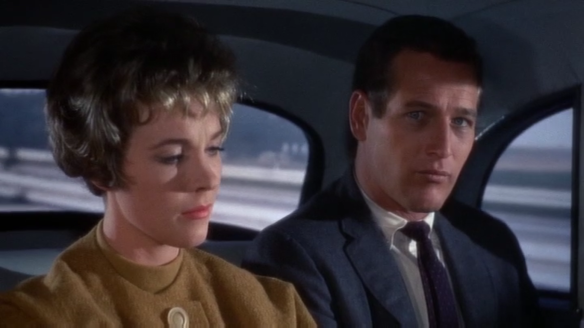
torncurtain1Torn Curtain was Alfred Hitchcock’s fiftieth feature in an illustrious career. Though he was arguably on a slow decline, the film still channels the Cold War sentiment and the age of the spy thriller, while taking hold of the director’s fascination in the everyman.  The storyline unwinds as Professor Michael Armstrong (Paul Newman) and his assistant and wife-to-be Sarah Sherman (Julie Andrews) are rubbing noses with the best and the brightest physicists in Denmark.  However, unbeknownst to lovely sweetheart, the young professor is looking to defect and live behind the iron curtain. For Armstrong, it’s something that has to be done to gain some vital information from the communists, but for her part, Ms. Sherman does not understand what is going on and so she decides to follow her love who all too quickly began to give her the cold shoulder. But of course, things in a Hitchcock film are never cut and dry.

Armstrong tries to gain the confidence of a high-level Communist scientist who can crack the Cold War wide open with a secret formula. This is crucial, acting as the MacGuffin, a storytelling device Hitchcock used in many of his films, its only purpose being to move the plot forward. Thus, Susan finds out eventually that her fiancée is no traitor, but out of that comes the perilous prospect of getting out of the country. In the end, Newman and Andrews get away and live happily ever after. Like his previous work in North by Northwest, Hitchcock’s focus once more is on your average individual. The difference here is that instead of getting the spy life thrust upon him in middle America, the protagonist willingly dives headfirst into the world of espionage by readily going behind the lines of the Iron Curtain.

The reasons Torn Curtain slightly pales in comparison with his past works has numerous sources. In truth, he came from an earlier age of filmmakers perfectly at home in Classical Hollywood, except it appeared like the days of his rule might be coming to an end.  It was his impetus to make a Cold War thriller, but it was the studio who supplied the stars and ultimately led him to cut ties with one of his greatest collaborators Bernard Hermann. To make matter worse, Hitchcock was completely disgruntled by Paul Newman’s abrasive style. The director was bred during an earlier age, while Newman was a brash young product of Method Acting. Whereas Hitch had wanted to bring back his longtime cohort Cary Grant with a role for Eva Marie Sainte, he was handed two younger stars in high demand. As such, they did not seem to fit with his usual sensibilities, and it truly did seem to suggest that he could not quite change with the times. Although his leads were certainly not his perfect match, being the creative force that he was, Hitchcock interestingly enough counterbalances his stars with a wide array of foreign supporting players. To the American eye, they were nobodies, but when given interesting roles to inhabit they help to give added texture to this Cold War world created on the Universal backlot. It truly is a lusciously constructed façade, although all the pieces do not fit quite so well this time around.

torncurtain2However, when you watch any Hitchcock film you do wait to be dazzled with some twist or trick because he was always one to bring humor and fascinating aesthetic qualities into his films. Torn Curtain has a few such moments that quickly come to mind. The most prominent has to do with the editing of the sequence in the farmhouse. It is here where Gromek is murdered by Armstrong and the housewife, but it is cut in such a fascinating way.  It contrasts with Psycho’s shower sequence quite easily as they try and murder him first by strangling and then anything they can get a hold of whether it’s guns, knives, shovels. There is no score to speak of. Soon it becomes a methodical rhythm of cutting between contorted faces as they slowly but surely move towards the stove. The brutality and length of the ordeal suggest how ugly and laborious it is to kill a man. Hitchcock certainly does not glorify it in any sense.

3/5 Stars

Harper (1966)

harper1We are brought into the world of Lew Harper with a cold open full of character. There he is. Paul Newman. Soaking his head in a sink full of ice. Making his morning cup of Joe. Popping that first piece of chewing gum before heading off to his first appointment.

What follows is a narrative courtesy of Ross Macdonald’s The Moving Target and an up-and-coming screenwriter William Goldman. Really, the film pays tribute to all of Bogart’s great P.I. roles (even going so far as casting Lauren Bacall), becoming a ’60s revamp of The Big Sleep.

But although the plot is not quite as incomprehensible as its predecessor, the greatest joy of this storyline is the witty repartee of Goldman’s pen paired with wall-to-wall star power. We have Newman and Bacall headlining as a gumshoe and his client who is looking rather half-heartedly for her missing husband. We have young blood with Robert Wagner and Pamela Tiffin. Then some old reliable talent in the likes of Janet Leigh, Julie Harris, Shelley Winters, and Strother Martin. The characters might not be the most insightful, but who needs that when they’re fun.

Lew Harper’s marriage is going down the tubes as he begins digging around for leads on the whereabouts of millionaire Ralph Sampson. He begins his inquiries which ultimately lead him to a washed-up starlet (Winters) who he pumps for information. He meets her charming husband and pays a visit to a nightclub singer (Harris) with a drug habit.

The dive musical halls, a rogue truck, and an encounter with a new age religious cult point Harper toward’s Sampson’s kidnapping, but he must piece together all the broken shards. There are twists, turns, and big reveals that are only fitting for a mystery of this inclination.

It’s certainly a nifty charade of mystery accented by a bouncy score courtesy of Johnny Mandel. But this sublimely Paul Newman role is more fun.  In his own words, “He’s a regular beaver,” a jaded cynic prone to smirks and sarcasm. He’s a sly dog even before Jim Rockford. He gives off an air of not being particularly happy in his work, but who would be thrilled to be a private investigator? On top of the lousy lifestyle and unglamorous dirty work, his wife is calling for divorce proceedings.

And yet he reveals moments of humanity and charm, whether he’s stacking up on tea sandwiches, chatting it up with his pal Albert, or pulling one over on his wife over the phone with paper towels stuffed down his throat.

Harper serves up exactly what we want with Newman grabbing hold of a cynical streak like he does best and riding the waves of Goldman’s engaging script. It’s not rocket science, but everything translates into a thoroughly enjoyable experience all around.

3.5/5 Stars

(After being beaten up again)

“Hey Lew, you alright?” ~ Albert

“I’m awful tired of answering that question” ~Lew

Hombre (1967)

hombre1“You don’t get tired, you don’t get hungry, you don’t get thirsty. Are you real?” – Jessie

“More or less” – John Russell 

How to function within Western culture. That’s what John Russell must figure out as a man who was raised by Apache and then is forced to enter the “white man’s world” to collect his deceased father’s possessions (a watch and a boarding house). He starts out complete with long locks and a bandanna but soon switches over to more traditional western wear in a way blending into society — while simultaneously beginning to look more like the Paul Newman we know.

But he’s far from the affable ne’er do well. In fact, he hardly even utters a word. He’s not agreeable and about as terse as they come. He’s not looking for any favors and he’s not looking to hand out any charity. He’s also not going to take the white man’s flack. But his decision to sell his boarding house for horses is not too popular with the home’s residents, including the fiery Jessie (Diane Cilento).

hombre2Ultimately, Russell boards the local stage with a few other individuals. The destination doesn’t seem to matter much, but the people do. Leading the coach is affable Mexican Henry Mendez (Martin Balsam) and along with the two aforementioned, the other two misplaced tenants, young Billy Joe and his wife join the contingent. The coach is rounded out by Indian Agent Alexander Favor (Frederic March), his well to do wife, and finally, the vulgar tough-guy Cicero Grimes (Richard Boone).

When Dr. Favor learns of Russell’s background he requests that the Indian sit up top and such a reaction embitters Russell. But there’s not much time to worry about the prejudice because Cicero’s cronies hold up the stage in an effort to swipe some ill-gotten gain from the esteemed doctor. The survivors are left to die and Russell heads off on his own with a few stragglers trying to catch up with him. He has no sympathy to offer, but they follow him because he is the most knowledgeable among them.

Of course, the film must reach a crescendo and it occurs with Russell dealing with Dr. Favor and then Boone. Both men are crooked in their own ways. Grimes is sadistic in nature, but Favor is also a despicable and sorry excuse for a human being. And yet Russell himself has his own streak of heartlessness. What it means is that each man must face justice and in some way, shape, or form pay for their deeds. Just as the men come in different incarnations, they are complemented by varying degrees of women from all across the gamut.

Director Martin Ritt’s Hombre really feels like a riff off of Stagecoach and feels somewhat reminiscent of Boetticher’s western The Tall T (also featuring a no good Richard Boone). But it’s no doubt a western for the 1960s, coloring the West with more liberal and revisionist tones. However, the film deals not only with prejudice but morality. For although John Russell has a gripe with the world and its hypocrisy since his people are getting pushed out by men who call themselves “Christian,” he’s not without fault. Jessie so rightly points out, that if the whole world didn’t lift a finger then the whole world would go to hell in a hand-basket. And in many ways this world does.

3.5/5 Stars

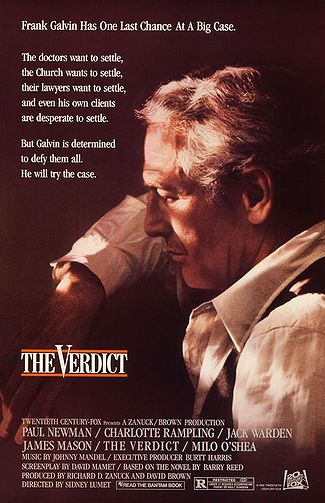
The Verdict (1982)

Verdict1Paul Newman is one of those people who bring other people into theaters. They’ll watch him on reruns when they’re surfing through the channels or tell their children and grandchildren about him. That’s just it. He’s a universal actor who transcends the years with his magnetism and charisma. A lot of folks would follow him to the ends of the earth cinematically-speaking, and he plays the bums and ne’er do wells like nobody else.

In some ways, it seems like he should have no place in the film like The Verdict. It’s a slow, brooding drama that churns and grinds methodically through a script courtesy of David Mamet, adapted from Barry Reed’s novel. It’s completely void of humor or charm in many respects. It’s bitter and battered, personified by Frank Galvin, a washed-up lawyer drowning in booze and drifting in a fog of cigarette smoke. His pedigree isn’t so hot either. In the last three years, he’s had four cases and has not won a single one. To make matters worse, he’s an ambulance chaser, the type of prosecutor that every self-respecting citizen would scoff at with contempt.

The film generally lacks polish or pizzazz for that matter, but Paul Newman and director Sidney Lumet are well-established professionals, who know how to develop the courtroom drama in such a way that it remains compelling. All the necessary bits and pieces are there to go along with generally stark and somber visuals.

James Mason is the opposition, a white-haired man with a penchant for winning and doing his homework so that all the holes are stopped up. He’s representing not only two renowned doctors but also the Archdiocese of Boston since they own St. Catherine’s hospital. Galvin’s mentor and colleague is Mickey (Jack Warden), who watches out for him despite his many failings. Being divorced, Frank also tries to find companionship with the aloof beauty Laura (Charlotte Rampling).

Galvin is tempted by a giant settlement, but there’s something inside of himself that says, take the case to trial. Of course, right from the beginning, it’s a train wreck, because he cannot find the witnesses he needs, and Ed Concannon is a real pro with an extensive legal team to do his bidding. On the other side of the room, you only have Frank and Mickey.

They’re able to dig up key witness Kaitlin Costello, although Concannon turns that against them as well. Furthermore, Frank learns something about Laura that doesn’t help. And there we are at the end of the case, a gray-haired lawyer sitting there seemingly defeated. But he does the only thing he can do, in all sincerity plead with the members of the jury to do what is right and just. That is all he can do.

Some might find comparisons to The Verdict in Lumet’s earlier masterpiece 12 Angry Men, including the casting of Jack Warden and Edward Binns. However, I think what makes the director’s courtroom dramas work so well is that they really don’t dwell too much on the actual courtroom. 12 Angry Men is about the discussion going on behind closed doors and The Verdict concerns itself with all that is going on outside in preparation. We see Frank for who he is in the office and out of it. Thus, by the time we actually get into that court of law there’s so much more riding on this verdict.

What’s especially striking about Newman’s performance is that there is almost a complete absence of drama. There is one violent outburst and aside from that, it’s as if he’s utterly fed up with the world. Throwing his hands up in a sense and giving in. Instead, he plays pinball or sits pensively with a drink in hand. That’s why this case is so important because it means something. It signifies an attempt to care again about right and wrong. But the question is, Does anything actually change in the character of Frank Galvin? We leave him sulking in his office, slowly nursing yet another drink as the phone rings out in the silence. What’s the verdict then? Is he a winner or a loser? I’m not sure he even knows the answer to that question.

4/5 Stars

Nobody’s Fool (1994)

NobodysfoolEarlier this year I wrote a piece on the evolution of acting that I envisioned as a case study of sorts. The second wave of actors I attempted to analyze included the likes of Marlon Brando, James Dean, and Paul Newman.

It is this last figure I wish to look at again in the context of Robert Benton’s 1994 film Nobody’s Fool. In all areas, this drama meanders along following town grump and crotchety ne’er do well Sully Sullivan (Paul Newman), who works as a freelance construction worker in a peaceful, snowy New York getaway. So, by all accounts, it seems like it should be a complete and utter bore, but it is not thanks, in part, to Paul Newman and his array of supporting players.

As I have watched more and more films in the last half a dozen years or so, there has been an ongoing trend where I tend to care less and less about substantial plot and more and more about characters. Don’t get me wrong, I love a taut thriller or an engaging mystery story, but the films that really do it for me have memorable performances that reflect a bit about the world we live in. Sometimes I even feel like a broken record, because I reiterate this fact so often, but I believe it to be the truth.

In other words, it feels utterly superfluous to go in depth about this film’s plot. It’s about a no-good Paul Newman, who left his wife, left his son, and never turned back. Now he must accept the path he chose and decide whether or not to spend his waning years finally getting to know his son and grandkid. It’s not rocket science by any means, and the film certainly feels dated, but Newman strangely does not, although his hair is a little bit whiter.

Now back to the generation of actors he came out of. They were the young, moody band of men brought up on the method that taught them to grab hold of emotions and experiences to be projected on the screen in each role they took. Dean was legendary, but his career was cut short. Brando was a giant, but slowly fell from grace and his waistline grew. Newman was famously married to his wife Joanne Woodward for over 50 years, started the charity Newman’s Own, and continued having a media presence in the late 20th and early 21st century. In other words, he aged gracefully compared to many of his contemporaries.

nobodys1

Nobody’s Fool falls closer to the tail end of his career, but he has the same gleam in his eye or maybe it’s that sour smile with a hitch in his giddy-up. But it feels genuine, it feels relatable, and it feels very much like the Paul Newman many people know and love. I know I do. He’s so often a malcontent or a bum and yet we cannot help but root for him.

He also has some wonderful moments to work with the likes of Jessica Tandy, Bruce Willis, and Melanie Griffith, among others, because first and foremost this is a film about relationships. These are people who have made mistakes and who are not always the wisest, but somehow we still appreciate them with all their faults and peculiarities. I guess that’s what the small-town mentality does, in a way.

You get to know everyone and you come to accept them for who they are. Stealing a snowblower, playing cards, drinking a beer, or buying your daily trifecta ticket just feels commonplace. That’s life.

3.5/5 Stars

Witness (1985)

Witness_movieI think of Harrison Ford much in the same way that I think of Paul Newman. They both play the brash, bold, smart alec characters that we adore as audiences. They make the perfect action adventure heroes but are not always respected as actors which is a shame. For Ford, his reputation hinges on a number of great characters from Han Solo, to Indiana Jones, to Rick Deckard. They all are magnificently memorable action heroes. Ironically it is the plain, seemingly everyday cop, John Book that allows Ford to truly show off his acting chops like I have never seen him do before.

The film begins when a young Amish boy named Samuel gets to take his first adventure into the big city with his mother, as they head to see some relatives in Philadelphia. Little Samuel has a pair of dark brown, wonderfully inquisitive eyes in which to take in this world that is so foreign to him. That is, in fact, one of the major themes of Witness, the colliding of two worlds that are at odds.

But anyhow, when he ventures into the restroom to use the toilet, he unwittingly sees a violent murder committed and he is able to hide in the stalls, but he also gets a look at one of the perpetrators. And so, just like that, this little boy who never spent a day in the real world is a key witness to a murder investigation.

That’s when steady, straight-arrow cop John Book comes into the picture. He’s not a bad man by any means, and he wants to wrap up the case quickly so he can let Samuel and his mother go as soon as possible. You can see he finds their customs strange, and Book feels a trifle awkward being around them, but he does his job the best way he knows how, by confiding in his superiors and having his partner watch his back.

Everything blows up in his face. He gets shot and he must make a mad dash with Samuel and his mother to their quaint Amish home. Now the roles are shifted as he must wait it out building up his strength as his pursuers try and locate him. His world of cops and guns seems to have no place in this farm community of peaceful people. But as a former carpenter and a decent individual, Book is able to adapt rather well. Rachael Lapp soon finds herself enjoying his presence around their home since she is a widower and her father-in-law Eli reluctantly allows him to stay.

Book learns how to milk a cow and helps in a barn raising, all the while building a rapport with Rachael, but others seem to be wary of the presence of such a man.

As would be expected, we have our final showdown between Book and his pursuers who are a lot closer to home than he would ever expect. When it’s all resolved he leaves the country peaceful once more, but not without some intense memories.

Peter Weir’s film has a rather interesting pacing for a thriller, starting out slowly, but we know it must be building up to some impending doom so I would reserve from calling it boring. When that moment comes, it becomes a breakneck thriller before quieting down once more in the Amish town. Then the last 20 minutes are that of a dynamic action film. However, it is in these more tranquil moments that Harrison Ford gets to show off his humanity, whether it is talking about guns with young Samuel or dancing to a car radio with Rachael. There’s no doubt that you have not seen Ford like this before, and it’s definitely worth seeing him in this gripping ’80s thriller.

4/5 Stars