
 If Preston Sturges was a comic wordsmith then Sullivan’s Travels was his magnum opus. It has so many pieces worth talking about, despite it only running a meager 90 minutes. It is the kind of comedy that director John L. Sullivan (Joel McCrea) would want to make, and it’s a message movie against message movies. It’s a film about filmmaking (including mentions of Capra and Lubitsch). There’s even a scene where an ecstatic actress goes racing around the studio lot, completely disregarding the period piece she is acting in. The script has the undeniable frenetic poetry of Sturges and even takes time to wax philosophical at times. Sullivan opens the film with some very grandiose vision of what film can mean for the everyday filmgoer (I want this picture to be a commentary on modern conditions. Stark realism. The problems that confront the average man!).
Sturges’ film is scatterbrained and insane in its pacing at times. Take the opening speeding sequence as a newly bedraggled Sullivan tries to shake his caravan so he can really get a feel for the common man’s plight. It almost gives you a heart attack as they blitz down the road, people and everything imaginable flying every which way. It’s faster than most modern action sequences could achieve.
However, although Sturges is undoubtedly known for the strength of his scripts, it’s important to note that Sullivan’s Travels has some wonderful visual sequences. Many of them lack his typical lightning dialogue and instead rely on music and images to develop scenes. Sometimes it’s the plight of the homeless on the road as Sullivan and his companion make their way across country. I would have never thought of this comparison before, but sometimes his heroes elicit the same type of empathy that would be given to Charlie Chaplin or the Gamine (Paulette Goddard) in Modern Times. In that same way, this film so beautifully fluctuates between comedy and heartfelt drama.
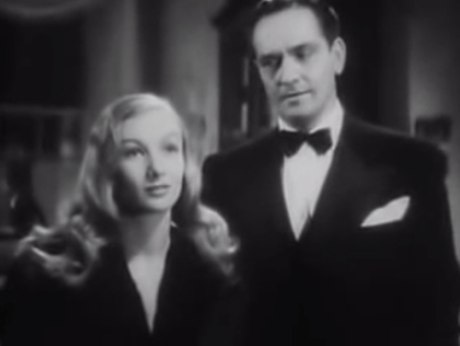
Another beautiful thing about Sullivan’s Travels is the cast. Our star is Joel McCrea, who is sometimes known as the poor man’s Gary Cooper, but that is rather unfair because he’s a compelling actor in his own right. Just look at this film to prove his case. Also, he and Veronica Lake (Ms. Peekaboo Haircut herself) have a fun relationship going from the beginning when they first meet in a diner. You might say the shoe’s on the other foot since she thinks she’s doing a good deed for this down on his luck nobody. She has no idea that her “big boy” is actually a big shot movie director. However, it makes no difference, because in some ways she feels responsible for him, and so she takes part in his noble experiment even afterward. That’s where we build respect for them, and she, in turn, falls for him. It’s what we want as an audience. And we finally get it when Sullivan beats his death and a chain gain to return to civilization. His nagging wife has married some other boob, so Sullivan gets his girl.
Sometimes I feel like a broken record, but it definitely seems like they don’t make character actors like they used to. It helps that Sturges has a stock company of sorts and the studio system probably helped in propagating certain actors. However, there’s no doubt that players like William Demarest and Porter Hall are so memorable. Their voices. Their look. There’s no escaping them and there are numerous other faces that you get deja vu with. We’ve seen them before somewhere and just cannot place it.
5/5 Stars




 The director’s unsteady handheld camera feels a little abrasive at times, but also brutally honest, spending a great deal of time on close-ups. Cretton’s script is relatively simple, still, it continually brims with harsh realities and little moments that feel terribly human. It might be Grace sitting solemnly in an abortion clinic, the brooding Marcus throwing down a heartfelt rap, or Jayden illustrating her pain through the story of an armless octopus. The minutiae work marvelously, collectively making these into people who we can truly feel for.


 ngsters, prohibition, Al Capone, the St. Valentine Day’s Massacre. It all sounds like some distant piece of folklore that by now is far removed from our modern day sensibilities. But when films like The Public Enemy, Little Caesar, and of course Scarface came out, these things were at the forefront of the national conscience. In fact, it seems like these films have seeped into our culture, making it hard to pull the legends and cinematic stereotypes away from the cold hard facts that have now dissipated with time.
 4 Star Films