Review: The Big Sleep (1946)

b4c25-bigsleep1

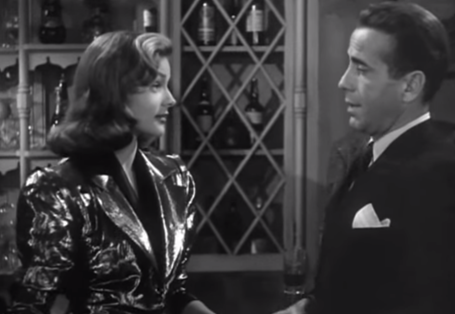
Philip Marlowe is undoubtedly Raymond Chandler’s character, but Howard Hawks and Humphrey Bogart brought him right out of a pulp novel and stuck him on the silver screen to ever be solidified in our minds. Needless to say, this is a quintessential film-noir coming right at the tail end of WWII, known as much for its incomprehensible plot line as it is the romantic pairing of Bogey and Bacall.The title credits role and the contours of our two leads can be seen in the background, cigarette in toe with Max Steiner’s furious score pulsing in rhythm. We find ourselves on the doorstep of a man named Sternwood. A hand is ringing the doorbell and a servant answers. The hand, of course, belongs to Humphrey Bogart or closer yet Philip Marlowe. Right off the bat, he gets the come on from the flirtatious younger daughter of Sternwood and he takes it in stride.

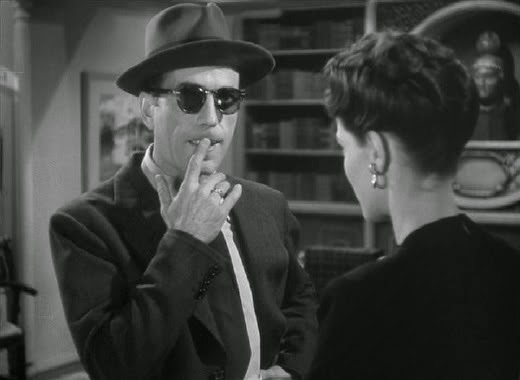
When he meets the sickly man of the house, he’s stricken to a wheelchair parked inside a greenhouse. He and Marlowe get chummy, and he calls upon the P.I. to find a man named Geiger, while bemoaning the trouble his daughters get into. For good measure, Marlowe also gets his first taste of Sternwood’s older daughter Vivian Rutledge who is more mature, but suspicious all the same. From then on the case is a series of storefronts, L.A. street corners, and car interiors. It’s hard to believe, but it also seems so dark and dreary with buckets of rain to boot. It must be L.A. in winter (or in an alternative universe). Bogey has a little fun masquerading as an antique book aficionado and every lady he interacts with feels like another Carmen Sternwood. Always ready to flirt and he usually gives them the time of day.
He stakes out a home and he investigates a piercing scream only to find a disoriented Carmen in a big mess. Next, a dead man is pulled out of a Packard near Lido Pier. The names keep piling up too. There’s A. G. Geiger, Sean Regan, Owen Taylor, Joe Brody, Eddie Mars, Harry Jones (Elisha Cook Jr.), and a number of others. Most are seen at one time or another but a few are not.
08bfb-bigsleepBy this point, The Big Sleep is less about all the facts and more about how we get there in the end. Obviously, the source material is from Raymond Chandler, but the witty script full of great patter is courtesy of William Faulkner and Leigh Brackett of all people. Bogey and Bacall have some fun on the telephone (You like to play games don’t you) which coincidentally has no bearing on the plot. Later on, they have some more spirited back and forth about horse racing. It’s at these times that you cannot help but chuckle at the rapier wit of the script. Philip Marlowe is a great character with a lot of great things to say indeed.
Soon we suspect there is something romantic going on between Eddie Mars and Rutledge. A few more stooges get it and Marlowe gets himself beat up in a dark back alley (Of course). Next thing we know is our new favorite gumshoe is tied up in a house with two ladies. Rutledge is there and the wife of Eddie Mars. What? He gets out of harm’s way thanks to Vivian, and the showdown that we have been waiting for comes to pass. Marlowe outsmarts everyone and puts the damper on the case. Everything seemingly comes to a smooth resolution, the audience just has little idea how we got there. But that’s not the greatest of concerns.
It would be great enough to watch The Big Sleep for the sass and repartee which it is positively dripping with. Thanks to the reworking of the film in 1946, the Bogey and Bacall dynamic became more prominent and fun. Although it is slightly disappointing that a lot of Martha Vickers’s performance ended up on the cutting floor, it is made slightly better by a memorable appearance by a young Dorothy Malone. All in all, there is very little to complain about if you just sit back and enjoy this very engaging film-noir for what it is. Howard Hawks brought us yet another unassuming post-war classic that is unequivocally American.

4.5/5 Stars

Caught (1949)

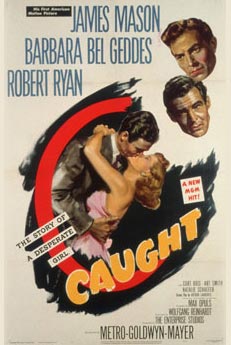
Caught_(1949_film)Max Ophul’s Caught is an interesting mix of soap opera drama and dark, brooding noir. It follows aspiring model Leonora Eames (Barbara Bel Geddes), who is obsessed with improving herself through charm school, landing a modeling job, and finding a rich husband. She’s not the only one in a world of young pretty girls who thinks money makes the world go round.

She’s a little bit different than the others, but they have slowly made her buy into the whole system. Then, one night she gets what all these gold digging girls could only dream of, she meets the filthy rich and oddly-named Smith Ohlrig (Robert Ryan), and it’s all quite by accident.

Soon more to prove a point than for love, Smith marries Leonora, and she tries her best to love him like a good wife. But he’s too busy and too difficult to get close to. She spends all her days stuck at home and unhappy with Smith’s hired aide Franzi Kartos (Curt Bois). Leonora realizes she needs something else and heads out to get a job away from Smith and his money.

The first opportunity she gets is as a receptionist for the doctor’s office of a kindly young pediatrician and his older colleague across the hall (Frank Ferguson). He pegs her as an odd applicant from the beginning but allows her to come on and work. Once she commits, Leonora proves to be a hard worker and she and Dr. Quinada (James Mason) hit it off, though he still finds her peculiar.

caught2

Once more, Leonora tries to patch things up with Ohlrig who begs her to come back home, which she does. Because she wants their marriage to still work out. However, Leonora also gets some big news from a doctor that complicates the situation. She truly is caught. She cannot leave Smith due to their marriage and other difficulties while her affections truly lie with kindly Dr. Quinada who feels the same.

Ultimately, there has to be a showdown and so there is. Leonora has to make her decision. Then Smith has one of his angina attacks and she doesn’t want to help him. It causes her increased guilt and ensuing complications. But Ohlrig doesn’t die and Leonora finally has the future she wants with Quinada.caught3Max Ophul’s was always a master with these types of melodramas and his trademark dolly shots are as prevalent as ever, developing some of the scenes wonderfully. It becomes more than a plot but a visual presentation too, and the shots often are augmented by how he moves in and about a room.  Robert Ryan steps into the villainous role easily and James Mason is a surprisingly amiable good guy. Also, though his role is small, Frank Ferguson is nonetheless pivotal and thoroughly enjoyable as a fatherly figure. Of course, Barbara Bel Geddes is a worthy protagonist, because she is ultimately the one trapped between her two male counterparts and she is the one who goes through the most mental torment with Ohlrig potentially being close behind.

Above all, Caught is a timeless indictment not simply of corrupt capitalism but a generally misguided philosophy that money is everything. Quinada has the best approach, realizing that money is necessary, but it can never buy you happiness or remedy your relationships. Smith never figures that out and it is difficult for Leonora to leave that worldview completely behind — as it is for many of us.

4/5 Stars

They Live by Night (1948)

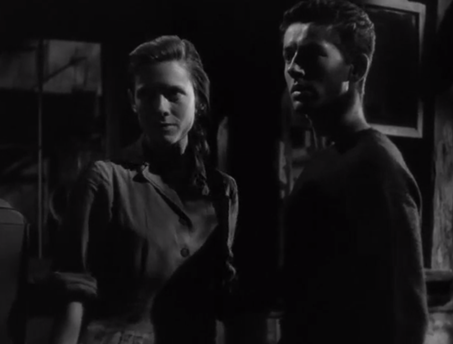
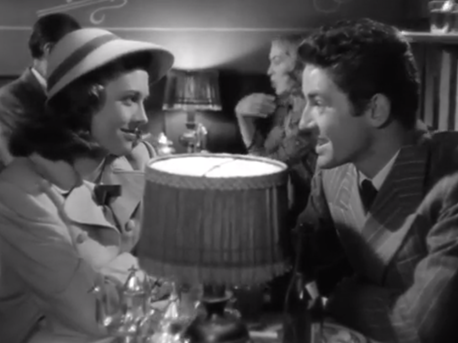
theyliveby4Regrettably, I have seen very little of Nicholas Ray, however from his debut in They Live by Night, I saw the same care spent on his youthful characters, which is also noticeable in Rebel Without a Cause. He does not treat “Keechie” and “Bowie” as cardboard cutouts or kids who are dumb and in love. They have value and feelings that are worth examining more closely.

The film opens with three thugs breaking out of the local prison. Two of the men Chicamaw (Howard Da Silva) and T-Dub (Jay C. Flippen) are weathered criminals. The third, Bowie is a baby-faced kid looking hardly a day over 20, but he went into the clink for a reason.

They find shelter at a nearby filling station where Chicamaw’s mangy older brother (Wil Wright) makes a living with his timid, no-nonsense daughter Katherine. They get a car and have enough money to get their feet off the ground before a big bank job in Kelton.

theyliveby2It goes off without a major hitch, but soon after Bowie gets in a car accident and Chicamaw takes him back to his brother’s to be cared for. Katharine is there and the two of them find companionship in each other because neither one has anyone else to turn to. They are young, naive, and in love. They’ve never had these types of feelings before.

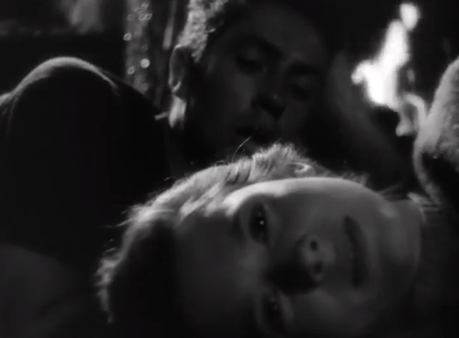
Since Bowie needs to lay low, he takes “Keechie” with him and they make an adventure out of it. Ultimately, it results in a cheap $20 marriage and a lot of nice intimate nights spent together driving and cuddling. They’re living the lives of carefree newlyweds who need no one but each other. They find a simple cottage out in the backcountry owned by a homely proprietor (Byron Foulger), and it acts as a new home. A perfect oasis from the newspapers, the cops, and Bowie’s accomplices.

However, they do catch up with him eventually, and he and Katherine split fast after a tiff. They want a normal life, but Chicamaw and T-Dub won’t allow it because they need more money from another bank job. He won’t and in the subsequent attempt, his former partners eat it. The lookout is still hot for the boy as well.

theyliveby1He seems so undeserving of hard justice, but it is bound to come after him anyways. For such relative newcomers, Farley Granger and Cathy O’Donnell (The Best Years of Our Lives) have such genuine chemistry opposite each other. Granger is more often than not gentle and kind. O’Donnell is pretty in a simple, unadorned type of way. They elicit so much more sympathy than Bonnie and Clyde or even the fugitives in Gun Crazy. Perhaps because they aren’t even outlaws, only young kids who are victims of their circumstances.

4/5 Stars

Force of Evil (1948)

Forceofevil

This is Wall Street… and today was important because tomorrow – July Fourth – I intended to make my first million dollars. An exciting day in any man’s life. Temporarily, the enterprise was slightly illegal. You see I was the lawyer for the numbers racket”  ~ Joe Morse

Not in recent memory has a film left such a different taste in my mouth. Force of Evil has all the trappings of a thoroughly engrossing noir crime film. There’s the crooked lawyer Joe Morse (John Garfield), looking to get ahead by helping a top level gangster named Tucker take over the numbers racket in New York. There’s his estranged older brother Leo (Thomas Gomez) wanting nothing to do with his brother’s dirty money. It’s a classic Cain and Able type conflict. Add realistic location shooting inter-cut with voice-over, and a David Raksin score to make a real winner.

Yet Force of Evil is a dangerous film to take at face value because on that level alone it is highly entertaining. However, director and screenwriter Abraham Polonsky created something special here at only 78 minutes in length. His film has a certain rhythm that is hard to pinpoint. John Garfield especially delivers his lines impeccably, drifting in and out of common everyday jargon and moral convictions. It’s a slightly higher level of dialogue that deserves more digestion and thought. He even gives a taxi cab soliloquy that gives On the Waterfront a run for its money.

As a big picture, the plot makes sense for the most part. Joe is on the verge of making millions on the Fourth of July, and he wants to cut his brother in on it. But his brother works one of the smaller rackets which is bound to be pushed out. He has his own sense of morality, where he can bear what he does but not what Joe will hand him.

Leo reluctantly agrees to join the big operation out of necessity until things get way too involved, and this time Joe is in a place where he has to get out himself, with no way of protecting his brother. His resolve to watch over his brother is to no avail when the Ficco Gang tries to push their way into the racket. Meanwhile, Joe still finds time to flirt with the innocent and proper Doris Lowry (Beatrice Pearson), the former secretary of Leo, who is in complete juxtaposition with Mrs. Tucker (Marie Windsor), who Morse keeps company with initially.

However, this whole mess is constantly being complicated. There is “Freddie” Bauer (Howland Chamberlain), the nervous fellow who used to work with Leo and now, with the big takeover, is looking to blow the whistle on whoever he can to stay out of the fray. There’s the police who seem intent on getting their hands on everybody they can and not showing favoritism towards anyone. There’s Leo who is righteously indignant while also taking his brother’s offer of a better position begrudgingly. There’s Doris who is in all ways sensible and yet still falls for Joe, not in your typical passionate way, but it still happens nonetheless. There’s the line between legitimate business and criminal activity that is constantly be zig-zagged.

Finally, there is Joe who deserves the greatest amount of scrutiny. John Garfield apparently could not pinpoint his character’s deal initially either, but he must have figured it out because he nailed it. It’s probably his greatest performance. He’s the kind of guy who blows the whistle on his own brother in order to help him in his own way. It doesn’t quite make sense, and he seems so often blinded, but he keeps pushing forward in a vain attempt towards success. All the caustic words and aggressive come-ons don’t work. Ultimately, he has to come to reality. When Joe does, that’s when he realizes what he has started and what he has done to Leo. By that point, it’s nearly too late for him, and it’s most definitely too late for Leo.

4/5 Stars

Body Heat (1981)

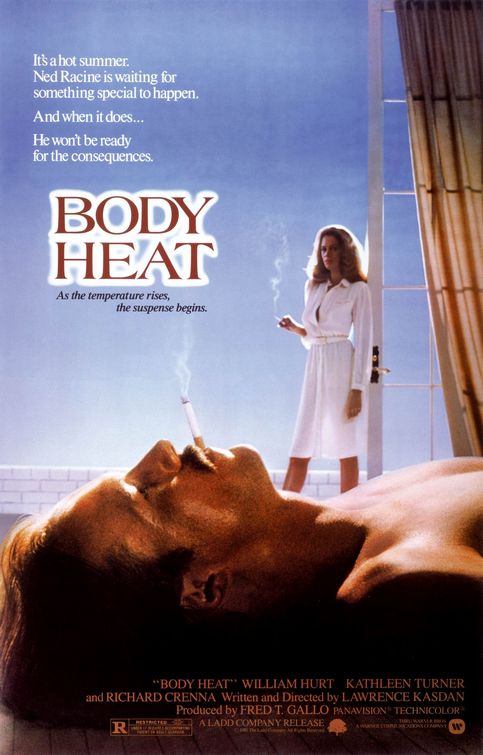
Body_heat_ver1In his directorial debut, Lawrence Kasdan (screenwriter for Empire Strikes Back and Raiders) brought us a neo-noir burning with passion and positively dripping in sweat. Quite the combination indeed.

It opens with the seductively jazzy score, courtesy of John Barry, dancing over the credits. It brings to mind cool afternoons with cool drink in hand. The first shot we are met with is a man driving in his convertible, top down and shades up. He’s a cool and collected looking young man, but we know that there must be something lurking underneath all of this. This exterior is soon dropped and we are met with a reality that is heavy with humidity and sticky days.

Our protagonist is Ned Racine (William Hurt) who is a struggling lawyer working in Florida during an especially sweltering Florida heat wave. One indelible evening he has his first encounter with a beautiful, cool blonde named Matty (Kathleen Turner) whose temperature runs a little hotter than most. He makes a pass or two even after finding she is married, and she rejects his attempts at first. However, during a point of no return, the two give into their cravings and spiral into a passionate tryst. Their affair is fairly easy to keep hidden from Mr. Walker (Richard Crenna), but an old high school friend of Matty’s and Matty’s niece unwittingly find them out one way or another.

They’ve had enough of secrecy and Racine resolves they must kill Walker so that Matty might be freed and so she might also get money due to his impending death. Not satisfied with that, Matty wants to alter the will so she gets more. Racine is completely against that idea.

The night of the murder comes and they act it out with precision and Racine gets rid of the body.  He finds out only afterward that Matty had a new will drawn up and he doesn’t like it one bit, but he is forced to play along. The prosecutor and police detective involved in the case (Ted Danson and J.A. Preston) happen to be friends with Ned through work. They spend many a sweaty afternoon chatting it up at the local diner. That’s what makes it hard when all the facts begin to pile up and slowly but surely Ned’s involvement becomes more suspect. His alibi and the degree of his relationship with Ms. Walker is being questioned.

Meanwhile, he and Matty must find a pair of glasses that might incriminate them. It becomes clear all too soon that things are not as they seem. Matty ultimately abandons Ned, and he winds up behind bars, happier without her. In one final revelation, he starts to put some of the pieces to together in prison. He’s a hot mess.

It’s difficult not to make comparisons between a film like this and classic noir such as Double Indemnity. In both films, there is a man who seems fully committed to going through with a crime, but it is really the woman who has the most to gain from the situation. Furthermore, Ned as the Walter Neff character has his Barton Keyes in the form of Lowenstein and Oscar, who are friends but also the ones who must bring him to justice. However, Body Heat can get away with more, such as sexuality and allowing certain crimes to go unpunished. It’s a rather surprising ending that is nonetheless very interesting.

Body Heat also has the cigarette prevalence of a film-noir (which Ted Danson comically will not take part in). It’s as if Lowenstein is the only character who realizes this habit is out of place in a world of 1980s sensibilities, not to mention crimes of passion.  It was odd seeing Ted Danson in a pre-Cheers role gulping down ice tea after ice tea. Kathleen Turner and William Hurt were a good fit as the gorgeous siren and her partner in crime. They are two attractive people and yet that did not put them outside of the law as they would find out. Body Heat certainly wrenched up the heat a couple of notches and never let off. It positively burns with frenetic energy and unbridled passion.

4/5 Stars

Review: Goldfinger (1964)

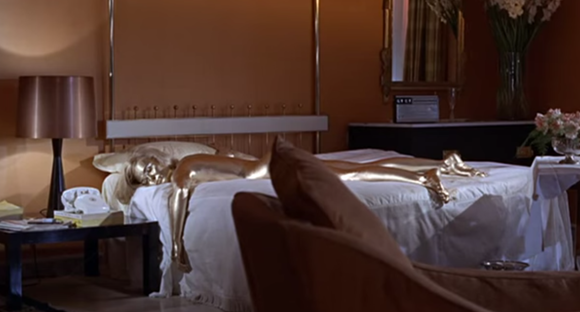
goldfingerThe film opens with a wonderfully unnecessary opening gambit, which allows us to reenter the world of dashing MI6 super spy James Bond (Sean Connery). His electrifying escapade culminates in the memorable quip, “Shocking, positively shocking” and just like that we jump headlong into his next adventure, Goldfinger!

Shirley Bassey’s striking rendition of the title tune reverberates over the metallic credits setting the tone for one of the great Bond films. It starts with the music and never wavers as we pick up with MI6 on a nice holiday in Miami Beach. He has his first run-in with international gold dealer and suspected smuggler Auric Goldfinger (Gert Frode). Bond has a little fun with the cheater at the expense of a young woman while also having his first encounter with the mysterious Odd Job.

Goldfinger leads Bond all over the place from Switzerland then back to the United States. MI6 discovers how Goldfinger does it while also crossing paths with Jill Masterson’s sister Tillie, who has a personal vendetta to make Goldfinger pay. It doesn’t go so well.

Bond is imprisoned but not before proving himself to be a nuisance. He is nearly mowed down by an industrial laser, but Goldfinger thinks better of it and ships him off to his base on a Kentucky farm. Bond gets his first tete-a-tete with pilot extraordinaire Pussy Galore, and needless to say, he is intrigued. Meanwhile, his American ally Felix Leiter attempts to track his whereabouts and keep tabs on his progress.

Imprisoned yet again, he, of course, escapes just long enough to witness the plans of Goldfinger to use a deadly Delta 9 nerve gas to incapacitate the defenses at For Knox so he can swipe all the gold from the stronghold.

He first gets rid of some lowly American mobsters and captures Bond again. Operation Grand Slam begins as Pussy leads her group of pilots over Fort Knox deploying the gas over the premises. It takes effect instantly and soon Goldfinger rolls in with his forces and Bond in toe. It’s like taking candy from a baby and Bond can do very little as he is handcuffed to the bomb which is to set off in the vault. A rather sticky situation indeed.

But alas it was all a ploy. The gas did not actually work and all the troops suddenly get up and convene on Fort Knox with Goldfinger and his forces still inside. The game seems to be up, but not before another shocking moment between Bond and his old nemesis Odd Job.

The rascally Goldfinger gets away but Bond at least ends up with Ms. Galore. He used all his power of persuasion to acquire her help. What happened to Goldfinger, you ask? He comes back to enact his revenge, of course, and it nearly works. Instead Bond and Pussy get in some passionate necking while the search parties are out looking for them.

It is hard to top this early Bond installment for a plethora of reasons. It has the best theme song. It has arguably the best villain (or villains if you include Odd Job). Perhaps the best Bond in Sean Connery. The best decked-out car in the Ashton Martin DB5. And a couple memorable Bond girls. When it is all said and done, it adds up to an enjoyable spy thriller stuffed with intrigue, wit, and a crumbling of early 1960s sensibility. Above all it’s a “positively shocking”  piece of entertainment sure to give you a volt.

4.5/5 Stars

Review: From Russia With Love (1963)

fromrussia1To Love it, To Love it Not… Sean Connery is back as Bond and so there is plenty to enjoy with From Russia with Love (1963). Out of personal preference, my top three favorite films in the franchise would have to include Goldfinger (1964), Casino Royale (2006) and this beauty, all packed with quintessential Bond.

Sean Connery is arguably the best Bond. Some of that resulting from being the original and also simply because he was made for the role with dashing good looks, an impressive physique, and one smashing accent. Next, comes arguably one of the best so-called “Bond” girls in Tatiana Romanova (Daniela Bianchi) who plays the beautiful Russian opposite the handsome Brit. They’re a match made in heaven beginning with steamy encounters, followed by violent escapades, and topped off with playful romance. There’s not more you would want, except action and villains and gadgets, which we also get along with some ubiquitous Cold War sentiment.

In this installment, the Soviets are pitted against the CIA and MI6 with the nefarious SPECTRE manipulating both sides. They have received the aid of one of the Soviet’s highest officials in Rosa Klebb, who puts their plan into action. She, first and foremost, recruits deadly assassin “Red” Grant (Robert Shaw), followed by the pawn Tatiana Romanova, who works at the Soviet consulate in Istanbul. She is to be the siren to lure Bond into a trap with the tantalizing promise of a Lektor device (which MI6 desperately wants).

Thus, as any good spy would, Bond goes after this presumed admirer and first meets with station head Ali Kerim Bey. One man is dead and the Soviets suspect the Westerners. Bey’s office is bombed and the Soviets are the obvious culprit. However, the whole time it’s Grant working incognito.

Bond is taken by Bey to a gypsy camp for refugee and after an evening capped by ambush, he has his first meeting with none other than the beautiful Romanova. The new accomplices ultimately steal the Lektor without a hitch and board the train as “newlyweds” with Bey. However, the ever lurking Grant is waiting for Bond and his companions. Without getting into all the gory details, it sets the stage for a great fighting sequence.

007 gets away with a recently drugged Romanova and puts a helicopter as well as a fleet of motor boats out of commission single-handedly. Number 1 of SPECTRE is very displeased, and Klebb has one last time to make things right. She has a wicked pair of kicks. That’s over soon enough.

What’s left is a romantic gondola ride with our two lovebirds and the notes of Matt Monro playing over the kisses. Talk about a first date, this one was a great one, even for all us third-wheelers.

Goldfinger maybe the apex of Bond viewing, but From Russia with Love is a close contender for that title. Its action does not look half bad even after 50 years, and Sean Connery is quite the hero. What more is there to say about Daniela Bianchi except God was very good to her. Very good indeed. It’s a great adventure with everything you would want and expect in a spy thriller. It’s from Russia with love.

4.5/5 Stars

Ratatouille (2007)

RatatouillePosterOnly Pixar could make me empathize with a rat, and they did it with true style and sensitivity like they have done many times before. Ratatouille is often a forgotten classic that I easily forget in a repertoire that boasts such modern masterpieces as Up, Finding Nemo, The Incredibles and of course the Toy Story trilogy. However, Brad Bird’s tale of a gifted rodent and a hapless chef deserves to get its just desserts too and so I will attempt to do that now.

As was already hinted at, Remy (Patton Oswalt) is a very unique rat, because he has an incredibly sensitive palette thanks to an impeccable sense of smell. He cannot stand digging through the trash heaps like his brother Emile and he has higher aspirations than his single-minded father. One day Remy comes across the revelation of mixing foods and flavors in a culinary epiphany. His family doesn’t quite understand his more cultured aspects (walking upright, reading, cooking, etc.), and it ultimately gets him into trouble.

He winds up in none other than Paris and sitting on a rooftop he sees his own personal Mecca. The restaurant of Gusteau (Brad Garret), the man who famously said that anyone can cook before he was taken down by pernicious food critique Anton Ego (Peter O’Toole). After his tragic death, Gusteau’s lost two of its stars and that’s right about where a young man named Linguini (Lou Romano)  comes in.

He’s a bumbling nobody with little talent and only a note from his deceased mother vouching for his character. The incumbent tyrant of a chef (Ian Holm) reluctantly gives him a job as a wash boy which he barely is able to perform. In a fateful moment, he ruins a soup and Remy drops in to salvage the dish. Now after an initial berating, great things are expected of Linguini after a critic loves his new dish. Skinner suspects something is up.

In this predicament with nowhere to turn, Linguini looks to this little chef, and Remy decides to help him. Thus, begins the strangest of symbiotic relationships as Remy learns to control Linguini who acts as the front for the artistic genius who just happens to be a rat. For a while, it works really well. They keep Remy hidden under Linguini’s hat while also keeping Skinner constantly delusional with visions of rats.

Then, success continues to come Linguini’s way. Thanks to Remy the restaurant is a hot spot once more, he gets the girl Colette, and he has become the main attraction at Gusteau’s displacing Skinner. But it gets to his head a little too much, and he and Remy part ways.

The big night of Anton Ego’s return to Gusteau’s is fast approaching and the culinary dream team is no more. Once again Linguini is lost without his culinary partner. But the ever faithful Remy gets the support of his family and returns to the kitchen to aspire to his dreams. Linguini also finally has the courage, to tell the truth which ultimately loses him the respect of his staff.

However, Remy and Linguini both learn something about family and relationships, realizing the need to be who they are. In a brilliant stroke of genius, the ever resourceful Remy makes a simple yet elegant Ratatoullie. Everyone expects the disdain of Ego and yet it never comes. You see Ego also learns something about himself. Upon seeing the mind behind the dish that took him back to his early years, he remains pensive for once. He finally understands the wisdom in Gusteau’s simple adage.

The voice talents of this film are obviously wonderful, from the impeccably-casted Patton Oswalt to Brad Garrett as the jolly Gusteau and Peter Sohn as rollie-pollie Emile. However, I want to focus specifically on the late great Peter O’Toole.

It is rather extraordinary that just before seeing this film again, I took in How to Steal a Millionaire. It too is set in Paris, involves deception, and has its share of drama. Featured in that film is a younger O’Toole, handsome, blue-eyed and far from world-wearied. But the reality is, he had a hard life and you can hear it in his wonderfully Shakespearian, but still noticeably older voice. He brings such a wonderful lineage to this film, and he turns in one of his great roles. Peter O’Toole was part of a dying breed of theater-trained actors who will be greatly missed for their tour de force performances.  But once again many thanks to Pixar for doing the impossible. In some weird, disgusting way I love rats now.

4.5/5 Stars

“In the past, I have made no secret of my disdain for Chef Gusteau’s famous motto: Anyone can cook. But I realize, only now do I truly understand what he meant. Not everyone can become a great artist, but a great artist can come from anywhere. It is difficult to imagine more humble origins than those of the genius now cooking at Gusteau’s, who is, in this critic’s opinion, nothing less than the finest chef in France. I will be returning to Gusteau’s soon, hungry for more.” – Peter O’Toole as Anton Ego

Union Station (1950)

unionstation1Although it features the pairing of William Holden and Nancy Olsen, Union Station certainly is no Sunset Boulevard, but it doesn’t need to be. It’s a modest procedural of 80 minutes, but it has a gritty realism that is rather reminiscent of Pickup on South Street (1953) or The Naked City (1947). This is ironic since it’s hardly believable and yet it still ropes us in. The story goes something like this.

A young woman  (Olsen) says goodbye to a blind friend and later after she boards a train, she sees two suspicious men board the same car as her. At the final destination of Union Station, she goes to lead cop Willie Calhoun (Holden) who uses his network of plainclothesman to investigate and tail the men. As it turns out, the blind girl has been kidnapped and a ransom is put up for her at $100,000. Her father is understandably desperate to get her back and does whatever he is relayed to do. He remains in contact with Calhoun and the Inspector named Donnelly (Barry Fitzgerald) who resolve to get his daughter back and apprehend the perpetrator.

However, the man they are dealing with has been around the block a few times, and he is well acquainted with Union Station. Thus, the station becomes the main point of interest in the film evolving from less of a game of cat and mouse to a chess match. Men are tailed aboard trains, in terminals and everywhere else. When one man leaves another takes his place, eyes are always watching and the beauty of it all is you can never tell who is a policeman and who is not in the veritable mass of humanity. But it goes the other way too.

The ransom is ultimately set to go down at Union Station and just in the nick of time, Calhoun catches a break. All that’s left is to chase down the mastermind, but it’s not so easy as he also has the blind girl Lorna stashed away. Calhoun must race to apprehend the culprit while also getting to Lorna first. It’s a photo finish.

Did I say already that Union Station employs a gritty realism? Well, it does, and it is full of slimy criminal types pitted against no-nonsense cops who are not opposed to using rough methods if necessary. Willie Calhoun is the number one tough guy and he’s relentless in his job as the intense finale suggest. Donnelly is a character blessed with the voice of a Leprechaun thanks to Fitzgerald and believe me that’s a compliment. He’s a personable, mentoring type who is a nice compliment to Holden. Inquisitive Joyce Willecombe is necessary to get the plot rolling and also as the love interests, but Nancy Olsen gives an appeal that reaches farther than that.

Enough said, now take a trip down memory lane to Union Station where you are sure to be lost with the masses in this engaging procedural.

3.5/5 Stars

Review: Mildred Pierce (1945)

mildredpierce1Mildred Pierce is a hybrid between two genres in a way. It most certainly could be categorized as a weepie 1940s melodrama, a so-called “woman’s picture,” and yet it has the undeniable framing devices of a typical film-noir. It’s unique in other ways as well. It features a strong, independent woman as the lead, the eponymous Mildred Pierce and her aspirations and the struggles in her life become the focal point of this story.

Before any gun was fired or a dead body was found at a beach house or any of that happened, Mildred was a stay at home housewife with two daughters and a husband. It becomes all too clear that all is not right in the Pierce household as Bert becomes annoyed with Mildred, who spends so much time doting over eldest daughter Veda (Ann Blyth). It’s as if she needs to earn Veda’s love and Bert realizes the issue early on. They separate and soon after they watch their youngest daughter die of pneumonia suddenly.

What happens next is Mildred’s big break. She starts out all alone and discouraged before finding a job as a waitress, and ultimately, starting up her own restaurant with the help of the hapless Wally Fay (Jack Carson). She finds a loyal friend and employee in Ida (Eve Arden) and a rejuvenated love life thanks to the socialite Monte Beragon (Zachary Scott).

Veda on her part is ecstatic to finally have a life of nice things with the stream of income coming in from her mother, however, she still does not approve of her mother working in the restaurant business. Mother is so Philistine after all.

Thus, despite all the work and effort, she has put into holding onto her one remaining daughter, Veda begins to drift farther and farther away from Mildred until a fight causes Veda to leave home. Most people would say good riddance, but Mildred Pierce is not like that. She has an unhealthy, almost obsessive need for her daughter’s affection. She will do anything to get her back and most of it has to do with giving Veda stuff.

She is far from happy but finally marries Beragon, because she thinks it might bring Veda back to her home. It works but what she doesn’t know is that she is getting forced out of her own company by Bergaon. That evening she found her gun and then Beragon got murdered on the premises of his beach house.

Back in the station, the shadowy noir sensibilities are still present and Mildred abruptly finishes up her tale. Except for the police investigator and the audience know better. That was not the end of the story. There’s one last cruel twist.

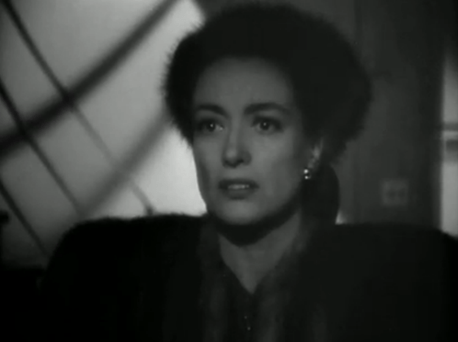
In my mind, Joan Crawford is rivaled only by Bette Davis in giving me the shivers, except in this film her eyes are so expressive, giving off emotion without her even saying anything. Within this film, I find the character dynamics and gender conflict to be quite interesting and there are really 6 main characters we can look at:

Mildred: A strong woman who gains her independence the hard way by putting in work to earn her honest wage. She is not a bad person per se, but her weakness is an unhealthy love for her daughter, or rather, a need to have the affection of a girl who never can be satisfied. It leads to divorce, a loveless marriage and a lot of heartaches.

Veda is a little spoiled brat and most of the pain and problems in the film stem from her. She constantly plays on her mother’s emotions heartlessly and even goes so far as to steal her man. That is perhaps the ultimate slap in the face after all she has already done.

Ida: Along with Wally Fay, Ida is perhaps one of the more likable characters in the film, because she is a strong woman who also holds a lot of wit thanks to the performance of Eve Arden. She also utters the famous line that shines some light on the Veda situation (Alligators have the right idea. They eat their young).

Bert: Although he takes part in an affair and is not the perfect husband, I think Mildred and the audience realize how right he was. He saw all the drama with Veda coming, and he remained civil with Mildred through it all, continuing to look out for her.

Monte: He may not be a “villain,” but Beragon is ultimately another corrupt character who is driven by money and his social status. However, it is interesting to ponder whether it was his own avarice and playboy instincts that led him to do what he did, or was he wholly influenced by Veda?

Wally: Finally, we have Wally Fay played the always enjoyable Jack Carson. He too has his eye on Mildred, but although he can be forward and a little annoying, he ultimately looks out for her much like Bert. And yet to call him an angel would be an overstatement because he still has his own interests in mind.

That’s what makes these characters so fascinating since there are some obvious antagonists, but each character, at their core,  has faults. Thus, it makes sense that this film has melodrama brought on by familiar conflict and the like, only to descend down into the noirish world brought on by vice and greed. Whatever you label this film as, the fact of the matter is, it was a major hallmark for the fading Joan Crawford as well as the ever versatile director Michael Curtiz.

4.5/5 Stars