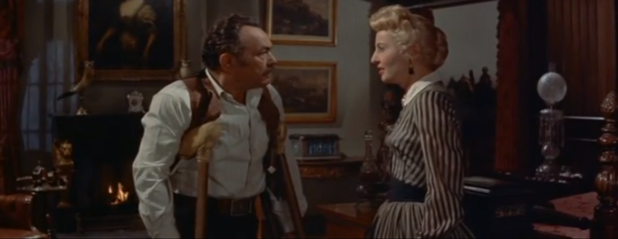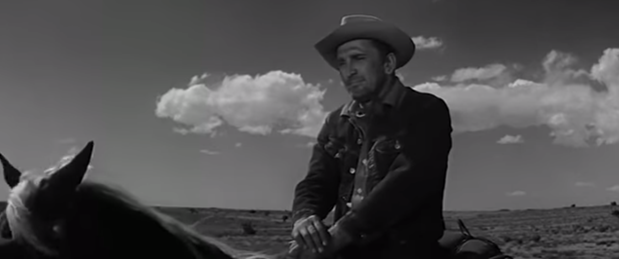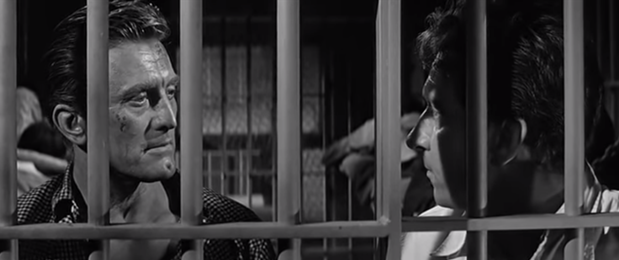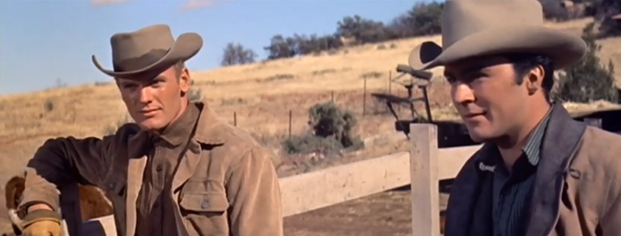
No Name on The Bullet (1959): America’s Hero Becomes a Villain

Nonameonthebullet.jpg“We might be the only two honest men in town.” – Audie Murphy as John Gant

Audie Murphy had the added reputation of being a hero in real life, and so it hardly hurt him in his efforts to portray valorous protagonists on the big screen. However, despite being a fairly humble effort, No Name on The Bullet deserves some acknowledgment for giving Murphy the chance to be on the other side of the spectrum.

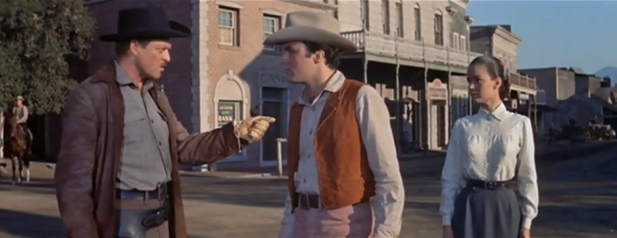
He’s introduced in the picture with foreboding music. It’s the only character cue we need to go with his dark clothes. He’s no good guy. Soon he’s taken a room at the local hotel and his very presence has gotten the whole town buzzing with apprehension.

Initially, it feels like a somewhat corny setup hinging on overt melodrama. Although Murphy’s by no means over the hill, and even though I’ve only seen him in a couple films, he was never really a compelling lead.

Early on, his youthfulness aided him as did the mystique of his extraordinary war record. If anything, he is a living testament to courage not being solely predicated on imposing physical prowess. Whereas the westerns of old certainly were, and he does not meet one’s typical impression of a gunslinger. His part as John Gant, though menacing and curt, hardly can be considered intriguing at first glance. He feels like a walking trope.

But as he settles in, everything gets more and more engrossing. In fact, the movie’s increasingly deceptive because his part gets better and better the more involved the townsfolk become.

The implications are that his very name strikes fear in every man because he is a notorious assassin who has killed upwards of 20 or 30 men in the past. However, he’s never met a conviction of any kind because he always goads his targets into fighting back. The question remains: Who is he after? The subsequent punchline seems obvious. Someone is going to be dead by the time he leaves town.

The local Sheriff (Willis Bouchey) is a decent man who nevertheless feels helpless. If Gant doesn’t do anything, there’s no law against sticking around town. All he and his deputy can do is keep an eye on the fort.

It’s this unsettling, restless stalemate of the narrative conceit that proves to be the movie’s bedrock. There is also an innate reminder No Name on The Bullet functions very much as a morality play. In terms of story, Gant is the stimulus in the town causing the dark predilections to come to the surface or, more comically, the scurrying rats who want to confess their shading dealings.

Because his mere presence sends shockwaves through the community. The tension comes with not knowing who he is actually after. I even momentarily thought (like The Gunfighter) maybe he’s simply looking for a respite. Not so…

Despite the antagonism, Gant does find one benevolent soul (Charles Drake) who doesn’t hold his reputation or vocation against him, at least not initially. It’s easy since a certain amount of ignorance proves blissful.

Their mutual respect within the picture is informed by the real-life relationship between Murphy and Drake. Murphy considered the other man his best friend and used his pull to get Drake in many of his movies so they could work together. It’s not altogether magical, but there’s no denying it helps their rapport.

Luke Canfield (Drake) is son of the blacksmith while simultaneously filling in as the local doctor. He is pledged to be married to the perky daughter (Joan Evans) of one of his ailing patients. There is little doubt he has a stake in keeping the peace. Even as they come to understand each other, there’s a sense that he and Gant remain diametrically opposed. Still, the gunman suggests they aren’t actually all that different.

They commence a literal chess match that becomes a pretense for the town’s many issues. They trade personal philosophies, with everything that happens around them informing their views of humanity. In the wake of their meeting, the real games begin.

With the sheriff’s powers in question, the invalid judge proposes two alternatives: either vigilante justice — the western standard of mob rule — or let Gant kill his man. Then, everything would be settled.

Though hesitant, Canfield finally resolves to get at the head of the mob to try and ensure no further bloodshed will take place. As town physician, this is his main prerogative. As a trained killer with a job to do, Gant has other ideas, even if he’s not looking to take the other man down with him. They appear to be two immovable forces at a kind of impasse.

The final twist is a lovely bit of, shall we say, poetic justice. The story is served best by an open ending because this is not a distillation of reality; it is a western parable of good vs evil, human corruption, and ultimately, some form of instinctual integrity.

Thinking about it in retrospect, it really is a fine stroke of inspiration to turn America’s greatest WII hero into a villain. It sends a distinct message to your audience: We must look inside ourselves and consider our own character.

Do we stand up to scrutiny? Are the heroes we prop up all that different than our villains or do we often choose to see what we want to? For that matter, are we very far removed from those that we conveniently categorize as villains?

Now 14 years after the end of WWII, you might say America was in a place to start coming to terms with its specters. The 50s were still an age of innocence, but we were on the cusp of something far bleaker. No Name on The Bullet is a portent for a future generation of westerns. Those bearing the mark of a far muddier morality.

3.5/5 Stars

Man Without A Star (1955): Kirk Douglas Drifting

ManWithoutAStar1955Poster.jpgThere are few better ways to get yourself into the spirit of a western than the majestic gusto of Frankie Laine (self-parodied in hilarious fashion by Blazing Saddles). It’s the segue into a mythical world.

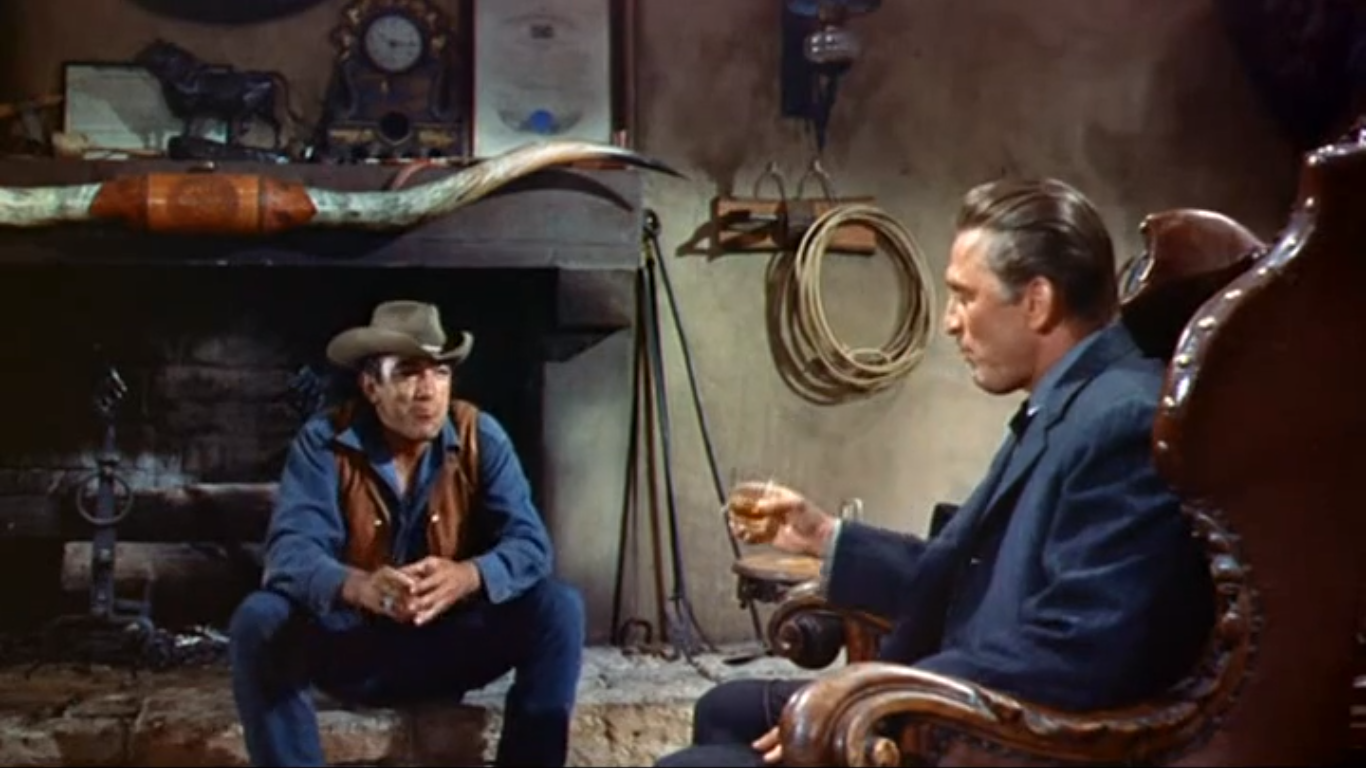
I assumed Kirk Douglas would be the fellow lacking a tin star. And yet the title is a bit more poetic, if not altogether helpful. He’s a staple of westerns just as the plot he finds himself ensconced in is an archetype. Dempsey Rae (Douglas) is the quintessential drifter, constantly on the move. He never had time enough to look up at the constellations and settle on his place among them.

Not surprisingly, all things in the film revolve around Douglas who brings his usual vigor to the role. A fun dose of jocularity tones down his usual intensity, finding time enough to even knock back a few tunes on the banjo. Because, if I’m completely honest, he’s not the first man you think of as a western star. Not the features or the physique.

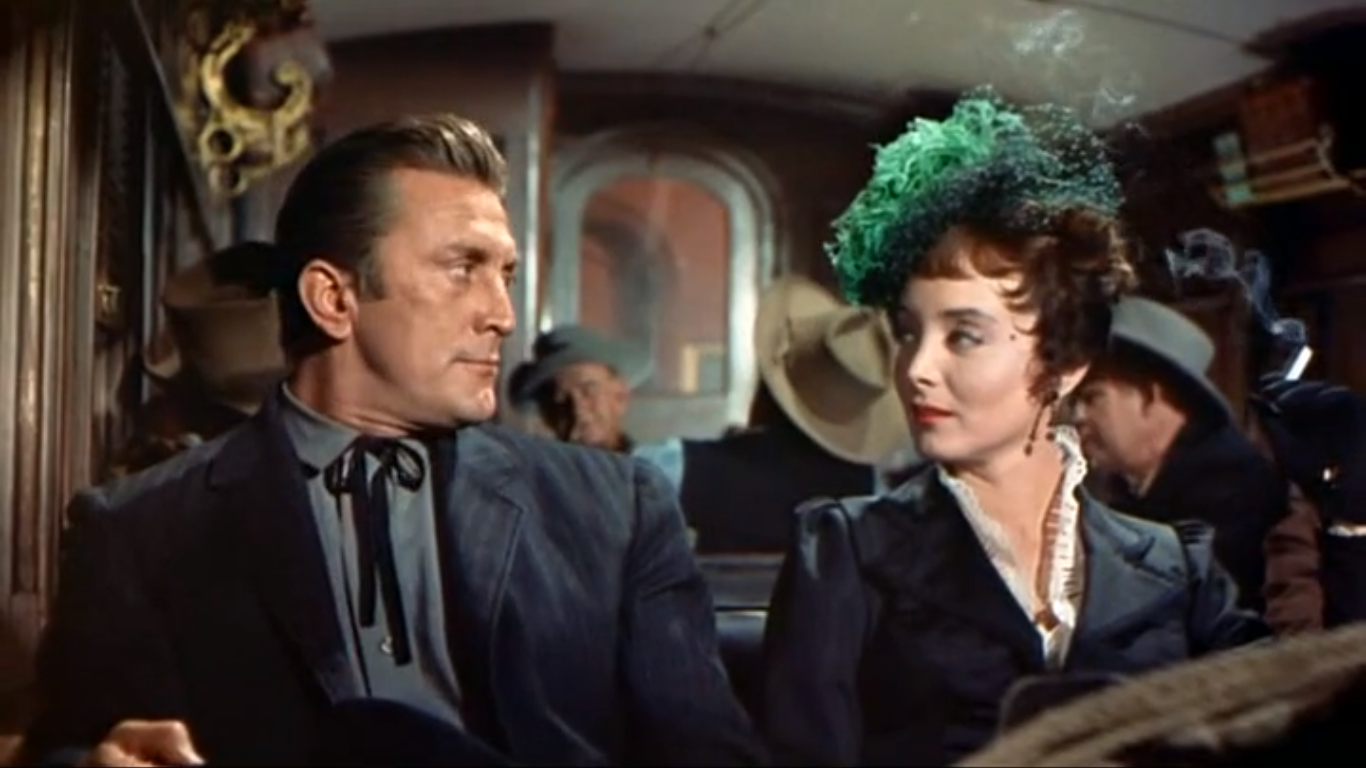
Still, he’s able to inhabit the role such that he spills out into everything and holds down the film with his very presence. If not an immediately recognizable cowboy, he is a larger-than-life talent.  His part in the story begins in a cattle car where he winds up sharing his open-air compartment with a callow kid from Texas (William Campbell). They witness Jack Elam knife a man, turn him in to the authorities, and get out of further trouble as stowaways.

They stop at the nearest town just passing through with the two men joining forces and becoming instantly chummy. The older man mentoring the young buck — keeping him out of trouble, drubbing him up a job, and teaching him how to shoot. Fancy tricks don’t matter. You’ve got to be quick and sure on the handle. Furthermore, they keep each other constantly amused, a fine example being when the naive wrangler walks into the local saloon in the most hilarious new duds.

In fact, aside from the opening run-in with the authorities, this is a thoroughly amicable storyline, at least until barbed wire comes into the picture. One of the local ranching families aren’t bad folks by any means, but they certainly have a different way of thinking.

There’s a sense it all goes back to the mythos of the open range — nothing to stop you, nothing to drag you down — so you remain free. This is the type of idealized rhetoric Dempsey speaks in. The wire gets in the way of this tradition, finding a hard-and-fast way to section off and also commodify the land.

Strap Davis (Jay C. Flippen) is the foreman, a decent man who brings the boys on as cowhands to work The Triangle, owned by some unnamed investor from back east. Among other luxuries, they look with awe at the new-fangled inventions like indoor plumbing with a toilet inside the house. They’re in for an even greater surprise when their new boss turns out to be a woman named Reed Bowman (Jeanne Crain).

Crain is domineering as the cattle magnate and incumbent owner of the Triangle. Without question, it’s one of her most authoritative and thus, one of her most intriguing roles. Behind Douglas, she is the most commanding force as she looks to surround herself with cunning enablers, aspiring to oversaturate the pastures with her stock and gobble up as much wealth as she possibly can.

It’s the age-old conundrum. Douglas is smitten with her assured beauty, even to the proposition of marriage, and yet he can’t carry himself to stay with her as she becomes more and more consumed with her ambitions. The cattle wars end up being fought more by outsiders than those at its center.

Richard Boone and a new crowd are called in to give the cattle matron a more persuasive bargaining power. They rough up Rae something awful, leaving him hog-tied like a pig after one sound beating. Meanwhile, the formerly inseparable Texans are now on opposite sides of a feud. All of a sudden, Jeff’s not the callow laughing stock with a dumb grin on his face. He knows how to kill, losing a level of innocence. It becomes friend against friend.

Claire Trevor is a favorite, and she could play the hooker with a heart of gold part with her eyes closed.  Apart from being the obvious counterpoint to Crain, she is the friend and the romantic interest Rae can fall back on. She will always always have him unconditionally. She actually makes the dead-end role into something, but it’s a shame she’s not given something with more heft or narrative significance.

We have this continued swinging of allegiances. So it’s not a new storyline with its cattle and factions — disagreement over land, and guns looking to muscle their way in by railroading the competition. All of these elements are easily derivative from previous oaters.

But the cast is a joy to watch in action for what they are able to bring to the scenario. It makes for an engaging interplay as characters are turned against each other and stretched to their limits, just enough to make it compelling without breaking with convention too radically.

Expect there to be the preemptive happy ending where reconciliation is discovered and good gives evil a sound drubbing. There’s nothing wrong with that because it’s the drifter’s journey to get there holding our primary interest.

3.5/5 Stars

Note: This review was written before the passing of Kirk Douglas on February 5, 2020. 

The Fastest Gun Alive (1956) and Glenn Ford Eaten Up Inside

the fastest gun alive 2.png

“There’s always somebody faster.” – Walter Baldwin as a Blind Man

The Fastest Gun Alive chooses to reveal its threat before it offers up anything else. A hulking Broderick Crawford rides into a no-name town flanked by two cronies. He yells into the saloon for some man to come out and proceeds to gun him down in a quick draw. The only reason: Bragging rights. He wants to be known as the fastest gun, and now it seems he’s earned the title.

We now know the inevitable will happen. There’s always somebody else. In this case, it has to be Glenn Ford. Sure enough, the story takes us to another town. It seems like it’s made up of honest people trying to make a go of life on the frontier.

Among their ranks is George Temple (Ford), who runs the local general store with his devoted wife (Jeanne Crain), well along in her pregnancy. Per usual, Ford plays a variation on his grounded hero with a demon planted in his past. It’s not said explicitly — but his actions speak for him — his current life is eating him up inside.

So much so he hides his excursions out to shoot targets from his wife and buries his old firearm in the backroom where it can’t be found. Normally well-groomed for the West, Ford’s hair seems often stringy and plastered down on his face. A new look for him and he doesn’t have a hat to corral it. Because he has presumedly shed all aspects of that kind of life. Still, there’s little doubt it lingers in his past.

For now, there are happy times to be had. The high point is a town-wide shindig complete with some fancy stepping from a young Russ Tamblyn. His shovel stilts dance becomes a highly involved number showing off his physical prowess in what feels like a black & white extension of Seven Brides for Seven Brothers. In one solitary scene, The Fastest Gun Alive shows more technical verve than other less exuberant musicals.

However, soon thereafter, the stage brings news of the gunfight, and it has the whole town buzzing with excitement. It’s typical of simple folks. The pontificating old man McGovern keeps the town enraptured with his yarn-spinning about the event of the century, at least as he tells it.

Meanwhile, Temple continues to suffocate under the life in his store — where the games of customer service are driving him insane. Between insufferable customers with their petty requests and grubby children handling the confectionaries, he’s about had it. Except this is only a manifestation of his underlying problem. The news of the gunfight prods old wounds as does his conflicting issues of pride.

He starts falling back on old habits like whiskey drinking. The monkey on his back won’t leave him alone since he cares so deeply about how others perceive him, just as he cannot handle their unintentional derision. It’s what makes him the antithesis of Shane or Atticus Finch, for that matter.

George Temple is insecure. It goes back on the age-old tenets of manhood, being able to prove yourself, to be taken seriously in the ranks of your gender, whether through feats of strength, cunning, or sheer stupidity. However, the consequence is his greatest fear — making himself a whole lot more conspicuous — and sounding the call for anyone who wants to challenge him.

Echoing High Noon, the church becomes the town’s public forum, in this case, involving a man’s resolution to give up his gun and leave the town behind. The bottom line is no one wants him to leave, and he hasn’t committed any infractions. One by one they join in solidarity to keep the secret so no one will ever hear of Temple’s exploits.

It seems a rather strange scenario. But what it does is indicate just how close-knit this community remains. This alone is commendable and yet truthfully, the story stalls here. It opts to bide its time, milking the dramatic irony for all its worth. The inevitable feels like it’s continually being delayed in lieu of a debate.

Even if the townsfolk don’t know what’s coming, he knows that someone riding in to test out his skills is imminent. He doesn’t want to be around to meet them. That is, of course, unless they come to meet him…accidentally. Because it only takes one, in this case, a boy, to spill the beans.

There is no taking it back, and Crawford won’t rest until he’s proved himself the better shot, even with a posse on his trail. It’s these moments where not only Crawford comes into fuller relief but also his partners in crime, a pair of solid characters in Noah Beery Jr. and John Dehner. Two lesser men would have made this interim period far less agreeable.

Even then, it feels like the story’s fizzling out a bit, although it does maintain this one galvanizing strand of tension. It’s almost enough. The one crucial piece of information is finally revealed, and it’s not so much of a revelation as it turns our theme on its head.

Temple’s father was a famed lawman who taught his son everything he knew. He became an even faster man but he’s never drawn on another human being. It’s kept him scared out of his wits. He admits in the same scene, “I’m so afraid, I’m sick to my stomach.” So it’s no longer about pure bravado. True bravery is suggested to be doing something even when you are deathly afraid. I’ll leave the rest to your imagination.

This is arguably one of Ford’s better performances for the very fact he’s forced to shed his typically cool and robust exterior in favor of something far more tremulous and vulnerable. It relies on the unraveling of his purely masculine image. Otherwise, The Fastest Gun Alive deserves its place rightfully several rungs below the likes of The Gunfighter, High Noon, Shane, or even Day of The Outlaw. That is no criticism, only an honest assessment of a decent western with a unique perspective.

3.5/5 Stars

Un Flic (1972) and Fatalistic Forms of Masculinity

Un flic 1.png

“The only feelings mankind inspires in policemen are indifference and scorn.” – Eugène     François Vidocq

Some of the great filmmakers are not great because they document a reflection of the world. More so they bend the world unto their own artistic vision, allowing us to see landscapes, plotlines, and people under a very particular microscope.

One might wager Jean-Pierre Melville is such a filmmaker. All his works are noir whether photographed in black & white or color. The palette does not matter. Because it has to do with temperament, stylings, the way characters talk, what they wear, and the things that take up their time.

Un Flic is about as typical as you might get in such an underbelly. It’s about a cop on a beat. He gets to work when the city sleeps. But of course, what does make him extraordinary is the very fact he is played by Alain Delon. If there is a man we could nominate for defining Melville’s hero, it would be he. Again, whether good or bad, it really does not matter. In this world, both function in a similar manner. There is a calculated aloofness. A predilection toward violence and yet some semblance of a moral code, wayward as it may be.

The events begin with immediately novel imagery. Torrential rain, crashing waves, a beachfront bank, in that order. It’s both environment and plot being established because said banks are often in the habit of getting burgled. So it is with this one.

The ubiquitous trenchcoats and fedoras are donned by the perpetrators. In a Melville picture, they are always in vogue. The added touch is dark sunglasses to conceal their identities. The quick cutting back and forth to wordless close-ups of the four co-conspirators help give the heist the much-needed cadence. It’s all in the build-up of the suspense, whereas Melville moves quickly through the events.

The deed is stripped down to the barest essentials. Guns coming out. Cut to cash in a bag. A bank vault being opened. Bank employees with their hands up. The audience needs little else. Except for the designated hero trying to fight back and thence the wrinkle in the plot. They screech off into the fog and our story is born like all the great heist films of yore.

Beyond black and white, blues and grays seemed to be Melville’s fondest companions. His world is made of them. Sleek and austere. Cool and detached. There are few better descriptors. Alain Delon’s piercing eyes match them well and as Un Flic is often a film of searching glances and competing eye lines, it’s more than a good fit.

Un flic 2.png

Is there a more spectacular power couple of the 1970s than Alain Delon and Catherine Deneuve? It’s hard to think of one. There’s the most peculiar scene with the commissioner wandering through a nightclub, staff getting ready for the evening. He goes to the piano, tinkers for a few notes, and sits down to play. Cigarette between his lips and I think there’s a drink sitting on the edge almost like it’s there waiting for him. Deneuve comes out — hears the tune — listens as if it’s a song they’ve known for years, shared together in each other’s company.

Mind you, it’s possible none of this could be true, but in Melville’s world they might as well be Bogey and Bacall or Bogey and Bergman and this is their “As Time Goes By.” Why the commissioner was there and how they all relate is not explained and somehow I like it far better this way. It foregoes realism and logical exposition for something of a far more tantalizing nature. Their scenes together are surprisingly few and yet little feels wasted.

There is a robbery to be solved and accordingly, the accomplices reconvene in an art museum to make their plans — including what to do about their compatriot currently sitting beleaguered in a clinic. However, the film’s most intriguing interplay has some roots in the traditions of Double Indemnity, where the criminal element is sometimes too near — too closely entwined — for you to even see them right next to you.

A kind of unspoken kinship forms between Delon and Richard Crenna, who, aside from the dubbing, fits relatively seamlessly into this picture. Again, it comes down to representing alternate sides of the same coin.

We might also consider Deneuve vaguely coming out of the imprint of Phyllis Dietrichson, playing the men, stuck on her, like pawns. And yet it could merely be the wordless spell she casts, but we almost are drawn to believe she does love them both. Again, the words are never put to it so no easy answers are ever arrived at. Everything is conjecture.

For all intents and purposes, the majority, or at least long stretches, of Un Flic are silent cinema, and it’s easy to appreciate them. The most fascinating criminals or often defined not by word so much as deed. Whereas the opening job is done in quick and efficient strokes, the second effort involving helicopters, trains, and elaborate inner workings, is a far more intricate, far more methodical endeavor. Melville seems to relish the mechanisms of the criminal most of all.

The perils of Un Flic are not unwarranted. It develops a razor-thin dichotomy between romanticized cops-and-robber tactics and this underlying toxicity. Guns at one time stylish, as a token of machismo, are also exponentially deadly. Men exist duplicitously as both handsome rogues and cold-hearted cads, backhanding the weak who get in their way. Friends and lovers are won and lost in a glance and the blink of a moment.

It’s a social tradition out of a different era, which is true. Of course, in retrospect, we must take the bad with the good. It would be Melville’s last film in a truncated, albeit stellar career. But one cannot help and still find something mystifying even a tad alluring about the world he accentuates. Where his style feeds into his characters and back again in this self-perpetuating ecosystem. Ultimately, what’s presented is a fatalistic form of masculinity. There is no more pertinent analysis of France’s foremost noir auteur.

4/5 Stars

Le Doulos (1962): Belmondo Plays Bogart

le doulos.png

“In this job you either end up poor or riddled with bullets.” – Jean-Paul Belmondo

Director Jean-Pierre Melville has an impeccable gift for taking the most mundane actions and behaviors and making them so compelling. In the opening notes of Le Doulos, we have an ordinary man strolling across a sidewalk, under an overpass, feet clacking on the pavement. The music rages behind him, as he’s enveloped in shadow and the title credits.

Melville readily leans into his penchant for gangsterism and Hollywood pulp introducing this man with a fedora and trenchcoat. They are an extension of each of his players. Just as each frame is equally tinged with the somber detachment readily available in any of his films. Because the characters are always products of their environment, incubated and cultivated by the writer-director, in the same way; their dress is an extension of their identity.

Le Doulos itself derives from a slang term for a type of “hat,” a police informant. The stoolie, of course, is one of the age-old cretins right up there with traitors and child molesters. No one has any pity for such a miserable excuse for a human being. Conventional wisdom dictates they deserve to be kicked out into the gutter or locked away with the rest of the animals.

Except in some sense, Melville’s picture isn’t making this sort of ready-made statement. There is more to his small-time criminal types, facilitated by a complex plot and nuanced characters. It comes down to the old quandary of honor among thieves. What does human nature have to tell us when wealth and women are involved?

In this particular story, Maurice is a recently paroled thief and as is often the case, he’s already got his next crime in the works. It’s a safe-cracking job involving a former accomplice named Silien (Jean-Paul Belmondo) and one other party.

For being the lead, Belmondo takes some time to integrate into the story, eventually paying a house call on Maurice and his lady friend Therese. And yet from his first entrance, he takes to the environment like a fish to water. If Alain Delon helped develop the aesthetic of Melville, Belmondo deserves a prominent place as well. They both make compelling criminals because their charisma is irrefutable.

For me, a defining moment for the Belmondo persona was standing outside the movie house mimicking the tough guy iconography of Humphrey Bogart in Breathless (1960) because for French cinema he was at home in the same world and thus, there was hardly a more suitable partner in crime, as it were, than Melville.

One cannot say he’s carved out of the same block as Bogey. He’s impudent even a bit scrawny, but there’s nevertheless, a rogue charm to him. Handsome in a way that assumes the complete antithesis of a classical matinee idol.

I couldn’t help but think how quaint and simple petty theft was to commit in the old days. That is, until it isn’t. There’s nothing elaborate about the blue-collar crime, in fact, it’s a banal safe cracking job. We know not if there’s even any payoff worth noting. However, even this scenario gets botched when other gangsters come on the scene.

One cannot help but think of Band a Parte – made the following year — as Godard famously counted Melville among his idols, even giving him a small role in Breathless. He subsequently took his advice on how to edit the picture, hence the birth of his famous jump cuts.

At first, I assumed this latest wrinkle was the police being tipped off, but that would make our title too easy. This is not Melville. We must constantly revise our opinions of our central protagonists.  As is, it feels as if the film might be climaxing about an hour too early. How will there ever be a story out of what’s left to talk about? And yet Le Doulos stays true to form by analyzing such a stooge in his natural habitat.

Instead, he lets one criminal bleed out and another one get it in the gut from Maurice’s pistol. All of a sudden, more prison time seems an all-too-likely possibility as he sweats it out. This is where Belmondo shines, playing all sides, as a perceptive wheeler-dealer working both angles on the cops and robbers.

le doulos 2.png

Silien is openly accommodating to the police, including their hard-bitten chief (Jean Desailly). When they look to question him at the station — a wonderfully blocked sequence with nary a cut — a normally bland and subpar scenario we have to live with, is made far more compelling.

The informant begins his obligatory rounds including a visit to a gambling house. It’s a quintessential Melville moment as he follows the fedora through hatcheck as one of the blatant symbols at the core of his picture, as worn by Belmondo, in particular. It is his marker just as guns and trench coats are also some of Melville’s directorial calling cards.

Then Michel Piccoli walks through the side-door of the nightclub. Perhaps he’s the key. And yet it’s not him, just as it’s not the three female characters who are all pawns — not only compliant accomplices to the male lovers in their lives — but mechanisms of the director to move the story.

It would sound overly harsh if most, if not all, of Melville’s characters were not also relayed to us in this fashion. Even this severity somehow fits the world and conveniently functions for the sake of the story.

What becomes evident is just how convoluted Le Doulos is, which is especially surprising for a French film but, of course, this is another fitting hallmark borrowed from American noir. Melville employs several expositional scenes and even some flashbacks, in order to fill in some ambiguities in the story thus far.

By the time we reach the finale and the final steps of this picture, there is a satisfying if fatalistic weight to the dramatic situation. The abysmally rain-drenched ending is also immersive cinema at its finest.

Because what is a gangster picture if not marred by some dark current of tragedy? Belmondo is not what we believed him to be and yet in the natural order, he cannot be allowed to exist. Fate has not allowed for it. Fittingly, his final act is to straighten his fedora in the mirror one last time. Bogart would have been proud. He went out an unequivocal anti-hero.

4/5 Stars

Two For The Road (1967): A Rom-Com for a New Era

two for the road 2.png

“If there’s one thing I despise it’s an indispensable woman.” – Albert Finney

The world seemed a very different place in 1967. It had changed and with it, love and the romantic comedy underwent a transformation of its own. Because, in some sense, humanity had reached a new tipping point. It’s easy to make assumptions: to cite Vietnam, social unrest, student protests, racial violence, any number of issues. There was this underlying implication the 50s and the early 60s (before November 22nd, 1963) were a time of hope and promise — surplus naivete.

Even the films had changed. Just look to Who’s Afraid of Virginia Woolf?, The Graduate, Bonnie and Clyde. Then, there was a new batch of progressive works like In The Heat of The Night and Guess Who’s Coming to Dinner?

Two for The Road must fit into this puzzle as well, though it’s place is more difficult to explain and thus, we might wager a guess why it’s not often voiced in the same company. It doesn’t necessarily have to do with it being a weaker movie. Still, because it doesn’t capture the “moment” as much, it cannot easily be rewarded for being cutting-edge.

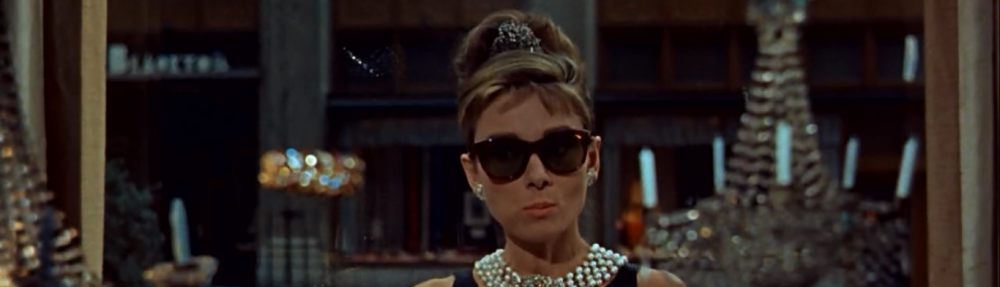
And yet, in its own way, it was of its time and representative of this ongoing form of change. Because it is a mature romance. Audrey Hepburn — the movie-watching world’s darling — has had her heart broken, been trampled on, and done some irreparable damage of her own.

This was not just make-believe, mind you. Reality and the theatrical overlap closer than we probably realize (Hepburn’s marriage to Mel Ferrer was sadly on a fast decline). However, Stanley Donen, coming from his pedigree as a musical maestro, never quite lost the sense of romanticism — his belief in magical things.

You could say Audrey Hepburn was one of the perfect embodiments of his beliefs because she was so sweet, demure, and beautiful. We can all imagine her at the center of romances galore — she was in some of the most iconic, after all. And yet amidst the lingering illusions of Hollywood, there is this sense of something more heart-wrenching and hard.

Albert Finney might be the finest vehicle to acts as an opposite force of nature — larger-than-life, barrel-chested, and in many ways the utter antithesis of Audrey. He came of age in the resurgence of Britain’s gritty kitchen sink dramas. He was by no means a counter-cultural figure, but he has the gusto of a Brando and his disciples — a bit of the cocky bravado that’s nevertheless disarming. In no small way, they make the perfect couple in cinematic terms, sitting at the crossroads of the decade. Somehow they’ve met and found themselves on near equal footing.

The story itself, by Frederic Raphael, is ambitious as it skips and jumps through a love story, a constant exercise in cuts and whip-fast transitions. In fact, you might say Two For the Road is won in the editing room even more so than most films because it builds peaks and valleys with both a frenetic pace and constant changing snapshots of life. It resonates on these levels without ever feeling turgid. If it does turn on a dime, then it gives the freedom — the necessary space — for leeway and visual connections between past and present.

two for the road 1

It commences at the beginning of the end. The husband and wife slump in a car, watching cynically as a pair of newlyweds walk out of a church. They see their youth reflected back at them. But there were happier times once, what now seems like many eons ago.

The adolescent days full of sun-soaked afternoons and equally idyllic intentions. The French countryside was ripe with promise. Open-air automobiles and “thou” was all that necessitated a contented life. Of course, those were the days when “thou” meant a happy companion. Riding in the MG with a persistent “donk” in the engine only facilitated moments to look back on and laugh.

Finney is constantly mislaying his passport, chomping through apple scruff, and doing his Bogart impressions. One of his finest hours is strolling into a ritzy hotel that they can’t afford, his coat bulging with the edible spoils from the outside — only to drop them all over the lobby.

two for the road 4.png

Hepburn is clothed in red, hair free, and alive on so many levels. Picking up a ride as a hitchhiker a la Claudette Colbert. Seeking shelter from the rain or frolicking in the shallows without a care in the world. It’s an extension of her earlier personas from Roman Holiday and Funny Face.

Then come the spirals charting the bitter dissolution of a marriage as it crumbles into fractured pieces of apathy. Affairs follow on both sides, involving a cajoling lady motorist and a supremely confident French romantic. We cannot help but feel they are pale imitations of the real thing. They are only a momentary antidote. They cannot truly satisfy and repair the wounds.

The paradoxical aspect of love is evident with time. Yes, the honeymoon is over, the nagging begins, the arguments, raised voices, life gets in the way. And yet somehow it seems true that you often only know you love somebody else after the speed bumps and roadblocks. Closer still, you love them in spite of them.

Henry Mancini’s score is one of his most lastingly melancholy, striking the notes back and forth between a whirly gig warmth of summer carnivals and then the summers after when you’ve fallen out of love. The repeating string motif continually reinforces this feeling even as he reaches out for lingering bits of nostalgia.

Because there’s a playfulness dancing within the frames just as there is elegance. How can it not be with Audrey Hepburn? So, while we have a sense these are movie stars — glamorous, richly-attired, all the superlatives — their love affair is besieged with the slings and arrows aimed at each of us.

Petty squabbles. Tedium. Poor communication. Evaporating memories. Jobs and families. Reprioritized lives. Most important of all, falling back in love — even if it’s only the hint of a spark — sometimes it’s enough. So have Audrey and Donen grown into a new decade? We must admit they are different, wiser, wounded even, but the great gift is how Two for The Road still leaves some space for love to exist.

In the midst of a myriad of distractions and messy lives between flawed people, it really is a miracle. It is romance coming to terms with changing times and yet not quite giving up on the ideals of romantic commitment.

4/5 Stars

Indiscreet (1958): In Honor of Stanley Donen

indiscreet 1.png

Note: This post was written soon after the passing of Stanley Donen.

Cary Grant and Ingrid Bergman on adjacent title cards is all you should need to watch the movie. Although I came for an entirely different name because this past spring we lost Stanley Donen — the last remnant of Hollywood’s Golden age — and it seemed necessary to pay him the highest tribute I can. It’s not with words, no, but by actually sitting down and enjoying one of his films.

Ingrid Bergman is one of the sweetest screen stars. She’s not altogether impervious to vengeful thoughts, but you never see her taking it too far.  We always want the best for her, and it’s little different here. Her preexisting life is utter humdrum. Everything about it is just too immaculate.

As a well-to-do, internationally acclaimed actress, she is, nevertheless, a woman who comes back from a tour abroad totally dissatisfied with the men she’s been able to come across. It’s not that they aren’t handsome, rich, good dancers, or the like. But she wants someone interesting, an intellectual equal, and a little old-fashioned charm wouldn’t hurt. Her usual circles don’t appear to be a ready breeding ground for such types.

Anna’s emotionally involved sister — married to a high-ranking official — questions why she has never settled on a man. Perhaps her standards are just too high (don’t listen to her Ingrid!). No matter, it looks to be another dull evening out on the town at a foreign dinner. The speaker is no doubt a snooty new candidate for NATO. It’s a high-class bore.

However, the stuffy ordeal all of a sudden gets a lot more swoon-worthy for everyone involved when Cary Grant walks through the front door. We’ve all but been guaranteed a diverting evening. So Margaret, ever prying into her sister’s affairs, gets set to play a bit of a matchmaker, relishing the setup, and the predictable outcomes. We have our story. Grant being charming and Bergman enjoying his company while still remaining aloof. He’s almost too good to be true. What of skeletons in his closet?

Dare I say, it’s all inconsequential, lest you get the wrong impression? Because there’s no doubt about it. The plot is facile. The conflict is thin. On the other hand, the tete-a-tete is most agreeable. One would habit a guess, without our stars, the picture would be quite flat. With them, all of a sudden, characters and the subsequent story is given texture. Their chemistry is present before the picture begins, and it exits with them after the final curtain. This is one of the keys.

Stanley Donen doesn’t have to do too much touch-up around his already spectacular talent, but he does utilize a split-screen to conveniently mollify the production codes, with the two lovers sharing a telephone conversation in their respective beds. Nora Ephron purportedly loved this movie thus, When Harry Met Sally got much the same treatment. It can be seen as another homage just as Sleeping in Seattle came out of the tradition of An Affair to Remember.

In Indiscreet they occupy themselves talking about the mundane things from the weather, to playing the violin, elder statesmen, and lamb chops. We don’t care all that much because the bottom line is spending time with Cary and Ingrid. There is Grant’s mild reveal. He’s got a big secret. Well, it’s not too big, but I’ll avoid spoiling it all the same.

If Fred Astaire’s dancing is immaculate, then Grant’s is equally so for entirely different reasons.  It’s not from any amount of meticulous choreography, but his spry and innumerable graces. He always walked this phenomenal thin line between suavity and comic pratfalls, no doubt learned in his early days as an acrobat.

His physical prowess hasn’t atrophied, aiding him splendidly on the dance floor in Indiscreet, through every step of his flailing, jumping jig. What’s more, Bergman, eyeing him with an unfettered look of disdain, is equally important. There’s no question it’s a defining scene in an unassuming trifle of a rom-com.

The final act is consumed with Anna’s attempt at a bit of friendly revenge. She puts on a pitiful charade to get back at her masquerading lover, engaging the services of her in-house help. The final punchline is a genuine amount of sincerity coming over the man as the clock strikes 12. Why you ask? Because we want a happy ending.

It’s a strange sensation to see Cary Grant’s profile in an embrace, with Ingrid’s head nestled on his shoulder, smiling off past the camera. I felt like I’ve seen this all before somewhere. Was it in Notorious, An Affair to Remember, North by Northwest, Charade? Maybe it was all of the above. It never gets old. When the greats get together, it’s not always perfection; sometimes all we’re looking for is diverting entertainment.

It seems apt to call upon a line Cary Grant sneaks into the end of the film. He’s harried. It seems like he’s being laughed at for being vulnerable. He hasn’t understood the underlying joke.

So pacing around in front of his giddy romantic partner, he surmises men are the true romanticists. I cannot corroborate if this is true or not, but there’s a sneaking suspicion that Stanley Donen might believe this as well. It’s hard to dispute when you watch his movies, as buoyant and propelled by romantic fancy as they are. Indiscreet is little different. It’s a fitting testament to one of the unsung greats. He will be dearly missed.

3.5/5 Stars

Alphaville (1965) and Godard The Humanist?

alphaville 1.png

“That’s always how it is. You never understand anything and, in the end, it kills you.”

As a simple rule of thumb — a heuristic if you will — you can learn much about a person based on what camp they fall into when it comes to the Nouvelle Vague. For simplicity’s sake, let’s suggests we have Jean-Luc Godard, Francois Truffaut, and “Other” (We’ll unfairly stuff Rohmer, Chabrol, Rivette, The Left Bank, and all the rest here).

Many probably wouldn’t need this scenario. All it takes is a one-word, guttural response: “Godard” or “Truffaut” For me, it’s Truffaut. It’s as if the wavelength he operates on so often connects with me. Whereas with Godard it’s always more a matter of admiration for his prolific creative powers and the intellect buried in each of his projects. I appreciate him from an analytical distance.

From the outset, Alphaville epitomizes the dichotomy of Godard: both the brilliance and what can make him utterly maddening at times. He’s the perpetual visionary iconoclast and artistic maverick like few others before or after (and he’s still at it!).

We’re met with a blinking light, like an interrogation lamp, shining down on the audience. The opening voiceover relates, “Sometimes reality can be too complex to be conveyed by spoken word. Legend remolds it into a form that can be spread all across the world.” This is our introduction to the computerized brain and technological chimera: Alpha 60.

Godard’s protagonist functions a bit like a world-wearied Buster Keaton in his later years. Lines covering his stone face are perfect for suggesting that he’s seen the world. This alone makes him sufficient, but expatriate Eddy Considine was also known in France for his long connection with the serialized crime detective Lemmy Caution. Here he is tasked with missions, but as should be expected with noir storytelling, each successive leg feels more befuddling than the last.

Godard took Caution to the extreme, totally untethered out in his devised limbo of clunky Parisian sci-fi. It’s the profundity of taking the labels of the future (my labels, not his) and making them feel mundane, like the contemporary moment. Still, it’s hardly a stretch to call Alphaville a forerunner to HAL,  Blade Runner, or even Altman’s Long Goodbye, a film where you have a dissonance between worlds and time frames.

There is one moment when the all-knowing voice says something to the effect that there is never the past or the future. There is only the present — where we can exist right now. So, really, there is not an issue of incongruity because everything we see is accepted as it is, functioning in this landscape as one.

Godard, working with his famed collaborator Raoul Coutard, initially doesn’t even bother with chiaroscuro, but instead an utterly binary palette. Horizontal slats of darkness above strips of light or vice versa. A cigarette and gun in Caution’s hand are both visible, while his entire face is literally pitch black.

Getting to Alphaville and a hotel in the heart of this metropolis is a trip. The lobby feels conventional enough. This is a mere extension of the Parisian landscape. And yet he gets led to his room by a lady who looks suspiciously like a lady of a night (especially when her clothes start coming off), and Godard adds another lovely non-sequitur when a thug all of the sudden materializes in the bathroom leading to a stylized struggle.

Our tough guy runs for his gun on the bed and shots ring out through the room. He makes the agitated but lucid observation moments later, “Everything weird is normal” in this town. He’s never been more correct.

We get a suggestion of what Godard is playing with — the conventions and ideas he wants to tinker around with — as both an artistic and intellectual exercise. Beatrice, the first of several femme fatales, we find out, is a level-three seductress. It’s all too apparent the misogynism has not evaporated in this alternate world.

alphaville 2.png

Anna Karina appears next as the daughter of a high-ranking official with intimate knowledge of Alpha 60. Caution christens her a “pretty sphinx,” and she is an unsuspecting product of the disconcerting sci-fi dystopia that has overtaken society. Ironically, it comes packaged a lot like Paris in the 1960s run by capitalists.

As far as gadgets go, Caution employs a portable lighter-intercom slightly less ostentatious than Maxwell Smart’s shoe phone. There are government-sanctioned executions for those showing sentimentality, where the festivities are made into a bit of a water aerobics showcase. Another popular form of entertainment is theater executions — the electric chair in more diverting circumstances.

Logic is law. Tears and love are among those things outlawed. No one comprehends what “conscience” means anymore. I even made the initial assumption the books in the hotel rooms were Gideon Bibles. However, it turns out, “The Bible” is not theological but linguistic, in the form of a dictionary, as delivered by Jean-Pierre Leaud in a blink of a cameo. When words get eradicated from the cultural lexicon new editions are published and disseminated to the public.

As the tenets of society get more and more perplexing, Caution’s mission begins to spiral into chaos, toward the final destruction of the mechanical beast. Godard chops up cinematic reality with disruptive negative images that do feel otherworldly. There are car chases, murders, and corpses of those asphyxiated splayed on the floor. It seems Alphaville really is crumbling from the inside out.

The movie itself is full of these deconstructions, clever amalgams of Godard’s cultural proclivities, and his own personal wizardry. But if we are to fall back on my totally unessential litmus test, he rarely touches me to the degree Truffaut is capable of. There’s never the same laughter or warmth emanating from his characters.

Yes, in Breathless (1960) and Vivre sa Vie (1962) they come the closest and there are extended periods that speak to me, momentarily touching my heart and my soul, if I can be so transparent. But at a certain point, they end because Godard is not in the business of humanity as much as he is in the business of the mechanisms of cinema itself. He is the great artist. Truffaut the great humanist. In turn, each affinity made them into two of the most passionate filmmakers the world has ever known.

Both very avid, opinionated, obsessive cineastes. It even drove a wedge between them in later years after their catalytic collaborations in the early 60s. It’s not all that unsurprising. Arguably their most similar films conceptually, are vastly different in both vision and execution.

Consider Contempt (1963) and Day for Night (1973) or even Shoot The Piano Player (1961) and Alphaville (1965). The first pair act as two entirely singular odes to the art of filmmaking. The latter two are indebted to the glories of film noir and other cheap genre fare.

But again, it feels like Truffaut is far more capable of humanity. You never get the same sense of transparency from Godard. There is even a feeling he relishes his status as this cryptic figure — a reputation, I might add, he has maintained for most of his career.

And yet even Godard, with all his enigmatic stylings, can continually surprise me like so many others. This is his ability to morph with the times and take on new forms like a Bob Dylan — to make a flawed musical comparison. For me, it was the final line of his movie — all but forcing me to eat my words — forcing me to feel empathy.

Natascha remembers how to say “I love you” as they drive away from the hysteria of Alphaville back to the Outer Countries. For Godard, this is a heady statement, the height of sentimentality even. It’s unexpected but fitting, his constant muse throughout the 60s, Anna Karina, emblematic of his most fertile creative period, it’s her words that ultimately define Alphaville. I love you. Maybe Godard is a humanist after all. At the very least, Karina in all her affection helps to humanize him.

4/5 Stars

Note: Since writing this piece, Anna Karina passed away on December 14th, 2019. R.I.P. to a legend. 

Port of Shadows (1938) and The Face of Jean Gabin

port of shadows 1.png

“Like the movies. I see you. I like you. Love at first sight.” – Jean Gabin

Jean Gabin has one of the great visages of the cinema. But in making such a statement you immediately run the risk of giving the wrong impression. To actually see him on the big screen is to know what I mean. He is not classically handsome in the Hollywood sense, fitting somewhere in between Spencer Tracy, Bogart, and Fonda when Hank had a chip on his shoulder. And yet set off in black and white as Gabin always was during his most prolific periods, there is something unmistakable about his face.

It is worn with the grooves, contours, and the residual sadness that come with life. He gives the impression of seeing the world, having his heart ripped out, being battered and bruised, while still choosing to press on anyway. You could say he has the entire French experience of the early 20th century on his brow. He’s simultaneously a projection of their best self in the face of hardship.

Historically, the cultural mood and the looming world war to come were ill-omens, as far as the release of the film was concerned. It was far too portentous to be met without some amount of resistance

In Port of Shadows, Gabin fittingly plays a jaded soldier who catches a lift to the nearby port town of Le Havre. In an opening act of clemency, he keeps his truck-driving benefactor from quashing a mutt masked by the billows of fog. It’s an instant flag. We know this man. His emotions are not obvious, but they are there; he concerns himself with the well-being of others. There is a heart under there somewhere. Scene after scene his constant companion is the runty little dog, a continual reminder of who he is as a man.

Along with setting up its star, we soon learn director Marcel Carne cares about his characters and takes care of them. Not that the environments are unimportant. Between the pitch darkness of the highway or the smoky and garish interiors of the club, there’s atmosphere aplenty. But Carne is focused on his players; their faces and distinct movements, allowing them to be focal points of scenes in a generally clean, uninterrupted fashion.

Between the instantly palpable world and the menagerie of players cycling in and out, Port of Shadows cannot help but feel like a prototype for everything from Casablanca to the entire film noir movement with its smoky brand of realism.

I don’t know much about the time frame of when the picture takes place. In all honesty, I’m not all that concerned with that so much because instantly you are pulled into a world’s depth of field with its shadow and fascinating figures. There’s a compulsion to fall into the story and be as fully involved as possible.

He’s in town, flat broke, and there’s an unspoken understanding he’s not looking to get noticed by the local gendarmerie — most obviously a deserter. This is one of those picturesque places where you can fall in with drunken vagabonds and find yourself on the receiving end of neighborliness.

As is, everyone who is down-and-out or in trouble seems to go to Panama’s, though it serves as little more than an old shack with a couple of rooms.  A sorry excuse for a hangout and yet it has far more life than the fancy club in town. It’s the people there who truly make it worthwhile.

port of shadows 2.png

Jean (Gabin) is given a meal by the ragged proprietor, gets some fancy talk from an amiable artist, before meeting the most important person: Nelly (Michele Morgan). She’s young but precocious, mature beyond her years. The same might be said of Morgan who assuredly holds her own against all her male costars. She’s thoroughly outnumbered yet she handles it poise.

It’s a testament to the strength and varied colorfulness of the characters that the illustrious Michel Simon almost becomes of less interest as Nelly’s despicable godfather, especially compared to the peculiar sots he was tasked with portraying in Boudu and L’Atalante. His big scenes come near the end of the picture anyway.

Mostly this is a love story. In a rare moment of self-reflexity, Jean mentions how theirs is a movie romance. It’s this heightened sense of romantic reality. If we put it up against anything we experientially know to be true, it’s poppycock, but between the eyes and embraces of Morgan and Gabin, it just feels right.

We also learn more about Jean. Not only is he capable of deep measures of love, but he has no tolerance for lowlifes and scum — those lacking a sense of honor or principle. You have it out with a man face-to-face with fists, not from behind. One of his main targets is the local gangster Lucien who is nothing more than an arrogant rich kid with too much time on his hands. He wants his hands on Nelly. Jean is having none of it. He cuts directly through the artifice, slapping him around for his impudence.

The story comes to a head on the docks and again, of all places, at the bumper cars in the middle of a carnival. You do not mess around with Jean Gabin when a girl is involved. This could be the movie’s ending; the romance would be the euphoric and the hero would remain triumphant. However, it is a movie and so a greater, darker, more wistful avenue of drama is in order.

Because Jean knows he is not safe, though he has gratefully taken another man’s identity. It is better for him to leave on the latest vessel shipping out to Venezuela the following day. His love for Nelly is great, but there is a need to move on, to let her be while also keeping her away from the trouble that would come from knowing him. He does the selfish or heroic thing (depending on how you look at it), in cinematic terms, and he doesn’t tell her. He holds off as long as possible.

One fine sequence is at the waterfront bar with kegs of alcohol lodged right outside the door. There’s a conversation at the bar between the bartender and an old acquaintance we’ve already met. At a distant table, our protagonist, with his new identity bequeathed him by the philosophizing painter, charts his course for Venezuela aboard the freighter now sitting in the harbor.

These seem like mundane enough scenarios, but instead of a normal cut, Carne rides an extra with his camera, acting like the seamless segue between the two conversations. It’s a classy and efficient way to keep the scenarios fluid even in a seemingly sedentary state.

These lulls lead up to what can only be seen as the film’s inevitable tragedy. Like the most sublime expressions of cinema, Port of Shadows is a visceral, emotive experience capable of so many things. It’s a piece of art: humorous, tragic, brooding, and searingly romantic. In short, a sheer pleasure to take part in.

4.5/5 Stars

Floating Clouds (1955): Capturing Japan’s Post-War Zeitgeist

floating clouds 1.png

The Odyssey to finally get to Mikio Naruse has been a long and arduous one. I must admit, like many before me, his name carries none of the recognition we commonly lavish upon Kurosawa, Ozu, Mizoguchi, and a select few. So, for the longest time, there was no pursuit. His name was totally unknown.

However, as you begin to familiarize yourself with Japanese cinema (and I must admit to still being a relative novice), there are certain names that you keep coming back to. Masaki Kobayashi and Kon Ichikawa fall right behind the illustrious trifecta. Certainly, you have the Japanese New Wave directors like Shohei Imamura, Nagisa Oshima, Masahiro Shinoda, and Hiroshi Teshigahara.

However, for some reason, I just could not stop thinking about Mikio Naruse. It seemed like I was always being reminded of him. Whether it was Kurosawa praising his writing or Hirokazu Kore-eda saying his style was more akin to the lineage of Naruse and not Ozu. Again, it reflects an oversight on many film aficionados. We do not pay Naruse much respect because, frankly, there’s not much access to his work in America.

In fact, because I am so fortunate to come of age as a cinema lover in a world that is so globalized, with content so accessible, it is not a form of helplessness that I have felt too often. It’s not simply a matter of his film’s being hard to come by; it felt like only a few were readily available.

This absence of his work made it all the more imperative to reach him. Finally, I can attest to dipping into his filmography and finding myself deeply fortunate to have made his acquaintance. If it’s allowable to use a German word to describe a Japanese condition, Floating Clouds captures the zeitgeist of Japan in the aftermath of WWII.

The film’s structure feels as fluid as its title. It trusts the audience to follow along without voiceover cues of any kind, drifting in and out of the present and flashbacks set before the war had ended. This is the fashion in which we get to know our two “destitute expatriates” now reunited in 1946.

They met for the first time in Indochina. It’s a world we can contrast with another romance like Red Dust. An outpost out in the forests of Asian proves a far more bearable place to pass the war.  If you recall, the earlier film is made by the red hot chemistry between Clark Gable and Jean Harlow (and with Mary Astor).

Except in such a patriarchal society, like Japan, it always seems to be the man who has the say. Tomioka (Masayuki Mori) begins his acquaintance with Yukiko (Hideko Takamine) with slight jabs at her, all but solidifying his gruff character for the entirety of the film. These rocky foundations give way to passionate romance and Naruse does something dynamic by cutting right between a kiss in the past to one in the present. So much has changed and yet nothing at all. Much of Floating Clouds is about this reconciling this past with the present.

The pensive serenity is one of the unifying hallmarks of the picture. This is another point of departure with a Hollywood romance like Red Dust. This, paradoxically, feels like a grand statement — choosing a tranquil path in a medium that is so often filled with noise and a world full of constant turbulence.

Even in considering his countrymen, Kurosawa is often more dynamic in composition and action. Thus, it seems most obvious to contrast Naruse with Ozu. However, whereas Ozu heralds his presence within the frames through the meticulous craftsmanship and attention to detail, you do not necessarily see this to the same degree in Floating Clouds.

It is stripped down to a near Verite approach, which still cannot be mistaken for shoddy work. In fact, it boasts beautiful interludes between two people on par with a picture like Late Spring. It’s not a perfectly ordered fabrication of reality where human drama plays out. The spaces feel rich with the impoverished and worn layers of Japan as it lay. The people are much the same, unadorned yet imbued with truth.

Hideko Takamine is extraordinary for how she is able to manage a spectrum of emotions — exuding an inner strength and individuality — while still giving way to honest feelings of regret. She can be the adulterer, the nagging lover, the broken heart, all of the above , as they cycle through time.

No less important is Masayuki Mori as he acts as her perfect counterpoint. He gives her nothing, or at least very little. Every potentially thoughtful action is dismissed and any form of commitment is avoided doggedly. There is even so much about their preferred temperaments putting them at odds. It seems like circumstance and they’re own interactions together all but destined them to part ways and move on with life. He returns to his wife “nobly,” while she is supported by the brother-in-law who formerly took advantage of her. Every relationship is riddled with these personal dilemmas.

There is another brief snapshot that resonated with me — both in its mild humor and how it proved indicative of the times — when Yukiko is walking down a street alone. In the periphery, we see what looks to be a Japanese woman with an American G.I. He seems to be at least a head taller than everyone else. Then, almost on cue there comes a voice, speaking my native tongue: English.

It’s a second G.I. looking for a date, and he affably asks her in broken, bastardized Japanese (rather like what I’m capable of speaking), if she’s alone and where she’s going. She simply smiles and moves on, either to brush him off or resign herself to a superficial evening of companionship. He exists as more of an archetype than a fully defined character even given that his name is “Joe.”

However, what it provides is a fascinating counterpoint to what we are used to in our little universe, where everything commonly revolves around the western world, if not America. Pictures like House of Bamboo, Sayonara, Teahouse of the August Moon, they all give us a very specific and tailored experience.

It’s somewhat strange and fascinating to feel like the “other.” The soldier here is the sailor in Lola (1961) or the soldier in The Marriage of Maria Braun (1979). In fact, they all serve much the same function. They come to represent a different type of relationship and with it a diverging life, even if it’s only meant to be a momentary fleeting fancy. 

This is not a picture where we see the chaos and the bloodshed. After all, these two were the “lucky ones” stationed in Indochina. And yet we see the shadowy imprint of a former life involving suffering, poverty, and the ignominy of surrender. It doesn’t seem too farfetched to claim Floating Clouds somehow channeled the thoughts and feelings of a generation. The Best Years of Our Lives might be similar to a generation of Americans.

Consequently, as a viewer in this contemporary moment and an American on top of that, there is a realization of how much I take for granted in this story. I am more like the American soldier than I am this couple. It proves a humbling observation, carving a path toward some sense of empathy.

floating clouds 2.png

 Eventually, her lover turns up again — still as brusque and egocentric as ever, looking around at her plain surroundings and commenting on how well she’s doing. These types of evasive, indirect proclamations are all she ever gets. So she’s hanging on his words, getting whisked this way and that with partial promises and empty hopes, never going anywhere. Later on, he has his eyes on the pretty young wife (Mariko Okada) of an acquaintance (even soaking in the public bath together). After all, in superficial terms, she is much more “desirable.”

To consider the American soldier again, he was on leave for two months before shipping home. Even in the short amount of time, he was overflowing with geniality. If we take Floating Clouds as indicative of all of Japanese society, it proves a telling portrait. There is no affection or sense of vulnerability within men. Endemic to the society and more so a holdover of the war. It’s not simply about women being overly emotional, though this is often the cultural expectation. More emphatically so, the men lack any type of emotion. They are ingrained with this stoic (sho ga nai) mentality.

There are numerous walk-and-talks, and the scenery and setup might as well be interchangeable, but the subtext and junctures in their lives are starkly different each time. So we have all these snippets wedged in between their life events as they orbit in and out of each other’s lives.

It’s easy enough to juxtapose it with Citizen Kanes dinner table scene where a relationship is seen crumbling in a matter of minutes. Stretched out as it is, within Floating Clouds, these walks continue this metaphor of progression. It is the progress of life, of a relationship, and of the world existing around us. Because while the steps might remain the same, the circumstances are different around every bend. Time marches on with each footfall.

It’s not about being ships in the night either — that they missed out on one another’s company — simply put, they are abrasive together. Their traits and identities are constantly causing them to attract and repel each other again and again.

The lasting image is a bent head, but this is not one of Ozu’s quiet forlorn scenes where a father has just made the honorable decision to give up his daughter. These are ugly, bitter tears. He is weeping. And this man, for the first time in his life, is providing physical acknowledgment of how much another individual human being meant to him. In a Hollywood picture, the action would be meaningful, but not unprecedented. In this movie, it feels heart-wrenching because we have yet to anything so transparent.

It’s an evocative final note in a work rarely prone to this kind of overt outpouring. It’s the cathartic release in a bittersweet tragedy. All we can do is bemoan the fact this man was never vulnerable enough to admit the depths of his love during life. Unfortunately, in this particular life, there is no resurrection.

4.5/5 Stars