Bitter Victory (1957)

“He and you and I will become a part of history — of its futility” – Richard Burton as Jim Leith

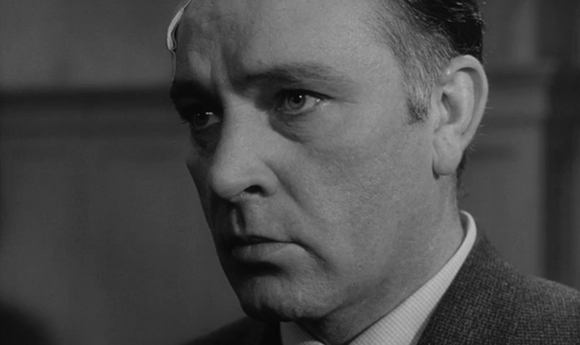
Bitter Victory is a curious confluence of talents and material. Nicholas Ray was earmarked to helm this British war movie with French-American backing. Aside from the primary leads, the rest of the cast was purportedly decided by lottery.

The film’s aesthetic is somehow impeccably represented by the wide array of combat dummies shot in black in white accentuating the muted tones of a rational military drama. It’s instigated by a secret mission behind enemy lines in Benghazi. This is North Africa during WWII.

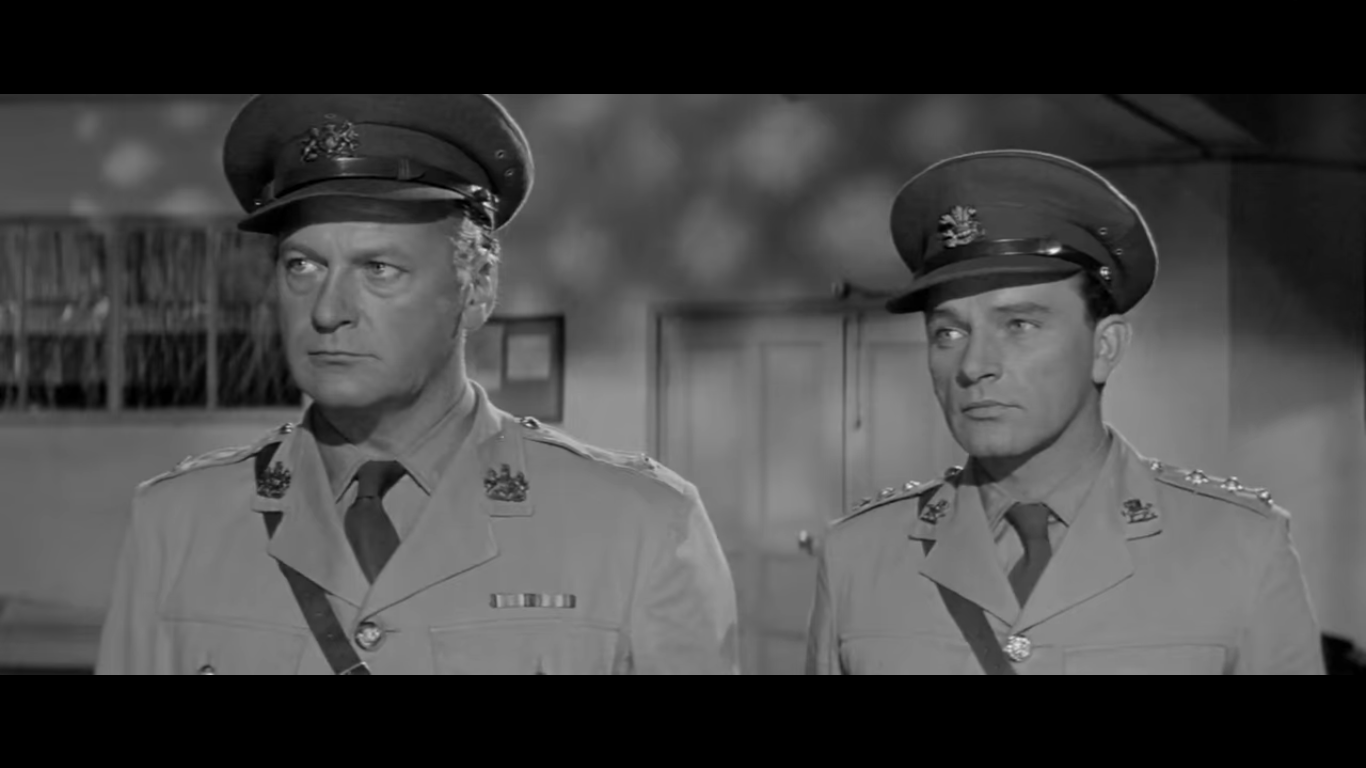
There are two men being considered to lead the excursion: A curt, lifelong soldier Major Brand (Curd Jurgens). He’s by the book and adamant no one see his weakness. Then, a young, handsome fellow named Captain Leigh (Richard Burton) with a certain no-nonsense perspicuity and a background in ancient artifacts, not the mechanisms of war. He’s volunteered to serve his country. Whatever that means.

There are some pleasantries, and they take off to the club for the enlisted, a momentary calm before the work at hand. Thrown into the narrative as we are, it becomes apparent these are characters with some kind of overlapping history in a broad sense, and we become aware of their subtext involving a woman (Ruth Roman).

At first, it isn’t so engaging. The soldier with the sound effects and pyrotechnics at the bar seems to do more with his inebriated histrionics than them. Still, Ray ends the mounting sequence with a kiss in a carriage. Except before we see it in full, the carriage whisks away in this brilliant bit of kinetic energy playing out on the screen.
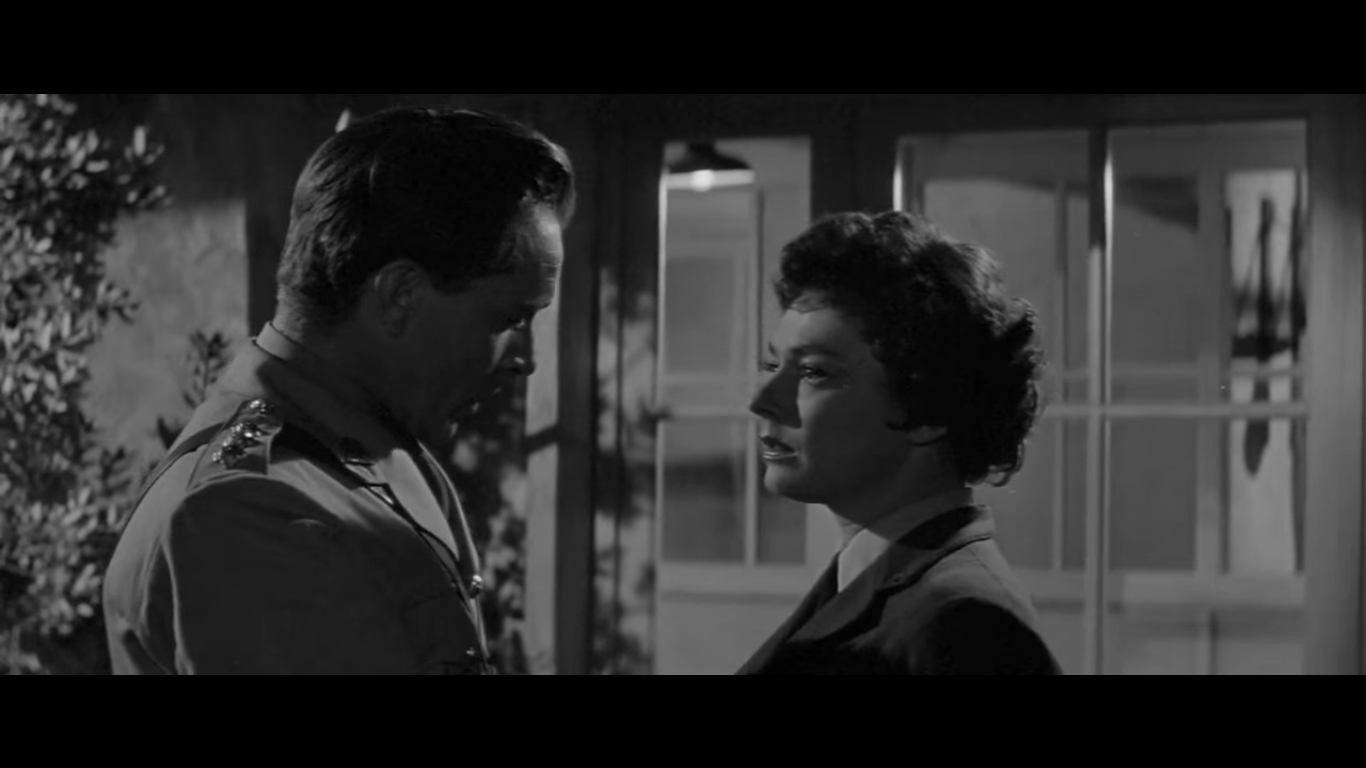
Roman is more mature and less delicate than we’ve ever seen her, partially thanks to the military garb but also due to the men she’s kept in her life. They’ve toughened her even as they grapple with romance.

It’s hardly a movie of jingoism as Burton represents a kind of jaundiced pessimism that would be his closest companion in The Spy Who Came in From The Cold as well. He’s hardly an adherent to wartime hero worship. And if Jurgens is beholden to the strictures of military protocol, he certainly doesn’t allow them to make him a joyful spirit. He’s constantly living life dictated by honor, fear, and his own inadequacies in command.

But we must remember there is a task at hand. They gather their company of recruits. Their plans are relayed through a model in a control room and curiously everyone seems to laugh off what might happen if their transportation a la humpback camel doesn’t make it to their rendezvous.

Soon they’ve become robed infiltrators cloaked by night loitering around the streets under Nazi occupation. Murder in the dark is silent though no less traumatic when it comes, even when it involves taking the life of an enemy in the line of duty.

These mission scenes have a clean and efficient luster, hardly dawdling when it comes to the action and as they disappear into the night and fight a skirmish over the sand dunes, it’s another perfect encapsulation of their clandestine task.

But the futility rushes back to Captain Leigh when it comes to the wounded. An enterprising soldier suggests getting a stretcher for a fallen comrade — but the pragmatist notes they would bleed to death in an hour — so the soldier goes down to offer a cigarette as a final consolation. He has an inherent human kindness and there’s something in Burton’s eyes as he watches. Is it regret or helplessness? Such decent showings of goodwill don’t come easily to him.

For some explicable reason, he stays behind as the others move forward. It might have been an order, but it might as well be to spite his superior. Whatever the reason, it’s hardly as baffling as Jurgens being cast as an Allied soldier. It feels like a gross mischaracterization no fault of his own.
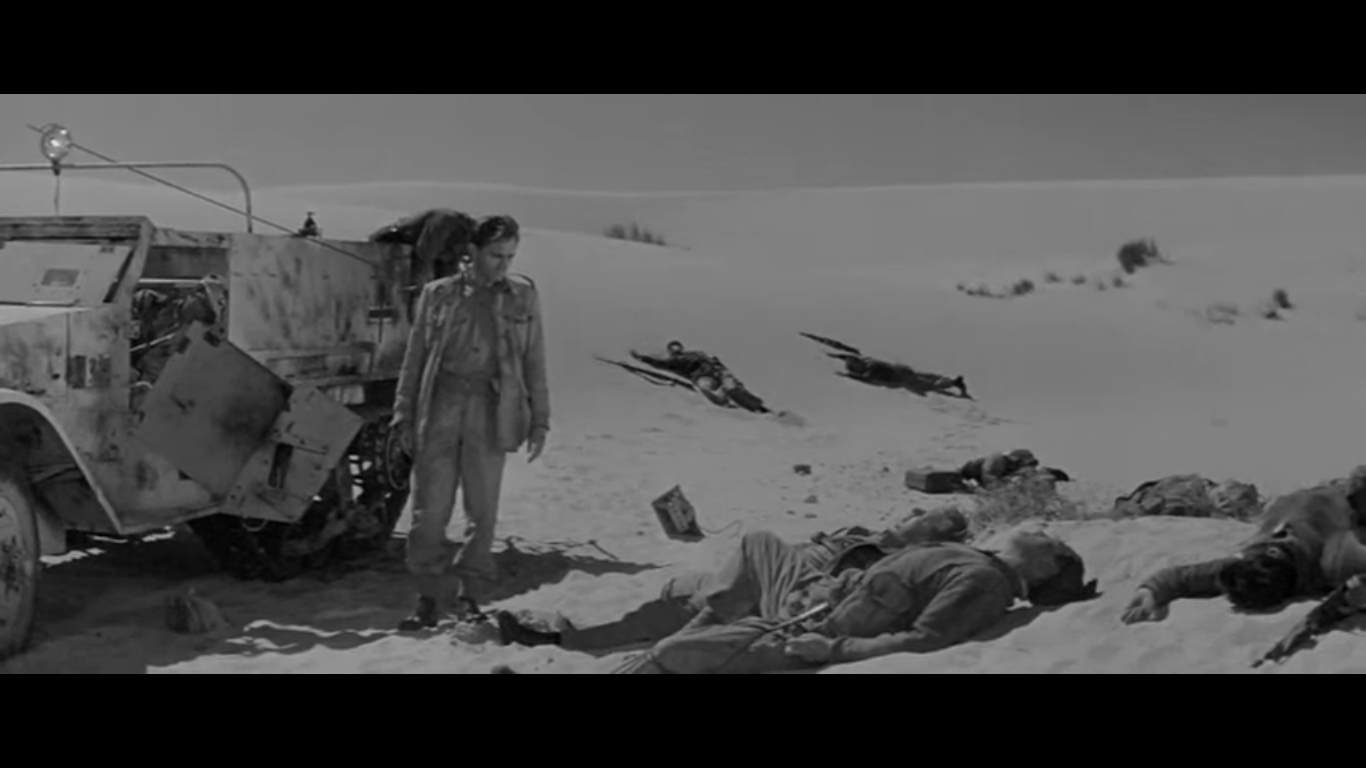
Bitter Victory does continue to tease out a version of the love triangle involving  David and Bathsheba where the man in the position of power is jealous for another man’s wife. Here the tables are turned. At the same time, the movie does feel like the antithesis of many “men on a mission” movies because it rarely feels bloated by pace, set pieces, and bits of narrative exposition and execution.

The character conflict becomes of greater interest than the actual task at hand. This is the movie’s wellspring because Burton and Jergens cultivate a mutual distaste throughout the entire movie. It continuously simmers and reaches the extremes of venomous vitriol. It’s more poisonous than the Germans, or even scorpions up a pant leg.

Burton bemusedly admits, “I kill the living and I save the dead,” and yet he still manages to scoff at his superior. “You have the Christian decency that forbids killing the dying man, but approves the work of a sharpshooter.” War so often seems to operate in baffling hypocrisies. It doesn’t make sense nor are the outcomes of war particularly equitable. They never have been.

When Roman clings to the arm of one of the barracks mannequins for support, her innate tenderness makes it feel like a totem for the man who didn’t come back. Again, it’s this dissonance of conflicting moods and emotions — what the military exonerates and exults in the service of duty and what the present company of soldiers standing by knows to be actually true.

The visual metaphor becomes even more overt when the same dummy is pinned with a medal. It comes to represent the core dilemma of the movie caught between duty, heroism, and the very manner in which we express and memorialize our sense of wartime. There are no easy answers. By the time Burton and Ray are done with us, they’ve blistered us to our core. You know a war picture has probably succeeded when it galls you and leaves you even momentarily disconsolate.

3.5/5 Stars
The Night of The Iguana (1964) and The God-Shaped Hole

night of the iguana 2

It’s a Sunday morning in St. James Episcopal Church. The minister pulls his sermon from Proverbs 25:28: “A man without self-control is like a city broken into and left without walls.” But there is an elephant in the room, an unspoken force coming between the shepherd and his sheep. He starts to stutter before he erupts in an indignant tirade lambasting his parishioners.

There’s something unsettling in seeing Richard Burton as a minister. I would have felt a similar unease with Peter Finch as a preacher (he was a surgeon in A Nun’s Story). Although it’s true, the similarly resonant actor, Richard Todd portrayed one of the most sincere clergymen ever in A Man Called Peter.

But Burton has the largest and most volatile personalities of all three.  So when he loses his train of thought during his Sunday sermon, perched from his pulpit, it’s not altogether unwarranted watching him implode on the spot. We expect as much.

It feels like Reverend Lawrence T. Shannon (Richard Burton) has inherited the lectern from Barabara Stanwyck in Miracle Woman, though his conflict is more difficult to sort out. It’s as much about the watch-dog hypocrisy in his own church as it is his personal crises of conscience. We don’t know what his presumed sins are, but as the pews clear and he thunders down the aisles, he calls out the fleeing congregants, denouncing them thusly:

“You’ve turned your backs on the God of love and compassion and invented for yourselves this cruel, senile, delinquent who blames the world and all that he created for his own faults! Close your windows. Close your doors! Close your hearts – against the truth of our God! ”

Be that as it may and totally regardless of his innocence or guilt, the next moment we see Shannon, he’s fallen to a new low — taking a busload of Texas schoolteachers down through Mexico so he can serve as their tour guide past all the religious relics below the border.

night of the iguana 3

What a sorry figure he is — a tortured, broken, smarmy man just trying to get by. This portrayal is generally enhanced by the realization that Richard Burton, though he probably grew up in The Church of England, was at the very least a cultural atheist. Nor does he come off as a ministerial type. He was notorious for drinking like a fish. Meanwhile, his highly publicized off-screen tryst with Elizabeth Taylor was commanding the contemporary tabloid covers. It all fits into this conflicted, mercurial performance of his. Hardly likable but strangely compelling for all its wild instabilities.

James Garner is said to have turned down the role because “it was just too Tennessee Williams” for his taste. He’s not wrong and frankly as much as I love him to death, the part wouldn’t have fit. Burton can carry it off because his demons, whether real or imagined, are far more visible onscreen.

However, there is another pressing question. How in the world do you get the creative marriage of John Huston and Tennessee Williams? I’m not sure if you could call it a perfect match, but it’s ceaselessly interesting. It’s a new side of Mexico — in the fishing village of Puerto Vallarta — well after The Treasure of The Sierra Madre. Consequently, the setting seems a bit left-of-center for typical Williams fare even as the sordid dramatic content is much what we would expect. In the middle somewhere the two men meet.

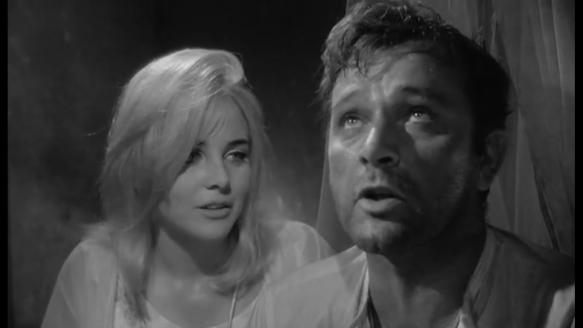
The words from Proverbs are easily recalled as the disgraced Reverend finds himself being pursued by a loquacious young blonde (Sue Lyon continuing in her Lolita vein). She finds him easy to talk to and fascinating — his life is engaged with people’s souls and yet he’s young and virile. Charlotte takes a dip with him innocently enough and still notes she could never do this with the preacher back home in Texas.

It’s the first sign of hot coals. He wants nothing of her coquettish advances even as the acerbic chaperone Ms. Fellowes (Grayson Hall) watches him like a hawk — ruling over the girl with an iron fist of ascetic repression. It makes her a tiresome thorn in Shannon’s side; he’s about ready to go mad. Eventually, he does.

Having just about enough of their campfire songs and rigid drudgery, he shanghais the busload of priggish Baptist schoolteachers, taking them on a harrowing ride, bumping their way down the dusty backroads. He screeches to a halt, jumps out, rips out the distributor head, and proceeds to streak up the hillside with his suitcase. They might as well be in the middle of nowhere.

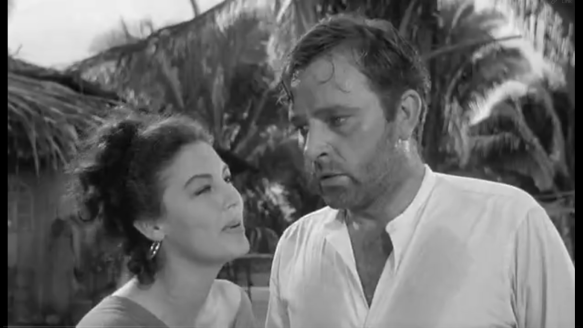
For the sake of this movie, they are not. The tropical Costa Verde hotel is hidden up in the forest overlooking the water, and it just happens to be run by an old friend of Shannon’s. Fred is dead, but his wife, the larger-than-life Maxine Faulk (Ava Gardner), is still running the place. She’s an earthy force to be reckoned with indebted to Gardner’s lively showing.

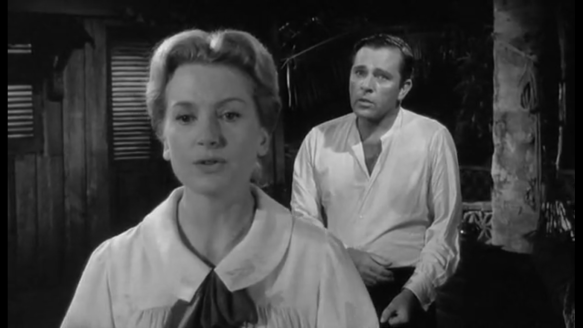
If not for her, Burton would probably steal the show, but he’s met with another gale storm of enduring cheerfulness and utter obstinance. Their impact is such you almost forget about Deborah Kerr. Sure enough, she appears on their doorstep as the peripatetic painter, Hannah Jelkes, who travels with her grandfather, a diminutive, 98-year-old poet.

night of the iguana 1

Though the other two dominate the screen, she quietly commands it. When Gardner and Burton get to shoving the drink cart at one another, it is Kerr who becomes their unofficial mediator. Because she is a voice of reason, an artist with a pensive gaze, and a surprisingly lucid perspective despite her meager lifestyle.

Later Charlotte bursts into Shannon’s room yet again causing him unwanted torment as she tries to get him to go away with her. She’s very good at stirring up men’s hearts and instigating mini scandals in the process. In another scene, a fistfight for her affections breaks out between the tour’s bus driver (Skip Ward), and some local boys replete with music, maracas, and stereotypical flourishes. Huston plays it for a laugh. It’s inconsequential if not altogether inane.

Because it is from the stage, The Night of The Iguana does seem to stall. Eventually, the bus leaves without Shannon and the second half of the story feels like an existential dialogue more than anything else. It could be a dead-end, though on the merit of our three established stars, it remains something intermittently though-provoking if not entirely compelling.

The curious thing is how the adversary melts away. True, the bus leaves with both his temptation and condemnation and yet he has pity even on his adversary. “Miss Fellowes is a highly moral person. If she ever recognized the truth about herself it would destroy her.” He recognizes her as another conflicted, constricted creature — a fellow Iguana tied up to a post.

With the bottom dropped out of his life, Shannon wants to swim to China, seemingly a handy euphemism for ending it all. He’s taken to the brink of his wits, lashing out at Maxine and anyone else who will avail him. It’s Kerr who rules the final act amid the paucity of moral rectitude. She perceives that his version of Golgotha is on a green hillside overlooking the water. His cross being strung up in a hammock on the verandah. In comparison, it seems like a fairly cushy alternative. She strips him down to who he really is.

Far from condemning him, Jelkes feels strangely sincere and genuine, particularly for Williams. She perceives that his problem revolves around “The need to believe in something or in someone — almost anyone — almost anything.” It’s Augstine or Pascal’s God-shaped hole rehashed. Likewise, she deflects his metaphors. She is not a bird but a human being. Nothing human disgusts her except if it’s unkind or violent. What extraordinary statements they are, and Kerr delivers them with a perfectly composed performance.

As each person tries to decipher their own religion or least some semblance of existential understanding, whether through legalism, drink, or sex, even cutting Iguana’s lose as a private act of personal Godship, she’s the one character who brings down the thoughts and words of the wise and makes them feel foolish.

For a film suffused with a great deal of religiosity, she’s startling unprepossessing. And yet in her words and in her humanity are the roots of something bountiful and beautiful in their very simplicity. It’s the kind of simplicity that can help loosen the Iguana from the hitching post, where we find out by sojourning, it’s possible to fill up the vacuum inside each and every one of us.

4/5 Stars

Classic Movie Beginner’s Guide: Ava Gardner

We wanted to continue our ongoing series by highlighting a few of the best films of an actress we’ll be writing about in the next weeks. Ava Gardner was renowned throughout her career as one of the most alluring leading ladies in Hollywood.

And although she was linked romantically with everyone from Mickey Rooney to Frank Sinatra, and wound up plastered all over the tabloids, we want to acknowledge some of her most noteworthy films. Because she left an indelible mark on cinema. Let’s have a look at her career, shall we?

The Killers (1946)

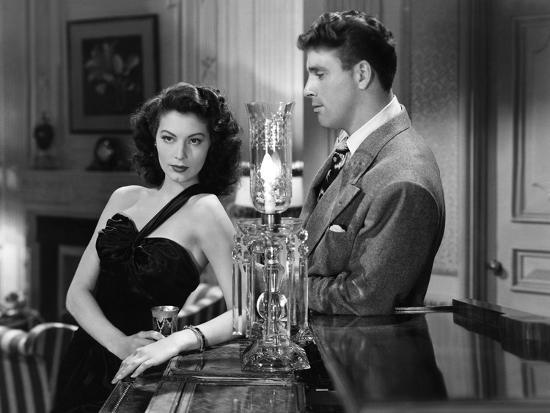
This is the movie that put Ava Gardner on the map and rightfully so. She still remains one of the most deadly film noir sirens thanks to her turn opposite the tragic Swede played by Burt Lancaster. She casts a spell on him (and her audience), thereafter catching him deeper and deeper in her tantalizing web of destruction.

Pandora and The Flying Dutchman (1951)

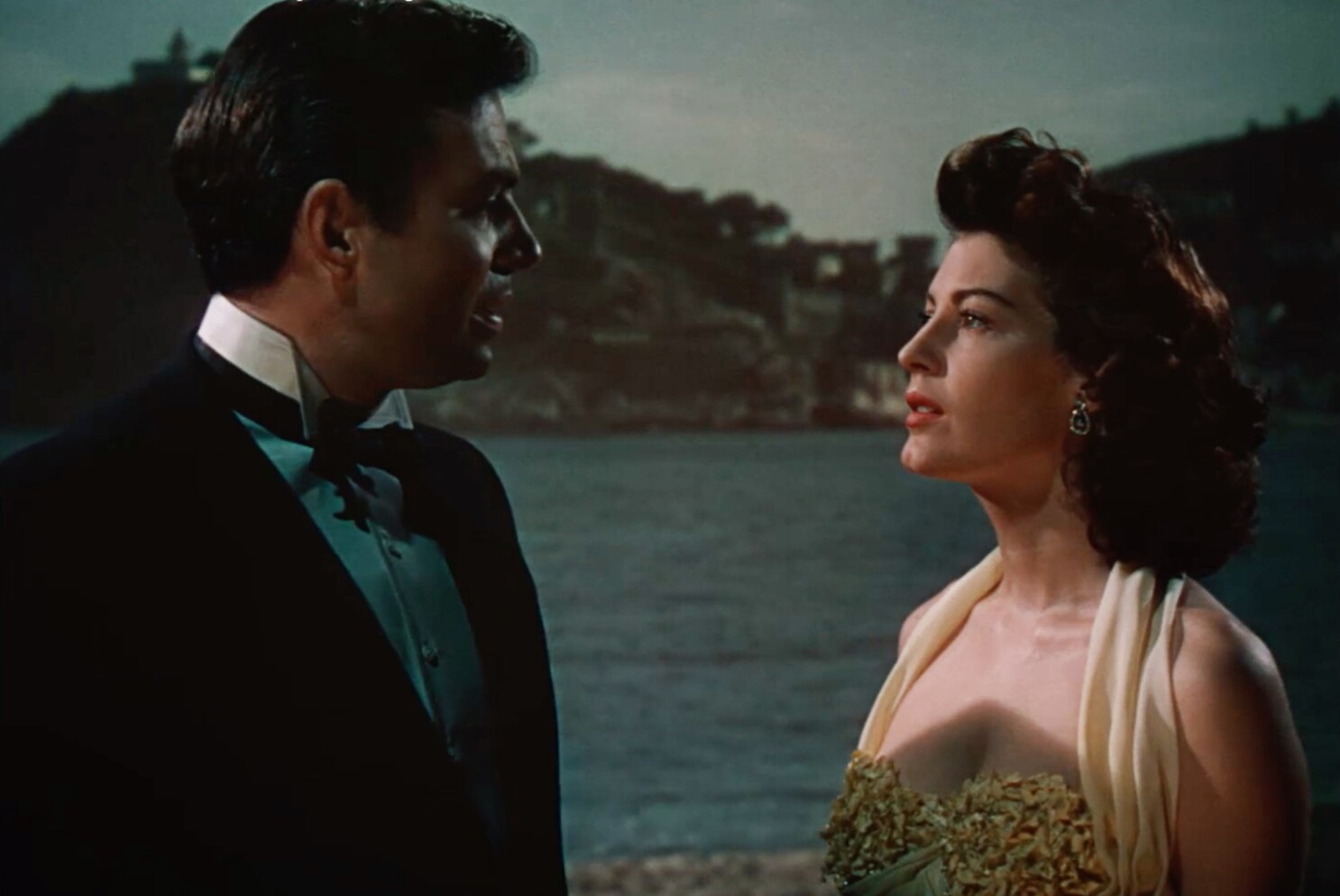
With a flip of the coin, you could just as easily choose The Barefoot Contessa. However, thanks to the bewitching Technicolor of Jack Cardiff and this kind of fated love story collapsing time between Gardner and James Mason, it’s hard not to recommend Pandora. Part of the reason comes with how it plays with the mythology around Gardner’s own reputation. Regardless of the plot, it’s transfixing for totally capturing her supernal beauty.

Mogambo (1953)

It’s easy to think of this as the prototypical Gardner role. She’s gorgeous as per usual, but she also has spunk, running off her mouth and ably sparring with anyone who comes her way, be it man or beast (ie. Clark Gable). She flaunts herself all over the screen, cracks jokes, and leaves yet another lasting impression in John Ford’s picture.

The Night of The Iguana (1964)

She held her own in On The Beach and Seven Days in May with the likes of Gregory Peck and Burt Lancaster, but it’s her part opposite Richard Burton here that shows how her persona evolved over time. She’s seen the world and gives the repressive film a vitality and richness that would be lacking otherwise.

Other Films: Bhowani Junction, Shadow of The Thin Man, Singapore, Show Boat, My Forbidden Past, The Snows of Kilimanjaro, The Band Wagon

Do you have your own favorite Gardner films that you would recommend to a first-time viewer?

The Spy Who Came in From the Cold (1965)

thespywhocame1Adapted from the John le Carré novel, this is a black & white spy thriller that personifies cold war paranoia in ways that Bond never could. Richard Burton is an operative working in Berlin before being demoted to a librarian job. It looks like our narrative is heading in a direction hardly fit for a spy film. Its intentions are not so obvious at first, and it keeps its audience working for the rest of the film.

Alec becomes fond of his colleague Nan Perry (Claire Bloom) who is a young member of the British communist party, but he’s also prone to drink and outbursts of anger. He’s become the perfect target for defecting, and the enemy reaches out to him just as would be expected. They send him to the Netherlands promising payment for the disclosure of British secrets. In these moments there is a great deal of dialogue that feels somewhat trying. It ends up being a slow burn for Burton and the viewer as new layers and wrinkles are added to this whole espionage affair. Only does it get interesting when the girl winds up back in the equation. All of the sudden, the stakes are a lot different, a lot more hangs in the balance, and a lot of new twists present themselves.

As an audience, we are thrown into the tension of the moment, and we become utterly befuddled by all that is going on around us. It’s as if when we finally prick up our ears in anticipation we no longer know all the ins and outs of what’s going on. Where do the allegiances lie?  Who is “good?” Who is “bad?” Or is everyone just a muddied shade of gray?

Perhaps the most disconcerting revelation is only alluded to and remains more prominent in the original novel. Here we have a storyline where the sadistic German ultimately survives and the Jewish agent is destroyed. It’s a cruel bit of irony that hardly needs to be explained, but the implications are decidedly troubling. With such an observation we cannot help but recall the pogrom-filled past of European history — most devastatingly the Holocaust a mere 15 or 20 years before.

The Spy Who Came in from the Cold is a dour, misanthropic picture of the Cold War era. A narrative perfectly matched for Burton’s pair of somber eyes, cynicism, and brooding. He’s a man who speaks of Peter Pan and God in the same breath — they are both fairy tales. His role as a spy is never glorious, instead besmirched by conspiracy and lies. When you put it that way it’s not very appealing at all, and it shouldn’t be. Director Martin Ritt, unfortunately, is a greatly under-appreciated director and his films are often tinged with moral and political undertones that follow troubled characters.

Notably, this film felt like a precursor to The Three Days of the Condor, except this time it’s about the British organization Control that pulls the wool over the eyes of the enemy. The conspiracy runs so deep it’s almost difficult to even comprehend it.  Maintaining its tone, the story ends much like it began, very bleak indeed. This is a film that deserves your time and demands your full attention.

4/5 Stars

“What the hell do you think spies are? Moral philosophers measuring everything they do against the word of God or Karl Marx? They’re not! They’re just a bunch of seedy, squalid bastards like me: little men, drunkards, queers, hen-pecked husbands, civil servants playing cowboys and Indians to brighten their rotten little lives. Do you think they sit like monks in a cell, balancing right against wrong?” ~ Richard Burton as Alec Leamus

Who’s Afraid of Virginia Woolf? (1966)

Starring Elizabeth Taylor and Richard Burton with director Mike Nichols, this taboo-breaking adaption of the stage play revolves around a middle-aged couple. George is a professor and he and his wife Martha have a love-hate relationship. Urged by her influential  father, Martha invites a young couple to their home. Because of the late hour and lots of alcohol, the rest of the evening becomes a wild war full of nasty insults, hurtful games, and manipulation. Martha and George use their guests and go as far as physical violence. However, in the end secrets are uncovered and they realize that they truly are afraid of Virginia Woolf. What began as a joke became all too true. At points this film seemed to elude me but I will say the acting was intense and powerful. There were moments where you disdain these people, then you feel pity for their plight, and other times you may even be able to relate to them in some ways.

4/5 Stars