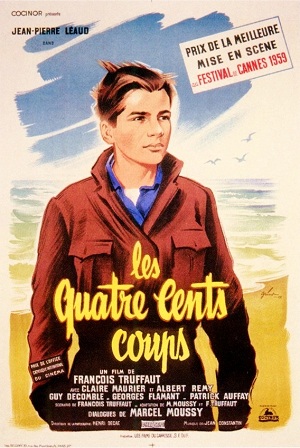
The 400 Blows (1959)

This French New Wave film directed by Francois Truffaut, more aptly titled The Wild One or Raising Hell, is about a young boy named Antoine. He comes from a working class family and his parents are struggling and frustrated. In school he gets poor grades and his teacher often punishes him. Annoyed with his life, he runs off for a time committing petty crimes and exploring the streets with a friend. That ends when he is caught stealing his father’s typewriter. Fed up for the last time his parents send him away to an observation center for boys. After he arrives Antoine escapes and runs to the ocean a sight he has never seen. With that the camera zooms in and we clearly see the face of this troubled, young boy. It is easy to appreciated this film because it does not glamorize the situation but tries to deal with it sensitively. Truffaut made a very good one here reflecting on his own experiences.

5/5 Stars

The Rules of the Game (1939)

bcb9f-la_regle_du_jeuThis French film directed by Jean Renoir is a light comedy that turns into a critique of the Upper classes. The film involves the superficial events and racy love affairs as only the French can have. It opens as a famous aviator lands his plane only to be disappointed that his married lover did not come to see him. Soon we learn that her husband has a mistress of his own. Put these four together,  Renoir in his jolly role of Octave, all the other guests, then the many servants, and soon you have a major spectacle. They dine, hunt, gossip, put on a show, quarrel, and above all fall in love. It is all fun and games however until someone gets hurt. Although this film is not what we may be accustomed to in our present generation, it is easy to appreciate the satire, cinematography, and ensemble cast. Kudos to Renoir for making a very intriguing film.

4.5/5 Stars

The Good, The Bad, and The Ugly (1966)

Starring Clint Eastwood, Lee Van Cleef, and Eli Wallach as the title characters, this is a memorable Spaghetti western. Angel Eyes (Cleef) is on the prowl for a man who stole some gold. Meanwhile Tuco (Wallach) is on the run until three bounty hunters confront him. However, Blondie (Eastwood) is the one who turns him in and then helps Tuco escape after he picks up the reward. Finally, the two accomplices split up on bad terms. The next time Tuco turns the tables capturing Blondie and marching him through the desert. While on their journey they learn where the gold is hidden. First they have run ins with Angel Eyes an the Union army and then they got caught up in a Civil War skirmish. The two of them endure it all and go to the cemetery where the gold is. There they have the final showdown with Angel Eyes in epic fashion. This film is great because it is exciting, it features an iconic Ennio Morricone score, and it has great cinematography which is a trademark of Sergio Leone. An Italian western may seem strange but Leone somehow makes it work.

5/5 Stars

Tokyo Story (1953)

42390-tokyo_story_posterThis critically acclaimed Japanese film directed by Yasujiro Ozu has a relatively simple plot having to do with a kind elderly couple going to Tokyo to visit their adult children and extended family. They are excited to see the big city but it is not quite like they had expected. Furthermore, all their relatives and family have very busy lives making it difficult for them to spend time with the couple. The eldest son who is a doctor and then a daughter who owns a salon decide to send their parents off to a spa. Unhappy, the elderly couple return to Tokyo but they feel like they are imposing. Finally, the two of them head home and there the wife becomes ill. Because she is dying, her children do decide to visit. However, after she has passed away it seems they all too soon forget her and go on with life. This film is an interesting study of the void between generations. It also uses realism and focuses on the manners of the Japanese without fully criticizing them.

4.5/5 Stars

Rashomon (1950)

Directed by the famed Akira Kurosawa, the film starts off with two men eventually joined by a third. Both seem very melancholy and they explain this is because of something that happened three days earlier. Apparently a bandit met a husband and wife on the road and raped the wife with the husband being killed. However, this event is shown in four different accounts all varying greatly and we never learn what is fact and what is actually fiction. Because of this horrible event, one of the men who is a priest loses faith in mankind. The film ends just as it began with the two men alone under a pagoda watching the driving rain. However, an act of kindness quickly renews the priest’s belief. Kurasawa’s film certainly has an interesting plot device and camera work. Historically, it is also important because it introduced the world to Japanese cinema

5/5 Stars

City Lights (1931)

In this Charlie Chaplin film we follow the Tramp as he romances a blind flower girl and is befriended by a crazy millionaire. In line with all the great Chaplin silent films, this one has many comedic moments but also sentimentality. In one scene the Tramp might find himself dragged along with the millionaire or fighting in a boxing match. However, the next sequence he might be sharing a very nice moment with the girl who only knows him by his voice and kind deeds. Fittingly, in the final moments of the film, the flower girl who can now see is reunited with the humble tramp who showed her so much kindness. Overall this was a very good film and it seemed to have a wonderful balance of humor and romance. It proves that sound is not always needed if you are a good storyteller.

5/5 Stars

Other Chaplin films I may watch in the future include The Kid (1921), The Circus (1928), and The Great Dictator (1941)

Ben Hur (1959)

Ben Hur, directed by William Wyler and starring Charlton Heston, tells the tale of Christ in connection with the young nobleman-turned slave, Judah Ben Hur. We follow Hur as a friend turns against him and he and his mother and sister are imprisoned. Soon he is doomed to a life rowing on a galley but on the way there a kind , mysterious stranger gives him a drink to quench his thirst. It takes a few years but Hur’s fortune turns and he is no longer a slave but a great chariot racer. The time comes to seek revenge and he beats his former friend in the ultimate chariot race. However, his victory is shorlived since he learns his kin are now lepers and the man who showed him kindness years before is now to be crucified. Returning the favor, he gives the suffering man water before He is hung on the cross. Despite the man’s death, miraculously his mother and sister are freed from leprosy. This epic is monumental and tells a wonderful story intertwined with the Gospel.

5/5 Stars

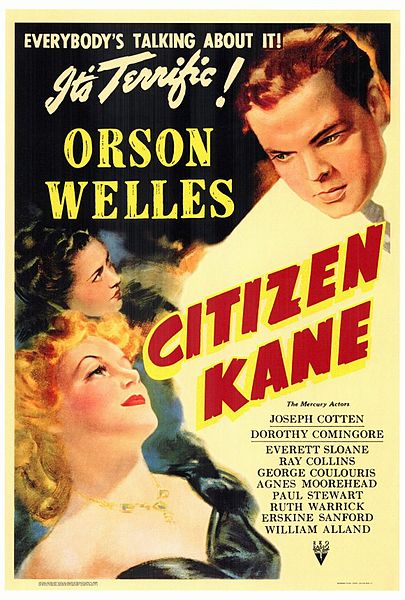
Citizen Kane (1941)

The first time I ever saw the film, I actually wrote Citizen Kane off because my hopes were so high thanks to its major critical acclaim. Those hopes were soon dashed after viewing it once, but over time I realized I needed a second viewing. This second chance allowed me to see the minute details, which can be easily overlooked or forgotten. Now I can truthfully say I have a new found respect for this film.

The brainchild of Orson Welles, Citizen Kane opens somewhat unimpressively, however it is certainly very moody and atmospheric. As the camera closes in on a great mansion, we are given a first-hand view of a dying man followed by his mysterious final word “Rosebud.” In the following newsreel, we learn the man was Charles Foster Kane (Welles), a millionaire tycoon and newspaperman. A journalist (William Alland) is enlisted to find out anything he can about Kane. First, he scours the memoirs of Kane’s deceased childhood guardian (George Coulouris). Then, he talks with Mr. Bernstein (Everett Sloane), who worked with Kane’s paper the Inquirer. He gets around to talking to Kane’s unstable former friend Jedediah Leland (Joseph Cotten), as well as Kane’s second wife (Dorothy Comingore). We learn from these accounts about Kane’s early years, his success with yellow journalism, the evolution of his first marriage, and the rise and fall of his political career. Furthermore, we find out about Kane’s unhappy second marriage that ultimately left him loveless after looking for affection his whole life. Fittingly, we are again left with the bleak view of his fortress Xanadu, and we now have the knowledge that “Rosebud” was in fact utterly trivial.

Obviously, Greg Toland’s black and white cinematography using deep focus and low camera angles is noteworthy. The framing of the narrative with different points of view and flashbacks was unique at the time. The actors age in front of us showing the progression of time and montage is used to effectively condense time. There are the overlapping and fragmentation of dialogue to create a realistic feel throughout the film. Bernard Hermann puts together a score that slowly changes along with Kane. And of course, you have the supposed basis of Kane on William Randolph Hearst. Historically, Citizen Kane may, in fact, be the most important film of all time, and artistically it is certainly up there with the best of them. I will let others decide if that makes it the very best film, period.

4.5/5 Stars

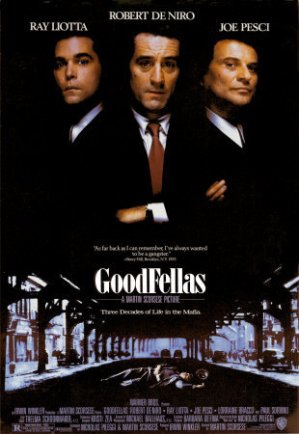
Goodfellas (1990)

Starring Ray Liotta, Robert De Niro, and Joe Pesci with direction by Martin Scorcese, the film follows the true story of Henry Hill and his life as a mobster. Early on in the 50s Hentry began doing work for the influential mobster Paulie (Paul Sorvino). He began skipping school and slowly begins making a lucrative living with the mob.  Soon he meets Jimmy Conway (De Niro) who loves to hijack trucks as well as the foul-mouthed, quick-tempered robber Tommy DeVito (Pesci). Over time Henry becomes successful after an Air France robbery and eventually he gets married to a woman named Karen (Lorraine Bracco). However, Henry gets caught up in a murder and he also starts seeing another woman. He still has problems but he begins a lucrative drug trade and the Lufthansa heist is pulled. The heat is on and Henry is eventually caught and decides to rat on his friends. He is then forced to live life as a nobody. I appreciated the period music, voice over, tracking shots, and freeze frames. The language of DeVito and others is tiresome but it shows how inherently corrupt they are.

5/5 Stars

The Silence of the Lambs (1991)

Starring Jodie Foster and Anthony Hopkins in two memorable performances, the film opens with a young FBI agent in training, Clarice Starling (Foster). A serial killer nicknamed Buffalo Bill is on the loose and Starling is given the assignment of talking to the incarcerated Hannibal Lecter (Hopkins). He formally was a brilliant psychiatrist and he turned into a cannibalistic killer. Lecter gives Starling hints on how to find the killer but not without forcing her to open up about her past. She closes in on the murderer and after some tense moments she finishes the job a hero. Now a certified FBI agent, Starling gets a call from Lecter who had escaped previously. He bids her farewell as chilling as ever and this time he is a free man. The acting was good and there were definitely some great thrills.

4.5/5 Stars