Speedy (1928)

speedy1It’s hard not to appreciate Harold Lloyd. His life was less tumultuous than Buster Keaton and during the 1920s he was more prolific than Charlie Chaplin. So if you look back at his career you can easily argue that he was not playing third fiddle to the other silent titans. He was their equal in many respects, and it’s only over the years that he’s fallen behind the others. But he deserves acknowledgment at the very least and his comedies such as Speedy make his case with rousing gimmicks and gags aplenty.

The film opens with Pop Dillon, the last of the horse-drawn streetcar drivers. He’s a kindly old man who lives with his radiant granddaughter Jane, who is faithfully by his side. But a corrupt railroad magnate is trying to buy him out, and he’s ready to go to great lengths to get what he wants. It’s about what we expect to happen, so the real entertainment factor comes with how we get there.

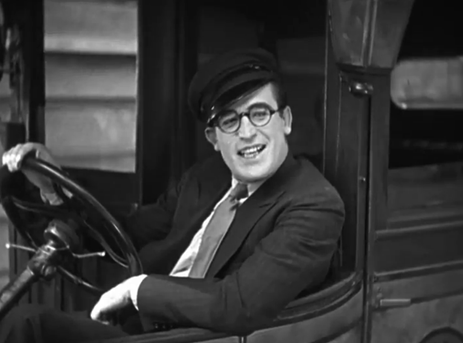
Enter Speedy (Harold Lloyd) a baseball-loving soda-jerk turned crazy cab driver and the sweetheart of Jane. It’s true that he starts out working the coffee counter with great dexterity while keeping up to date with the latest box scores of Murder’s Row. However, after a major blunder, he knows he won’t have a job when he gets back. Rather than stew in his misfortune, Speedy heads out on a Sunday afternoon in Coney Island with Jane. This proves to be a wonderful aside rather like in Sunrise: A Song of Two Humans, and there are a lot of great little gags being pulled by Lloyd, and others occur unwittingly. He tricks a myriad of folks with a dollar bill on a string and a crab in the pocket causes a lot of chaos. He even picks up a new unwanted friend in a hungry dog. But perhaps most of all the sequence is a fun nostalgia trip to the fair, showing off all the attractions circa 1928. It’s an eye-opening experience, and it still looks like quite a lot of fun.
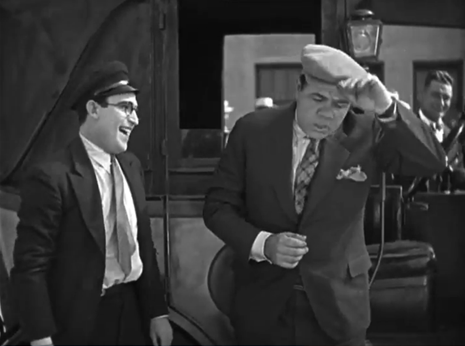
speedy3The other section of the story begins with Speedy garnering a job as a cab driver, but he has an unfortunate aptness for picking up tickets. He does, however, pick up some precious cargo in Babe Ruth (playing himself) and it leads to a wonderfully raucous ride to Yankee Stadium courtesy of Speedy’s crazy maneuvering through the streets of New York. Even Lou Gehrig sneaks in on the fun with a wry grin.

As the last order of business Speedy must save Pop’s cart from utter extinction and what follows is a rip-roaring brawl in the streets between the young thugs and the old-timers. Instead of being suspended from a clock, Lloyd must race against it to get Pop’s stolen livelihood back to its track in time. Once more he puts his madcap driving to good use.

Speedy lives up to its name and certainly justifies the popularity of Harold Lloyd. Its strengths include a plethora of sight gags that play off the audience’s sense of dramatic irony. Put them in the hands of such a nerdish icon and it spells true comedic gold. It’s Lou Gehrig approved no less.

4/5 Stars

Greed (1924)

Greed3With some cinematic endeavors, there is simply an aura that surrounds them which informs how we look at them. Erich von Stroheim’s ambitious silent film Greed is such a picture. To this day, a full cut of the film has never been found and perhaps never will be, but it has survived in two versions. A four-hour cut which attempted to maintain the original continuity through stills and then a 2 and a half hour cut which I saw. So you could question whether I got the full experience of Greed or not, but that is almost beside the point because the essence of this film is summed up in the title. True, it could just as easily be called sin, avarice, grudge, humanity, or all of the above. But allow me to explain more fully what I mean.

The narrative follows a slow-witted man named McTeague (Gibson Gowland), who picks up the dentistry trade from a traveling doctor. He moves to San Francisco and soon becomes smitten with the cousin of his boisterous pal Marcus (Jean Hersholt). Trina (Zasu Pitts) is quiet and a bit timid around a man as intimidating as McTeague, but they make it work. Soon enough they’re engaged and a lottery ticket Trina picked up on a whim pays off handsomely. $5,000 to be exact and this is the 1920s! They’re getting on alright because McTeague is still working and his wife is very, very frugal. But Marcus feels entitled and a grudge over the money ensues. He wants part of the cut because he thinks he deserves some good fortune too. Things between him and John finally reach the boiling point and there’s no turning back. Rather than try and patch things up, Marcus decides to get into ranching and says goodbye to his formerly close friend, but not before serving up a little revenge. He sets the dentistry board on McTeague and since he doesn’t have a true credential, his right to practice is terminated.

The loss of John’s job is aggravated by the fact that Trina is increasingly stingy, never wanting to dip into her big payoff, even when they really need it. Gold in many ways has become her master, and it leads to marital turmoil. McTeague was always a big man, but usually quite gentle. But his inner fury is finally uncorked and in one angry outburst, he goes so far as to bite his wife.

Mac leaves only to come back again and the results are not pretty. Soon he has a price on his head and he makes his way as a fugitive into the desert. And thus, the finale is shot on location in Death Valley, the perfect place for a climactic showdown between McTeague and his old pal Marcus. Of course, money doesn’t help much when you’re trapped in the desert, or when you’re dead for that matter.

Obviously, greed doesn’t bode well, but this story is an interesting inversion of the typical plot line, because in this case it is the woman who has the money, and she’s the one that the greed eats away at. She becomes obsessive and even bitter about every last piece of change. But her money also has a ripple effect that reveals the pettiness, avarice, and begrudging nature that plagues both her husband and cousin.

So in order to enjoy this film, you need to have an appreciation for the spectacle that von Stroheim has developed and the commentary he has weaved through his narrative about greed. That in itself makes this film one to truly ruminate over because it suggests so much about the ugly side of human nature, and that has hardly changed in the past century.

The Cabinet of Dr. Caligari (1920)

Das-Cabinet-des-Dr-Caligari-posterI’ve never seen anything like it, and I mean that in all truthfulness. The Cabinet of Dr. Caligari has the esteem of being called the original horror film, and that’s not something to be taken lightly. Perhaps I’m more partial to Murnau’s Nosferatu that came out two years later, but this film directed by Robert Wiene is really the epoch of German Expressionism. The German Expressionism Movement, after all, was not simply about painting, or architecture, or theater. It bled into the Weimar film industry as well, drifting as far away from realism as was possible at the time. Some say D.W. Griffith wrote the rules of moving pictures as we know them today, and if that’s so, then it was this film that tried to push the boundaries to the limit.

In an effort to be transparent, I will acknowledge that The Cabinet of Dr. Caligari does not engage me, narratively speaking, like some other silent films. It follows a Dr. Caligari as he presents his spectacular somnambulist Cesare (Conrad Veidt) at a local carnival. But all is not as it seems as a string of murders terrorize the town by night. Also, I was not a big on the score that accompanied this version. It was rather a discordant cacophony and it did not seem to go well with the action, but that is often a problem with silent films if they do not already have a score to go with them.

CABINET_DES_DR_CALIGARI_01Nevertheless, the images alone are striking, and it is still fascinating for the very reasons I mentioned above. It boasts the craziest sets, highly stylized, and made up of every type of angle and shape imaginable. We know resolutely that this is not reality, these are simply facades being put up to engage our eyes. It features a mise-en-scene for the ages, with no attempt to try and be the least bit objective. There’s no effort to aim for realism; none whatsoever, and that level of audacity is impressive. Furthermore, it’s mind-boggling to think that so many people and so many films were influenced by this movement. Especially in Hollywood.

Without it, we would not have 1930s horror films like Frankenstein and Dracula. There would be no Film-Noir or at least not the same moody, atmospheric creature that we know today. In truth, it was many European directors like Fritz Lang, Billy Wilder, Otto Preminger, and even Alfred Hitchcock, who channeled this movement in their own work. It proved to be so important to the medium of film and thus, it’s important to remember these roots. So maybe The Cabinet of Dr. Caligari is not as engaging today, but there is much to be admired and extracted from it still.

4.5/5 Stars

The Wind (1928)

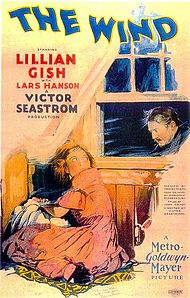
190px-The_Wind_(1928)The makers of The Wind took their content seriously. Filming commenced near Bakersfield in the Mojave Desert where temperatures fluctuated around 100 degrees. Eight airplanes where used to churn up enough force for the effect of swirling sand and much of the crew was forced to wear protective clothing while facing the elements. It sounds like a hardly pleasant experience and yet Swedish director Victor Sjostrom’s project with silent film goddess Lillian Gish proves transcendent to this day.

An early inter-title explains the film’s story of a “woman who came into the domain of wind,” and essentially that sets up this archetypal woman vs. nature story. Gish is our heroine Letty, who has come all the way from Virginia to live with her cousin. Why she would want to live in such nasty conditions is not clear, but she must have had good reasons. Every sequence you are reminded of this film’s title, because hats, hair, scarfs, are always blowing in the wind, no exceptions. Tranquility does not have a place in this film. Vast expanses of desolate terrain reign supreme and the men match the land. The first acquaintance Letty makes on her way out is the forward cattle buyer Wirt Roddy. He warns her of the treacherous country she is about to enter, but she is, after all, Lillian Gish. Nothing will stop her.

When she finally arrives at the ranch of her cousin Beverly, he is delighted to see her, but his callous wife and bratty kids are not so warm with their welcome. Letty also catches the eyes of two ranchers: The rugged Lige Hightower and the aging Sourdough. Both have a hankering to ask for her hand in marriage, and the dance in town seems like the perfect place for popping the question.

But a giant cyclone strikes leaving destruction in its wake, and the general public seeks shelter below ground as the men try and brace for impact. In the mayhem, Roddy declares his intentions and now there are three suitors vying for Letty’s affections. It’s good fun for Letty until the jealous Cora forces her out of the house. She doesn’t want Ms. Sly Boots wrecking her home as she surmises.

Letty needs someone to turn to and her first choice is Roddy, but he always was a grinning conniver, and he finally confesses he’s already married. That won’t do and she reluctantly chooses Lige. Although, since he is so rough around the edges, she doesn’t know how to relate to him. She certainly doesn’t love him, and he catches on pretty quickly when trying to kiss his new bride. Despite, a violent side, Lige proves he does have a grain of decency buried in the sand somewhere. He resolves to get enough money to send Letty back to where she came from and, he soon loses his scruffy beard.

Lige goes out in the elements out of necessity in taking part in a roundup. His wife initially pleads with him to take her along, but the conditions are too adverse and she is left behind, all alone between four flimsy walls which are supposed to defend her from the forces that be. A deadly Northern is coming, personified by a prancing stallion, but that’s not all. Roddy sneaks back to Letty intent on taking her away with him, and between the never-ending onslaught of wind and sand, along with her former suitor, Letty is beside herself. It’s a frantic struggle against the wild forces of nature, not to mention a craven man. However, being the heroine that she is, Lillian Gish find her gun and does what she has to do. As they say, absence makes the heart grow fonder, and thus when a jaded Lige gets home, he is surprised to be met by Letty with open arms. They share the original Titanic embrace, with the wind billowing around them, eyes closed, enjoying this moment of pure adrenaline. Even for the 1920s, Gish is a universal beauty, and there’s a pristine magnetism to her. I would never wish any type of harm or misfortune upon her. She has such a sincere face. Or maybe it’s a fragile frame backed up by courageous nature. Her struggles remind me somewhat of The Gold Rush or Steamboat Bill Jr. because in each of these films a character we truly care about is pitted against nature’s wind. These films have different effects, but each is powerful in its own right.

4.5/5 Stars

The Crowd (1928)

220px-Crowd-1928-PosterThe Crowd is a true piece of urban Americana, setting the standard when it comes to your average everyday American. King Vidor’s film lacks big-name star power and plays on a universal story similar to Murnau’s Sunrise. Our protagonist is Johnny Sims, who was fittingly born on the 4th of July. He’s the quintessential stand-in for anyone who has ever pursued the American Dream. He faces the death of his father at an early age and grows up getting lost in the masses of New York. With wall to wall skyscrapers towering above and a hopping city life, it’s easy to disappear.

This film is not Metropolis, but it is about a metropolis with the same behemoth sets swimming over the top with extras. In fact, at his job, Johnny looks like the original C.C. Baxter from The Apartment. He’s a cog in the giant mass of humanity, a little stop in the ever-churning conveyor belt.  Like Baxter, Sims becomes smitten with Mary, a lovely girl he meets on a double date with his joking colleague Bert. A lively night at a carnival and going through the tunnel of love cements their relationship. Soon they are married and heading off to the perfect honeymoon destination: Niagara Falls. This is where the love story is at its peak, riding on a wave of euphoria since these two are loved and in love. They feel indestructible, and there’s no one in the world that they would rather be with.

But as per usual, life happens to get in the way of love. Johnny isn’t too fond of Mary’s brothers and her mother, and the feelings are mutual. They just don’t see eye to eye, and they are skeptical of his prospects as a breadwinner. Matters are made worse during a tiff where Mary threatens to leave, and Sims does little to object. Their house is slowly falling apart, although they keep it together momentarily since she announces her pregnancy. That is the thin thread that binds them together.

Following their baby boy, comes a little girl, and finally, the raise that Johnny has been hoping for, but it’s not much. Things continue to be difficult as Johnny still waits for his ship to come in. His wife is annoyed with him and the meager prospects ahead. We are reminded that it’s not the big things but often the little ones that cause the most damage. Like little biting remarks that cut to the quick. And yet somehow, Johnny and Mary hang onto their romance.

In one scene she gazes down from the windowsill at him on the street below and they make up after a row. It’s rather reminiscent of Romeo and Juliet, reflecting that they still care about each other. But matters are not helped by the fact that Johnny seems pretty useless. On a beach holiday Mary struggles to get everything right, and despite her best efforts, it all turns out wrong.

Only a few years before Johnny laughed out loud at a man forced to humiliate himself carrying signs masquerading as a clown. How embarrassing! And yet a desperate Johnny winds up with a similar lot. It doesn’t help that personal tragedy strikes his family where they are most vulnerable. In its day it was actually considered obscene (for featuring a toilet), and it was far from a success due to a downbeat ending. This is a Pre-Depression world, and yet life is still far from easy.  And that allows The Crowd to stand the test of time fairly resiliently because it’s still possible to relate with its patriotism, its tragedy, and its resolute optimism.

4.5/5 Stars

Strike (1925)

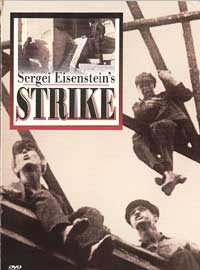
Strike_(film)Strike deserves a place alongside Battleship Potemkin and Man with a Movie Camera in a trifecta of films from the Soviet Union that while reflecting political agendas most certainly influenced film as a medium. Honestly, it’s a film that’s hard to pin down exactly. It’s the debut of a man named Sergei Eisenstein, who at this point had very little experience, although he would gain renown in later years. It’s a film to glorify the state that commissioned it by depicting events before the state was ever founded. Is this a comedy, solely propaganda, or a social drama?

It’s a film commenced with a quote by Lenin and broken into sections like, Reason to strike, The strike draws out, and Extermination. And yet words or plot summary is not enough, especially with a filmmaker like Eisenstein. How do you describe the impact of a man hanging himself? How do you explain the hordes of people fleeing the police? Wives and children suffering without food and provision, because the men of the house are striking. It’s a mass protest certainly, but when you break it down to the individuals, that’s where you begin to see the real pain.

Maybe I’m forgetting something, but I’d almost rather watch Strike than Eisenstein’s undisputed masterpiece Battleship Potemkin. In some ways, I found this strike and uprising more exciting and vibrant. In itself, the Odessa Steps is an amazing sequence and literally textbook stuff, but this film feels more fun thanks to a lighter initial tone. The common men are throwing the baddies out of town. There are spies with the greatest code names, pocket watch cameras, and antagonists who are great big caricatures.

Instead of feet on steps, it’s hands with fire hoses that become the focal point of the retribution. By the end, it feels like we’ve been manipulated by a wicked sense of humor. We have slowly been descending deeper and deeper into chaos. People running. A cow getting slaughtered. Carnage. Eisenstein effectively plays with the emotions and it’s not without impact. Although the last chapter is somber, Strike feels very accessible for a silent film. There’s a lot to be seen here and like Man with a Movie Camera or Battleship Potemkin, it’s much more than propaganda. I’m not communist and the ways of Lenin and Stalin have generally gone out of fashion as far as I know. However, the work of Eisenstein has remained pertinent, and his inventiveness and investment in the film-making craft are immense. At a basic level, he knows how to elicit emotions persuasively and that is a powerful aspect of film.

4/5 Stars

Broken Blossoms (1919)

brokenblossomsBroken Blossoms or The Yellow Man and the Girl. How do you deal with such a film coming from modern sensibilities of race and romance? It actually turned out to be easier than you would think, but not altogether straightforward. D.W. Griffith is no stranger to racial controversy in his films. because his archetypal Birth of Nation (1915) is known as much for its influence as it is for its depictions of African-Americans and the KKK.

For Broken Blossoms, he places the microscope on Asians and in this case a “Yellow Man” or “Chink” named Cheng. It’s not necessarily a good start, but it’s important to realize the lens and the times this film comes out of. Those terms are offensive and seemingly insensitive to us, but back in the teens, those terms were commonplace. Thus, if we put that aside for a second, it becomes important to look at actual depictions and objectives.

Cheng (Richard Barthelmess), who was indeed portrayed by a white actor, is characterized as a peaceful and kind individual looking to live in harmony with his fellow man. Bruising boxer and abusive father, Battling Burrows, is our obvious antagonist and the complete opposite of Cheng. It’s not simply a clash of race, but of temperaments, and kindness versus hate. The First Lady of Cinema Lillian Gish plays Burrow’s long-suffering daughter Lucy to perfection. I cannot remember the last time I had so much pity for a single character because with every close-up or piece of body language, Gish seems to suggest her horrible plight. She is so sweetly demure and yet so much tragedy is placed in her path.  As an audience, we cannot help but have compassion for her like Cheng. Her father constantly expects her to perform housekeeping duties and beats her whenever he pleases. In a sense, Cheng is her savior, but Burrows isn’t too happy about that.  The idea that there could be any type of love between his daughter and this “Chink” is out of the question.

brokenblossoms1I suppose in a sense this is a love story and we want both these characters to be happy. One inter-title says of Cheng: “The beauty that all Limehouse missed smote him in the heart.” It’s a beautiful line and suggests the wonderful connection that these two seem to have. Although the dream loses a little of its charm when Gish’s character calls her suitor “Chinky.” It was in this moment where I stopped feeling sorry for simply Gish, but also her character. She seems like a girl like Mayella from To Kill a Mockingbird, who is bred with racism and yet she becomes so lonely in the process. All the abuse leaves her empty and searching for something. In that case, her only outlet was wrongly-accused mockingbird, Tom Robinson. In this case, it’s Cheng, the only person who seems to see Lucy Burrows differently.

I cannot speak for others but I can forgive Broken Blossoms for some of it’s more unfortunate moments and I’m sure Birth of a Nation would require a lot more dialogue. There are certainly numerous outdated, rudimentary views here from Southern-bred director D.W. Griffith. But I think if we look at the bigger picture, this is a film that attempts to point out evil and bring to light a little beauty even if it comes from an Asian and a defenseless young girl. I not sure what to make of it. Can we call it a clear-cut interracial love story? Maybe, but perhaps that’s not the biggest issue. This is a film that tries to move its audiences by evoking emotion and deriving pity for its protagonists. It’s a far more intimate portrait than Griffith had done before. On that level, Broken Blossom succeeds.

4/5 Stars

Man With a Movie Camera (1929)

Man_with_a_movie_cameraWatching a film like Man with a Movie Camera makes me disappointed that there are not more films like it, because what it does, along with the most historically significant films of our times, is transport us to a different time and place we can never fully know or comprehend. Dziga Vertov does that with Soviet Russia circa the 1920s, and it’s pretty amazing. It doesn’t have some grandiose agenda but acknowledges flat out that it is simply an experiment. What it does so well is stripping film down to its most basic components. Consecutive moving images. The images that end up within and outside the frame.

There’s an inherent difficulty placing Man with a Movie Camera up against other films because it functions so differently. It has such vast importance on an experimental and inventiveness spectrum. It’s not a narrative that will grab hold of your interest and it’s not even made in the typical documentary form that we are used to. However, if you quiet yourself for a few moments, it really does have a fascinating quality. If we just sit back and watch, we can marvel at the little things as if we were just sitting on a bench and perhaps watching the world going by.

We see the streets of Russia in cities like Kiev and Moscow. The birds, the people, and even the movie theaters, all comprising day to day life. It actually feels rather like the German silent People on Sunday (1930), and it is crazy to think how mundane this communist society feels. Then, there are other moments that are quite invigorating or at least they get the blood pumping. Cars, trains, machinery, water, in constant fluid motion and it’s a spectacularly relentless rush.  Vertov even does some photography of athletes and sports which feels very much like a precursor to Leni Riefenstahl’s work in Olympia (1938).

There are other times where Vertov is literally playing with the medium. Playing with the film images, still images, and seemingly anything else he can think of. But he warned us beforehand so it’s quite alright. There’s double exposure, aerial shots, split screen, slow-motion, stop-motion, and probably so many other techniques and tricks that we easily take for granted.

Also, we hardly think about the pace of these images, because they feel so normal. But that in itself should cause us to stop and back up for a moment. Man With the Movie Camera has an average shot length that was unheard of at the time. Instead of over 10 seconds, it was going about 2 seconds. That’s about what you get with your average blockbuster now, but when Vertov did it, people thought it was abrasive for its sheer speed. It was different than anything they had ever been subjected to before and yet it would appear that over 80 years later we are most certainly indebted to this cinematic experiment. It’s one for the ages because even if you’re not fully captivated, it’s hard to downplay how influential this work was. It revolutionized and totally rearranged how people perceived film.

4.5/5 Stars

Metropolis (1927)

MetropolisposterFritz Lang’s archetypal sci-fi epic is steeped in politics, religion, and humanity, but above all, it is a true cinematic experience. It is visually arresting, and it still causes us to marvel with set-pieces that remain extraordinary. How did Fritz Lang piece together such a gargantuan accomplishment? Maybe even equally extraordinary, how was I able to see almost a complete cut of this film, which was at different times thought to be lost, incomplete, and ruined?

Metropolis really feels like one of the earliest blockbusters, although I would have to further substantiate that. Still, it’s basic story is generally captivating following a young man named Freder from the upper echelon of society with a father who runs things. This young man is really in the perfect position to succeed, the way society is set up. He even goes to the preeminent school where all the boys are dressed in white. Little does he know in the lower depths the beleaguered, grungy, weary masses in black are slowly killing themselves with work. The machine that drives this society is never satisfied, always desiring to be fed more and more and more.

When the boy finally sees the reality of the infrastructure his paradise is built upon, he cries out in horror. This is not the way things are supposed to be. He eventually switches places with one of these workers and attends a meeting deep in the catacombs (an allusion to the early Christians), where the pure goddess Maria lifts the spirits of her fellow man. But of course, the evil inventor Rotwang is enlisted by Freder’s father Joh Frederson. Their own relationship is marred by conflict over a woman they both loved. Freder’s dead mother. And so the scientist looks to resurrect his long lost love, and he needs Maria to develop his plan. He kidnaps her and from her likeness creates a double, who goes out to wreak havoc on all of Metropolis. The apocalyptic words of the Book of Revelation ring true as the whore of Babylon deceives the masses and leads them to destruction.

But Freder is the Mediator, he is the Savior of his people, and he is necessary to bring peace and tranquility to a world that has descended into such brokenness. So Metropolis is certainly a film full of symbolic touches, religious connotations, and political commentary, but all of this is developed by Fritz Lang through an archetypal hero’s narrative.

Hollywood has become an industry seemingly so obsessed with story, screenplays, plots. Certainly, a film like Metropolis is at least adequate in that area alone, but what really sets a film such as this apart is its cinematic scope. The sheer vast expanses it fills. The scope it creates through its plethora of extras and encompassing sets is hard to downplay. How to describe scenes where water is literally breaking down walls and covering masses of fleeing children? Or smokestacks spewing out refuse while trains, planes, and automobiles pass by in every direction. People scattering this way and that, following the false Maria in a chaotic frenzy. It reminds us what the motion picture, the moving picture, is all about. The images that are brought before us lead to a suspension of disbelief because more importantly they are incredibly affecting. At the atypical 20 frames per second, they are images full of tension, full of energy, and full of life.

Metropolis-new-tower-of-babelIn a sense, with Metropolis, we can easily see a precursor to Chaplin’s Modern Times a decade later. There is a general apprehension of the machine and the impact of a true industrial revolution. There is a fear that there are more positives than negatives. That machines will take over and man will become outdated. Perhaps someday our creation will destroy us. By today’s standards, such notions seem archaic, but are they? We still live in a society ever more obsessed with advancement, technology, and all the things that come with that. However outdated some of Metropolis might feel, and there are numerous such moments, at its core is the final resolution that between the body and the mind there must be a heart to regulate. We are not simply animals with bodies or rational machines with minds, but the beauty of humanity is that we have a heart, pulsing with life and vitality. That is something to be grateful for and never lose sight of.

5/5 Stars

Nosferatu (1922)

nosferatu1The hand of F.W. Murnau is less noticeable in this early classic of his, but Nosferatu still works seamlessly as a piece of drama and horror. In fact, it by now has become somewhat of a horror classic and the archetype when it comes to vampire movies, taking a lot of inspiration from Bram Stoker’s Dracula. I think one of the things that makes Nosferatu so gripping is the fact that it mixes the plausible with the supernatural making for this weirdly rewarding ride. Is it scary? No, not in the modern sense of the word.

But it’s a story steeped in Myth. There is mention of the Black Death, supernatural creatures, and a being that “suckles himself on the hellish elixir of their blood.” What wonderful imagery that develops a genuine awe in this devilish being. And yet in the same instance, we’re getting scientific explanations of venus fly traps and tentacled polyps acting as symbols certainly but also tying us back to the real world. These forces of nature are real, backed by science, and make a vampire just a little more conceivable.

Running through Nosferatu is a love story, and much like Sunrise, although Nosferatu is a “symphony of horror,” there is also a bit of a love song underlying the vampire tale. It lends this story some heart, because these characters, like our protagonist Hutter, actually have something to live for.

Nosferatu most certainly is a symphony, and along with the expressionistic images, it uses title cards as well as excerpts from ship logs, books, and letters to tell the story. One such inter-title card from Count Orlock reads: Your wife has a lovely neck. Hutter has little idea what he means (or pretends not to), but we know, making it a rather funny but unnerving comment. There’s something about knowing what is undoubtedly going to happen and being powerless to stop it. For instance, when someone acknowledges they have two mosquitoes bites quite close together that spells trouble to the audience, but we can only watch and wait.

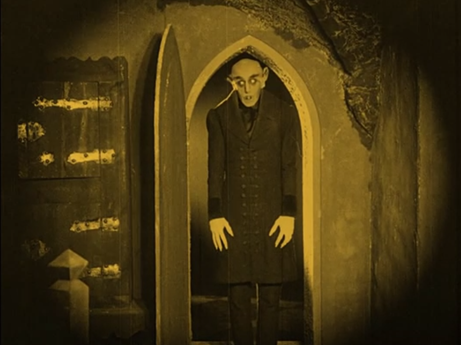
nosferatu2Because when Hutter first goes to offer Count Orlock a house we know it is bad news, to begin with, but it takes a long time for anything to actually happen. Orlock moves into the abandoned mansion across from Hutter and his wife, and that’s when the danger strikes close to home. There’s a madman in the hospital diverting attention, and Hutter winds up incapacitated so he is incapable of coming to the aid of his love. She is left vulnerable and the vampire has already proven what havoc he can wreak with the crew on a ship. Aside from Max Schreck’s frightening facade complete with pointy ears, bulging eyes, and menacing fingers, the vampire literally appears and disappears into thin air. There is a haunting aura built around him because he is something supernatural, something that we cannot understand except through myth. I found myself getting tense waiting for something that I was not sure about. That was the exciting part. It’s not a blood and guts, monsters jumping out of closets, kind of horror. It’s not ridden with cliches either because it was the one creating its own mystique.

It’s hard to believe how much popular culture has been derivative from Stoker’s Dracula, much like Doyle’s Sherlock Holmes, or Shelley’s Frankenstein. However, amidst all the vast works of Dracula and vampires, Nosferatu stands out. It represents the visual aesthetic of German Expression wonderfully, and it casts a long shadow. It’s hard not to, at the very least, admire its artistry and be taken aback by its legacy. In the realm of silent films, Nosferatu is a must, pure and simple. It doesn’t rely on bloodcurdling shrieks and screams, but the images begin to invade our consciousness. One seems fleeting and the other sticks with us.

4.5/5 Stars