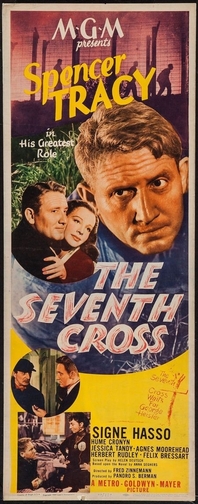
The Seventh Cross (1944)

Fred Zinnemann had one of his first Hollywood successes with the daring Seventh Cross. Since he was Austrian and lost family to the concentration camps, the personal nature of the material is unquestionable. He takes the novel by fellow Austrian emigre Anna Seghers and packs the story full with a wealth of European emigre actors and a few choice Americans as well. What it delivers is a stirring testament to humanity and the joining together of grit and determination in the face of oppressive evil.

I actually don’t mind Spencer Tracy playing the lead in the picture because it has the Hollywood bent of the studio system. Like casting James Stewart as a Hungarian in The Shop Around The Corner, there’s a collective understanding that Tracy’s attributes, as a kind of grounded everyman, are what matter most. It helps make this very specific and personal story a universal story for all men to see themselves in.

He is one of seven prisoners who make a nighttime escape from a Nazi concentration camp. As they all break off from one another and go their separate ways, we know the goal is the active pursuit of survival in a malevolent world. There’s nothing more fundamental, and we walk alongside George Heisler as he searches out any old friends and his former flame, who might be able to help him in his dire need.

Meanwhile, all the other prisoners are mercilessly rounded up and hung up on the crosses erected by the camp commandant; they are meant to be a warning sign to anyone else, but everyone knows the inherent metaphor. They are martyrs to the cause like the thief hung next to Christ. There is hope that they will one day see paradise.

The story utilizes a dead man’s voiceover before Billy Wilder took the device for Sunset Blvd. Here it feels a bit more like a crutch to distill Anna Seghers novel down; he lives as a ghostly subconscious entreating Heisler to remember the address 46 Morganstrasse…

At its best, the movie becomes a lyrical pilgrimage for this character as he’s privy to the kindness, passivity, and utter heartlessness of common people, each in turn. Because at your lowest, when you have nowhere to go and you rely solely on the good graces of others, this is where their true nature becomes evident.

I can see Classic Hollywood films, taking on Nazism, being derided in a modern context for going too soft, especially if you have a preconceived notion of what they might be. Certainly, these artists didn’t know every atrocity that had been perpetrated, but they were not stuck with their heads in the ground. In many cases, they knew far better than the general American public.

There’s immense consequence to everything within the frame, and Zinnemmann brings many searing evils to the screen, both seen and unseen. The aforementioned cross imagery is bleak iconography borrowed from Seghers. There are little boys with Nazi armbands rumbling around town to try and tattle and find fugitives.

One of the runaways, a formerly famed trapeze artist, must flee across the rooftops as locals gawk at the show and the Nazis hunt him down like cornered game. He takes one final curtain call after being mortally wounded and leaps forward in total serenity. It’s his final performance with his last breath. Heisler watches the scene, and before catching the ending, he disappears around the corner grimly.

His former flame Leni (Kaaren Verne) vowed to wait for him, but now she’s married and terrified to see him. The fear in her eyes manifests itself in brusque accusations. He has nothing but fondness for her; he’s requesting food and accommodation, and she will give him nothing. He stuffs a few crusts of bread in his pocket and disappears, feeling totally betrayed.

There’s another particularly unnerving scene. As the dragnet closes around George, he gets a tip about a doctor who might be sympathetic and can bandage him up for a wound. He pays a call on the man. Dr. Lowenstein (Steven Geray) states in accordance with the law that he must tell his patients before working on them that he is Jewish.

There might be other contemporary cinematic depictions of the Nuremberg laws or other anti-Jewish legislation like this, but the mundanity of this institutionalized prejudice is like ice in the veins. It’s right there in the open and in the face of this, the doctor still chooses to do an act of good.

Our hero is graced by another generous soul when he’s put up in a Hofbrau on his perilous road to freedom. By now, his name and likeness are all over the papers; Toni (Signe Hasso) the barmaid, could turn him, and yet she doesn’t. They share the kind of solitary love story that exists suspended in movies or those real-life moments where there is no time to stop and think before two ships pass on in the night.

George Macready even gets one of his first opportunities to play a conflicted, if ultimately sympathetic man caught in the crosshairs of the war and his own personal comforts. It takes all kinds for the sake of the cause.

Hume Cronyn shows up over halfway into the movie, and he is our respite. Paul Roeder might have the first genuine smile in the entire film with his domestic life alongside his wife, Liesel (Jessica Tandy), being a refuge from the hopeless world at large. He treats George well, symbolizing the growing tide toward human decency.

What he also represents is another viewpoint. The movie has the right to paint the Nazis as villains, and yet it does present a German character like Paul, who has been mostly shielded from the horrors.

What he sees is the economic prosperity and the help he’s received as he goes about providing for his wife and caring for his kids. The government has done good by him, and this is what he holds onto. George must help him see the other side and bet on the human proclivity toward good, even if we must forgive how easily Paul gets away from SS interrogation.

For being a film with so much grief and oppression — even if it’s fashioned on a Hollywood backlot — the movie does ring even more resolutely with this affirmation of human dignity. Instead of labeling it mere naivety, I prefer to see the optimism as represented by Paul and the little people.

Felix Bressart has the briefest cameo as the local delicatessen owner who brings George sustenance for the long journey ahead. Like his Shylock speech in To Be or Not To Be, he comes to signify the entire picture with his resolute encouragement. He doesn’t know the man, and yet he extends this generous hand; he’s just one of the faithful worker ants who will not let goodness die. Together, they can overcome.

What the film does well is distill these sentiments into individual human interactions we get to observe and imbibe as an audience. So although we are not completely inured to the state of the world, we are not blinded to it either, like Paul.

In 1944, there was still much of the war to be fought and won. Thus, The Seventh Cross does feel like a daring picture and one with immeasurable worth. I’m not sure if it was appreciated in its day, but looking back on it, there is much to admire in its incisive self-awareness.

3.5/5 Stars
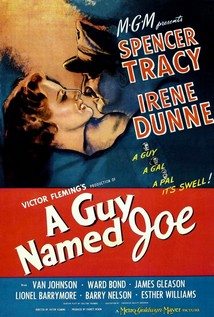
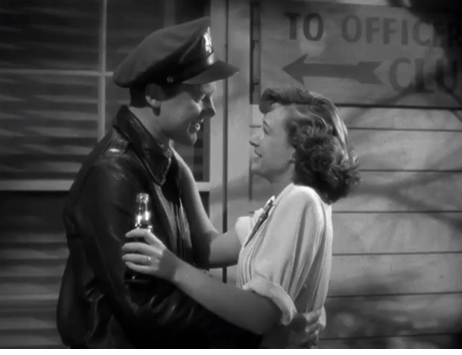
A Guy Named Joe (1943)

Although I would probably choose 30 Seconds Over Tokyo, a movie also penned by Dalton Trumbo and featuring Spencer Tracy and Van Johnson, there are numerous reasons to search out A Guy Named Joe.

This was Van Johnson’s first starring role, allowing him to craft a stage presence that would only become more self-assured with time. It nearly got derailed by a gruesome car accident that purportedly left him with a plate in his forehead. And yet out of this came one of the most popular young stars of his day.

Also, Irene Dunne, one of the often unsung comediennes and finest dramatic actresses of the 30s and 40s, gets the opportunity to show her stuff opposite Tracy. I will never miss an opportunity to see her because she’s easy to rate next to other luminaries like Katharine Hepburn and Barbara Stanwyck.

Some well-informed viewers might also be aware that Steven Spielberg transposed the action to the 1980s with his light remake, Always, starring Richard Dreyfuss, Holly Hunter, and a cameo by Audrey Hepburn. It’s easy to surmise the later film misses out on the historical context, making A Guy Named Joe about something immediate.

Pete Sandidge (Tracy) is your stereotypical loose cannon, hotshot who’s always receiving the ire of his superior (James Gleason). Nevertheless, the two of them maintain a playful game of cat and mouse because deep down, they both know they’re invested in the same cause.

Pete’s also reunited with his effervescent girlfriend, the alliterative Dorinda Durston (Dunne). She also flies planes, albeit not in combat. All the lovey-dovey grousing and such isn’t new, but between Tracy and Dunne with Ward Bond as the third wheel, it’s inherently watchable. They channel a love-hate relationship: getting sore at each other and making up in a passionate reverie.

Tracy and Dunne aren’t normally associated, and yet watching them together is an immeasurable pleasure because they have a grand capacity for bits of sly humor and shared humanity, elevating the material above mediocre fare.

The movie also boasts some impressive and truly immersive aerial sequences as Pete leads his men on one of their perilous bombing raids against the enemy. This latest mission also signals a shift in the story; a fatal crash occurs, and Pete’s last gasp of heroism means he’s good and dead.

He’ll spend the rest of the movie as a guardian angel, though he’s more like a ghost. So A Guy Named Joe quickly shifts from a purely WWII picture to another film in the cinematic angel canon (It should come as no surprise that producer Everett Riskin also worked on Here Comes Mr. Jordan).

Pete walks through the clouds of the afterlife not with a harp but a decidedly more militaristic objective. There’s a pointed weightiness in casting by making Lionel Barrymore the CO of the heavenly realms. He passes down to the newly deceased his marching orders: He will be serving as an unseen co-pilot to some new recruits.

Again, the movie shifts to focus on Don DeFore and Van Johnson as two problem flyers still wet behind the ears. Johnson plays a wealthy, if diffident, young man named Ted Randall who can barely keep his plane airborne. Tracy shudders at the future of the war in the hands of such callow talent, but he tries to get them up to speed anyway, albeit subconsciously.

These sequences are rather mundane because, unlike other stories in the angel canon, Tracy’s connection to the real world is very thin compared to Claude Rains, Cary Grant, or even Henry Travers in It’s a Wonderful Life.

The movie picks up again when Van Johnson is on the ground and progressing in confidence. We see an early pairing of Johnson and a nearly unrecognizable Esther Williams, perhaps because she’s not robed in Technicolor and a swimsuit. They share a dance, and he extends an act of kindness to a homesick soldier.

Tracy is forced into being an observer in the physical sense, and somehow, the passivity doesn’t suit him. It’s good for a few gags and dress downs of former friends and colleagues who can’t hear him, but it becomes a bit of a gimmick.

And after waving a movie about Tracy and Dunne in front of us, it tries its best to stitch together something between Dunne and Johnson that just feels a bit disjointed and forced.

Still, A Guy Named Joe has these compartmentalized moments of human connection, laughter, and tears, making it more than worthwhile. You get the sense of the war years, the transience that these young men and women felt on so many accounts. Be it the death of friends and comrades, or even the distance of loved ones so far away. Everything spells heightened emotions.

To its credit, I never thought I would see a movie with Irene Dunne breaking ranks to fly a bombing raid solo and drop a payload on a Japanese target. There’s something both ludicrous and oddly progressive about it, never mind how it seems to muddle the collectivist themes the movie seems to be aiming for.

However, the fact that there can be no catharsis for Tracy and his lost love might be a final lesson about the war years. It is a dream and a desire that cannot be fulfilled. In its wake, Johnson and Dunne must chase after each other instead in a swelling romantic ending without any earthly consequences as Spence disappears into the distance. It’s a pale imitation, but it will have to do.

3/5 Stars

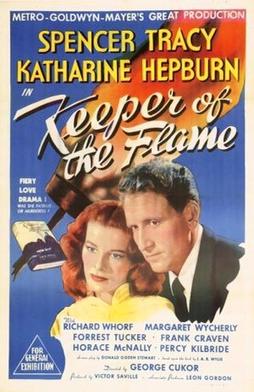
Keeper of The Flame (1942)

Keeper of The Flame strikes me as good ol’ fashioned Hollywood storytelling. It’s conveyed through a fatal opening car crash and a flashing montage of newspapers spelling the death of that great American institution, Robert Forrest. We’re hooked immediately as the story keeps on rolling.

The world itself in the formerly sleepy town has the definitive consciousness of Home Front America, full of interiors and then exterior-looking interiors, all on the studio lot. Moreover, there’s a frantic industry and a general chaos in the face of shortages, bringing out American know-how and good humor in the face of everyday adversity.

Namely, a bevy of journalists and well-wishers descending on the place not fit to handle such an overflow, especially during wartime. A harried Donald Meek monitors the telephone line and does his best to get the flood of people in front of him booked in any vacant rooms still available.

Steven O’Malley (Spencer Tracy) wanders in unannounced and mostly unseen. He pays respects to an old friend who barely recognizes him. It’s the eyes. He gives Janey (Audrey Christie) that quiet congenial Spencer Tracy look, and she asks quizzically if it hurt much when Hitler gave him the boot.

We glean he must have been a war correspondent, either based in a concentration camp or the Berlin press bureau. Their jokes are casual. You know they must do this in their line of work and in 1942, we can hazard a guess they don’t know the full extent of what they’re saying.

Christie has the whip smart repartee of a journalistic working woman a la Rosalind Russell. Since the house is packed, she coyly registers him as her “husband,” though there’s another colleague up for her affections (a young Stephen McNally).

O’Malley has an aspiration to get into the grieving Mrs. Forrest so he might share her husband’s story with the people. Riffing off of It Happened One Night, his pals quip that she’s the Queen of Jericho and he’s no Joshua. The walls of her castle won’t come down for just anybody. Though Tracy always had a certain dogged tenacity about him, and that’s what makes him a compelling, active hero.

Algonquin Round Table alum Donald Ogden Stewart builds out his screenplay in the opening act with all these intriguing nooks and crannies and characters who seem capable of existing of their own accord with intricate backstories.

Howard Da Silva is a guarded vet of the Argonne and de facto groundskeeper of the Forrest estate. A little boy (Darryl Hickman) grieving the wake of this great man from a lamppost; we learn he too has an intimate connection to the deceased.

There’s another relation to Mrs. Forrest who’s equally distrustful of the press and drinks his sorrows away with ginger ale. The dead man’s bespectacled press secretary (Richard Whorf) chooses a different approach: He’s highly elegiac and accommodating because his job requires levels of PR, though there’s plenty he’s not letting on about.

Beyond Christie, a personal favorite is the peculiar old cabbie (Percy Kilbride), laconic and chewing his cud while offering up homespun wisdom. He provides O’Malley transportation to and fro as the journalist pokes around for his story.

We know from a fair distance Keeper of The Flame is a kind of grade-A American propaganda piece, and it finally becomes most explicit when Tracy gives a little soft-spoken speech to Daryll Hickman about not letting the unseen enemy make them slaves and kick them around by putting chains on their minds and tongues.

In its defense, it’s mostly soft-pedaled moralizing because Tracy’s soapbox is small and he has a way of making the serum of slightly hokey words tolerable thanks to his usual candor.

However, the local doctor (Frank Craven) provides one of the most telling remarks after paying a house call to the imposing estate: “Ever since we’ve been falling out of touch with God, we’ve become pushovers for hero fever.” When he speaks of a young woman who was sent away, he surmises,  “You don’t fall in love with a god, you just worship him.” He’s a sympathetic fellow and in making his opinion of Forrest quite clear, it’s one of the first dubious signs we have to go on.

These ideas are thematically rich with potential, not to mention controversy. The movie becomes less so with the tinges of forested and thunderous gothic melodrama. Coincidentally, it’s not material I would immediately attribute to George Cukor although the 1940s were replete with such fare.

And it’s true there is a vague Citizen Kane-like bend to the story of a prominent man now dead. Although I also think of Welles’s other great figurehead Harry Lime for casting a shadow over the film, which is not too dissimilar to Hitchcock’s Rebecca, albeit gender swapped. These are mostly uncharitable comparisons and few can argue the point.

Katharine Hepburn might seem uncharacteristic in something so grim and restrained, but she proves her capacity for it. While I always am skeptical of her as a shy wallflower in a picture like Undercurrent, she handles this tormented role with a certain inscrutability. Although I don’t know if even she can manage keeping the story from getting out of hand.

There’s something in it on the tip of my tongue tying into almost John Fordesque mythmaking, whether it be Fort Apache or The Man Who Shot Liberty Valance. Sometimes you print the legend to protect people because the truth is too destructive to reveal. Except Tracy isn’t squeamish about giving the electorate a sober reality check.

In this regard, it feels like a daring sort of picture and you wonder if this was the saving grace, making it a draw for audiences beyond the conspicuous nature of the romance and brooding genre elements.

Still, the initial propaganda moments burn off only to come back like a raging conflagration. Hepburn brings them back again and she drops them right in our laps when she mentions fascism as embodied by her late husband. In one sense, it’s an impressive rallying cry and also an utter disappointment given the film’s best parts.

The finale of literal fire and water is all things histrionic and ham-fisted. Hardly the film’s finest achievement. All of this comes with a convenient ending, but I suppose in wartime you give the people what they want — assuming this was it.

Even with the underlying sentiment, Keeper of The Flame still has its moments that feel downright groundbreaking, and better yet, the wit of the supporting characters lives on in the mind’s eye. Alas, this was not meant to be.

Most of all, I regretted characters like Audrey Christie and Percy Kilbride fading away without consideration; I suppose they were sacrificed on the altar of a greater cause. I understand the sentiment and still, it feels like a waste of a stellar set-up for such conventional ends — even if it was for the sake of galvanizing wartime propaganda.

Perhaps this is all the more reason to want more out of the film. This is a good impulse because it means there are more than a few things worthy of praise.

I’ve only one final thought. In many ways the movie presages what Jacqueline Kennedy chose to do in the wake of her husband’s tragic death. More than once in the movie, an allusion is made to Abraham Lincoln, and Jackie made sure her husband had a funeral evoking that of the nation’s first slain president.

Then, at his final resting place in Arlington Cemetery, there burns an eternal flame. She was the keeper of that flame — solidifying his stature for generations of Americans. I won’t get into conjecture about her husband’s legacy, but it does play as an intriguing counterpoint to this film’s central figure.

3.5/5 Stars

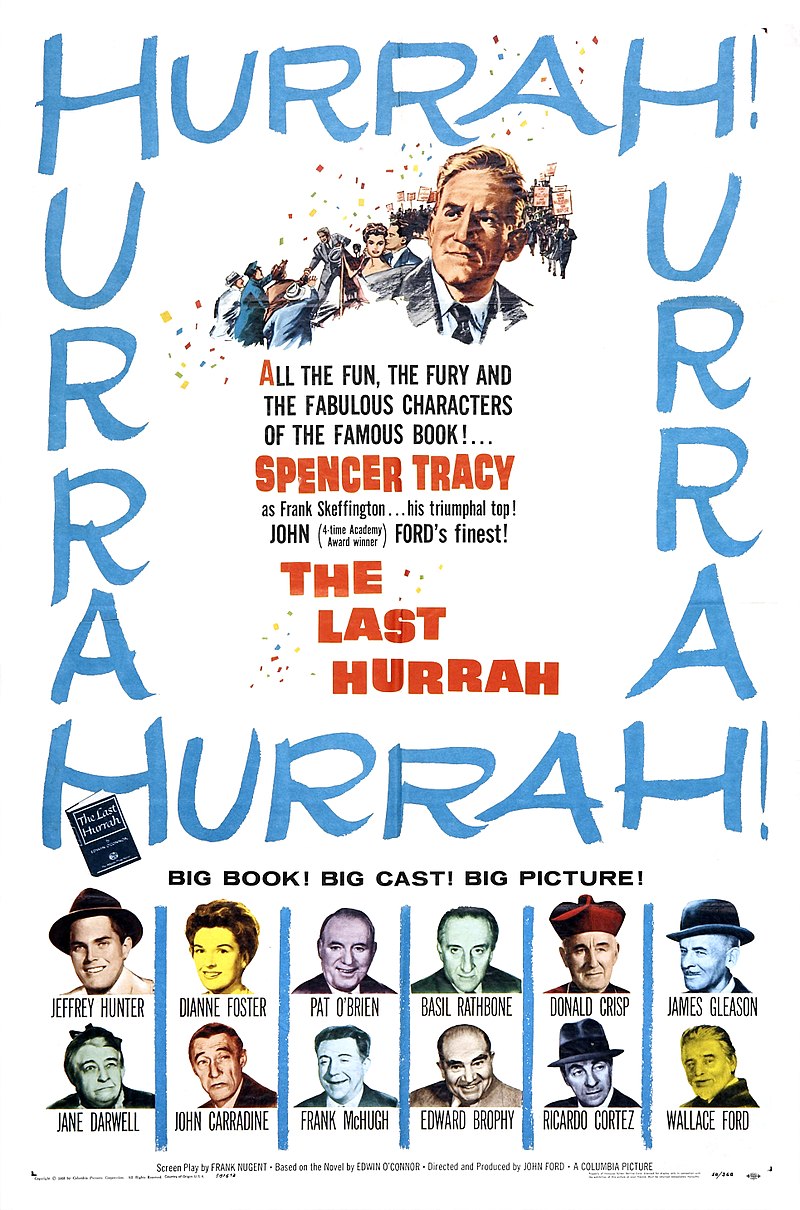
CMBA Blogathon: The Last Hurrah (1958)

This is my entry in the Spring CMBA Blogathon Debuts and Last Hurrahs.

In the isolated occasions when I had to debate in high school classes those who did this kind of thing for fun and seemed most destined for politics, were all people I would never want to vote for regardless of affiliation.

Because it seemed like there was a self-selecting bias. The people who wanted, nay desired, this kind of world, were not ones I necessarily respected.

How could a decent person of moral fiber get through and win? The cynical answer is they can’t unless they are propped up by a political apparatus of some kind. However, before I sound too jaded, I still am optimistic there are good people working in government.

No one would confuse John Ford’s The Last Hurrah for a tirade against big government and political machines. This is not a Frank Capra picture. Instead, there’s a certain level of give and take, a nuance, celebrating a style of old-fashioned politics while acknowledging the need for political strategy and networks.

No director brought more of the Irish-American experience to film than John Ford and you see it from his Calvary westerns to his West Point hagiographies, and even a portrait of his homeland like The Quiet Man.

Frank Skeffington (Spencer Tracy) is in the midst of his latest and perhaps final foray campaigning for the mayorship in a New England town. His personal entourage of right-hand men in bowler hats (including Pat O’Brien and James Gleason in his final role) have seen him through everything.

My initial observation is that this is a mature man’s game. The young (including myself) seem like idiots. His son (Arthur Walsh) isn’t registered to vote, doesn’t watch the debates, and is always running off after golf or other frivolous entertainments.

Another local magnate (Basil Rathbone) who opposes Skeffington has a son (O.Z. Whitehead) who makes a fool of himself by unwittingly accepting the position of local fire commissioner. Skeffington has instant leverage against his old adversary. Then, there’s an up-and-coming appointment — a young Catholic war hero and lawyer. More on him in a moment.

Skeffington is not naïve. He knows how to play the game. He’s continually pragmatic, pressing his advantages and the alliances at his disposal and knowing what it takes to win. You don’t maintain the office year after year without knowing the rules of the game. Perhaps Ford casts him with a rose-colored, nostalgic tinge, but at least he has some scruples or at least a sense of who his people and electorate are. Because he’s been knee-deep in the community.

His most obvious opponent is an unknown newcomer named McCluskey, and it becomes apparent he feels like a caricature cutout of John F. Kennedy if the man lacked charisma and intelligence.

Of course, JFK was a famously photogenic figurehead who used Frank Sinatra jingles, his public image, along with a platform to beat out Richard Nixon in 1960 (He also hailed from one of the most influential families of its day thanks in part to his father Joe Kennedy).

Nixon himself practically instigated the political television revolution with the pathos appeal of his Checkers speech in 1952, and thenceforward the televised debate presaged a radical new kind of American politics. The rules changed.

Adam Caulfield (Jeffrey Hunter), Skeffington’s nephew, works as a sportswriter at a local paper. His editor (John Carradine) fights tooth and nail against Skeffington with an obsessive grudge, throwing every iota he has behind McCluskey so he might vanquish his mortal enemy. Adam is far more accommodating and has a congenial relationship with his uncle.

When he pays the seasoned politician a visit, Skeffington calls politics the greatest spectator sport! He invites Adam to cover the events and tells him in confidence that he wants to try and win a campaign race one last time the old-fashioned way; he’s astute enough to know his days are numbered thanks to television and other readymade forms of advertising.

Although it’s not mentioned explicitly I can imagine Skeffington admired the political acumen and rhetorical vigor of a great American stalwart like Abraham Lincoln. John Ford of course made a whole film about his early years and rise to prominence before he ever became president.

I mention this only to echo the thoughts of Neil Postman in Amusing Ourselves to Death. Our culture shifted drastically from a literary culture where arguments were well-thought-out and expounded upon in debates hours long. And yet in the 1950s and 60s, we see this concurrent shift to a visual, image-based society.

Suddenly we watch campaigns being won and lost by optics, the most beautiful people, or those with the largest media share. It’s a far cry from the past and this is part that’s being memorialized. It’s a strange thing to be reminiscing about a world cataloged most comically in a movie like The Great McGinty, but there is something rather quaint about it compared to the juggernauts of media and consolidated power at work today on a global scale. It dwarfs anything out of the past by sheer scope and reach.

The whole film might easily be encapsulated by a few adjoining sequences. There’s a quiet scene with Anna Lee. Her husband Knocko has passed and left her little to nothing to subsist on. In an act of sheepish compassion at the kitchen table, Tracy offers her a sum of money on behalf of his dead wife. It feels like a pretense he’s made up, and yet here no one sees his kindness aside from the camera.

However, he sticks around for Knocko’s wake, and it becomes an extension of his political campaign. When word gets out, everyone seems to be coming by to pay their respects too, though it feels more like posturing. These moments can be humorous, darkly cynical, and still somehow have glimpses of communal warmth.

Taken on the whole, The Last Hurrah is a grand picture with a lot of cast, story, and ambition. But all that space gives Ford the opportunity to move around in and go to work with his gaze set on humanity. It’s the communal events or moments of ritual where Ford is at his finest: dances, weddings; here it’s a wake and a funeral.

I mentioned Capra before and his pictures, Mr. Smith Goes to Washington in particular, decry the mechanism of the political machine. However, the adapted novel and surely Ford as well had a prescience about them.

He somehow bridges a gap between Capra’s cinema, Sturges’s McGinty, and the emerging landscape. Because Elia Kazan in some ways would depict our certain future with A Face in the Crowd. It offered up a harsh critique focused on a country bumpkin turned charlatan who uses television to captivate the public and wield his newfound influence for political gain.

In such a climate the old guard like Skeffington can no longer exist. Part of this is the march of time. There are aspects of him that feel archaic and ugly with his back parlor dealings. And yet in the same breath, as we look at the vitriol that is shoveled today and the proliferation of social media, it does feel almost quaint. Again, this might be naivete speaking. We so quickly forget the political muckraking of prior centuries because we were not there.

I had to sit with this film, and the longer I was with it the more it moved me. Ford does what he does best by eulogizing someone he deems to be an everyday American hero. The flaws are laid bare and still, he can be lauded as a great man by all those he groused so bitterly with all through the years. On his deathbed, before he is about to be given the last rites, the local Cardinal (Donald Crisp) comes to ask his forgiveness. They have been at odds, bitter rivals, and yet, in the end, there is grace and mutual respect.

It feels like a beautiful testament, like a bygone sentiment we rarely see in politics today. Because Skeffington does signal the end of something — maybe it’s the classical statesman or something else.

Spencer Tracy lying on his deathbed is a picture of blissful contentment, and he has the feisty spirit of an Irishman to the end. The film has all the hallmarks of a swan song, but thankfully he and Ford still had so much to offer us respectively, and in their final years they continued to deliver some of their most rewarding work.

4/5 Stars

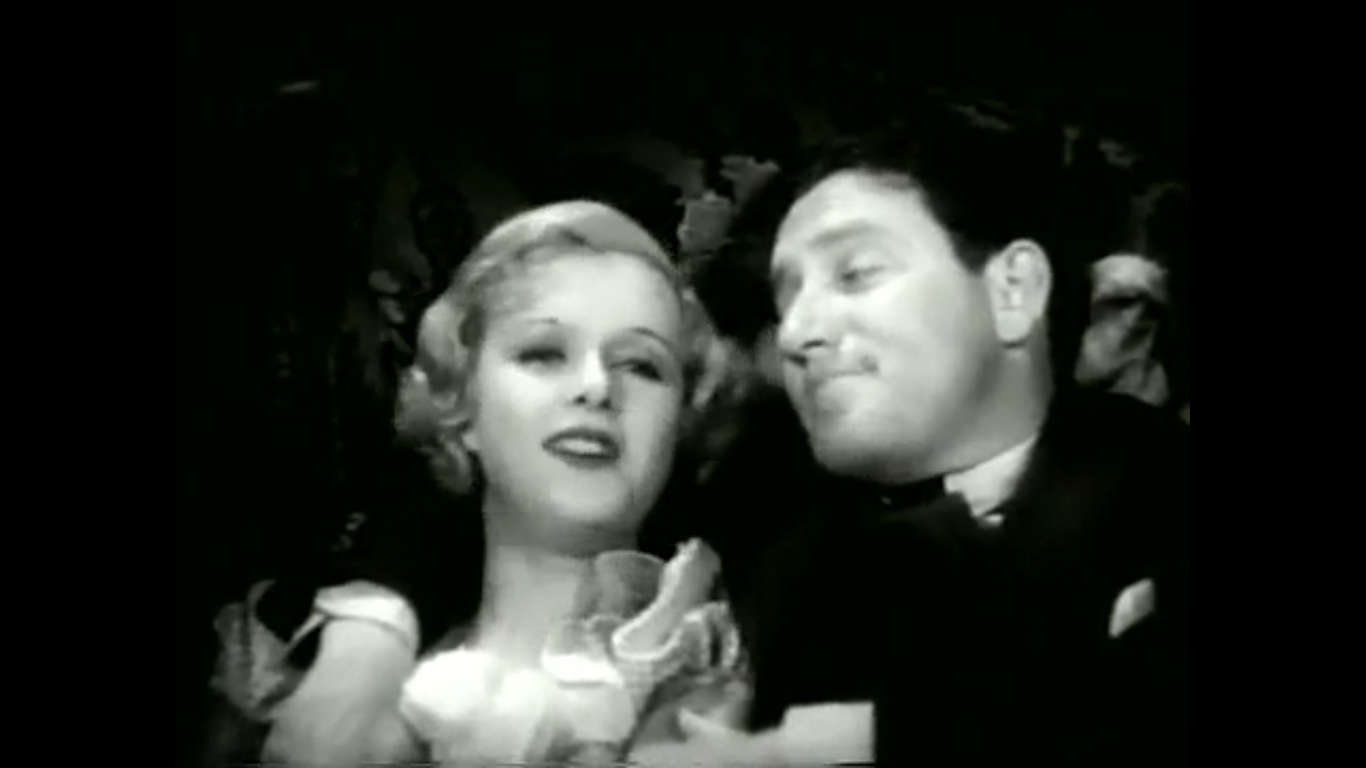
Me and My Gal (1932): Spencer Tracy and Joan Bennett

Spencer Tracy falls easily into the role of an Irish cop on the beat, Danny Dolan, working in the heart of the pier on the Lower East Side. What stands out immediately is his humanity and good-natured benevolence extended to his neighbors. In a matter of minutes, he’s nabbed himself a banana, rescued a dog, and drummed up a bit of small talk with a pretty cashier (Joan Bennett).

The film itself provides a  fairly simple framework. Director Raoul Walsh finds himself sculpting a world out of characterizations and vignettes, not unlike future endeavors like Strawberry Blonde or Gentleman Jim. But it showcases precisely how a couple of weeks of shooting can translate into an enjoyable piece of work.

Dolan falls into company with a detective named Al (Adrian Morris) hanging around the docks and watching out for a big-time gangster named Duke Castanega. However, before they can roll out the welcome wagon, they get accosted and thoroughly distracted by the most persistent drunks in film history (Will Stanton). He’s in a perpetual state of belligerent inebriation only made funnier by the fact he’s probably the scrawniest character in the whole picture.

One of the other scenes bursting with life comes in the wake of the marriage of Kate Riley with her sister Helen (Bennett) by her side. Soon the minister has summed up the proceedings and every man looks to get a smooch from the bride before her nebbish husband can get in edgewise.

Soon the after-party is flowing with beer, belches, drumsticks, and boisterous conversation. Walsh pulls out a trick he would use later in Gentleman Jim where his characters speak to the camera. Actually, they speak over and past it and what it does is intuitive, bringing us into the fold of the movie. So right in this moment, we as an audience are there at the wedding experiencing the frenzy with everyone else.

The chemistry sparks early between Tracy and Bennett, and it slowly grows into a mutual appreciation. He does her a good deed at her sister’s wedding, turning a blind eye and earning points with her blustering father. Later, Danny and Helen trade advice: He straightens his new bowler and she stops chewing gum.

One of their lighter moments on the beat involves the aforementioned drunk in yet another altercation. This time they must defuse a confrontation involving a man who was slapped in the face with a fish. It doesn’t fall into the realm of high-brow comedy, but that doesn’t mean it can’t be delightful.

For Me and My Gal — like many films from bygone eras — also has standalone details we can look at from our current station in history and truly appreciate. A radio salesman pulls out all the tricks to get the Rileys to bite on his best merchandise. The budding couple eat vanilla ice cream together in the kitchen, and a cup of java is two bits.

Even better is the linguistic education. Sporting the new bowler, one asks the other “Well, how do I look?” They say “Jake”  with a playful flick of the brim and a superlative adjective is born. Likewise, the weighty insult getting hurled around on all sides is “beezock.” Look it up. 

In fact, nothing’s sacred. They take a few minutes to razz a contemporary moving picture where they say one thing out loud, and then a minute later express what they really think. The way they amuse themselves with this gag feels like unusual territory for the era as we hear their inner thoughts playing against their spoken words (in a prodding nod to the movie Strange Interlude). 

As he tugs her down and she plops on the couch next to him, they are such a wonderful portrait of romance so perfectly in sync. In these self-reflexive sequences, I couldn’t help but find my mind drifting to Joan Bennett and Spencer Tracy. They both had long and illustrious careers, and almost 20 years later they would play opposite one another in a starkly different picture: Father of the Bride.

For now, they are young and in love. Bursting with all sorts of sass and equally romantic elan. Take the scene later on when he charges into her hash house aiming to marry her, and she’s clattering around behind the counter giving him her glib repartee. It’s the way romance is supposed to play out and around all the cliché beats of wanted gangsters and what-have-you, these are the other elements of the movie that feel singular and almost transcendent.

These are the little “pieces of time” Jimmy Stewart said actors can give an audience. When they reach over the counter to kiss, the embrace sends both their feet shooting up in the air like a pair of cinderellas. Tracy’s a terribly genial chap, but he works all the better with an able sparring partner. Bennett has a whipsmart, blistering independence about her, and she’s also constantly at the defense of her cowering sister.

Kate’s one weakness is the man she’s trying to forget, an escaped gangster named Duke (Walsh’s brother George). We know where the picture is going after a prison escape, the sheltering of a fugitive in an attic, and a brazen bank robbery. Only one logical resolution remains. There’s the obligatory confrontation and Tracy becomes a hero. Why dwell on any of this? We’ve seen it umpteen times before (and after). 

Walsh seems to have a great deal more fun in the final minutes. Now there is a second wedding in process, and it’s yet another excuse for mayhem. We sit there trying to take it all in as Tracy and Bennett get whisked around, swamped by people, trading kisses. How lovely it is to be a part of this contingent living vicariously off their energy. 

Spencer Tracy always makes the toils of an actor feel effortless and Bennett does a swell job to counter him. People don’t talk much about their onscreen partnership, but it’s pleasantly appealing. In the back of our minds, we know with content in our hearts Me and My Gal was just the beginning. More people should seek it out.

3.5/5 Stars

Thirty Seconds Over Tokyo (1944): WWII Written by Dalton Trumbo

30 Seconds over Tokyo.png

“One-hundred and thirty-one days after December 7, 1941, a handful of young men, who had never dreamed of glory, struck the first blow at the heart of Japan. This is their true story we tell here.”

It’s easy enough to lump Air Force and Destination Tokyo with this subsequent film because we have the impediment of years between us. We have yet another cast rallied around a star; this time it’s Spencer Tracy leading the charge, as the pragmatic James Doolittle, on a highly confidential mission that would be known to future generations as the Doolittle Raids.

In the contemporary moment, if they had enough time and/or money an audience would possibly have a much easier time differentiating because each picture took on a slightly unique facet of the war. Air Force is all but a flying fortress in the days leading up to and directly following Pearl Harbor. Destination Tokyo is about the recon needed for the Doolittle Raid. 30 Seconds Over Tokyo is a bit like the triumphant exclamation point or at least the start of one.

The work wasn’t done for the Allies but it was a sign of forward progress. And with the benefit of hindsight, we can fill in the open-ended conclusion. We know V-J Day eventually happened only a year later. Consequently, it was also deemed one of the more accurate war pictures as far as military details go.

Much of Tracy’s time is spent as a no-nonsense observer of what is going on. The rest of his performance feels like it’s made up of monologues and yet, as is normally the case, he’s so candid and earnest when he delivers them. He quickly draws the moviegoer in just as he does with all the crew members under his command. It’s the magic he has over a rapt audience to the point you believe every word he says.

Otherwise, Lt. Ted Lawson (Van Johnson) is pretty much our lead. I know he’s not much of an emoter, but he might as well be our stand-in for the American G.I. For the time being, he is surrounded by a bevy of compatriots including Robert Walker, Don DeFore, and Robert Mitchum, among others. They all raise their hands when it comes to volunteering for a top-secret mission.

There’s an electricity in the air as they prepare for news of their assignment even as they are warned that they will be pushed to the limit of their capabilities and then some. The utmost secrecy is maintained and their training is commenced in earnest. The work is hard and they play hard after.

One of the crowd is a goofy down-home caricature portrayed by John R. Reilly. He can be found pounding away to the rhythms of “Chattanooga Choo Choo” in the barracks, intent on any merriment he can muster during off-hours. Meanwhile, the crew of the self-proclaimed Ruptured Duck becomes proficient in their new skill set.

30 seconds over Tokyo 2.png

In his free time, Lawson (Johnson) looks to get all the time in with his beaming wife as possible. Though Phyliss Thaxter glows with utter radiance in every scene, it does feel a bit overly twee at times.

Since a group of the fellas have their brides with them, they get together to dance, finding solidarity in songs like “Deep in The Heart of Texas” and a Hollywood mainstay, “Auld Lange Syne.” It’s especially effective for wringing out every last drop of emotion. Wives tearfully cling to their husbands for the last time, knowing that they will soon be separated for who knows how long.

Sure enough, the men get their assignment after coming aboard an aircraft carrier. They will be paying a visit to Tokyo by air and the anticipation sets in even as the flyers all look a bit like fish out of water (on the water). Regardless, it becomes a perfect excuse to play up the camaraderie between the army and the navy away from the football field. They’ve got a job to do, and they’ll do it together.

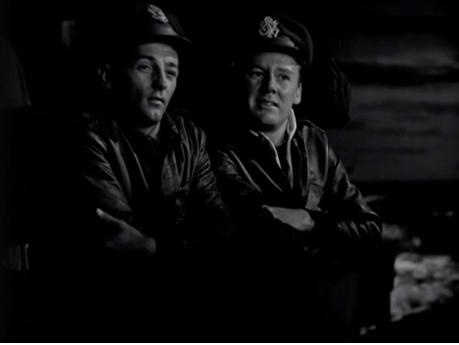
Robert Mitchum and Van Johnson share a most curious conversation lounging on the prow of the boat, staring off into the darkness. One can only imagine it is screenwriter Dalton Trumbo speaking — not in propaganda but humanity.

First, Johnson offers up how his mom had a Jap gardener once who seemed like a nice fellow. Mitchum says he doesn’t like ’em, but he doesn’t hate ’em either. They agree you get mixed up sometimes. Where are they going with this meandering interchange?

The answer: Trumbo’s brand of what might be most precisely termed “American progressivism.” Some rationale must be proposed for what is at hand and so he does his best. Though it foregoes demonizing the enemy, it takes an alternative path with the same conclusion. It’s the most rational progression. Drop a bomb on them or they’ll be dropping a bomb on Ellen or loved ones like her. It’s highly practical even as it remains problematic.

30 seconds over Tokyo 3.png

Still, the gears are turning. They have their final briefing with Doolittle and agree to meet in Chungking for the biggest party they’ve ever seen. In reality, the moment of truth really does feel like little more than thirty seconds. When they hit the mainland a flurry of Japanese Zeroes fly over, only to pass them by without notice, moving on with their normal patrol. It’s a lucky break.

They end up dropping their loads on the designated targets with efficiency. It’s the aftermath where things get a bit dicier, not so much due to the enemy but weather conditions. The Ruptured Duck is forced to bail out, sustaining injuries, and rescued by Chinese locals under bleak conditions.

Though poorly resourced and kept on the run by impending Japanese, the Chinese are held aloft as loyal Allies ready to aid in this joint cause against the Japanese. It becomes so intriguing how they become such sympathetic figures. Two close-ups come to mind. The Chinese characters are not kept at arm’s length. We are given a chance to study their faces. It’s maybe not a lot, but it’s something. The juxtaposition between the Chinese station versus the Japanese is made supremely obvious.

So while Thirty 30 Over Tokyo has understandably been lauded for a certain level of historical accuracy, there is still a necessity to parse through its stances as a cultural artifact. Like any film, it is a product of its times and a tribute to the minds behind it, whether Mervyn LeRoy or Dalton Trumbo. Each man no doubt had his own agenda, be it bugetary or ideological.

To that point, the picture is framed by a corny romantic crescendo that’s difficult to take seriously. Otherwise, it an intermittently rewarding portrait of a specific time in WWII history. It’s difficult to remake a movie such as this without losing some of its inherent credibility.

3.5/5 Stars

Classic Movie Beginner’s Guide: Katharine Hepburn

I’m back at it again with a new Beginner’s Guide where we take a famous person and make their lengthy career manageable by picking 4 films to watch in order to get your feet wet. Here’s a jumping-off point for Katharine Hepburn.

I make a point of not quantifying actors by how many awards they’ve won. Still, she did win 4 Oscars! There’s little else to say. She was a gem.

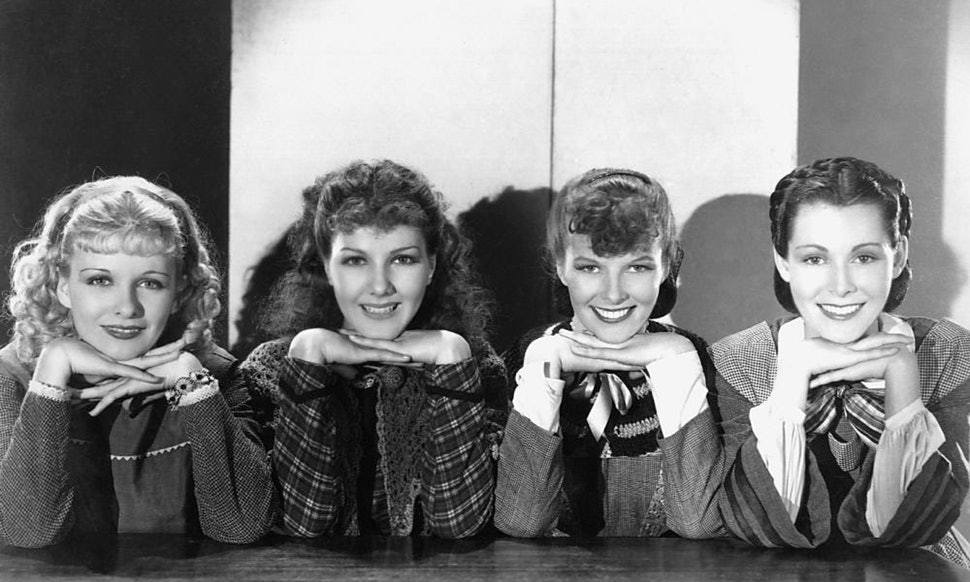
Little Women (1933)

Image result for little women 1933

I’m partial to this film because Hepburn exudes all the attributes of Jo March for me. The cast is a fine array of young talent and if you have any attachment to Louisa May Alcott’s material, it’s hard not to appreciate the antiquated candor of this one.

Philadelphia Story (1940)

Image result for philadelphia story 1940

It’s almost old-hat to mention Katharine Hepburn was considered “Box Office Poison” at this time in her career (after “failures” like Bringing Up Baby and Holiday). So, of course, I mention it. But Philadelphia Story reestablished her and to this day remains one of her finest vehicles. With director George Cukor, James Stewart, Cary Grant, and Ruth Hussey, what could go wrong?

The African Queen (1951)

Bogart and Hepburn. It’s about as indelible a pair as you can get onscreen. They hardly disappoint in this character piece by John Huston setting the two seafarers off on a conflict-filled adventure through the swamps aboard the titular vessel. As a side note, it’s rather reminiscent of Heaven Knows, Mr. Allison featuring two other luminaries.

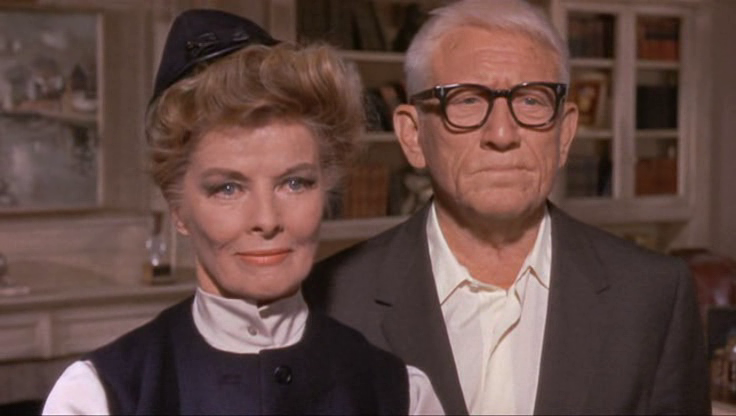
Guess Who’s Coming to Dinner (1967)

Related image

It’s as much an ending as a beginning. Hepburn was well-known for her on and off-screen romances with Spencer Tracy who was deathly ill. This film would be his last and capped off a partnership that included the likes of Woman of The Year and Adam’s Rib (On second thought, go watch this!). There’s so much history there and they work wonders together one final time.

Worth Watching:

Stage Door, Summertime, The Lion in Winter, On Golden Pond, and so many more!

Bad Day at Black Rock (1955): Spencer Tracy and Small-Town Bigotry

Review: Bad Day at Black Rock: Japanese-Americans and Small-Town Bigotry

In its theatrical cut, Bad Day at Black Rock opens furiously, charging forward with the momentum of a freight train as the credits roll and Andre Previn’s score thrashes in the film’s most manic moment.

From thenceforward, its greatest strength is restraint. The whole town cowers around watching the train arrive with a mysterious one-arm man named Macreedy aboard. If the mysterious out-of-towner isn’t enough, it might also be the fact they haven’t had a visitor for well-nigh four years. This is big news but they aren’t looking to be neighborly. The local observation from the train conductor is telling:

“Man, they look woebegone and far away.”

“I’ll only be here 24 hours.”

“In a place like this, that can be a lifetime.”

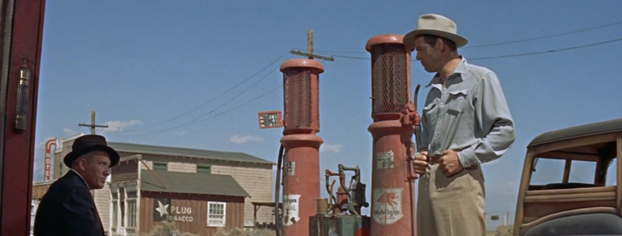
The opening minutes not only set up our character but this impeccable environment for accentuating the underlying unfriendliness. The wide-open spaces of Lone Pine, CA are as much about the vast planes created between people as it merely breathtaking landscape. Because it’s gloriously austere, and it’s completely evident we really are off the beaten track.

Spencer Tracy might seem an odd choice, given the traits of his character; he seems too old and overweight to be a recently discharged veteran of WWII, especially since the year is 1945. And he’s hardly a western hero or an action star in the commonly accepted sense. A film like this would normally call for a hybrid between Joel McCrea, Gary Cooper, or Clint Eastwood.

It borrows from westerns and noir, but I hesitate to label it as either. Because it has near revisionist outcomes and a palette more akin to large-scale epics than B-level entertainment. There’s really nothing else I can think of with such a fascinating and simultaneously confounding pedigree.

Macreedy is intent on visiting Adobe Flat, but he seems like a genial fellow. It’s everyone else who loiter around menacingly. They’re either outright brusque like, the local hotel clerk, or pushy folks who ask him straightforward-like what he wants around their town.

bad day at black rock 2.png

In certain terms, Black Rock is the epitome of rural America — with a sinister twist. It’s smaller than small. Everyone knows the business of everyone else. But these folks are about as tight-lipped and inhospitable as anyone ever in the history of humanity when it comes to outsiders. What’s more, they have little reason to be unless they have something to hide. Of course, they must be covering some secret, but we don’t know quite what it is. There we have our movie.

The beauty of the story is how it plays close to the vest on both accounts. Because Macreedy seems to be in no hurry to broadcast his news all around. Simply the fact he has come to town at all seems like enough. He finally does let his business come out talking to the local sheriff (Dean Jagger), another very gracious fellow in line with all the others. Macreedy is there to see a man named Komoko. The name is a tip-off for some. He is Japanese and we are sitting on the tail-end of WWII.

It recalls the quote always attributed to Hitchcock: “The thrill is not in the bang but the anticipation of it.” John Sturges, while known for action films, does such a measured job of stretching out of the tension of this picture. It gets to this unbearable high deserving some sort of release.

bad day at black rock 5

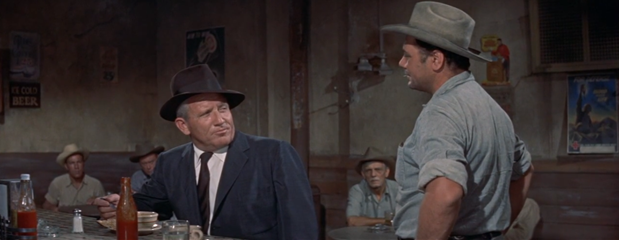
One could say it happens in the diner. Spencer Tracy is working on a bowl of chili, only to get needled by Ernest Borgnine. First it’s a squabble over a chair, then it’s a bottle of ketchup being poured into a bowl of chili. It’s a maddening scene of belittling, but Spencer Tracy takes everything in stride with the finest brand of mild amusement. Everything slides off his back. The following interchange is representative:

“You’re a yellow-belly Jap lover, am I right or wrong?” – Coley Tremble
“You’re not only wrong, you’re wrong at the top of your voice.” – Macreedy

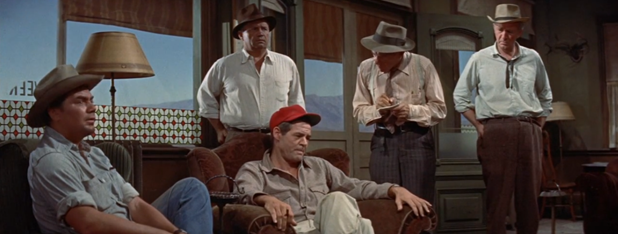
Robert Ryan and Lee Marvin are lounging around to watch the show. Up until this point Macreedy has kept his cool and one might say he walks out as calmly as he came in, but he also exerts himself like he has yet to do. It’s a cathartic moment and as an audience, it gives us an unalienable belief in our hero. We wanted to believe he could hold his own implacably and he can. But the forces against him are nevertheless stifling.

We get the final piece of vital information. Macreedy came to town because of Joe Komoko, who died in Italy saving the life of his brother-in-arms. Forever in his debt, he thought the least he could do was pass on a medal and his condolences. It’s gratifying to have it spelled out, but the bottom line is still the same. Tracy is all but trapped without any outside assistance.

His only chance is some inside help — someone who is willing to do something right for a change, instead of turning a blind eye. The closest he finds is in the local doctor/undertaker (Walter Brennan) who gives his best half-hearted attempt to help the stranger.

Meanwhile, the town’s poor excuse for a sheriff (Dean Jagger), who spends his days nursing the bottle and his nights sleeping in his own jail cell, finally feels compelled to take a stand. His behavior strips him of his badge. The final reluctant players are the tight-lipped hotel clerk and his young sister (Anne Francis), who both aid Macreedy begrudgingly. In a town like this, each action seems nearly monumental. One questions if it is enough.

I challenge anyone to stack the movie up against most any cast of the 1950s, especially because this is not some grandiose epic. This film clocks in at a mere 81 minutes of film, but it has more than enough to go around. Robert Ryan, in particular, is a crucial piece. He always gets these roles as militant bigots and in one sense you feel bad for him and in the other, he’s so convincing at it you can understand why.

His blatant malevolence briefly hidden under a thin exterior is the perfect foil for Tracy to bounce off of. Because they share conversation civilly enough, but it all draws out how diametrically opposed they are. Macreedy got it in Italy. Smith tried enlisting straight after Pearl Harbor but wasn’t accepted.

We come to understand his view of humanity is cut-and-dry. Komoko was a lousy Jap farmer. Pearl Harbor and Corregidor. They’re all the same. There’s no such thing as a loyal Japanese-American. Its this type of rhetoric we must immediately be wary of. For it is pernicious.

At his first chance, Macreedy decides he should get out of town since he’s hit a dead-en, attempting to notify the state police on his way out. He bumps into another bystander, the squeamish telegraph officer Hastings, who excuses himself by saying, “I’m just a good neighbor.”

Of course, as Macreedy suspects, his definition only stretches to those who share his skin tone. He is yet another problem character. Because he has no guts and if I indict him then I am indicting myself as well. There is no place for wishy-washiness with such issues.

bad day at black rock 4

Bad Day at Black Rock, personally, is an important film for me because, like Daisy Kenyon or The Steel Helmet, it stands as a record of Japanese-Americans place in a polarized society. There was injustice done, and it’s not something we should try and forget. The acknowledgment alone is a victory and yet another important record in the annals of visual history.

However, getting beyond, this thriller is ultimately about a hero who is doing his best to honor another man — of course, he happens to be Japanese-American — but most importantly he is given the dignity and the respect of a human being. Because there is no greater love than a man laying down his life for his friends. Even if we never see Motoko, or his deceased son in person, their presence over the film is still felt, and it’s meaningful for me. The implications are that he matters as not merely an innocent citizen but a sacrificial hero for the sake of our country.

It manages to be universal. Because Black Rock could be the stand-in for any such towns. In this particular instance, it’s about a Japanese man. But in other stories, he could be any marginalized individual. The hateful frenzy of The Red Scare is too fresh to disregard any type of allegory in that context.

This type of bigotry and incensed racial (or political) hatred is not a thing of the past. It disadvantages many types of people by conveniently terming them “other” from the accepted subset of society.

What always fascinates me in history and in the stories we excavate is finding the people who faced this abhorrent reality and willingly pushed against it. Still, others initially accept it with apathy. It’s the path of least resistance. However, even they are forced to make a stand, lest they continually bury their conscience and grow miserable.

Bad Day at Bad Rock is about precisely these types of people, and it takes all sorts. So the beauty of it is that we can enjoy its utter intensity and the mystery at its core. It keeps its secrets close and only divulges them at opportune moments. The dialogue too is sparse and measured.

But seething under the surface is a commentary framed by a none too flattering portrait of America. It stands as a testament to fear leading to hate and hate leading to violence. There’s this sense of full-blown conspiracy and holding onto each other’s secrets because we’re all implicated.

If we are to break the chain, it’s imperative to band together in opposition and bring all those dirty secrets into the light. The greatest gift Spencer Tracy gives to this picture is not brawn but the unwavering sense of integrity — in his acting and in that iconic face of his. In a world of shady two-timers, his candor is something we can trust.

4/5 Stars

Boom Town (1940)

boom town 6.png

Clark Gable was anxious to do a movie about oil — wildcatters as they call ’em — because his father had been an oil man. Of course, MGM was looking to put him in such a picture too and when a certain story was published in Cosmopolitan it would prove the inspiration for Jack Conway’s Boom Town.

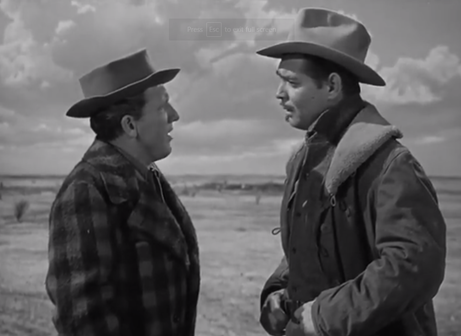
The most obvious attraction to this picture then and now is the copious amount of star power. We already mentioned MGM’s beloved Gable but Boom Town has Spencer Tracy, Claudette Colbert, and Hedy Lamarr all readily available. This would be the two men’s final film together out of three outings. It’s not so much that they didn’t like each other but the fact that they were both formidable attractions and Tracy was starting to command top billing.

In an industry consumed with A-list and B-list stars, MGM didn’t quite know how to go about keeping them together and so they never appeared in the same film again. I can’t say that it leaves me heartbroken.

They meet on a plank crossing a muddy mining street. Whether it was purposeful or not you can’t help but recall the fateful meeting of Robin Hood and Little John. Except these two men share the same name. The local saloon keeper christens them Big John (Gable) and Square John (Tracy) respectively. They’re none too amicable at first but after a bar brawl that looks more like lawn bowling, they’re pals enough. Those type of things builds camaraderie in hard-bitten men like these.

Soon enough they are going halfsies on a piece of land “Shorty” has been aiming to drill on. Frank Morgan isn’t much help as the begrudging equipment salesman and so they take matters into their own hands. A lovable Chill Wills plays a drawling Sheriff with a penchant for cookbooks and a decent shot with a rifle.

The film could have been a gusher laden with drama but most of the blasts of energy are few and far between hidden under layers of good luck and hard luck, romantic interplay, and the ever-changing tides of the oil business. Some of these themes would be echoed again in works like Giant (1956) and There Will Be Blood (2007).

The most rewarding scene by far is watching Gable and Tracy brawl it out in an office. By now they’ve both been big men who have known both failure and success. But this strips everything down to the two of them and the woman caught between them.

boom town 8.png

I must admit that Hedy Lamarr’s part is rather uninteresting — little fault of her own — though most would note that she is as alluring as ever as the ingenious socialite and serial eavesdropper who helps McMasters take over the New York market.

Claudette Colbert is compelling enough in a role that reunites here with her It Happened One Night (1934) leading man, though the role was written initially for Myrna Loy and there is an innate sense that if she could have repeated her spectacular turn in Test Pilot (1938), this picture now transplanted to the oil fields would have been better for it. As it is Gable and Tracy do seem to command most of the attention. After all, this is really their story as we watch them rise, fall, and come back clawing again and again.

The final big moment, however, goes to Tracy standing up at the witness stand and even though he and McMasters have long since parted ways, pushed each other out of business, and even come to blows, he still manages to exonerate the man of any wrongdoing.

Because if nothing else they are both oil men with ideals of what the country might be if we take care of our limited resources for our children. You might call “Hogwash” but it’s a nice sentiment anyways and as usual, Spence delivers it with his typical candor that silences any naysayers. However, one wonders what the picture might have been if Colbert and Lamarr were given a bigger stake.

3/5 Stars

Test Pilot (1938)

test pilot 1.png

Test Pilot is a fine piece of time capsule filmmaking and there’s little doubt that the film showcases a dizzying array of airplanes that we very rarely see today. In that sense, it’s an aerial picture with some truly dazzling footage.

By 1930s standards, this is also an action picture, a sprawling exhibition that simultaneously has a pretty thin story in some patches. In fact, it’s too long for its own good. But it’s a character drama as much as an aerial show, which takes precedence over anything else, narrative included.

The screenplay was forged by Howard Hawks (who worked on several other flight films) and a whole host of others. Its overall success is not necessarily in any amount of tension that is created or a certain brand of visceral storytelling though there are undoubtedly some emotional moments, the brunt of the heavy lifting comes from the cast as they articulate the beats of the script.

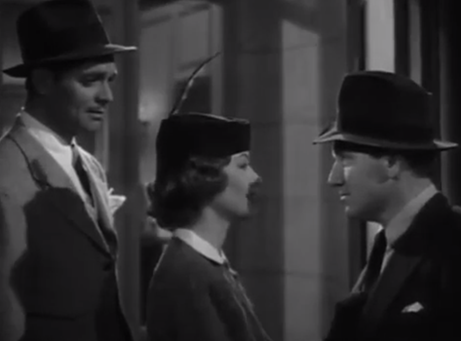
It’s true that under veteran director Victor Fleming and a cast including Clark Gable, Spencer Tracy, and Myrna Loy, it’s difficult to find a more prestigious partnership out of MGM in the 1930s. This was pretty close to tops. Still, even in this dynamic, there were foreseeable problems. Spencer Tracy has a bit of a thankless job playing the faithful mechanic Gunner Morris, the character who is there to support his friend and he conveniently never gets the girl.

You can understand why Tracy could get a little tired of such roles because there’s no doubt that Gable is in one sense the main attraction as the eponymous “Test Pilot” Jim Lane. He was the great movie star of the age.

test pilot 3.png

However, Tracy was the acting powerhouse of the two and that’s the chafing at work once again in this picture. The stellar personality and the quality talent seesawing back and forth. Except Tracy’s stock had been rising year after year and by now he was a solid draw in his own right. It’s evident that he’s a formidable third wheel in the picture though he had his sights set on something slightly more gratifying.

In fact, he’s nearly invincible. Gable famously implored “Spence” to go ahead and die already because the actor milked his last words for all they were worth. However, even if this jousting match between the two male stars is most visible, out of the three I think Myrna Loy comes away having the most fun and getting the most out of the picture. It’s completely understandable why she cherished her work here.

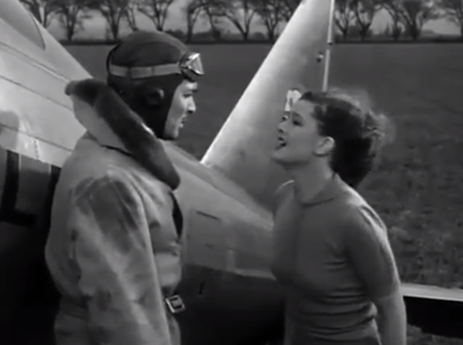
She is the Kansas girl who has her head in the clouds like a ditzy farmer’s daughter watching as a man brings his plane down on her family’s land. He’s simultaneously an ungrateful lug and her shining knight. There’s something whimsical and wholly uninhibited about her that lets her meet a grouchy pilot out in the pasture with a wit of her own and yell her head off at ballgames like a seasoned fanatic.

Her performance runs the entire gamut from near screwball antics to deep heartfelt emotion. The dimensions there are at times difficult to read — even enigmatic. I think that’s why Jim falls for her. She’s in some ways just as tantalizing and fascinating to him as the air above.

Test Pilot also examines tragedy of such a pioneering and devil may care lifestyle — themes that Douglas Sirk would streamline in a picture such as Tarnished Angels (1956). Here we get the alluring frolicking fun of going where no man has gone before until it is tapered by the stark reality at hand. Icarus had the thrill of his life but it’s possible to fly too high or for your engines to blow out or for your instruments to fail. It’s a part of the lifestyle that pilots come to accept. They take the risk because the skies call out to them so earnestly. It’s their obsession.

Jim is one of those who has always followed that call. His story is really about his romance with two women. His wife waiting for him on the ground and the blue heavens which call out to him from above. It takes a reality check ripping something so dear away for him to realize he doesn’t mind being grounded. It was the one thing he swore he would never do and yet, in the end, he gladly does it.

3.5/5 Stars