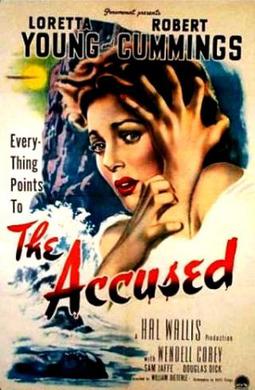
The Accused (1949)

Loretta Young must own a pair of the most luminous eyes in the history of Hollywood, and in black and white, she’s incandescent. More important than that, she’s one of the great sympathetic heroines of Classic Hollywood. In The Accused, she plays both a woman in danger and a working professional. They don’t have to be mutually exclusive, and it makes for a far more nuanced character, especially for the post-war 40s.

Like poor Ida Lupino in Woman in Hiding, we meet her in the dead of night on the road. It’s evident she’s frantic and on the run from something. She gets picked up by a truck driver, though she’s not much for conversation, and he lets her off without much consequence.

A flashback introduces her pre-existing life as Dr. Wilma Tuttle, a professor of psychology at an unnamed university in L.A. It’s finals week as students take their exams and classes wind down.

We get an inkling of drama as we watch the wordless interaction between the fidgety teacher with a leering male student, mirroring her every move and, no doubt, turning in a Bluebook analyzing her own personal psychoses from biting on pencils to tugging on her hair. It’s a queasy relationship because, although she’s in a position of authority, she also seems helpless to do anything.

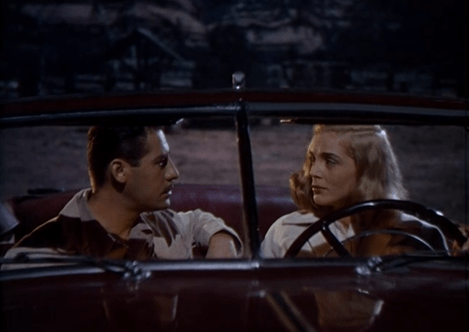
Douglas Dick does well as the slimy, if charismatic, co-ed who looks ready to entrap his teacher; he’s a kind of skeevy-eyed homme fatale playing teacher’s pet and coaxing his favorite instructor along — first offering her a ride home and then stopping by the seaside in Malibu.

Without using too much equivocation, it becomes a movie about assault and trauma, with the feminine victim becoming the accused, much like Anne Baxter in Blue Gardenia. There needn’t be a movie, but in the 1940s, she operates out of a position of fear in a predominantly male world.

Wilma’s internal monologue gets a bit oppressive, becoming a monotonous crutch, but the cavalcade of performers who come alongside Young are a worthwhile reason to stay the course. Robert Cummings and Wendell Corey aren’t showstoppers necessarily, and still, they have the prerequisite appeal to see them through the career of a reliable actor in Hollywood.

We meet lawyer Warren Ford (Cummings) and Lt. Ted Dorgan (Corey) together at Malibu police headquarters. The former was the boy’s guardian, and the policeman is investigating the case. After the boy’s body washed up on the beach, it was deemed an accident and no foul play.

No fingerprints were found in the car. Immediately, as an audience, we’re doing our mental calculations. Could this be, or is it merely a glaring plot hole? I’ll save you the trouble. Young was wearing gloves as a true lady does in the 1940s. Or else she wiped them…

The film’s asset comes with how it ties all of its primary relationships into twisted knots, all in the name of interpersonal tension. Warren has some personal connection with the deceased, but he quickly becomes enamored with the lady professor, and why wouldn’t he be? They effectively mix work and play, with Cummings being the smooth silk to Corey’s abrasive sandpaper approach.

In its latter half, The Accused becomes a Columbo episode from the inside out. We have our Hollywood star. There’s an opening prologue before the police get involved, and she falls in love. She also begins to feel trapped by what otherwise would be everyday occurrences as she tries to protect herself and cover her tracks.

One of her pupils is a primary suspect. She’s also requested to drop off the dead boy’s Bluebook, which might incriminate her. The truck driver who picked her up in the dead of night is called in as an eyewitness. Then, there’s the business of a missing note that she left for the dead boy and then misplaced. She must find and incinerate it.

Corey’s character is difficult to read. There’s something horrid about him, far worse than his incarnation in Rear Window, and yet he tries to play it off as an act or all part of the game he’s embroiled in on the daily as he does his job. It’s a bit of a curious surprise to see both Henry Travers and Sam Jaffe taking up positions in the police lab. There’s a rational inevitability about the work they do.

Wilma feels the heat, and a date at a boxing match brings out all her latent traumas to the surface again as she transposes the boxer in the ring with the boy she killed. In one sense, there needn’t be a movie because she is a victim, though she digs a bigger hole for herself.

Ultimately, the movie’s denouement is open-ended. The courtroom proceedings are just beginning, and her fate is far from settled, but as we stare into the dazzling eyes of Loretta Young, it’s easy enough to know she will beat the rap with a hedge of innocence around her.

If you dwell a little too much on the implications, the optics that Dorgan also observes might be a flaw in the justice system — if sympathetic appearances are taken as everything. However, in a movie about a woman who is assaulted and then plays the culprit out of fear, it’s at least par for the course.

There’s also a couple of oddities: Corey flirts with her in the courtroom, and Cummings is effectively defending her for killing his “nephew,” though they weren’t close. And still, Corey’s impish sense of humor and Cummings’s passionate orations for his beloved don’t change the bottom line.

This is Loretta Young’s movie, and even as she plays an intelligent woman often hassled and infantilized by the world around her, there’s something so winsome and generous about her performance. The noir elements burn off to make it a story of reclamation and vindication of a life. If you go digging, it does feel like a movie moderately ahead of its time, courtesy of screenwriter Ketti Fring and Young, respectively.

3.5/5 Stars

Joan Crawford: Possessed, The Damned Don’t Cry, Harriet Craig

In our ongoing exploration of Joan Crawford and Bette Davis’s filmographies, here are three more films building on Crawford’s renewed critical success in the 1940s after Mildred Pierce (1945) and Humoresque (1946).

Possessed (1947)

Possessed opens with Joan Crawford wandering the city streets past cable cars and hamburger joints with a far-off look in her eyes. Although I should briefly clarify this is Possessed from 1947 (as the actress made an earlier movie with the same title). The unknown woman is searching for a man named David, and instantly we have the pretext for our story.

There’s a  wonderful extended POV shot of Crawford being wheeled into the hospital as she is overtaken by a catatonic stupor, and the doctors try to piece together what to do for her and who she is.

If they’re in the dark, then we at least learn a little bit more about her. David (Van Heflin) was a man in her former life, in love with a piano and a parabola but not ready to marry her. He doesn’t want to be tied down and his ambitions lie in his work and a job up in Canada.

She’s obsessed and crazed with him, and the thought of him leaving her forever. Instead, she resigns herself to a life with her employer (Raymond Massey) who has lost his wife and has sent his kids away to school.  Crawford’s not a villain, but how this relationship blooms, there’s another obvious reference point. It’s apparent how the movie blends and finds itself at the crossroads of Double Indemnity and Mildred Pierce.

As her mental instability takes over, it’s almost as if a scene from Mildred Pierce is playing out in her head as she duels with a vitriolic stepdaughter. However, while this feels more like a facsimile of the prior’s year success, it’s really Hefflin who steals the picture’s other half.

Because Possessed finds Hefllin at his most caddish and cold (“My liver rushes in where angels dare to tread”). He has wit like Johnny Eager, but he’s also willing to run roughshod over Crawford without any amount of remorse. He’s a hedonistic, self-serving creature, and it only becomes more evident when the impressionable Carol (Geraldine Brooks) gets drawn in by his casual wiles.

They get married and Louise becomes more paranoid and hallucinatory by the hour. This movie is bookended by her descent into mental turmoil, and it’s hard not to laud Crawford for her genuine alacrity for the part making the rounds of psych wards and facilities just so she could provide greater authenticity. No matter what feels antiquated to our modern sensibilities, the movie is worthwhile for her performance, which seems to come in sharper relief with each subsequent layer of her ever-shifting personality.

3.5/5 Stars

The Damned Don’t Cry (1950)

The film’s title was ripped from a Eugene O’Neil quote, and it gets at the poetic essence of the movie more than its particulars. When a racketeer’s carcass is found ditched near a desert resort, it sets off alarm bells and triggers a search for a missing oil heiress played by Joan Crawford.

The impetus of her entire existence in the film is summed up in a single scene of definitive exposition.  She lives alongside her husband, parents, and their little boy near the oil fields where her husband works. It’s a meager life. They can’t afford pleasure. And so when she splurges to get their son a bright new bicycle, her agitated husband (Richard Egan) tells her to take it right back.

The bike effectively becomes a vehicle for their marital conflict since they are scrimping and saving just to make ends meet. However, it’s also a token of tragedy in Ethel’s life searing her with wounds she will never forget. She leaves her past behind to make a new life for herself as an individual because her corner of familial bliss looks to be dead.

As the story progresses, it feels like a bit of a throwback for Crawford from the ’30s and her days as a driven working girl making a go of it. She learns quickly how to play the game to get ahead, modeling and then doing some overtime with out-of-town buyers after hours.

Then, she literally meets a man, a CPA (Kent Smith), at the water cooler. She winds up sprawled out on his desk asking for a cigarette and making his acquaintance with her self-assured flirtations. She has some misguided notions about his importance and yearly take-home pay. Either that or she confuses her acronyms.

In other words, he hardly has the money to bankroll the evening he has unwittingly been escorted to. Still, she goes to bat for him putting Martin in contact with some of her other “friends.” It starts out with the men discussing business together behind closed doors with Lorna left in the drawing room withing for their return. It feels oddly uncharacteristic because we know Crawford will get into that room eventually (and most likely dominate it).

George Castleman (David Brian) is the kingpin at the top, an elegant self-made mobster fascinated by art and antiquities. He’s trying to keep his cronies in check, the most headstrong of the bunch being Steve Cochran, who’s running the racket out in California. This is not Martin’s world, but Ethel has gotten him into it, and for the time being it’s lucrative enough.

But with her innate ambitions, Crawford’s character always has her sights set on the next prize. With the help of the society pages, she turns herself into the newly-minted heiress Lorna Hansen Forbes.  Going forward, the movie blends the world of some of Crawford’s Pre-Code working-class drams with that of 711 Ocean Dr., another ’50s film concerned with wires, bookies, mob influence, and of course, California desert getaways.

Here it’s a more hands-on approach. For most of the film, Cochran waits in the wings brooding, but he gets his moment in California with some filming even taking place at Frank Sinatra’s own home made up in mid-century modern. Crawford has them all. The whole crux of the drama is composed of these spokes radiating out of Joan Crawford leading to four men who are attached to her at different times.

It gets so overblown and preposterous, and yet you can’t quite look away because the dilemma is made plain. She’s ingratiated herself with so many people to get what she wants, and since she’s caught between so many options, for the first time in her life, she’s not sure what to choose.

Everything must succumb to a bombastic round of Production Code comeuppance where all retribution is neatly doled out and moral ambiguity is left to languish. It makes for a hearty round of theatrics but also a minor disappointment. Because we’ve seen these tactics used in this kind of forced storytelling so many times before. Still, you can’t take the film’s title away. It’s one for the ages. Moreover, Crawford seems more than worthy of it.

3.5/5 Stars

Harriet Craig (1950)

“How many ways do you lie Harriet?” – Wendell Corey

In Harriet Craig, Joan Crawford plays the quintessential domineering lady of the manor. Before we even see her onscreen she has her whole staff in a tizzy as she rushes off on a last-minute visit to her sickly mother. If we can make an early observation, she’s a bit beastly.

Wendell Corey makes her stand out all the more thanks to his free and easy charm as her husband. He’s rarely been more likable playing gin rummy with the elderly Mrs. Fenwick, a woman of good humor and a light in her eye.

As Crawford’s opening perfectionism slowly burns off or at least is put aside, Harriet Craig somehow gives off the sense of an early sitcom of the era. It has to do with the setting and the world — the way the spouses interplay — and it doesn’t seem like the scenario could possibly boil over into something cataclysmic.

At first, Harriet feels nitpicky and fastidious. These aren’t negative qualities on their own per se, and her husband coaxes out brief moments of good humor. However, it becomes evident how deeply manipulative she really is.

Suddenly Harriet Craig becomes a blatant subversion of the portrait of post-war suburban bliss. Walter is offered a job to work with the company over in Japan. It’s a big promotion, and he’s elated. Harriet finds ways to derail this threatening source of change.

She drops a few intimating remarks to keep her orphaned cousin (K.T. Stevens) and her husband where they can serve her best. She gets snider by the day trying to preserve her life under glass.

One of the few who sees through her is the perceptive housekeeper Mrs. Harold, who has faithfully shared Walter’s family for years, but recognizes just how much Harriet is a canker. Her household is all a sham cultivated by its primary architect: Harriet.

Eventually, her pyramid of well-orchestrated deceit begins to tumble as all her half-lies and casual mistruths are found out. In all her neurotic pride, she’s prepared to rot in that house. The irony of the picture is how she’s tried to control everything — she’s particular about every iota of that place — and now that she’s made her own mausoleum, she has to lie down in it. That home is all she has.

I’ve never ventured to watch Mommie Dearest, and far be it from me to pry the fact from fiction, but part of me wants to know how the core faults of Crawford’s character were indicative of her real self. Part of me likes to believe she intuitively made the role into something that resonated with her, whether she fully recognized it or not.

3/5 Stars

Desert Fury (1947): Small Town Melodrama in Technicolor

desert fury 1.png

The draw to Desert Fury must begin with its intriguing cast running the range of personalities. John Hodiak and Wendell Corey (in his film debut) are driving into town. There’s this sense that their relationship is familiar but they feel like out-of-towners, somehow bringing a ting of noirish sentiment into what might otherwise be a straight-laced picture from director Lewis Allen.

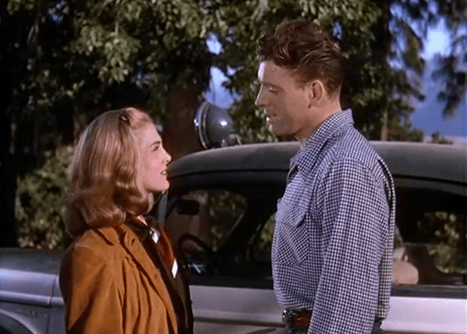
The town was doubled by Piru in Ventura County and the colors of Charles Lang are grand if a tad on the campy side. All the better to serve the visual melody of the film. Burt Lancaster is Tom Hanson, the sheriff in the small town where he happens upon Lizabeth Scott on Main Street, a rambunctious creature of trouble nosing around for romance in her wood-paneled Chrysler New Yorker Town and Country. He warns Paula Haller to watch herself, which she easily laughs off before driving home.

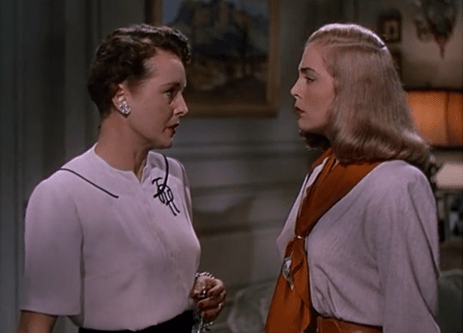
Part of her disposition must be genetic because while they couldn’t seem different, her mother is a very independent-thinking, straight-talker who lays it out like she sees it. Fritzi feels like the toughest dame Mary Astor has ever played — the cocksure proprietor of the local gambling joint — used to throwing around money and being on top of everything, and well-liked by everyone if she can help it.

That being said, she’s hardly the maternal type — in fact, she hardly feels like a mother at all — even as she’s vehemently against Paula following in her footsteps. Because hers is a tough life doing her best to shield the impressionable girl from the same trajectory. Surely, that must be it…

The Purple Sage proves its own self-contained world for the characters to lose themselves in. Our primary players are thrown together again and it never ceases until the final exhale.

Because out of everything Desert Fury can possibly offer, the relational dynamics are one reason to latch onto the film and stick around just to feel out what’s going on and where it possibly could be heading with each character exerting their own pressures on the story.

desert fury 4

Lizabeth Scott could be simpering but with her smoky voice and youthful looks, she always managed to be an enigma. Not always the most engaging performer but somehow she fits the curious makeup of a picture like this. As her mother observes with an inflection of eros, she’s “nice and fresh and alive.”

John Hodiak is generally curt, with an abrupt delivery and whether it’s his performance or his own nature seeping into the part, there’s no nuance or finesse to what he puts out. But as Eddie, he’s allowed the benefit of a past — a past that makes Fritzie wary of any advances on her daughter. It attributes menace to him regardless of what he is capable of offering.

Johnny is his lifelong companion since their youth, protective of him, even jealous for his affections playing as an inversion of Fritzie — as both housekeeper and bodyguard to his longtime associate. But the secrets run deeper still.

What A.I. Bezzerides and Robert Rossen’s script evolves into is this kind of tug-of-war with Paula acting as both the object of desire and the token with which to play out these feuds and affections. She gladly honks and smiles her way into all sorts of conflicts, driving her town car with a cavalier daring from the very beginning. Her sheer impetuousness propels the story.

She’s drawn to Hodiak, and he’s enchanted by her, showing her the door in another instance only to instantly revert back again to his charmed infatuation. It’s a tumultuous if moderately intriguing bedrock for romance.

Because Lancaster is invested in her too, warning against association with such a character. Whether it’s on account of her personal safety or his own guarded affections feels immaterial. Even as Fritzie offers a pact — land for the hand of her daughter — the proud lawman balks at the offer because he wants romance on his own terms.

desert fury 2

Fritzie knows where he stands but even she doesn’t get it. One evening Lancaster walks into her office searching and yet keeping his cards close to his chest. It’s as if he’s letting her try and figure it out.

Meanwhile, Paula and Johnny have their own strange war playing out over Eddie colored with its share of passionate kisses, flying fists, and slaps of disdain. The incendiary couple ignites most of it.

However, what’s even more important is what is alluded to not simply off-screen but from each individual’s past personal dosier and shared history. They know one another out of the confines of this hour and a half. The ensuing array of heightened dramatics and supposed revelations are nothing unusual or unforeseen on their own.

It’s the observable action speaking in the final stretch (along with the theatrical Miklós Rózsa accompaniment) with cars barreling down the desert highway in hot pursuit of one another.

It’s a Hollywood denouement — hardly a reinvention of themes from love triangles to shadowy pasts — but the melange of performances and the slight subversions teased out speak to something. Where the final kiss is not between Lizabeth Scott and her alpha male but with her mother.

While not a moral tale,  it’s a movie voicing the tangled, clouded, dysfunctional relationships plaguing a small town — and the world at large. The guise of  Technicolor melodrama is a fitting pretense.

3/5 Stars

The File on Thelma Jordon (1950)

the file on thelma jordon

There is arguably no director who is, in retrospect, more important to the film movement that became classified as film noir than German emigre Robert Siodmak. His name isn’t quite as well known as the Billy Wilders or Fritz Langs necessarily but one can contend his influence on this style is without equal.

While not his greatest achievement, The File on Thelma Jordon is yet another example of the man’s proclivities for deliciously shadowy melodrama which, while not always plausible, is more often than not incessantly intriguing.

In this particular case, we are involved with a local district attorney (Wendell Corey). He is a man who loves his wife while not being too fond of her overbearing father. In fact, Cleve conveniently stays away from home whenever the in-laws are around. It’s certainly complicated his marital relationship as of late.

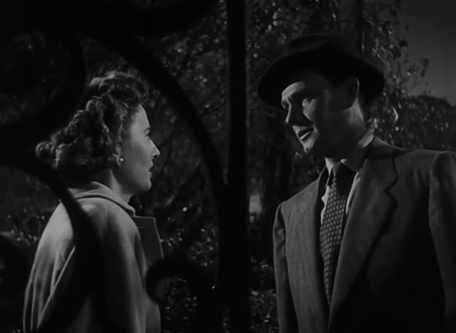
One such night he stays at the office to knock a few back only to cross paths with a Ms. Thelma Jordon (Barbara Stanwyck) who mistakes him for someone else as she recently inquired about protection for her paranoid aunt — a woman fearful of burglars. On the verge of a real bender, he invites her for a drink and they spend some time together. She’s just what he’s been looking for to fill the void in his life.

Meanwhile, his wife is going away with the kids for a summer at the beach house and he hates to see them leave; he really does. Maybe he knows deep down they are slowly drifting apart and his urges to see the other woman are all but insurmountable. He can’t fight it much longer. There used to be someone — an estranged one-time husband named Tony — but he’s purportedly no longer around. Cleve brushes him off and they keep seeing each other whenever possible.

But their relationship hits a dramatic turn one evening. She calls him up in the thick of night and he comes at her beck and call. They slink in the shadows as she breaks the news to him. Her aunt has been killed by an intruder; the old woman’s worst fears coming to fruition with priceless jewels being stolen from the safe.

The situation is complicated by a frantic Thelma who panicked by altering the crime scene and failing to call the police. Now the man across the road has his interest piqued and comes over to investigate. In the heat of the moment, they must hastily cover everything up as Cleve rushes out of the window and Thelma feigns sleep. It’s all part of an intense interlude coursing through the middle of the picture making the collective heart of the audience pulse with anxiety.

What follows is a murder inquest and then a trial with Ms. Jordon standing as the defendant. She’s got herself a stone-cold and exacting lawyer who could care less about her guilt or innocence. In his mind’s eye, she is innocent and that’s how he plans to win her case regardless.

Meanwhile, Cleve gets put in a very sticky and uncomfortable situation as he finds himself made the prosecuting attorney on the case. As the two sides try to legally sway the jury, the identity of a mysterious Mr. X still swirls around the case, and Cleve tries everything to throw the case in the most indirect ways possible. It’s a perilous balancing act where he will lose something regardless. Siodmak milks it for all its tension as the frenzied proceedings press on with the media jumping on it like ravenous wolves. Someone’s got to be a fall guy. Stay the course and you might be surprised in how the case resolves itself.

Wendell Corey could always be called on for steady and at times wry support but that being so, it’s refreshing to see him in a substantial leading role playing opposite a true professional. They work capably together as the story relies mostly on their two performances.

Barbara Stanwyck is great when she’s bad. Phyllis Dietrichson is the epitome of this fact, remaining one of the crowning achievements of her career. Though a lesser-known incarnation, Thelma Jordon is worthy of some notoriety in her own right.

However, the sublimeness of Stanwyck here is how she never really feels slimy or full of guile, even in the stages when the books are all but closed on her case and we get a fuller picture of who she is. The whole time we are kept constantly guessing and fluttering this way and that in indecision. More than once she surprises us.

The trick to a femme fatale like herself is never consciously deciding to be destructive. She’s doing what she personally believes to be right even if it’s due to a lapse in judgment or an impending sense of fear. I’m sure there was some greed in there too but we all harbor a little bit deep in our hearts somewhere.

So though it ends with a malaise that can only be film noir, there is some sense of rightness in the way everything goes down. It’s not to say there’s not a bite to the picture. When the file closes on Thelma Jordon two lives have been deeply affected forever with far-reaching repercussions. There’s no changing that.

3.5/5 Stars

Sorry, Wrong Number (1948)

sorry wrong number.png

“In the tangled networks of a great city, the telephone is the unseen link between a million lives…It is the servant of our common needs — the confidante of our inmost secrets…life and happiness wait upon its ring…and horror…and loneliness…and…death!!!” ~ Opening Prologue

Sorry, Wrong Number is a fairly unique adaptation in that it came into being from a radio play written by Lucille Fletcher, successfully realized for audiences as essentially a one-woman production by Agnes Moorehead — a fine actress in her own right. Director Anatole Litvak does an extraordinary job of making this film version tense and certainly cinematic, as it cannot function in the same ways as a radio show if it is to be similarly effective.

Like Rear Window (1954) or Wait Until Dark (1967), the suspense in the film comes with being constrained in a space with no way of escape from an impending intruder. It’s little surprise Barbara Stanwyck is divine offering her typically captivating performance even if, given her usual predispositions, she hardly fits the helpless wife archetype. Being the professional that she is, there’s no doubting the ferocity of emotion within her. To use a hopelessly corny pun, she hardly phones in her role as Mrs. Stevenson, the bedridden wife of a husband who just cannot seem to be located.

Though still young, Burt Lancaster brings the screen presence that made him a mainstay of early film noir. Still, he and Stanwyck somehow seem ill-paired as husband and wife. One could contend that works nicely into the plot as their marriage is essentially one-way, becoming increasingly loveless as more of the picture is revealed. She wants him and her daddy has the money to make the world spin. It’s not romance. It’s a business transaction.

So although Harry Stevenson (Lancaster) is initially going with another gal (Ann Richards), soon enough Leona’s got him. They get married and he gets a job working under the father-in-law but he feels his hands are tied with no real prospects of making anything of himself. He’s not content with this kind of lifestyle. He has ambitions of his own.

One might suspect he’s finally had enough and left his wife for good. Of course, part of the fun is that the story is pieced together through different characters recounting events, done through voiceover fragments. It becomes a kind of compulsory game we must play along with.

First, it’s Mr. Stevenson’s secretary who recounts the woman who came to his office with something urgent to talk about and it piques Mrs. Stevenson’s suspicions. Then, she gets in contact with the old flame named Sally Hunt Lord who is now happily married to a District Attorney. Nevertheless, she was worried that Henry might have been mixed in something awful, even tailing her husband and trying to get at her old beau to uncover what might be the matter. It’s all very mysterious.

Next Leona breaks up her Doctor’s (Wendell Corey) dinner engagement only to hear more of the story and how her husband kept the doctor’s prognosis from her. By this point, we’ve gotten in so deep that we have layered flashbacks. Only in noir, and we still have yet to stitch the entire convoluted mess together.

The last crucial figure is a specter of a caller named Waldo Evans who actually turns out to be a kindly old man caught up in the racket that Stevenson’s been promoting. The script doesn’t give us much to go on based on the restrictions of the production code but it has to do drug trafficking. That much is almost certain.

By this juncture, we’ve almost forgotten William Conrad was in the picture but he shows up right where you would expect him in the thick of something big. As she’s put through the ringer of psychological duress, trapped in her ominously vacant home, Stanwyck’s absolutely maxed out on the intensity.

Admittedly it does feel like two pictures told in tandem and spliced together. Stanwyck headlines what we might term the “woman’s drama” while her husband is embroiled in a shifty noir replete with the murky shadings of a criminal underworld. Of course, Lancaster is remembered for his early pictures like The Killers (1946), Brute Force (1947), and Criss Cross (1949) which share some nominal similarities.

Sorry, Wrong Number showcases an icy ending that was nearly unexpected for not only how abrupt it is but also how very unsentimental. To say more would give it away outright. Flaws readily acknowledged, Sorry, Wrong Number is a noir worth making time for as it builds tension to a fever pitch and obscures its hand behind minute after minute of methodical voiceover. When we’ve finally caught up with the events rumbling forward in real time, it’s too late to do anything and before we know it, everything’s already come to fruition. One might call that an adequate success in the storytelling department.

Due to its histrionics, the picture was ripe for parody. In fact, Barbara Stanwyck was featured on a segment of The Jack Benny Program in 1948 using extensive recordings from the film only to have Benny wind up in much the same mess. And of course, there’s Carl Reiner’s noir sendup/clip show starring Steve Martin, Dead Men Don’t Wear Plaid (1982). It’s all in good fun.

3.5/5 Stars

Review: Holiday Affair (1949)

holiday affair 1.png

Holiday Affair might be a bit of an oxymoron as far as Christmas movies go. It’s not too far off the truth to christen it an old-modern Christmas classic, at least depending on how you define your terms.

It’s a Christmas picture that has all but sailed under the radar since its original release in 1949 though it has, rather recently, gained some modest recognition around Christmastime. Given Robert Mitchum’s normal workload for RKO, it feels like an outlier in comparison with most of the dramatic or noirish crime fare he was usually expected to star in. And part of this might have been due to circumstance — circumstance that might also explain why this picture wasn’t such a big hit.

Mitchum was fresh off his famed drug bust for narcotics possession which ironically, far from killing his career, managed to project his image as a bad boy and a major box office draw. But Howard Hughes wanted to try and soften his image and the picture in the pipeline was Holiday Affair. It’s certainly not what we are normally accustomed to for a Mitchum vehicle. Contemporary audiences might have concluded the same.

In earlier iterations, the film was slated to star the intriguing cast of Montgomery Clift, James Stewart, and Teresa Wright. In fact, it’s interesting to note Wright could have been in the Christmas classic of two years prior, The Bishop’s Wife (1947) as well. Alas, she did not end up in either picture. Still, that should in no way dismiss what we actually received.

Although visibly quite young for the role of the widowed mother Mrs. Dennis, Janet Leigh makes it work due to a pluckiness and genuine chemistry that buoys her relationships with her on-screen son (Gordon Gebert) and both of her male counterparts (Mitchum and Wendell Corey).

What brings them all into the most curious of love triangles is a momentary interaction at the toy store. Connie Ennis is a comparative shopper a little too eager to purchase a model train and Steve Mason (Mitchum) is the employee on the other side of the counter.

Though he doesn’t say anything, he’s got her pegged. Sure enough, she comes back to return the gift but instead of reporting her he lets it slide — only asking her never to come to his department again. He subsequently gets fired and is back on the streets, biding his time in order to realize his dreams of becoming a shipbuilder in California.

Meanwhile, Connie doesn’t have an affluent lifestyle but perhaps more important than that, it’s a generally happy existence. Her husband was killed in the war, yes, but she and her son Timmy have a tight-knit relationship. They’re truly there for one another. It’s no fluke she constantly calls her pint-sized man of the house, Mr. Ennis. Because it’s true. He is the most important man in her life.

Although there is another man who is hoping for the privilege to become a part of their family. Carl (Corey) is a divorced lawyer who has long made his intentions plain to Connie. It’s just a matter of figuring out if she’s ready for marriage. And he seems like a good practical man to go through life with. Still, that isn’t everything.

Because Robert Mitchum is added to the equation and between both men, Timmy finds Steve a lot more fun and I think it’s reflected particularly well in the relaxed performance that Mitchum gives.

He’s surprisingly compelling in his scenes with the child because, again, he may have the image of a tough guy but when you watch him speak there’s no pretense. He’s not talking down to the kid. He nearly treats him as an equal or at least not in the condescending manner that adults often have. That’s the key.

The rest of the story, including the final act, doesn’t need spelling out. You probably already can gather some sense of what will unfold. But this film is a reminder that predictability isn’t king. Sure, it’s present but there are also a plethora of idiosyncratically enjoyable moments to be relished.

Among other things, they involve gaudy neckties, hobos, salt and pepper shakers, feeding orphan squirrels, and eating with the seals in the park. A delightfully ornery Henry ‘Harry’ Morgan provides a cameo at the Police Precinct that helps draw out some of the film’s more absurd digressions.

There’s a lovely marital toast and an equally awkward confession. But more than any of this there’s the realization of what family might be and what true happiness looks like during the holidays.

In an earlier moment, in typical Mitchum fashion, he taps the lady of the house on the shoulder and proceeds to kiss the surprised Connie before proclaiming “Merry Christmas.” End scene. Or on Christmas morning little Timmy springs in on his mother to wish her a “Merry Christmas” of his own. It’s these little trifles that make this a congenial outing for those craving a bit of nostalgic yuletide cheer.

3.5/5 Stars

Review: Rear Window (1954)

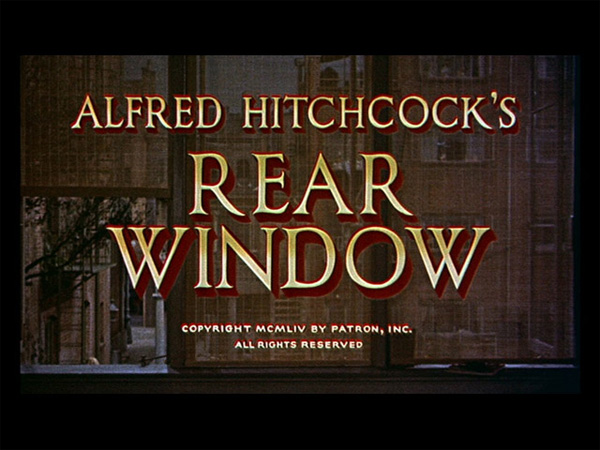
Hitchcock_stills_0006_rear-windowWho in their right mind would make a film that takes place in a courtyard? Rear Window has always been fascinating from a technical standpoint, and Alfred Hitchcock is certainly not “The Master of Suspense” for nothing. He uses the confined space of a single Greenwich Village courtyard with an incapacitated individual to truly build the tension to immeasurable heights. The events within the film are often highly bemusing as Hitchcock has a wicked sense of humor, whether Jefferies is trying desperately to scratch that itch or the conversation turns morbid as he tries to eat breakfast.

The script has so many great little moments of back in forth repartee; some supplied by the always dynamic Thelma Ritter who plays the nurse with a lot of advice and opinions about rear window ethics: “We’ve become a race of peeping toms. What people ought to do is get outside their own house and look in for a change. Yes, sir. How’s that for a bit of home-spun philosophy.

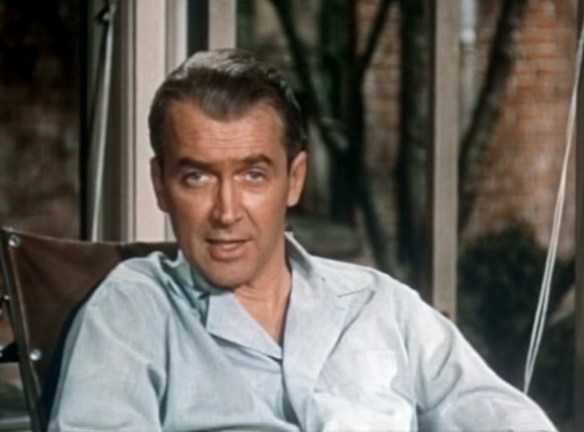
James Stewart is always a pleasure, but this time around he is perhaps at his most constrained as famed photographer L.B. Jefferies, who is laid up in his apartment for weeks on end with a leg in a cast. He got the injury thanks in part to his last big photo shoot where he ran in front of an oncoming race car. With nothing better to do, he spends his idle moments people watching and getting to know his neighbors. That’s one way to put it at least. As an actor, Stewart is stuck and relegated to conveying his whole performance through his gaze and the dialogue he speaks to those few who come in and out to see him. Most of what he’s doing is simply looking across the way and yet it works.

His neighbors are as follows:

There’s Ms. Torso who is an aspiring dancer and always the target of many men. There’s Ms. Lonelyheart who never can find the love she so desires. A washed-up composer spends the entire film trying to figure out his newest project (even getting a visit from Hitchcock himself). There are the newlyweds who hardly ever leave their bedroom because they’re doing something… Then, comes the older couple on the second floor with a cute little dog and the sculptor who lives below.

Most interesting of all is the couple directly across the way from Jefferies’ because that’s where a long-suffering husband and his wife live. All seems normal, to begin with, however, Jefferies begins to have his suspicions thanks to circumstantial evidence and no sign of Mrs. Thorwald. His first thoughts immediately shoot to murder, but it seems highly unlikely. Day and night he continues to watch seeming to get more evidence, only to have his theories crushed, and then gain new hope through more evidence.

James_Stewart_in_Rear_Window_trailerThe interesting part is that as an audience we are fully involved in this story. We see much of the picture from Jefferies’ apartment, because there is no place to go, and so we stay inside the confines of the complex. In this way, Hitchcock creates a lot of Rear Window‘s  plot out of actions occurring and then the reactions that follow. We are constantly being fed a scene and then immediately being shown the gaze of Jefferies. It effectively pulls us into this position of a peeping tom too. Danger keeps on creeping closer and closer as he discovers more and more. The narrative continues to progress methodically from day to night to the next day and the next evening.

In the climactic moments, he finally faces the man who he always looked in at from the outside and yet by the end the roles are reversed with Jefferies space being fully invaded, and yet he can do little to flee, because of his cast. Hitchcock cuts it in such a choppy and chaotic way which breaks with the smooth continuity of the rest of the film, but it works so wonderfully in stark juxtaposition.

This is one of the main appeals of Rear Window because it has this Hitchcockian story of murder, mystery, and suspense. However, I am constantly eager to revisit this story, since there are so many other intricacies that are of interest.

Although the film uses a score by Franz Waxman, the majority of the sounds heard are diegetic and they either are street noises or music wafting around the courtyard from one of the apartments.  Also, there is only one small outlet to the outside world. At times, it becomes fun to survey what is going on whether it is kids playing on the street corner or cars passing back and forth. It builds this sense of realism suggesting that this world that has been created is larger than this one set full of apartment buildings.

Another important element is themes of romance and love. Jefferies comes into the film with issues in his own love life. His girl is the elegant and refined Lisa Fremont (Grace Kelly), who seems perfect, too perfect in his estimation. In his mind, they just don’t seem compatible enough, and he cannot see marrying her. It’s something they have to work through because she truly loves him.

Really every character essentially has a different outlook on love and different struggles, because romance is never an easy thing. Like the lyricist’s song, it is so often fragmented, but in their case, Jefferies and Lisa seem to figure things out just as the song finally gets finished. The moment where you can see it in Jefferies’ face that he is both impressed and worried for Lisa’s safety seems to be the time when things change. He realizes his love for her since she is very dear. He quits his thinking and his analyzing of their relationship, as gut-wrenching emotions take over when she is caught. In a sense, he listens to Stella’s earlier advice: “Look, Mr. Jefferies, I’m not an educated woman, but I can tell you one thing. When a man and a woman see each other and like each other they ought to come together – wham! Like a couple of taxis on Broadway, not sit around analyzing each other like two specimens in a bottle.”

Wendell Corey, in his supporting role as Jefferies’ friend and the police detective, is a man who can be a skeptic and still prove his loyalty as a friend. They can be at odds and still poke fun at each other with mutual affection. It feels real. Raymond Burr as the villainous Lars Thorwald works well too because he is certainly an angry, unfriendly grouch, but he does not seem altogether evil. It shows how easy it is for the lines to be blurred.

rear-window-first-shot-of-gkAbove all, Grace Kelly shines opposite Jimmy Stewart. There’s no one quite like her, so elegant, eloquent, with a touch of playfulness and adventure. She is willing to fight for her man and even go out on a limb for him (ie. breaking into Thorwalds’ apartment). One of the film’s most extraordinary images, out of many, has to be when a shadow covers the face of Stewart as he rests. Then there is a close-up of Kelly, her face slowly descending towards him. It’s hard to forget and for the rest of the film, she attempts to not let him forget her.

It’s not often easy for me to make statements like this, but Rear Window has to be close to my favorite film of all time. Yes, I said it. It never gets old for me, and I pick out new things every time. It’s more than just a mystery thriller. Hitchcock made it a technical marvel that is also steeped in themes of love and ethical questions. The players are the best of the best from James Stewart, to Grace Kelly, to Thelma Ritter, all down the line. It’s at times deliberate, but never boring, completely immersing the viewer into this drama as a firsthand witness. It’s the type of cinema we just don’t get every day because it has everything and it cuts to the core — to the most visceral level. That is the sign of cinematic greatness.

5/5 Stars