The Imitation Game (2014)

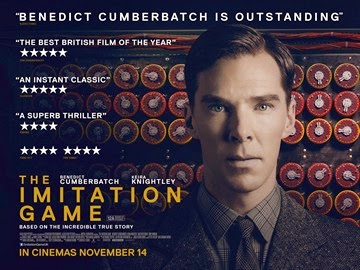
09cf1-the_imitation_game_posterWhen you think of decisive moments in WWII the conversation leads often to D-Day, The Battle of Midway, The Russian Front and The Battle for the Atlantic. If Britain had been cut off from U.S. supplies the case could be made that The Allies would have undoubtedly lost the war. That’s where the Enigma cipher comes into play and along with it Alan Turing.

Alan Turing is one of the unsung heroes of WWII and in many ways the father of modern computers. He’s a big deal and it’s hard to make that point enough. That’s what makes it exciting that he finally got the biopic treatment and with a portrayal by Benedict Cumberbatch no less. It does not get much better than that!

As far as biopics go The Imitation Game is a polished period piece set in War-torn Britain spanning the years of WWII into the early 1950s. Visually beautiful, scored nicely, and generally uplifting, it feels as wonderfully English as a cup of tea and the English countryside. Although the film at times may trod the typical path of other troubled-genius type films,  it often rises above the usual based-on-a-true-story fray. A primary reason for this is Benedict Cumberbatch who plays Turing not with dramatic outbursts, bravado, and bluster, but quite the opposite.
In the year 1939 Turing, a professor at the time, attempted to join the top secret project at Bletchley Park to crack the German’s Enigma code. He seems like an odd candidate for the job since he has only an affinity for puzzles and no knowledge of the German language, but that proves to be unimportant.
He has the right amount of vision paired with the obsession to come at the problem like no one before him. He does not just want to crack one of the tedious strings, he wishes to crack them all using a machine. It was absolutely unheard of and his colleagues discount him, understandably, because he is not much of a team player and far from a social butterfly. However, he discovers a worthy ally in Susan Clarke (Keira Knightley) who proves to be indispensable in his work as well as repairing his rapport with the team.
With the prospect of all his work with the machine being wasted and terminated, his colleagues back him up in front of his superiors. Turing has one last chance to succeed and someway, somehow he does. But success does not come without great responsibility. Once they have the weapon to counter the Germans they must use it cautiously only taking the most necessary steps. It becomes clear that there is a fine line between playing God with human lives and winning a war.
The war is won in the end, however, and the top secret endeavor is disbanded. Alan Turing is far from a war hero because few know what he did. His only label is indecency and he is given the option of imprisonment or hormones in response to his charges of same-sex attraction. A year later he committed suicide at the age of 41.
Cumberbatch is seemingly the perfect Turing with all the quirks you would expect. Except there are also traces of sensitivity and he so adeptly shows subtle emotions on his face. He was an oft-tortured man inside and out, spanning from his boarding school years to his post-war existence. Keira Knightley on her part is enjoyable as a counterpoint, remaining true to Turing no matter the circumstances.
Obviously you can always call into question the accuracy of these types of films and no doubt artistic liberties were taken, but all in all The Imitation Game did a commendable job of painting a picture of a man’s life in a very different age. Alan Turing finally got the credit he was due, and it was done with a great deal of sensitivity, heart, and even humor which mostly overshadowed any saccharine moments.
4/5 Stars

Review: It’s a Wonderful Life (1946)

5632c-wonderfullife4Every time I go through the emotional, romantic, heart-warming and at times uncomfortable roller coaster that is It’s a Wonderful Life, something new always seems to stick out to me.

It is always impressive for a film of this length that so much is packed into it. Within minutes we are fully enveloped in this story, and every sequence gives further insight into these characters. There is hardly ever a wasted moment because there is significance in each scene. Pointing us to the nature of George Bailey.

Furthermore, it is easy to forget the darkness that this film submerges itself in because it reaches such a jubilant crescendo. However, this is a story that covers the years including The Great Depression and World War II. Its protagonist sinks into a state of wretchedness complete with angry outbursts, negative feelings, and drunkenness. George Bailey loses all hope and his perspective is so completely distorted. For all intent and purposes, his life looks like it’s over, and it takes a frightening alternate reality to shake him out of his disillusionment. Put in this framework, it makes sense why it was a commercial flop when you juxtapose it with the big winner that year The Best Years of Our Lives. They both deal with post-war reality, but with very different lenses.

That’s the benefit of hindsight and a new context since we do not usually see It’s a Wonderful Life as a gloomy post-war tale, but a more positive parable that is universal in its impact. The first part of this story feels a bit like a Job story of hardship, and the second act is reminiscent to Dickens’ A Christmas Carol, but that’s the simplest of observations. There is a lot more to be parsed through.

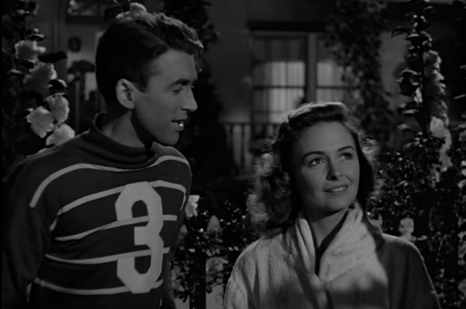
The romance of George and Mary is what many of us aspire to and it causes us to really empathize with their young love that weathers the good and bad breaks they receive. It’s the fairy tale love story we want, with the rock hard reality we are used to in our own lives. Some favorite moments in their life together would be the splash they make during the Charleston dance off, singing Buffalo Gals together, smooching on the telephone together, sharing a makeshift honeymoon together, and embracing after George gets his new perspective on life.

There are a fair number of close-ups utilized in this film, but they are usually used at crucial points in the narrative, and they tell us a great deal about both George and Mary.

The first key moment comes during a freeze frame of grown up George with hands outstretched giving us our first look at the man we will be following from there on out. The next big moment occurs when George learns that Potter will gain control and the Building and Loan will be disbanded if he leaves. He realizes in an instant that he must give up his plans. Then, he waits excitedly for Harry with Uncle Billy and it is a happy moment, but George learns his younger brother might have another job. The camera follows his worried face as he goes to follow his new sister-in-law. Never thinking of himself, he realizes that Harry has a chance for better things and that leaves George still working the Building and Loan.

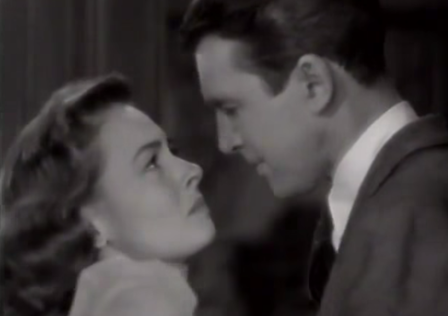
After their tiff, the scene where George and Mary are talking on the phone with Sam Wainwright is a solidifying moment in their relationship. There are so many underlying emotions and unspoken feelings that they are having trouble figuring out and reconciling. And yet there is that violent epiphany when their eyes link. The tears and anger are quickly traded for passionate kisses reflecting the often complicated facts of romance.

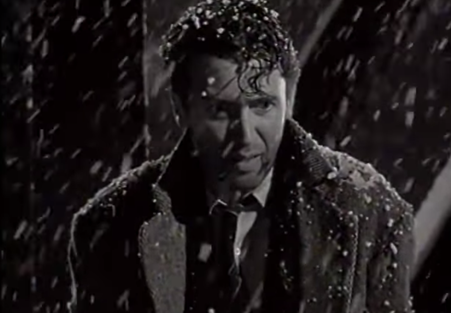
One of the final close-ups that hits home occurs when the now non-existent George stumbles away from the front door of his mother, who now has no concept of him. There is sweat on his brow (maybe from the 90 degree summer heatwave) and desperate bewilderment in his eyes. This is the lowest point he could have imagined. His own mother does not know who he is. His wife has grown old and lonely in an existence of exile. Stewart’s face is so expressive and earnest suggesting that George knows just how important human companionship is. Humanity was made to be in fellowship with each other. Lack of money means very little in comparison to our friendships and family ties. This is essentially what George finally comprehends and what Clarence reminds him. George understandably lost sight of his wife and his children and his friends. They were a gift not to be taken lightly.

Aside from these close-ups, it is also evident that a great deal of  effort was put into creating this world from the characters and their back stories to the town itself which was constructed on the RKO lot. Everything from the building facades, to stray dogs, and snow make the drama more atmospheric. It’s one of those films that reveals the beauty of using real props inhabited by seemingly real people. That’s why I sometimes am disillusioned by CGI. Although it can allow us to create amazing spectacles, oftentimes it creates a world that feels altogether fake and alien. It’s not relatable and it lacks the humanity that makes up our existence each and every day. In other words, it has very little of what makes It’s a Wonderful Life so compelling to me.

Perhaps there are more impressive or greater films, but there are few with greater heart and there is something to be said for that.

5/5 Stars

Le Silence de la mer (1949)

f9677-lesilence1Out of the many titans of French film, I found a personal favorite in Jean-Pierre Melville. Aside from changing his name in honor of the American author who wrote about the great white whale, Melville was also a member of the French Resistance during WWII. Thus, he seems to be the perfect man to helm a film based on a novel that was secretly published during the Nazi occupation. You would think that it would be brimming with political agenda and underhanded controversy.

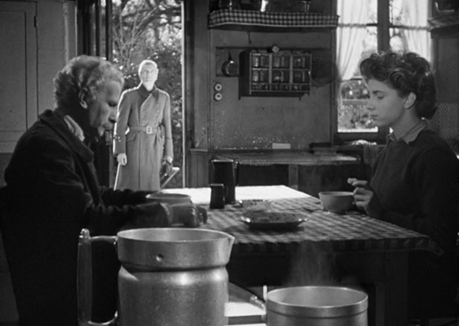
Instead, Melville gifts us a nuanced and sympathetic film about a German Lieutenant who is quartered in the home of a French gentleman and his young niece. In many ways, much of the story plays out as an extended monologue rattled off by Werner von Ebrennac, and it becomes the perfect narrative device for an intimate character study. He is met by silence and passive aggression from his hosts, who hate his guts and the situation they have been placed in. He represents everything they despise, and his mere presence also reminds them of the shameful fact that France has fallen.

And yet he is far from the stereotype, and Melville never allows this German Lieutenant to succumb to our preconceptions. This has to be one of the most sympathetic depictions of a German soldier ever seen captured on film. It turns out that Ebrennac is a perfect gentleman, cultured in literature (Moliere, Rascine, Cervantes, Dante, Shakespeare, and Goethe), and a seasoned musician. His head is full of romantic ideals about the reviving of France as it is taken under the wing of its new conqueror.

His words are always met with a quiet contempt as uncle and niece continually sit reading and knitting. It never seems to change or stop. There is never a change in temperate or a word spoken. Just the words of Ebrennac every evening after he gets back and the voice-over of the older gentlemen constantly illuminates us about the unspoken workings of his mind.

Soon, however, the Lieutenant learns the reality of the war from Treblinka to the Nazi ideology pervading the psyche of all the German military. Friends have been brainwashed, and his view of the German war is completely dashed. There is nothing left to do but apply for a transfer and resign himself to the hell that has been created. Uncle and niece reluctantly bid farewell to a man who was the exception.

This was Jean-Pierre Melville’s first feature, but I really enjoyed it as simple as it is. He seems to understand the ambiguities of war. It often is difficult to decipher who is in the right or the wrong. Germany was the odious villain and France the obvious victim. However, in this domestic drama the tables are seemingly switched in stark contrast.

4/5 Stars

The Stranger (1946)

f6c39-the_stranger_filmIn a whirlwind, the film goes from a moody foreign locale to a quaint American town called Harper, but it never ceases to be a gripping film noir. Considered Orson Welles‘ weakest project thus far, The Stranger is still thoroughly enjoyable thanks to the performances of Edward G. Robinson, Loretta Young and Welles himself. Much like Shadow of a Doubt, this film shows that noir thrillers can still take place in middle America, and they can be pulse-pounders all the same. Also, an evil man can easily exist in a mundane environment and still be evil.

The reason we end up in Harper of all towns has to do with an “escaped” Nazi war criminal. He was allowed to escape and investigator Mr. Wilson (Robinson) follows him. It’s an idyllic little town and one of its most respected members is professor Charles Rankin (Welles), who is soon to be wed to pretty Mary Longstreet (Young). Little does she know that he is former Nazi war criminal Franz Kindler, and he is the man the escaped Konrad Meinike is looking for. Mr. Wilson is very interested in his whereabouts too.

Meinike soon disappears but not before deterring Wilson. However, not one to shy away from his duty, Wilson soon ingratiates himself with the local people, especially the newly married Mary and her kindly family. He is eager to learn more about the professor and at first, the gentleman seems above reproach, but something lurks underneath his calm exterior. Soon the beloved family dog Red is killed, an increasingly manic Rankin confesses his predicament to his wife and conveniently leaves out a few facts. Now constantly paranoid, Mary’s life is in far more peril than she realizes, and Wilson takes all the precautions he can. The clanging of the newly refurbished clock becomes a point of major contention, and it also serves as the perfect locale for a final climatic showdown (Put aside the absurdity and just watch it).

The whole town turns out for the show and finally after getting conked on the head and nearly killed during the case, Mr. Wilson finally has time to relax. Welles is not quite as memorable as Harry Lime here but still a sophisticated villain of sorts.  Likewise, Barton Keyes is a bit more memorable but Edward G. Robinson still brings his personality, iconic voice, and memorable mug to the table. Loretta Young has a radiant face and eyes like always. In other words, they do what they do. It works in making The Stranger a worthwhile thriller with the expected melodramatic music and shadowy facades of a film-noir. This is undoubtedly an oversimplification, but  then again, Orson Welles needs no introduction, and he certainly does not need me to vouch for creative genius.

4/5 Stars

Saving Private Ryan (1998)

c1b38-saving_private_ryan_poster

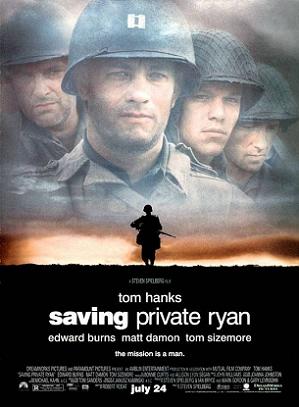
Telling an amazing story of bravery, Saving Private Ryan is both inspiring and moving. Beginning with the invasion of Normandy on D-Day June 6, 1944, the film follows a group of American soldiers as they look for a Francis Ryan. Since all three of his brothers are dead their mission is to find him and send the private home . Despite the dangers and the subsequent deaths of many comrades, they finally complete their mission after one last heroic fight. The movie flashes forward to the present day Ryan as he kneels at the graves of those brave men who saved him. Unsure he asks his wife if he lived a good life because those soldiers payed the ultimate price for him. With director Steven Speilberg, Tom Hanks, Matt Damon, and other good character actors, this is a powerful war film with great battle sequences as well as amazing heroism.

5/5 Stars

The Great Escape (1963)

Based on true events, this film describes the heroic exploits of POWs in a German Stalag during World War II. With extreme heart and teamwork the men take upon the task of making a massive escape. Led by Richard Attenbourough, Steve McQueen, James Garner, and Charles Bronson to name a few, they begin their monumental task. Despite adversity, their plan slowly becomes reality and escape is imminent. When the time comes over 70 men get away in the night, escaping secretly across Germany. However, relief is quickly replaced by tragedy as many of the escapees are shot or captured. Through it all the Allies struggle courageously against the Nazis. By the end they may be a little battered but they certainly are not beaten. Besides a wonderful ensemble cast, this film has one of the most iconic themes and chase scenes of all time.

4.5/5 Stars

Twelve O’Clock High (1949)

Starring Gregory Pb181c-twelve_oeck, the film follows a strict brigadier general who takes command of a group of bombers who fly precision daytime missions during WWII. Frank Savage is sent to relieve his friends because the group has suffered a great deal of poor luck. From the get go this tough leader is at odds with his men. They all want to be transferred and yet with the help of the camp adjutant, Savage is able to lead them effectively. His touch tactics lead to success in the air and a pride in his men develops. However, after one good mission Savage is incapable to go up the next day. He becomes a lifeless man and only when his men return does he revert back to normal. All this is remembered by Major Stoval as the film concludes. Peck and Dean Jagger were both very good and the bombing mission was certainly exhilarating to watch. It is more about the people then the war and that still makes it a good film.


4.5/5 Stars


The Last Metro (1980)

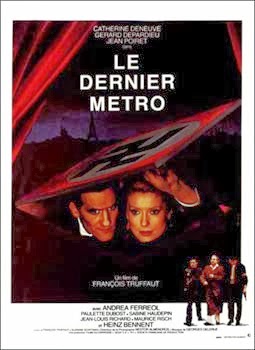
Directed by Francois Truffaut and starring Catherine Denueve and Gerard Depardieu, the film opens with the very French-sounding love song “Mon amant de Sant Jean” playing over the credits. We find ourselves in occupied France during WWII where a little theater is struggling to stay open. The  famed Jewish director Lucas Steiner has been forced to flee from the Nazis although in reality he is actually hiding in the cellar of the theater. In his absence his wife Marion has taken up his role of running the theater while also continuing to act. Early on we are introduced to the young actor Bernard who is chosen to play one of the new roles in the upcoming production. At the same time Marion must try and acquire the permit to stay open from a man whom she despises, the art critic Daxiat, who has anti-Semitic beliefs. They do stay open however, and with the director’s notes of Lucas they prepare their show and open to great success. Many of the French come to their shows as an escape before they take the Last Metro home. However, at their performance Daxiat gives them a harsh review and it angers Bernard. His actions ultimately jeopardize the theater and as a result his relations with Marion become strained. As if that were not enough some Gestapo come to the theater searching for Lucas and they must rush to hide him. Needless to say the film ends on a positive note but the film is not so much about resistance against the Nazis compared to the struggles of a theater to survive. Denueve gives a moving performance and although this is not Truffaut’s best, it is admirable. As the audience, not only do we watch a movie, but we watch the play within the movie and then the drama behind the play, so Truffaut  takes us a little deeper.

4/5 Stars

Go for Broke (1951)

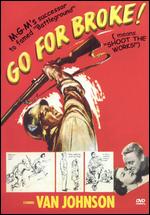
Starring Van Johnson along with a handful of WW II vets, this film looks like your average war film. It follows this group of soldiers from their initial training all the way to deployment. Then, we follow their exploits in Italy and France that coincide with their everyday interactions. However, this film is very significant because it actually tells the story of Japanese Americans in the 442nd infantry unit. They not only faced the enemy on the battlefield, they also had to deal with a great deal of prejudice within the armed forces. However, as with the example of Van Johnson, the Budha-Heads were able to win respect because of their courageous fighting. In the climatic moments of the film these men save a lost division and then return home as heroes. Since I am half-Japanese it was exciting for me to come across this film because this kind of topic has not been covered often. The fact that it actually had Nisei actors and was  made quite soon after the war is also amazing.

3.5/5 Stars

Rome, Open City (1945)

Directed by Roberto Rossellini this Italian neorealist film depicts the harsh realities of life in Rome during WWII during Nazi occupation. We are given an inside look at the bravery and everyday lives of these people. We become familiar with a fugitive engineer and resistance leader. He gains assistance from a kindly and collected priest who also runs a church. Their stories intertwine with a widowed woman who is just about to be remarried, a beautiful girlfriend, and a Gestapo office who is intent on stopping the resistance. After one tragic event everything continues on a downward spiral. The fugitive Manfredi and the priest, are both betrayed. Don Pietro must look on as the other man is brutally tortured to the point of death. Next, the Gestapo try to use the priest’s own beliefs against him and yet he will not yield either. He too then faces a fate just as horrible. This film at times was brutally realistic and it is perhaps one of the most moving films I have seen. We do not normally think of the struggles of Italians during WWII since Mussolini was allied with Hitler, however much like the French or even Germans, they faced tremendous danger and hardship. Furthermore, it humanized the Italians in my mind a great deal. This is the first film of the war trilogy that I have seen and now I want to see the other two. As you can see I’m still a little fuzzy on my Italian history and I would love to learn more.

5/5 Stars