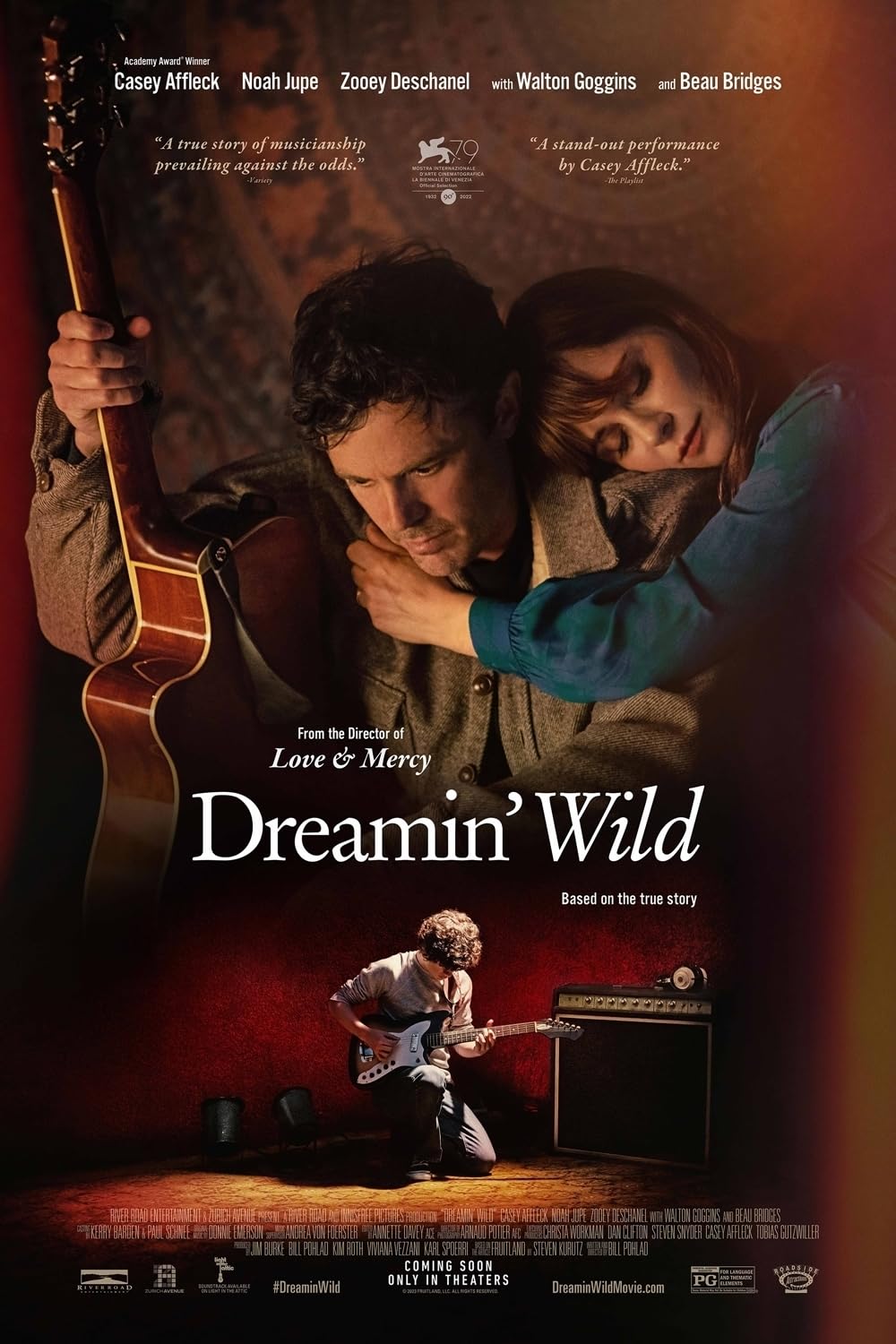
Dreamin’ Wild (2022)

I’m a sucker for a good jukebox biopic and Dreamin’ Wild is one of the films that might fly under the radar just like its subjects. And yet when you actually come face to face with it you find something tender and sentimental in the most endearing of ways.

There’s something to be said of a contemporary movie that unabashedly focuses on a close-knit family that loves each other dearly and celebrates them. For whatever reason, contemporary cinematic culture almost feels averse to certain topics because they feel staid and formulaic. Subversion and cynicism win the day on most occasions.

Dreamin’ Wild almost feels radical because the film is buoyed by so much goodness and it’s part of what makes this adaptation of the Emerson brothers’ story worth felling. The fact that these teenagers made music, and it only made a dent 30 years after its release is astounding. In the same breath, it feels like something worth championing without a lot of fabricated drama — at least in the beginning.

The ascension and the celebration of the success in itself is the kind of underdog story that still can grip us as human beings. Dreamin’ Wild reminds us why. Matt Sullivan (Chris Messina) has been trying to find them because he wants to reissue their work on his record label. There’s a sincerity to him that’s disarming and genial. You can tell he’s genuinely glad to be brought into this family’s orbit and do this for them.

Donnie (Casey Affleck) and Joe (Walton Goggins) find out the internet is blowing up about their record. Pitchfork gives them a fantastic review and The New York Times comes out to do a profile on the family. Matt says there’s high demand for some concerts to get them out there in front of fans. The upward trajectory is rapid and yet so thrilling to watch unfold because we get to live vicariously through the brothers’ joy deferred after so many years.

In the face of this overnight stardom, Affleck does his trademark mopey, despondent role, but in all fairness, he does it quite well. We wonder what it is buried in his past that might conceivably get in the way, but it’s a story engaged with the artist and the creative genius coming up against familial obligation. And in this regard, it seems pertinent to highlight the movie’s writer and director.

Bill Pohlad’s other most prominent project as a director was Love & Mercy about Brian Wilson, and it’s easy enough to try and thread these stories together. They share similar architecture with two contrasting timelines. This one throws us back into Donnie and Joe’s boyhood with small swatches of time and interactions reverberating into the present.

You begin to see what might have drawn the writer-director to this pair of stories because they examine someone with such an uncompromising creative vision, but for whatever reason this single-mindedness can somehow derail the relationships you hold most dear. Things around you suffer for the sake of the art.

And whereas Brian was struggling against his own demons and the authoritarian presence of his father, Dreamin’ Wild almost has the answer to that. Donnie’s father as played so compassionately by Beau Bridges is the picture of generosity and unconditional love. So much so it almost crushes Donnie with his own guilt and shame — the inadequacies he feels with his failed music career thus far. He’s dealing with some issues analogous to Brian in some ways, but they develop in a very different kind of creative environment.

Joe (Goggins) is such a pleasant person and it becomes evident he’s always been a champion for Donnie, his creativity and his talent. They’re close-knit and always ready to  support one another. And Joe knows he’s not going to be some great artist and he’s contented in that; Joe takes each new develop with a wonder and genuine appreciation. He’s pretty much happy to be along for the ride, but he’s present through it all.  His younger brother struggles to do the same because he’s terrified about making the most of his opportunity and with it comes debilitating angst.

In a movie enveloped and incubated in so much goodness, it’s ultimately this that threatens to derail the whole uplifting narrative. One crucial scene involves the rehearsal process. Joe is just getting back into it. He’s rusty, and so to compensate Donnie brings in some back up musicians including his talented wife Nancy (Zooey Deschanel).

Donnie’s tormented perfectionism will not condone his brother’s mediocre playing and so he lashes out. It’s true maybe he’s not John Bonham, but something has been lost and the magic of the moment is in danger of evaporating amid this kind of creative tyranny.

Joe feels awkward; he can’t defend himself and so Nancy stands up for him and calls out her husband for his distorted expectations. What is this big triumphal success, this grand rediscovery if Donnie cannot enjoy it with his brother playing drums by his side? It would feel hollow any other way. Those of us who are not musical savants understand intuitively.

It’s about being present and appreciating the moment. Sometimes less than perfect is okay if it means getting the most out of what’s in front of you and being fully present with the people you love. Because what does perfection profit you? We always fall short. Still, if you have family in your corner who know and love you in spite of your faults, that is a supreme a gift.

The movie’s most fundamental themes are about brothers, fathers and sons, and so more that I resonate with. I won’t try to put words to them all so that you might be able to experience them of your own accord. Even a momentary prayer before a big show feels emblematic of a quiet revolution.

Ultimately the boys do reconcile and they have one final performance. It’s not a big triumphant show (like before), and although I enjoyed hearing the music again I questioned the necessity of the moment.

Then Pohlad did something I wasn’t expecting; it took my breath away. He shows his two actors. They’re on guitar, drums, and singing.  The audience, including their parents, looks on, and then when he cuts back. Now staring back at us are the real Emerson brothers in the flesh.

I can’t quite articulate it, but there’s something so powerful about this subtle shift as the make-believe of the movies becomes reality, and we see those people there making music together and enjoying one another’s company with their real parents looking on. It’s a full-circle culmination of everything we could desire.

I think it’s the intimacy I appreciate it. You can tell the people making this movie — just like Chris Messina’s character — are doing it because they are captivated by this story. It moves them. I feel the same way, and for whatever the flaws or tropes of Dreamin’ Wild, I was immediately rooting for it. Of course, the first thing I did after the credits rolled was to search out this little record from 1979 by two rural teenagers. Pretty remarkable.

3.5/5 Stars
Almost Famous (2000)

Almost_famous_poster1Almost Famous is almost so many things. There are truly wonderful moments that channel certain aspects of our culture’s infatuation with rock n roll.
It’s easy to become entranced with the opening moments, not necessarily because we are introduced to William, his protective mother (Frances McDormand), or even his older sister (Zooey Deschanel) who looks to leave the nest behind to go off and find herself. To steal a line from Simon & Garfunkel, she goes off, “To look for America” and we can ride the wistful waves of Paul Simon’s lyrics to understand exactly what she means.  But she also leaves behind a gift for her little brother under his bed. It’s easy to surmise that it’s drugs, something to “expand his horizons” but instead it’s so much more. It’s what this entire film hinges on: Music.

And when he opens the treasure trove of records his sister bequeathed him this is an initial kairos moment that also manages to be one of the most magical in the film–one that leaves goosebumps from sheer recognition. He flips through the albums. The Beatles, The Stones, Dylan, The Who, Led Zeppelin, Hendrix and on and on. Enough said. Each of these bands means so much to so many people as do some of these albums.

Almost Famous is at its best when it’s channeling those very things. Its soundtrack has the propitious fortune to include some authorized tracks from Led Zeppelin as well as Neil Young, David Bowie, and of course Elton John, his “Tiny Dancer” filling up the band’s bus with a chorus of voices in one of the most remembered sequences.

The film’s story is intriguing for the very fact that it has the potential to feel so personal in nature. It functions as a fictionalized autobiography of Cameron Crowe’s foray into rock journalism as a bit of a teenage prodigy from sunny San Diego who first wrote for Creem and then in the big leagues for Rolling Stone Magazine circa 1973.

That’s a narrative ripe with possibilities and anecdotes sure to pique the interest of anyone who loves music and there are certainly some of those moments. People jumping off rooftops into swimming pools their heads spinning on acid, tour buses crashing through gates to make a quick getaway from a horrible gig, and plane flights on the edge of death that elicit a long line of last-minute confessions.

But we are also reminded that life on the road is a grind, it can be dangerous too but more often than not it’s surprisingly dull. What happens to William (Patrick Fugit) is that he gets subjected to this life and far from changing, it simply changes how he sees these people. Ultimately, there’s a bit of disillusionment and alienation with getting that close to people you idolize. In many respects, he looks ridiculously out of place in this lifestyle of groupies, tour buses, backstage antics, sleazy hotel rooms, and sex, drugs, and rock n roll.  He’s too clean cut. Too much of a straight arrow. And that’s part of what’s interesting.

But while it’s easy to latch onto the trajectory of our character and care about his growth and maturity, the themes of Almost Famous feel muddled and not in a way that’s  enigmatic and mysterious. It just drops off at a certain point.

It’s almost transcendent, almost a masterstroke, almost captures our heart but it’s not quite there. Despite its best efforts it somehow still feels slightly removed from the moment it comes out of–a moment that now is easy to eulogize about as both electric and exciting in a way that the band Stillwater never is. Maybe that’s the point.

We can reiterate again and again that the music is phenomenal and while the situations had potential to be gripping they never quite reached that apex. Everything is quite satisfactory, it’s enjoyable watching this wide-eyed lad follow around this rock band, but there are moments when the film drags. Take the rock and roll out of these people and they aren’t altogether compelling. That might be an unfortunately cruel thing to say too.

But Lester Bangs (Phillip Seymour Hoffman) the famed rock critic repeatedly notes that rock is on the way out and this film seems to surmise as much. At times it doesn’t feel completely caught up in the throes of its time, it’s not caught up in the moment as if there’s this subconscious feeling that it will all come to an end.

On the reverse side, William lives life alongside some of these figures who are never truly all that magnetic or memorable whether Russell (Billy Crudup) or even the iconically named Penny Lane (Kate Hudson). The name dropping and connections to others make them the most intriguing. Dinner with Dylan here, something from David Crosby there. Led Zeppelin fanboys, David Bowie’s manager, and so on and so forth. Those connections have cultural clout still but once again the fictional Stillwater were only almost famous. Their name whether in fiction or reality has been lost to time and there’s no aura to them. Because we have nothing to sink our teeth into.

Maybe it’s the very fact that the film does this so well that it feels unremarkable. It takes time on those who really didn’t matter in the grand scheme of rock ‘n roll when the critics and pundits got together to write the narrative that would be accepted for a historical fact from that point forward.

However, Almost Famous also takes a particular care to show what it was and still is to be a rock star in this kind of volatile lifestyle always on the road. The fame and applause are amplified but so in many ways are the heartbreaks and ultimately the scrutiny that can either make or break you.  There’s no privacy in the general sense. But that’s the point, as a rock star you give much of that up. The question is, what happens when you’re in the middle ground? You’re not quite there but the journalists are still looking for their story, digging through your music, life, and affairs. No one has ever desired to be Almost Famous because, in some cases, you get the worst of both worlds.

4/5 Stars


Elf (2003)

220px-Elf_movie“The best way to spread Christmas Cheer is singing loud for all to hear.”
Elf is truly a Christmas miracle. It’s a relatively modern Christmas classic (a bit over 12 years old) that holds its own in a season usually dominated by old perennial favorites. Yet, again and again, it constantly excites, mesmerizes, and bedazzles in more ways than one.

Will Ferrell is the major treasure of Elf because, without his child-like wonderment and sincerity, this film could go downhill all too quickly. Buddy walks into female locker rooms, walks around New York in an Elf suit eating discarded gum, and calls his grown-up father “daddy” in a musical serenade, after all. But to his credit, Ferrell goes for it wholeheartedly completely engulfing himself in a magical realm that bewitches every other character who decides to join him. Everyone else walks in abject reality, but Buddy like Elwood P. Dowd (Harvey) or Dudley the angel (The Bishop’s Wife) exist outside of that and when they rub up against everyone else, they leave everyone, including the audience, changed.

From the outset, Elf comes right out of a storybook as Papa Elf (the venerable Bob Newhart) recounts how a human and his adopted son saved Christmas. Of course, it starts out as a sorry tale, because truth be told Buddy cannot figure out what his purpose in life is. What is he good at? What are his talents? For all the other elves it’s obvious: they make toys.

But when Buddy finally learns of his secret past he leaves his papa behind in a tearful goodbye, gains some sage advice from Santa (the equally venerable Ed Asner), and heads off on an iceberg to find his real father in the Big Apple.

There must be a catch, and there is a small one, Buddy’s father Walter Hobbes (James Caan) is on the naughty list. In fact, he’s a real Scrooge working slavishly day after day as a children’s book publisher. But you see Buddy doesn’t see people for their faults and that’s the secret of Ferrell’s success because his innocence and irrepressible will towards his fellow man is contagious. New York might be a culture shock and Hobbes as well as his young boy Michael are not too thrilled with Buddy’s arrival, but that’s because he’s so foreign – so nice. Ultimately, he becomes the best thing to happen in their life.

In truth, Buddy goes transforming New York systematically whether it’s the Hobbes’ home, Gimbel’s Department Store, or wherever his feet take him. And of course he finds love in his world-wearied coworker Jovie (Zooey Deschanel) and saves Christmas, but that’s nothing unexpected. It’s not the results, but how we get there that counts – all those quotable moments in between.

Too often I feel bludgeoned to death by all the new takes on the Christmas season annually jostling for my affection. But the beauty of Elf is that it pays its respects to the past, thereby solidifying its own timelessness in the present. It doesn’t have to be the next big thing, but it is something that I would gladly sit down and watch annually, because of its spirit and seasonal charm. We get nods to A Christmas Story and Ralphie, an homage to George Bailey on the Bedford Fall bridge, and even Miracle on 34th Street (Buddy working at the rival Gimbels).

The music never steals the show but it does accent some sequences nicely including the voices of Louis Prima, Stevie Wonder, Ella Fitzgerald, Frank Sinatra, and so on. Each character fits well in director Jon Favreau’s narrative. The manager (Faizon Love) is a crack-up. The hired Santa (Artie Lange) is a thug. Peter Dinklage is an angry elf. James Caan is grumpy and cynical. Zooey Deschanel is pretty and cynical. Ed Asner is an endearing grouch. Bob Newhart has his usual stuttering charm. And Ferrell wraps it all up nicely with a pretty bow. Although it does completely sidestep the origins of the Christmas holiday, Elf does what it set out to do very well. It exudes Christmas spirit unabashedly.

“Christmas spirit is about believing, not seeing.” – Ed Asner as Santa

4/5 Stars

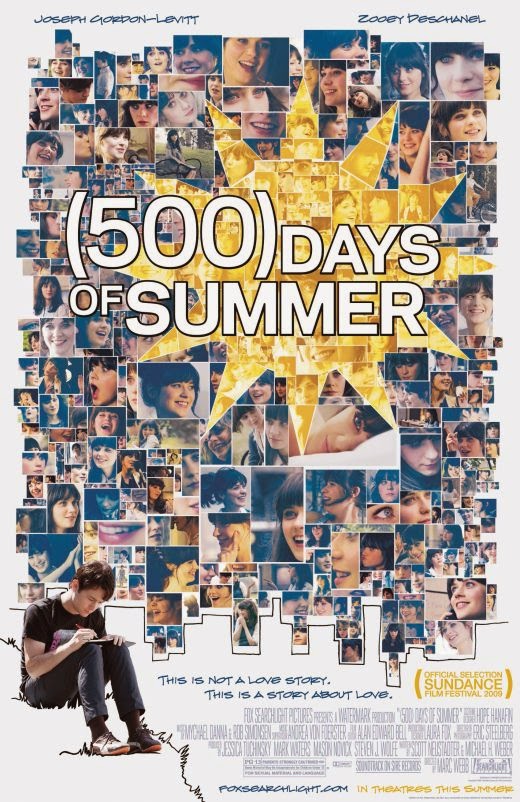
(500) Days of Summer (2009)

16ddc-five_hundred_days_of_summer“This is a story of boy meets girl, but you should know upfront, this is not a love story.”

This one line is uttered by the very thematic narrator of (500) Days of Summer and it describes an aspiring architect-greeting card salesman named Tom Hanson who meets Summer Finn at the office.

This often inventive and imaginative romantic comedy highlights the highs and woes that come with a relationship. You see Tom and Summer are seemingly two conflicting forces of nature from the beginning. He is a hopeless romantic believing in fate and love at first sight. She does not quite buy into that stuff, and she is only looking for “a friend,” nothing too serious. The so-called Summer Effect is what draws Tom to her. She is seemingly a normal everyday girl, but there is something extra special about her. But you will see for yourself.

The film’s scriptwriters do an excellent job at highlighting the minutiae that go along with any relationship. The Smiths are a point of agreement. Ikea is a place to fantasize about the American Dream, the copy room can be a place of romance, and Ringo Starr’s “Octopus’ Garden” will always be a point of contention. Mind you, all of this is out of sequence because that’s the way the memories come flooding back.

There are days when the whole world seems to be smiling with you. The birds are singing, you’re Han Solo, and it just makes you want to dance. There are days when you have bed head and your dreams are broken. There is no longer faith in romance. One day it seems like the walls are coming down and you are truly getting to know this significant other on an intimate level. Another day a small squabble over a punch and soon enough you hate everything about her. Her smile, her knees, her hair, they’re all awful.

All these things happen to Tom because Summer is not looking for anything more substantial, but he feels he is getting mixed signals. They are finally reunited and he thinks this might be his second chance. However, expectations seemingly never mirror reality. He is disillusioned realizing movies, pop songs, and even greeting cards are responsible for the lies society feeds us about love.

Now Summer has moved on in a big way, the wounds still hurt Tom, but they meet at that same bench overlooking Los Angeles for a final time. So you see this was not a love story after all. However, remember the date May 23rd, a Wednesday. We do not know the outcome but if nothing else it was the day that Tom reaffirms his belief in love.

(500) Days of Summer was different enough to be an enjoyable film which was instigated by a nonlinear storyline that pulled us along through a relationship ( day 1-500). Joseph Gordon-Levitt and Zooey Deschanel were both enjoyable and Tom’s friends and sister had enough personality to add something to the film. The music is often fitting (“Sweet Disposition” by Temper Trap helps the indie vibe), and both leads got an excuse to work out their vocal cords.  By the nature of the narrative, the story jumps around a lot, seemingly leaving loose ends. Perhaps that is just my own hangup. Because, like any love story, this film may have its imperfections, but that is not to say it is not worthwhile.

4/5 Stars