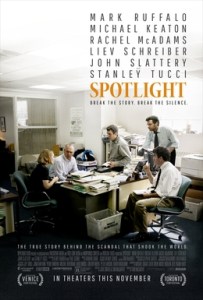
Spotlight (2015)

Spotlight_(film)_poster“They say it’s just physical abuse but it’s more than that, this was spiritual abuse.”

I wrote a piece tracing the obvious parallels between All the President’s Men and Spotlight, two films that I could easily see both shaking the very framework of American society through their very candid portrayal of journalism. When actually getting to see Spotlight the connections became even more prominent. Our narrative begins, not in Washington D.C., but in Boston Mass, 1976. It even goes so far as having a Ben Bradlee connection. Bradlee Sr. worked with Woodward and Bernstein while the Big Throat story was breaking. Of course, numerous years later Bradlee Jr., continuing the family profession, was working at the Boston Globe and becoming an integral part of what was going on there.

But enough with similarities, this film, written and directed by Tom McCarthy, deserves its own personal set of commentary. Spotlight is the investigative unit of the Globe and as such their work is not for the quick news flash, but grinding out long, detailed stories, although at times it takes a while to latch onto a juicy tidbit.

However, a new, rather stiff editor named Marty Baron points the team towards a story where a lawyer is accusing a local Cardinal about doing nothing after he found out a local priest was sexually abusing children. It’s a problematic scenario that deserves a little more time, but at this point, it’s an isolated event. It’s one man’s evil. One man doing nothing to remedy an outlier in the Catholic Church.

What follows is as troubling as it is imperative storytelling. The members behind the Spotlight team are not arrogant, self-righteous people, or figure pointers, only truth seekers. That’s their job, after all. The cast is well rounded and credible while no one figure steals the spotlight, literally. Michael Keaton is their leader “Robby” who has close ties with the community even going to high school across the street. Mark Ruffalo is the integral member Michael Rezendes who not only writes the story but has the important task of trying to needle a local attorney for information and documents that can blow the story wide open. Meanwhile, Sascha Pfeiffer (Rachael McAdams) carries out numerous interviews of her own in this multiple-pronged assault for the truth.

Their investigation looks to victim organizations, lawyers, priests, and a psychotherapy specialist. If it’s not obvious already, Spotlight makes it painfully clear that this is not a story of a few isolated incidents but an entire epidemic. This is the whole country — the whole world. It makes you positively squeamish and it’s perturbing in its brutal honesty. There’s no way for it to be sanitized and that’s indubitably frightening. We should be angry, we should be grieved, it should be abrasive to our senses.

It’s bringing to light an entire conspiracy of corruption. There are no paper trails, evidence is swept under the rug, and person upon person remain tight-lipped either due to guilt or shame. Humanity is drawn to darkness, but we want things to be brought to light. It’s the dissonance of what it is to be a person — the constant battle going on in our own human hearts. This isn’t meant to be about individual finger pointing, but an indictment of a system. An indictment of what we all are capable of. If it’s not being able to maintain the celibacy requirement, then it’s a pastor addicted to pornography, or a man sleeping with someone else’s wife. They’re different scenarios, but the people behind them are all similarly broken.

With the narrative of Spotlight cataclysmic events such as 9/11 shift focus, but they cannot fully distract from the bleeding that is still going on behind the scenes. There’s still a need to get to the root of the problem and they do. Mark Ruffalo’s character talks about having some deep down inclination that he will one day go back to the church and then came the day that all that came crashing down as they prepared to break the story. All his hopes went unrealized. It has to be an abysmal feeling. These are folks living in a secular world and a Church that falters so greatly is of little comfort. God is a distant deity, not a personal one, so it seems.

When the story hits the pavements you know that all hell is going to break loose, but what really happens is that all the pain, suffering, and shame has finally received the spotlight it deserves. The major realization is not that one person is the problem or even that another person is the problem. But the most frightening revelation Spotlight offers up is that we’re part of that problem. That’s tough news to swallow and this is a film that does it with immense credence and poise. Perhaps the toughest moments of the film come when the lights have died down and we see the staggering numbers of just how many cities were rocked by similar scandals. If you’re like me you see cities that are all too familiar. A film of this magnitude begs for some kind of response from its audience. It’s up to the viewer to decide what that will be — whether social, spiritual or something else entirely.

This is a potent film of the highest nature that lifts up journalism as a noble profession, while simultaneously rocking its audience with a real-life narrative of substantial magnitude. I’m not one prone to bloated statements, but this just might be the best picture of the year. Its impact has been duly noted.

4.5/5 Stars

A Most Wanted Man (2013)

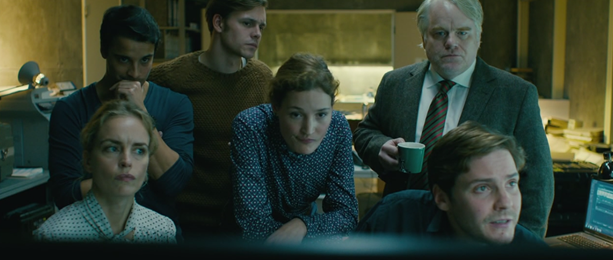
mostwantedman1A Most Wanted Man gained some notability as one of the last works of Philip Seymour Hoffman, and it must be acknowledged that he gives a truly worthwhile performance. No surprise there.

He’s Gunther Bachmann, the German head of a covert team that is looking to undermine potential threats from Islamic terrorist organizations in a post-9/11 society. The film features cinematography that can be best described as sullen and pale, fitting the mood of a, at times, dismal Hamburg, Germany. It looks to be everything a spy thriller is supposed to be, boasting an international cast including the likes of Rachel McAdams, Willem Dafoe, Daniel Bruhl, Nina Hoss, and Robin Wright, who are all intriguing to see in action.

But it is Hoffman with his team that commands the most attention, as they try and monitor an escaped political prisoner from Chechnya, who is seeking refuge but is also suspected of terrorist affiliations. He is contacted by a compassionate lawyer  (McAdams) who wishes to help him, but they get caught up in Gunther’s plan and try and flee from his prying eyes. It doesn’t exactly work. But really they are both part of a bigger ploy to pin down a wealthy Muslim philanthropist who could be in it even deeper with terrorist organizations. They just have to catch him with the help of some insiders and a banker (Dafoe), so Dr. Abdullah can be put away unequivocally. But Gunther also has his superiors and the American diplomat (Robin Wright) continually questioning his plans and mistrusting his motives. After all, he works for a, technically, unconstitutional organization that’s supposed to be off the radar.

mostwantedman2What A Most Wanted Man becomes is a brooding game of watching and waiting interspersed with a few moments that get the heartbeat up. But honestly, it’s mostly waiting, and it does serve to build the tension. There is one final turn that we could probably expect, and overall this is not a film of high volumes of action. In fact, there is barely any. Except by the time it ends, we are left with the same hopelessness and moroseness that seems to float over these characters in a haze. We are constantly wondering, “Where do their allegiances lie?” or “Why are they doing this?” and in the end, it doesn’t seem to matter. This is by no means Chinatown in its intricacy or otherwise, but you do get that same sense of futility.

I must admit I was a little surprised to see Rachel McAdams playing a German, but ultimately I was able to accept it. And although my knowledge of German film is limited, it was exciting to see two talented actors like Nina Hoss and Daniel Bruhl be featured, but they regrettably were relegated to smaller, hardly interesting turns. We might have to simply content ourselves with their other roles. Because this is most certainly Philip Seymour Hoffman’s show first and last. And it would, unfortunately, end up being his last. However, he left us as jaded and distraught as ever, and that’s a compliment to the actor he was.

3.5/5 Stars

La Strada (1954)

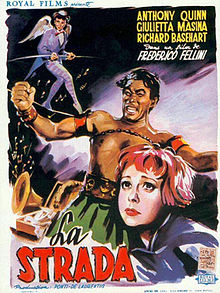
220px-La_Strada_PosterFederico Fellini’s La Strada is in the tradition of other films like Chaplin’s The Circus (1928) and even Nightmare Alley (1947). He even goes so far as to feature two regular Hollywood performers in Anthony Quinn and Richard Basehart. This film is prominent for helping the Italian master achieve mainstream success, and it functions as a sort of crossroads. It still has one foot planted in a neorealist world with the other slowly entering a world of whimsy. It also suffered a production schedule that was as plagued with problems as the characters depicted therein.

The plot itself is relatively straightforward following a volatile strongman (Quinn) who buys a shy young woman off her mother to travel from town to town with him. He’s a real entertainer, and he teaches her most of what he knows so she can assist in the act. However, when they’re not working together, and the show is done, he goes right back to treating her badly and making life quite miserable for her. Zampano’s not the understanding sort.

Giulietta Masina has a starry-eyed quizzical face that elicits not so much a negative response, but one of perplexment. It’s the perfect visage for say a clown (which she masquerades as) since it can be so jovial and in the same instant sad and somehow distant. As her life on the road progresses she finally forgets loyalty and goes on her own to get away from Zampano’s abuse. While being alone she comes across the performance of a skilled acrobat (Richard Basehart) and what follows is a rocky partnership in a rat tag act that once again includes the strongman. But the constant heckling and joking of “The Fool” gets on Zampano’s nerves until things start to get violent. Once he gets out of prison for his behavior, he and Gelsomina get back together, but a run-in once more with his old nemesis turns out badly.

This time all the wind is taken out of her sails after what happens. She is a mime without any emotion, hardly any life left in her. One night Zampano leaves her behind in the night never to see or hear from her again. His existence from then on is as dismal as Gelsomina’s outcome.

Fellini himself suggested that La Strada was a very personal film, and it brings into question if he had a bit of Zampano and Gelsomina inside himself. La Strada also lacks the excess of his later films, instead contenting itself with simple roads and humble people — a stream of beautifully austere images without much extravagance. Also, with the character of Gelsomina comes a wistfulness that drives the tone of the film. As she contemplates with “The Fool,” everything must have a purpose, because if even a pebble has no purpose then everything is pointless. It’s in many ways a dismally bleak film, but still enduringly interesting.

4/5 Stars

The Revenant (2015)

The_Revenant_2015_film_poster (1)By definition, a revenant is someone who returns, but there is often a connotation that they are returning from the dead like a specter. The term gives major insight into Alejandro González Iñárritu’s latest undertaking with Leonardo DiCaprio. It’s a fully immersive, grimy, gory, grisly, grizzly-filled piece of cinema caked in blood, sweat, and tears in every sense of the word.
Its production took the cast and crew to Canada and Argentina to shoot sequences that were probably just as desolate in person as they looked onscreen. In that way, Iñárritu did not fudge or cheat with the use of excessive computer-generated imagery. Even if his production was overlong and undoubtedly volatile, you could say he was rewarded with vast expanses of engulfing cinematic visuals. Emmanuelle Lubezki yet again probably becomes one of the film’s biggest assets and his use of natural lighting is superb. In truth, it’s a painful exhibition in acting by DiCaprio and this icy frostbitten wilderness becomes the backdrop for a gargantuan feat of survival.

What would inspire such a film? I think many people were asking that, and it does find some of its story from the true circumstances of Hugh Glass, a 19th-century explorer, trapper, and guide who was part of a fur trapping expedition out west. After enduring an onslaught from a group of belligerent Pawnee, Glass can hardly recover from a bear mauling that essentially leaves him a lifeless carcass of a man.

His scared and scattered band is just hoping to get to their outpost to regroup, but their leader (Domhnall Gleeson capping off a phenomenal year) is intent on holding onto Glass because he’s the only one who knows the way back. His main insubordinate is the grubby, paranoid, scumbag John Fitzgerald, played so invariably corrupt by Tom Hardy. Glasses Pawnee-born son, the young trapper Bridger (Will Poulter) and a reluctant Fitzgerald agree to stay behind with the feeble man, while the others push forward. But being the backstabber that he is, Fitzgerald looks to bury Glass alive or finish him off for good with his musket. It doesn’t make much difference to him, but Hawk doesn’t want to see his father dead. Fitzgerald could care less. After all, what is he supposed to do? Keep this man alive only so he might die too?

Bridger naively follows Fitzgerald’s lead and they leave Glass behind for dead. There is no man who could survive, half-frozen, half-dead and still find a way to live another day. That’s where the story goes into stage two of survival.

The images that follow are ceaselessly gripping with majestic landscapes that are raw and brutal in the same breath. DiCaprio forges through streams, makes fires by some miracle, and keeps warm any way humanly possible. To don such a role you almost have to give up any human sensibilities and allow yourself to simply exist. He crawls and claws painfully, eats raw meat torn from a dead bison carcass, and sleeps inside the hide of his dead horse. It should repulse us in our modern lifestyles of comfort and excess, but in the same sense, it is a fascinating portrait of realism taken to the extreme.

The final chapter follows Glass as he returns to the fort, gets in contact with Captain Henry, only to chase after the fleeing Fitzgerald one last time. When he caught news of the ghost man’s return from the dead he knew the implications. Dead men tell no tales, but it’s a different story if they don’t die.

Unfortunately, The Revenant is rather laborious in the end and it’s a fatalistic revenge tale certainly but it’s not altogether satisfying. True, the perpetrator of evil is brought to justice, but that doesn’t mean a great deal. Perhaps because we admire Glasses gumption, but we never really build a connection with him. He truly is a solitary figure looking to avenge the death of his boy. There’s not more to grab hold of with this dynamic, maybe due to the fact that he is really a ghost. He’s so gaunt, battered, and spent that there is little space for emotions to fill all the nooks and crannies. Only a constant, pulsing desire for vengeance.

Still, we can always go back and be contented in Lubezki’s gorgeously stark visuals. The frontier look of this film brought to mind Malick’s film (also with Lubezki) The New World for a brief instant, and it makes me want to give it another look. Otherwise, The Revenant stands as an impressive feat, but it does not quite have the emotional wallop that it had the potential to wield. Although, the performances are thoroughly impressive, even if it’s more for their singular commitment than anything else.

4/5 Stars

Viridiana (1961)

220px-Viridiana_coverLuis Bunuel like another cinematic auteur, Ingmar Bergman, seems to often fill his films with religious imagery and themes, but whereas Bergman appears to have genuine questions about his own spirituality, Bunuel is all but content to subvert all such depictions for his own purposes. He has a wicked sense of humor with the opening crescendos of Handel’s “Messiah” playing over the credits only to come back later when his film is at its most tumultuous.

The story opens, of all places, in a convent with a pretty young novice (Silvia Pinal) preparing to take her vows. But she is ordered by her superior to visit her long-estranged uncle. She is reluctant but goes anyways to his mansion in the country as a courtesy.

There she meets the lonely old man (Fernando Rey), isolated in his great home with only a few servants surrounding him. In young, vibrant Viridiana he finds joy and dare we say, love because in her face he sees the likeness of his now long deceased wife. She embodies the objects of all his passions and desires that he forgot so long ago when he was widowed. However, Viridiana is aloof and will show no affection towards him, ready to stay only as long as she has to. But he wants her to stay, needs her to be by his side forever, obsessing about her, and using all means necessary to keep her in his midst. It’s disconcerting how far he takes things, even lying to his niece that he took advantage of her in her slumber. Now if she leaves the house, she can never be the same woman she entered as, even if what Don Jaime is false. In the end, she does pack her bags in a tizzy and her hopeless uncle takes his life.

Now the life of a nun seems impossible, her life all of a sudden becoming tainted by these events. So she resigns to do the next best thing by taking her Uncle’s home and opening up its doors to the less fortunate — the beggars and the sickly. It’s a nice sentiment, but it doesn’t turn out especially well. She also becomes connected once more with her Uncle’s illegitimate son (Francisco Rabal), who has a more cynical view of the world. He sees her piety with an air of contempt.

In the chaotic interludes that follow, the house is torn to shreds by all the benefactors of Virdiana’s charity. While she is away, they make for themselves a rich feast, “A Last Supper,” pulling out all the stops like table clothes, fine china, and wine. What ensues is utter debauchery that Bunuel plays for laughs all the while Handel reverberates over the din.When Viridiana returns and sees the degeneracy around her she slowly dissolves into a shell of who she used to be. She’s been broken and much to her cousin’s delight, she’s lost her ardor, now jaded by all that is around her.

It’s a depressing conclusion suggesting that charity is all in vain because there is a degree depravity that courses through all people. In some sense, I find a Bunuel film more uncomfortable and disconcerting than most any, because he displays the most surreal, idiosyncratic, and even perverse things as comical. He lacks reverence and reveals the darker side of humanity all with a smile on his face. His style of filmmaking is abrasive because it rubs up against social mores and has fun with the baseness of mankind. If we note that before going forward, it still seems possible to learn from him and be a tad mystified by his work.

4/5 Stars

That Thing You Do! (1996)

thatthing6Recently I’ve seen a lot of films about music, musicians, and the like. There’s Llewyn Davis, who seems to have talent and yet gets little recognition for what he does. There’s the street musician in Once, who also has a lot of talent and we like to think that he makes the big-time, although the film leaves his fate open-ended. One is steeped in melancholy and the other has a raw beauty. Tom Hanks directorial and screenwriting debut That Thing You Do! seems to have very little in common with those films except in that features music. But that deserves some explanation.

Hanks’ film is a nostalgic trip for anyone wanting to get sent back to the 1960s via the 1990s. It’s a thoroughly enjoyable little romp that revolves around a group of typical teens in Pennsylvania, who go from a small-time talent show to one-hit wonders touring the state. But that’s exactly it. They’re one-hit wonders, who lack the talent of older more experienced musicians. In reality, they’re just a group of kids, still wet behind the ears, and just excited for the ride they are about to embark on. Even over the course of the film, their one smash hit, the eponymous “That Thing You Do!” can feel repetitive, and it is easy to realize that this is not the type of music that real connoisseurs want. It’s for the masses. The shrieking girls and the guys who want to dance with the shrieking girls. It’s certainly superficial, and yet there’s something quaint and at the same time infectious about it.

thatthing2We can readily get behind this little band christened The Oneders and modified to The Wonders for easier pronunciation because they’re a lovable bunch. Their members include appliance seller-turned flashy drummer Guy (Tom Everett Scott), lead singer and serious-minded Jimmy (Jonathon Schaech), the jokester Lenny (Steve Zahn), the “other guy,” and, of course, the ever-present Faye (Liv Tyler).

In many ways, they shadow The Beatles. They ditched one drummer for a better one. They both lost their first bass player. Their first hit took a ballad and sped it up to great effect. The little similarities are undoubtedly put there by Hanks, but with all the similarities it only serves to point how different these boys are. They’re not going to end up music royalty like the lads from Liverpool. And that’s okay.

thatthing3We can get satisfaction out of their first airplay on the radio or the genesis of a romance that we were always expecting. In a way, this film is like a lesser American Graffiti even going so far as giving its characters an epilogue. It takes us back to that time and place, makes us feel good, and gets a few of us nostalgic for the olden days. Although, the old televisions and dishwashers don’t exactly look like fun now.

But let’s get back to that romance. The film Starter for 10 had a similar enigma when it came to the blond or the brunette. I suppose you could call it a trope, but on one side you have the primped and provocative Charlize Theron and on the opposite side of the spectrum is Liv Tyler, who acts as the honorary fifth member of the Wonders. She is constantly faithful and encouraging in the boys rise to the top, and they are better because of her. That’s the kind of girl you’re supposed to get and the right guy gets her.

3.5/5 Stars

Note: I watched the version of the film with 39 minutes of added footage and what it really did was develop these characters a little further so you grow to appreciate them even more. Otherwise, I’m sure the original cut gives you the same narrative so either version is probably fine.

Pillow Talk (1959)

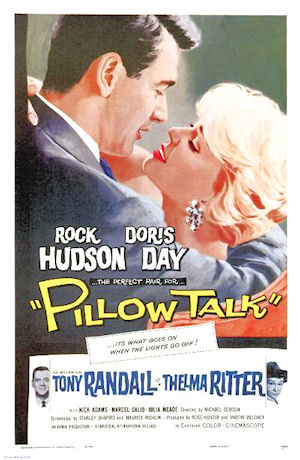
Pillowtalk_posterIt’s the original Rock Hudson Doris Day Rom-Com, with the seemingly perpetual split screen, to match the party line that constantly weaves its way through the story. It’s technicolor, it has an infectious title track, and it’s absurd wackiness somehow adds up to a boy-gets-girl happy ending.

The imposing and dashing Hudson plays songwriter and major playboy Brad Allen, before masquerading as tenderhearted Texan Rex Stetson. But how does he get there? What causes him to play such a ludicrous part? It comes in the form of Jan Morrow, our peppy platinum-haired interior decorator who has had just about enough of her party-line partner, the estimable Mr. Allen.

Her often swanked housekeeper Alma (Thelma Ritter) doesn’t mind eavesdropping and swooning along with all the other impressionable women he romances over the telephone. Jan, on the other, thinks it’s sickening behavior for a man. She would never allow herself to be taken in by such a cad.

Of course, there’s more to the story since one of Jan’s clients, the neurotic millionaire Johnathan Forbes (Tony Randall), is madly in love with her. There’s another wrinkle though, that’s far more important. He knows Allen from his college days. When Brad gets his first view of Jan, she’s an absolute knockout and he wants to win her over, but she hates his guts, at least over the phone. Enter a sweetly sincere Texan and she is swept off her feet surreptitiously.

Brad manages the charade for some time, but for the comedy to work, it must all come crumbling down. In this case, as expected, Ms. Morrow and Mr. Forbes figure things out at almost the same precise moment. It looks like Brad is sunk for good. There’s no hope for such a louse. But then again, if Pillow Talk ended there, it’s audience would be left muttering despairingly and crying inconsolably. The exclamation point comes when Hudson pulls his bride-to-be out of her bed and forcibly carries her through the streets of New York. It sets the stage for some quips perfectly at home in a quaint bedroom comedy plucked out of the 1950s.

Day and Hudson were stupendously popular with the populous and this film would begin their string of pictures together. Although they never reached the excellence, or more aptly, the above-averageness of Pillow Talk, they have remained relatively popular even to this day. Ms. Day was always a fan favorite and rightly so with her impeccably powerful voice, raucous comedic performances, and self-assured charm. And she’s still with us bless her heart! It will undoubtedly be antiquated and overly saccharine to many, but if you have a soft spot for either  Rock or Doris, then enjoy it without reservations. It’s a rather entertaining guilty pleasure.

3.5/5 Stars

Brad: Look, I don’t know what’s bothering you, but don’t take your bedroom problems out on me.

Jan: I have no bedroom problems. There’s nothing in my bedroom that bothers me.

Brad: Oh-h-h-h. That’s too bad.

The Sixth Sense (1999)

The_sixth_senseAll I knew going into The Sixth Sense was that it featured Bruce Willis and there was a twist at the end. That was about it. Thus, it was an interesting opening to have our main character already be shot within the first few minutes. But it’s not much of a spoiler per se because we quickly flash-forward to a year later.

That first case came back to haunt him in the form of a very distraught patient, with a major grudge, however, Dr. Malcolm Crowe has seemingly gotten past it and continued with his life. It doesn’t mean that his marriage is not still difficult and his work still taxing, but he gets by. Finally, he gets a case that might help him resolve his previous failures, at least that’s how he sees it. Of course, the intelligent, but aloof boy Cole Seer (Haley Joel Osment) sees the world in a whole different way. He literally sees dead people, but let’s take a step back for a moment. He has trouble connecting with his loving but nevertheless troubled mother (Toni Colette) and Dr. Crowe seems like his only friend. None of the kids at school like him, because they think he’s a creep.

What Crowe does is help him work through everything that it is unique about Cole and also help him see that there may be some purpose behind these ghosts that he can see. They want him to do things for him so maybe this is Cole’s chance to help them. And so he begins the process and despite it being terrifying and disconcerting at times, he is able to lay to rest these specters. Finally giving them peace and in the wake of a traffic accident that results in a death, Cole finally opens up to his mother. She has trouble believing him at first, but she never discounts her son, which leads to a tearful scene between mother and son.

M. Night Shyamalan is obviously well-known for his great interest in supernatural stories with twist and turns, but to his credit, he firmly plants his films in a reality, like Philadelphia, that we can grasp onto. That’s our base and he can go from there with psychological thrills and even a touch of horror. However, his film actually has characters that are far from throwaway, even if we just look at Malcolm, Cole, and his mother. They are individuals that we can grow to care for over the course of the movie even with the supernatural plot devices and of course, the final surprise ending.

Honestly, I had an unfair advantage knowing that something was coming, so I caught onto some of the peculiarities leading to the final disclosure, but I was still relatively surprised when it came. Despite the rather contrived plot and purposefully cryptic opening, followed by a long wait, the final payoff of The Sixth Sense is certainly worth it.

4/5 Stars

Punch-Drunk Love (2002)

punchdrunk1When Paul Thomas Anderson said he was making a comedy with Adam Sandler, people undoubtedly scoffed at him. I know I would have if I had known about this film back then. However, he proved that you should never question him as a director. Much like a Kubrick or a few other auteurs, I’m not necessarily the biggest fan of Anderson, but you have to admit his films are interesting and very much their own entity.

Punch-Drunk Love is a comedy certainly, but not in your typical sense. It’s a romance, but it’s not quite like any romance I’ve ever seen. Thanks to the bolstering performance of Adam Sandler, it’s whimsical and odd. He plays Barry, a rather passive and antisocial type, who seems constantly quelled by the dominating personalities of his many sisters.

He’s obsessed with buying up pudding for a chance at frequent flyer miles, he picks up a harmonium tossed on the road-side, and most of all he’s lonely, but he’s not comfortable going on dates. His sister tries to set him up with a nice friend of hers who happens to be British (Emily Watson). Barry rejects an offer to go out to breakfast with them and out of loneliness calls a phone sex line. Out of stupidity, he hands over his credit card info, and the rest becomes a big scam that he can’t escape.

Thus, his work phone at the office is ringing off the hook from a girl trying to steal his money. His sister is continually trying to set him up, and Barry seems to live in his own little weird world at times, overflowing with his own personal odd ticks and quirks. He also has an anger problem, meaning he’s bad news if you give him a hammer.

punchdrunk2At times the film is thoroughly unsettling and nervously, uncomfortably funny, thanks in part to Sandler, but also the pervasively weird sound design that utilizes the harmonium. At his core, Barry is a lonely and confused man, aren’t we all, and it reveals a depth to Sandler that many probably have not seen before. It helps that the sweet Emma Watson makes us believe he is likable and in truth, he is somewhat endearing in how he can get lost in an apartment building or always wears the same blue suit. He even follows her to Hawaii for the sake of love. But don’t get any wrong ideas. This is nowhere near the realm of 50 First Dates.

3.5/5 Stars

Grand Illusion (1937)

GrandeIllusionI’m not sure if it’s because I’ve been bred on a certain brand of war movie, but I naively went into Grand Illusion expecting a typical P.O.W. drama. In the back of my mind, I was even ready to compare this title to later works like Stalag 17 (1953) or The Great Escape (1963). Honestly, what was I thinking? With a Jean Renoir film no less.

But that’s the marvelous quality of this film. On the surface level, it looks like an archetype that we are used to. War is being waged. Soldiers are captured. Soldiers are trying to escape. In this case, the particulars are a group of French P.O.W.s in a German camp during WWI. You have the basic idea certainly, but you will not understand the power of this film with such a description. With such a set-up you expect Germans to be the craven villains and the French to be the courageous boys making their nation proud. But that’s not quite the case. It’s more complicated than that.

It’s no surprise that this film was banned by Mussolini, confiscated by Goebbels after the invasion of France, and shown in a private screening to FDR. Certainly, WWII had not started yet, but in 1937 Hitler was on the rise and a wave of fascism mixed with patriotism was flooding Europe. In the midst of such a climate, Jean Renoir, a master of so-called poetic realism, lays down a film like this. It has war, it has patriotism, and it even has enemy factions, but the difference is that Renoir gives them humanity. He casts even his “enemy” in a sympathetic light and suggests that there is a humanity that lies inside of human beings of all different classes, creeds, and nationalities (but he also acknowledges racial discrimination still exists).

Early on in the film von Rauffenstein (Erich von Stroheim) shoots down two enemy flyers in Captain de Boeldieu (Pierre Fresnay) and Marechal (Jean Gabin). However, instead of sending them away to the prisoner of war camp, he shows them the ultimate form of hospitality by inviting them to dine at his table. The cynic inside of me thought, “this must be a trap, a gimmick of some kind because he is a German after all, and they’re supposed to be the villains.” Pretty narrow-minded of me, and of course nothing happens. They share a meal and even find some common ground before going off to the camp.

This next part of the film reminds me the most of a film like Stalag 17 because there is the camaraderie, the mixing of all sorts of different people, but they are all fighting against a common enemy so there is a solidarity between them. For instance, Rosenthal (Marcel Dalio) shares his lavish care packages from back home, Cartier keeps things lively as a former vaudeville performer who is constantly cracking jokes, and even Boledieu, who is of an aristocratic background is generally well liked by everyone. Together they undertake the project of escaping the camp.

Of course, there’s still time for musical performances with song and drag and impromptu renditions of “La Marseillaise.” For such a disturbance Marechal (Gabin) gets solitary confinement, but there never seems to be any malice behind it. It feels more like the protocol of war, and he is let out soon enough. The way things work out the gang is transferred all to different camps and their tunnel is utterly wasted.

De Boldieu and Marechal’s final stop is literally a fortress that is run by their old acquaintance, the now badly maimed Von Rauffenstein. He is as civil as he has ever was but still advises them not to try escape. All the same, he regrets his reassignment and seems generally wistful about the whole situation. Meanwhile, the two officers once again come in contact with Rosenthal. The trio puts together a planned diversion led by De Boldieu which will let the other two escape. It puts von Rauffenstein in another regrettable position, but Rosenthal and Marechal do get away.

As fugitives, their dispositions fluctuate from positivity to loathing, and finally a contented state of comfort when they stay at the farmhouse of a young German woman named Elsa (Dita Parlo from L’Atalante). This is another section of the film that highlights human relationships in an extraordinary way. We expect her to be totally poisoned against “the enemy” and yet she is not. Elsa seems to see the human beings behind the French uniforms and comes to trust and almost rely on their companionship. As Rosenthal recovers from a leg injury, Marechal and Elsa get closer and closer. The time comes for the two men to leave and it is an absolutely heart-wrenching goodbye. It’s so different than our initial preconceptions.

And soon after the film ends, not with some dramatic capturing or even really a chase. But the two men get across the border to snowy Switzerland and that’s where we leave them. Except not with the usual jadedness or even the adrenaline rush of a run-of-the-mill war thriller. Grand Illusion is more piercing than that, speaking to the relationships that can cross war zones if we are only willing to see them.

Jean Gabin is a wonderfully honest-faced actor and the closest description I can give is a man with a Spencer Tracy-like visage except more imposing. Marcell Dalio did some wonderful work with Renoir, and it is unfortunate that he was relegated to such small roles in films like Casablanca, but he is nevertheless even memorable in that. Erich von Stroheim was a titan in his own right as a director and actor, but he was somewhat of a fading star by this point. However, he plays his character with a civility and sense of honor which I have never quite seen equaled before. It was a special performance that reflects a dying breed. The aristocratic soldier of the highest order in all circumstances.

Renoir himself summed up the film years later as being about human relationships and fittingly said the following: “I am confident that such a question is so important today that if we don’t solve it, we will just have to say ‘goodbye’ to our beautiful world.” Here is a master recognizing such a vital key to our very humanity — our personal interactions with one another.

5/5 Stars