Unknown's avatar

About 4 Star Films

I am a film critic and historian preserving a love of good movies. Check out my blog, 4 Star Films, and follow me on Twitter @FourStarFilmFan or Letterboxd. Thank you for reading!

Sunflower (1970)


sunflower

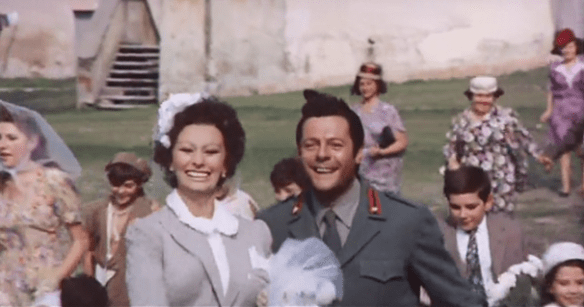
Vittorio De Sica is at the forefront of Europe’s most accessible filmmakers of the 20th century and that’s because the stories he crafts are heartfelt, moving, and also enter comical territory with ease. Sunflower pairs him once again with two of Italy’s Titans Sophia Loren and Marcello Mastroianni, and as you would expect the film starts off full of passion, playfulness, and a little pasta. It’s the dawn of WWII and the frisky pair is in love, deciding to get a quick marriage so they might get a 12 day leave before Antonio has to ship out.

In a sense, this is a kind of war film, because Anto gets sent off to the Russian Front and we get a glimpse of the harsh realities there. We are treated to some newsreel style war footage all the while veiled with a billowing red flag. Sunflower is not a film about the politics of the war per se, but rather the effect that war has on people and their relationships.  It can heighten passion, tear people apart, and change lives for good.

When the news comes home that the war is over, there is a flood of relief and then everyone including Giovanna (Sophia Loren) frantically begins the search for their kith and kin. Worried mothers and wives bring their long-cherished photos into train stations clinging to the hope that just one person passing by will be able to give them some fragment of hope. That’s what Giovanni gets and it’s not much, but a jaded soldier who suffered alongside Anto tells her the last time they were together, he was freezing to death in the snow. Her first reaction is to berate him, but he’s too tired to care by now. So she prepares for the journey to Russia to find the whereabouts of her long-lost love. She will not take no for an answer, but what she finds is more painful than even she could expect. It’s a different type of scar, a different type of hurt that no one could foresee.

sunflower1In some respects, Sunflower feels like a precursor to Life is Beautiful (1997), because both films are full of hopefulness, but they both exist as heart-wrenching stories. They deliver the same moving swells of emotion, but for different reasons. Sunflower ends up feeling a little like Umbrellas of Cherbourg in its tragedy. But the title seems to suggest, maybe, just maybe, like the old adage says, out of the ashes beauty can still rise. All the pain and suffering are only the fertilizer for flowers to spring up from the desolated earth. A memorial of what has happened, but also a harbinger for the future.

This is truly an international film because although it’s in Italian, it was partially shot in Russia (a first for the USSR) and features Russian performer Lyudmila Savelyeva in a prominent role. But the lovely score comes courtesy of America’s own Henry Mancini, rounding out this film perfectly. It’s another pleasant surprise from Vittorio De Sica.

4/5 Stars

The Blue Angel (1930)

blueangel1The Blue Angel is the name of a nightclub and it turns out to be a very fateful nightclub indeed. It just takes us a while to figure out why. Although Josef Von Sternberg’s film is known, rightly so, for making a star out of Marlene Dietrich — in the first of their 6 collaborations — this early German sound film is nevertheless about the decline and fall of Emil Janning’s character. Immanuel Rath begins as a professor at the local college, and although his pupils are unruly, he commands the utmost respect. He sees it as his prerogative, and he is quick to bring order and discipline to these young lads. But boys will be boys and they become corrupted by the beautiful cabaret singer Lola-Lola (Marlene Dietrich). One evening the professor drops into the seedy joint to look out for some of his troublemakers and talk with the proprietor. Of course, he unwittingly ends up meeting the gorgeous girl backstage and returns the following evening with a seemingly very flimsy excuse.

Ironically, his boys are not the only one who take a liking to her. The once restrained and reserved man of learning begins to change. He becomes a man obsessed and infatuated beyond the point of logic. But what does he care? He enjoys being in Lola’s company and the idea of a marriage proposal makes complete sense in the reverie that he is swimming in. So they do get married. The professor leaves all the common sense behind and goes on the road traveling with his wife and their promoter.

blueangel2But by this point, he is a sorry figure, so pitiful and bedraggled in every way. He reluctantly parades himself in front of audiences as a clown just to make some money for him and his wife. It is, of course, inevitable that he return back to his old stomping ground, and it does eventually happen. He reluctantly goes onstage and it is difficult to watch this final chapter. Lola is no longer his. He’s completely ruined. Completely destroyed. Oh how far the man has fallen, as he winds up keeled over on top of his former desk in the gymnasium.

I think I enjoyed Emil Janning’s in The Last Laugh more and yet to its credit The Blue Angel does not cop out in the end. It has a tragic trajectory that in some ways feels like a precursor to such noir as Scarlet Street and Nightmare Alley. It’s understandable how Dietrich became a star because stars have the capability of drawing your attention. Janning’s gives a wonderful performance certainly, but the allure of Dietrich is too much to discount. She steals the show just like she steals the Professor’s heart. We’re just “Falling in Love Again and we Can’t Help It.”

4/5 Stars

Metropolis (1927)

MetropolisposterFritz Lang’s archetypal sci-fi epic is steeped in politics, religion, and humanity, but above all, it is a true cinematic experience. It is visually arresting, and it still causes us to marvel with set-pieces that remain extraordinary. How did Fritz Lang piece together such a gargantuan accomplishment? Maybe even equally extraordinary, how was I able to see almost a complete cut of this film, which was at different times thought to be lost, incomplete, and ruined?

Metropolis really feels like one of the earliest blockbusters, although I would have to further substantiate that. Still, it’s basic story is generally captivating following a young man named Freder from the upper echelon of society with a father who runs things. This young man is really in the perfect position to succeed, the way society is set up. He even goes to the preeminent school where all the boys are dressed in white. Little does he know in the lower depths the beleaguered, grungy, weary masses in black are slowly killing themselves with work. The machine that drives this society is never satisfied, always desiring to be fed more and more and more.

When the boy finally sees the reality of the infrastructure his paradise is built upon, he cries out in horror. This is not the way things are supposed to be. He eventually switches places with one of these workers and attends a meeting deep in the catacombs (an allusion to the early Christians), where the pure goddess Maria lifts the spirits of her fellow man. But of course, the evil inventor Rotwang is enlisted by Freder’s father Joh Frederson. Their own relationship is marred by conflict over a woman they both loved. Freder’s dead mother. And so the scientist looks to resurrect his long lost love, and he needs Maria to develop his plan. He kidnaps her and from her likeness creates a double, who goes out to wreak havoc on all of Metropolis. The apocalyptic words of the Book of Revelation ring true as the whore of Babylon deceives the masses and leads them to destruction.

But Freder is the Mediator, he is the Savior of his people, and he is necessary to bring peace and tranquility to a world that has descended into such brokenness. So Metropolis is certainly a film full of symbolic touches, religious connotations, and political commentary, but all of this is developed by Fritz Lang through an archetypal hero’s narrative.

Hollywood has become an industry seemingly so obsessed with story, screenplays, plots. Certainly, a film like Metropolis is at least adequate in that area alone, but what really sets a film such as this apart is its cinematic scope. The sheer vast expanses it fills. The scope it creates through its plethora of extras and encompassing sets is hard to downplay. How to describe scenes where water is literally breaking down walls and covering masses of fleeing children? Or smokestacks spewing out refuse while trains, planes, and automobiles pass by in every direction. People scattering this way and that, following the false Maria in a chaotic frenzy. It reminds us what the motion picture, the moving picture, is all about. The images that are brought before us lead to a suspension of disbelief because more importantly they are incredibly affecting. At the atypical 20 frames per second, they are images full of tension, full of energy, and full of life.

Metropolis-new-tower-of-babelIn a sense, with Metropolis, we can easily see a precursor to Chaplin’s Modern Times a decade later. There is a general apprehension of the machine and the impact of a true industrial revolution. There is a fear that there are more positives than negatives. That machines will take over and man will become outdated. Perhaps someday our creation will destroy us. By today’s standards, such notions seem archaic, but are they? We still live in a society ever more obsessed with advancement, technology, and all the things that come with that. However outdated some of Metropolis might feel, and there are numerous such moments, at its core is the final resolution that between the body and the mind there must be a heart to regulate. We are not simply animals with bodies or rational machines with minds, but the beauty of humanity is that we have a heart, pulsing with life and vitality. That is something to be grateful for and never lose sight of.

5/5 Stars

Notting Hill (1999)

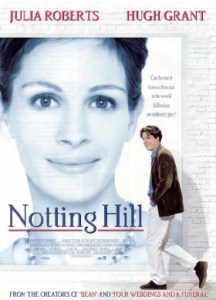
NottingHillRobertsGrantThere is a scene in the film where a group of friends is sitting around the dinner table in the Notting Hill district of London, and they are having a friendly after dinner competition to decide whose life is the most hopeless. The winner gets the last delectable piece of fudge. One person sitting at the table is seemingly out of place. Actress Anna Scott (Julia Roberts). Her face is plastered on double-decker buses all down the squares. She made $ 15 million on her last film, circa 1999. You would think she’s got it made. But this woman takes her turn and shares about her own brokenness. She’s had surgeries to maintain her beauty. The tabloids rake her life over the coals, and when she gets old, she will only be remembered as the shell of someone who used to be famous.

It’s a haunting, honest look at what it means to be a celebrity superstar, and it is for this reason that Notting Hill works as a charming, at times witty, and altogether unlikely romantic comedy. It’s this simple suggestion that two people, from two entirely different spheres of life, can be together, because of the simple urge of every human for companionship, closeness, and someone to know they exist.

The two individuals, in this case, are Anna who I’ve already mentioned and Will Thacker (Hugh Grant). He’s a nobody just like you and me. He owns a corner travel bookstore, very cleverly named The Travel Book Co. He’s gotten his heart broken seriously twice and his roommate is the oddest crackpot you could ever have the misfortune of living with. That is his average, everyday life, in the neighborhood of Notting Hall.

That’s what makes a visit by an inconspicuous Anna Scott to his bookstore all the more extraordinary, while still allowing for the suspension of disbelief. Everything follows sequentially as it should. He runs into her with a cup of coffee and offers his flat as a place to freshen up. The first kiss comes quite by accident. Days later he winds up in a press conference once again face to face with this great star. But she surprises him by being his date to a small dinner for his sister’s birthday. A nighttime jaunt is accented with all the romance you could ever expect.

It’s too perfect and what follows are two obligatory strikes in their fantasy relationship. Will learns about Anna’s big shot boyfriend (Alec Baldwin) who is back in town. He’s caught off guard by it. Months go by as he tries to forget her, but she shows up on his doorstep looking for that person to talk to once more. When the tabloids show up, she is peeved, directing all her anger at Will, perhaps a little unfairly. And that looks to be the end of it all.

Months roll on again like pages in a travel log and here Anna is again in his shop, like the first time they met.  There’s an earnestness in her request to rekindle a relationship that makes us ache for Roberts. Like any frightened, often wounded, ordinary man, Will turns her down. It’s the logical decision. After all, he doesn’t want to get hurt again. Strike three. Except… his friends rally with him to catch her before it’s too late, because what’s the fun of rationality?

They go racing like a daft crew from Top Gear, “Gimme Some Lovin'” thumping in rhythm with Will’s beating heart. He gets to the Savoy Hotel just in time for her final press conference. A la Roman Holiday he professes his love incognito, and they wind up with it all. Red carpets, quiet afternoons in the park, and most importantly each other.

Notting Hall had me hooked simply with its images of England, a place that is near and dear to my own heart. It’s also a wonderful backdrop for romance, and this story from Richard Curtis finds it’s perfect duo in Julia Roberts and Hugh Grant. He is handsome certainly, but that is overshadowed by his decent, every man quality which attracts Anna to him. He’s the man who willingly defends her honor in a restaurant, not because it’s easy, but it’s simply the right thing to do. Meanwhile, Roberts perhaps is playing a version of herself, as an actress, but she gives the character the necessary insecurities, eliciting more sympathy than I would have thought possible for someone coming out of Hollywood. Yes, Notting Hall might be a few minutes too long, but getting to walk down Portobello Road just might be worth it.

3.5/5 Stars

Two Days, One Night (2014)

Deux_jours,_une_nuit_posterIf people watch Two Days, One Night, they’ll probably recognize one face and you’ll hear something similar to the following: “That’s the girl from Inception and the Dark Knight Rises right?” The more observant viewer might say something like: “Isn’t that Marion Cotillard?” And they would be right on either of these accounts and yet the Dardenne Brothers (who the average viewer, unfortunately, might not know), take Ms. Cotillard and place her in a completely different type of role altogether. They take an A-List Hollywood star and drop her in the every day, lower class world that the brothers themselves came out of. In fact, the story and most of their stories are set in Seraing, a French-speaking area of Belgium that is known for industry.

They have an immense fascination in simple people just trying to make ends meet. Most of their stories have mundane narratives like The Kid with a Bike (2011), and Two Days, One Night is little different in that respect. It’s so basic in conception and yet in this banal and rough-edged world, the Dardennes find immense beauty.

Our chief subject is Sandra, a young woman who is married has two kids and has just battled her way back from depression. Undoubtedly it was a tough road, but she is obviously resilient and ready to get back to work. After all her family needs the money because her husband only works at a restaurant. But her whole reality is changed in a matter of minutes when she learns she will be laid off. Her company can either keep her on or give all their other employees bonuses. The majority took the bonus over Sandra. Her work friend Juliette buys her another ballot for the following Monday, so Sandra has a few days to try and plead her case. But she’s done fighting. She’s tired and defeated before she begins. It’s her husband Manu who urges her forward and reluctantly Sandra follows through.

This is the core of the film as Sandra goes from home to home, ringing doorbells, and talking with the people hidden away in their homes. They are no longer her faceless colleagues, but soon they become living, breathing people. Just like Sandra, they have a personal stake in this decision. Maybe it’s to pay for a daughter’s schooling, remodeling a home, or trying to stay afloat as a single parent. There are those who are simply fearful of being laid off and those who hope that Sandra will succeed while admitting they’ll vote for the bonus. They all seem like generally legitimate responses, and Sandra knows that just as we do, but she tries anyway, at least to talk with them–get them to see her side. Because this decision has major repercussions, and it’s not just occurring in a vacuum.

Things are teetering dangerously on the edge of equilibrium for everyone involved because everyone seems to be between a rock and a hard place. And there’s no difference between Marion Cotillard and all these other unknown actors. They’re all bracing themselves for sinking in the same boat.

In a way I found myself comparing this film to the courtroom drama 12 Angry Men because in a similar manner Sandra must go about trying to convince her colleagues to change their minds, and talk them out of their convictions. It’s a difficult task, and this film speaks to the logic and rationale that dictate human decisions. There are individuals all across the board from those who only are looking out for themselves. Is it too hypocritical to call them selfish? It’s hard to know. There are those who want to good, but just cannot, and finally those who stand by Sandra, because they feel it is the right thing to do. The most painful of these interactions occur with those colleagues, who are so conflicted inside. You can see the situation at hand tearing them apart.

Other directors would be terrified of such a film, looking to fill slow moments with some kind of heightened state of action. The Dardennes are content with having their actors rock out to Them’s “Gloria” after a long day. And true, there are many moments of tension and even conflict, but most of this film is about people talking, mirroring the rhythms of real life. The camera is constantly by Sandra’s side, peering at her face, and staying on her hip. Her face has to carry some scenes at times, and it does so wonderfully. Really, this is a film that displays her resilience, grit, and determination to push forward. It had the potential to be either feel-good drama or a tragic story, but it finds a beautiful middle ground. Sandra comes out an undisputed winner, just not in the way that she expected.

4.5/5 Stars

Zootopia (2016)

ZootopiaDisney has scored again. On almost all accounts Zootopia is grade-A family entertainment. To address the elephant in the room, the film is rather formulaic in its hero’s journey and at times it feels like we are attempting to systematically check off all the necessary moments in the rise, fall, and redemption of our spunky heroine. However, there are moments of wit and grace that begin to slowly grab hold of us an audience. It, in turn, becomes ceaselessly inventive with this metropolis of anthropomorphic animals, whether it is the rhythms of daily life or the social issues present that look strangely familiar.

In truth, it works as a thinly-veiled parable for mankind in our present condition. The lines are not black and white, but predator and prey. True, there are differences and they give way to pernicious spells of racism or more aptly in this context, “specism,” but there is room for understanding and symbiosis, to use an ecological term. We could go back and forth for a long time about the actual mechanisms and minutiae of evolution and whether it makes sense or not, but the bottom line is that humans and animals have a lot in common.

Zootopia playfully makes that blatantly clear, and within all the subtle ribbing, it does have a broader message which is true of all great pieces of family-oriented animation. Movies have the ability to allow us to more fully understand the world we live in and that applies to children as well–in fact, they are even more malleable.

There are various other reviews alluding to Animal Farm, In the Heat of the Night, and Who Framed Roger Rabbit. All are interesting touchstones for this film, but obviously, all comparisons falter at some point. For me, Zootopia has surprisingly interesting social undertones to its drama that try to make sense of these things even for young viewers. That’s no small feat and perhaps even more praiseworthy it delivers it in a delectable story that follows in the footsteps of the best buddy films and police procedurals. It’s all wrapped up in the encapsulating animation of Disney that at points feels overwhelming, but the characters of Judy Hopps (Ginnifer Goodwin), Nick Wilde (Jason Bateman), and even the likes of Clawhauser give it winsome charm.

Everything from Sloths at the DMV to a raspy Godfather possum is on point, and the film continues with a stream of gags. However, we are always being drawn back to the journey of Officer Hopps as she tries to prove herself and solve the mystery behind the 14 missing animals. But if this was only her journey it wouldn’t be all that interesting. Thank goodness she has a buddy to cross her will, make her stop and think, and ultimately stand by her when the world isn’t a utopia anymore. I’m not sure what I think about Shakira’s presence in the film, but I’ll let it slide this once.

4/5 Stars

Nosferatu (1922)

nosferatu1The hand of F.W. Murnau is less noticeable in this early classic of his, but Nosferatu still works seamlessly as a piece of drama and horror. In fact, it by now has become somewhat of a horror classic and the archetype when it comes to vampire movies, taking a lot of inspiration from Bram Stoker’s Dracula. I think one of the things that makes Nosferatu so gripping is the fact that it mixes the plausible with the supernatural making for this weirdly rewarding ride. Is it scary? No, not in the modern sense of the word.

But it’s a story steeped in Myth. There is mention of the Black Death, supernatural creatures, and a being that “suckles himself on the hellish elixir of their blood.” What wonderful imagery that develops a genuine awe in this devilish being. And yet in the same instance, we’re getting scientific explanations of venus fly traps and tentacled polyps acting as symbols certainly but also tying us back to the real world. These forces of nature are real, backed by science, and make a vampire just a little more conceivable.

Running through Nosferatu is a love story, and much like Sunrise, although Nosferatu is a “symphony of horror,” there is also a bit of a love song underlying the vampire tale. It lends this story some heart, because these characters, like our protagonist Hutter, actually have something to live for.

Nosferatu most certainly is a symphony, and along with the expressionistic images, it uses title cards as well as excerpts from ship logs, books, and letters to tell the story. One such inter-title card from Count Orlock reads: Your wife has a lovely neck. Hutter has little idea what he means (or pretends not to), but we know, making it a rather funny but unnerving comment. There’s something about knowing what is undoubtedly going to happen and being powerless to stop it. For instance, when someone acknowledges they have two mosquitoes bites quite close together that spells trouble to the audience, but we can only watch and wait.

nosferatu2Because when Hutter first goes to offer Count Orlock a house we know it is bad news, to begin with, but it takes a long time for anything to actually happen. Orlock moves into the abandoned mansion across from Hutter and his wife, and that’s when the danger strikes close to home. There’s a madman in the hospital diverting attention, and Hutter winds up incapacitated so he is incapable of coming to the aid of his love. She is left vulnerable and the vampire has already proven what havoc he can wreak with the crew on a ship. Aside from Max Schreck’s frightening facade complete with pointy ears, bulging eyes, and menacing fingers, the vampire literally appears and disappears into thin air. There is a haunting aura built around him because he is something supernatural, something that we cannot understand except through myth. I found myself getting tense waiting for something that I was not sure about. That was the exciting part. It’s not a blood and guts, monsters jumping out of closets, kind of horror. It’s not ridden with cliches either because it was the one creating its own mystique.

It’s hard to believe how much popular culture has been derivative from Stoker’s Dracula, much like Doyle’s Sherlock Holmes, or Shelley’s Frankenstein. However, amidst all the vast works of Dracula and vampires, Nosferatu stands out. It represents the visual aesthetic of German Expression wonderfully, and it casts a long shadow. It’s hard not to, at the very least, admire its artistry and be taken aback by its legacy. In the realm of silent films, Nosferatu is a must, pure and simple. It doesn’t rely on bloodcurdling shrieks and screams, but the images begin to invade our consciousness. One seems fleeting and the other sticks with us.

4.5/5 Stars

The Last Laugh (1924)

lastlaugh1Without sound, silent films become almost a completely visual medium and there was no one more visually-minded than German director F.W. Murnau. Aside from the opening title card and a message to begin the epilogue, he stays away from that kind of aid to tell his story and instead relies wholly on the image. His film does, however, boast a vibrant score, so that fills the void in the absence of dialogue.

Emil Jannings, the rotund, mustachioed leading man, stars as the veteran hotel porter, who is demoted to bathroom attendant due to his age and frailties. And it’s true that he always seems bent over and perpetually weary, but it only gets worse when he loses his esteemed position as the symbol of The Atlantic Hotel. Before he stood beaming ear to ear in his prim and pressed uniform that reflected his status. Then, he winds up towel in hand, resigned to stay hidden away in the bathroom. Now everyone could care less about him. It’s a tragic trajectory that this story takes.

The film opens at the lavish hotel which feels very similar to the grand hotel, and this along with the man’s apartment building are the main locations that Murnau works with. And he does set up his scenes so interestingly, whether it’s around a revolving door in the hotel or the staircase in the apartment. He’s constantly giving us a perspective of things with wonderfully textured, layered shots exemplified sublimely in such moments as Jannings superhuman feat carrying the large chest. Murnau gives it a wonderfully dreamy, ethereal quality, the way he clouds the frame. He also uses his actors in dynamic ways to fill the space in front of us. It hardly ever feels static or boring for that matter, because there’s almost always something of interest to be looking at.

lastlaugh2This is a very heart-wrenching film, because, in a sense, at its core, it’s about aging gracefully and trying to navigate that season of life. Because, the reality is that, each one of us will grow old. Our bodies won’t be able to function like they used to. Our feet will grow weaker. Our eyes will become tired more easily. We can completely understand this man’s plight. He has pride and the shame of acknowledging his demotion is too much for him to bear. He tries to hide it, from the wife and from the neighbors, but, of course, they find out. His family is ashamed and his neighbors belittle him with glee. The saddest thing is this doorman is not a bad fellow, as illustrated by how he comforted a little girl who was being made fun of. He’s a good man, and he deserves better than this and yet life very often is not just. The gossips and the connivers seem to get ahead. The beatitude, the first shall be last, hardly ever seems to be true. In fact, the film pauses with the following title card:

“Here the story should really end, for, in real life, the forlorn old man would have little to look forward to but death. The author took pity on him and has provided a quite improbable epilogue.”

There is a major shift in tone as the doorman is left a huge sum of money rather unexpectedly, and he spends the days now eating heartily and generously tipping all his former colleagues at the hotel. It almost feels like a completely different story, and it’s the ending that we want as an audience. Except still lurking in the back of our minds is that this is very rarely reality. But there is some satisfaction that at least in this case Emil Jannings had The Last Laugh.

This film is literally a piece of film history that has thankfully been reconstructed for our viewing pleasure and I’m thoroughly glad it was. I’ve only seen Murnau’s Sunrise: A Song of Two Humans, which is magnificent. However, after watching this earlier work it made me realize I need to examine more of his filmography, including Nosferatu (1922), Faust (1926), City Girl (1930), and Tabu (1931).

4.5/5 Stars

The Graduate (1967)

thegraduate1“You’re living at home. Is that right?
Yes. 
Do you know what you’re going to do?
No.
Are you going to graduate school?
No.” ~ Elaine Robinson to Benjamin Braddock

As a recently graduated person, I thought it was only pertinent to return to this landmark film to see if I could glean any new insight. In many ways, the main premise of The Graduate always repulsed me. I couldn’t get behind the comedy because it seemed so at odds with what is going on onscreen.

But now I think I more fully understand Mike Nichols’ style as he leads us through Buck Henry’s script. There certainly is a wicked wit dwelling there, but there’s also more to it. He’s trying to undermine social mores and say something by switching tones on us. In this case, it seems like he’s talking to all those listless souls just set adrift after college. He was their elder, but in the characters of Benjamin Braddock (Dustin Hoffman) and some respects Elaine Robinson (Katherine Ross), young people found their equals.  People they could relate to in their own anxiety and at times apathy about the future. And it’s as much Elaine’s story as it is Ben’s since they both are riding off into the great unknown of their future together.

Thus, this isn’t just about an affair, though that did help to shatter the Production Codes. There is so much more that actually causes Benjamin to get involved with Mrs. Robinson (Anne Bancroft). The implications extend far beyond.While The Graduate‘s main hook seems rather curious, the rest isn’t all that crazy. In fact, it’s quite relatable.

We get our first view of Ben, sullen and anxious as he rides the moving walkway in the airport terminal. The haunting vocals of Simon & Garfunkel’s “Sound of Silence” ring in our ears, but there’s also that almost comical voice reminding travelers to use the handrails.

It’s when he touches down and gets home that things become all too real. He’s entering back into his parent’s world which is reinforced by this general theme of suffocation and in some sense alienation, fawned over by parent’s friends and encased in a scuba suit. Ironically, he’s no hippie or counter-cultural revolutionary, but he still feels at odds with the community he finds himself in. There’s a generational gap, and even Hoffman’s own portrayal is so contrary to this WASP society. In casting Hoffman, not a particularly handsome young man, an atypical example,  Nichols is ratcheting up the irony.

thegraduate2Then Mrs. Robinson coolly enters his life. It’s perhaps best signified when she tosses him the keys. They end up in the fish tank almost as if on purpose and after that she has him reeling for good. Soon he’s walking into the lion’s den (or lioness’s) as she expertly manipulates and elicits the precise response from him. In these moments the film is elevated by the awkward, huffing and puffing, and nervous chattering of Hoffman. We often forget the second part of his famed line, “Mrs. Robinson you’re trying to seduce me. Aren’t you?” His general naivete and hesitancy say it all.

I also made a startling discovery. Ben doesn’t have any friends! Or else, where are they? The inference perhaps being that he spent so much time being a track star, being on the debate team, and being editor of the paper that he never stopped to do the other things that college is all about. Building relationships with other human beings your own age. When he gets out and realizes his directionless anxiety, he tries to remedy it in other ways. The most obvious way is sleeping with Mrs. Robinson.

thegraduatesBut when he meets Elaine Robinson and finally begins to connect with her on a peer-to-peer level, it’s something so profound to him. Having someone his own age that he can relate to, who feels the same unnamed apprehension and angst that strains on him. It’s what makes Ben become so mixed up. He has true feelings for her, while his affair with Mrs. Robinson only serves to poison all that could be good. And his illogical, unhealthy pursuit of Elaine continues to Berkeley where she is attending school. Still, Mrs. Robinson and her now estranged husband look to send their precious daughter far away from Benjamin Braddock.

thegraduateThat’s what makes his final Herculean effort all the more climactic. He bursts in on her marriage to another man and whisks her off to another life altogether. A life that seems exciting at first, because, oh how great it is to be young and in love. But once they climb aboard that bus in their tattered garments, have a chance to sit down and really think about what they are embarking on, you see something else in their eyes. The laughter slowly dissipates and as they look around nervously, they begin to somber up. True, Ben is no longer alone in an airport terminal, he has a fellow traveler, but that does not make the future any less unpredictable or scary for that matter.

That is the life of a graduate. In so many ways feeling like an outsider, a foreigner in a land that you used to know. You’re living at home. You don’t know what you’re going to do and you’re not going to put off the decision by going to grad school. We’ve all been in a similar place one time or another and that’s why this film resonates, not only with the generations of the 1960s but even to this day.

What truly elevates The Graduate above Nichols’ other films, aside from this universal quality, is the stellar soundtrack courtesy of fellow New York natives Simon & Garfunkel, who became icons of the folk scene during the 60s and 70s. Their album Bookends is still a classic, featuring the fully polished version of “Mrs. Robinson.” While not all the lyrics are here in the film, it became an anthem, reflecting the gap created between the older generations and their kin. While the likes of “Sound of Silence,” “April Come She Will,” and “Scarborough Fair” lend themselves to the more introspective moments of the film like no score ever could. It’s part of what makes The Graduate a cinematic watershed of the 1960s.

4.5/5 Stars

The Shining (1980)

theshining3Stanley Kubrick is not generally known as a horror film director. His impact was far broader than solely one genre. How is it then that he made one of the enduring canonical films in the horror genre? It’s been over 30 years and people are still talking about The Shining — still using it in every kind of parody and homage imaginable. Like a Hitchcock or a Spielberg, he’s one of those directors with an eye for what’s thrilling as far cinema is concerned, but perhaps more so Kubrick deals in complexities. Ambiguity is his friend as much as the beautifully shot interiors of The Shining. He builds and constructs the perfect scaffold to work off of, and it’s full of tension and shock value, but it leaves the audience with questions. I watched Nosferatu recently and what I came out of it with was a conviction that it was not your typical horror film — it seems to follow you and haunt your thoughts in a sense. The Shining is a little more like a modern horror with frightening images, and yet it shares that same quality. You cannot help but ruminate over it or think about what you just saw and what it really means. Truth be told, I don’t know what to think about the cryptic ending and, in all honesty, I don’t care too much, although it makes for interesting discussion.

theshining1This film found its source in Stephen King’s novel (which I have not read). For the life of me, I had never thought of the significance of the title, but Scatman Crother’s character explains it in the same way that his mama had before him. “Shining” is being able to talk without your mouths. The little boy Danny Torrance has such an ability, and it proves to be the entry point into this film’s conceit. Not only is he able to say things without talking, but he sees things, horrible things, that other’s cannot — rather like The Sixth Sense (1999).

His father Jack (Jack Nicholson) and mother Wendy (Shelley Duvall) take him to a Colorado mountain getaway for 5 months of isolation, because it seems like a good deal. After all, Jack wants to get some work done on his book and he could use the unbroken solitude,  but of course, there’s an underlying tension that slowly builds as their time alone draws nearer. It’s done through the foreshadowing of cryptic images, violent tales of local folklore, and of course, a score that is constantly ringing in our ears. That’s the best way I can describe it. We know something is up.

So what does Room 237 mean? What about Grady and the bartender who serves Jack his drinks at the bar? They’re just as perplexing as Danny’s ability or the sudden change that seems to come over Jack. There are these perplexing moments that are difficult to account for whether it’s the initial introduction of the Chief (Scatman Crothers) and Danny, who he telepathically communicates with. Then, Jack Nicholson carries such a genial quality, and yet underlining all those Cheshire cat smiles is something deeply troubling.

theshining4Amidst the dreams and haunting images that blur the line between fantasy and reality, past and present, there is a strange fascination that develops for The Shining. Almost a morbid fascination, because we know something is wrong, but we keep watching anyway. We want to know what happens and furthermore, Kubrick’s visuals are often mesmerizing, although they remain indoors for the most part. His camera often trailing characters as if they are prey.

He pays his audience the final respect of not giving us everything and not tying up all the loose ends. We are left with images and photos ingrained in our mind’s eyes. Admittedly, Shelley Duvall is not an actress I usually pay great attention to, and certainly, this is Nicholson’s film along with Kubrick. He was made for such a twisted, layered role, that overflows with a certain level of affability and then becomes completely psychotic. It makes him far creepier than any villain clothed in black because Jack Torrance will openly kill you with a sing-song voice. That’s pure evil.

4/5/5 Stars