 As both a political drama and feel good movie, this film cemented James Stewart as an acting powerhouse. Furthermore, despite its age, it acts as a timeless reminder of the evils of political machines. It makes us root for the underdog, and it is distinctively American. Here is a cast and a story that seemingly could never be equaled, but what this film really had going for it was an idealistic outlook. I can, myself, often be a cynical person, and still Mr. Smith never fails to make me acknowledge the numerous attributes that make our country great, whether it is through montage, monuments, music, and of course Jefferson Smith himself.
In one of his best performances, Jimmy Stewart is an idealistic, naive boy’s troop leader named Jefferson Smith. The starry-eyed Smith trusts that our nation is founded on some very noble principles that should be fought for tirelessly in government and in society. Above all, he is a likable fellow, who earnestly believes in the merits of this country, and he is beloved by boys all across the state. Now, this all sounds fine and dandy, but it would never have come across on the screen if it had not been for Stewart. He emanates this awkward and innocent energy that puts life into the idealistic creation of Jefferson Smith.
When the film opens, everything is in turmoil when a senator suddenly dies and a replacement is needed fast. Believing Smith will be a pawn, a powerful man named Taylor (Ed Arnold) gets Smith a seat in the nation’s Senate. There he joins the respected Senator and old family acquaintance, Joe Paine (Claude Rains), who is also a cog in Taylor’s machine. However, although he is out of place in Washington, the patriotic Smith does his best to be worthy of his position. He realizes that the press will not give him a break, and the other Senators do not take him seriously.
So, on the urging of Paine, he decides to come up with a bill for a boys camp back in his home state. He requires the help of the world-weary secretary Saunders (Jean Arthur) to get his bill done. Initially, she is disgusted by his naivete, but as she grows to know him, she realizes he is only going to get himself hurt. His action to propose a bill soon find him face to face with the political machine that elected him. Taylor also has stakes on the piece of land where the boy’s camp would be, and he wants it for a dam.
Smith finds himself being accused of using his position for his personal gain, and pretty soon he is before a committee with false evidence piling up against him. With all odds and seemingly everyone else against him as well, Smith makes one last monumental effort. Thanks to the help and guidance of Saunders, Smith fights to plead his case through a filibuster.
Fatigued by many hours of giving impassioned speeches and reciting the Constitution, Smith finally collapses, but not before effectively succeeding at his task. I doubt this would ever happen in real life, but in the film, it is fantastic watching the Senate break out into complete and utter mayhem. Ultimately, a young man with “a little bit of plain, ordinary, everyday kindness and a little looking out for the other fella,” was able to win. True, it may be overly sentimental, but it is a wonderful piece of sentiment all the same.
Frank Capra was wonderful at these type of cheering tales and his stars were in top form. There is an absolutely wonderful supporting cast here including Claude Rains, Edward Arnold, Eugene Pallette Thomas Mitchell, Charles Lane, Harry Carey, William Demarest, Beulah Bondi, and numerous other familiar faces I don’t even know the names of. That’s the beauty of the studio system I guess. It may have the same director, same leading man, and some of the same general themes, but Mr. Smith Goes to Washington covers completely different territory from Capra’s later classic It’s a Wonderful Life. Mr. Smith should be seen as a unique, and very much American film.
5/5 Stars

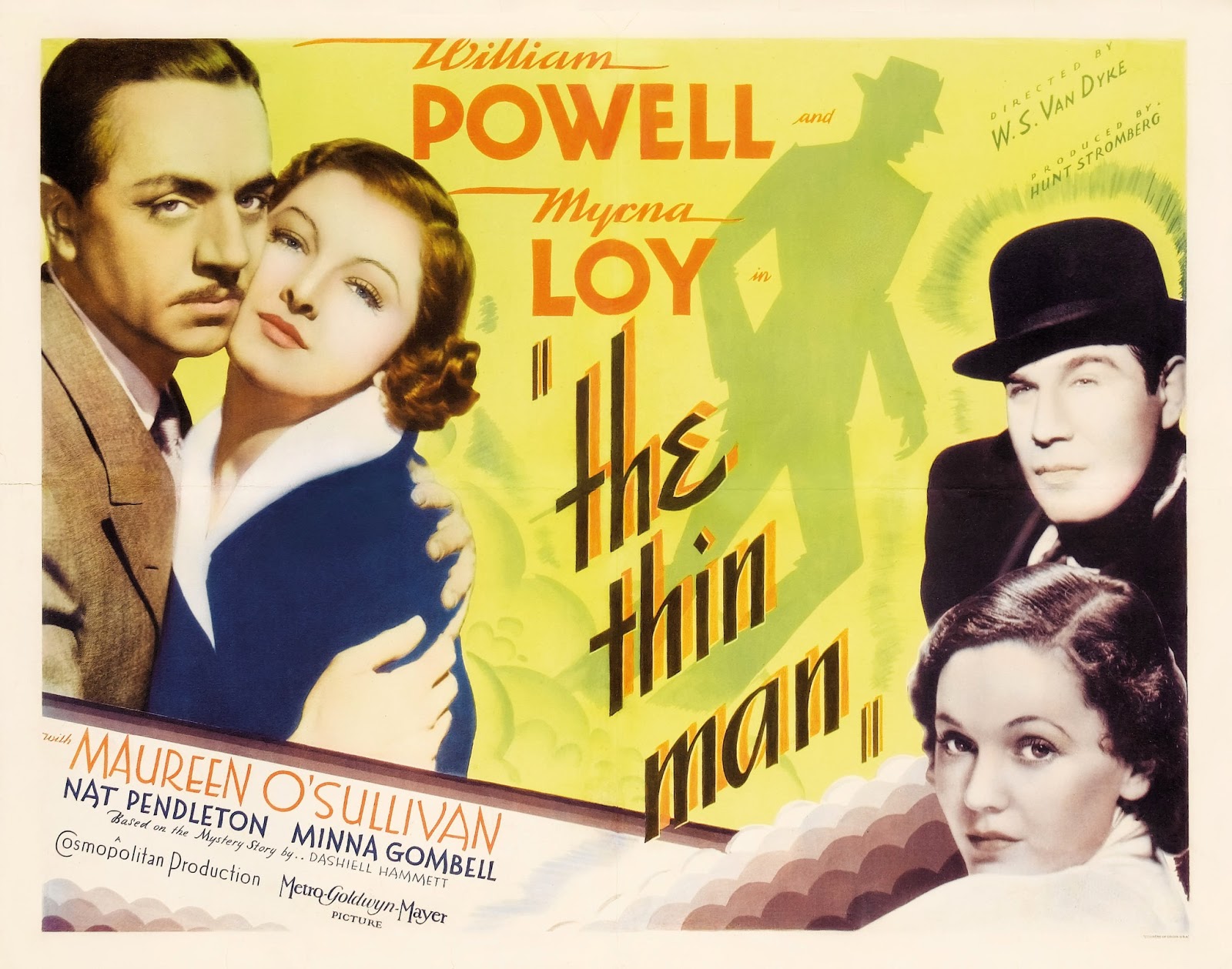 Starring William Powell and Myrna Loy and adapted from a Dashiel Hammet novel, this comedy-mystery follows a former detective and his rich, loving wife. At first Nick Charles is reluctant to go on a case that revolves around a thin man who he knew and who has disappeared. The police believe he is the culprit behind the three subsequent murders. Other mysterious events and the many suspects, leave both the police and audience unsure. After the constant begging of Nora, Nick follows a hunch and joins the case. He seemingly makes a break through and he and Nora hold a dinner with all the suspects. There the truth is discovered and the culprit is found. This is like a screwball comedy that is further complicated by the mystery. Powell and Loy play off each other very well and the supporting cast is good.



 4 Star Films