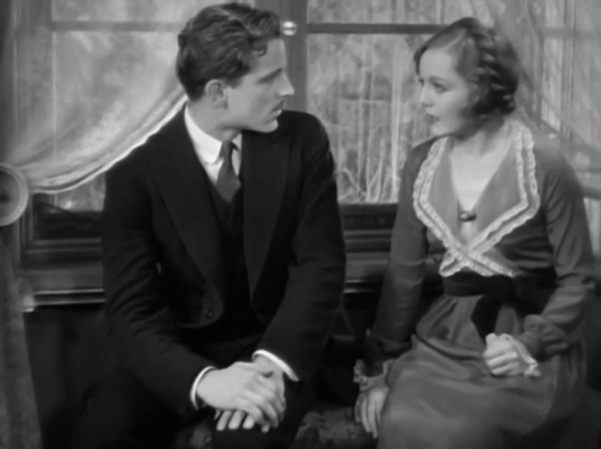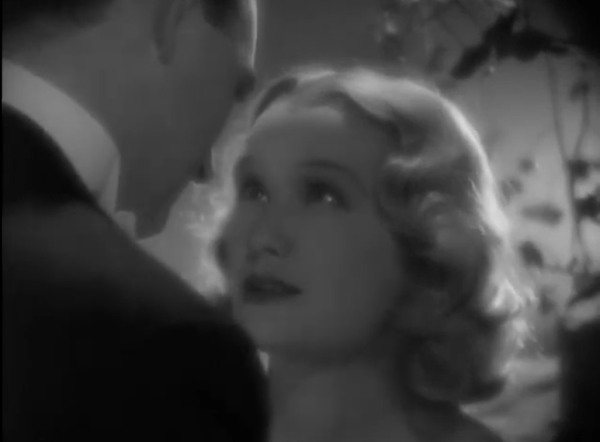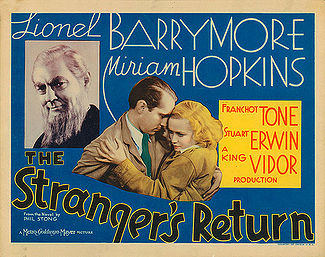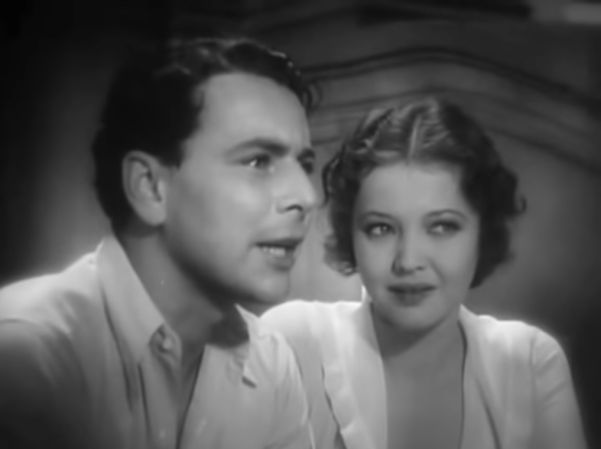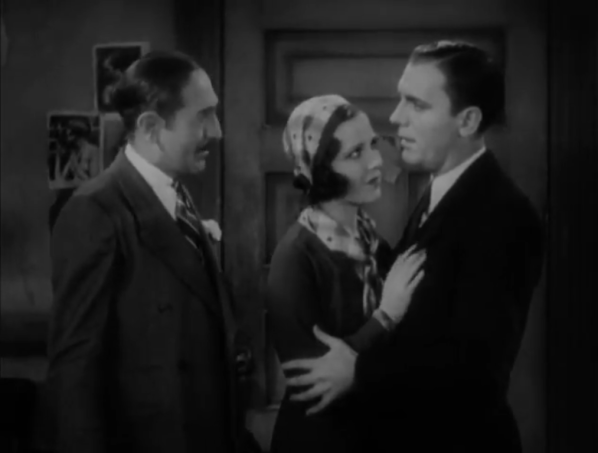
The Stranger’s Return (1933): Lionel Barrymore and His Granddaughter

Strangersreturn

Establishing shots often get a bad name for their bland or token quality, but it’s true when done well, they can set the tone and create an instant impression on the audience. King Vidor’s The Stranger’s Return instantly accentuates this rural milieu. It feels like a stable and equestrian existence, a supremely serene safe haven.

As the movie progresses, we are privy to marvelous pictorials feeling akin to Jean Renoir or John Ford. There is a bit of that pastoral sense of space where the landscapes feel untarnished and beautiful down to their very compositions. Regardless, the land is nothing if not punctuated by human beings meant to till the soil and cultivate it.

Inside a farmhouse, we meet a family of grown-ups sitting around the breakfast table with their patriarch. Beulah Bondi is among them, and they aren’t mean-spirited folks by any means, but they’re generally dutiful and reserved.

I am reminded of the moral tale in the Book of Virtues from my childhood where the adult children care for their dying mother and the chest under her table — just waiting to swoop in and get their due. They can only imagine what treasures she will bequeath them upon her death. It’s the same unspoken undercurrent in this film because Grandpa Storr isn’t oblivious. He knows what’s going on. The difference is, that he’s not ready to go down without a fight.

Lionel Barrymore is bearded like you’ve rarely seen him before. He plays Storr as an ornery man of the old world — giving his healthy cereal to the chickens and proceeding to cook himself up some steak and eggs. He grumbles about how he would rather do something he likes for a few minutes than have to live a hundred years hogtied. We understand him and appreciate his convictions in minutes.

He’s rich with recollections of the Civil War and his childhood exploits on the farm he still maintains. There’s this curmudgeonly bluster about him that is the perfect façade for an obvious heart of gold. As he’s advanced in years, he’s aided by his trusty cowhand Simon who’s known to take a nip of the corn liquor but also remains steadfast when it comes to working Grandpa’s land. The elder Storr also keeps up a good-natured feud with this closest neighbor (Franchot Tone). He’s built himself quite a life of contentment.

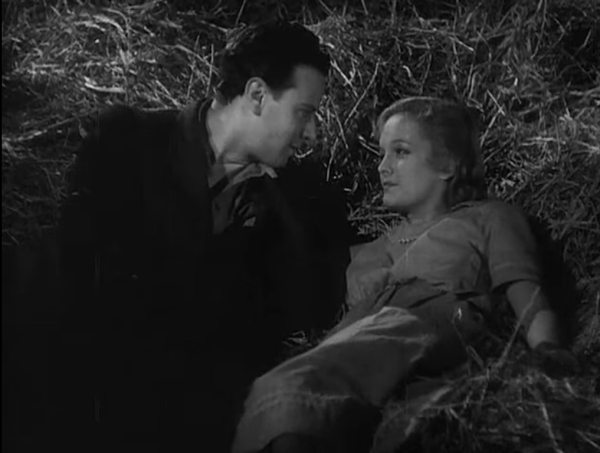
The entire movie develops out of the momentous return of his granddaughter — just recently divorced and living back east — who’s prepared to pay her grandfather a visit and go back to basics. Louise (Miriam Hopkins) becomes quite the talking point in the household seeing as she doesn’t live with her husband. That just isn’t done. Of course, Grandpa operates outside of the typical small-minded hypocrisy. He’s radically individual-minded and stubbornly prodigal himself.

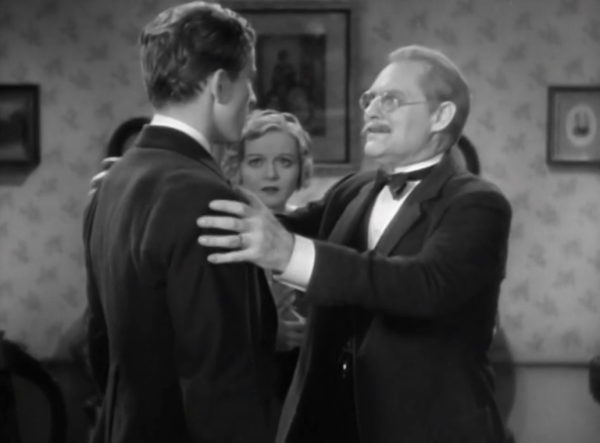
Barrymore and Miriam Hopkins cultivate what feels like an instant rapport. Consider the moment where they sit outside on the hanging bench together — their conversation so easy and amicable. She might come off a bit like the prodigal daughter, but if this is true, then he’s more than generous in spirit to be the father figure who welcomes her back to her roots.

Together they strike up a fine friendship with Guy Crane (Tone) and his sympathetic wife Nettie, who both live just down the road. Crane’s the old story of a charming young man who went off to college and then wound up marrying his childhood sweetheart and returning to farm life.

It happens rather organically but Guy and Louise strike up an instant chemistry — at first, it’s good-natured and innocent. It comes to a head at a local dance where they spend plenty of time in each other’s arms and people will talk. One, because Louise is a divorcee and totally alluring, and, two, because Guy dances divinely and is spoken for. If the relationship between grandfather and granddaughter is the crux of the storyline, Tone and Hopkins do much to augment the film. He’s deeply charismatic and there’s always a wry twinkle of mischief in her eyes bringing them together gaily.

There’s nothing dismissive in the simple observation that Louise doesn’t seem like the churchgoing type, but it’s a delight when Grandpa is concerned. After all, as a faithful parishioner, he hasn’t missed a Sunday in years. It gives him peace being there.

The preacher gives his fitting message on 1 Corinthians (Therefore let him who thinks he stands take heed lest he falls). Far from being an implicit indictment of Louise and Guy, it seems to be aimed all the more at any snooty-nosed hypocrite who feels affirmed in their own preening self-righteousness. Grandpa is hardly one of their ilk even as he nods off perfectly at ease.

In the tradition of communal farm life, the Storrs put on a huge spread in exchange for local labor. The bountiful feast the women whip together makes the eyes bulge in its sheer extravagance. Hopkins does her duty gallantly by going out to the pump for water and passing around the plates and coffee, turning the heads of all the farmhands as she goes about her work. Grandpa couldn’t be prouder of his kin.

In what look to be his waning hours, Grandpa’s mind gets overtaken by fanciful delusions about the Civil War, and his children look to cart him off away from the farm for his own good. Could it signal the end of Grandpa or is it a ruse to divvy up the goats from the sheep? Metaphorically speaking, he knows the ones who love him will take care of his sheep. That person is Louise.

The Stranger’s Return lingers over an illicit theme as the two lovers have their affections grow deeper by the hour. It’s such an obvious outcome, and yet the story never succumbs to anything. This is never its intent. Instead, it finds meaning and sincerity dancing sensitively around all of this. In the end, it slates itself as an archetypal tale of a city girl destined for the farm and the farm boy who chose the city as an act of preservation.

What sets the movie apart is this amiable quality — how it is blessed with both humor and integrity of character. People don’t want to hurt one another because they’ve forged relationships cutting deeper than convenient altruism. As someone familiar with two worlds, it makes me hold a deeper affection for rural and urban lifestyles. They both have pros and cons, but what makes them impactful are the people you forge bonds with.

4/5 Stars

Street Scene (1931): King Vidor and Sylvia Sidney

street scene

Film at its finest is able to use images to leave an indelible impression on an audience. King Vidor’s Street Scene opens with a telling montage. Kids being sprayed by a hose in a street. A slab of ice being carried off by a worker. A man swatting gnats away from his horse. A dog sprawled out on the pavement. There’s more, but we already get the idea: it’s a blisteringly hot day in a New York neighborhood.

The foreknowledge that this is a stage-bound studio street corner makes the “scene” no less engaging. There would be later pictures to channel the same intimacy and sense of a world — some of the Warner Bros. Cagney pictures or Dead End spring to mind. However, here we also get a sense of a myriad of voices — even immigrant stories — and plenty of people chewing the fat all across the city.

While it’s faux reality, it does feel like a wonderful piece of world-building. We get to know the whole row of people for minutes at a time. What Vidor has done is pluck out a moment in time for us to just sit in and relish. People shuffle by in and out of frame, down the sidewalk, poking heads out of second-story windows, or lounging on the front steps.

Beulah Bondi, in her debut (God bless her soul), is one of the first we get to know. When she’s not out walking her dog or bemoaning the weather, she’s gossipin’ about other folks. Namely, Mrs. Marraunt (Estelle Taylor), who is rumored to have a male suitor. She’s married of course. The busybodies love to titter on about this juicy piece of scandal. They fail to recognize how lonely she is with a husband (David Landau) who is totally absent from her life.

Sylvia Sidney doesn’t show up until 20 minutes into the movie although she could be considered the star of the picture. Recently, she’s been accompanying a local boss (Walter Miller) who has the hots for her. It’s possible he can get her out of her humble community. It’s not the nicest place. Her father is the same absent, aloof breadwinner and her mother is constantly agitated and beside herself with nerves. Their home life is hardly stable, and it’s quite public given the close-knit existence with folks window to window in the tenement.

In one of the intermittent visual montages, Vidor captures daily life in the community adding some lovely touches you couldn’t get any other way. With the very focused framework of this individual housing complex, the story builds out from here, layering in the moments on top of one another.

When Sidney asks her Jewish neighbor and childhood friend Sam (William Collier Jr.) how you’re supposed to act in the synagogue — she has a funeral to go to — the very pointed question feels genuine.  She’s hardly interrogating him. Instead, she’s curious and surprised he has no spiritual beliefs.

All his knowledge and truth come out of the many books he consumes. She holds the sentiment “You gotta believe in something to be a little happy.” We hear little more about such matters but the hope might as well color her entire outlook on life even in the midst of tragedy. Their Romeo and Juliet friendship feels like a minor caveat underlying entirely different familial issues.

In one particular scene, Vidor instantly mobilizes what feels like the whole mass of humanity to overwhelm the movie. At its apex, New York comes alive. In fact, a moment must be taken to make a stunning acknowledgment. There’s an uncanny resemblance to Spike Lee’s incisive tour de force Do The Right Thing.

Surely as such a prominent cinephile, Spike Lee has seen the picture or somehow imbibed it. The cursory similarities begin with the heatwave and the cross-section of humanity, and then come down to the same inherent eye for human drama as well as intercultural relationships. Both directors feel fully engaged even immersed in their worlds.

For his part, King Vidor intuitively understands the material coaxing a great deal more depth out of it than what initially meets the eye. Part of what differentiates this picture is its lead. Sidney is the picture of stoic beauty going on bravely in the face of unimaginable tragedy. There’s a strength and assurance present in her being but also a quiet dignity. We watch her actions and responses and each and everyone feels enriched with candor.

It’s the contemporary world distilled into a moment — the street bustling with people of all sorts of backgrounds, beliefs, and fears. The picture is 90 years old, and yet I look at it rather incredulously. Not because of what doesn’t translate, but because so much still resonates within its frames.

There are gossips, lonely people, bullies, and young dreamers trying to figure out what to do with their lives. The world is still made up of all sorts, and when we’re thrown together, we very rarely agree. We have to learn how to live with one another each and every day. Sometimes we fail miserably.

In its closing moments, the world returns to the same shorthand of children playing in the street. Sidney walks off determined to move forward with her life by getting away from the street that has represented her entire existence thus far.

At the same time, it has so many memories attached to it and also instigated the greatest traumas she’s ever had to endure. For such a short, stagy endeavor, Street Scene is deceptively rendered. Vidor somehow makes it chockful of what can only be described as human pathos. From the days of The Crowd, he still gets it and puts it to good use. Sidney does the rest.

Alfred Newman’s theme would take on a life of its own as a motif recurring again and again in numerous of the studio’s movies.  Here it plays almost as ironic counterpoint. A straightforward score would have brimmed with some kind of dramatic crescendo. Newman’s work, which I have heard referred to as Gershwinesque, is far more playful. I would stop short of saying it’s unfitting. More so, it accentuates a different kind of tone altogether.

3.5/5 Stars

The Front Page (1931): His Boy Friday

the front pagde

With The Front Page, Ben Hecht and Charles MacArthur’s ode to the Mythical Kingdom, the world of newshounds was translated to the movies by Bartlett Cormack and Charles Lederer. Given their own experience hammering away at copy, they locked in on the newsroom parlance going so far as to base many of the characters on their associates. Having not seen the play, it’s difficult to know what liberties were taken.

Many might already know it was reworked as His Girl Friday and it’s true The Front Page serves as the fitting prototype for all of these newsroom pictures of the day. Lewis Milestone does an admirable job trying to liven up the stage beats and the camera does move laterally more than I was expecting. When Hildy Johnson (Pat O’Brien) makes his fateful exit from his “office,” it’s hard to forget the host of reactions to his departure with time stretched out by the magic of cinema.

Likewise, the talking picture still feels youthful, learning what it means to move, as Adolphe Menjou huffs around his office looking for his best story scribe Hildy. They provide the central dynamic for the story to rest on as conniving editor Walter Burns tries with all his might to hook his best writer before he quits the business to go off to New York with his fiancée and her mother, never to be seen from again. Burn’s last chance to nab him is the biggest local story: The hanging of a man named Williams. More on that in a moment.

It should be noted that the most immediate alteration Howard Hawks made was to make Hildy Johnson — not an altogether masculine name — into a woman, who in the Hawksian mode, is capably one of the boys. What it did was ratchet up the contentious romantic dynamics between Cary Grant and Rosalind Russell, who elevated the screwball antics to their zenith. It was a stroke of genius.

After oozing so much about their chemistry, it’s hard to fairly evaluate Grant and Russell’s predecessors. To be fair, I’ve nothing against Pat O’Brien but he’s simply not the most intriguing nucleus when placed together with Menjou. O’Brien did his best work opposite a charismatic lead like a Cagney or even Walter Huston.

Also, Menjou hardly has the caddish charm of Cary Grant. In fact, the meat of their performances feels staid and conventional in comparison. I know this is dangerous, but it’s an unavoidable trap.

It is easy to be complimentary of the picture in other areas. The Front Page really sings in the adjoining spaces because even more so than His Girl Friday it thrives on being an ensemble piece carried over from the stage. The majority of its time is spent in the writer’s room with the colorful gallery of working stiffs and this is where all the action is anyway.

Between cards and puffs of smoke, they’re on the telephones nosing around for a story. Walter Catlett, the bespectacled veteran, is at the center of the action, anchoring the community with his quips. Floating on the fringes around a host of wisecrackers are the likes of Frank McHugh and then Edward Everett Horton. The beloved character player is unmistakable as his typical boob, a germaphobe named Benzinger. He writes for The Tribune.

The rest of the plot will be familiar to anyone who is aware of Hawks’ film. Williams is sentenced to be hung for killing a colored man in a city where the colored vote counts. There’s a sense that we are talking about a vague approximation. The fact we never hear more commentary on the crime and that our cast is entirely white is certainly a sign of the times and another potentially worthwhile caveat.

Mae Clarke reached immortality by getting a grapefruit squashed in her face, but she also performs as the first cinematic Molly Malloy — the one person willing to intercede on Williams’s behalf. The other fact worthy of mention is Clarence Wilson, the bald, pipsqueak making the rounds of the newsroom. It took me a moment to figure out that he’s supposed to be the police chief. In his trembling hands, law and order don’t have a prayer.

When it’s all said and done, it’s hard not to see the voluminous shadow cast by His Girl Friday. Sure, it technically came after but its reputation looms large. The Front Page isn’t a bad picture. It’s still in the nascent days of Hollywood. Lewis Milestone does a decent job of visualizing the stage play, and the cast is ripe with all sorts of colorful talents. The dialogue flies. There’s no problem in that department. From hamburger sandwiches to peeping in teepees, to Jack London-style journalism, you get all sorts. This is the beauty of the bustling environment drummed up. We get to be passive observers of the world.

However, if there is one area of critique to hone in on it’s mainly the leads. To be frank, in weighing Cary Grant and Rosalind Russell with Adolphe Menjou and Pat O’Brien as a unit, there’s just no comparison. These feelings are my own — totally subjective as they may be — but their screwball chemistry cannot be topped. The Front Page still remains as an important historical marker, if only partially because of its relation to the later film. It definitely speaks more of His Girl Friday than it proves a critique of Lewis Milestone’s movie. In fact, aside from All Quiet on The Western Front, Milestone probably deserves a lot more respect than he usually garners.

3.5/5 Stars

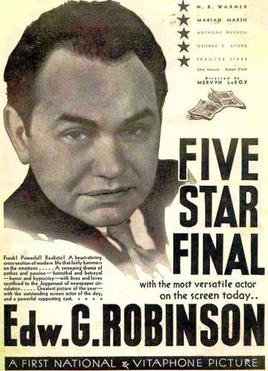
Five Star Final (1931): Edward G. Robinson and Yellow Journalism

Five_Star_Final_1931_poster

Five Star Final has its place among a bevy of real-world Journalism movies as perpetuated by Hollywood in the Pre-Code era. Probably equally important is director Mervyn Leroy, who at this point in his career was about to be tackling some of his most pointed material including I Am a Fugitive From a Chang Gang and Three on a Match, which if not totally vying for social realism, certainly blended it liberally with melodrama to instill a social message.

It should be noted before the war over Citizen Kane, famed magnate William Randolph Hearst took offense at this movie, whether or not it was outrightly aimed at him or not. Regardless, it hit close to home. I’ll let you be the judge.

This paper happens to be called the Evening Gazette and it’s anchored by editor Joseph Randall (Edward G. Robinson), though he’s not introduced for several minutes, remaining an unseen figure. Instead, we are given a clear sense of the rest of the framework built around him.

One of his story peddlers Ziggie (George E. Stone) has a perfect name to go with his line of work. His latest shenanigan involves taxi races through downtown, a cinch to drum up some surefire news.

Aline MacMahon is Robinson’s world-wearied social conscience. In other words, his secretary, who is secretly devoted to him even as the paper goes to seed. Full disclosure, I’ve always maintained a lingering affinity for MacMahon based on her general affability and her prowess in both comedy and affecting drama. Here she strikes a steady medium.

It’s true the modern newspaper game is all about mass circulation and with it all sorts of gimmicks and salacious material to grab people’s eyes. Sensationalism is the name of the game to go with lady models buried in the back of the papers. It might be vulgar, but it works wonders. Mr. Hearst was probably well-aware of it.

This is what Randall is fighting against. At first, we have the sense he’s trying to run a tight outfit — he’s a grade-A journalist — but the pressure from upstairs makes him cave and play the way they want it.

The top man, Mr. Hinchecliffe, doesn’t want their editorial integrity to suffer in so many words, but he wants to position themselves to capture more readers. It’s the old game. Sensationalism and smut sell. It takes a lot less effort and integrity than honest, human-centered journalism, and it’s more profitable.

In a sense, Robinson is at home wheeling and dealing, bustling around amid the chaos, getting on the horn and chomping on his cigars as people come in and out. He thrives on the energy. We come to understand his favorite words to fill out a story are “blah, blah, blah.”

The world itself is engaging — the characters who inhabit it in the office and walking the beat — but the film strays in its moralizing plotline. They’re looking to drudge up a story now 20 years old by getting people interested in the crucifixion of a woman.

By coincidence, the woman (Frances Starr) — now terribly respectable and married to an affectionate man (H.B. Warner) — watches her vivacious young daughter prepare to wed the man of her dreams. Everyone is deliriously happy though a land mine from the newspapers looks to totally decimate her salvaged life.

It’s Randall who set it off at the behest of his superiors because when he wants to be, he has a wily acumen, stooping to every trick in the book. One of his handy stooges is the marvelously-named Isopod. No man is right for the role but Boris Karloff — a once aspiring minister who was summarily booted out and ended up in the paper racket instead. Now he uses his religious training to get into people’s confidence.

It works much the same for Mr. and Mrs. Townsend. There’s something about his formidable voice where his sinister tone becomes unctuous in the company of his callers. He is ready to wheedle them for information, and they oblige, completely vulnerable in the fangs of such an insidious wolf in minster’s clothing.

When the Five Star Final edition comes out at 11:30 one night, the obvious trajectory of their story is sealed. In a world still reeling in the wake of the stock market, the character assassination they are assailed with seems just as hopeless. It’s not something the paper can redact or recant nor do they plan to. It’s lucrative news even at the expense of human lives.

In the final moments, there’s another meeting of the minds. Mr. Hincheclife is flanked by his Yes Men with Randall behind his desk. They are all complicit. A bitter daughter bursts in on them lambasting them for the irreparable harm they’ve caused. She beseeches the omnipotent cowards — all the cogs in the system — to conduct an act of God, by raising the dead. Of course, they can’t. They can only look on ruefully. Totally implicated and utterly guilty. The indictment is fierce and wind-ranging.

Robinson’s the one man who seems to acknowledge his part in it. While he can’t repair this mess, he vows never to become a slave to circulation again as he and his best girl shake off the dust of the crummy establishment. It’s swelling with this sentiment, but the point has been made. Five Star Final is not always elegant but between the lively characterizations and the mordant subject matter, it’s difficult to ask for more from the movie.

3.5/5 Stars

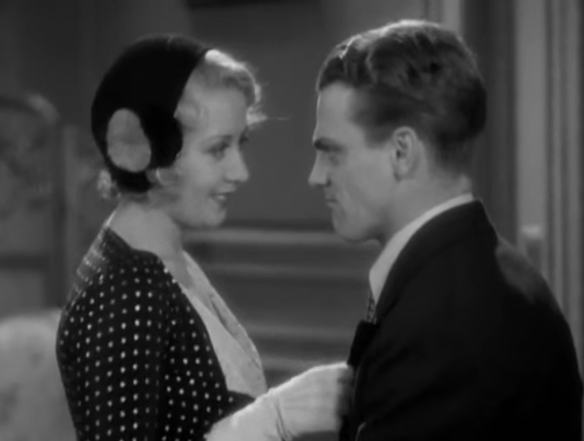
Blonde Crazy (1931) with Joan Blondell and James Cagney

blonde crazy

From the outset, Blonde Crazy promises to be a midwestern hotel chamber piece. It’s a story of the help: including opportunistic bellboys (James Cagney) and plucky chambermaids (Joan Blondell). He does her a service by nabbing her a job, and in such a world, he probably expects some recompense.

James Cagney is still kicking around and feeling out his persona; Joan Blondell’s on the way up with him. It’s mind-boggling that in the year 1931 alone both of them put in time in over half a dozen pictures each for Warner Bros. They were both building up a body of work quite quickly.

In a movie like this, the people I’m often preoccupied with are the Charles Lanes and Guy Kibbees — the host of able character actors who always show up in a movie like this. Blonde Crazy has quite the assortment. It’s stuffed with the kind of familiar faces, making a small trifle like this worthwhile, playing desk clerks and delinquent jewels salesmen, among other things. You know the types.

If the story remained in the hotel, it would be severely handcuffed because its stars are meant to be out in the world! Thankfully, the movie breaks out of the constraining formula and finds itself allowing Cagney to shine because there was no one who could do charisma like him. However, Blondell’s never one to be discounted, keeping with him tit for tat.

She exhibits plucky defiance ranking up there with any of the top female performers of the 1930s, coping with the social systems while still holding her own in a man’s world teeming with come-ons and everyday misogyny.

Does it matter what it has in the way of plot? Hardly. Instead, Bert (Cagney) and Anne (Blondell) leave the hotel, becoming business associates or better yet, accomplices drumming up clever (and slightly dubious ways) to make a quick buck.

Blondell is never taken in. She sees right through Burt and still stays with him. He has flashes of decency but driven as he is by money and other superficial qualities, he’s a tough guy to try and wrangle in. Still, their prevailing attribute is their loyalty to one another. Cagney likens himself to a modern Robin Hood. He does have that kind of rapacious charm (and this is before the world knew Errol Flynn).

In time, they’ve had an upgrade frequenting the lavish hotel circuit as partners, though their romantic status remains a bit hazy. Bert inserts himself into a fistfight on the dance floor. It seems like the perfect point of intersection for Cagney. He comes to the aid of Louis Calhern a man he’s been eyeing for some time namely, because of his scintillating female company (Noel Francis). She’s been giving him the look. Anne knows it too. She wasn’t born yesterday.

Unfortunately, Bert gets punked. He’s been made a sucker. In the movie world, you don’t make a sucker of Jimmy Cagney and get away with it. With his pride hurt by the big boys, he looks to regain his stripes by pulling a double-sided con of his own, just to break even. He doesn’t bother to tell Anne. It’s preliminary work for greater coming attractions. If you want to try and get a line on Cagney’s character, he’s not quite his usual gangster type; he’s a smaller operator, but still stretching the boundaries of the law. In his own words, he’s “not tough just mercenary.”

For all the names crammed in the picture, I almost forgot to mention Ray Milland. I hardly knew he was in pictures this early in time, and he looks like a babyface, albeit a handsome one. He’s relegated to the secondary role. He’s Anne’s dreamboat. The complete antithesis of Cagney. He has class. So they get married. But he’s fallen into a bit of misfortune. The only man who can probably pull him out is good ol’ Bert.

All these bits and pieces feel conventional. There’s the immediate romantic tension and the story zips along. Milland is nothing aside from the other man. But if you miss out on Cagney and Blondell’s rapport, then you’ve failed to appreciate the merit of the picture. They make it shine.

While it’s not cutting-edge entertainment, Blonde Crazy does simultaneously straddle the lines of genre. It’s not totally gangster — there’s romance and melodramatic flourishes — and there’s a lightness of comedy. This is what lingers.

Because, in the end, Bert’s sent up for a prison sentence and Anne dutifully shows up professing her undying love. They were meant to be together. What I will remember is how Cagney says “Hone-eee,” and how Cagney, donning his most elocutionary voice, spouts off a bit of Elizabeth Barrett Browning. And it’s a violent picture: full of socks, slaps, and spanks, all in a comical vein and totally indiscriminate. Everyone gets in on it. It helps in illustrating the underlying fact that this is not just Cagney’s movie. Blondell more than holds her own, and they make it better together. What’s more, this was just the beginning.

3.5/5 Stars

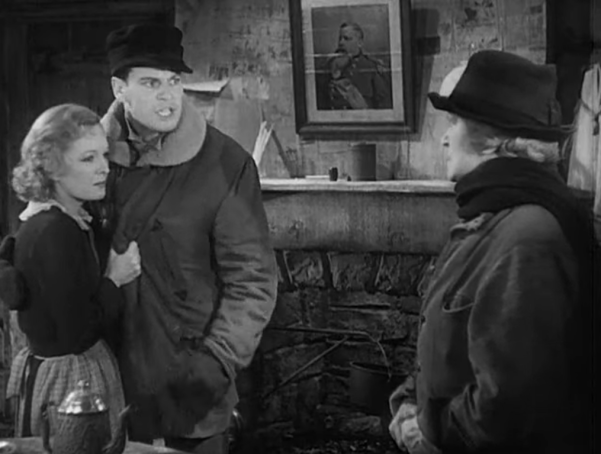
The Informer (1935): John Ford and Victor McLaglen

The opening title card sets the stage in strife-torn Dublin in 1922 with a reference to Judas, the man who betrayed Jesus Christ to be killed. The allusive nature of the story becomes apparent only with time, connecting with John Ford’s own deeply religious inclinations as an Irish Catholic.

I won’t say Ford’s able to make a soundstage more atmospheric than the real place because reality would provide a grittier, more authentic ambiance, but here we have the mist, large vacant sets, and crumpled up newspapers that flutter around like tumbleweeds. It’s Dublin as can only be conceived in the dream factories of the studio system. 

Some might forget before John Wayne was one of his primary avatars, Victor McLaglen came to represent Ford’s version of hardy masculinity even earlier, and it’s no different here. Even when he was displaced in later years, he still found time to turn up in the director’s pictures, most notably in The Quiet Man and his cavalry trilogy. Ford never seemed to forget actors who had put in their service with him.

As The Informer set down its roots, it feels a bit like watching Hitchcock’s England pictures from the ’30s. You can see the early brushstrokes of the master, but it’s almost as if the technology hasn’t quite caught up with their ambitions and the capabilities of what they’re yearning to do. Sound, color, lighting, and the like would improve in the ’50s and ’60s as would both men’s budgets leading to some of their finest achievements and a plethora of the most lauded pictures Hollywood has ever known.

For now, they work with what they have and manage to spin a decent cinematic yarn all the same. Because necessity is the mother of invention; still, it’s also about how you utilize the time and resources on hand to make something as substantive as possible.

The Informer was made for RKO probably due to the fact no one else was willing to take a chance on it. It’s a meager picture in many regards, and this is easy to forget since it was a stunning success during that year’s award season. But it was a film made for a relative pittance over the course of a couple of weeks plus change.

While one would probably never call it Ford’s most profound achievement, you can tell he’s put his blood into it — his history as a proud Irish-American — and its core dilemma is a powerful bulwark to build a film around and an acting performance.

Gypo Nolan (McLaglen) is a man caught in the middle of civil unrest plaguing the lands since their inception. The British think he’s with the Irish and the Irish think he’s with The British. Mostly he’s out for himself just trying to subsist and earn himself a bit of merriment. Still, he can’t scrounge up a job from either side. It’s far from a desirable place to be.

He does have a few friends: Katie (Margot Grahame) is his lady although because he’s not good for much money, she works as a streetwalker to scrape out a living. Still, she’s devoted to the big lovable oaf. Another is Frankie McPhillips (Wallace Ford), a wanted hoodlum for the IRA resistance and a brother in arms for Gypo. They’ve grown up together and as is the prerequisite for a community like this, their friendship is forged in a life lived in proximity. Gypo loves the man, but he’s also penniless with no prospects.

It’s not exactly 30 pieces of silver, but Gypo makes a rash decision to sell out his friend — this isn’t so much of a spoiler — because this becomes the context for the rest of the movie. He’s tortured by his conscience even as no one suspects him in the wake of the tragedy he instigated against his friend and the man’s grieving family.

His only defense is to swim in self-absorbed debauchery. It gets him out of the moment providing a brief escape from his guilt. He belts a policeman and another lad on a street corner before wrangling fish and chips for a whole host of onlookers in a show of drunken generosity thanks to his newfound wealth.

In another scene, he stumbles in on a hotsy-totsy establishment run by a local matron where all the men and women wear top hats over drinks, conversation, and other things. He bowls them over with his rowdy entrance pushing down pipsqueak and gathering pretty girls up around him. These all feel like a part of his mental smokescreen.

Behind the scenes it’s a much grimmer scenario as the pragmatic Dan Gallager (Preston Foster) sends his cronies out into the streets to track down Frankie’s betrayer. This isn’t a mission of mercy. They live in a kill or be killed economy, and they’re prepared to take the necessary actions to preserve their cause against traitors, even those with deep roots in the community.

The drunken Gypo is pulled into a meeting with another suspect (Donald Meek) as the truth is slowly sussed out. The tribunal standing by has echoes of M, though it’s now been superimposed by this sense of Catholic guilt and justice.

McLaglen makes his way through the entire movie boisterous, gruff, and drunk like any good McLaglen performance except this easily must be the bar by which to judge all others. It’s either a really good job of acting or Ford helped him get into the part with a little trickery and added encouragement from the spirits. At least that’s how the story goes. Either way, it works with the actor dispensing this trail of blustering, sniveling, disoriented guilt, and gravitas making the picture go.

Dudley Nichol’s script doesn’t necessarily employ great prose — it’s not a thing of beauty — but Ford is able to utilize its framework to tell a worthy story. The final images culminate in the ultimate biblical picture.

Gypo stumbles into a church with one final chance to pay recompense for his sins. He gains absolution from the Mother (Una O’Connor), standing before the Crucifix, arms outstretched (May God Have Mercy on His Soul). The sentimentality doesn’t feel like typical Ford — though he could certainly be deceptive about it — and this form of religious iconography is something relatively apparent even in his final picture Six Women.

The Informer’s unparalleled success paved the road for him ahead with many great entries to come. Ford certainly was a master in blending classical storytelling with his personal vision. It shows how personal filmmaking can break through the barriers and resonate with audiences on an impactful level.

4/5 Stars

Pilgrimage (1933): A Mother’s Journey of Reconciliation

pilgrimage

It’s a private fascination of mine to consider the sanctity and sheer awesomeness of human life in a very particular context. How parents pass on their genes — a package of habits and physical phenotypes to their kids — that we can then witness before our very eyes. And this is even true of those who are dead and gone. Their children remain as a testament to who they were and still remain in our hearts and minds. By no means a carbon copy, but you can look into their eyes or see a photo and observe a brief glimpse of the person you knew before who is there no longer.

In some circuitous way, Pilgrimage becomes a story partially about this type of lingering memory. It is a journey and it involves certain people, but it evolves into something quite different than what I was expecting and this is to its credit. Allow me to explain.

It’s one of those rural tales set in Three Cedars, Arkansas on the farmland of Hannah Jessop (Henrietta Crosman). The dynamic is simple. She’s a hard-bitten mother who’s lived a rugged life running her farm. Her son (Norman Foster) is a strapping, fresh-faced man in love with the girl (Marian Nixon) down the road and remains discontented with a life in the fields. There’s a chafing between mother and son.

She’s not going to let him marry a “harlot,” though there’s a distinct possibility she would never agree to any girl he chose to marry. Furthermore, she can’t understand how her boy can be so ungrateful and would willfully defy her. It’s a generational divide opening between them.

Watching a Ford picture, you’re waiting for those individual moments you can take with you. I’m thinking of Henry Fonda leaning up against the post in My Darling Clementine. John Wayne trotting off into the foreground at the end of The Searchers. In Pilgrimage, I’m reminded of a man sitting on his bed as he plays around with his dog — playfighting and having the animal crawl through his open arms.

It’s actually a mechanism for biding time because he waits for his mother to fall asleep so he can drop out of his second-story window and race off to be with his love. Earlier, during their first official meeting in the movie, there are a pair of memorable subjective camera shots when the two lovers come upon one another with a pond between them.

I’m adding my own emphasis, but it’s as if to say this is supernal love — love supreme — and its not meant to be torn asunder. It has some of the poeticism of Sunrise and the pastoral imagery of The Southerner.

Screenshot 2020-07-05 at 6.07.04 PM

Still, ornery Mrs. Jessop vows to get in the middle of their marriage, and she does it quite handily. She signs her boy up for war — not out of any sacrificial heart and love of country — but purely out of selfish indignation. This act seems so egregious and totally indicative of her character.

What’s curious is how it is not so much dwelled upon as it becomes a reality in front of us. Perhaps her boy really wanted to go off to war and serve his country. We have some indication of that even as he only has a couple minutes with his betrothed before he ships out. It’s the first inclination that this is not about the lovers at all. Who does this event affect the most but Hannah herself?

It provides the needle in Hannah’s heart, and she has to live with her decision now for a lifetime. One of the film’s finest transitions comes with shots of enemy artillery caving in the trenches only to cut to a ferocious downpour at the Jessop farm. It’s two forms of chaos, one man-made and the other natural, but equally thunderous. In fact, the soundtrack is the same. They bleed into one another seamlessly.

Now the man we thought was one of our central characters is gone. It’s 10 years later and his mother is still there holding down her home. This might be when the lightbulb goes off. This was her story all along.

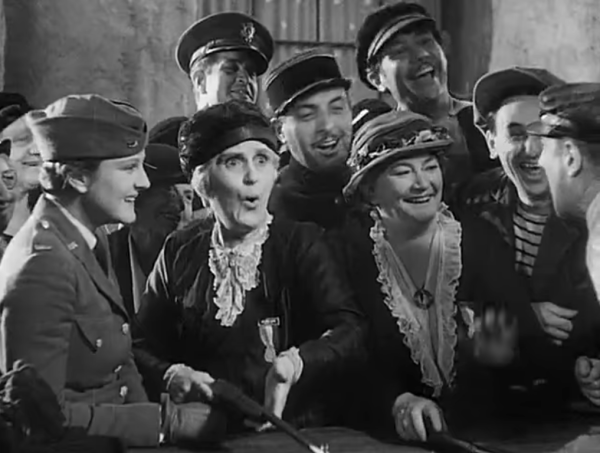
Soon a woman from the war department or some such organization shows up on her porch with the mayor to coax her to follow all the other Gold Star Mothers over to France bidding their sons one final tearful adieu. She surmises, “How reconciling it would be to stand beside the grave of one’s heroic death.” Of course, she’s doesn’t understand Hannah. It’s the bitterness and buried guilt still gnawing at her. She’s a proud woman, after all, and she’s adamant about not going. She very nearly doesn’t. However, if she never boarded that ship there would be no final act.

pilgrimage shooting gallery

Ford’s sense of war is exhibited in how he’s able to cast it as both this swelling, deeply patriotic thing and still something troubling. He is aware of the dissonance of the horrors of war. The most touching sense of it all comes with a procession around a grave inlaid in the ground and the ladies all lay their flowers down on the grave, even Hannah.

True, they do the tour of the whole place and build a kind of maternalistic camaraderie touring around the Bastille, and Hannah and one of her newfound companions (Lucille La Verne) even tear up a local shooting gallery for kicks. It’s a sign of Ford’s penchant for broad humor, and he can never totally mask it.

But the subject feels different. For one thing, Henrietta Crossman’s performance feels like one for the ages and deeply impactful even today in a medium where stories of the elderly often feel dismissed or invalidated. In her time, she was a giant talent on the stage and you cannot watch the picture without gaining an appreciation for her.

Because this is about her evolution more than anything else — this is her story — and she carries it with the kind of aplomb that’s capable of moving mountains. By that, I mean the audience’s heart. We eye her watchfully for the majority of the film, and she’s righteously stubborn and outright vindictive in her jealous affections. Although it takes time, she melts, and this progression is key. It becomes evident within her very being.

pilgrimage

The mode isn’t altogether subtle. She meets a boy on a bridge. Thoughts of suicide or something else might be swirling around in his half-drunken mind. She grabs him by the arm and by some force of compulsion takes charge of him. She feels a need to take care of him rather like with her own boy.

It’s true it’s a different actor and a different girl, but it becomes clear enough that they (Maurice Murphy and Heather Angel) are little different than her own boy and his girl a generation before. What has changed is her outlook. She sees their warmth, their fears, the hopelessly passionate affection they have for one another, and she sympathizes. Did she stop being a parent? Certainly not. Rather, her eyes have been opened just as she has been filled up with a far more benevolent spirit.

Finally, she comes to terms with being cruel. Finally, she realizes she had a convenient name for her attitude as “a God-fearing, hardworking, decent woman.” She talks some sense into another mother (Hedda Hopper of all people) in the straightforward manner she wished someone would have talked to her. It bears an incisive truth that’s hardly unloving. And it’s as if this is her slice of redemption because it is something we can see; Hannah sutures the wounds so they can heal. Both of another mother and her own.

She goes out to the Argonne somewhere and kneels before the grave of her son falling prostrate on it. For the first time, it feels she is actually able to grieve. It’s a cathartic release for a woman who has guarded her heart and buried her feelings and failures for years. What a glorious outpouring it is. All I could think of was that Pilgrimage has a sense of death Saving Private Ryan can never quite understand. The pain and relief of seeing this gravestone are so closely tied to our character. She is being made new in front of us.

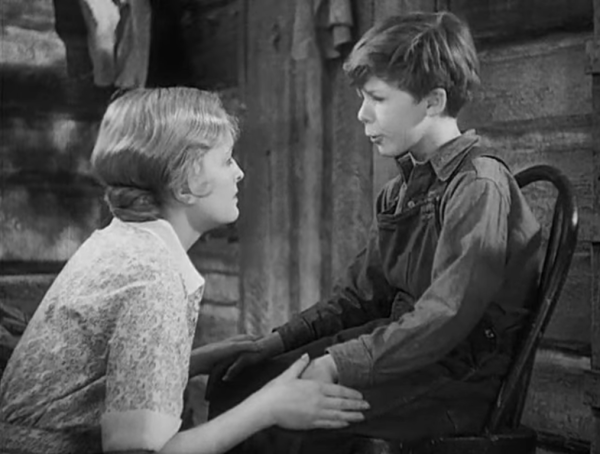
There is only one thing left to do and as a final outward expression of her reconciliation and renewed heart, she reunites with the only family she has left on earth. Her estranged daughter-in-law and quizzical grandson. She overwhelms them and grabs her boy up in her arms. Because that’s what he is of course. Little Jimmy is a stand-in for his father and so Hannah smothers him with her love. It was a Pilgrimage to be sure. Hannah traveled across the sea only to come back home a revitalized human being. Now she can look into Jimmy’s eyes and know full-well she is forgiven and loved.

4.5/5 Stars

The Lost Patrol (1934): A Tale of Survival

Screenshot 2020-07-03 at 11.12.23 PM

The Lost Patrol comes out of the colonialist traditions of the era with the white soldiers in Mesopotamia doing battle with an Arab enemy who strike like ghosts. They are phantoms and rarely seen in the flesh. It’s an unwitting bit of commentary but it also simultaneously becomes one of the story’s most unnerving assets. There’s a tension born in an adversary who is all but invisible and still has a deadly sway on the story.

The film’s opening images are telling in establishing setting and the man behind the camera. Because this is a John Ford movie. It’s a fairly early offering, but there are elements that feel unmistakably relevant to his oeuvre. There’s the shadow of horses trotting across the sand, and then a line of riders snaking their way across the wide-open vistas of the dunes. It’s a variance on the western form or at the very least a transplant.

During this journey, their thick-skulled commanding officer is knocked off unceremoniously. He also never thought it prudent to tell his second-in-command what their orders were. With him gone, the remaining contingent is left wandering through the desert wasteland without any kind of direction.

The Lost Patrol is an expeditious drama with little time to waste and so survival becomes its primary focus. It’s not searching out a destination or looking to vanquish the foe as much as it’s about these men living to fight another day. It’s a windswept character piece more than anything.

We see Victor McLagen at his most restrained and sensible. His wealth of experience has taught him to keep his head, and he makes darn sure that all his men stay on high alert. Take, for instance, the euphoric scene where the mirage is real, and they finally settle on a spring of water. The men are satiated by a cool drink — a lifeline in the midst of such an arid and desolate terrain — and they fall into it with joyous elation. Their Sergeant is the one man who holds back, chiding them to take care of their steeds.

If McLagen is one of the stalwarts, Boris Karloff is uncharacteristic as Sanders, a jittery and spiritually inclined fellow clinging to his belief although he seems ever ready to spout off jeremiads. For him, their latest discovery is tantamount to The Garden of Eden.

It is an oasis, but they’re also stuck there. Instead of being excommunicated, they might as well die where they stand if they can’t get support. Much of the film at this juncture comes from digging in and waiting it out. We get to know the band of men and at the time same are brought into the tension of their prolonged campaign of survival.

A young lad, wet behind the ears, is crazy about Kipling and the glories of war. Whereas he’s woefully ignorant of the tough side of the life he’s chosen. Morelli (Wallace Ford) is a bit more jocular blowing off some steam with his harmonica even as he brushes off his own bad luck, calling himself the Jonah of their expedition. Still, their leader doesn’t see fit in tossing him overboard. They’re only going to prevail if they stick together.

Because this is a Ford picture, there also have to be a couple token Irish old boys to round out the company. They’ve seen much of the world thus far, and they have more or less willed themselves to fight another day. It’s baked into their stock.

By far the most intriguing has to be Boris Karloff as he’s taken over by his religious fanaticism. And he’s not the only one to totter toward the precipice of insanity or unrest. There are others. In fact, how does one not lose their mind under such dire circumstances?

Their situation is laden with the kind of dread of a who-done-it murder mystery. Men get knocked off or become lost to the elements, one by one, until their mighty group is dwindling with the unseen enemies still lurking just beyond the sand dunes.
Though the parameters of the drama come out of a bygone era that we have left far behind, somehow Ford’s film maintains some amount of its mystique. He’s already well-versed in capturing the panoramas around him in striking relief. He’s actually aided even more by hardly showing his villain at all. Time honors this decision because it falls away, and we forget the stereotypes as much as we feel the specters hanging over the patrol.

To the very end, McLaglen is a stalwart and you can see how Ford is able to fashion him into a reputable even idealized champion. He’s not unlike a John Wayne or other figureheads Ford found ways to fashion into his personal visions of inimitable manhood. There’s something admirable about them — found in their mettle and loyalty — even as they exude a persistently evident humanity.

3.5/5 Stars

The Criminal Code (1931): Howard Hawks in The Big House

Screenshot 2020-07-03 at 4.26.44 PM

Although this is still a very early talkie, you can already see Howard Hawks developing a more intricate sense of dialogue which he would be known for in his pictures — most notably His Girl Friday. In the opening scene at the police station, we have dialogue piled on top of each other between pinochle and the lastest crime being called in over the telephone.

It’s a wonderful melding of both character and exposition being delivered fluidly in a manner that supplies us so much in such a short amount of time. Soon the two quarreling cops are on the scene at a nightclub where a fellow was knocked off.

The by-the-book incumbent district attorney, Mr. Brady (Walter Huston), sees an open and shut case, although it’s a rotten break involving a kid and a girl, and another man is dead. He concedes this and yet the law is his Bible — an eye for an eye, somebody’s gotta pay mentality — going back as far as the precepts of Hammurabi in ancient times. He’s not willing to budge an inch.

He unceremoniously consigns a young man (Philips Holmes) to 10 years in prison as penance for his wrongdoings. Even it if was only one false step, the law says he has to pay for his deeds. There is no other recourse. Time passes and prison life has gotten to him, left him stir-crazy and ragged. He’s no longer the fresh-faced kid he once was and news of his dear mother’s passing is yet another blow.

His bunkmates try and watch out for him and settle his nerves, but they’re not totally sympathetic. How can they be? Some of the men put in there by Brady feel duped. There’s this pervasive sense of restlessness and unease.

This prevailing mood only grows worse when Brady takes on the role of the new warden in the prison. The incarcerated mob ignites with yammering in the jail yard because the new man has come to town, and he was instrumental in putting so many of them away.

Brutal law and order are maintained by Gleason, the paunchy head prison guard, who’s not above threats and psychological intimation. There’s one in every big house, and he has a standing appointment with Boris Karloff’s Galloway.

In fact, Galloway is loaded with the kind of menace Karloff thrived on throughout his career, and he becomes a stellar conduit throughout the movie even as Gleason represents all that’s wrong with authoritarian power trips. They have a mental duel going on that takes a while to come to fruition.

One bright light is Constance Cummings, a genial countenance of stylish propriety and beauty. Her very presence comes to represent so much in the movie, and it’s true she represents both a beacon and a sliver of hope for Robert. If nothing else, he wants to be in her presence — just to see her and talk with her — because she makes him feel human again.

Screenshot 2020-07-03 at 3.52.46 PM

The narrative wouldn’t be complete without a botched escape attempt, but what’s more intriguing are the consequences. Because the stool pigeon, a sniveling squealer named Runch gains the ire of the entire compound and there are rumblings of unrest. Retribution is brewing in some form.

Robert does his best to stay out of it, but he’s also not prepared to help the canary. In the resulting drama, he’s implicated while maintaining his innocence. It also puts him wholly at odds with the warden who looks to get him parole. Still, he’s beholden to the law in all things. It’s guided his entire life, his entire career. Leniency is not in his vocabulary.

Whereas Robert has become beholden to the other side and the honor among thieves, if we can call it that. You don’t rat and you keep promises because what good is it if you can’t keep your word? It shows his personal integrity. For his reluctance to speak he’s put in “the hole” and subjected to the malevolence of Gleason.

Although there is a standoff and the kind of finale we expect, the crux of the story — all its thematic ideas — come in this earlier portion. Because Mary returns from her time away and what it does is provide perspective. She loves this man, Robert, even though he’s never said it outright. She knows he is the one, and it causes her to confront her father with the truth.

Father and daughter have it out in civil discourse in the first moment where they aren’t pals and actually stand up for their personal prerogatives and what they believe to be right. While it’s not exactly Scarface, Hawks does a stellar job of grounding a tale of crime and punishment once again with a familial relationship. Phillips Holmes isn’t a particularly enthralling actor, but between the likes of Huston, Karloff, and Cummings, there’s a fine array of color. It more than deserves a spot as an unsung Howard Hawks picture.

3.5/5 Stars

The Last Flight (1931) and The Lost Generation

the last flight

The Last Flight could conceivably be tacked onto the end of The Dawn Patrol. Although there is only one full scene of aerial combat, it informs everything that’s to follow because this shared experience colors the lives of the men who pushed through it. Some of them have been pushed through irreparable change. They are men with PTSD before we ever had a diagnosis.

As two of them (Richard Barthelmess and David Manners) are ushered out of the hospital there is a sense of foreboding. The physician and the audience seem equally aware of it. The doctor likens them to a pair of fine Swiss watches crushed on the pavement. The question remains how do you assimilate them back into society? As he grows didactic or at least waxes poetic, he marks them as spent bullets; his prognosis comes very near to the sobering Korean drama Aimless Bullet a couple generations later.

In fact, The Last Flight could be an equally heavy and laborious affair given the context. These are men who must face something even more difficult than war. War is something they were trained for. Life afterward is uncharted territory. It’s not something that can easily be prepared for; it’s more daunting and laden with consequences.

This is another installment in the men returning from war sub-genre, and it’s no less striking every time I see it done well or at least in a new manner. Under the circumstances, the normal response is to seek to delay the future for as long as possible. These fellows take it to the extreme.

From a technical standpoint, talkies still feel new, and the dialogue is initially a bit stunted and awkward pushing the obvious wounds of its characters. This could be tepid going. Instead, The Last Flight bubbles with its own brand of lithe and breezy effervescence. This is the mood accorded by its main players because they are looking for a life far away from their war-torn experiences up in the air. Trauma is best remedied by drink and trivial conversation so they set flight for Paris.

By entertaining all the frivolous diversions they can manage and hardly acknowledging the war again, the film says so much about these characters (as does their idle talk). Their evening progress full of drinking, dancing, and more drinking.

One of the people they happen upon and make a part of their entourage is Nikki (Helen Chandler). She’s a ditzy girl and a bit like a forlorn little puppy so they absorb her into their group. She’s got money and doesn’t quite know how to take care of herself. They take it upon themselves to do just that, which includes guarding her against the advances of a conceited nincompoop (Walter Byron).

There’s not a whole lot to it, but it comes into its own spilling out of the confines of your typical fare much like the drinks they’re constantly consuming. They let their inhibitions go giving way to a giddy even laissez-faire attitude.

Among other diversions, Cary tells Nikki the tale of the world’s most famous lovers Héloïse and Abelard, and starts to fall for her, only to have his feelings hurt over a misunderstanding. Because she’s an unwitting girl who couldn’t hurt a fly. And so the gang and Nikki follow Cary to his train to Lisbon and cram into his compartment.  They’ve stayed together thus far, and there’s no reason for breaking up the team.

If you’re waiting for the bottom line of the movie, know that it never comes. Not really. There’s hardly a point to it, but then again that’s the point right there. It encapsulates the very existence of these men. One of their buddies gets mixed up in the bullfighting ring, another gets into a skirmish at a carnival shooting gallery. In both accounts, there are lasting consequences.

the last flight

All Quiet on The Western Front might be chosen as the emblematic film in considering the plight of WWI and how war is such a futile endeavor. It strips men of their youth, of their vitality, and of their very lives. And numerous films of different eras reiterated these themes with their own nuances. Take The Eagle and The Hawk as another fine example or even La Grande Illusion, or the aforementioned Dawn Patrol (also with Bartholmess).

However, The Last Flight might stand in what seems like a class of its own. It’s not about how men die in the morass of the battlefield or how they get crippled by the gross delusions of war. Because the whole film is built out of the interim period, the delay of going home. This reading of The Last Flight is so crucial to appreciate what it is. Most post-war films are about the return and coming to terms with life and transition.

These men never get that far. They make it to a kind of purgatory — they get out on the other side — and yet this is never a movie about acclimating back to home. It’s built out of the peregrinations and distractions of men who are completely listless.  They are the so-called “lost generation” of Hemingway and Fitzgerald.

For some, it’s almost a merciful end not having to touch down on American soil. Hence, this being their last flight together as comrades-in-arms. There was never a life for them outside of what they had already experienced, and they could never return home and hope to be the same people they were before. It’s just not possible.

If we’re instilled with anything, it is that The Last Flight is a film of brotherhood and a shared experience above all else. Simultaneously, its brand of freeform, invariably crude narrative is rather invigorating, since it cuts against the accepted grain of the times. It plays as a very singular time capsule speaking to the age like few other films I can think of.

3.5/5 Stars