Thieves’ Highway (1949): Apple Crates and Femme Fatales

thieves highway 1

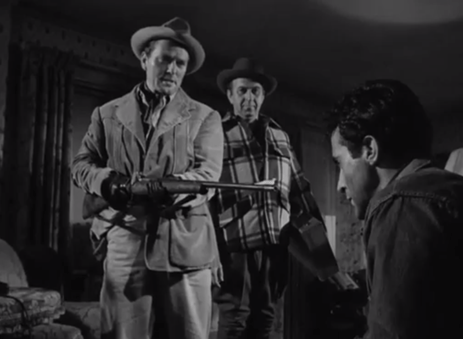
Nick Garcos (Richard Conte) makes a joyous homecoming to his parents after literally traveling the seven seas, armed with boxes of gifts to lavish upon them. In a matter of minutes, we already have a warm feeling and an affection, however cursory, for these characters we have just met.

With money to spare and a pretty girl (Barbara Lawrence) just waiting to marry him, it really does seem he doesn’t have a care in the world. However, he’s rudely awakened when he entreats his father to put on a pair of moccasins. The old man becomes dour for the first time and confesses he no longer has use of his legs.

It seems like a major reveal for the boy not to know, but it nevertheless gives traction to the forthcoming story. Mr. Garcos used to be a truck driver and yet one fateful evening, he took a load of tomatoes to San Francisco. Far from getting paid, he found himself receiving a vocal I.O.U. and getting into an accident late at night under dubious circumstances. One has to admit he’s a kindly man but a bit of a pushover.

While it doesn’t begin as a revenge story, Thieves Highway’ certainly becomes one as Nick looks to not only get his father’s money and clean up the mess left behind but also get even because its pretty obvious foul play was involved.

First things first, he looks to buy his father’s truck back, from a shifty old pro named Ed Kenny (Millard Mitchell). Instead, they wind up going into business together ready to carry the season’s first load of Golden Delicious apples to try and make a killing. With the other man’s know-how and Garcos youth and tenacity, they just might make out. Soon they’re caravanning up to San Francisco to cash out on their load. It seems simple enough, but such a journey never is.

Richard Conte fits seamlessly into this role that capitalizes on his versatility in playing both heroes and villains. Because while we can label Nick our protagonists, he exhibits violent tendencies only visible in noir films where the dividing line between good and bad is often inconsequential.

Valentina Cortese plays Rica, the hooker with a heart of gold who is initially paid $100 to lure Garcos away from his truck. If it’s totally a stereotype — she is an apple crate femme fatale if you will — then Cortese still manages to play the mixture of sensuality and genial warmth in a manner that makes us care for her as an individual. Because she gives us a couple hints, suggesting a character with more good than bad — someone who is in a tough bind, yet still out looking for goodness and love to welcome into her life.

If Rica is the embodiment of an opportunist getting their chance at redemption, Mike Figglia is pure deceitfulness. Lee J. Cobb played sour apples before but Figglia is just about as ruthless as any of his boisterous antagonists. He is a trenchant embodiment of crooked free-market industry. There is no integrity to him and even less humanity as he strives to swindle his way to one dishonest buck after another. It’s not simply survival of the fittest but the roost is literally ruled by those who have no sense of rectitude whatsoever. They absolutely relish sinking other people for their own gain.

Thieves’ Highway had its predecessors in the likes of They Drive by Night (1940), coincidentally taken from a story written by this film’s screenwriter. However, though it has its own gritty Warner Bros. elements, it’s nevertheless a studio lot entry. John Ford’s Grapes of Wrath (1940) as well, while more of a migrant story, shows us the merciless side of cutthroat capitalism.

Just to get to the marketplace takes a lot of winding roads. There are bribes stuck up tailpipes, Garcos jacks up his truck with the back of his neck, and the worst for Kinney involves his ride continuously conking out. All for the sake of a truckful of apples.

thieves highway 2

Simultaneously, two vultures (Jack Oakie and Joseph Peveney) in a truck of their own, are ravenously following Kinney as his own vehicle moans and wheezes its way toward its final destination. If time is money, he’s losing cash value fast and everyone knows it.

Still, the young newcomer has done pretty well for himself. He’s not taking any flack from Figlia, and he comes out of the shrewd operator’s office with $500 and a $34000 check. It sounds good, but it’s already a red flag. Because we know something’s going to happen to that valuable piece of paper. We just know it.

Sure enough, the story takes a devastatingly fatalistic nose dive on both Nick and Kinney’s end of the story. It’s a film literally chewing up and spitting out its protagonist.

A truck decimated. A hillside covered with busted apple crates. Then, back in the market a big fat nothing. There’s a sense of helplessness even as despondency sets in. Surely, this cannot be worth it? And yet Garcos somehow pulls himself together instead of rolling into a ball. Because he has an injustice to rail against and the perfect target is Mike Figlia.

One can quibble over whether or not it is neutralized by a slightly gushy ending — noir is certainly at its most mordant in the pits of despair — but there is still much to recommend in Thieves’ Highway.

Director Jules Dassin is one of the prominent names in post-war noir, because he made the genre not simply stylistic but imbued it with real-world grit, palpable for different reasons. Because we feel it and could see roadways and back alleys that get closer to reality than the studios ever could on their backlots.

For those familiar with the real San Francisco, Thieves’ Highway authentically embodied the robust produce industry set up within the city, detailing the area formerly adjacent to the Embarcadero, not mention more images of Oakland Produce Market.

It’s the kind of immersive imagery you can’t begin to fake in a convincing manner, and it adds another fascinating accent to this picture. Because not only is it a story with heady themes of revenge, but it’s planted in cold hard historical reality. Films at their best provide such documentation.

4/5 Stars

The Curse of The Cat People (1944): The Oddest of Horror Sequels

800px-Curse_of_the_Cat_People_lobby_card.jpgThe Curse of the Cat People feels like entering a storybook only to find ourselves in Tarry Town near Sleepy Hollow. Fittingly, we are placed with a group of kindergarteners who have come with their teacher to frolic and enjoy a field trip to the place brought to life in the tall tales of Washington Irving.
Immediately, this latest Val Lewton production plays to its greatest strengths by melding folk tale, supernatural sensibilities with bits and pieces of our world. The medium through which the picture chooses to work is a little girl named Amy (Ann Carter). She’s a serial daydreamer with her big doe eyes constantly glowing with light. One moment she’s infatuated with a butterfly and an overeager boy obliterates it in his attempts to catch it for her. She proceeds to rear back and slap him across the face.

It’s only her way but the other kids see her as odd and aloof. She’s not like them. With its opening premise in place, it’s safe to say The Curse of the Cat People is one of the strangest sequels for the very fact it has a decent amount to do with its predecessor and yet feels as if we have literally been transposed to a different cinematic world. Also, the name is an utter misnomer.

We have an offshoot taking the basic characters and settings from its predecessor while foregoing normal horror beats for a stranger set of psychological and adolescent themes. It might as well be an entirely standalone film with the urban working environment being replaced with a rural suburbia.

Now our hero from Cat People (1942), Oliver Reed (Kent Smith), has settled down with his wife Alice (Jane Randolph) and his little girl, but parenthood has made him a bit testy. Given the powers previously wreaking havoc on his life, perhaps it’s warranted. He wants to shield Amy from his deceased wife’s fate at any cost. 

But if we look at their current domestic life, it’s fairly sterilized in a way that might quickly become sickening to watch. They go by their three names: “Daddy,” “Mommy,” and “Darling” while their able-bodied, eloquent servant Edward (Sir Lancelot) keeps house. However, this very veneer is set in sharp juxtaposition with forces far more volatile and unnerving — at least at first.

Amy begins to have arcane experiences with the old Farren House where a cantankerous matron resides with her brooding, spectral-like daughter. So if we want to get technical, the movie is really about two families: One seemingly perfect, the other accursed.

On one such visit, Mrs. Farren grips the little girl with the local myths. The recounting of the Legend of Sleepy Hollow all but sweeps us up in a moment of pulse-pounding vigor, in spite of taking place entirely in a single drawing-room. Something about it is so alive and deeply unsettling.

As a defense mechanism, Amy calls out to a phantom who comforts her. We’ve all had invisible companions at one time or another so it’s not a strange request. However, her friend feels far more tangible than any of ours.

Of course, it’s Irena (Simone Simon) the woman her father has never dared tell her about. Besides, Irena is dead. As her parents worry about her mental stability, Amy is comforted by having Irena as a confidante. 

Life continues cheerfully enough. On Christmas, all the most important people in her life get a present. Carolers come by and begin an impromptu chorus of, “Shepherds Shake Off Your Drowsy Sleep.” Mommy reminisces about her memories putting on “mummers plays.”

We expect something darkly twisted to invade this holiday conviviality and yet it never comes. What was initially exploited is childish fancy intertwining with this supernatural entity. But everything gives way to a heart-aching sincerity. We come in expecting one twist, and we get an almost anti-twist in its place. Instead of being haunted by demons and cursed things, a young girl makes friends and finds a way to heal wounds through a firm embrace. It turns out this could be an offbeat Christmas classic in some circles. 

The picture strikes this curious tone between obvious markers. Though it makes it maddening to try and categorize — especially for contemporary advertisers — now it plays more like a blessing than a curse. Because we expect something mundane and one dimensional, only to get a surprisingly inventive exploration of childhood and imagination. While we never quite forget we have a minor production on our hands, this Val Lewton-produced effort continues his run of beguiling material.

Taken as a body of work, Lewton’s pictures are bewitching to the very last frame. A young up-and-comer, Robert Wise, would also be called upon to complete the picture. It’s probably an understatement to say it was a humble beginning to an auspicious career. 

3.5/5 Stars

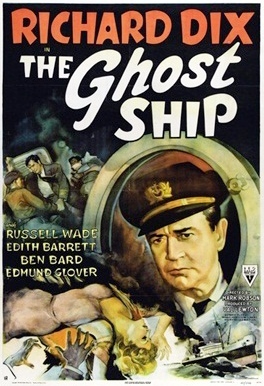
The Ghost Ship (1943): Creaky Yet Atmospheric

Ghostship.jpg“What a hobby to pick: authority.” 

The Ghost Ship is yet another serving of shadows and sound courtesy of legendary cinematographer Nicholas Musuraca and former editor-turned-director Mark Robson. However, the film is punctuated by few dramatic notes and instead settles in to develop a world of continual foreboding. It begins with the near-ESP of a blind street peddler who warns a youthful 3rd officer (Russell Wade) about the new ship he is about to board.

Though our lead actors are fairly bland types — the kind of people who could easily be slotted into any number of similar projects — I still found myself interested in them. Because with both Richard Dix and Wade I hardly have any history with them; it’s a tabula rasa. They remain as a reminder of how many actors and actresses are all but lost to time just waiting to be discovered anew. Some give a more lasting impression than others.

But Ghost Ship‘s most intriguing characters are certainly the shipmates because each man has an element to his performance. Sparks (Edmund Glover) is probably the most affable and the closest thing to a friend the new 3rd officer has onboard. Beyond this, the radioman sprinkles in some Latin with his normal vernacular.

Our next person of interest is an all-seeing mute who is nevertheless given the courtesy of a voiceover. He is the first among seafaring hands aboard, including Boats (Dewey Robinson, a Preston Sturges regular), the calypso-singer (Sir Lancelot), and the Greek who needs his appendix taken out mid-voyage. This is a whole ordeal in its own right.

But none of this gets at the reason the Altair just might be one of the most perturbing seas vessels in the annals of maritime movies. It should be noted the previous third officer died under unusual circumstances and rather dubiously, Mr. Merriam is occupying the same room the deceased man passed away in. Another old mate is found dead on the deck without much fanfare.

There were flying coffins during WWII, but this is a floating coffin if there ever was one. Its all very curious because The Skipper seems a good, honest seaman. His new mate likes him and the men — though at times disgruntled — listen to him, for the good of the outfit.

One particularly perilous event involves a loose hook on the bridge all but ready to decapitate a mate. Still, as time progresses, the captain’s words get more and more troubling. Without blinking an eye, he says, “I have rights over their lives – I have the right to do anything for the crew – because their lives depend on me.”

He is drunk on authority. It remains his only concern, and he will do anything to maintain his image, even fabricating events involving the aforementioned appendix operation. He can raise people from the brink of death while a cascading stack of clinking chains quickly means the demise of another man. No one can prove it outright, but the captain literally holds everyone’s life in his hands.

The third officer wants no part of this scenario. However, it seems fate brings him back into the clutches of this dictatorial madman, and the net is slowly contracting around him. Only time will tell if he is stopped in his tracks before knocking off another defenseless victim.

Obviously, given the time period, we can have a guess at the allegorical references toward the crazed power hunger of Hitler. It’s not difficult to see the parallels, but I don’t think we need much of a reminder such slavish devotion is detrimental. In this regard, such a pronouncement seems altogether superfluous.

The plot is also a bit stagnant and our leads admittedly bland. We are reminded of not only wartime shortages but that these are far from A-list talents on hand. In spite of these admissions, it’s all the more astounding to consider the impression this Lewton production still manages to provide.

The bottom line is that the ideas and the visuals are still worth remembering. Because Ghost Ship is not completely derailed by its shortcomings, still casting a fine vision lingering ominously over every frame.

3/5 Stars

The Seventh Victim (1943): Lewton’s Economy Rules

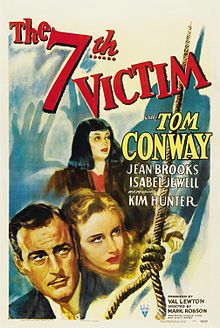
Seventh-victim-poster_one_sheet.jpgWhat a picture for Kim Hunter to have come into her own (and Mark Robson for that matter). The 7th Victim is a chilling gem, and the motor to move the story forward is an audacious girl, Mary Gibson (Hunter), who makes a decision to leave her boarding school of stain glass and angelic choirs, to search after her missing big sister.
Upon arriving in New York, Mary finds out Jacqueline, in an uncharacteristic fashion, sold her profitable cosmetic company eight months prior. Something must be up. Our kiddy noir hits its paces as Mary’s intrepid investigations lead her to Dante’s Italian Restaurant. She checks in on her sister’s rented room only to find a chair and an ominous hangman’s noose.

Next, she files a claim with the missing person’s bureau and looks to hire a private eye to give her help in a city that feels generally unfriendly. However, this is not entirely the case as she makes the acquaintance of Jason, a local poet who looks to lighten up the atmosphere. Likewise, Hugh Beaumont acts as a calming force in this labyrinth of turbulence and underlying dread. Nevertheless, he warns Mary that her sister, “Lived in a world of her own fancy. Didn’t always know the truth.” Another portent of some ill fate awaiting her.

Admittedly, on a micro-level, all the pieces simply do not fit together. To understand why we only need look at what moments were potentially left on the cutting room floor. In the age of narrative incoherence in crime storytelling, The 7th Victim is among the best (or worst). The fact that in such a short time it can be so befuddling must speak to something. Dissenters might clamor this is a disjointed mess but if this is faulty storytelling there is also a sense of apprehension present, inherent to such narratives.

It cannot simply be about four scenes that were famously cut out of the picture. Though we would have gained clarity in one sense, in another these missing pieces somehow aid in this byzantine journey weaving a yarn out of relatively meager resources. The dialogue is just okay but on a macro level, it’s all very intriguing.

The creme de la creme of chiaroscuro photography occurs when Mary goes down to a mysterious shop with Mr. August on a clandestine mission that goes awry. Anyone walking into such a world would know to begin with no good will come of it, inching down a hallway of darkness.

Then, we have the curious appearance of Dr. Judd (Tom Power) from Cat People who conveniently provides another male character with information on Jacqueline’s current situation. He subsequently has deep abscesses of knowledge about a cult of Palladian Devil Worshippers operating out of Greenwich Village. Again, we have a mythology evoked with traditions and sacred texts lending credence to this widespread conspiratorial atmosphere.

Because of course, as you might have guessed already, Jacqueline (Jean Brooks), now cloaked in a bob of dark hair, found herself immersed in a very foreboding crowd. They don’t look too kindly on those who let their secrets out. Another stylistically rewarding moment comes right after the woman is released from certain death and winds up wandering the darkened streets in a near dazed state. She scurries away into the shadows to evade an unknown pursuer — frantically seeking the aid of an oblivious theater troupe.

We’re on again with the perplexing waling nightmares because the film chooses to dwell in such places. But if the picture chooses to acknowledge Satanic cults the equal and opposite must be called upon to whether the evil. Though not an obviously religious man, the good psychiatrist asserts there is proof that good is superior to evil.

It comes in the words of the Lord’s Prayer. He speaks the words, “Forgive us our trespasses as we forgive those who trespass against us…Deliver us from evil.” Again, the real world liturgy pads the narrative with a kind of believable ethos even as Jacqueline is still hounded by some unknowable, supernatural specter.

The final scene is a blink and you missed it circumstance. Provided a few more seconds to sink in it could have been a horrible thing. As is we hardly have time for the facts to dawn on us until the movie is over, literally seconds later. While not optimal there’s no discounting how the scene was handled visually. Even in this single moment, it says so much with what is not seen and a sound compared to so many other pictures bloated with extravagant sets and resources.

7th Victim is a reminder that sometimes our movies lack imagination, thinking money and special effects can be thrown at a story to make it novel. While this might be true on a most superficial level, sometimes it is constraints that bring out creativity and reveal to us how starkness in the right context can be a beautiful gift. Val Lewton’s horror unit is one of the small wonders of classic cinema, and they cast an indomitable shadow, widely in part to cinematographers like Nicholas Murucasa. This one is another low-lit gem. Once again economy rules.

4/5 Stars

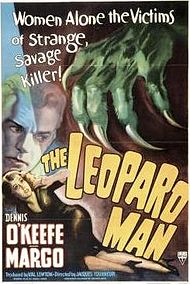
The Leopard Man (1943): A Work of Sound and Shadow

190px-Leopard_man.jpgIt’s fitting that a pair of castanets act as our entry point into the latest entry from Val Lewton’s RKO unit. Not only do they instantly grab our attention, but they foreshadow the auditory nature of the film and, in the cultural context, provide a little shorthand for where our setting might be.

Because with this stereotypical “Latin flavor” we find out soon enough we are indeed in New Mexico. At the local nightclub, Kiki (Jean Brooks) bemoans the fact her rival Clo-Clo (Margo) is constantly clicking, and it does seem blondes like herself are on the downside. However, her boyfriend, a fledgling publicity man (Dennis O’Keefe), has a new stunt to make waves with the viewing public.

When he walks into her dressing room with a leopard on a leash, she nearly dies of fright, and we have entered into the kind of territory intent on making our B feature a pulpy pleasure. Kiki reluctantly makes a grand entrance with her new pet and makes quite the impression as patrons look on with shivers of trepidation. Except her moment doesn’t last long as Clo-Clo scares the creature off and it goes racing off into the night — a beast off on the loose. One can only imagine what a deadly cat might get up to lurking in the shadows on any given evening…

From this point onward, the picture introduces a plethora of players from a fortune teller hiding in the shadows with her deck of cards just waiting to tell Clo-Clo her fortune. There’s the hapless bloke Charlie who gave up his prized leopard to Manning and wants his remuneration.

Then the local girl deathly afraid of the beast at large and nevertheless gets locked out of the house by her mother until she fetches the cornmeal for her father’s supper. We know the inevitable is about to happen. The creature will find her. Her world is developed almost solely through sound. The drip of water. Feet trudging through the dirt. A train passing overhead. They punctuate the scene immaculately leading into the big reveal. Because we know what is waiting for her…

She makes a mad dash to the front door of her home crying out to her family to open up but she gets no further. Like Cat People before it, The Leopard Man is made as much out of what is not seen and it has one of the most startling cinematic death scenes executed through utter minimalism.

Because although Manning and his girl feel awful about their hand in this girl’s tragic death, they soon realize more might be afoot. Another grisly death follows and then a subsequent evening Clo-Clo…

It is the stripped-down sound design in the picture that reflects the Lewton/Tourneur unit at the pinnacles of their powers. Where pure suggestion is imbued with so much meaning. So little can be so very much. Whereas M was a picture where the killer has a calling card, in this film the murders can be remembered by their accompanying sounds.

The wind whipping through the trees as a woman sits locked in a garden. A car engine driving off to get someone to open up the gate. Rustling leaves being stepped on and then quiet. With Clo-Clo it’s little different with the same repetition of her heels clicking on the pavement in rhythm with her castanets. Then, she too reaches a finality.

Despite the stylistically rewarding elements, The Leopard Man gets less interesting with time as it comes out the leopard might be masking a more mundane serial killer plot. Not to sound overly callous, but this is more of a real-world development. Aside from courting too many characters who dilute the impact of the whole story, The Leopard Man feels more stagnant than its predecessors.

The greatest pity is how there isn’t the same unnerving magic hanging over the picture. It probably has too big a stake in reality. What its predecessors were blessed with, in narrative terms, was the supernatural mixed in with everyday reality. The Leopard Man falls on the wrong side of the fence, unable to leave us with the same type of lingering specter. Its strengths were always in what was not actually there, instead of human beings of tangible flesh and blood.

3.5/5 Stars

I Walked with a Zombie (1943): Shadow and Psychology

IwalkedwithazombieThe film commences brilliantly as Frances Dee can be heard in voiceover with almost fond recollection, matter-of-factly stating, “I Walked with a Zombie.” The way she expresses it immediately debunks anything we might think from an admittedly exploitative title. Producer Val Lewton does not settle for a straightforward slapped together horror flick.
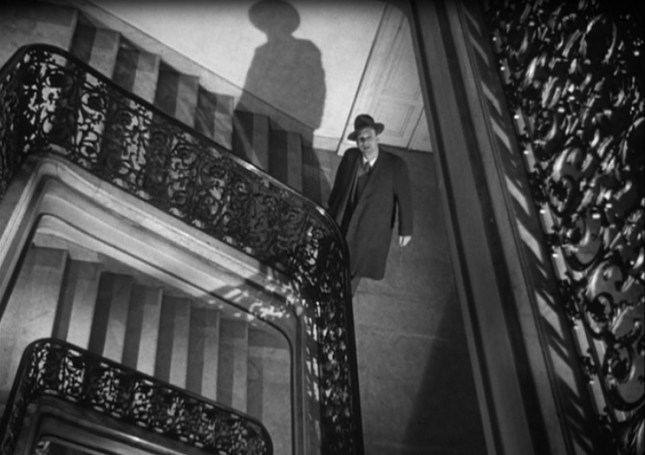

His ambitions were always to elevate the concepts he was handed into something indelibly interesting. Our heroine Betsy Cornell (Dee) is a Canadian nurse who applies for a position taking care of a man’s wife. It’s all very mysterious, but she’s eager to work and sets sail for San Sebastian where she will be in the service of Mr. Paul Holland (Tom Conway).

Lewton re-framed the source material into a Jane Eyre tale transplanted to the West Indies. Here Ms. Cornell arrives by boat, immediately struck with a callous first impression of the aloof Mr. Holland. He easily dismisses her childhood fear of the dark, while noting he never should have hired her.

I still contend most children are never afraid of the dark per se but what might come out of it. It’s the fear of an unknown thing lurking out of reach. Meanwhile, his younger brother (James Ellison) is a charming fellow who immediately takes a liking to the new nurse and helps to make her feel welcome. We have polar opposites set up and obvious points in a possible love triangle.

However, in following the plotting of Bronte’s work, the elder half-brother is tortured by a secret, literally locked away. It is, in fact, his mysterious wife, whom Betsy unwittingly meets one night, upon hearing a startling noise. At first, she’s taken aback by this specter of a woman, this ghost, this living dead.

But as her kindly doctor explains, supplying a firm foundation of ethos to this enigma, a portion of the spinal cord is burned out, and it has permanently made her a sleepwalker who can never be awakened. Aside from a potentially dangerous foray into shock therapy — to induce some sort of coma and hope for the best — her future prospects look dim. That is unless there’s an alternate means to bring about healing.

Like the Wolf Man before it, we are introduced to a stylized but nevertheless real locale that thrives by mixing the logical digressions that come from our world with ghostly influences. Screenwriters Curt Siodmak and Ardel Raye create a kind of poetic mythology for a supernatural conclusion to be crafted out of. Whether they meant to or not, they succeeded in canonizing zombies in the same manner werewolves were developed in Siodmak’s earlier script.

What’s lovely is how Betsy foreshadows all sorts of events to come and there are strangely mesmerizing objects to captivate us. The figurehead of a slave ship features Saint Sebastian himself pierced by arrows. It lends this undercurrent of the brutish injustices of the slave trade to the landscape we must come to terms with.

These very same traditions have the same weighty dolefulness but are also imbued with an otherworldly quality of its own. It gives this shading to the African-American characters who seem so happy-go-lucky like other Hollywood creations, and yet there’s an almost unnerving sense about them as if something is working under the surface. It’s hard to put an exact finger to it, but though they look similar, they aren’t quite straightforward stereotypes.

A local club singer chants an island song mixed with family folklore telling of the deep-rooted tragedies of the Holland family. The local populations are also adherents of local voodoo customs, and their nightly drumbeats ring out through the air ominously, picked up by the tropic winds. It’s yet another layer to this continually bewitching atmosphere.

Another character of crucial importance is Mrs. Rand, the deceased patriarch’s widow, and Wesley’s birth mother.  Her own station in life, as the wife of a Christian missionary, creates a juxtaposition between a so-called normal religion and a darker, more dubious strain.

Because it cannot help but bump up against the voodoo rituals even as black and white people now exist together. In fact, one might say the religious rituals become nearly intertwined. Betsy begins to realize maybe some powers at be might be capable of lifting the spell that has entranced Ms. Holland, even as she herself falls for the comatose woman’s husband.

As such, it is not horror lingering over the frames but a near mesmerizing catatonia. It carries you up in its grips from start to finish, trying to decipher what to make of such a vision. Enchantment, ugliness, cruelty all apply. And yet it’s difficult to cry out and out evil against the people partaking in these dances or voodoo ceremonies. The acts themselves might be evil, but the people are held in the grips of entrancement. Everyone is, to varying degrees, weighed down with desolateness even before the fateful dead are laid to rest.

We must recall the beginning voiceover once more. The fact Betsy walked with a zombie might hold an inherent element of terror, but more so, it carries with it a despondency that cannot be lifted. It hangs over us and haunts us just as the lurching Carrefour does throughout the picture.

The beauty of most any of the Val Lewton films of the 40s is how the studio and the audience expected one thing — a low budget horror flick with a provocative title — then the producer turned around to make micro-budget gems steeped in shadow and psychology. They have more depth and complexity than they have any right to.

Each entry boasts sumptuous visuals hiding weaknesses in the budget department to fully develop, not necessarily a world, but the impression of a world. One might contend the latter is far more powerful in an expressionistic capacity. Arguably, Lewton had no more formidable collaborator than director Jacques Tourneur who had an established knack for conjuring up the most splendid atmospherics.

This time he is aided by the black and white photography of Roy Hunt. In their hands, every character has a doppelganger in the form of shadows creeping along the walls with their human counterparts. It’s developed with the utmost efficiency, which seems all but a lost art these days.

But the astounding economy is matched only by a ceaseless ingenuity. Because the artfulness they managed to accomplish on the very same shoestring budget, is part of what makes them marvels even today. If you willingly invest your time in one of these RKO pictures, it’s very likely you’ll be met with a lasting impression. The dividends, as far as cinematic capital is concerned, are enormous.

4/5 Stars

The Third Man At 70

Oh, how I love The Third Man (or The 3rd Man). Regardless of how you write it, Carol Reed‘s post-war noir is one of those special films that was a case of love at first sight.  I knew some of the reasons already, but watching the film with a friend (on his first viewing) teased them out even more so. It was a nice reminder of why this film continues to enchant me and engage me on fundamental levels time after time.

Dutch Angles in Post-War Vienna

third-man1

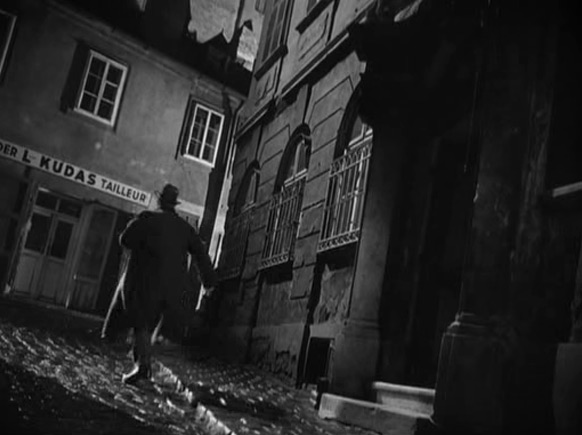
My buddy was right. The Third Man is inherently disorienting. Visually the film presents all of its subjects from a stilted perspective. They’re always slanted, featured in crammed together close-ups, and never quite sitting square in our line of vision from the camera’s uncomfortably low angles. Whether we realize them or not, there’s no doubt the dutch angels (from “Deutch” or German) manipulate how we experience the action.

Starting with these formalistic elements, the mood is perfectly ingrained in the fundamental building blocks of the story with the crumbling city sectioned off into its uneasy alliances between the WWII victors. We have a crosshatching of districts and a melting pot of language and objectives.

Thus, when the blundering American author Holly Martins walks into the story, he, like his audience, has very little understanding of what is going on. His level of comprehension is lost in translation even as he goes around trying to get to the bottom of the scenario. Joseph Cotten does a fabulous job in the part effectively becoming our eyes and ears in the environment.

And this strong association is part of the reason I so vehemently decried Netflix’s tampering with the original film’s ambiguity. If you’re like me and Holly Martins, you’re no polyglot, aside from a few token phrases here and there. When the old man or woman in the house rattles off something, you’re lost in the unfamiliarity. You’re waiting for someone to explain it, even trusting on the good graces of others. In some regards, you are helpless.

It’s part of the way the film toys with us. You realize the whole time maybe you’ve been played and a whole level of the film’s context has flown over your head. Subtitles alleviate our ignorance but also cause us to lose out on some of the perplexity felt as a result of such a global battleground. The Third Man capitalizes on the richness of these cultural ambiguities.

The Zither & Herb Alpert

going places

The music is next on my list. My friend was right again. The title song’s awfully familiar and after Anton Karas got plucked off the streets of Vienna to provide the lively but strangely hollow and foreboding soundtrack, it would go onto some acclaim on the music charts (including a guitar rendition by Guy Lombardo).

The tune is one of a select few early movie themes to hit the mainstream remaining fairly recognizable even today. This is even more surprising given its inauspicious roots. My friend connected the dots later only to realize he’d heard the particularly Latin-flavored version by Herb Alpert and The Tijuana Brass on their album !!Going Places!!  He taught me something new, but you learn a lot being friends with an avid record collection.

Quick Pacing

img_thirdman

It might be a mere generalization, but I feel like there are often complains leveled at films of yore that they languish, there’s too much talking, and they don’t boast enough action. But I think my buddy was spot on once more. The Third Man has surprisingly timely pacing (aside from the deliberate final shot).

One of the practical reasons for this might have been director Carol Reed literally being hooked on the stimulant Benzedrine to get through his hectic shooting schedule around the clock. This might be one explanation for the zip, even in the opening monologue. However, there’s also an undeniable drive to The Third Man because it’s stuffed with questions, mystery, and underlying tension.

As information begins to reveal itself, we have screeching taxi rides, reveals, harrowing meetings on Ferris wheels, and climactic chases sequences clattering through the rubble-strewn streets and labyrinthian waterworks. But the reason it grips us has to do with falling in with intuitively compelling characters. That’s as good a place as any to bring him up…

Harry Lime: Super-Villain?

welles_thirdman5

The final observation I found to be particularly interesting was my buddy’s acknowledgment that Harry Lime felt surprisingly modern, a precursor even to the current villain. I want to tease out this idea even more because I’ve been drawn to movies that layer their menace. I can think of the likes of Black Panther or Mission Impossible: Fallout as two recent examples.

However, what I mean by this is how you don’t quite know where the trouble is going to come from, who you can trust, and who will betray you. It makes for a glorious puzzle to navigate. Is Calloway someone we can give our allegiance to? He’s an awful stickler for the law without clemency.

Mr. Crabbin is an unnerving chap before we ever learn who he is and the shifty-eyed likes of the Baron, Dr. Winkel, and Popescu have far more to tell than they willingly divulge. The woman Anna (Valli), who loves Harry, is almost delusional with her unwavering love for a scoundrel. Even Cotten, our initial hero, lumbers around like a drunken idiot, thinking he has everything figured out.

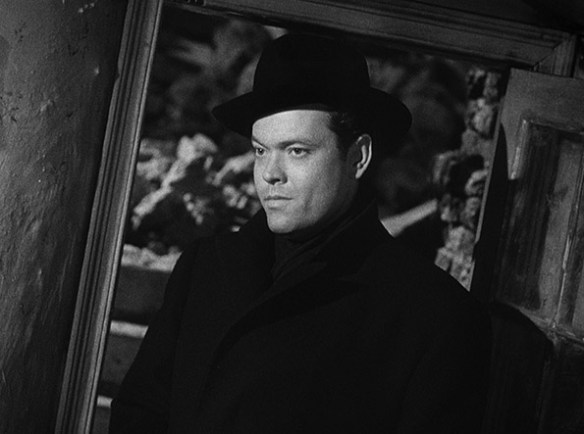
And of course, there’s Mr. Harry Lime himself. The most iconic charismatic, machiavellian anti-hero. Orson Welles makes him a dashing shadowy specter, larger-than-life and theatrical. But there’s no discounting the mercilessness pulsing through him. None of these characters are straight-laced by any stretch of the imagination. They have some flaw, evil, or vice dragging them down. Lime just remains the mastermind and the poster boy of it all.

The one character who seems like a generally agreeable chap is, of course, the one who SPOILERS gets it. Somehow it fits the times and the world. It couldn’t be any other way.

So 70 years on The Third Man still remains one of the preeminent examples of a quality thriller, pulsing with atmosphere, style, romance, and intrigue. To say they don’t quite make movies like this anymore is immaterial.

What’s truly staggering is how brilliantly Carol Reed’s film still holds up. I look forward to many more viewings to come, preferably with a friend or two. After all, they’re the ones who help me appreciate classics like these with new eyes.

Happy 70th Year to The Third Man! You’re still looking great!

I’m also proud to be a part of the Classic Movie Blog Association celebrating 10 years of existence. Here’s to many more.

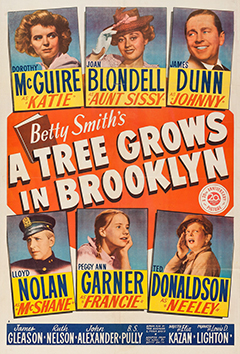
A Tree Grows in Brookyln (1945): The Precursor to I Remember Mama

ATreeGrowsInBrooklyn1945Poster.jpgThe reveries of a Saturday afternoon in childhood are where A Tree Grows in Brooklyn chooses to begin and it proves a fine entry point, giving us an instant feel for the world the Irish neighborhood of Williamsburg in Brooklyn. Its contours are impoverished, even harsh, but also richly American.
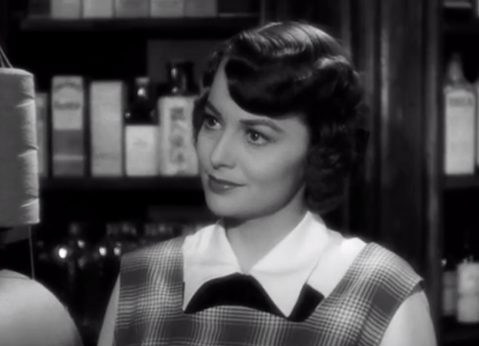
There is a mother (Dorothy McGuire) who is practical and ever-resourceful, scrimping and saving to eke by an existence for her family. She faithfully pays her family’s due to the door-to-door insurance man Mr. Barker, who is always ready to sow some juicy gossip around the community.

It occurs to me that Katie Nolan (McGuire) is a precursor to Irene Dunne’s role in I Remember Mama. But there is also a near-callousness that is lacking in the latter part, which is mostly sunshine. In this regard, it gleams with a certain individual truth. Struggling  to make ends meet, Nolan asserts, “My kids are going to be something if I have to turn into granite rock to make them.” She dishes out tough love and makes difficult decisions in what she deems is their best interest — an extension of her undying love for them.

There’s an extraordinary shot showing bickering wives, stories up in their apartments, with clotheslines strung up every which way and a man trying to fix the source of their problems.

Nearby sits the little girl enthralled with her book and you understand first hand the power of the library. Because with the internet, television, and movies we’ve deluded them but, at a certain time, books were a way of escape, of learning, and open avenues to distant places.

Francie (Peggy Ann Garner) is, without question, the emotional center and if we are to extend the earlier juxtaposition further, she is an analogous version of Barbara Bel Geddes’s character in I Remember Mama. We view the memories of the past through their impressionable eyes.

She too is captured by her imagination — the rapturous escapes that stories and music can provide a fanciful mind like hers in the station of life she finds herself in. Francie’s deepest wishes are granted when she is able to attend a fine school where her benign teacher gently cultivates her passions.

The advice passed down to her is empowering as Francie is inspired to be a writer. She must write about the things she knows imbuing them with truth, which can then be dressed up with the whims of her imagination.

It’s true Francie maintains an underlying sweetness and innocence even in the midst of heartache. For instance, there is the annual Christmas ritual retrieving discarded trees and boy do the kiddies bring home a whopper. Its presence alone puts some yuletide cheer and the smell of evergreen into their holidays.

It only takes such a minor yet meaningful Christmas scene to humble us in our modern tendencies so that we realize how off-base our modern celebrations are. These folks have nothing and yet to look into their eyes you see such contentment in the singing of a song and quality time spent together.

However, the most debilitating ideology in the film is the concept of neverending cycles — believing the lie that change is impossible and things will never be different. Because already you have a self-fulfilling prophecy. We see it most obviously in the marriage of Francie’s parents.

Johnny Nolan is an ebullient father bred on dreams and singing. There’s always a song in his heart whether “Swanee River” or “Sweet Molly Malone” and unfortunately, for the sake of his family, a bottle in his hand. His daughter memorializes him aptly, “He had nothing to give but himself but this he gave generously like a king.”

The words stand tall and true. To my mind, I have not seen such a compelling father finger as Johnny Nolan in some time and the reasons are as obvious as his flaws. He’s an alcoholic. He makes promises he can never keep. He’s practically useless when it comes to providing for his family. And yet through all his shortcomings shines a light of generosity and geniality that positively warms the cockles of our heart. We cannot condemn him without loving him just as deeply. There you have the testament of a truly impactful character.

Aunt Sissy (Joan Blondell) proves another bright spot in the film and her vivacity, much like her brother-in-law’s, injects the film with a buoyancy making us grow fond of them even as their flaws are laid fully bare. Sissy has her own struggles holding onto a marriage with a couple of husbands already coming and going. Her escapades leave her baby sister shaking her head and hoping to shield her kids. And yet even Aunt Sissy has her admirable qualities.

The local police officer Mr. McShane (Lloyd Nolan) walks his beat with a quiet integrity, disregarding any stereotypes of policemen and fashions them into compassionate people the world could probably use more of. Meanwhile, kind old Mr. McGarrity (James Gleason) heaps neighborly generosity on the Nolan’s in an effort to help the overextended Mrs. Nolan make ends meet.  It’s the benevolent spirits in the film who are quietly memorable.

Too blinded by the resonating sentiments, I failed to see the obvious denouement of A Tree Grows in Brooklyn, which nevertheless proves deeply satisfying. As its title suggests, out of death and decay can grow new hope. It comes from hardy stock and dutiful cultivation, which all seem integral to the American way of life.

For me, it’s almost unthinkable to think the man who played a small part as Googie in City for Conquest only 5 years letter would alight on a directorial career that shook Hollywood over and I don’t think that’s hyperbole. He brought us Brando and Dean, conquered stage and screen and left an indelible mark on film acting forever. Of course, we’re talking about Elia Kazan and here he has his first prominent muse Dorothy McGuire (a founding member of the La Jolla Playhouse) who is often an unsung star fitting as she’s playing an unsung heroine

It seems a fitting entry point into Kazan’s career as it is an immigrant story and he came from such a family. It makes no difference that he wasn’t Irish because we can surmise the essence is much the same. He believes in the American dream no doubt and the love and integrity that can see people through the turbulence of life.

However, perhaps the most striking acknowledgment has to do with the fact this story does not thrive on intensity — one might see that as being a marker of Kazan’s most noted works — it’s tenderness mostly. But then if you stop a moment and think of Brando slipping on the glove belonging to Evie (Eva Marie Saint) or James Dean crying to his father (Raymond Massey), you realize he never lost those sentiments. What made his films was the real emotions that reach out to us. He never allowed for those sensations to waver. There you have an integral element of his success.

4/5 Stars

To Each His Own (1946): Olivia de Havilland Does Melodrama Well

To Each His Own 1.png

Ginger Rogers purportedly passed over the script for To Each His Own because, at first glance, it’s hardly a glamorous role; but for the right person, it could be something unquestionably special. That actor was Olivia de Havilland.

Certainly, the production is bolstered by Mitchell Leisen, a mostly forgotten director who made a string of highly memorable comedies and romantic pictures during the 30s and 40s. It’s no different here. And then you have Charles Brackett, formerly half of the lucrative writing partnership with Billy Wilder before alighting on his own as a producer. None of that can be discounted nor a handily-played dual debut by John Lund. But we must return to Olivia de Havilland.

In the opening interludes, she comes off as acerbic and curt, a forlorn type of person. No relationships or community or people to worry about or to worry about her. She’s joined by another middle-aged man named Desham (Roland Culver) and they make quite the pairing, taking on the night watch duty over the holidays so others might celebrate.

He coolly makes the observation that people like themselves are alone for one of two reasons — not caring enough for other people or caring far too much. Though Ms. Norris divulges little, we instantly gather she fits into the latter category. This is what starts us on the journey through her past, which led her to a man named Bart Cosgrove (John Lund).

But before their fateful meeting, the flashback sets up the world of Pierson Falls, familiar to anyone who has glimpsed It’s a Wonderful Life with its parochial atmosphere and local drugstore. Match that with the jingoism out of Hail the Conquering Hero and you have a slice of life in this little town during WWI.

John Lund is sour and far harsher than I recall in say The Mating Season and it serves him quite well. He and his co-pilot (the always reliable Frank Faylen) are the two jaded flyers who get the hardiest of welcomes from the townsfolk. However, this is their umpteenth stop on an endless bond tour. They’ve become overly familiar with people like Bernadock Clinton (Arthur Loft) the asinine town cryer making a continual bother of himself ushering the flyers around like prized sideshow attractions. And it would be more of the same if not for the meeting of the flyer with the town’s most eligible gal.

To Each His Own 2.png

The heightened emotion of wartime uncertainty swirls around them and they share a rapturous, if whirlwind, romance that Captain Cosgrove was never expecting. All too soon, he’s off again leaving his newfound love behind and to use euphemistic vernacular, they’ve created a ticking time bomb.

Here To Each His Own enters its scandalous phase where Jody must confess to her father that she’s had a child out of wedlock. The old man (Griff Barnett), with the steady voice, sounds uncannily like Will Geer and spouts unassuming wisdom, “We don’t judge each other. We love each other.” But small towns are not usually as forgiving and so lest people talk, Jody decides to leave her child on a doorstep. Hoping to pick her child up later and “adopt him.”

Instead, a couple who’ve been tragically hit with a miscarriage are thankful for this second chance at cultivating life and they take the child. Of course, the couple is one of Jody’s old beaus and another peer. They got married because Jody rejected him. The dramatic situation is clear enough.

When the mechanizations of the plot become clear, it also becomes clear just how awful the circumstances are — just horrible. They’re apt to tear your guts out. After the passing of her father, Jody, who needs a job, proposes coming on as a nursemaid, but there is no compassion there. She gets pushed out of the scenario thanks to a jealous wife and a husband who still holds a boyhood crush.

She has no choice to move on and, being a go-getter, she takes charge of a bootlegging business and turns its front, Lady Windemere’s, into a legitimate international operation proving highly successful. Whenever she has a free moment, Jody does her best to manufacture chance encounters just so she can glimpse a few minutes with her son who is growing in knowledge and stature. But she knows deep down, with each passing year, little Gregory is less and less her son.

Melodramas or so-called “women’s pictures” can be hit or miss depending on how thick they lay it on and how much the music swells at the exact moments of deepest impact. But in full consideration, To Each His Own might be one of the finest such pictures to come out of the 1940s, and it’s no small coincidence that it shares that distinction with the thematically similar Stella Dallas.

When it’s all said in done, it’s about heartwrenching relationships between mothers and their children and when the mothers are portrayed by such stalwart titans as Barabra Stanwyck and, in this case, Olivia de Havilland; the drama enters territory that can easily pierce the heart to the core.

To Each His Own is also somehow akin to Random Harvest with dramatic irony being integral to the plot — one character knowing something that deeply affects how they live their life — except the person they care about knows nothing about it. This is by no means a criticism either but simply an acknowledgment that these stories can tug at the heartstrings with great fervor.

Again, it comes down to the players as much as the scenario. They must be people that we are capable of feeling great pathos for. Certainly Stanwyck, Greer Garson, and Ronald Colman and even Olivia de Havilland. Maybe she’s known for being difficult or a perfectionist or what have you, but that has nothing or maybe everything to do with her as an actress.

She makes us care about her as she moves from every stage of her life. And I say life because it feels less and less like a performance and more like real life. She, like Stanwyck before her, is able to carry the weight of youthful exuberance and maternal toil equally well.

Far from being unglamorous for winding up being mother to a grown son, I think a film like To Each His Own makes you appreciate the beauty of de Havilland even more. Because there’s a realness and a depth there that you would have never gotten in a career of roles opposite Errol Flynn. You just wouldn’t.

That’s part of what makes it special. And like the other previously mentioned titles, it goes out with a few tears but also espousing dreams. We can question the final moment — the rationality; the catering to the audience — or we can just enjoy it like a wedding feast with the ones we love.

4/5 Stars

Gentleman Jim (1942): Biopic by Marquess of Queensberry Rules

Gentleman_Jim_-_Poster.jpgBoxing movies and biopics are a mainstay of Hollywood. It’s an established fact so naming names is all but unnecessary. The affable brilliance of Gentleman Jim is its agile footwork allowing it to sidestep a myriad of tropes attached to biopics and the schmaltz that Old Hollywood was always capable of serving up.

Certainly, a great deal of credit must be heaped upon Errol Flynn who seems to relish the very opportunity to portray such a magnetic man as James J. Corbett — always perceptive and driven with a bevy of tricks at his disposal to get ahead. I can’t help but hear Butch Cassidy’s words in my ears, “I got vision, and the rest of the world wears bifocals. Corbett could live by that credo too.

Authenticity is to be trodden upon softly and so there is a sense Flynn has taken the “gentleman” moniker of his namesake and fashioned the role around his own roguish charm, good looks, and irrefutable charisma. Thus, it becomes almost second nature for him to play the part because there’s this sense that he’s playing what he knows best, and loving every minute of it.

He’s meant to come from hardy Irish stock with a jovial father (Alan Hale), two boisterous older brothers, an awestruck sister, and the ever maternal mother figure. Around all these types Flynn and Jim feel like outliers. They’re not meant to fit into this family and yet it somehow manages to work — Marty McFly anyone?

The script, co-written by Vincent Lawrence and Horace McCoy, begins by drawing up the story in a most agreeable fashion that takes into account our hero’s life but also considers any number of stray antecedents that led to his rise in the boxing world.

Boxing in its most barbaric forms is being outlawed across the nation. Jim and his hapless buddy Walter (Jack Carson) spy the prominent higher-up from their bank at a fight only to have the police raid the event. Soon they’re all in prison with their prominent friend and Jim sees it as the perfect opportunity to earn some favor. Soon Judge Geary has brought on his young protege as a new brand of fighter: one with class.

Being a fast worker, Jim gets himself into the elitist Olympic Club doing his best to look the part of a  well-to-do gentleman, despite hardly having a dollar to his name. Concurrently he begins annoying the gentleman around him with his constant stream of boys sent around paging him.

It becomes quickly apparent that Gentleman Jim exists in a world, not unlike that of Walsh’s Strawberry Blonde (1941), where America seemed to have acquired a newfound propriety. Nasty pugilism had been replaced with marquess Queensberry Rules and someone like Jim Corbett was able to become something.

He soon is acquainted with Ms. Victoria Ware (Alexis Smith) who along with her family are members of the social elite and patrons of the bank. I must admit that the Canadian actress has all but slunk under my radar aside from her part in Conflict opposite Bogart.

But I have rectified the oversight because she gives a lovely turn opposite Flynn allowing the sparks to fly in the most vehement way possible. High-class respectability can only get you so far. Sometimes you just want to see someone get wailed on for their own good.

She has just about enough of his conceited ways finding him utterly infuriating with his faux polished manners and overblown head. He has the gall to criticize her idol worshipping of such an eminent legend as John L. Sullivan. Corbett being an utter nobody himself. But he’s got ideas and the fancy feet to go someplace.

Upon leaving their little tiff, he dances his way back down the street zigzagging through oncoming passerby. He’s got John L. Sullivan (an impeccably cast Ward Bond) on the mind now. Because there was no bigger national hero, icon, and legend than John L. Sullivan. The film even evokes the famous phrase, “I just shook the hand that shook the hand of John L. Sullivan!” He was that big of a celebrity.

Backed by William Frawley in his corner, Corbett is soon on the rise taking on anyone who will get him some visibility. In the ring, the suave-looking Irishman is a model of agility and impeccable footwork. Though Flynn, to his credit, stood in for most of the scenes his flying feet were spotted by world-class former welterweight Mushy Callahan.

Many of the sequences capture the immersive even suffocating atmosphere of a boxing match through fairly furious cutting, especially for an old film. Inserting shots of the ring, mincing feet, and a flurry of audience reactions throwing together a swirling experience.

The most frenzied is a back and forth river barge slugfest with haymaker after haymaker flying through the air. Corbett and his hulking opponent wind up decking each other flat again and again.  Flynn takes a plunge into the water only to lay out his competitor for good minutes later.

The victor is finally raised as the police arrive on the scene to crash the proceedings and all the spectators jump ship in the most tumultuous and mayhem-filled denouements to a fight you’ve ever witnessed. The beauty is we get an almost birdseye view of the madness from the cheap seats and we see on what a large scale everyone is frantically escaping. Jumping into the drink. Screaming and shouting. It’s the kind of bedlam that’s contagious and a real enjoyment from reel to reel for some inexplicable reason.

Surely the fight to top them all is Jim Corbett against John L. Sullivan. But just as important as the actual bout is the skirmish going on outside the ropes. As the telegraph lines are flooding the country with news round after round, Corbett’s clandestine backer watches expectantly for him to get clobbered.

Meanwhile, Ms. Ware’s father with a glint in his eye eggs her on very tenderly toward the most antagonistic man in her life and subsequently the most important. In the movies at least, the people who detest each other the most wind up making the most passionate romances.

Aside from love, Gentleman Jim is refreshingly light on heart-wrenching drama or needless sentiment for that matter. It slips up in one solitary moment where a gracious Sullivan looks back wistfully at an illustrious career and pays his respects to Gentleman Jim. If anything it shows that Flynn can play genuine just as he can slather on the charm.

For contemporary audiences, it no doubt carried a sardonic edge as the actor was simultaneously embroiled in a scurrilous court trial that all but ruined his reputation for months on end.

Regardless, standing on its own merit, Gentleman Jim might just be one of my new favorite boxing exhibitions and the key is that there’s seemingly no agenda. It ebbs and flows around a life and characters without concerted realism or a need for continual heightened drama. And yet we still find it compelling and jovial with all sorts of moments worth telling the folks at home about.

In fact, that might just be Raoul Walsh’s finest attributes making every scene, action, brawl, what-have-you, totally immersive, effectively involving the audience through his array of shots. While Flynn and Smith are finally in each other’s arms, Jack Carson makes one final call straight to the camera shouting that the Corbett boys are at it again, duking it out in the parlor. Some things never change and the beauty is that we’re in on the joke as much as anyone within the frame. What a delightful biopic. Shamelessly fun to the very last word.

4.5/5 Stars