It Happened Tomorrow (1944)

it happened tomorrow.png

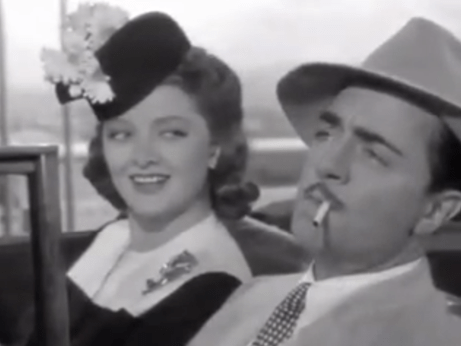
Rene Clair makes no justifications for his flights of fancy and it’s true that the stuff is unabashedly whimsical to the zenith. He made a reputation for himself in his native France for his playful cinema and for the decade or so he was in Hollywood (1935-1945) he continued much in the same vein. Most people would say it came with lesser dividends though some of his more memorable offerings included I Married a Witch (1942) and this film, It Happened Tomorrow.

Again, it involves highly unconventional orchestration like he was all but accustomed to in his comedies. It’s nary for everyone. In fact, it probably relies too heavily on its nifty bit of novel storytelling involving a journalist who begins to receive the following day’s news in advance. He can predict the future and it proves advantageous for grabbing the scoop and betting on the horses among other trifles.

Subsequently, the film begins rolling out a red carpet full of tropes upon tropes. But no one can shame Clair for sticking to his own whimsical abstractions and if you do allow it to invade your space you might just find yourself taken with its jungle gym-like acrobatics through time.

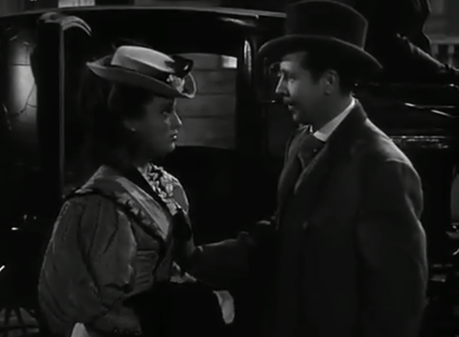
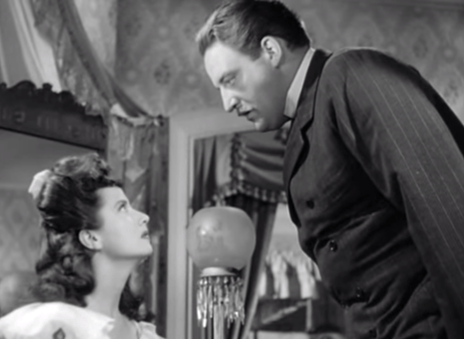
It starts 50 years ahead of our story with the golden anniversary of a couple talking about a small matter that happened years before. Then we fall back to the 1890s where Lawrence Stevens (Dick Powell) has the monotonous distinction of penning obituaries for the local paper before finally being promoted to reporter by his grouchy editor Mr. Gordon.

But then something far more miraculous happens. Lawrence doesn’t realize the implications at first when Pop, a veteran newspaperman with a near-saintly demeanor, becomes Lawrence’s guardian angel. To speak in known references, he might very well be this movie’s Clarence. His true gift is offering his young colleague the following day’s headlines.

They involve, of all things, updated classified adds, irregular snowfall and then an Opera House Robbery — offering the first moment of realization that Lawrence might have something extra special in his grasp. Simultaneously he becomes, enamored with the clairvoyant half of a niece (Linda Darnell) and uncle fortune telling duo.

Not until reading a little further into Linda Darnell’s history did I realize just how young when she made it big in Hollywood. Like her finest efforts, she dazzles with that bright-eyed concern next to Dick Powell. Though he would begin the redefinition of his career shortly with his introduction as Philip Marlowe and upcoming hardboiled fare, there’s still time for something light. He carries it with his usual assured comic energy as the headlines continually drive him into action.

One night he’s saving a girl from jumping off a bridge — his own girl in fact — to make a prophecy come true and then the next morning he’s tipping off the suspicious police chief on where to capture some wanted bank robbers.

Lawrence is now the talk of the town and the go-to writer for the paper with his uncanny nose for news. Soon he’s asking for Sylvia’s hand in marriage though a momentous misunderstanding leads her uncle to insist on a shotgun arrangement. If that’s the case he gladly takes the poison. But to bankroll their happy future together he bets on sure thing after sure thing at the racetrack. After all, he can’t lose. Or can he?

If you could know when you were going to die would you know or is ignorance really bliss? The movie begins its downward spiral after Lawrence’s winnings are swiped and it is foretold that he will die the same day in a hotel at 6:25pm on the dot.

Flimsy physical comedy takes over as we plummet toward the inevitable despite Lawrence’s vehement attempts to derail fate. He still winds up in the lobby of the St. George Hotel, within the very confines where he is destined to be gunned down. Like clockwork, everything unspools toward that exact end. The most exasperating thing is he saw it all coming and could do nothing to stop it.

But with a knowing wink, Clair flips the conceit on its head and that’s the story’s flash of momentary brilliance because we see as the narrative gets back around how things can work out in such a convoluted but somehow logical fashion. The paper reads: Lawrence Stevens is Dead. Of course, we know he’s alive. But the movie manages to make the headline ring true. You can have your cake and eat it too.

3/5 Stars

Unfaithfully Yours (1948)

unfaithfully yours 1.png

Though Preston Sturges would never eclipse the heights of the early 40s again and his stellar run was slowly spiraling down, we do have Unfaithfully Yours and for my money, that’s recompense enough.

It documents the life of a prestigious conductor, Sir Alfred De Carter (Rex Harrison), happily married to a gorgeous woman (a stunning Linda Darnell) with ample help from a staff including an efficient personal secretary (Kurt Kreuger) and a crotchety Russian played by Lionel Stander. The entourage includes his wife’s wisecracking little sister (Barbara Lawrence) and the sister’s husband, an insufferable bore of the bourgeoisie named August (“He’s got $100 million don’t also be expecting Mickey Mouse”).

The whole issue arises when said brother-in-law, played by Rudy Vallee, takes Alfred’s passing entreaty quite literally to “watch over his wife” while he’s away. As August was also away paying a visit to mother, he has a private detective check in on his sister-in-law. The P.I. collected a comprehensive dossier on her activities while he was gone, which Sir Alfred promptly rips up.  It doesn’t help that the hotel house detective (Al Bridge) is very thorough in his job, driving the conductor to burn the documents decisively, followed by a valiant effort to put out the subsequent conflagration in his dressing room.

However, all his attempts are to no avail and the conductor starts getting ideas; the rumors that were in the back of his mind now start moving to the front, making him irritable.

What other film, featuring a tailor just trying to eat his lunch in peace, winds up leaving an impression because the man is given enough to say? It’s quintessential Sturges and he doesn’t disappoint many of his faithful players either. Each gets a spot of their own. The private detective (Edgar Kennedy) gets a contentious visit from De Carney and turns out to be a patron of the arts. He’s a keen follower of De Carney’s oeuvre even. Sturges gives him the perfect summation of his opinions, “For me, there’s no one who handles Handel like you handle Handel.”

There are also a few choice Sturges lines that I couldn’t help but recall being recycled from other pictures such as being “left to hang on a meat hook” and the age-old favorite “nuttier than a fruitcake.”

As the director slices through the material, De Carney thrusts and waves his way through Rossini, Wagner, and Tchaikovsky. He’s so attuned to his craft, in fact, that he daydreams through each, the music setting the perfect melody to each of his mental confrontations with his wife.

unfaithfully yours 2.png

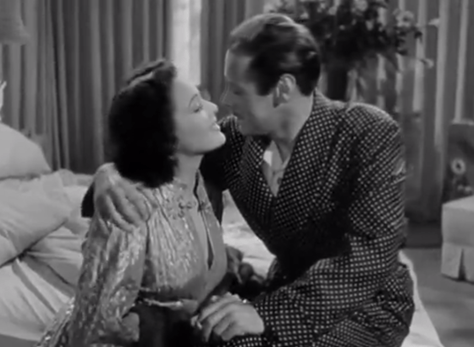
The first arrangement of events is calculated yet diabolical, played to a piece booming with sweeping, all-encompassing, passionate rage. Using a voice recorder, he stages the perfect murder to entrap the other man. He ends up cackling in the courtroom with relish as he watches Tony get his sentence. It’s all too easy. Hitchcock might have been proud.

His middle piece captures the pure melancholy of the entire scenario. Both maudlin and chivalrous, as he decides the greatest act of love he can perform is to let her go to her true love while writing her a check that she might never have to work her pretty hands ever again. The final coda picks up the tempo again in a ragingly melodramatic fashion that culminates in the proposition of Russian roulette between a gentleman and his rival.

What actually happens is like so: It entails an inexplicable trashing of his apartment after dipping out of his finest hour prematurely. Lamps and wicker chairs are systematically demolished, not to mention the knocking of the telephone off the line and unwittingly pranking the operator again and again. Glass shatters, pratfalls, miscues, clunking about like a witless neanderthal. It is all present.

There is a Georges Rouault painting up on a wall that I distinctly remember from an Art History textbook I once read. So, obviously, this makes this picture the height of culture and it might as well be. Juxtapose that with Rex Harrison, always so refined and erudite, seen stomping about and making a shambles of his apartment and you have one of the film’s high points. And the picture has much to offer us even amid its bleak and admittedly dark deviations.

What’s striking is not simply that this is a physical comedy (typical Sturges) but that it wholly relies on Rex Harrison’s abilities and is nearly a wordless sequence. For a man who was so renowned for his pen, Mr. Sturges shows an apt restraint. This long extended scene says in visual terms that the very way we envision things never hold a candle to actual reality, where things get complicated and muddled by this or that. Nothing is left where we remember it or sudden onslaughts of sneezing come out of nowhere.

Recording machines, that despite being “so simple they operate themselves,” never seem to behave properly, foiling us at every possible interval. In fact, each of his nefarious ploys that he dreams up get thwarted.

unfaithfully yours 3.png

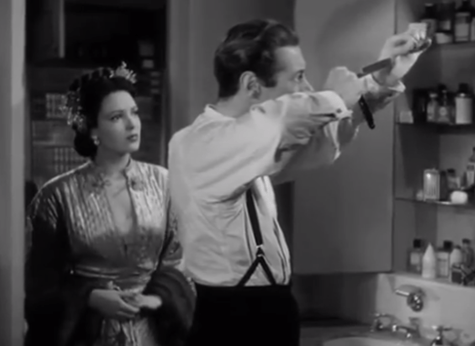
His wife comes home and they have a normal, healthy, human misunderstanding. Husbands get accidentally cut by razors, spill ink pots all over the desk, and wives innocently confuse the marginally different games of Russian Roulette and Russian Bank, worrying about the moods of said husbands.

The only flaw in Unfaithfully Yours, if we can call it that, is the fact that the husband has no open line of communication with his wife. Of course, not having it allows the film to cycle through each of its subsequent movements, thanks to our protagonist’s mercurial nature.

What I find most troubling about it is how he jumps too quickly to accusatory behavior in taking the higher moral ground. His better half is given the lower position as the doting wife, though her sincerity is never in question like his. I suppose it’s precisely why we must see Harrison acting like such a numbskull lunatic; we have a counterweight.

It’s true that the picture could have featured the pairings of Ronald Colman and Francis Ramden then James Mason and Gene Tierney at different intervals. Rex Harrison was brought on with Carole Landis to play his wife, only to have the actress replaced due to difficulties between her and Harrison. Landis is remembered today namely for her romantic ties to Harrison, her figure, and a terribly unfortunate, premature death.

It seems nearly impossible to separate the two as the picture’s release date was pushed back in part to the actresses death and her close romantic ties to Harrison (married to Lilli Palmer at the time). He was the last person to see her alive as well as one of the first people who discovered her body. While the parallels to this film aren’t altogether obvious, there’s nevertheless still some controversy swirling around both.

What we are left with is that Unfaithfully Yours is funny and then sad and then sadly funny again. We can’t laugh but we must just as life must be full of laughter. For it is one of the grandest antidotes for poison. The acerbic poison that crops up in people due to jealousy and distrust. The picture might be truer to life than we would care to admit. I’d generally be interested in hearing Rex Harrison’s thoughts. I guess we’ll never know. The viewing public in 1940s America certainly wasn’t ready for such a perversely pitch-black picture. It was probably too far ahead of its time. Even today it still maintains that sting of biting wit.

4/5 Stars

Hail The Conquering Hero (1944)

hail the conquering hero 1.png

I have long sought out this picture, and all I can say is all hail the conquering hero! It’s everything that could have been hoped for in a Preston Sturges wartime comedy. But in order for the laughs to come along with a great deal more, there must be a setup — a watering hole for our main players to familiarize themselves.

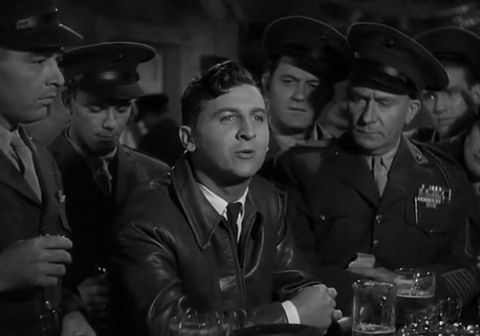
Sure enough, we are introduced to a fairly somber nightclub scene or maybe it’s simply the face of the one man the camera chooses to focus on, sitting dejectedly at the bar. There slumps Eddie Bracken, slightly pudgy and round-faced. By no means classically handsome but he and Preston Sturges had quite a thing going for a couple years.

He got sent home from the Marines for chronic hayfever. I’m extremely empathetic to his condition, as I’m sure innumerable others are as well. Anyway, he’s too embarrassed to go home, and it’s been a year now and he’s still not returned. However, he has nothing except the highest regard for the Marines, as his father gave his life serving his country. In fact, it was the very day our boy was born.

He pays it forward to a group of Marines on leave with no dough, thanks to the gambling habits of one of their pack. The act of charity isn’t lost on them and they get acquainted. Soon they find out the name of their benefactor. It has the be the most patriotic names ever invented: Woodrow Lafayette Pershing Truesmith (sans the Truesmith).

They are regaled with his story and stunned by his encyclopedic knowledge of the exploits of the Marines out on the battlefields. Their leader, Sergeant (William Demarest), even finds out they have a lot more in common as he knew the elder Truesmith — Winky Dinky for short — before he perished.

The only place for the film to go from here is back to Woodrow’s roots and so without his consent, his mother gets called up and it’s announced that he’s getting sent home. Woodrow’s against it from the beginning but his new pals say there’s nothing to it. He’ll wear a uniform for a day, give his mother a hug, and take off the uniform soon after, completely forgotten. Of course, as they ride the train into town, they have no idea what’s been stirred up in preparation.

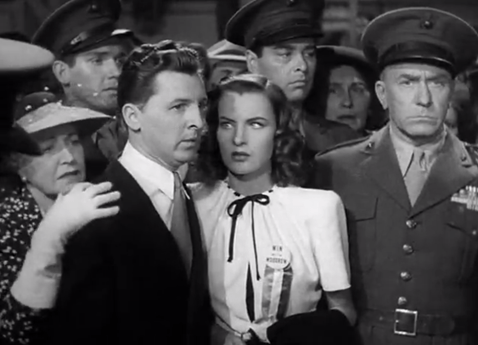
A homecoming like you’ve never witnessed has been hurriedly assembled by the local committee chairman (the frantically hilarious Franklin Pangborn) and it’s the true essence of cacophony with unrehearsed dueling brass bands; the mayor and any number of folks milling about in expectant anticipation. The show is just beginning to warm up now.

What many will find astounding is just how perfectly Hail the Conquering Hero has been constructed by Sturges, at least in the way it skirts its topics with simultaneous delicacy and verve. Here is a film striking an impeccable course between that very same comedy and then admiration for the armed forces because no one can forget WWII was still blasting away across the world.

hail the conquering hero 2.png

Likewise, the church service far from belittling the faith is a lingering visual gag as we watch the dueling reactions of the two sides of the pews. First through the hymns and then a very sincere homily from the preacher culminating in yet another rousing display of goodwill. By now Woodrow has little hope to derail any of the fanfare with the erection of a commemorative statue christened “Like Father, Like Son” soon in the works. All his newfound Marine buddies are good for is stoking the fires and applauding the sentiment.

The next great sequence is cued by the music and Mother answers the door and mentions that the Judge (Jimmy Conlin) and some other civic leaders want to see Woodrow. Immediately his mind leaps to the worst possible scenario. The game must be up and all his Marine buddies inconspicuously grab household items in case of a tustle that might take place in the drawing room. Of course, their intentions are nothing of the sort. Far from it. The lead up makes the outcome into yet another outrageous reveal.

Just around this juncture, it becomes increasingly apparent that all the characters appear to move in packs and Sturges crams the frame gladly with bodies and faces and more appendages. Woodrow does his best to avoid the spotlight, flubbing his speech to the masses, and trying to downplay the bid for mayor thrust upon him only to be thwarted at every turn by a cheering crowd of well-wishers. One man even proclaims his was the greatest speech since William Jennings Bryan’s “Crown of Thorns!” Already we have the swellest giggle-fit inducer I’ve encountered in some time.

hail the conquering hero 3.png

I wracked my brain only to realize I’d never seen Ella Raines in a comedy before and for much of this picture she’s in the periphery, her comely smiling features on the screen with a whole host of others. But there are a few moments that, far from playing merely humorously, prove deeply moving as she is split between the man she is betrothed to marry and the one she truly loves.

The family she’s caught up in includes a quibbling father and son. The incumbent mayor (Raymond Walburn), who ponificates incessantly, attempts to dictate his speech in his latest bid for reelection only to get annoyed by his dim-witted boy (Bill Edwards) who nevertheless corrects his grammatical blunders. She’d do well to get out of there. Nevertheless, they are a bounty for humorous dialogue.

The stakes are set for a reversal of fortune with a number of parties having a chance to oust our hero. One man who’s buddy-buddy with the Mayor, the cool and collected Jake (Al Bridge) is mighty curious about Woodrow’s service record and he sends a wire to the Marine Base in San Diego. He gets the incriminating news shortly.

But ultimately it comes down to Woodrow himself and Sturges puts the perfect words in his mouth that Eddie Bracken then utters with an assured conviction. Riffing off the Biblical epithet he notes, “My cup runneth over with gall” and proceeds to pour out with veracious intent all the lies and masquerades he’s been too scared to admit to his own town. His guts are laid out right in front of him. Yes, his mother cries. The townspeople look on somberly and his Marine buddies can do nothing to dispel any of it. Even the words of the Mayor and his pal mean nothing now.

With such a showing you would think it was all over for Woodrow and he tells his mama that he’s going to leave again. He cannot stay. Not like this at least. But his girl comes back to him because she at least loves him unconditionally.

hail the conquering hero 4.png

At the train station the parlor games look like they might commence again but this time the whole town is involved, a lynching all but imminent. The Marines this time wrap up their belts inconspicuously to prepare for combat once more. Of course, the mob is there for a very different reason altogether.

The film has the foresight to see what so many of its contemporary war movies were, only made plainly obvious with the luxury hindsight: Light-hearted and good-intentioned yet still mawkish propaganda pieces. So Sturges took up his pen and tackled such hero worship and small-time jingoism, and yet settles on a resolution proving to be as venerating as it is satisfying.

Hail The Conquering Hero is a miracle assemblage of poignancy and humor; I don’t know how it comes away still intact and with my heartfelt laughter and deepest respect no less. It’s not an easy road to traverse by any means. Only a few have managed it. Chaplain in The Great Dictator (1940) distinctly comes to mind and Preston Sturges here.

4.5/5 Stars

Christmas in July (1940)

christmas in july 1.png

“If you can’t sleep at night, it isn’t the coffee – it’s the bunk” – Maxford Coffee House Slogan

Christmas in July is one of Preston Sturgeses earliest efforts where he both scripted and directed the material. He was fed up with how others had handled his handiwork. Obviously they must not have directed it in the zany scattershot way they should have. He would all but rectify that oversight in the early 1940s with his string of successes.

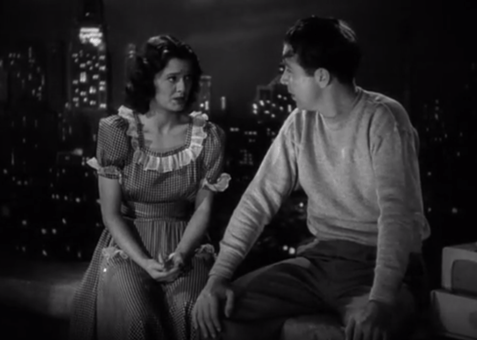
We are privy to a rooftop romance between Jimmy MacDonald (Dick Powell) and his best gal Betty Casey (Ellen Drew) as they take up a light squabble over modern living and radio sweepstakes. The man is intent on winning the grand prize of $25,000 for the Maxford House Slogan Competition. He hangs attentively around the radio to get the verdict. He, his girlfriend, and millions of other Americans.

But a snafu arises when the jury is hung in their decision-making process by an obdurate Mr. Bildocker (William Demarest). The radio announcer has no choice but postpone the annoucment. Not only does it annoy the public by leaving them hanging on a meat hook, it leaves space for a practical joke to go horribly awry.

You see, Jimmy is adamant that his slogan will be the kicker and he’s not shy about telling everyone about it. First, his girlfriend, then his mother, and finally any coworker who will listen. Three wiseguys in the office overhear his spouting and pull the gag to end all gags. All it takes are a few slips of paper, some paste, and an unused telegram slip. It’s a pretty horrible joke. You can probably envision it already.

In fact, I could just see it unfolding like the emperor’s new clothes and yet it’s more good-natured and innocent. He sees the note, reads it, and proceeds to stand on top of his desk to share his good fortune and tell his colleagues to gather around. It’s a sequence full of canned laughter as the floor manager comes by to see what the ruckus is about.

Jimmy and Betty are glowing and positively floating down the corridors together. They must be dreaming. He quite innocently wanders into the Maxford offices inquiring about his winnings and walks out again as nice as you please with a check for $25, 000. Next, comes the department store jewelry case and every other department they have.

Seeing the astonishing check in his possession, the store all of a sudden gets very generous and soon he’s being given everything on credit. Buying new fangled whizzbang contraptions like the all-in-one Davenola. Diamond rings and fur coats for his girl follow, and gifts for everyone else in his family and the adjoining neighbors. The street in his old neighborhood is pure bedlam with the passing out of toys to all the kiddies and free caraousel rides and confections. They’ve never had it so good. There has never been such a respite before.

christmas in july 2.png

As an audience we are in on quite a big secret. We know the bubble must burst some time. Our greatest fear is that it will completely devastate MacDonald. He’s the kind of man who requires the approbation of others to believe that his ideas are any good and that can be dangerous.

For all the madness, there is a very sincere consideration of the American Dream in this picture, not to mention what people deem to be truly important in their lives. His Manager, far from being a mere boob, has some suprisingly sagacious knowledge to dispel:

“Mr. MacDonald. I’m not a failure. I’m a success. You see, ambition is all right if it works. But no system could be right where only half of 1% were successes and all the rest were failures – that wouldn’t be right. I’m not a failure. I’m a success. And so are you, if you earn your own living and pay your bills and look the world in the eye. I hope you win your $25,000, Mr. MacDonald. But if you shouldn’t happen to, don’t worry about it. Now get the heck back to your desk and try to improve your arithmetic.”

Thankfully, the picture is loaded end to end with character parts. It’s positively swimming in them. Though he never worked with Dick Powell and Ellen Drew again, who coincidentally have a fine genial chemistry, many of the smaller bit players became mainstays of Sturgeses stock company. Aside from William Demarest (who gets the final comic punchline as per usual), you will see many other familiar faces if you’re acquainted with the director’s canon. In other words, Sullivan’s Travels (1941) Et Al.

There’s this innate sense that he’s stuffed this particular script with any number of inside jokes and he mastered the art of humorous character naming, only adding to this swirling cauldron of mayhem born out of one simple gimmick.

Hanging his hat on a slogan like, “If you can’t sleep at night, it isn’t the coffee – it’s the bunk” is seemingly a foolhardy task and yet he all but pulls it off. I must confess that I couldn’t get my head around the statement for a while because it seems that “bunk” used in its informal and archaic etymology as “nonsense” isn’t as common today But it reflects Sturges perfectly.

If there is a modern heir apparent to Preston Sturges I am still in the dark. The closest might be the Coen Brothers and yet their work has never undone me in the same ways. Maybe I’m looking in the wrong places. You also had a contemporary in Frank Capra who was well-versed in populous fare but though he had close collaborators, he rarely wrote his material or had the same unorthodox pizazz of Sturges.

Billy Wilder proved capable of much the same as Sturges, both as writer and director, but even he worked often with writing partners. His work was injected with a cynicism even foreign to Sturges in all of his idiosyncratic, zinging panache. Each is worthy of an examination due in part to their differences. However, Preston Sturges  was really one of the first high profile screenwriters, preceding so many modern success stories. He gave the formerly uninspired and restricted post a newfound respect at a time when that was all but unheard of.

One part of me speculates whether his humor is dated and another part asks why we don’t have films quite like this anymore? Part of the answer might be because of television. The kind of hijinks and episodes that Sturges seemed to showcase often got translated into I Love Lucy episodes and numerous other sitcom tropes that would gain traction over the years.

Still, there’s little doubt that something deeply satisfying is afoot — a film that zips along at an hour and seven minutes yet leaves us feeling like a whole boatload has happened in that same amount of time. Because it’s true. There are dour notes. Moments of wistfulness even, but paired with all that is frenetic and wonkers, you find Preston Sturges coming out on the other side with a comedic trifle that speaks to a great many things about American life, however superficially. Because remember, the punchlines are just as important as the lessons.

3.5/5 Stars

Ramrod (1947)

ramrod 1

Right away, in the very first moments, we know something’s amiss when the driver of a passing wagon notes to the woman at his side that they just passed her father…and they proceed to keep going without even a word of greeting.

It’s true that Ramrod is a riff on the age-old family feud but it involves several other men who are tied up in it too. Frank Ivey (Preston Foster) plays god where nothing and no one sees the light of day without his say so. Because remember these are the days when whoever had the most firepower and the ability to lean on others was king.

True, the sheriff (Donald Crisp) has a duty to uphold the peace but his jurisdiction and authority can only reach so far. One man against an entire posse doesn’t amount to much. Important to this story is that the old man from the opening scene, Ben Dickason (Charles Ruggles), has long sided in all of his affairs with Ivey. He’s even told his daughter to marry him and he does it again when the bully runs her latest beau out of town.

But Connie Dickason (Veronica Lake) is resolute and not about to let anyone push her around and so she decides to take the land bequeathed to her and try and make a go of it as a cattle rancher. She knows its an uphill battle in opposition to Ivey but one key to the enterprise is Dave Nash (Joel McCrea) who finds himself all of the sudden on the wrong side of Ivey as well. Now he has a reason to take up an offer from Connie becoming the ramrod of her outfit.

Soon he assembles a workforce including his pal Bill Schell (Don DeFore) to see the game through by legal means playing by the rules because the local sheriff is a buddy and Dave is not about to put his friend in a compromising position. He respects him too much. Others are not so valiant. For all intent and purposes, total war has begun.

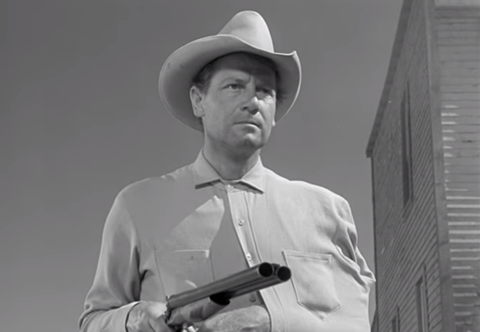
First Connie’s homestead is razed to the ground, a cowhand is given a going over, and another man is gunned down in retaliation. Both sides have blood on their hands’ thanks to this eye for an eye mentality that continues to escalate matters. A herd of cattle is stampeded. The sheriff gets it for attempting to enact justice. Dominoes continue to tumble with each subsequent shotgun blast of malice.

Dave winds up as a fugitive for avenging his friend’s death by gunning down his purported killer. He finds himself wounded and trying to sneak past the searching eyes of Ivey. They manage to get him away to a secluded cave but even their his safety is put in jeopardy by — you guessed it — Connie Dickason. She has her meddling hands in many things.

ramrod 2

The one person who won’t let him down, despite a myriad of faults, is Bill and he devises a plan to draw the enemy away from his friend by acting as a decoy. The posse winds into the mountain crags to gun Dave down for good; they fail to comprehend who they are actually dealing with.

With her then-husband directing, it makes sense that the film provided a prominent berth for Lake. It’s a juicy role full of a mixture of innocent intentions and conniving. There’s absolutely no question about it; it’s another femme fatale role as she plays a “man’s game” by pitting all the men in her life against each other to get her way so she can pick up the pieces. In totality, it’s a nifty bit of maneuvering to get the desired results, successfully pouting her way to the top. But a curious counterpoint is Rose (Arlene Whelan) who is without question the guardian angel of the picture tugging at Daves heartstrings while Connie continually entangles him.

Retroactively it’s seamlessly easy to label this a noir-western sharing company with such hybrids as Pursued (1947) and Yellow Sky (1948). This breed of western is dark and brooding, concerned with psychological warfare as much as it is rough and tumble enforcement of justice. We half expect Ramrod to cram itself down our throats and it might as well with all that goes down.

The cast is steady with a plethora of recognizable character actors including Charles Ruggles and the diplomatic hand of Donald Crisp. Don DeFore as the bright-eyed ranch hand nevertheless knows how to hold a grudge with the best of them. You’ve never seen him so grungy. Lloyd Bridges fills a near bit part as a hot-headed heavy as usual while the scapegoat Virg is portrayed by Wally Cassell (Cassell lived to the ripe, old age of 103). With the reteaming of Lake and McCrea we had a reunion of Sullivan’s Travels (1941) and yet the reason it didn’t happen earlier was McCrea was not all that fond of his leading lady. By no means does that detract from this minor western success.

3.5/5 Stars

Tall In The Saddle (1944)

tall in the saddle 1.png

“Boy oh, boy has somebody come to town!” – Gabby Hayes

How else is there to describe Gabby Hayes except for a cantankerous old cuss? When we first set eyes on him he’s berating his old mare for making him spill his liquor although he’s already swigged down quite the snootful.

Even Walter Brennan who was often cast in similar roles showed some diversity in performances during his early years (maybe Hayes did too) but Gabby will always be such a lovable coot in my eyes. Because, you see, if you grow up on westerns of the B variety with the likes of Gene Autry and especially Roy Rogers, Gabby Hayes was a mainstay of the genre as far as sidekicks go. I was fond of Smiley Burnette and Slim Pickens but no one holds a candle to Hayes.

He makes us chuckle along with the tall handsome stranger who’s just witnessed the same events. Before ever interacting we know they will wind up good friends. They hold a mutual admiration for each other.

The man named Rocklin, played by Marion Morrison and known to the world as John Wayne, rides shotgun on the stage headed for the town of Santa Inez. The coach’s other occupants are a terribly irksome old crone and her demure young niece who are heading to the same town for some business. Rocklin has come for the prospect of work.

However, he finds out the man who paid for his train passage was killed and his holdings have passed on to the very same young lady in the stage except her peevish aunt is not about to allow her to conduct her own affairs.

Rocklin seems to have little reason to stay and yet he does. He gets into a tussle with a young hot-head over a poker hand. Then, the next day he gets a faceful from strong-willed Arly Harolday (Ella Raines); she comes into town to get this brazen newcomer to hand the money over.

How can you not love John Wayne? His lady costar confronts him, guns-drawn and shrilling at him to stop and turn around but he just keeps on walking nonchalantly as she fires a hail of bullets all around. He pushes the saloon’s door open and saunters up to the bar, nice as you please.

The next such moment could have easily been a climax — as a gun duel looks all but imminent. Wayne cuts a business proposition short and proceeds to clock hulking George Clews over the head with the butt of his revolver before going back inside to return to his conversation. He subsequently gets hired on as Topaz ranch foreman.

tall in the saddle 2.png

As he so eloquently puts it, “No women is going to get me hogtied and branded.” However, that does not account for the power-hungry land grabs and the shooting of men in the backs that’s being orchestrated. Wayne must navigate with his own brand of sleuthing. A later highlight follows our hero destroying an entire office space having it out with his old football chum Ward Bond, playing a local judge.

While there’s nothing especially novel about the yarn spinning, there’s nevertheless something comforting in this as Paul Fix pulls double duty as co-scriptwriter (with Michael Hogan) and also portraying the thug Bob Clews.

It does feature two formidable female characters, one in Raines whose fiery pistol-packing showcases her own charisma opposite Wayne, while Audrey Long, who plays the reticent Easterner, proves to have enough intuition to see the picture to its conclusion. Because it must end with Wayne a wanted man, a posse coming to get him, and two guns looking to finish him off. But he has some corruption to thwart and let me assure you he puts an end to it just as assuredly as he nabs the girl — I’ll let you be the judge which one it ends up being.

Search for an underlying moral and you might not discover anything outright. What you will receive for your trouble is a good ol’ fashioned western vehicle for John Wayne that he tackles with his usual fearless gumption. Despite his rediscovery in Stagecoach in 1939, that didn’t mean that The Duke had quite risen above B fair completely. For what it’s worth, Tall in the Saddle does the low budget genre justice.  Besides Duke would get plenty of other quality movies in the future.

This is an unnecessary aside but whenever I hear John Wayne speak Spanish it always seems to add another layer of authenticity to his persona. He once said that he’d want to be remembered by the phrase, “Feo, fuerte y formal.” He was ugly, strong, and had dignity. Sounds about right.

3.5/5 Stars

The Song of The Thin Man (1947)

the song of the thin man 1.png

The Song of The Thin Man is really and truly the swan song of the series and while I did enjoy most of the additions, there is a sense that it was time to end the franchise. The year is 1947. The war is over. Things have changed. It really has little to do with William Powell and Myrna Loy being older or past their prime, because they are still a joy to watch working in tandem and they’re hardly over the hill.

But in some respects, society didn’t need Nick and Nora anymore. They were more like a touch of nostalgia than an up-and-coming force because they were born out of the Depression years and though they grew and matured as characters well after that, it seemed like as good a time as any to let them be.

Their son, little Nick Charles Jr. (a young Dean Stockwell) is a precocious lad like his father.  His behavior is deserving a spanking though his father is averse to giving it out even on his wife’s behest. But this was never meant to be a family comedy. Even Asta was always a sidekick and not a focal point.

Most of the film is conceived on a luxury liner, the S.S. Fortune amid nightclub musicians and patrons who have come out for a charity benefit put on by the wealthy David Thayer. It’s the perfect locale for, you guessed it, murder.

The center point of it all is Tommy Drake, the band leader scrapped for cash and with plenty of bones to pick with any number of people. He wound up gunned down from behind. In introducing all the players, it’s safe to assume they’re potential suspects too. There’s songbird Fran Page (Gloria Grahame), the ship’s proprietor Phil Brant (Bruce Cowling), and the soused musician Buddy Hollis (Don Taylor). It’s Brant and his forbidden fiancee, Janet Thayer (Jayne Meadows), who come to the Charleses so that Phil’s name might be cleared.

Bess Flowers turns up in a fairly visible role given her usual penchant for bit parts in hundreds of high profile films. Leon Ames returns to The Thin Man universe in an unusual circumstance of the same actor taking on a different role. Helen Vinson who played his wife previously was not available for the picture and so the exquisite Patricia Morrison (currently 102 years young at the time of this viewing) filled the part instead. Even noir regular Marie Windsor shows up as a gangster’s moll although I’m not sure if she even utters a word.

Anyway, back to the business at hand, Nick and Nora Charles and the mystery. One of the best parts of the film is watching the Charleses be introduced to the jazz beatnik culture craze and their guide is none other than Clinker (Keenan Wynn) a real hip cat on the reed who happened to be aboard the liner when the murder occurred.

It should be noted that when rock n’ roll came Beethoven could be found rolling in his grave. Currently, his bust simply looks begrudgingly from his perch, given the state of affairs with the contemporary music scene.

Interestingly enough, there aren’t many police authorities running around to get in the way. It’s all Nick Charles joined by his wife and, in this case, Clinker who has connections to really help them understand the scene.

Although the setup and the characters are interesting enough, the film probably has the least satisfying finale of any of the Thin Man films. It winds up back on the ocean liner but it somehow doesn’t come off like its predecessors. Even the fact that the picture is a good 20 minutes shorter than the earlier films seems to suggest the beginning of the end. But on the bright side, for once Nick was able to retire for good — to his bedroom that is. It’s fitting, really. Mr. and Mrs. Charles gave us plenty of laughs. They deserve to rest in peace.

3.5/5 Stars

The Thin Man Goes Home (1945)

thin man goes home 3.png

Sometimes it’s necessary to go back to the basics. We’ve been introduced to the social elite of New York and San Francisco, invited along to giant family estates, and frequented the race track and wrestling rings. It only makes sense that at some point we would finally be introduced to their roots.

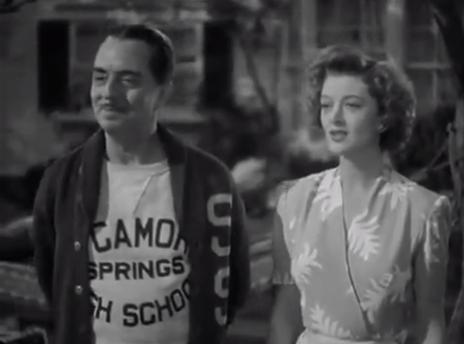
What is the occasion, you ask? Nick has a birthday coming up and what better way to surprise his parents (Harry Davenport and Lucille Watson) then popping in on them in his hometown of Sycamore Springs? It’s not the most comfortable of trips, crammed together with other passengers; before resigning themselves to the luggage car, for Asta’s sake, where he gets accosted by the local livestock. But be it ever so humble, say it with me, there’s no place like home!

The premise is plainly given but this might just be the most enjoyable installment since After the Thin (1936).  That is not to say the other entries were not amusing. They most certainly were. But there’s something gratifying about getting to know Nicky’s community a little better. Due to the passing of W.S. Van Dyke, it is Richard Thorpe who takes up the reins without too many noticeable hiccups or maybe there are just enough.

There’s the inevitable running into a plethora of old acquaintances of all sorts of ticks and demeanors. Most curious among them is the aptly named Crazy Mary (Anne Revere) or the starstruck young debutante Laurabelle Ronson (Gloria DeHaven). Nick takes each reunion in stride while also finding time to fix tables and fiddle with deadly hammocks all to the mild amusement of his better half.

The comedic range of gossip around town is astounding as the whole neighborhood drums up a story about how the town’s most famous citizen has returned to investigate a homegrown murder. It couldn’t be further from the truth, until it becomes true. What happens is the most ludicrous of murders yet, with a young man (Ralph Brooks) showing up on the Charles’ doorstep only to get the axe a minute later.

Mr. Brogan (Edward Brophy), a reformed greeting cards salesman, is always coming out of the bushes to give Nick a tip but of course, he didn’t see or hear the murder. Still, he provides his services to the amateur detective by pulling his wife away for an evening.  Myrna Loy in the humorous tailing sequence showcases her talents, making the scene into her own shining moment away from her husband. Though they are inseparable in one sense, the film benefits from these digressions as wayward as they might seem.

There are so many juicy tidbits to latch onto but one of the most crucial is a fateful painting of a windmill that Nora buys her husband as a birthday present,l due to some childhood significance. But there’s also a couple (Leon Ames and Helen Vinson) anxious about getting their hands on the piece for its perceived value. It’s no small coincidence the painting was attributed to the deceased victim.

At the Charity Bazar, the Charles make their appearance and Asta hops up on the counter to pay a visit to a house check girl in the periphery (I have no idea why this caught my eye). Meanwhile, Loy is forced into a jitterbug with an eager sailor serving as a convenient diversion. Nick doesn’t want her to be with him while he goes snooping around upstairs. And in these moments you see the allure of the Charles marriage.

The husband is the quintessential bachelor-type who nevertheless makes an affectionate husband and his beautiful Nora, a high-brow socialite, is ever the understanding wife. But beyond this archetypal pairing, you have the wryly comic tug-of-war between them as the smirking Nick always looks to throw his wife off the track and she always does her best to stay right there by his side.

In fact, the payoff looks different in the small town as everyone of possible motive is gathered into the drawing room but also it is Nora and not Nick who becomes the master of ceremonies, quelling their objections and keeping the audience under raps while her husband gets ready to make his appearance.

Given the crazy nature of the murder, it would be safe to reason the finale would be a little wild too and that assumption holds. But that cannot take away from what this film has to offer. Because what is The Thin Man without Nick and Nora Charles? It would be nothing and yet in this picture, they both continue to shine as they always did together. Even as the years progress, they don’t change all that much. The only thing that’s different is Nick has made strides with his drinking hobby which has been traded out for a flask of cider. One can only surmise the reason for this change was the wartime ration on liquor.

3.5/5 Stars


Shadow of The Thin Man (1941)

the shadow of the thin man 1.png

Little Nick Charles Jr. is growing up and his loving daddy, in lieu of fairy tales, reads to his son about the horse races. Some things never change. Despite an unfortunate stereotyped-laden portrayal provided by Louise Beavers, the picture quickly settles into another enjoyable jaunt.

In fact, it’s a perfect day for the races until Nick gets pulled over for speeding. That’s only the beginning. Because the cop proves to be a big fan of Mr. Charles. After all, if we haven’t realized it already, he is a household name. Everybody seems to know him. Policemen, conmen, jockeys, and anyone else you can possibly pull out of a hat. It makes no difference. By now, his wife never shows an ounce of surprise. She only smiles, nods, trades pleasantries and never says another word about it.

The recurring gags keep coming with yet another former acquaintance with a grubby nickname like “Fingers” running into Nick and inquiring if the dame he has in tow is his new girlfriend. It seems like no one ever thought him one to get married.

It’s all good fun and there’s even the return of Nick’s old buddy, old pal, Lt. Abrams (Sam Levene reprising his role). This sense of world building and the introduction of characters was always The Thin Man series at its best, but there’s also business at hand — a jockey named Gomez has been whacked.

However, Nick tries to avoid getting pulled into yet another case by patronizing the arts, namely a wrestling match. It’s one of the film’s most delightful diversions but there’s also a sneaking suspicion it must tie into the case somehow. The forces lurking in the shadows hang over the racetrack murder like a stench and they’ve got there hands in all the places, including the press. Maybe even higher up too.

A youthful Donna Reed makes an early appearance as a naive secretary and while still growing as an actress, there’s no doubting her sincerity that always shined through in all her work. With writers Albert Hacket & Frances Goodrich, then James Stewart and Sheldon Leonard also involved in earlier installments, and Reed being featured here, it does seem The Thin Man was a bit of a training ground for It’s a Wonderful Life (1946).

But back to the current business at hand. Molly’s beau Paul (Barry Nelson) is a prime suspect when murder strikes again. With the young couple right at the center of the mess, compassionate Nora wants her Nicky to get them out of it and that he does.

Also, tied up in the case are stuttering Rainbow Benny, famed acting instructor Stella Adler in one of her actual roles as Claire Porter, Frank Faylen as a nervous ticket booth operator, and you guessed it, a whole host of others.

Still, Nick finds time to get accosted by kids while taking Nick Jr. around on the carousel. While Asta’s best gag is getting trapped in a revolving door chasing after a fugitive. Myrna Loy doesn’t get as much screentime as she should but as usual she provides a calming and still slyly comic presence. The continuity provided by W.S. Van Dyke is there as well though this is the first script not penned by the screenwriting duo Hackett & Goodrich.

By now it’s all but inevitable. Everyone gets rounded up to the police precinct. Nick Charles takes center stage bringing wifey along and Lt. Abrams is in the middle of it all for good measure. But he’s really only the white noise and perfect stooge as Nick deduces his way to the finale as he always has. It’s true that the formula feels a tad overspent but seeing as Hollywood is used to beating dead horses to a pulp recently, this one doesn’t feel that bad. At least it’s a good time and we still have Powell and Loy as amiable as ever with a continous spritzing of humor.

3.5/5 Stars

Review: Holiday Affair (1949)

holiday affair 1.png

Holiday Affair might be a bit of an oxymoron as far as Christmas movies go. It’s not too far off the truth to christen it an old-modern Christmas classic, at least depending on how you define your terms.

It’s a Christmas picture that has all but sailed under the radar since its original release in 1949 though it has, rather recently, gained some modest recognition around Christmastime. Given Robert Mitchum’s normal workload for RKO, it feels like an outlier in comparison with most of the dramatic or noirish crime fare he was usually expected to star in. And part of this might have been due to circumstance — circumstance that might also explain why this picture wasn’t such a big hit.

Mitchum was fresh off his famed drug bust for narcotics possession which ironically, far from killing his career, managed to project his image as a bad boy and a major box office draw. But Howard Hughes wanted to try and soften his image and the picture in the pipeline was Holiday Affair. It’s certainly not what we are normally accustomed to for a Mitchum vehicle. Contemporary audiences might have concluded the same.

In earlier iterations, the film was slated to star the intriguing cast of Montgomery Clift, James Stewart, and Teresa Wright. In fact, it’s interesting to note Wright could have been in the Christmas classic of two years prior, The Bishop’s Wife (1947) as well. Alas, she did not end up in either picture. Still, that should in no way dismiss what we actually received.

Although visibly quite young for the role of the widowed mother Mrs. Dennis, Janet Leigh makes it work due to a pluckiness and genuine chemistry that buoys her relationships with her on-screen son (Gordon Gebert) and both of her male counterparts (Mitchum and Wendell Corey).

What brings them all into the most curious of love triangles is a momentary interaction at the toy store. Connie Ennis is a comparative shopper a little too eager to purchase a model train and Steve Mason (Mitchum) is the employee on the other side of the counter.

Though he doesn’t say anything, he’s got her pegged. Sure enough, she comes back to return the gift but instead of reporting her he lets it slide — only asking her never to come to his department again. He subsequently gets fired and is back on the streets, biding his time in order to realize his dreams of becoming a shipbuilder in California.

Meanwhile, Connie doesn’t have an affluent lifestyle but perhaps more important than that, it’s a generally happy existence. Her husband was killed in the war, yes, but she and her son Timmy have a tight-knit relationship. They’re truly there for one another. It’s no fluke she constantly calls her pint-sized man of the house, Mr. Ennis. Because it’s true. He is the most important man in her life.

Although there is another man who is hoping for the privilege to become a part of their family. Carl (Corey) is a divorced lawyer who has long made his intentions plain to Connie. It’s just a matter of figuring out if she’s ready for marriage. And he seems like a good practical man to go through life with. Still, that isn’t everything.

Because Robert Mitchum is added to the equation and between both men, Timmy finds Steve a lot more fun and I think it’s reflected particularly well in the relaxed performance that Mitchum gives.

He’s surprisingly compelling in his scenes with the child because, again, he may have the image of a tough guy but when you watch him speak there’s no pretense. He’s not talking down to the kid. He nearly treats him as an equal or at least not in the condescending manner that adults often have. That’s the key.

The rest of the story, including the final act, doesn’t need spelling out. You probably already can gather some sense of what will unfold. But this film is a reminder that predictability isn’t king. Sure, it’s present but there are also a plethora of idiosyncratically enjoyable moments to be relished.

Among other things, they involve gaudy neckties, hobos, salt and pepper shakers, feeding orphan squirrels, and eating with the seals in the park. A delightfully ornery Henry ‘Harry’ Morgan provides a cameo at the Police Precinct that helps draw out some of the film’s more absurd digressions.

There’s a lovely marital toast and an equally awkward confession. But more than any of this there’s the realization of what family might be and what true happiness looks like during the holidays.

In an earlier moment, in typical Mitchum fashion, he taps the lady of the house on the shoulder and proceeds to kiss the surprised Connie before proclaiming “Merry Christmas.” End scene. Or on Christmas morning little Timmy springs in on his mother to wish her a “Merry Christmas” of his own. It’s these little trifles that make this a congenial outing for those craving a bit of nostalgic yuletide cheer.

3.5/5 Stars