Review: Notorious (1946)

notorious 1.png

I never put much stock in a Hitchcock title out of force of habit or lack thereof because he never seemed to. But thinking on Notorious I came to the rather unextraordinary epiphany that it refers to lovely Ingrid Bergman as much as any Nazi, at least from a certain perspective.

In the film, she plays the daughter of a Nazi war criminal who was put on trial and found guilty. She, however, is not implicated in his deeds. Instead, busying herself with having a good time, drinking, dancing, laughing — all the superficial pursuits that can distract her from a post-atomic world. You might even say her reputation precedes her and that provides the framework for how others see Ms. Huberman. Namely, one government agent named Devlin, put on her case and writing her off early on as a certain kind of woman.

There’s that initial shot at one of her parties where all the guests are dancing and drinking and everything’s jovial and there Cary Grant sits on the edge of the frame just his profile identifiable to us. And the beauty of the scene is that Ingrid Bergman starts talking to him but instead of showing us his face Hitchcock elects to wait until everyone is gone and they’re sitting together in the next scene. But already there’s this implicit sense that there’s something unusual about this man even without putting words to it.

In the subsequent scene, we get our first view of Cary Grant and Ingrid Bergman together and how wonderful they look. But Bergman’s character makes an off-handed remark about love songs, about how they’re a bunch of “hooey.” Of course, that pertains to this film and where it will decide to go in the realms of romance, but in my own mind, I see it also functioning as a reaction to Casablanca’s “As Time Goes By” — a film where lovers fell in love partially because of a song.

It’s easy to put the title of a spiritual sequel on Notorious for numerous reasons. Once again we have Bergman and Rains in crucial roles and then trading out Bogey for another legend in his own right, Cary Grant. The paranoia of Casablanca is replaced with the sunnier disposition of Rio de Janeiro which nevertheless is underlined by a certain looming Cold War menace. In this case, instead of the letters of transit, we are provided a Hitchcock MacGuffin, including a bottle of wine, some uranium, and an iconic UNICA key.

But if nothing else these minor remarks can put the debate to rest conclusively. Notorious is a spectacular film in its own right and it enters some similar yet still uncharted territory in accordance with the waters Casablanca chose to ford a few years prior. Meanwhile, Grant has glimpses of his previous self from other films but soon enough he falls into the role of cool and calculated federal agent Devlin in what feels like a true departure.

There’s that supremely unnerving shot as we take on the perspective of a disoriented Ingrid Bergman as Grant walks into the room and hangs over her in a strangely alarming way. Everything is setting up the dynamic at this point.

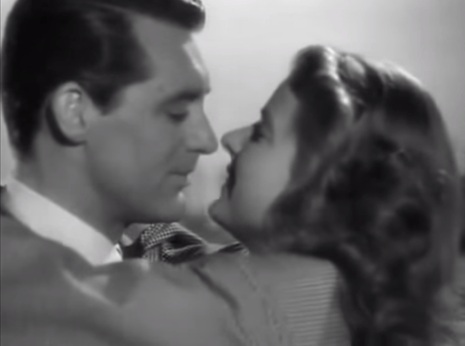
Still, others will remember the extended make-out session that made history by upholding the Hays Code ” three-second rule” while simultaneously perfectly encapsulating nearly an entire romance in a matter of four or five minutes. There was little else to be said because it was all seen in that one sequence and Hitchcock could proceed with his conceit.

Because, ultimately, Hitchcock’s picture is built around this idea: The American government has a little job to be done and Alicia and Devlin are caught in the middle. Thus, it becomes that time-worn idea of love versus duty. In one sense, Devlin’s caught in a terrible position and yet in the other he treats Alicia so badly — and it’s not simply that this is Alicia but this is beautiful, sweet Ingrid Bergman that he is pushing away. Still, in pushing her away, it’s leading her toward the objective.

He’s simply not willing to dictate anything because that means being vulnerable. Very simply he’s not willing to open up.  Cary Grant has never felt so icy, so aloof, and so unfeeling. Then, on top of this, Sebastian (Rains) looks a far more agreeable fellow cast in such a light. He genuinely loves this woman even if she is a spy. It makes for a conflicted viewing experience.

Though there is a juncture in the film where Devlin is beginning to shift his way of thinking. But as if on cue (undoubtedly) one line of dialogue out of Alicia’s mouth during a racetrack exchange (“You can add Sebastian to my list of playmates”) poisons his whole frame of mind again. His prior opinions of Alicia are confirmed and he sours to her — never giving her the benefit of the doubt from that point forward — and ultimately torturing her so that there is no other choice.

Just like that, she goes through with it. Instigating her relationship with Alexander Sebastian (Claude Rains) and succeeding so thoroughly that she’s married to him soon enough. For the U.S. government this is a smashing success but for Alicia and Devlin it’s nothing of the sort.

The descending stairwell crane shot is textbook Hitchcock and so often cited but it’s for that very reason. He so directly points us toward the cues of the scene and he does it with his usual technical elegance.

He gives us a party but it’s a party underlined with so much tension because there are stakes that go beyond the nominal appearances. There’s the fact that Devlin’s one of the party guests but also Alicia has that all important key that proves to be their chance to figure out what Sebastian is hiding. But it also makes them far more suspicious.

Beset with paranoia as much as illness she’s suffocated by the presence of her husband and mother-in-law. It looks like Devlin will never come to her. But he does. We’ve seen this before. Cary Grant comes to her bed as she lies there disoriented and looks up into the eyes of this man looking to be her savior instead of opting to use her. At least on one account, the tension has been resolved.

But in the same breath never has there been so much sympathy as for Claud Rains in the closing moment indicative of how Hitch has even given his purported villain a chance to be sympathized with and Rain’s typically compelling performance does precisely that. So even in this final moment, Hitchcock is playing with us giving us that Hollywood ending that we desire and at the same time undermining it in a wonderful way that’s both suspenseful and artistically arresting.

Notorious just might be the Master’s purest expression of his art lacking the micromanagement of Selznick in Rebecca (1940), the technical experiments of Rear Window (1954), the psycho-sexual layers of Vertigo (1958), the man-on-the-run motif of North by Northwest (1959), or even the low budget and marketing frenzy of Psycho (1960), while still garnering the highest production values in its day.  The results speak for themselves, positioning Notorious as one of the definitive romantic thrillers by any standard.

5/5 Stars
Review: Spellbound (1945)

spellbound 1.png

The Fault… is Not in Our Stars, But in Ourselves… — William Shakespeare

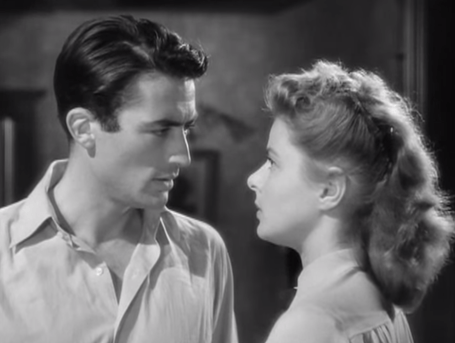
It’s so easy to adore Ingrid Bergman and it’s no different in Spellbound. Yes, she starts off as an austere psychiatrist purely interested and invested in scientific thought and practices in psychoanalysis. However, by the film’s conclusion, she evokes the passionate vitality that made her so beloved in pictures such as Casablanca (1942) and Notorious (1946).

The eminent Gregory Peck was still in the dawn of his career and while not your typical Hitchcockian hero, he is Gregory Peck a handsome actor with tremendous presence and a quiet dignity that made him an acting favorite for years to come, shortly to gain the reputation of an undisputed superstar. Put two such icons together and it’s honestly very difficult not to be won over, especially in a Hitchcock picture.

In fact, I’m predisposed to empathize with both of them from the very beginning and to thoroughly enjoy this picture even if it’s hardly the best of Hitchcock or the respective stars. But the story about the female psychiatrist Constance who falls in love with her colleague and subsequent patient one Dr. Edwards does have its share of enjoyments without question, aside from the names above the title.

As with any solid Hitchcock movie, there’s psychological duress and the man is implicated in a murder that he must run away from even if it’s proved he is innocent. So Spellbound is no question a romance and a bit of a mystery wrapped up neatly in a psychological thriller.

Michael Checkov the famed Russian stage performer (and nephew of Anton Chekhov) plays Dr. Brulov, Constance’s old mentor — a charming sort of gentleman who is impertinent but oh so sweet to his friends  — exhibiting the most jovial of personalities.

Even today, there still is a certain logic to psychodynamic therapy as there is to cognitive behavioral therapy that seems believable depending on how it is utilized and who is practicing it. Thus, though there are jumps Spellbound makes that are a little bit preposterous or a little too easy to resolve — like the perfect correlation between dreams and reality — there’s still kernels of truth in this film and it must be lauded for tackling the ideas of Freud in ways that were fairly groundbreaking for their day.

It also boasts the famed dream sequences inspired and partially orchestrated by the acclaimed surrealist artist Salvador Dali. His imprint is undeniable on the images that Peck recounts, reminiscent of the Persistence of Time and other similar works. Even Hitchcock would continue to address these topics with an arguably more Hitchcockian dream sequence in Vertigo and some similar analysis at the end of Psycho to assess Norman Bates.

Of course, Hitchcock films are at their best when the plot is working in spite of dialogue. Though the script is composed by Ben Hecht who has a long list of wonderful accomplishments, there’s also the influence of the overbearing hand of David O. Selznick on the picture meaning it relies perhaps too much on verbal explanation instead of Hitchcock’s own timeless setpieces or visual approach to cinema. Still, he does manage a few perspective shots that are particularly interesting providing us the frame of reference of several of his characters in key moments.

There’s also the benefit of Miklos Rozsa’s particularly elegant score which nevertheless is less a Hitchcock score as Bernard Hermann would famously compose later. In some respects, it suffocates the drama though it does include the cutting edge use of the Theremin, this marking one of its earliest appearances in a film score.

But ultimately, Spellbound does have a delightful false ending, as things slowly spiral down into despair only to find their new conclusion as all the puzzle pieces of Peck’s character begin to fit together. His exoneration is followed by the ousting of the real perpetrator, another quintessential Hitchcock villain.

The summation seems to be that though humanity might be wrought with shortcomings, many of them buried so deep inside, love does have an uncommon power to heal old wounds. The fault might be in ourselves but that need not be the resolution of the story.

3.5/5 Stars

Review: Rope (1948)

rope 1.png

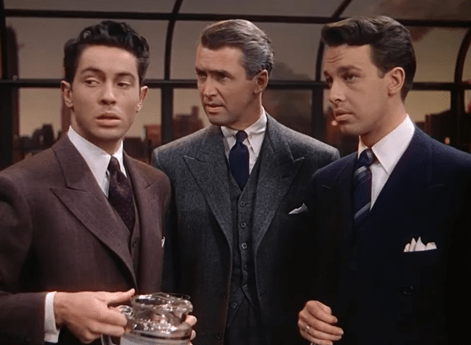
Rope’s title sequence is composed of your prototypically serene establishing shot. But really, you could not have a more unique and in some sense unnerving picture. It was Alfred Hitchcock’s first foray into Technicolor and it’s quite the looker as are the beautifully constructed backdrops that spice up the mise-en-scene for this glorified stage play.  He also busied himself with camera set-ups in an effort to shoot the picture as near to a single take as was possible with the technology of the time. He actually “cheated” a bit by splicing segments of film together at intentional breaks to give the effect of continuous motion. Still, it’s an impressive endeavor all the same.

But the experiment is twofold both behind and in front of the camera. It’s all a reworking of the murderers Leopold and Loeb, two affluent students who succumbed to Nietzsche’s superman complex. The project was an early script by playwright Arthur Laurents penned from an adaptation by Hume Cronyn, a Hitchcock regular in several earlier pictures (Shadow of a Doubt and Lifeboat).

In this case, Brandon (John Dall) and Phillip (Farley Granger) are looking for the perfect victim in the perfect murder. Where murder is a crime for most men but a privilege for a few — like themselves.  It all begins with a shockingly graphic opening for the 40s that rips away any shred of upper-middle-class sensibilities put upon us by that establishing shot. It’s all a ruse.

The assertive, far more charismatic Brandon also happens to be the main architect pulling along the flighty Phillip into his little experiment.

The act of throwing a small get-together against this exhilarating backdrop proves tenuous because of the insidiously dark deed that Hitchcock has made his audience privy to. Otherwise, this would be a run-of-the-mill picture of cocktails and hor ‘d oeuvres. But underline it with a murder and it’s a completely different proposition altogether.

Their exhibition comes as little surprise from two men who are snobbish, entitled jerks. Their lives are so dull that they stoop to murder to see if they can be brilliant enough and brazen enough to pull it off, going so far as inviting their most astute mentor played by none other than James Stewart.

Though I enjoy him as much as the next fellow, Stewart does feel oddly out of place in this film and within this role of Rupert. He seems to know it too. Nevertheless, Hitchcock would find far superior uses for him in due time.

There are also a couple knowing winks to the sinisterly attractive James Mason (a future Hitchcock collaborator) who is conjured up to do battle against the dreamboats Erroll Flynn and Cary Grant by a few admiring partygoers. Of course, no one seems to take into account that they have Jimmy Stewart right in their stead.

We begin to feel for Janet and Kenneth two schoolmates who have been used in the game. She is soon to be engaged to the formerly eligible David. Kenneth was the beau she was with before he broke it off. Now their lives are manipulated just like the late boy’s father who is also invited to the gathering.

Rupert proves that he knows something’s afoot not that it’s all that difficult to see Granger’s character slowly coming apart at the seams. Alcohol hardly helps his unstable demeanor. It becomes a showdown with his two pupils but he could have never expected this. It’s on this level that Rope is thoroughly troubling. It’s in this way that we begin to understand why Nietzsche might have been troubled by his own conclusions. There is little hope in this conception of the world.

Simply put, the film is dour to its core. It has no heart and in that sense, Jimmy Stewart does not feel at home within its heartless frames. The charade falls short for these very reasons. Though it’s technically ambitious, it doesn’t quite manage that perfect Hitchcock balancing act of crime mixed with wit. There’s no way it can with such a worldview.

Still, Rope shows, if anything, that Hitchcock is never complacent, always looking for the next great challenge. That is one of the many reasons that we still hold him in high regard as one of the foremost directors of any age. Because even a callous film such as Rope is worth seeing.

3.5/5 Stars

Saboteur (1942)

saboteur 1942.png

“It’s my duty as an American citizen to believe a man innocent until he is proven guilty.” 

I stand corrected. Maybe Foreign Correspondent (1940) is not Alfred Hitchcock’s most patriotic movie. Maybe it’s Saboteur, made two years later. Or maybe they are both made by the fact that they are more than mere propaganda and that’s what makes them still worthwhile today. This is, above all, another thriller by the same man who continually tinkered with the genre in the subsequent years.

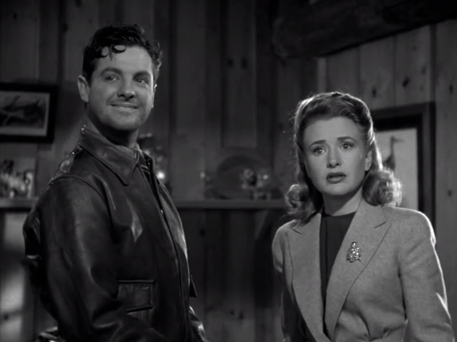
The narrative starts with wartime industry which has hit its boon since there are Nazis and Japanese to fight. Defense Plants have become a crucial part of the war and also part of everyday life for the average American. Robert Cummings is the epitome of one, a fresh-faced lad who all of the sudden finds himself wanted for the murder of his best friend which happened after a ruthless act of sabotage. In this respect, Saboteur is a more elegant version of Hitchcock’s predecessor Sabotage (1936).

There’s a wonderful sequence where our protagonist has hitched a ride with a gabby truck driver who consequently looks a bit like James Cagney. Every subsequent thread of conversation and even the passing billboard, all points back to everything that’s gone down so far. The man’s trying to run away but he can’t. Fugitives never have been able to as far back as Jonah. They always have to face the music.

Barry Kane follows the one wild lead he has involving a man played by Norman Lloyd (a future Hitchcock partner in Alfred Hitchcock Presents) and it lands him at a stately ranch that feels like quintessential Americana — it’s a luscious slice of West Coast leisure. But it’s another delicious instance where Hitchcock allows villains to live lives not unlike our own with families, babies toddling around, and swimming pools. Except these people also happen to be involved with conspiracies threatening national security in the wake of WWII.

After, a harrowing escape from the police with a swan dive off a bridge, Kane continues his journey. Saboteur quickly becomes another entry in Hitchcock’s innocent man-on-the-run canon and while not the tip of the spear, it’s thoroughly entertaining for the very fact that it remains on the move as it jumps from place to place. In fact, there are obvious shades of 39 Steps (1935) and North by Northwest (1959) in place as it goes literally from coast (California) to coast (New York).

And in each location, we meet a row of interesting side characters whether a trucker or the sagely blind man and a band of eclectic circus vagabonds. But the most important is the stalwart Patricia Martin (Priscilla Lane), initially looking to turn in this traitorous criminal with his hands cuffed together until she realizes that’s not who he is.

The director and his writers use the whole film to tell tiny parables about America where the circus can function like our democracy or a decision to not turn in a man can merely be an exercise in basic human rights. In these moments the film evokes the kind of patriotic messages that feel unconvincing when viewed now. Even Cummings brief stint on the soapbox facing off against his sophisticated foe is an obvious call-to-action.

But for 1942 it makes complete sense and that hardly takes away from the thriller that Hitchcock still manages to spin because though war might be afoot and Film serves different purposes on the Homefront, it can still function as entertainment. Hitchcock was one of the greats in that capacity. A murderer is set loose in a movie theater during a crime picture and the action leads us most iconically atop the standard bearer of American freedom and equality, Lady Liberty herself. Once again, it’s the perfect Hitchcock ending even if that’s more in going with the style of the entire picture thus far rather than pure execution.

3.5/5 Stars


Review: Foreign Correspondent (1940)

foreign correspondent 1.png

If Alfred Hitchcock had any contribution to the war effort then Foreign Correspondent would no doubt be it. Nazi Minister of Propaganda Joseph Goebbels was purported to have admired its qualities as a work of propaganda and that’s high praise coming from someone who was quite familiar with influencing people. If nothing else it proves that moving pictures can be deeply impactful on mass audiences and that still holds true much the same today.

It’s also subsequently reductive to call our leading man Joel McCrea the poor man’s Gary Cooper which may have come into being because the other star turned down the role. Something that he subsequently regretted. However, there’s something inside of me that thinks that McCrea almost works better because he has a sardonic edge. Cooper was quiet and strong, a true blue American but McCrea is ready to hit the pavements with a voice that’s incisive.

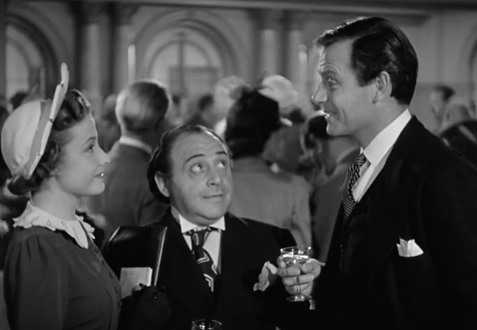
In this picture that’s his trade. He’s used to crime beats and as such he’s given the task as a scoop getter, a foreign correspondent, in the European theater for the folks at home. What he comes upon is more than he could ever imagine with international treaties, assassinations, kidnapping, drugging, and far-ranging conspiracy. All because of a peace conference looking to alleviate the belligerent rumblings in Europe. In this case, Johnny Jones (McCrea) aka Huntley Haverstock acquaints himself with an international peacekeeper named Van Meer only to have the man disappear, reappear, and wind up in places that one would never expect. It’s all very peculiar.

One of his other acquaintances is the lovely and bright young woman played by Laraine Day (known to baseball fans as the future Mrs. Leo Durocher), who has joined her father (Herbert Marshall) at a summit of the International Peace Party.

Within this basic storyline laced with some snappy lines provided by a whole slew of script contributors (including regulars Charles Bennett and Joan Harrison), Hitchcock strings together some lovely visuals including crowds of top hats, crowds of umbrellas, and a lively chase as Haverstock sprints through traffic to try and apprehend a gunman. Unsuccessfully I might add.

The world is highlighted by some equally inventive locales that are simultaneously indigenous to their environment in typical Hitchcock fashion like the windmills in Holland. With its churning mechanisms and creaky stairwells fit with cavernous hallways, you can tell Hitchcock finds great delight in using the stage to build the stakes of his story.

Because it’s all a massive cover-up and that conveniently sets the stage for our romantic comedy which is being overlaid by this international thriller of stellar intrigue. As our intrepid correspondent acknowledges, he’s “thrown a monkey wrench into some international dirty business whatever it is.” That’s about all we need to know and it does suffice.

My only misgiving is how easily Laraine Day’s character gives way and loses her disapproving edge to fall madly in love with Joel McCrea. Still, the film doesn’t end there. There’s a lot more that must happen. A lot more crises to be averted.

Though it’s hard to know the precise timeline now, there’s an innate sense that Foreign Correspondent is really on the cutting edge of the current events and it benefits from that very quality that still lends a certain amount of credence to this nevertheless wildly absurd plot.

Because though it’s undeniably a work of fiction as noted by the opening disclaimer, there’s still the touches of truth that were all too obvious to the general public. Namely, Hitler and a World War threatening to explode — bombs already raining down on Great Britain as undeniable proof.

The most remembered setpiece comes last and it’s a beautiful touch of ingenuity, Hitchcock simulating the crash landing of an airplane like few others of his era would ever dare to attempt and it comes off with torrents of energy that leave a stirring impression.

But that is almost matched by the passionate rallying cry that Joel McCrea sends up over the radio waves to his fellow Americans, urging them to keep their lights burning because they’re the only source of hope in a world getting increasingly darker. This final monologue was essentially an afterthought penned by Ben Hecht but it’s heft no doubt impressed Goebbels. This one’s an international thriller with a patriotic tinge. Fitting, as Hitchcock in many ways would be as much an American as he was an Englishman.

Foreign Correspondent is sutured together along those same lines. Because just as Joel McCrea and George Sanders’ characters work together to get to the bottom of things, the imminent war necessitated a partnership between the American and British nations. It was a long time coming but the lights kept burning and remained indefatigable to the very end.

4/5 Stars

Review: Rebecca (1940)

rebecca 1.png

“Last night I dreamt I went to Manderley again…” ~ Joanne Fontaine in Rebecca 

In normal circumstances, voice-over introductions rarely resonate but for some reason, the ethereal tones of Joan Fontaine opening Rebecca leave a lasting impact and that’s after well nigh 80 years.

This was Alfred Hitchcock’s first film in Hollywood and it truly is a stunning debut but if you take a step back and see who was working behind the scenes, it soon because fairly plain that this was as much of a David O. Selznick film as it was a Hitchcock one, if not more so. Because Selznick had Hitch under contract and he was following up the grandeur of Gone with the Wind (1939) with another costume drama positioned to be a smash hit.

Though Rebecca was slightly less ornate and preoccupied with its more gothic sensibilities, Daphne du Maurier’s novel was nevertheless ripe for a Selznick treatment with a sturdily constructed story and quality production values all across. And of course, you have the acting talent which while not necessarily head and shoulders above all of Hitch’s previous works was nevertheless top of the line.

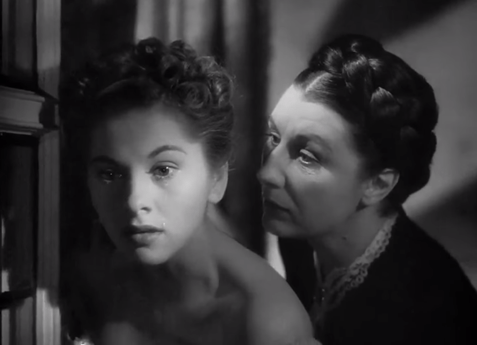
First, of course, is Laurence Olivier providing a great deal of import to the part of one of our protagonists, George Fortescue Maximilian De Winter, the tortured man of breeding whose life is stricken with past tragedies. But equally crucial is Joan Fontaine’s role as the unnamed woman who subsequently becomes the second Mrs. De Winter after a whirlwind courtship in Monte Carlo. She began as the meek lady in waiting for a boorish socialite Mrs. Edythe Van Hopper only to fall in love with the older man.

Fontaine inhabits the role with a breathless wide-eyed timidity that’s immediately attractive and makes her the object of our sympathies. She always gives off the appearance of a frazzled little deer in the headlights like she doesn’t quite know what to say or what to do in the presence of others whom she deems more important than herself.

It’s that very quality that drew me to Fontaine from the outset the first time I saw Rebecca and no doubt a similar quality that draws Maxim de Winter to her character. There’s an undeniable innocence there full of an angelic beauty that exerts itself each time she interacts with others, eyes wide with mouth agape. That in itself is an immaculate illusion given Fontaine’s own life full of estrangement. Here she is faultless and demure.

And that comes into focus even more clearly because Maxim can often be an unfeeling man, swarmed with past demons though he might be. Put them together and he’s certainly the dominant figure. The same goes for their arrival at his stately home Manderley. The current Mrs. De Winters is totally overwhelmed by this grand estate and the staff that frequent its halls.

The shining example is the apparition of a housekeeper Ms. Danvers (Judith Anderson) and it’s a career-defining role for a character actress who always could be imperious and a little unscrupulous. But she was never as harrowing as the fiercely loyal woman who starts playing mind games with her new employer.

You also have the incomparable George Sanders playing his English gentleman with biting wit and a touch of blackmail. He becomes pivotal to the story for the very sake that he speaks up on the deceased Rebecca’s behalf as much as Mrs. Danvers does. They adored this woman that Maxim loathed so deeply by the end of their relationship. And it’s in this chafing that the ultimate conflict is uncovered — the type of conflict that threatens to rip Maxim away from his new love and splatter his reputation in the courtroom drama that ensues.

Much like Laura (1944) in her eponymous film, Rebecca lingers over the entire narrative and haunts its frames from start to finish. Yet in the latter work of Otto Preminger, the lady actually makes an appearance on screen incarnated by the entrancing Gene Tierney.

Here Rebecca is a specter who never tries to show herself. There is no physical semblance of her, only signs and references of her being — most memorably the scripted letter “R.” Because, truthfully, she doesn’t need to show her face. She almost wields more power without being seen. It’s that rather unnerving feeling of impending dread that’s hanging over the audience as much as it does Mrs. De Winter.

In the end, Hitchcock didn’t exactly get the murder that he would have liked but in any case, it does not fully take away from the impact of Rebecca. Instead of being a film of overt actions it starts to work on our psyches as a sterling psychological exercise matched by its deliciously dark atmosphere. The mental distress is heightened by the eerie interiors marked by layers of shadow and the shrouded impressionistic seaside that envelops the De Winter compound. Fittingly, Manderley is razed to the ground once and for all.

Ironically enough, though the production is very much on the Hollywood scale, it’s probably the most “British” film that Hitchcock ever made in America based on not only the subject matter but the majority of the acting talent because on top of Olivier and Sanders you have such esteemed character actors as C. Aubrey Smith, Nigel Bruce, Melville Cooper, and Leo G. Carroll (a Hitchcock favorite).

Still, he was blessed with the best talent he had at his disposal since the infancy of his career, in part because of his move across the Atlantic. Joan Harrison who would become one of the most prominent and only female producers in Hollywood turned in work on the script along with Robert E. Sherwood with the score being composed by Hollywood icon Franz Waxman. Even if the players at work are not necessarily evocative of the many trademarks we usually attribute to the director, that hardly makes Rebecca any less of a delight.

Furthermore, there is something inherently honest about the lead portrayals throughout the film. Not necessarily because they’re realistic but they are full of fear and hatred and emotion and you see it in the words and on the faces of the characters. This is hardly a playful film. It’s not trying to subvert drama with humor or dry tonal reversals. But it’s candid in its despair as much as in its joy.

For all their intrigues and complexities in technical feats, storytelling, and psychology, sincerity is not always something you look for in a Hitchcock picture. Here it works. Casting this devasting love story up against the backdrop of gothic horror makes it all the more affecting. The marriage of the talents of David O Selznick and Alfred Hitchcock turns out to be a surprisingly bountiful proposition. Even if it wasn’t made to last.

5/5 Stars

A Matter of Life and Death (1946)


Matter_Life_Death_Hunter_Niven

Matter of Life and Death is planted in its era. It carries the vague notions of a war film, it’s certainly a romance, and it revels in the throes of fantasy. But on the whole Michael Powell and Emeric Pressburger’s film functions outside the typical confines that are put on film as a medium. The scope it dares to take on is far more expansive.

The plot is made in the first few minutes when a pilot looks to eject amid the fog engulfing his failing bomber. It’s in that single moment where he picks up the signal of a radio dispatcher down below and their lives are never the same. Believable or not they fall instantly in love — in that moment of heightened emotion — they find a connection. She, never to see his face and he, never to make it out alive.

The Conductor (Marius Goring) from the other side is already looking to pick him up. Except something goes terribly wrong, or terribly right for the pilot, depending on your perspective. In other words, he doesn’t die. He escapes death. It causes a bit of a stir and Conductor 71 must try and rectify the situation.

But of course, Peter David Carter (David Niven) quite by chance is reunited with the woman from the other side of the wire, the American named June (Kim Hunter) and they are allowed a happy life together. Except with his reservation with the afterlife still up for contention, Peter finds himself being visited by the Conductor who coaxes him to accept his death. Instead, Peter calls for an appeal and his case is set to be brought before the highest authorities to decide once and for all if he must accept his death as ordained or have it postponed so that he might continue to cement his love for June.

It evolves into a wonderfully fantastical courtroom drama, wrapped up in romance, with a bit of time travel, purgatory, special effects, and color all mixed together in a tirelessly imaginative arc.  It’s true that the ambitions of the conceptual narrative are really unlike any other cinematic creature as it cycles so lithely through time and space. Freezing images, moving characters about this way and that, and cutting back and forth between worlds most easily differentiated by their color schemes.

Still, in some way, I was gripped more with the furious emotion of The Red Shoes (1948) and yet with its phenomenal conception and immaculate staging, A Matter of Life and Death manages to be an extraordinary picture by most accounts. If its waves of romance did not seize me instantly, its sheer inventiveness was nevertheless breathtaking.  And if the concept enthralls me even more than the narrative does then so be it. It shares a world akin to Seventh Heaven (1927) or Wings of Desire (1988) and that alone is worthy of praise — carving out a place in the pantheon of transcendent films — featured on the conveyor belt that makes its way through the years.

Fantasy films were made to be like this, arguably functioning in a realm that only films could facilitate and Powell and Pressburger examined near unfathomable realms. Not only with scripting but the selection of shots, and developing fascinating spectacles out of the Other World from the stairway to heaven to the infinite courtroom where Peter’s case is debated. Jack Cardiff’s photography takes on the monumental task of balancing two worlds with equal import — the world we know and the complete other realm that has yet to be revealed to us who are still among the living. It leaves us feeling enamored with both. Not simply because of beauty but sheer size and scale.

The storyline comes down to the final moments where Peter and June are asked to make the kind of choices we have been expecting. Right about now we can hear the words ringing in our ears, there’s no greater love than to lay down one’s life for the ones you love. Their actions say as much. But as we might just come to find, give and it will be given back to you more abundantly than you could ever imagine. Sacrifice all that you have and you will find yourself gaining so much more.

It brings to mind a dialogue that emerged from the courtroom when the prosecutor (Raymond Massey) notes that “nothing is more important than the law. The whole universe was built on it.” But his learned opposition (Roger Livesey) ascertains that “this is a court of justice not of law.” The implications being that the law is good and must still be fulfilled but justice is the key here, where right is done by all men and love reigns supreme.

There are a plethora of interesting topics that arise from The Archers’ film but one of the foremost is the sentiment of not only the post-war but of an entire millennium. It’s a belief that could arise from many marginalized points of views suggesting that there is a great deal of prejudice and ill-will that could be exacted against the English (and certainly Americans too), anyone who has been a major world power.

The jurors put up against the defendant all have grievances they could hold against the English people, but then again, we are not our fathers’ fathers and we cannot necessarily turn back the clock on their past sins. But what this film does suggest more powerfully still, relevant in a post-war era or any age really, is the idea that people can reach out across the sea and really across the world to be united by something. We’ll give it a name to it and call it love in its many forms — more specifically as the Greeks might call them, storge, philia, eros, and greatest of all agape.

4.5/5 Stars

Note: My entry in the Time Travel Blogathon


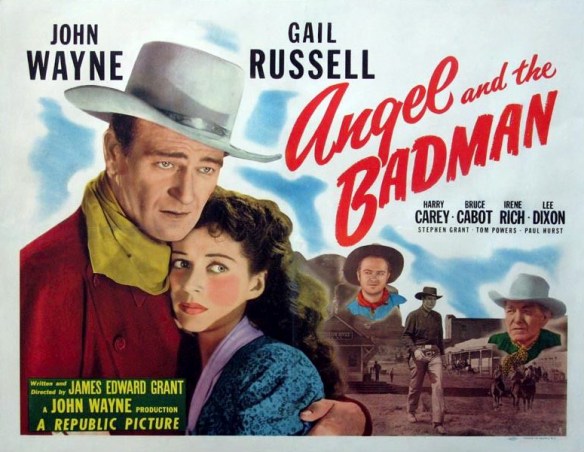
Angel and the Badman (1947)

Angel_badman.jpg

With John Wayne partnered with his longtime collaborator James Edward Grant (Hondo, McClintock!) it’s easy to see Angel and the Badman as an early vehicle for his conservative ideals but far from being heavy-handed, it goes down as a solid B-picture with a surprisingly unique perspective on the West.

In this instance, the western is used to construct a fairly simple parable that plays out over the frontier using figures that we know well from every cowboy picture we’ve ever seen.  The outlaws and the homesteaders, the sheriffs and the doctors, they’re all present.

But underlying their every interaction is a certain purpose. It’s not simply to entertain — though the film is adequate in that department and has it’s share of gunfights and showdowns. It foregoes most of the normal set pieces to carry out its main objective as a moral tale. Still, these established figures help draw up the themes by the very way they see the world.

Quirt Evans (John Wayne) has and always will be an outlaw as preordained by society until the fateful day when he finds sanctuary in the home of a Quaker family after incurring a wound. They take care of him and nurse him back to health but above all, they give him the benefit of the doubt — that he is not too far gone and he still has more than a fair chance to redeem his life if he so chooses.

The local apothecary functions as the main counterpoint to our angelic first family. He is very rational-minded, devoted to scientific thought and his cynicism leads him to begrudgingly patch up the outlaw all the while grumbling under his breath. It’s telling though that he holds this overtly religious family in high regard. But nevertheless, the parameters have been set. We must sit back and find out where John Wayne falls within the frames of this corral.

It’s true that he’s saddled with a past full of womanizing, guns, greed, and every other sin known to man. In fact, the local sheriff is bent on hanging a rope around his neck but the old veteran (Harry Carey) is a sly fellow ready to bide his time and let Quirk slip up somehow.

The main point of contention is a payload of gold that a band of glowering thugs is intent on getting a handle on. Quirt is all that stands between them and the prize but even in his injured state he still packs a gun — the bullets inside and his stellar marksmanship being the key deciding factors.

Playing against this very storyline is a parallel thread that bears equal importance if not more. Penelope Worth (Gail Russell) is the daughter of this Quaker family and she is tasked with taking care of this formidable outlaw. In any other scenario, they would be oil and water. Their lives and personalities should never mix and yet in this romance, they ultimately do. True, his lawless lifestyle chafes against the worldview of these religious Quakers who promote an existence of good will and pacifism. Still, people can change.

John Wayne notably disliked High Noon (1952) and his most famous denouncement of the picture can be seen in Rio Bravo (1959), viewed by many as a cinematic answer to its predecessor. However, in this earlier film, you see in Wayne’s character a man who also falls for a Quaker much like Will Kane (Cooper) does in High Noon. But here he comes from the wrong side of the law. Still, she redeems his very nature and far from throwing off the perceived shackles of her beliefs or simply tolerating them to stick to what he knows best (namely gunplay and showdowns) he does the fairly brazen thing and wholeheartedly embraces her way of life. Because he loves her.

It begs the question, which outcome is more believable: The sheriff who went against his wife’s pleas so he could uphold his personal convictions or the outlaw who gave up his old way of life even in the face of death because he was transformed by the love and lifestyle of his woman? Rather than drawing up which one is better exactly, it might suffice to say that Angel and the Badman, while lesser known, is still a diverting western with its own moral dilemma because westerns are and always have been horse operas.

3.5/5 Stars

Too Late for Tears (1949)

Too_Late_for_Tears_DVDA couple is driving along a desert highway when a bag loaded full of cash is tossed into the back of their convertible by a passing motorist. They’re a pair of everyday nobodies and yet this single act of fate throws their entire existence into chaos. Of course, it gets a little leg up thanks to Jane Palmer (Lizabeth Scott) as she takes the wheel to get away with the cash, convincing her husband Alan (Arthur Kennedy) that they hold onto the payload for awhile. Finally, he relents and leaves the briefcase in a Union Station locker.
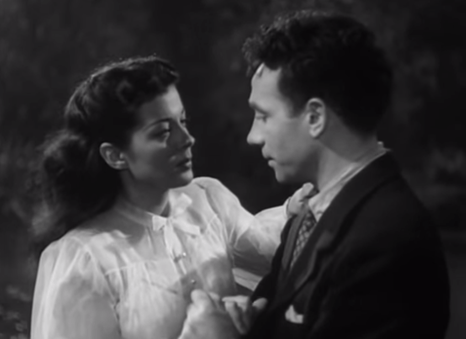
It’s a tad of an unbelievable scenario but that’s what makes it so exhilarating as Lizabeth Scott plays all parties involved using her doe eyes and feminine wiles to great effect like the foremost of femme fatatles that she is. And the fact that she does it both unwittingly and with willful intent is crucial to her turn for the very fact that it creates the seesaw of emotions.

There’s a certain sense of ambiguity because we begin to invest in her story and like her in one sense, while simultaneously distrusting her motives that seem mostly driven by avarice more than anything else. There’s also this extraordinary quality about her where she somehow manages to look young and feel old all at the same time thanks to her memorable baritone. It’s a bit unsettling.

The next important figure is Danny Fuller, Dan Duryea donning one of his sleazeball roles as a drunk who nevertheless has a bit of a sympathetic side at least put up against the acerbic poison of Lizabeth Scott. She’s the epitome of that long-held expression that greed is the root of all evil. If she didn’t write the book on it, she at least tore through its pages voraciously. Initially badgered by Danny for swiping the payoff he believes is rightfully his, she soon has him roped into her plan. It’s almost too much for the cad to bear. He calls her “Tiger” sardonically at first but he doesn’t realize how right he is.

But the most interesting setup in the narrative are the contrasting couples and they might not pair up the way you first expect with Arthur Kennedy getting the short end of the stick. He starts out happily married and winds up out of the picture.

There’s the rapacious Jane matched with Danny boy as they both feed into each other with their distrust and vices. Then you have the ever-present “Good Girl” or guardian angel,  Alan’s sister, Kathy (Kristine Miller), a sensible,  prepossessing young woman who only begins to distrust Jane as circumstances become more and more strained.

Meanwhile, Alan’s old war buddy (Don DeFore) comes a calling on his old pal and finds himself spending time with the man’s sister instead. But they become our necessary counterpoints to balance out the film’s more corrupt characters.

The final reveal that we’ve been waiting for arrives and it spells the end of Jane’s charade as she’s brought tumbling down. But as noir has a habit of doing, it manages to paint a bit of a happy ending against this dark backdrop with Kathy and Don winding up with each other and a shoulder to lean on. Still, that final image cannot quite downplay all the deceit and murder that has gone down up until now.

Too Late for Tears resonates thanks to a pair of incomparable sordid performances by Scott and Duryea. Miller and DeFore make a lovely couple but it’s the moneygrubbing ones who make this a true noir delight because they represent the incorrigible vices often found in humanity. That’s a lot more fun in the movies.

3.5/5 Stars

Review: Moonrise (1948)

moonrise 1.png

It’s like being in a long dark tunnel…the way you look and act and talk. ~ Gail Russel as Gilly

From its very foreboding outset, there’s no question that Frank Borzage’s Moonrise could be characterized as film-noir. Everything suggests as much from the scoring to the stylized imagery and even the subject matter. We have hangings, brawls, fistfights, and murder all under 5 minutes of celluloid. But equally important, the film delves into the psychological depths of despair and more than any of Borzage’s films it seems invested in the mental well-being of its characters.

Dan’s personal narrative is brought to us early on. His father was hung for some inexplicable reason. The kids in school brutally tease him about the ignominious shame of his family which he has no control over and all throughout his life thereafter he carries a chip on his shoulder. We don’t quite understand him but at least we begin to empathize. We meet Dan (Dane Clark) again as an adult at a local dance.

That’s where the next chapter in his story begins as he tries to bridle his anger and keep the reins firmly in check. It doesn’t always work so well for him. After all, he is the man with a constant death wish driving cars on wet roads like it’s the Indy 500. He is the man who is prone to strong-arm tactics. He is the man who trusts no one to be his friend and expects very little from others. But he does have one thing going for him.

Her name is Gilly (Gail Russell), she’s the local schoolteacher, and if nothing else her very presence humanizes him. She formerly ran with the local hotshot (Lloyd Bridges) but she has found some quiet decency in Dan and if she sees it, maybe we can see more in him as well. In some ways, he’s still a little boy and she reads him like one of her students with thinly veiled observations. His frumpy Aunt Jessie pins him as a good boy but that doesn’t make up for the absence of his parents or the anger that he still harbors from boyhood.

But a small town setting and a purported crime prove to be an ever-intriguing synthesis of Americana and the ugly underbelly which if it doesn’t rear its head through gossip alone, then murder certainly fits the bill in a pinch. It’s summed up by dances, carnivals, and coon hunts with an undeniable undercurrent of darkness.

As far as I can tell Charles F. Haas had few other feature scripts to his name but his work in Moonrise offers up some interesting figures full of witticism and unique voices that help to differentiate each from the diverse pack.

The bullied mute Henry Morgan is at one time befriended and also berated by Dan. Rex Ingram proves to be a landmark African-American actor for the era, full of a quiet strength and wisdom. As local keeper of the bloodhounds, he addresses his canines as Mr. Dog surmising that everyone is entitled to a certain amount of dignity. Just as importantly, he rightfully asserts that man is a communal being (Man oughta have a woman. Man oughta live with other folks).

The Local Soda Jerk has the jive talk down pat and Lloyd Bridges and Harry Carey Jr. fill in for a couple relatively minor spots. Of course, Ethel Barrymore is in the coveted keynote cameo as Daniel’s  sagely Grandma. But aside from Ingram’s significant turn, Alyn Joslyn is one of the more entertaining characters as the sheriff who waxes philosophical. One of townsfolk even notes as much that he should have been a preacher man instead of a lawman.

Cinematically speaking, Moonrise proves that the finest places to meet your best gal seem to be darkened interiors and if nothing else it’s a feast for the eyes and a treat for the audience. And it’s true that with its quaint country backwoods and swamps, Borzage’s picture shares some of its world with Joseph L. Lewis’s Gun Crazy (1950). But for Borzage, in particular, this feels very much like a departure which is by no means a bad thing. Here the love story is still present but it seems to ultimately have a different functionality altogether from many of the director’s most remembered entries.

3.5/5 Stars