Here Comes Mr. Jordan (1941)

here comes mr. jordan 1.png

I’ll lay my cards right on the table. I’ve never been a huge fan of Robert Montgomery. He just doesn’t have a charisma or a delivery that I much care for so as far as carrying a whole picture I’m not quite sold.

Still, with Here Comes Mr. Jordan, it all seems to work and it’s funny and clever in ways that would cause Hollywood to strive for storytelling that looked to think outside the box. Of course, the irony is, a new box gets created for people to work inside — a new style or sub-genre — but there’s little question that Here Comes Mr. Jordan feels very much the first of its kind. If not, I stand corrected.

It’s a story effortlessly built around quirky inventiveness. There are fantasy elements here that feel very much akin to the likes of Stairway to Heaven (1946), Random Harvest (1942), and Heaven Can Wait (both films from 1943 and 78).

Heaven is depicted as a kind of celestial processing center where human beings are plucked away from their life on earth to begin a new afterlife. Through intervention, by angelic beings, lovers can all but forget one another only to have some deja vu feeling that they’ve been together before.

And further still, the ideas of the heavenly and angels entering into everyday life soon became a staple of 40s and 50s Hollywood much in part to this picture. Without it, there’s a possibility that classics such as It’s a Wonderful Life (1946) and the Bishop’s Wife (1947) would not have been conceived in their most remembered forms. After all, what would those films be without Clarence or Dudley? Or what would this one be without Mr. Jordan for that matter?

Elaine May must have thought the story was ripe for more exploration too when she penned Heaven Can Wait which expanded a great many of these ideas only in a different context.

Unequivocably this rendition proves to be far from a one trick pony, taking a main conceit that admittedly seems absurd at first — even gimmicky — and turning it into a fantastical comedy with continual possibilities.

Imagine just for one moment that a feisty boxer, Joe Pendelton (Montgomery), preparing for his next big bout flies to the site of the fight only to have his plane malfunction en route. He looks like a goner but he’s pulled from the aircraft too soon by 7013 (Edward Everett Horton). In fact, it’s 50 years too early, his date with the afterlife is not until 1991 (In case you were wondering, Montgomery actually passed away in 1981). Being the bullish personality that he is, Joe’s not going to sit by when he had such a good thing going on earth.

The genial Mr. Jordan (Claude Rains) grants his wish and inserts Joe back into life but they must find him a new body — you see his previous one has already been cremated which makes for added complications.

We plot his journey between two distinct individuals and their bodies and aside from the opening plane crash, a few puffs of smoke, and a few parlor tricks, the film doesn’t rely too heavily on any amount of special effects. For all intent and purposes, things are normal as they’ve always been. It’s just the parameters that have changed. Namely the fact that Joe can see Mr. Jordan and no one else can. First, he’s Bruce Farnsworth formerly a crooked magnate who was murdered in his bathtub by his wife and her lover.

Boy, are they surprised when he turns up again. Mr. Jordan and the audience see Montgomery but the others see and hear the man that they think they’ve done away with. Still, coaxed by Mr. Jordan, Joe or Farnsworth, turns this man’s life around, taking ownership of his past indiscretions and helping the father of a young woman (Evelyn Keyes) who was accused of fraud.

here comes mr. jordan 3.png

Meanwhile, Joe, err, Farnsworth still has his sights on his previous shot at the boxing ring. It all comes off rather odd to those who used to know his alter ego but he calls up his old coach Max Corkle (James Gleason) and he’s finally able to convince him of his true identity due to his beloved saxophone always in tow.

Finally, it looks like he’s on the road that he wants but alas complications ensue. He finds himself falling for Ms. Logan and circumstances are such that he must find another body. He settles on a straight-arrow named Murdoch and subsequently gives the fighter a second chance in the ring while hiring on Max to be his coach so he can still actualize his dreams.

Mr. Jordan leaves Joe in this moment, seeing he has a version of the life he always wanted and the celestial being conveniently removes all of Joe’s memories of a previous life. Of being a man named Joe Pendleton. It makes for some goofy comedy with Corkle and supplies one budding meet-cute with Ms. Logan.

While the theology is probably sketchy at best, it’s a good-natured, comic interpretation of the afterlife that serves the world of the film well. The only thing in question is the ethical nature of angels removing human memories but surely Claude Rains knows what he is doing.

James Gleason is an absolute riot as the one human privy to the whole gag only to look like a complete nutcase when questioned by anyone else who is “normal.” He easily puts you in stitches and Edward Everett Horton has his flustered indignance down pat. He made a career out of it after all.

4/5 Stars

Mr. Blandings Builds His Dream House (1948)

mr. blandings 1.png

Here is a Cary Grant and Myrna Loy vehicle that makes a comedy out of the morning drudgery and cramped quarters of domesticated life in that pearl of a city, New York. It’s a satire of the All-American Dream with the wry commentary of Melvyn Douglas guiding us through the raucous adventure.

He positions the story as such, the main confidante and best friend of advertising executive James Blandings (Grant) and his wife Muriel (Loy). Any given morning in their apartment involves early morning duels over shutting off the alarm clock for a few last seconds of slumber. Then, there’s the fighting over mirror space and closet space and drawer space.

But they’re true Americans singing “Home on the Range” in the shower. Singing in the shower seems to generally be a hobby of Cary Grant as he would do it again in at least one other picture. Meanwhile, their prim daughters are attending a progressive school and filling Mr. Blandings breakfast conversation with unwanted social significance.

All he wants is to drink his coffee and read his paper in peace and intact. He’s granted neither luxury. But these are only symptoms of the problem. They have a lovely home in a lovely city with two lovely daughters and a terribly lovely marriage. They’re just hemmed in on every side. And at work, he’s been slammed with the advertising campaign for “Wham Ham” which seems a living nightmare.

It’s Mrs. Blandings’ idea to consider a renovation while Mr. Blandings isn’t too keen on bankrolling interior designing and home redecorating courtesy of one Bunny Funkhouser. Instead, they mutually agree to purchase a quaint Connecticut home with real “character” that coincidentally no one has had the courage (or the naivety) to even try and buy.

But attracted by the “convenient” commute of 50 minutes, a little Revolutionary War History about General Gates’ horse, and their own dissatisfaction with the current state of affairs, they commence the biggest undertaking of their lives.

The Hackett Place could very easily be the prototype of the Haney Place years later in Green Acres. In fact, this film made me yearn for the rustic folks from Hootersville and the construction craziness of Extreme Home Makeover from year’s past because it evokes both.

Rather than deal with it as is, the Blandings knock it to the ground and sink their first wad of cash in the mammoth project. The first of many. But they are hardly attuned with what remodeling entails and the complications never seem to end nor do the bills which come one after another.

While I was secretly hoping that Dreamhouse would be an update on Buster Keaton’s One Week (1920) with Grant showcasing his usually brilliant physical antics, what we got instead is a household comedy full of incessant complications.

While I probably would have enjoyed the former even more, there’s no doubt that this film is worth it for the Cary Grant and Myrna Loy dynamic. It’s that ability to bicker and joust and fight and still have the innate capability to make up and have the audience enjoy every minute. If the film had been made years later it would have been called Mr. and Mrs. Blandings Build Their Dream House. This is without question a joint effort of marital madness and reconstruction.

For those who cherish glimpses of the past available in the present, the Blandings home can still be seen on the property of Malibu Creek State Park in California. Unfortunately, I don’t think the Blandings still live there. Sadly, they vacated the premises some time ago. The commute from Malibu to New York City was probably too much for them.

3.5/5 Stars


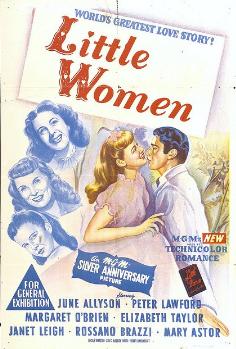
Little Women (1949)

Littlewomen1949movieposter.jpgIn the recent days, I gained a new appreciation of June Allyson as a screen talent and in her own way she pulls off Jo March quite well though it’s needlessly difficult to begin comparing her with Katharine Hepburn or Winona Ryder.

Meanwhile, Mervyn LeRoy was a capable director of many quality films and it’s difficult to say anything damaging about this one because no matter the amount of mawkishness, it’s all heart to the very last frame.

If possible to imagine, this cast is even more star-studded than the 1933 adaptation and yet still somehow the casting just doesn’t seem quite right. In the Katharine Hepburn anchored cast every character was almost perfectly wrought and they felt like an impeccable ensemble.

Somehow here you have the varying personalities rubbing up against each other and it doesn’t feel like this is the March Family as much as this is June Allyson, this is Elizabeth Taylor, this is Janet Leigh, and Margaret O’Brien. Their beloved Marmee being played by none other than Mary Astor. They’re all fine actresses with esteemed Hollywood careers in their own rights but as a family, the dynamic is slightly off.

Of all the names attached, Elizabeth Taylor feels the most at odds with the material, not that she couldn’t play these types of sincere characters — she did it in Jane Eyre (1943) and National Velvet (1944) — but she’s nearly past that stage of being cute and now simply comes off as a bit of a snob. If I know anything about the character Amy (which I may not) she’s hardly that.

This is also far from Janet Leigh’s best role as she all but disappears into the background because there’s this underlining sense that Jo is the oldest sister here (due to Allyson’s obvious age advantage over Leigh) and so with that subtext Meg loses a great deal of her quiet strength as the perceived eldest sister. Because that means she’s hardly the one that the others look up to due to her age. She’s just the noble one while Jo is the free spirit hurtling over fences and throwing snowballs. Thus, the order of sisters really does matter for the full integrity of the narrative.

Come to think of it, the other obvious departure in the film is the development of Beth as the youngest March girl which gave Margaret O’Brien the opportunity to play her and she does a fine job at stirring the heartstrings with her timid solemnity but another dynamic gets altered in the process. I also wasn’t sure what I would have to say about Peter Lawford as Laurie and yet he does a commendable job as does the stately mustachioed C. Aubrey Smith.

It’s fascinating how the same story with at times almost verbatim dialogue can give you a completely different sense of the characters. Because it’s true that this version borrowed much as far as dialogue from the 1933 version. Thus, the scenes are all but the same with slight alterations to the opening and such, but the results are starkly different.

The same goes for the setting or rather the tones of the sets. Though the colored pictorials are glorious and lend a real jovial nature to everything also helping to make this Little Women adaptation a shoe-in for annual yuletide viewing, some stories just are not made for that treatment. It’s no detriment to this film whatsoever but there’s something about the original black and white that evokes the nostalgic aura of tintypes and antebellum photography in a way that this one simply cannot. Little Women seems like such a story.

Of course, that’s only my opinion and it could very easily be the case that someone else’s conception of the March family is very different than my own. That’s part of the fascination with novels and their adaptations. Despite our best efforts, or maybe because of them, they all turn out vastly different. It’s probably for the best.

3.5/5 Stars

Broadway Melody of 1940 (1940)

Broadway_Melody_of_1940_Poster.jpg“The more you know about women the less you know about women.” It’s the story of my life and also a marvelous entry point for this film because it really is a throwaway line. It’s referred to several times thenceforward but really means nothing more. Anyways, if we came to this film simply for the plot it would have been buried under heaps of other more elegant or frenetic comedies over the years. But the reason to revisit this one for all those eager thespians out there is solely for the dancing and what dancing it is.
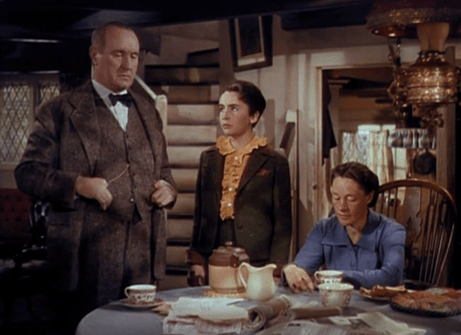
Don’t get me wrong. It would be tantamount to cinematic blasphemy to say that Fred Astaire belonged beside anyone else rather than Ginger Rogers on the dance floor but maybe it’s the novelty of the situation that makes me quite thoroughly enjoy this effort that paired him with his contemporary, the premiere dancing star Eleanor Powell.

Though working at a different studio now  (MGM instead of RKO), the plotline could have easily followed in the footsteps of many of Astaire’s earlier pictures. It’s pure cotton candy fluff about mistaken identity since he gives the name of his best buddy to a man he thinks is a collector. Is he surprised when he finds out days later that the man actually had connections with a big stage production starring the one and only Clare Bennett?  By throwing out the name of his chum King (George Murphy), he unwittingly paid his best friend the biggest favor of his life and he takes it in stride willing to sink into the background.

Still, he can’t help but harbor a crush for the divine Ms. Bennett and he starts getting a little peeved with how the fame is going to King’s head which leads him to get pig-headed and worse yet completely swacked before his grand opening. Obviously, someone else needs to fill in and wouldn’t you know it, we just happen to have Fred Astaire waiting behind the curtain to step in. The rest you can probably figure out for yourself. Meanwhile, Frank Morgan and Florence Rice appear intermittently providing a bit of comic background noise to fill in the idle moments with some mild buffoonery.

But the dancing, the dancing is as sublime as it’s ever been and it’s breathtaking watching Powell’s solo numbers as well as some of the other stunts, some comical and others mindboggling for their precision (Plate throwing and ball balancing come to mind). A few Cole Porter tunes still have their allure namely the famed “Begin the Beguine” number as well as the peppy “I’ve Got My Eyes on You” elevated still further by the dancing that goes with them.

Watching Astaire and Powell is enough. Because dancing done well by Astaire, Rogers, Kelly, Cagney, Powell, O’Connor, Charisse, any of those names, transcends the plotlines they find themselves in and captures us in a moment of sheer euphoric joy. This is coming from a man with two feet so far left that they’re practically right, so perhaps I’m too easily impressed, but I’d like to believe that every time they thrill me with their taps I’m getting my socks blown off by something sensational. Others can judge it as they may but I’ve said my peace.

3.5/5 Stars

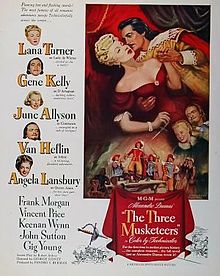
The Three Musketeers (1948)

220px-Three_Musketeers_1948.jpg

The Three Musketeers is a luscious Technicolor swashbuckler done in the fashion of the luxuriant Hollywood costume dramas of the time as we are no doubt accustomed to seeing. Fittingly, they’re also easily subject to classic stereotypes. It’s positively bloated with top-tier talent and whether or not it takes on its source material faithfully is generally beside the point.

Its aims are not those of authenticity and if they were it would be laughable. Maybe it is still laughable but it proves to be made for enjoyment as much as it is made up of cliches. Because in one single package it sums up all that is marvelous and to some, all that is tawdry about such productions of old.

It’s a cinematic “Illustrated Classic” courtesy of George Sidney who provides a film that’s precisely to his proclivities as we might expect even if it’s not so much a musical. It’s meant to be gobbled up voraciously by the children and enjoyed with unbridled enthusiasm by their parents. No more, no less.  And how can you not at least admire its sheer gaudy decadence and the way it chooses to slice a path through the material?

Where there’s no pretense to mask any of the actor’s normal speech patterns or any discernable patois. I think mainly of Van Heflin and Vincent Price sounding like they always have and who nevertheless are both generally enjoyable. We also have the pleasure of a cutthroat Lana Turner, an angelic June Allyson, and a various number of others including royalty played by Frank Morgan and Angela Lansbury and a lovestruck maidservant played by Patricia Medina. Undoubtedly there are still others lost under facial hair and plumage but, again, that hardly matters.

Initially, it also felt like a royal pity that Gene Kelly (playing the lead of D’Artagnan) was not dancing but then being the athletic performer that he is, it soon becomes obvious that his sword fighting utilizes many of the limber movements his dancing has and he really is well suited for such a role. If there was ever a genesis for “The Dueling Cavalier” look no further than right here.

Beginning with the opening duel with Richelieu’s men that sees the formation of the famed partnership as we know it, the picture proves to be ripe with thoroughly gripping and lightly comic fight sequences. They prove to be the highlight of the film on a spectrum of entertainment.

The best part is that they keep on coming at us with rip-roaring wreckless abandon, sabers at the ready, though it begins to fizzle out, in the end, overcome by a plodding narrative that seems no fault of Dumas but rather the adaptation itself. If I were to choose favorites I for one would single out Richard Lester’s adaptation but then again, maybe even that film is not for all.

3/5 Stars

The Stratton Story (1949)

stratton story 1.png

If you’ve never heard of the baseball player Monty Stratton, you’re not alone. In my days of wanting to be a ballplayer myself, I knew quite a bit about baseball Hall of Famers going back to the genesis of the game. But Stratton was not a Hall of Famer like Honus Wagner or Ty Cobb, George Sisler or Rogers Hornsby or even the members of the Bronx Bombers including Lou Gehrig and Joe Dimaggio. Though famed Yankee Bill Dickey does makes a cameo in this one.

Stratton was not in the same category as these men and there is a reason for that. Tragedy struck his life. Interestingly enough, Hollywood looked to make a movie out of it calling on the talents of Jimmy Stewart as well as director Sam Wood. It’s Wood’s association with the picture which causes me to surmise it was meant to be another Pride of the Yankees (1942) with Wood taking up duties again and one All-American in Gary Cooper being traded out for another in Jimmy Stewart.

No disrespect to Monty Stratton or anything that he went through but at face value, his story is hardly that of Lou Gehrig. Still, maybe that’s the point and we can learn something from that. Generalizing and putting all baseball biopics together is in error and in this case, it feels callous. This is a film that makes Monty Stratton’s story into his own and it’s at times winsome in its simplicity and still equally moving.

Watching this picture anchored by James Stewart in another everyman role is as charming as ever. Equally enjoyable is Frank Morgan or even the budding romance with June Allyson coming to fruition within its frames. His brusque mother (Agnes Moorehead) who only knows the tough life of a farm woman even has her affectionate side; you simply need to get to know her. Also, having an old pro like Jimmy Dyke playing the big league manager is yet another touch of authenticity that might be easily overlooked in the modern day.

Through and through, this is Stewart and Allyson’s film as we watch Monty make a name for himself going from being an indefatigable farm boy with a cannon to the minors in Omaha, and finally to the big leagues where dreams are made. Equally important to his career trajectory is the parallel story of how a potentially disastrous first date turned into a lifelong romance with his girl Ethel.

She sees him through a great deal both the highs like the birth of their son to the lows, a fatal event that will change Stratton’s life forever. It’s in this portion where we could criticize the film for stalling but it does rightfully so as Stewart must make a decision whether or not he’s going to fight back to regain his life.

Eventually, he does, going further than any naysayer might give him credit for. Then again, you get the sense that Monty Stratton was the kind of ballplayer that most folks found it in their heart to cheer for. Part of that appeal is Stewart’s typical geniality certainly but the man he was portraying had to be fairly special too.

The spectator in the movie theater might remark Gable and Turner are better kissers on screen but I’d truthfully rather watch Stewart and Allyson. They’re more my type of people.  In fact, I’m pretty sure I would have liked Monty Stratton too. He seemed like a humble fellow who lived his life with everyday dignity. They don’t always make them like that now. The same could be said for this movie.

The film closes with the prototypical “The End” credit but that really was not quite right. Because Monty Stratton was still pitching and had a long life ahead of him just waiting to be lived. That’s the power of this story. It recognizes a man who did not let circumstance deter him from continuing to live a full life.

Stratton died on September 29th, 1982 and within that time he made a second comeback to baseball, moved back to Texas to start a farm team, and was deeply invested in his community until his final days both in promoting Little League and attending his local church.

3.5/5 Stars

National Velvet (1944)

national velvet 1

“Everyone should have a chance at a breathtaking piece of folly, once in his life.” ~ Anne Revere as Mrs. Brown

There’s been many a boxing and a ball sport movie and so it seems only fair that there be room for at least one more Technicolor horse drama, especially one with the breathtaking and gloriously unbridled energy of National Velvet.

It showcases the lofty aspirations riding on the back of a horse and carrying the effervescent hopes of a young girl. I’m certain we could use more movies like this — ones done with this amount of candor and geared toward a broad audience — namely the entire family.

True, Clarence Brown is a director mostly lost to time and perhaps understandably so. This isn’t so much of a technical marvel as it is a story that wraps up its audience with some amount of vigor.

Nor was it a film shot abroad in some exotic location. But that is hardly a criticism, mind you. This was Hollywood’s rendition of the British Isles created in Pebble Beach, California much in the same category of other such period classics like How Green Was My Valley (1941) and Lassie Come Home (1943) — the most obvious point of connection being the always admirable Donald Crisp.

Featured front and center is Elizabeth Taylor in the days when she hadn’t yet been propelled to iconic sex symbol status and still remained the sweet precocious little girl who made the screen sparkle with her adorableness.

Here she is as Velvet Brown. Other girls, namely her big sister (Angela Lansbury) are boy struck but Velvet can best be described as horse struck. She dreams about them in her sleep, thinks about them in her waking hours, and must stop the moment she sees one of her favorite thoroughbreds in the fields on the road home to her town of Sewells.

From the first time she sees “The Pie” in all his majesty, she’s absolutely enchanted by him. It was a love story meant to be. Stirred up by her mother’s own past forays in sport, Velvet begins to entertain thoughts of entering her beloved horse in the Grand Nationals which she believes he is capable of winning with the right training and a rider who knows him.

With the guidance of Mi (Mickey Rooney), a young nomad hired on by the family, they get the horse trained up for competition. But of course, the only one who truly can ride “The Pie” and believes he cannot put a foot wrong is Velvet herself.

Perhaps it’s not as epic as a Ben Hur chariot race or a pod race but there’s still somehow such investment in Velvet and her horse and we feel the same urgency that’s coursing through Mi as he’s watching the race. It’s an infectious moment that catches us up in its swelling emotions to the very last leg.

Far more important than the outcome of the race, however, is how Velvet remains true what she deems to be right. She never lets her pure love of horses — or this particular horse — be muddied by any amount of press or potential fame that might come out of the partnership. Because she’s not seeking any of that. Her intentions are very sincere. She’s doing it all for the sheer joy of getting to gallop across country with her best friend. That’s reward enough for her.

It’s true that Velvet’s parents prove to constantly upend our typical expectations and there’s a pleasure in finding out more about their true character bit by bit. They are folks of hardy stock who are plain but not without their unostentatious charm that comes from being bred in a world of hard work and no doubt Christian charity.

Anne Revere gives one of the most enjoyable performances of her career, start to finish, imbued with an impeccably dry wit that also comes with being a mother who loves her family dearly and aspires for them to have hopes and dreams to carry them through life. You get a sense that she desires they might be decent people who never weary of doing the right thing. There’s a sublime nuance to her turn that would be lacking from the film’s frames otherwise. She is the moral heartbeat and the counterbalance to every other character.

Fiction also mirrored reality in that Elizabeth Taylor truly became the tenderhearted horse whisperer as one of the few people who could actually handle and ride her horse. There’s no sense of parlor tricks and if it’s possible to say this, there’s almost a visible chemistry between her and her steed. They seem meant to be together. Fittingly, on her 13th birthday after the filming was done she was bequeathed her four-legged friend and they remained together for his entire lifetime.

The only rather odd performance or casting choice might seem to be Mickey Rooney who was still a major star in 1944 but sometimes his role doesn’t feel the most authentic. It feels like he’s playing at his part. Meanwhile, Taylor continually bowls us over with every drop of cheerfulness she has in her being.

Maybe I am unfairly prejudiced against Mickey Rooney but he always seemed more like a personality than a true actor. Here as Mi he more or less looks like a tragic story waiting to happen but now thanks to a girl and a horse, he’s getting his shot at redemption. Thankfully for us, this is not wholly his story but more so the story of the horse and its girl.

It’s a wonderfully forward-thinking message for its day that a young girl with ambition can succeed in a man’s world even on the racetrack. Fantasy or not this is a story that uplifts with sheer climactic euphoria.

To all the future teachers, doctors, lawyers, explorers, scientists, and jockeys, this film gives its message loud and clear. Dare to dream. You can’t worry about what others might say. Just go out and pursue whatever it is with all the passion you can muster. No matter the outcome, there will be little to regret.

4/5 Stars

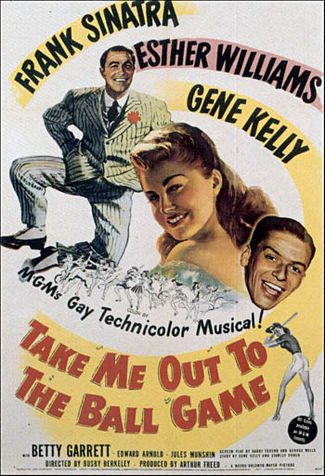
Take Me out to The Ball Game (1949)

Take_Me_Out_To_The_Ballgame_(MGM_film).jpgThere’s something perfectly in sync between Gene Kelly and Donald O’Connor so I could never choose another duo over them but Kelly and Frank Sinatra are such wonderful entertainers that they help make this period baseball number a real musical classic even if it has to fall in line behind a row of other quality contenders.
It’s easy to half expect to see Stanley Donen’s name on the marquee as director in part because of his prestigious partnership with Kelly but instead, we get an equally renowned name in Busby Berkeley. In fact, at this time Berkeley was a veteran of musicals. However, it’s true that Donen did help with crafting the narrative on this one with Kelly and would pick up directing duties with On the Town (1949).

America’s original Pasttime (before being challenged by Basketball and Football) is ripe for a musical homage as MGM seemed to take aim at all the popular arenas of entertainment. Set during the golden years of baseball, this story, in particular, takes interest in the fictional Wolves who share some resemblance to the famed Cubs of the early 1900s with the double-play combination of Joe Tinker, Johnny Evers, and Frank Chance. In this film, the archetypal slogan, “Tinkers to Evers to Chance” is adapted into a giddy tune “O’Brien to Ryan to Goldberg” with the trio of Kelly, Sinatra, and Jules Munshin taking the leads.

Esther Williams even gets her obligatory dip in the pool while still showing her prowess as a baseball player, a desirable heartthrob, and a club owner with a certain amount of business acumen. Because she really is at the core of the story’s plot.

You see the boys, O’Brien and Ryan, are having a grand old time coming off a stint in vaudeville during the offseason and now spring training is upon them and they are reunited with their clubmates along with the scintillating prospect of another league pennant. That is until they find out that they’re under new ownership, and they suspect it’s a stuffy nobody named K.C. Higgins.

Are they surprised with what meets their eyes? K.C. Higgins turns out to be a “she” instead of a “he” and a very attractive one at that. But that doesn’t detract from the bottom line. She’s a woman who expects that she knows the game better than they do. Thus, it’s a slight musical riff on the old battle of the sexes dilemma.

Their plan of action entails setting up their buddy Denny (Sinatra) with Ms. Catherine so they can keep her occupied and off their backs. Kelly is the fast-moving playboy ballplayer who also has a complicated relationship with Katherine Catherine (that’s what K.C. stands for). While the forward Shirley Delwyn (Betty Garret) is out to snag herself a man and sets her sights on poor helpless Dennis.

There’s a bit of a black sox scandal type thread that’s grafted in at the end with Edward Arnold playing his usual corrupt businessman who is looking to ruin O’Brien’s reputation and make a killing off betting against the Wolves. Thank goodness in this case Kenesaw Mountain Landis does not come in and expulse Gene Kelly who instead is allowed to dance another day this time with all his costars.

Aside from singing the game’s most revered song on screen, (which is a relief given its name), the film also has adequate room for some of the other important aspects of baseball namely antagonizing umpires, trash talk, clowning, and brawls. After all, what would America’s game be without those finer points?

Gene Kelly even gets around to putting another feather in his dancing cap with an Irish jig proving him to be yet again a master showman and virtuoso performer on taps. He’s also probably the first baseball player in history who carried two careers as a ballplayer by day and a hoofer by night. All in all, this was the kind of Technicolor spectacle that MGM was accustomed to offering up in the 40s and 50s and it’s satisfying stuff, if not quite their best.

3.5/5 Stars

Hollywood Canteen (1944)

hollywood canteen 1.png

This propaganda extravaganza showcases Hollywood in all its glory from the Brown Derby to the Hollywoodland sign and of course the pride and joy of wartime morale-boosting, the Hollywood Canteen.  It’s a bit of a faux reality, Hollywood’s rendition of what real life might actually be like since the Hollywood Canteen did in fact exist.

Historically, it began as an effort by John Garfield and Bette Davis of all people to support the troops and give them quality entertainment from the entertainment capital of the world. Though newsreel footage might serve as a better historical marker (albeit still biased), there’s no questioning the patriotic waves flooding through this picture.

True, even in this film there are anecdotes that point to a slightly different reality. Namely the fact that this was meant to be a Hollywood wide endeavor but all other studios balked and so the lineup is filled out by Warner Bros. catalog of stars and them alone.

Furthermore, it’s easy to surmise that far from being overcome by patriotic fervor, Joan Crawford probably took her role because the alphabetical billing conveniently put her above a couple perennial rivals in Bette Davis and Barbara Stanwyck.

Even with its authenticity in question, there’s no doubt that the film boasts talent. There’s an inexhaustible array of song & dance from the likes of the Andrew Sisters, Roy Rogers (with Trigger) and Jimmy Dorsey.  The stars also come out in full force with cameos from everyone conceivably under contract to Warner Bros from Kitty Carlisle, Jack Carson, Joe E. Brown, Ida Lupino, Jack Benny, and of course Peter Lorre and Sidney Greenstreet staying in character. Each one provides enough star power to fill in the idle moments around our main love story.

Still, there’s no doubt that Joan Leslie was one of America’s sweethearts and it’s no coincidence that our protagonist falls head over heels for her all the way in the South Pacific. The pair of lovebirds represents all that is seemingly good and upright about American ideals even if she is a movie star and he is only a common soldier.

That makes the prospect of actually meeting her beyond his wildest dreams, but Hollywood purportedly is in the dream making business and so Slim gets his wishes granted. A date with his dream girl is soon arranged by those tactful matchmakers Davis and Garfield.

Robert Hutton is almost uncannily reminiscent of Jimmy Stewart who was at the time leading bombing raids over Germany. It seems little coincidence that he would then land the crucial role as the universal soldier Slim — a man who saw his share of action and is home for a short spell — before heading out on his next tour of duty.

He represents all the boys fighting for not just the Red, White, and Blue but every color and creed. In his very starry-eyed and candid way, he mentions each one as the camera picks each out of the crowd. Curious the only group not mentioned were members of the Japanese-American infantry. Yet another incongruity with the world at large. But the red carpet that is rolled out for him at the Hollywood Canteen is meant to be only a small recompense for all his service to his country.

Delmer Daves’s picture much like Stage Door Canteen (1943) fits the realm of saccharine propaganda, even blatantly so, but if you allow yourself to be carried away by the historical moment it has its certain charms.

True, the Home Front or the Allied cause isn’t quite as unified and squeaky clean as it claims to be just as humanity on the whole and the stars behind Hollywood rarely could hold up to scrutiny. However, there’s still something here that can make you smile. Publicity stunt or not. Maybe it’s the romantic in me that likes to believe there’s at least a kernel of truth in here and if nothing else there’s honest to goodness sincerity.

3.5/5 Stars

Road to Rio (1947)

Road to Rio 1.png

My dad has been and forever will be a fountain of pop cultural knowledge. I learned the little I know from the best, the difference is, he lived through most of it. Still, I must admit, at times I didn’t believe some of these touchstones of yesteryear when I was a kid. How could anyone have actually written a song called “Hello Muddah, Hello Faddah” and what in the world does “You’re in the Groove Jackson” mean? They can’s possibly be real.

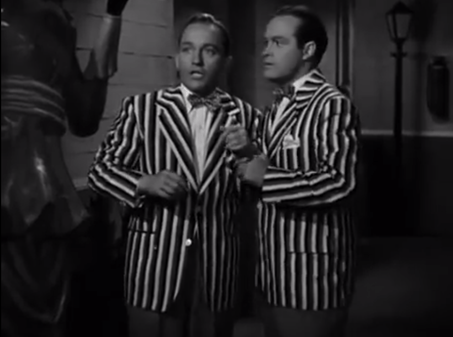
Of course, for those more enlightened than I was back then, you would have already known that both these fantastical things were in fact true. Alan Sherman was quite the nut and the same goes for Bob Hope and Bing Crosby. In that roundabout way, we get to the Road Picture that I’ve always cherished at least a little bit because of one particular gag. But let’s start closer to the beginning.

The wonderful thing about the Road films is the very fact that their two bozos know exactly who they are and they never stray from those characterizations from one picture to the next, even if the schemes change as do their names. There’s the same self-referential jabbing and fourth-wall-breaking executed in a way that later films would pick up on too. People loved Hope and Crosby and they enjoyed their onscreen buddy-buddy just as much. By the looks of it, they always seemed to be having as much fun as the audience and that’s the key. It’s contagious comedy.

I’m inclined to think that some of the greatest comics are the ones who come up with the lines on the spot. But whether or not Hope and Crosby actually ad-libbed any of their verbal jabs, to their credit, they had a complete handle on their personas and so every phrase comes off as genuine.

They’re always trying to pull off some get-rich-quick scheme only to wind up in some wild locale completely broke.  We’re always provided the enjoyment of Crosby’s ever-present condescending pet name “Junior” for his partner in crime. Because he takes on the mantle of the idea man and Hope unwittingly ends up doing the dirty work, in this case, a circus bicyclist up on a trapeze.

Crosby is also always playing the easily duped gentleman — a real sucker for the ladies — who’s not above throwing his pal to the lions except when it really counts. Plus you have to throw a little crooning in there to make all the ladies swoon a bit. We get an appearance by the All-American songstresses The Andrew Sisters performing “You Don’t Have to Know the Language” with Bing.

Still, everyone knows all that is “happening” in the world circa 1947 is in Rio so there the boys go as stowaways, of course, after getting chased out of town by an angry circus promoter. That’s what all the great comics do. Namely, The Marx Brothers, who were consequently also directed by Norman Z. McLeod in Monkey Business (1931) and Horse Feathers (1932).

Our two bunglers now aboard a slow boat to Brazil meet the ever-present Dorothy Lamour, the bodacious beauty in all their movies, as a grateful knockout, a damsel in distress. But something dastardly is going on as the gorgeous woman is caught in the hypnotic clutches of Gale Sondergaard who has a couple hired cronies (one played by a personal favorite Frank Faylen).

There are some real laugh riot moments not least among them watching the pals don their stuffiest British accents as they sway on the ship’s deck to snag an easy meal from a seasick patron or our heroes dressed to the tee doing their best impression of the samba. Of course, you have some tried and true favorites like “Patty Cake” or Hope’s sardonic one-liners such as affectionately calling his trumpet “Grable-bait.” Look it up if you don’t get it.

But the showstopper is the formation of their groovy band Americain made up of our hapless heroes and three Brazilian street musicians who earn a crash course in English. Composed of three universally accepted phrases: “You’re in the Groove Jackson,” “This is Murder,” and “You’re Telling Me.” Presto they’re Americans in a pinch and what follows is “Who’s on First” light.

The final charade is to break up an ill-fated marriage with a bit of safecracking and they bungle it immaculately.  The greatest surprise of all is that Hope actually gets the girl (like Road to Utopia) except this time he gets a little help.

3.5/5 Stars