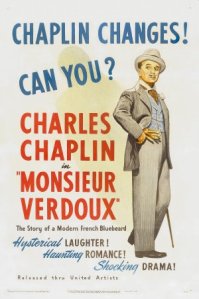
 Prior to the making and release of Monsieur Verdoux Charlie Chaplin had undoubtedly hit the most turbulent patch in his historic career and not even he could come out of scandal and political upheaval unscathed. To put it lightly his stock in the United States plummeted.
You would think that he more than anyone would have been aware of his current state of affairs. It’s a plausible assumption and yet that’s precisely what makes the release of his latest film during that very climate all the more remarkable.
Chaplin always had a handle on emotional clout and he was the king of pathos but with time as film evolved he did evolve with it and it could easily be said that his sound pictures were imbued with much more prominent political overtones, most notably in The Great Dictator and Monsieur Verdoux. The first was a blatant lambast of the world’s resident tyrannical dictator and his cronies with a tremendous bite that goes beyond simple comedy. The latter film takes a broader scope that’s not quite as evident at first.
It shares similarities with Shadow of a Doubt, Kind Hearts of Coronets, or even The Bigamist and it took inspiration from a passing whim of Orson Welles. But Chaplin plants his particular drama in the previous decade–the age of poverty and depression and that allows him to relate his protagonist once more to the plight of man as the Tramp did perennially. However, Chaplin’s latest incarnation is a far cry from the Tramp and no doubt on purpose. Chaplin had officially retired the character after Modern Times, but with the similarly depicted Jewish Barber in The Great Dictator, Monsieur Verdoux was a character with no semblance of his predecessors.
For lack of a better term, he is a wife killer, a Bluebeard, a gentleman murderer and there’s no other way to put it. Yes, he began as a bank teller with an invalid wife and little boy who hit hard times following the crash. True, he maintains his pretenses at civility and yet here is a character so vastly different from all others because for once Chaplin is making his hero difficult for the audience to like. At the very least, he’s a conflicted hero and as such the contemporary viewer was not about to pity him given Chaplin’s already muddied reputation. This was another nail in the coffin and it’s probably part of the reason Verdoux was generally scorned by the American Public at the time. But now, with the clouds of the cultural moment dissipated we can look at Chaplin’s blackest of comedies without the established biases.
The narrative is comprised mostly of Verdoux cycling from wife to wife, town to town, identity to identity with such fluidity it’s mindboggling. Our only indication that he’s moved is the ubiquitous image of the locomotive always chugging along to the next destination. But we’re introduced to this whole charade through the most curmudgeon, bickering household ever known to man in the Courvais.
The only reason they matter for this story is that Verdoux has married their sister who has just recently taken all her money out of the bank and vanished. Only the culprit knows what happened but presently he busies himself with tidying up his affairs in one location so he can check in on his other “business endeavors.” To Annabelle (Martha Raye) he is a sea captain away months at a time which explains his frequent absences.
Consequently, his Pigeon also has to be one of the most annoying chatterboxes of all time. It makes sense he’s crafting a poison to kill her even if it’s not quite forgivable. He also calls upon his second asset the rightfully suspicious Lydia while looking to woo the affluent Marie Grosnay who happens to be less of a boob than the rest of his conquests. Though he is a persistent devil. Soon enough wedding bells chime again and that becomes the fateful day when his many strands get tangled in one brief moment at his latest marriage ceremony.
If nothing else it suggests that the time is running out as global tensions rise and Verdoux finds his fortunes dwindle in the wake of his imprisonment. But now on trial, he’s allowed to be up on the stand and mount his final defense–his rebuttal against the indiscretions of mankind. Ultimately, it’s an invariably cynical take on the ways of the world comparing his spree of mass killing to the prospects of the very scientific mass destruction of the world at present. It’s all business, war and anything else you can imagine, merely profiteering endeavors to get ahead. As he walks off to the guillotine the Priest asks him if he has anything to confess and strikingly he asserts, “I am at peace with God, my conflict is with man.”
This is where we overtly see Chaplin’s stance once more as he stands up on his soapbox as it were but he gave us some indications earlier on as well. Verdoux’s most telling interactions come in the form of chance encounters with a particular young woman. At first, he sees her as a test case for his poison, but soon he’s taken with her words, the way she sees the world. It affects him deeply (You better go before your philosophy corrupts me ). And in a striking parallel to Limelight several years later, Chaplin’s character falls to his demise as this young woman’s fortunes increase. She doesn’t forget him. But the rest of the world isn’t quite so kind.
Monsieur Verdoux goes to the chopping block deservedly so as did Chaplin but the verdict’s still out on whether he deserved it all. Perhaps that’s what his film is getting at. He was full of faults as a human being but then again we all are. It makes sense that God is other, perfect, and outside of our messiness. It’s the rest of us that cause ruin, pain, and suffering. That’s where the blackness of this comedy finds its source and it’s something to ponder and then resolve to allay with doses of love and compassion.
4/5 Stars
 Cat People has one of those sensationalized B-picture premises and there are moments when its meager aspects let slip that this is a low-budget effort, but within those restrictions, it moves with a certain purpose and chilliness. It’s true that producer Val Lewton had a B-movie renaissance going on at RKO Studios and Cat People is one of his treasures.
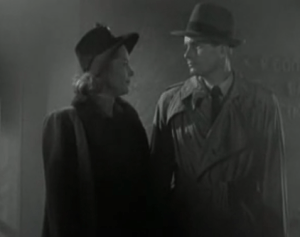 At Oliver’s work, talk around the water cooler is made compelling in that his best pal and colleague is the sensible Alice (Jane Alexander) always ready to lend a listening ear. She’s genuine in accepting Irena for who she is because she can tell that Oliver earnestly loves her. But at the same time, she serves as a contrasting figure — someone who is completely different than this enigmatic creature.
 Initially, I Remember Mama comes off underwhelmingly. It’s overlong, there’s little conflict, and some of the things the story spends time teasing out seem odd and inconsequential at best. Still, within that framework is a narrative that manages to be rewarding for its utter sincerity in depicting the life of one family–a family that feels foreign in some ways and oh so relatable in many others.
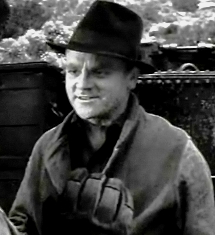 White Heat burns like hot coals even today as the epitome of incendiary cinema. It’s a gangster picture from master Warner Bros. craftsman Raoul Walsh that’s volatile and intriguing, highlighted by the always fiery James Cagney as a crazed man-child with a mom complex.
 John Garfield was never the most dashing of leading men but nevertheless, he was always thoroughly compelling as ambitious working class stiffs during the 1940s. He had a straightforward tenacity about him like he had to fight his way to the top. At the same time likable and destined for trouble right out of the gates. You can cheer for him and still rue the decisions that he makes. That’s what makes his foray as boxing champ Charlie Davis all the more believable. His aspirations are of a very real nature and they give his character a genuine makeup.
 Films Noir often find their hooks in lurid titles but also in metaphor. Ride the Pink Horse fits into the latter category as pulled from the pages of Dorothy B Hughes and adapted by Ben Hecht & Charles Lederer. The horse can be taken in the literal sense as one of the wooden animals that go round and round on the local carousel but there’s some symbolism in this opulent creature. In some distant way, it’s the fantasy of a different life that every man seems to crave when he doesn’t have it. But still, he strives and grinds to get closer and closer to it. More often than not he does not succeed in finding so-called contentment.
 And it’s from these opening moments that we try to get a line on Gagin by watching his every move and word. He’s brusque and abrasive with almost crazed features — constantly suspicious, demanding, and sour. He had a little too much cyanide for breakfast (although he does like fruit cocktail). Just as we watch him with interest, his probing eyes case every joint and every person he comes in contact with. Because, if it’s not obvious already, he’s not come to San Pablo for R & R. He’s come to town to avenge his dead army buddy, who was double-crossed and put out of a commission by a very big man (Fred Clark).
 Just as there is a cultured femme fatale (Andrea King), her counterpoint is the tentative Pila (played sympathetically but rather unfortunately by Wanda Hendrix), who floats in to watch over Gagin even when he doesn’t want her around. She stays anyways.
 Our introduction to The Mortal Storm feels rather flat. Bright and bland in more ways than one as we become accustomed to our main storyline. Professor Viktor Roth (Frank Morgan) is held in high regard all throughout the community as a prominent lecturer at the local university and beloved by his colleagues and family. The year is 1933 and the Bavarian Alps are still a merry and gay place to live. That’s our understanding early on as the Professor celebrates his 60th birthday with much fanfare and receives a commemorative memento from his class.
 Its title suggests that this film might be something like Lubitsch’s Heaven can Wait but The Devil and Miss Jones could easily hold the title as the original version of Undercover Boss. Although its main function is on the romantic and comic planes, it also has a bit of a social message behind it that signals for change.
 The film opens with a dead end drifter being ushered off a bus in the little every town of Walton, wedged somewhere between LA and SF. Although in actuality it was shot partially on location in Orange, California, serving up a perfect representation of quaint Middle America. You can almost hear Paul Simon singing from the future (Got off a greyhound to look for America) as Dana Andrews gets off the bus. Except he winds up at Pop’s instead. There he sizes up the town and gets his first eyeful of the alluring waitress Stella (Linda Darnell).
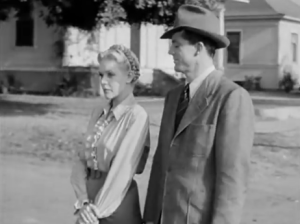 Being blessed with a certain amount of charm, Stanton strikes up a relationship with the untouchable gal, the churchgoer, the book reader, the generally good human being, June. He knows how to pull her out of her shell. Catering to her necessity to get out and live life (All the things you look down on are the things that make up life. Little things, like a game of bowling..or a swim at night, or a dance, a kiss, stuff that bubbles). It works and she begins to be swayed. Conveniently she also has a great deal of money. The outcome seems obvious and yet the story twists in unexpected ways.
 Fallen Angel undoubtedly gets a bad rap because it does not reach the rapturous, beguiling heights of Laura (1944) from the year prior, but it deserves to be seen in its own light. It’s true that both films are murder mysteries but while Fallen Angel isn’t all that interesting in that regard it has a surprisingly sharp script in other ways. Preminger works through his story with a certain dynamic assurance and like its predecessor, it’s the characters that are by far the most fascinating. Laura was a superior mystery, character study, etc., but Fallen Angel gleams brightly thanks in part to its classical chiaroscuro cinematography and an engaging menagerie of locals including Charles Bickford, Percy Kilbride, Bruce Cabot, and John Carradine.
 If you know what you want in life be sure of it and you can’t miss. I found that out early. ~ Lawrence Tierney as Sam Wilde
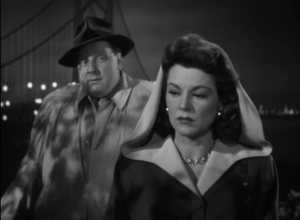 However, evil always looks to catch up with the guilty party and a private investigator is poking around in all the places he can to find the culprit behind an egregious crime. Walter Slezak’s Albert Arnett is a witty sleazeball with the lowest scruples imaginable when money is concerned. But he also happens to be decent at his occupation bringing him to San Francisco in pursuit of answers.
 4 Star Films